Logic
Logic
Argument
Argument
Deductive and inductive
argument
argument
Aristotle had a
Aristotle had a hierarchy of beings
hierarchy of beings—a method of
—a method of
putting each creature on Earth in a certain level.
1. The lowest among all beings, accordingly,
are
are minerals
minerals. That is due to them for not having any
. That is due to them for not having any
form of life.
form of life.
2. Above the minerals are plants that Aristotle called to
be in a
be in a vegetative state
vegetative state. They have life, they breathe,
. They have life, they breathe,
they produce, and they consume.
3. Higher than plants are animals because they
are
are sentient beings
sentient beings; they can sense, feel, and move.
; they can sense, feel, and move.
4. The highest among all beings, for Aristotle, is
4. The highest among all beings, for Aristotle, is man
man.
.
Because man is not only in vegetation, not only
sentient; man is a rational being. Man has life, senses,
and
and reason
reason.
. Reason
Reason, then, consequently is
, then, consequently is
what
what separates
separates man from beast.
man from beast.
LOGIC
LOGIC
 Greek philosopher Aristotle, who is called the “Father
Greek philosopher Aristotle, who is called the “Father
of Logic” for having the first recorded study of the
subject.
subject.
 Logic is an instrument (
Logic is an instrument (organon/tool
organon/tool) that the mind
) that the mind
utilizes in order to arrive at the Truth.
 Logic:
Logic: The study of arguments
The study of arguments
 Logic is the study of
Logic is the study of correct reasoning
correct reasoning.
.
 Logic – The science of correct reasoning.
Logic – The science of correct reasoning.
 Reasoning – The drawing of inferences or conclusions
Reasoning – The drawing of inferences or conclusions
from known or assumed facts.
LOGIC
LOGIC
 It includes both formal and informal
It includes both formal and informal
logic.
logic.
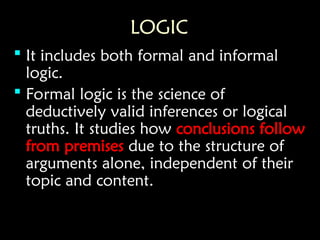
 Formal logic is the science of
Formal logic is the science of
deductively valid inferences or logical
truths. It studies how
truths. It studies how conclusions follow
conclusions follow
from premises
from premises due to the structure of
due to the structure of
arguments alone, independent of their
topic and content.
topic and content.
FORMAL vs INFORMAL LOGIC
 Formal logic:
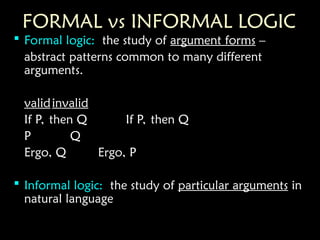
Formal logic: the study of
the study of argument forms
argument forms –
–
abstract patterns common to many different
arguments.
arguments.
valid
valid invalid
invalid
If P, then Q
If P, then Q If P, then Q
If P, then Q
P
P Q
Q
Ergo, Q
Ergo, Q Ergo, P
Ergo, P
 Informal logic:
Informal logic: the study of
the study of particular arguments
particular arguments in
in
natural language
natural language
ARGUMENT STRUCTURE
ARGUMENT STRUCTURE
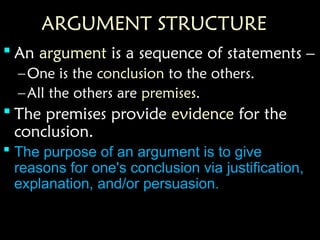
 An
An argument
argument is a sequence of statements –
is a sequence of statements –
– One is the
One is the conclusion
conclusion to the others.
to the others.
– All the others are
All the others are premises.
premises.
 The premises provide
The premises provide evidence
evidence for the
for the
conclusion.
conclusion.
 The purpose of an argument is to give
reasons for one's conclusion via justification,
explanation, and/or persuasion.
Argument
Argument
 An argument is an attempt to convince
An argument is an attempt to convince
someone (possibly yourself) that a
particular claim, called a conclusion, is true,
– The rest of the argument is a collection of
The rest of the argument is a collection of
claims called the premises, which are given as
the reasons for believing the conclusion is
true.
true.
– The conclusion is sometimes called the issue
The conclusion is sometimes called the issue
that is being debated.
EXAMPLES
EXAMPLES
 All humans are mortal.
All humans are mortal.
Brad Pitt is human.
Brad Pitt is human.
Ergo, Brad Pitt is mortal.
 Sarah was not at the party.
Sarah was not at the party.
Ergo, it couldn’t have been Sarah that
Jack was dancing with.
 Anyone who lives in Makati City, also lives
in the Philippines.
Justine lives in Makati City.
Therefore, Justine lives in the
Philippines. (valid)
 “If it is raining, then the streets are wet.
The streets are wet. Therefore, it is raining.
(invalid)
Example
Example
 If there is an earthquake, the detector will
send a message.
No message has been sent.
So, there was no earthquake (valid)
 Premise 1: All dogs can fly.
Premise 2: Fido is a dog.
Conclusion: Therefore, Fido can fly.
(valid, but false)
An argument is said to be valid if the
conclusion is logically true, whenever all
the assumptions/premises are true.
PREMISES
PREMISES
 Premises and conclusions are always
Premises and conclusions are always
propositions
propositions (statements) – they can be true
(statements) – they can be true
or false.
or false.
 They are
They are not
not questions, commands or
questions, commands or
exclamations.
exclamations.
– Test:
Test: “It is true / not true that P”
“It is true / not true that P”
where P = a premise or a conclusion
These are PROPOSITIONS or
premise:
premise:
Snow is green.
Snow is green.
I am Brad Pitt.
I am Brad Pitt.
These are NOT:
These are NOT:
*What color is snow?
*Hey, look, there’s Brad Pitt!
NOTE 2
NOTE 2
Although the premises, by definition, provide
evidence for the conclusion, this evidence
may be good or not.
may be good or not.
You have to let me go to the party;
everyone is going to be there.
NOTE 3
NOTE 3
 In standard form, the conclusion appears at
In standard form, the conclusion appears at
the
the end.
end.
 In practice, the conclusion may appear
In practice, the conclusion may appear
anywhere
anywhere.
.
Jack could not have been the murderer.
The victim was shot from 40 feet away.
Jack is blind and paralyzed from the
neck
neck down.
down.
PREMISE INDICATORS
PREMISE INDICATORS
Premise indicators:
Premise indicators:
____ there are no lights on, no one is home.
Since
Since
Because
Because
Assuming that
Assuming that
Seeing that
Seeing that
Granted that
Granted that
In view of the fact that
Inasmuch as
Inasmuch as
CONCLUSIONS INDICATORS
Inference indicators:
Inference indicators: Indicate the
Indicate the role
role of a proposition in
of a proposition in
an argument.
an argument.
Conclusion indicators:
There are no lights on. _____ no one is home.
Therefore
Therefore
Thus
Thus
Hence
Hence
So
So
For this reason
For this reason
Consequently
Consequently
It follows that
It follows that
Which proves/means that
As a result
As a result
TWO ARGUMENT TYPES
TWO ARGUMENT TYPES
 Deductive
Deductive arguments
arguments
(try to)
(try to) PROVE
PROVE their conclusions
their conclusions
 Inductive
Inductive arguments
arguments
(try to) show that their conclusions are
PLAUSIBLE
PLAUSIBLE or
or LIKELY
LIKELY
Deductive Reasoning
Deductive Reasoning
 Deductive Reasoning
Deductive Reasoning – A type of
– A type of
logic in which one goes from a general
statement to a specific instance.
 The classic example
The classic example
All men are mortal.
All men are mortal. (major premise)
(major premise)
Socrates is a man.
Socrates is a man. (minor premise)
(minor premise)
Therefore, Socrates is mortal.
Therefore, Socrates is mortal. (conclusion)
(conclusion)
the
the PREMISE
PREMISE in action
in action
 Deduction
Deduction: general
: general 
 specific
specific
How it works:
How it works:
major premise + minor premise = conclusion
Politicians are liars + Bob is a politician
Politicians are liars + Bob is a politician = Bob is a
= Bob is a
liar.
liar.
Deductive Reasoning
Deductive Reasoning
Examples:
Examples:
1.
1. All SLSU students eat pizza.
All SLSU students eat pizza.
Claire is a student at SLSU.
Therefore, Claire eats pizza.
2.
2. All athletes work out in the gym.
All athletes work out in the gym.
Matt Andrei is an athlete
Matt Andrei is an athlete.
.
Therefore, Matt Andrei works out in the gym.
Deductive Reasoning
Deductive Reasoning
3. All math teachers are over 7 feet tall.
Mr. D. is a math teacher.
Therefore, Mr. D is over 7 feet tall.
 The argument is valid, but is certainly not true.
The argument is valid, but is certainly not true.
 The above examples are of the form
The above examples are of the form
If
If p
p, then
, then q
q. (major premise)
. (major premise)
x
x is
is p
p.
. (minor premise)
(minor premise)
Therefore,
Therefore, x
x is
is q
q. (conclusion)
. (conclusion)
Venn Diagrams
Venn Diagrams
 Venn Diagram
Venn Diagram: A diagram consisting of various overlapping
: A diagram consisting of various overlapping
figures contained in a rectangle called the universe.
U
U
This is an example of
This is an example of all A are B
all A are B. (If A, then B.)
. (If A, then B.)
B
A
Venn Diagrams
Venn Diagrams
This is an example of No A are B.
U
U
A
B
Venn Diagrams
Venn Diagrams
This is an example of some A are B. (At least one A is B.)
A
A B
B
Example
Example
 Construct a Venn Diagram to determine the
Construct a Venn Diagram to determine the
validity of the given argument.
All smiling cats talk.
The Persian Cat smiles.
Therefore, the Persian Cat talks.
VALID OR INVALID???
VALID OR INVALID???
Example
Example
Valid argument;
Valid argument; x
x is Persian Cat
is Persian Cat
Things
that talk
Smiling cats
x
Example
Example
 No one who can afford health
No one who can afford health
insurance is unemployed.
All politicians can afford health
insurance.
insurance.
Therefore, no politician is unemployed.
VALID OR INVALID?????
Examples
Examples
X
X=politician. The argument is valid.
=politician. The argument is valid.
People who can afford
Health Care.
Politicians
X
Unemployed
Example
Example
 Some professors wear glasses.
Some professors wear glasses.
Mr. Einstein wears glasses.
Therefore, Mr. Einstein is a professor.
Let the green oval be professors, and the blue oval be glass wearers. Then x (Mr.
Einstein) is in the blue oval, but not in the overlapping region. The argument is invalid.
X
X
Evaluating Inductive Reasoning
 A valid deductive argument guarantees
A valid deductive argument guarantees
the truth of the conclusion, if the premises
are assumed as true. Hence, deductive
conclusions are known with
conclusions are known with certainty.
certainty.
 Inductive arguments reach
Inductive arguments reach probable
probable
conclusions. A strong inductive argument
makes a conclusion
makes a conclusion likely
likely.
.
Deductive vs. Inductive Reasoning
 The difference:
The difference:
deductive reasoning
deductive reasoning uses facts,
uses facts,
rules, definitions or properties to
arrive at a conclusion.
inductive reasoning
inductive reasoning uses patterns to
uses patterns to
arrive at a conclusion (conjecture)
• Inductive Reasoning
Reasoning based on patterns you observe.
Inductive Argument: an argument in which the premises
are intended to provide support, but not conclusive
evidence, for the conclusion.
• Conjecture – (inference formed without proof) (a
conclusion deduced by surmise or guesswork)
A conclusion you reach using inductive reasoning.
Example
A scientist dips a platinum wire into a solution containing salt (sodium
chloride), passes the wire over a flame, and observes that it produces an
orange-yellow flame.
She does this with many other solutions that contain salt, finding that
they all produce an orange-yellow flame.
Conjecture
If a solution contains sodium chloride, then in a flame test it produces an
orange-yellow flame.
the
the PREMISE
PREMISE in action
in action
 Induction
Induction: specific
: specific 
 general
general
How it works:
How it works:
particular premise + particular premise = conclusion
Mom lies about her age + Grandma lies about her age = All women lie about their ages.
INDUCTIVE ARGUMENTS
INDUCTIVE ARGUMENTS
 Every ruby discovered thus far has been red.
Every ruby discovered thus far has been red.
So, probably all rubies are red.
 Polls show that 87% of 5-year-olds believe in the
Polls show that 87% of 5-year-olds believe in the
tooth fairy.
tooth fairy.
Sarah is 5 years old.
Sarah probably believed in the tooth fairy.
 Chemically, potassium chloride is very similar to
Chemically, potassium chloride is very similar to
ordinary table salt (sodium chloride).
 Therefore, potassium chloride tastes like table salt.
Therefore, potassium chloride tastes like table salt.
Examples of Inductive Reasoning
Some examples
Some examples
1)
1) Every quiz has been easy. Therefore, the
Every quiz has been easy. Therefore, the
test will be easy.
test will be easy.
2)
2) The teacher used PowerPoint in the last
The teacher used PowerPoint in the last
few classes. Therefore, the teacher will
use PowerPoint tomorrow.
3)
3) Every fall there have been hurricanes in
Every fall there have been hurricanes in
the tropics. Therefore, there will be
hurricanes in the tropics this coming fall.
You are a good student.
You get all A’s.
Therefore your friends must get all A’s
too.
INDUCTIVE
Mikhail hails from Russia and
Russians are tall, therefore
Mikhail is tall.
Mikhail is tall.
INDUCTIVE
Inductive or Deductive Reasoning?
Geometry example…
Geometry example…
60◦
x
Triangle sum property -
the sum of the angles of
any triangle is always 180
degrees. Therefore, angle
x = 30°
What is the measure of angle x?
All oranges are fruits. All fruits
grow on trees.
Therefore, all oranges
grow on trees.
DEDUCTIVE
Determine whether each conclusion is based on
inductive or deductive reasoning.
Aundrea noticed that every Saturday, her neighbor
mows his lawn. Today is Saturday. Aundrea
concludes her neighbor will mow his lawn. i
Students at Blake’s high school must have a B
average in order to participate in sports. Blake has a
B average, so he concludes that he can participate in
sports at school. d
At Erwin’s school if you are late five times, you will
receive a detention. Erwin has been late to school
five times; therefore he will receive a detention. d
A dental assistant notices a patient has never been
on time for an appointment. She concludes that the
patient will be late for her next appointment. i
If Cooper decides to go to a concert tonight, he will
miss football practice. Tonight, Cooper went to a
concert. Cooper missed football. d
Whenever Nicole has attended a tutoring session
she notices that her grades have improved. Nicole
attends a tutoring session and she concludes her
grades will improve. i
Every Wednesday Kelsy’s mother calls. Today is
Wednesday, so Kelsy concludes her mother will call.
d
THE DIFFERENCE
THE DIFFERENCE
Key:
Key: deductive
deductive /
/ inductive
inductive
 If the premises are true the conclusion is
If the premises are true the conclusion is
necessarily
necessarily /
/ probably
probably true.
true.
 The premises provide
The premises provide conclusive
conclusive /
/ good
good
evidence for the conclusion.
 It is
It is impossible
impossible /
/ unlikely
unlikely for the premises to
for the premises to
be true and the conclusion to be false.
 It is logically
It is logically inconsistent
inconsistent /
/ consistent
consistent to
to
assert the premises but deny the conclusion.
INDICATOR WORD TEST
INDICATOR WORD TEST
Deduction
Deduction Induction
Induction
Certainly
Certainly Probably
Probably
Definitely
Definitely Likely
Likely
Absolutely
Absolutely Plausible
Plausible
Conclusively
Conclusively Reasonable
Reasonable
This entails that
This entails that The odds are
The odds are that
that
Summary of Argument Types
Deductive
Deductive Inductive
Inductive
Valid
Valid Invalid
Invalid Strong
Strong Weak
Weak
(all are
(all are (all are
(all are
unsound)
unsound) uncogent)
uncogent)
Sound
Sound Unsound
Unsound Cogent
Cogent (convincing)
(convincing) Uncogent
Uncogent
MEMORIZE THESE DIAGRAMS ! ! !

IPHP-lesson-9-logic-argument deductive and inductive.ppt

  • 1.
  • 2.
    Aristotle had a Aristotlehad a hierarchy of beings hierarchy of beings—a method of —a method of putting each creature on Earth in a certain level. putting each creature on Earth in a certain level. 1. The lowest among all beings, accordingly, 1. The lowest among all beings, accordingly, are are minerals minerals. That is due to them for not having any . That is due to them for not having any form of life. form of life. 2. Above the minerals are plants that Aristotle called to 2. Above the minerals are plants that Aristotle called to be in a be in a vegetative state vegetative state. They have life, they breathe, . They have life, they breathe, they produce, and they consume. they produce, and they consume. 3. Higher than plants are animals because they 3. Higher than plants are animals because they are are sentient beings sentient beings; they can sense, feel, and move. ; they can sense, feel, and move. 4. The highest among all beings, for Aristotle, is 4. The highest among all beings, for Aristotle, is man man. . Because man is not only in vegetation, not only Because man is not only in vegetation, not only sentient; man is a rational being. Man has life, senses, sentient; man is a rational being. Man has life, senses, and and reason reason. . Reason Reason, then, consequently is , then, consequently is what what separates separates man from beast. man from beast.
  • 3.
    LOGIC LOGIC  Greek philosopherAristotle, who is called the “Father Greek philosopher Aristotle, who is called the “Father of Logic” for having the first recorded study of the of Logic” for having the first recorded study of the subject. subject.  Logic is an instrument ( Logic is an instrument (organon/tool organon/tool) that the mind ) that the mind utilizes in order to arrive at the Truth. utilizes in order to arrive at the Truth.  Logic: Logic: The study of arguments The study of arguments  Logic is the study of Logic is the study of correct reasoning correct reasoning. .  Logic – The science of correct reasoning. Logic – The science of correct reasoning.  Reasoning – The drawing of inferences or conclusions Reasoning – The drawing of inferences or conclusions from known or assumed facts. from known or assumed facts.
  • 4.
    LOGIC LOGIC  It includesboth formal and informal It includes both formal and informal logic. logic.  Formal logic is the science of Formal logic is the science of deductively valid inferences or logical deductively valid inferences or logical truths. It studies how truths. It studies how conclusions follow conclusions follow from premises from premises due to the structure of due to the structure of arguments alone, independent of their arguments alone, independent of their topic and content. topic and content.
  • 5.
    FORMAL vs INFORMALLOGIC FORMAL vs INFORMAL LOGIC  Formal logic: Formal logic: the study of the study of argument forms argument forms – – abstract patterns common to many different abstract patterns common to many different arguments. arguments. valid valid invalid invalid If P, then Q If P, then Q If P, then Q If P, then Q P P Q Q Ergo, Q Ergo, Q Ergo, P Ergo, P  Informal logic: Informal logic: the study of the study of particular arguments particular arguments in in natural language natural language
  • 6.
    ARGUMENT STRUCTURE ARGUMENT STRUCTURE An An argument argument is a sequence of statements – is a sequence of statements – – One is the One is the conclusion conclusion to the others. to the others. – All the others are All the others are premises. premises.  The premises provide The premises provide evidence evidence for the for the conclusion. conclusion.  The purpose of an argument is to give reasons for one's conclusion via justification, explanation, and/or persuasion.
  • 7.
    Argument Argument  An argumentis an attempt to convince An argument is an attempt to convince someone (possibly yourself) that a someone (possibly yourself) that a particular claim, called a conclusion, is true, particular claim, called a conclusion, is true, – The rest of the argument is a collection of The rest of the argument is a collection of claims called the premises, which are given as claims called the premises, which are given as the reasons for believing the conclusion is the reasons for believing the conclusion is true. true. – The conclusion is sometimes called the issue The conclusion is sometimes called the issue that is being debated. that is being debated.
  • 8.
    EXAMPLES EXAMPLES  All humansare mortal. All humans are mortal. Brad Pitt is human. Brad Pitt is human. Ergo, Brad Pitt is mortal. Ergo, Brad Pitt is mortal.  Sarah was not at the party. Sarah was not at the party. Ergo, it couldn’t have been Sarah that Ergo, it couldn’t have been Sarah that Jack was dancing with. Jack was dancing with.
  • 9.
     Anyone wholives in Makati City, also lives in the Philippines. Justine lives in Makati City. Therefore, Justine lives in the Philippines. (valid)  “If it is raining, then the streets are wet. The streets are wet. Therefore, it is raining. (invalid) Example Example
  • 10.
     If thereis an earthquake, the detector will send a message. No message has been sent. So, there was no earthquake (valid)  Premise 1: All dogs can fly. Premise 2: Fido is a dog. Conclusion: Therefore, Fido can fly. (valid, but false) An argument is said to be valid if the An argument is said to be valid if the conclusion is logically true, whenever all conclusion is logically true, whenever all the assumptions/premises are true. the assumptions/premises are true.
  • 11.
    PREMISES PREMISES  Premises andconclusions are always Premises and conclusions are always propositions propositions (statements) – they can be true (statements) – they can be true or false. or false.  They are They are not not questions, commands or questions, commands or exclamations. exclamations. – Test: Test: “It is true / not true that P” “It is true / not true that P” where P = a premise or a conclusion where P = a premise or a conclusion
  • 12.
    These are PROPOSITIONSor These are PROPOSITIONS or premise: premise: Snow is green. Snow is green. I am Brad Pitt. I am Brad Pitt. These are NOT: These are NOT: *What color is snow? *What color is snow? *Hey, look, there’s Brad Pitt! *Hey, look, there’s Brad Pitt!
  • 13.
    NOTE 2 NOTE 2 Althoughthe premises, by definition, provide Although the premises, by definition, provide evidence for the conclusion, this evidence evidence for the conclusion, this evidence may be good or not. may be good or not. You have to let me go to the party; You have to let me go to the party; everyone is going to be there. everyone is going to be there.
  • 14.
    NOTE 3 NOTE 3 In standard form, the conclusion appears at In standard form, the conclusion appears at the the end. end.  In practice, the conclusion may appear In practice, the conclusion may appear anywhere anywhere. . Jack could not have been the murderer. Jack could not have been the murderer. The victim was shot from 40 feet away. The victim was shot from 40 feet away. Jack is blind and paralyzed from the Jack is blind and paralyzed from the neck neck down. down.
  • 15.
    PREMISE INDICATORS PREMISE INDICATORS Premiseindicators: Premise indicators: ____ there are no lights on, no one is home. ____ there are no lights on, no one is home. Since Since Because Because Assuming that Assuming that Seeing that Seeing that Granted that Granted that In view of the fact that In view of the fact that Inasmuch as Inasmuch as
  • 16.
    CONCLUSIONS INDICATORS CONCLUSIONS INDICATORS Inferenceindicators: Inference indicators: Indicate the Indicate the role role of a proposition in of a proposition in an argument. an argument. Conclusion indicators: Conclusion indicators: There are no lights on. _____ no one is home. There are no lights on. _____ no one is home. Therefore Therefore Thus Thus Hence Hence So So For this reason For this reason Consequently Consequently It follows that It follows that Which proves/means that Which proves/means that As a result As a result
  • 17.
    TWO ARGUMENT TYPES TWOARGUMENT TYPES  Deductive Deductive arguments arguments (try to) (try to) PROVE PROVE their conclusions their conclusions  Inductive Inductive arguments arguments (try to) show that their conclusions are (try to) show that their conclusions are PLAUSIBLE PLAUSIBLE or or LIKELY LIKELY
  • 19.
    Deductive Reasoning Deductive Reasoning Deductive Reasoning Deductive Reasoning – A type of – A type of logic in which one goes from a general logic in which one goes from a general statement to a specific instance. statement to a specific instance.  The classic example The classic example All men are mortal. All men are mortal. (major premise) (major premise) Socrates is a man. Socrates is a man. (minor premise) (minor premise) Therefore, Socrates is mortal. Therefore, Socrates is mortal. (conclusion) (conclusion)
  • 20.
    the the PREMISE PREMISE inaction in action  Deduction Deduction: general : general   specific specific How it works: How it works: major premise + minor premise = conclusion major premise + minor premise = conclusion Politicians are liars + Bob is a politician Politicians are liars + Bob is a politician = Bob is a = Bob is a liar. liar.
  • 22.
    Deductive Reasoning Deductive Reasoning Examples: Examples: 1. 1.All SLSU students eat pizza. All SLSU students eat pizza. Claire is a student at SLSU. Claire is a student at SLSU. Therefore, Claire eats pizza. Therefore, Claire eats pizza. 2. 2. All athletes work out in the gym. All athletes work out in the gym. Matt Andrei is an athlete Matt Andrei is an athlete. . Therefore, Matt Andrei works out in the gym. Therefore, Matt Andrei works out in the gym.
  • 23.
    Deductive Reasoning Deductive Reasoning 3.All math teachers are over 7 feet tall. 3. All math teachers are over 7 feet tall. Mr. D. is a math teacher. Mr. D. is a math teacher. Therefore, Mr. D is over 7 feet tall. Therefore, Mr. D is over 7 feet tall.  The argument is valid, but is certainly not true. The argument is valid, but is certainly not true.  The above examples are of the form The above examples are of the form If If p p, then , then q q. (major premise) . (major premise) x x is is p p. . (minor premise) (minor premise) Therefore, Therefore, x x is is q q. (conclusion) . (conclusion)
  • 24.
    Venn Diagrams Venn Diagrams Venn Diagram Venn Diagram: A diagram consisting of various overlapping : A diagram consisting of various overlapping figures contained in a rectangle called the universe. figures contained in a rectangle called the universe. U U This is an example of This is an example of all A are B all A are B. (If A, then B.) . (If A, then B.) B A
  • 25.
    Venn Diagrams Venn Diagrams Thisis an example of No A are B. This is an example of No A are B. U U A B
  • 26.
    Venn Diagrams Venn Diagrams Thisis an example of some A are B. (At least one A is B.) This is an example of some A are B. (At least one A is B.) A A B B
  • 27.
    Example Example  Construct aVenn Diagram to determine the Construct a Venn Diagram to determine the validity of the given argument. validity of the given argument. All smiling cats talk. All smiling cats talk. The Persian Cat smiles. The Persian Cat smiles. Therefore, the Persian Cat talks. Therefore, the Persian Cat talks. VALID OR INVALID??? VALID OR INVALID???
  • 28.
    Example Example Valid argument; Valid argument;x x is Persian Cat is Persian Cat Things that talk Smiling cats x
  • 29.
    Example Example  No onewho can afford health No one who can afford health insurance is unemployed. insurance is unemployed. All politicians can afford health All politicians can afford health insurance. insurance. Therefore, no politician is unemployed. Therefore, no politician is unemployed. VALID OR INVALID????? VALID OR INVALID?????
  • 30.
    Examples Examples X X=politician. The argumentis valid. =politician. The argument is valid. People who can afford Health Care. Politicians X Unemployed
  • 31.
    Example Example  Some professorswear glasses. Some professors wear glasses. Mr. Einstein wears glasses. Mr. Einstein wears glasses. Therefore, Mr. Einstein is a professor. Therefore, Mr. Einstein is a professor. Let the green oval be professors, and the blue oval be glass wearers. Then x (Mr. Let the green oval be professors, and the blue oval be glass wearers. Then x (Mr. Einstein) is in the blue oval, but not in the overlapping region. The argument is invalid. Einstein) is in the blue oval, but not in the overlapping region. The argument is invalid. X X
  • 32.
    Evaluating Inductive Reasoning EvaluatingInductive Reasoning  A valid deductive argument guarantees A valid deductive argument guarantees the truth of the conclusion, if the premises the truth of the conclusion, if the premises are assumed as true. Hence, deductive are assumed as true. Hence, deductive conclusions are known with conclusions are known with certainty. certainty.  Inductive arguments reach Inductive arguments reach probable probable conclusions. A strong inductive argument conclusions. A strong inductive argument makes a conclusion makes a conclusion likely likely. .
  • 33.
    Deductive vs. InductiveReasoning Deductive vs. Inductive Reasoning  The difference: The difference: deductive reasoning deductive reasoning uses facts, uses facts, rules, definitions or properties to rules, definitions or properties to arrive at a conclusion. arrive at a conclusion. inductive reasoning inductive reasoning uses patterns to uses patterns to arrive at a conclusion (conjecture) arrive at a conclusion (conjecture)
  • 34.
    • Inductive Reasoning Reasoningbased on patterns you observe. Inductive Argument: an argument in which the premises are intended to provide support, but not conclusive evidence, for the conclusion. • Conjecture – (inference formed without proof) (a conclusion deduced by surmise or guesswork) A conclusion you reach using inductive reasoning. Example A scientist dips a platinum wire into a solution containing salt (sodium chloride), passes the wire over a flame, and observes that it produces an orange-yellow flame. She does this with many other solutions that contain salt, finding that they all produce an orange-yellow flame. Conjecture If a solution contains sodium chloride, then in a flame test it produces an orange-yellow flame.
  • 35.
    the the PREMISE PREMISE inaction in action  Induction Induction: specific : specific   general general How it works: How it works: particular premise + particular premise = conclusion particular premise + particular premise = conclusion Mom lies about her age + Grandma lies about her age = All women lie about their ages. Mom lies about her age + Grandma lies about her age = All women lie about their ages.
  • 37.
    INDUCTIVE ARGUMENTS INDUCTIVE ARGUMENTS Every ruby discovered thus far has been red. Every ruby discovered thus far has been red. So, probably all rubies are red. So, probably all rubies are red.  Polls show that 87% of 5-year-olds believe in the Polls show that 87% of 5-year-olds believe in the tooth fairy. tooth fairy. Sarah is 5 years old. Sarah is 5 years old. Sarah probably believed in the tooth fairy. Sarah probably believed in the tooth fairy.  Chemically, potassium chloride is very similar to Chemically, potassium chloride is very similar to ordinary table salt (sodium chloride). ordinary table salt (sodium chloride).  Therefore, potassium chloride tastes like table salt. Therefore, potassium chloride tastes like table salt.
  • 38.
    Examples of InductiveReasoning Examples of Inductive Reasoning Some examples Some examples 1) 1) Every quiz has been easy. Therefore, the Every quiz has been easy. Therefore, the test will be easy. test will be easy. 2) 2) The teacher used PowerPoint in the last The teacher used PowerPoint in the last few classes. Therefore, the teacher will few classes. Therefore, the teacher will use PowerPoint tomorrow. use PowerPoint tomorrow. 3) 3) Every fall there have been hurricanes in Every fall there have been hurricanes in the tropics. Therefore, there will be the tropics. Therefore, there will be hurricanes in the tropics this coming fall. hurricanes in the tropics this coming fall.
  • 39.
    You are agood student. You get all A’s. Therefore your friends must get all A’s too. INDUCTIVE
  • 40.
    Mikhail hails fromRussia and Mikhail hails from Russia and Russians are tall, therefore Russians are tall, therefore Mikhail is tall. Mikhail is tall. INDUCTIVE
  • 41.
    Inductive or DeductiveReasoning? Inductive or Deductive Reasoning? Geometry example… Geometry example… 60◦ x Triangle sum property - the sum of the angles of any triangle is always 180 degrees. Therefore, angle x = 30° What is the measure of angle x?
  • 42.
    All oranges arefruits. All fruits grow on trees. Therefore, all oranges grow on trees. DEDUCTIVE
  • 43.
    Determine whether eachconclusion is based on inductive or deductive reasoning. Aundrea noticed that every Saturday, her neighbor mows his lawn. Today is Saturday. Aundrea concludes her neighbor will mow his lawn. i Students at Blake’s high school must have a B average in order to participate in sports. Blake has a B average, so he concludes that he can participate in sports at school. d At Erwin’s school if you are late five times, you will receive a detention. Erwin has been late to school five times; therefore he will receive a detention. d
  • 44.
    A dental assistantnotices a patient has never been on time for an appointment. She concludes that the patient will be late for her next appointment. i If Cooper decides to go to a concert tonight, he will miss football practice. Tonight, Cooper went to a concert. Cooper missed football. d Whenever Nicole has attended a tutoring session she notices that her grades have improved. Nicole attends a tutoring session and she concludes her grades will improve. i Every Wednesday Kelsy’s mother calls. Today is Wednesday, so Kelsy concludes her mother will call. d
  • 45.
    THE DIFFERENCE THE DIFFERENCE Key: Key:deductive deductive / / inductive inductive  If the premises are true the conclusion is If the premises are true the conclusion is necessarily necessarily / / probably probably true. true.  The premises provide The premises provide conclusive conclusive / / good good evidence for the conclusion. evidence for the conclusion.  It is It is impossible impossible / / unlikely unlikely for the premises to for the premises to be true and the conclusion to be false. be true and the conclusion to be false.  It is logically It is logically inconsistent inconsistent / / consistent consistent to to assert the premises but deny the conclusion. assert the premises but deny the conclusion.
  • 46.
    INDICATOR WORD TEST INDICATORWORD TEST Deduction Deduction Induction Induction Certainly Certainly Probably Probably Definitely Definitely Likely Likely Absolutely Absolutely Plausible Plausible Conclusively Conclusively Reasonable Reasonable This entails that This entails that The odds are The odds are that that
  • 47.
    Summary of ArgumentTypes Summary of Argument Types Deductive Deductive Inductive Inductive Valid Valid Invalid Invalid Strong Strong Weak Weak (all are (all are (all are (all are unsound) unsound) uncogent) uncogent) Sound Sound Unsound Unsound Cogent Cogent (convincing) (convincing) Uncogent Uncogent MEMORIZE THESE DIAGRAMS ! ! ! MEMORIZE THESE DIAGRAMS ! ! !

Editor's Notes

  • #2 Aristotle had a hierarchy of beings—a method of putting each creature on Earth in a certain level. The lowest among all beings, accordingly, are minerals. That is due to them for not having any form of life. Above the minerals are plants that Aristotle called to be in a vegetative state. They have life, they breathe, they produce, and they consume. Higher than plants are animals because they are sentient beings; they can sense, feel, and move. The highest among all beings, for Aristotle, is man. Because man is not only in vegetation, not only sentient; man is a rational being. Man has life, senses, and reason. Reason, then, consequently is what separates man from beast.