Logical ReasoningLogical Reasoning
SyllogismSyllogism
“A syllogism is a kind of logical argument that applies deductive reasoning to arrive at a
conclusion based on two or more propositions that are asserted or assumed to be true.”
Wikipedia contributors. "Syllogism."
Wikipedia, The Free Encyclopedia.
7 Jun. 2015. Web. 14 Jun. 2015.
Syllogism ???
● There will be 'statements' and 'conclusions' .
● The challenge is to check whether the given conclusions
are valid to the given statements.
Cases of statementsCases of statements
1.All
2.Some
3.All ... Some
4.Some ... All
5.No
Case 1: All
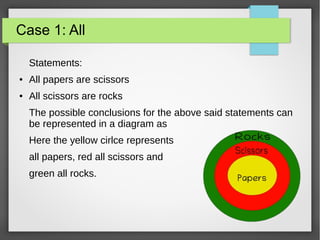
Statements:
● All papers are scissors
● All scissors are rocks
The possible conclusions for the above said statements can
be represented in a diagram as
Here the yellow cirlce represents
all papers, red all scissors and
green all rocks.
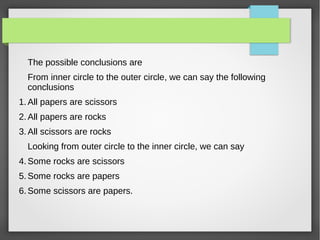
The possible conclusions are
From inner circle to the outer circle, we can say the following
conclusions
1.All papers are scissors
2.All papers are rocks
3.All scissors are rocks
Looking from outer circle to the inner circle, we can say
4.Some rocks are scissors
5.Some rocks are papers
6.Some scissors are papers.
Case 2: Some
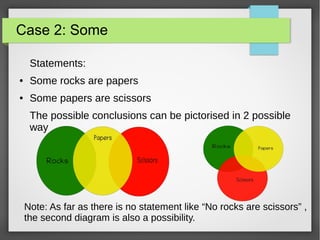
Statements:
● Some rocks are papers
● Some papers are scissors
The possible conclusions can be pictorised in 2 possible
way
Note: As far as there is no statement like “No rocks are scissors” ,
the second diagram is also a possibility.
Case 3: All ... Some
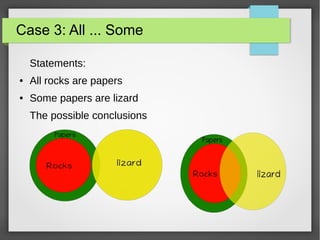
Statements:
● All rocks are papers
● Some papers are lizard
The possible conclusions
Case 4: Some ... All
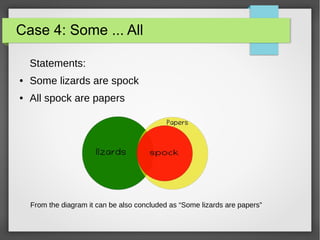
Statements:
● Some lizards are spock
● All spock are papers
From the diagram it can be also concluded as “Some lizards are papers”
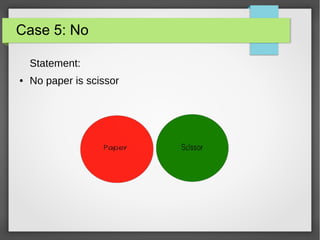
Case 5: No
Statement:
● No paper is scissor
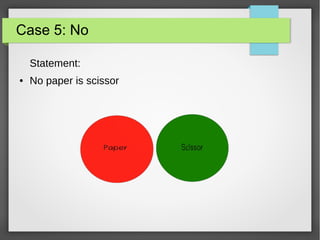
Case 5: No
Statement:
● No paper is scissor

Syllogism

  • 1.
    Logical ReasoningLogical Reasoning SyllogismSyllogism “Asyllogism is a kind of logical argument that applies deductive reasoning to arrive at a conclusion based on two or more propositions that are asserted or assumed to be true.” Wikipedia contributors. "Syllogism." Wikipedia, The Free Encyclopedia. 7 Jun. 2015. Web. 14 Jun. 2015.
  • 2.
    Syllogism ??? ● Therewill be 'statements' and 'conclusions' . ● The challenge is to check whether the given conclusions are valid to the given statements.
  • 3.
    Cases of statementsCasesof statements 1.All 2.Some 3.All ... Some 4.Some ... All 5.No
  • 4.
    Case 1: All Statements: ●All papers are scissors ● All scissors are rocks The possible conclusions for the above said statements can be represented in a diagram as Here the yellow cirlce represents all papers, red all scissors and green all rocks.
  • 5.
    The possible conclusionsare From inner circle to the outer circle, we can say the following conclusions 1.All papers are scissors 2.All papers are rocks 3.All scissors are rocks Looking from outer circle to the inner circle, we can say 4.Some rocks are scissors 5.Some rocks are papers 6.Some scissors are papers.
  • 6.
    Case 2: Some Statements: ●Some rocks are papers ● Some papers are scissors The possible conclusions can be pictorised in 2 possible way Note: As far as there is no statement like “No rocks are scissors” , the second diagram is also a possibility.
  • 7.
    Case 3: All... Some Statements: ● All rocks are papers ● Some papers are lizard The possible conclusions
  • 8.
    Case 4: Some... All Statements: ● Some lizards are spock ● All spock are papers From the diagram it can be also concluded as “Some lizards are papers”
  • 9.
    Case 5: No Statement: ●No paper is scissor
  • 10.
    Case 5: No Statement: ●No paper is scissor