3.3 Logarithmic Functions 
Graph and apply transformations to 
the graphs of logarithmic functions. 
http://nicktoons.nick.com/videos/clip/stimpys-big-day-log-song-1.html
GRAPH AND APPLY TRANSFORMATIONS 
TO THE GRAPHS OF LOGARITHMIC 
FUNCTIONS.
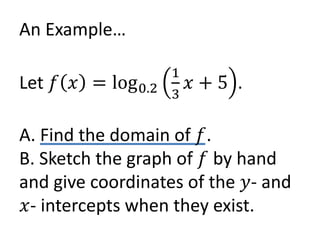
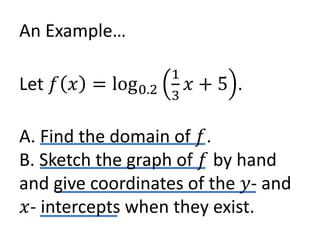
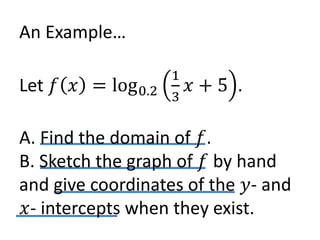
An Example… 
Let 푓 푥 = log0.2 
1 
3 
푥 + 5 . 
A. Find the domain of 푓. 
B. Sketch the graph of 푓 by hand 
and give coordinates of the 푦- and 
푥- intercepts when they exist.
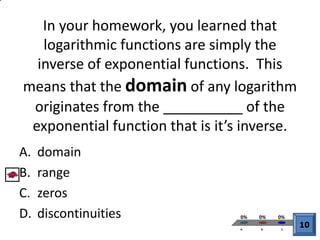
In your homework, you learned that 
logarithmic functions are simply the 
inverse of exponential functions. This 
means that the domain of any logarithm 
originates from the __________ of the 
exponential function that is it’s inverse. 
A. domain 
B. range 
C. zeros 
D. discontinuities 
0% 0% 0% 0% 
10 
A. B. C. D.
For any logarithmic function, 
0% 0% 0% 0% 
A. B. C. D. 
푓 푥 = log푏 푥 
the inverse function is 
푓−1 푦 = 푏푦 . 
What is the range of the exponential 
function 푓−1 푦 = 푏푦? 
A. −∞, ∞ 
B. −∞, 0 ∪ 0, ∞ 
C. 0, ∞ 
D. [0, ∞) 
10
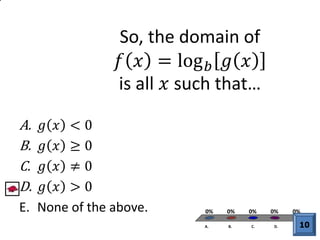
So, the domain of 
푓 푥 = log푏 푔 푥 
is all 푥 such that… 
0% 0% 0% 0% 0% 
A. B. C. D. E. 
A. 푔 푥 < 0 
B. 푔 푥 ≥ 0 
C. 푔 푥 ≠ 0 
D. 푔 푥 > 0 
E. None of the above. 
10
We know that when 
푓 푥 = log푏 [푔 푥 ] , 
the domain is all 푥 
such that 푔 푥 > 0. 
Back to our problem… 
푓 푥 = log0.2 
1 
3 
푥 + 5 
1 
3 
푥 + 5 > 0 
Solve for 푥 to find the 
domain of 푓.
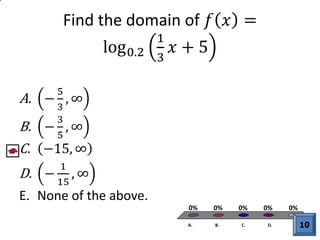
Find the domain of 푓 푥 = 
0% 0% 0% 0% 0% 
A. B. C. D. E. 
log0.2 
1 
3 
푥 + 5 
A. − 
5 
3 
, ∞ 
B. − 
3 
5 
, ∞ 
C. −15, ∞ 
D. − 
1 
15 
, ∞ 
E. None of the above. 
10
An Example… 
Let 푓 푥 = log0.2 
1 
3 
푥 + 5 . 
A. Find the domain of 푓. 
B. Sketch the graph of 푓 by hand 
and give coordinates of the 푦- and 
푥- intercepts when they exist.
OK, so the instructions say to sketch by hand, but… 
…instead we are just using the MyLabsPlus graphing 
system. 
First you will have to choose a tool from the palette. 
Recall that we are looking for the graph of the inverse of 
an exponential function. 
For each plotted point, (푥, 푦) that we find on the graph of 
an exponential function, we find (푦, 푥) on the graph of the 
logarithmic function.
Which of the following is the 
“Logarithm tool”? 
0% 0% 0% 0% 
A. B. C. D. 
A. 
B. 
C. 
D. 
10
Actually, if you’re not sure, MyLabsPlus makes it 
really easy for you! 
Just hover the mouse over each tool and it will 
pop up with a box that says it’s name. 
Click on the tool and then click anywhere in the 
coordinate plane to launch the input boxes…
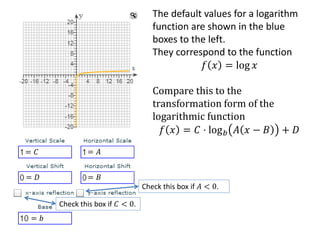
The default values for a logarithm 
function are shown in the blue 
boxes to the left. 
They correspond to the function 
푓 푥 = log 푥 
Compare this to the 
transformation form of the 
logarithmic function 
푓 푥 = 퐶 ⋅ log푏 퐴 푥 − 퐵 + 퐷 
= 퐶 
= 푏 
= 퐴 
= 퐷 = 퐵 
Check this box if 퐶 < 0. 
Check this box if 퐴 < 0.
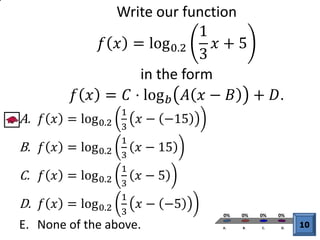
Write our function 
0% 0% 0% 0% 0% 
A. B. C. D. E. 
푓 푥 = log0.2 
1 
3 
푥 + 5 
in the form 
푓 푥 = 퐶 ⋅ log푏 퐴 푥 − 퐵 + 퐷. 
A. 푓 푥 = log0.2 
1 
3 
푥 − −15 
B. 푓 푥 = log0.2 
1 
3 
푥 − 15 
C. 푓 푥 = log0.2 
1 
3 
푥 − 5 
D. 푓 푥 = log0.2 
1 
3 
푥 − −5 
E. None of the above. 10
By comparing 
푓 푥 = log0.2 
1 
3 
푥 − −15 
to 
푓 푥 = 퐶 ⋅ log푏 퐴 푥 − 퐵 + 퐷 
we can see that 
퐶 = Vertical Scale = 1 
푏 = base = 0.2 
퐴 = Horizontal Scale = 
1 
3 
퐵 = Horizontal Shift = −15 
퐷 = Vertical Shift = 0
An Example… 
Let 푓 푥 = log0.2 
1 
3 
푥 + 5 . 
A. Find the domain of 푓. 
B. Sketch the graph of 푓 by hand 
and give coordinates of the 푦- and 
푥- intercepts when they exist.
Finding the 푦-intercept is done the same 
way for every function, including 
logarithms. Which of the following is the 
method that will find the 푦-intercept? 
A. Set the function equal to zero and 
0% 0% 0% 0% 0% 
A. B. C. D. E. 
solve for 푥. 
B. Find 푓(0). 
C. Solve for 푥. Then replace 푥 with 
푓−1 푦 . 
D. Apply the quadratic formula. 
E. None of the above. 
10
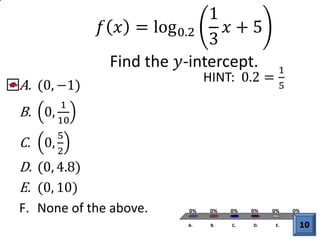
푓 푥 = log0.2 
1 
3 
푥 + 5 
푓 0 = log0.2 
1 
3 
⋅ 0 + 5 
푓 0 = log0.2 5 
Recall (from your homework) that log푏 푥 is 
defined as the exponent we must raise 푏 to in 
order to get 푥. 
0.2? = 5
푓 푥 = log0.2 
1 
3 
푥 + 5 
Find the 푦-intercept. 
0% 0% 0% 0% 0% 0% 
A. B. C. D. E. F. 
A. (0, −1) 
B. 0, 
1 
10 
C. 0, 
5 
2 
D. (0, 4.8) 
E. (0, 10) 
F. None of the above. 
10 
HINT: 0.2 = 
1 
5
An Example… 
Let 푓 푥 = log0.2 
1 
3 
푥 + 5 . 
A. Find the domain of 푓. 
B. Sketch the graph of 푓 by hand 
and give coordinates of the 푦- and 
푥- intercepts when they exist.
Finding the 푥-intercept is done the same 
way for every function, including 
logarithms. Which of the following is the 
method that will find the 푥-intercept? 
A. Set the function equal to zero and 
0% 0% 0% 0% 0% 
A. B. C. D. E. 
solve for 푥. 
B. Find 푓(0). 
C. Solve for 푥. Then replace 푥 with 
푓−1 푦 . 
D. Apply the quadratic formula. 
E. None of the above. 
10
푓 푥 = log0.2 
1 
3 
푥 + 5 
0 = log0.2 
1 
3 
푥 + 5 
Solve for 푥.
This is not as difficult as it might look. 
Recall from your homework that 
0% 0% 0% 0% 0% 
A. B. C. D. E. 
log푏 ? = 0 
A. log푏 푏 = 0 
B. log푏 0 = 0 
C. log푏 
1 
푏 
= 0 
D. log푏 1 = 0 
E. None of the above. 
10 
HINT: 푏0 =?
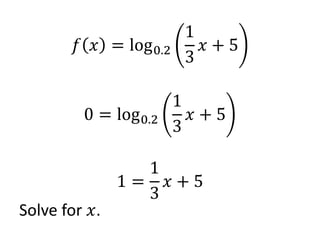
푓 푥 = log0.2 
1 
3 
푥 + 5 
0 = log0.2 
1 
3 
푥 + 5 
1 = 
1 
3 
푥 + 5 
Solve for 푥.
푓 푥 = log0.2 
1 
3 
푥 + 5 
Find the 푥-intercept. 
0% 0% 0% 0% 0% 0% 
A. B. C. D. E. F. 
A. 18, 0 
B. − 
4 
3 
, 0 
C. 2, 0 
D. −15, 0 
E. −12, 0 
F. None of the above. 
10

3.3 Logarithmic Functions

  • 1.
    3.3 Logarithmic Functions Graph and apply transformations to the graphs of logarithmic functions. http://nicktoons.nick.com/videos/clip/stimpys-big-day-log-song-1.html
  • 2.
    GRAPH AND APPLYTRANSFORMATIONS TO THE GRAPHS OF LOGARITHMIC FUNCTIONS.
  • 3.
    An Example… Let푓 푥 = log0.2 1 3 푥 + 5 . A. Find the domain of 푓. B. Sketch the graph of 푓 by hand and give coordinates of the 푦- and 푥- intercepts when they exist.
  • 4.
    In your homework,you learned that logarithmic functions are simply the inverse of exponential functions. This means that the domain of any logarithm originates from the __________ of the exponential function that is it’s inverse. A. domain B. range C. zeros D. discontinuities 0% 0% 0% 0% 10 A. B. C. D.
  • 5.
    For any logarithmicfunction, 0% 0% 0% 0% A. B. C. D. 푓 푥 = log푏 푥 the inverse function is 푓−1 푦 = 푏푦 . What is the range of the exponential function 푓−1 푦 = 푏푦? A. −∞, ∞ B. −∞, 0 ∪ 0, ∞ C. 0, ∞ D. [0, ∞) 10
  • 6.
    So, the domainof 푓 푥 = log푏 푔 푥 is all 푥 such that… 0% 0% 0% 0% 0% A. B. C. D. E. A. 푔 푥 < 0 B. 푔 푥 ≥ 0 C. 푔 푥 ≠ 0 D. 푔 푥 > 0 E. None of the above. 10
  • 7.
    We know thatwhen 푓 푥 = log푏 [푔 푥 ] , the domain is all 푥 such that 푔 푥 > 0. Back to our problem… 푓 푥 = log0.2 1 3 푥 + 5 1 3 푥 + 5 > 0 Solve for 푥 to find the domain of 푓.
  • 8.
    Find the domainof 푓 푥 = 0% 0% 0% 0% 0% A. B. C. D. E. log0.2 1 3 푥 + 5 A. − 5 3 , ∞ B. − 3 5 , ∞ C. −15, ∞ D. − 1 15 , ∞ E. None of the above. 10
  • 9.
    An Example… Let푓 푥 = log0.2 1 3 푥 + 5 . A. Find the domain of 푓. B. Sketch the graph of 푓 by hand and give coordinates of the 푦- and 푥- intercepts when they exist.
  • 10.
    OK, so theinstructions say to sketch by hand, but… …instead we are just using the MyLabsPlus graphing system. First you will have to choose a tool from the palette. Recall that we are looking for the graph of the inverse of an exponential function. For each plotted point, (푥, 푦) that we find on the graph of an exponential function, we find (푦, 푥) on the graph of the logarithmic function.
  • 11.
    Which of thefollowing is the “Logarithm tool”? 0% 0% 0% 0% A. B. C. D. A. B. C. D. 10
  • 12.
    Actually, if you’renot sure, MyLabsPlus makes it really easy for you! Just hover the mouse over each tool and it will pop up with a box that says it’s name. Click on the tool and then click anywhere in the coordinate plane to launch the input boxes…
  • 13.
    The default valuesfor a logarithm function are shown in the blue boxes to the left. They correspond to the function 푓 푥 = log 푥 Compare this to the transformation form of the logarithmic function 푓 푥 = 퐶 ⋅ log푏 퐴 푥 − 퐵 + 퐷 = 퐶 = 푏 = 퐴 = 퐷 = 퐵 Check this box if 퐶 < 0. Check this box if 퐴 < 0.
  • 14.
    Write our function 0% 0% 0% 0% 0% A. B. C. D. E. 푓 푥 = log0.2 1 3 푥 + 5 in the form 푓 푥 = 퐶 ⋅ log푏 퐴 푥 − 퐵 + 퐷. A. 푓 푥 = log0.2 1 3 푥 − −15 B. 푓 푥 = log0.2 1 3 푥 − 15 C. 푓 푥 = log0.2 1 3 푥 − 5 D. 푓 푥 = log0.2 1 3 푥 − −5 E. None of the above. 10
  • 15.
    By comparing 푓푥 = log0.2 1 3 푥 − −15 to 푓 푥 = 퐶 ⋅ log푏 퐴 푥 − 퐵 + 퐷 we can see that 퐶 = Vertical Scale = 1 푏 = base = 0.2 퐴 = Horizontal Scale = 1 3 퐵 = Horizontal Shift = −15 퐷 = Vertical Shift = 0
  • 16.
    An Example… Let푓 푥 = log0.2 1 3 푥 + 5 . A. Find the domain of 푓. B. Sketch the graph of 푓 by hand and give coordinates of the 푦- and 푥- intercepts when they exist.
  • 17.
    Finding the 푦-interceptis done the same way for every function, including logarithms. Which of the following is the method that will find the 푦-intercept? A. Set the function equal to zero and 0% 0% 0% 0% 0% A. B. C. D. E. solve for 푥. B. Find 푓(0). C. Solve for 푥. Then replace 푥 with 푓−1 푦 . D. Apply the quadratic formula. E. None of the above. 10
  • 18.
    푓 푥 =log0.2 1 3 푥 + 5 푓 0 = log0.2 1 3 ⋅ 0 + 5 푓 0 = log0.2 5 Recall (from your homework) that log푏 푥 is defined as the exponent we must raise 푏 to in order to get 푥. 0.2? = 5
  • 19.
    푓 푥 =log0.2 1 3 푥 + 5 Find the 푦-intercept. 0% 0% 0% 0% 0% 0% A. B. C. D. E. F. A. (0, −1) B. 0, 1 10 C. 0, 5 2 D. (0, 4.8) E. (0, 10) F. None of the above. 10 HINT: 0.2 = 1 5
  • 20.
    An Example… Let푓 푥 = log0.2 1 3 푥 + 5 . A. Find the domain of 푓. B. Sketch the graph of 푓 by hand and give coordinates of the 푦- and 푥- intercepts when they exist.
  • 21.
    Finding the 푥-interceptis done the same way for every function, including logarithms. Which of the following is the method that will find the 푥-intercept? A. Set the function equal to zero and 0% 0% 0% 0% 0% A. B. C. D. E. solve for 푥. B. Find 푓(0). C. Solve for 푥. Then replace 푥 with 푓−1 푦 . D. Apply the quadratic formula. E. None of the above. 10
  • 22.
    푓 푥 =log0.2 1 3 푥 + 5 0 = log0.2 1 3 푥 + 5 Solve for 푥.
  • 23.
    This is notas difficult as it might look. Recall from your homework that 0% 0% 0% 0% 0% A. B. C. D. E. log푏 ? = 0 A. log푏 푏 = 0 B. log푏 0 = 0 C. log푏 1 푏 = 0 D. log푏 1 = 0 E. None of the above. 10 HINT: 푏0 =?
  • 24.
    푓 푥 =log0.2 1 3 푥 + 5 0 = log0.2 1 3 푥 + 5 1 = 1 3 푥 + 5 Solve for 푥.
  • 25.
    푓 푥 =log0.2 1 3 푥 + 5 Find the 푥-intercept. 0% 0% 0% 0% 0% 0% A. B. C. D. E. F. A. 18, 0 B. − 4 3 , 0 C. 2, 0 D. −15, 0 E. −12, 0 F. None of the above. 10