S H A A N A R O E S T E
P H Y S 1 0 1 – L M 2
Michelson Interferometers
Michelson Interferometer
The following is an explanation of how and why a Michelson
interferometer works. This learning object assumes a
previous understanding of the basics of light waves.
Michelson Interferometer
A Michelson interferometer is used to observe interference.
It does this through a setup involving a light source, a light
detector, a beam splitter, and mirrors.
By splitting the beam of light and introducing differences in
path length for the resulting beams, interference can be
induced.
Michelson Interferometer
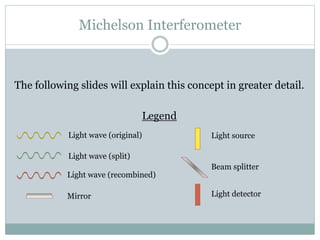
The following slides will explain this concept in greater detail.
Legend
Light wave (original)
Light wave (split)
Light wave (recombined)
Mirror
Light source
Beam splitter
Light detector
Michelson Interferometer
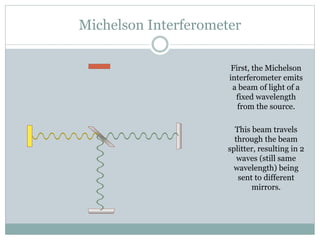
First, the Michelson
interferometer emits
a beam of light of a
fixed wavelength
from the source.
This beam travels
through the beam
splitter, resulting in 2
waves (still same
wavelength) being
sent to different
mirrors.
Michelson Interferometer
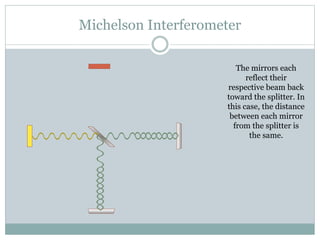
The mirrors each
reflect their
respective beam back
toward the splitter. In
this case, the distance
between each mirror
from the splitter is
the same.
Michelson Interferometer
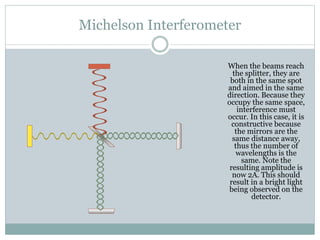
When the beams reach
the splitter, they are
both in the same spot
and aimed in the same
direction. Because they
occupy the same space,
interference must
occur. In this case, it is
constructive because
the mirrors are the
same distance away,
thus the number of
wavelengths is the
same. Note the
resulting amplitude is
now 2A. This should
result in a bright light
being observed on the
detector.
Michelson Interferometer
Now let’s modify the experimental settings by moving the
right mirror to the right by λ/4
(one quarter of the beam’s wavelength)
Michelson Interferometer
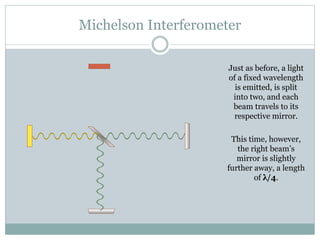
Just as before, a light
of a fixed wavelength
is emitted, is split
into two, and each
beam travels to its
respective mirror.
This time, however,
the right beam’s
mirror is slightly
further away, a length
of λ/4.
Michelson Interferometer
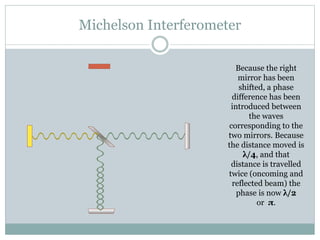
Because the right
mirror has been
shifted, a phase
difference has been
introduced between
the waves
corresponding to the
two mirrors. Because
the distance moved is
λ/4, and that
distance is travelled
twice (oncoming and
reflected beam) the
phase is now λ/2
or π.
Michelson Interferometer
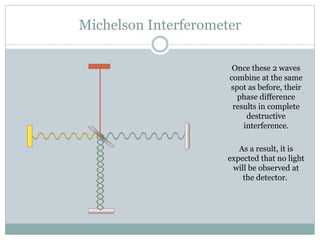
Once these 2 waves
combine at the same
spot as before, their
phase difference
results in complete
destructive
interference.
As a result, it is
expected that no light
will be observed at
the detector.
Michelson Interferometer
I hope this helped to elucidate the functionality and
underlying theory of this ingenious device.
Thank you for reading.

PHYS101 LO9 Shaan Aroeste

  • 1.
    S H AA N A R O E S T E P H Y S 1 0 1 – L M 2 Michelson Interferometers
  • 2.
    Michelson Interferometer The followingis an explanation of how and why a Michelson interferometer works. This learning object assumes a previous understanding of the basics of light waves.
  • 3.
    Michelson Interferometer A Michelsoninterferometer is used to observe interference. It does this through a setup involving a light source, a light detector, a beam splitter, and mirrors. By splitting the beam of light and introducing differences in path length for the resulting beams, interference can be induced.
  • 4.
    Michelson Interferometer The followingslides will explain this concept in greater detail. Legend Light wave (original) Light wave (split) Light wave (recombined) Mirror Light source Beam splitter Light detector
  • 5.
    Michelson Interferometer First, theMichelson interferometer emits a beam of light of a fixed wavelength from the source. This beam travels through the beam splitter, resulting in 2 waves (still same wavelength) being sent to different mirrors.
  • 6.
    Michelson Interferometer The mirrorseach reflect their respective beam back toward the splitter. In this case, the distance between each mirror from the splitter is the same.
  • 7.
    Michelson Interferometer When thebeams reach the splitter, they are both in the same spot and aimed in the same direction. Because they occupy the same space, interference must occur. In this case, it is constructive because the mirrors are the same distance away, thus the number of wavelengths is the same. Note the resulting amplitude is now 2A. This should result in a bright light being observed on the detector.
  • 8.
    Michelson Interferometer Now let’smodify the experimental settings by moving the right mirror to the right by λ/4 (one quarter of the beam’s wavelength)
  • 9.
    Michelson Interferometer Just asbefore, a light of a fixed wavelength is emitted, is split into two, and each beam travels to its respective mirror. This time, however, the right beam’s mirror is slightly further away, a length of λ/4.
  • 10.
    Michelson Interferometer Because theright mirror has been shifted, a phase difference has been introduced between the waves corresponding to the two mirrors. Because the distance moved is λ/4, and that distance is travelled twice (oncoming and reflected beam) the phase is now λ/2 or π.
  • 11.
    Michelson Interferometer Once these2 waves combine at the same spot as before, their phase difference results in complete destructive interference. As a result, it is expected that no light will be observed at the detector.
  • 12.
    Michelson Interferometer I hopethis helped to elucidate the functionality and underlying theory of this ingenious device. Thank you for reading.