LIVER TRAUMA
Muhammad Syazwan Mohd Hasim
31a
INTRODUCTION
• It is the 2nd commonest organ injured in blunt abdominal
trauma and the commonest injured in penetrating trauma.
• 1% - 8% of patient with multiple blunt trauma sustain a liver
injury.
FACTORS
• The large size of the liver
• Its friable parenchyma
• Its thin capsule
• Its relatively fixed position in relation to the spine and ribs
ANATOMY
CLASSIFICATION
I - Close Injury
1. According to mechanism of injury:
Direct hit, fall from a height, compression between two objects, Road traffic injuries
2. According to the type of damage:
rupture of the liver with damage of the capsule subcapsular hematoma, damage of
extrahepatic bile ducts and blood vessels of the liver
3. According to the degree of damage:
surface cracks and rupture to a depth of 2 cm, rupture to half thickness of the liver,
rupture depth of more than half of the liver
4. Localization:
Damage lobes or segments of the liver.
5. Character:
With damage of extra- and intrahepatic vessels and bile ducts.
II - Open Injury
1. Gunshot: bullet, shrapnel, the shot.
2. Machetes: stab
III - The combination of blunt trauma injury to the liver
GRADING
GRADING OUTCOMES
• Grade I,II
- minor injuries, represent 80-90% of all injuries, require
minimal or no operative treatment
• Grade III-V
- severe,require surgical intervention
• Grade VI
- incompatible with survival
CLINICAL PICTURE
• Pain
• Signs of blood loss
• Hematoma
• Tenderness upon palpation
• Dullness during percussion
DIAGNOSTICS
Ultrasonography
- fast, accurate, noninvasive, a good initial screening test
- sensitivity 88 %, specificity 99 %
DPL
- fast, sensitive, accurate and simple to perform
- invasive, cannot diagnose retroperitoneal injury
Computed tomography
- The standard evaluation method for stable patient . Performed with
dilute water soluble oral contrast agent and intravenous contrast
X-ray
- nonspecific, but useful in showing the extent of associated skeletal
trauma.
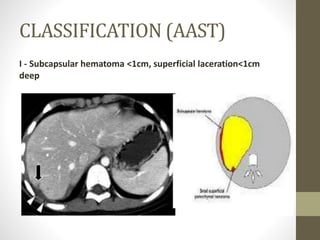
CLASSIFICATION (AAST)
I - Subcapsular hematoma <1cm, superficial laceration<1cm
deep
II - Parenchymal laceration 1-3cm deep, subcapsular
hematoma1-3 cm thick
III - Parenchymal laceration> 3cm deep and subcapsular
hematoma> 3cm diameter
IV - Parenchymal/supcapsular hematoma> 10cm in diameter,
lobar destruction
V - Global destruction or devascularization of the liver
VI - Hepatic avulsion
MANAGEMENT
CONSERVATIVE :
1. 86% of liver injuries stopped bleeding by the time of surgical
exploration
2. 67% of operations performed are nontherapeutic
• Criteria
- hemodynamically stable
- simple hepatic parenchyma laceration of intrahepatic
hematoma
- absence of active hemorrhage
- hemoperitoneum of less than 500ml
- limited need for liver related blood transfusions (12U)
- absence of peritoneal sign
- absence of other peritoneal injuries that would otherwise
require an operation
OPERATIVE :
• Initial hemostasis
1. Packing
2. Pringle maneoevre
3. Bimanual liver compression
4. Cross clamping aorta above celiac trunk
• Hepatotomy with direct suture ligation
- using the finger fracture technique, electrocautery or an
ultrasonic dissector to expose damaged vessels and hepatic
duct which ligated , clipped or repaired
- low incidence of rebleeding, necrosis and sepsis
- effectives following blunt liver trauma requires further
evaluation
• Resection debridement
- removal devitalized tissue
- rapid compared with standard anatomical resection, which
are more time consuming and remove more normal liver
parenchyma
- reduced risk of post-op sepsis secondary hemorrhage and bile
leakage
• Anatomical resection
- reserved for deep laceration involving major vessels or bile
ducts, extensive devascularization and major hepatic venous
bleeding
• Perihepatic packing
- Indication:
coagulopathy, irreversible shock from blood loss (10u),
hypothermia(32C), acidosis(PH7.2), bilobar injury,large
nonexpanding hematoma, capsular avulsion, vena cava or
hepatic vein injuries
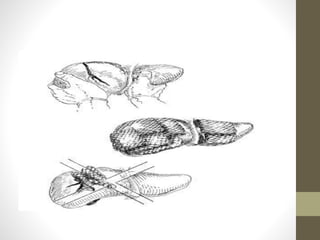
• Mesh rapping
- new technique for grade III,IV laceration, tamponading large
intrahepatic hematomas
- not indicated where juxtacaval or hepatic vein injury is
suspected
• Omental packing
• Intrahepatic tamponade with penrose drains
• Fibrin glue
• Retrohepatic venous injuries
- Total vascular exclusion
- venovenous bypass
- Atriocaval shunting
• Liver transplantation

Liver trauma

  • 1.
  • 2.
    INTRODUCTION • It isthe 2nd commonest organ injured in blunt abdominal trauma and the commonest injured in penetrating trauma. • 1% - 8% of patient with multiple blunt trauma sustain a liver injury.
  • 3.
    FACTORS • The largesize of the liver • Its friable parenchyma • Its thin capsule • Its relatively fixed position in relation to the spine and ribs
  • 4.
  • 5.
    CLASSIFICATION I - CloseInjury 1. According to mechanism of injury: Direct hit, fall from a height, compression between two objects, Road traffic injuries 2. According to the type of damage: rupture of the liver with damage of the capsule subcapsular hematoma, damage of extrahepatic bile ducts and blood vessels of the liver 3. According to the degree of damage: surface cracks and rupture to a depth of 2 cm, rupture to half thickness of the liver, rupture depth of more than half of the liver 4. Localization: Damage lobes or segments of the liver. 5. Character: With damage of extra- and intrahepatic vessels and bile ducts.
  • 6.
    II - OpenInjury 1. Gunshot: bullet, shrapnel, the shot. 2. Machetes: stab III - The combination of blunt trauma injury to the liver
  • 7.
  • 9.
    GRADING OUTCOMES • GradeI,II - minor injuries, represent 80-90% of all injuries, require minimal or no operative treatment • Grade III-V - severe,require surgical intervention • Grade VI - incompatible with survival
  • 10.
    CLINICAL PICTURE • Pain •Signs of blood loss • Hematoma • Tenderness upon palpation • Dullness during percussion
  • 11.
    DIAGNOSTICS Ultrasonography - fast, accurate,noninvasive, a good initial screening test - sensitivity 88 %, specificity 99 % DPL - fast, sensitive, accurate and simple to perform - invasive, cannot diagnose retroperitoneal injury Computed tomography - The standard evaluation method for stable patient . Performed with dilute water soluble oral contrast agent and intravenous contrast X-ray - nonspecific, but useful in showing the extent of associated skeletal trauma.
  • 12.
    CLASSIFICATION (AAST) I -Subcapsular hematoma <1cm, superficial laceration<1cm deep
  • 13.
    II - Parenchymallaceration 1-3cm deep, subcapsular hematoma1-3 cm thick
  • 14.
    III - Parenchymallaceration> 3cm deep and subcapsular hematoma> 3cm diameter
  • 15.
    IV - Parenchymal/supcapsularhematoma> 10cm in diameter, lobar destruction
  • 16.
    V - Globaldestruction or devascularization of the liver
  • 17.
    VI - Hepaticavulsion
  • 18.
    MANAGEMENT CONSERVATIVE : 1. 86%of liver injuries stopped bleeding by the time of surgical exploration 2. 67% of operations performed are nontherapeutic
  • 19.
    • Criteria - hemodynamicallystable - simple hepatic parenchyma laceration of intrahepatic hematoma - absence of active hemorrhage - hemoperitoneum of less than 500ml - limited need for liver related blood transfusions (12U) - absence of peritoneal sign - absence of other peritoneal injuries that would otherwise require an operation
  • 20.
    OPERATIVE : • Initialhemostasis 1. Packing 2. Pringle maneoevre 3. Bimanual liver compression 4. Cross clamping aorta above celiac trunk
  • 21.
    • Hepatotomy withdirect suture ligation - using the finger fracture technique, electrocautery or an ultrasonic dissector to expose damaged vessels and hepatic duct which ligated , clipped or repaired - low incidence of rebleeding, necrosis and sepsis - effectives following blunt liver trauma requires further evaluation
  • 22.
    • Resection debridement -removal devitalized tissue - rapid compared with standard anatomical resection, which are more time consuming and remove more normal liver parenchyma - reduced risk of post-op sepsis secondary hemorrhage and bile leakage
  • 23.
    • Anatomical resection -reserved for deep laceration involving major vessels or bile ducts, extensive devascularization and major hepatic venous bleeding • Perihepatic packing - Indication: coagulopathy, irreversible shock from blood loss (10u), hypothermia(32C), acidosis(PH7.2), bilobar injury,large nonexpanding hematoma, capsular avulsion, vena cava or hepatic vein injuries
  • 25.
    • Mesh rapping -new technique for grade III,IV laceration, tamponading large intrahepatic hematomas - not indicated where juxtacaval or hepatic vein injury is suspected
  • 27.
    • Omental packing •Intrahepatic tamponade with penrose drains • Fibrin glue • Retrohepatic venous injuries - Total vascular exclusion - venovenous bypass - Atriocaval shunting • Liver transplantation