Dr. Sudarshan
Under Guidance of
Dr. B. L. Yadav
Assistant Professor,
Upgraded Department of Surgery
History
Name: Bhori singh
Age & sex: 45 yrs ,male
Resident :Baroli ,Bharatpur

DOA:05/01/2013

Clinical presentation
Pain abdomen: last 3 days
Abdominal distention: last 3 days
Not passing flatus motion: last 2 days
No h/o fever
No h/o vomiting
Cont..
Past history:
 No h/o similar complaint
 No h/o previous surgery
 No h/o DM, TB, COPD, Hypertension , Bronchial
Asthma
Personal history
 Smoker
 Tobacco chewer
 Non alcoholic
 Normal bowel bladder habits
Examination











Conscious
Oriented
Afebrile
Pulse-92/min
B.P-100/70 mmHg
No pallor
No L.N Pathy
No icterus
No clubbing
No pedal oedema
P/A
Inspection:
 Abdomen distended with fullness present in upper abdomen
 No visible pulsation , peristalsis
Palpation:
 Abdomen is tense, tender
 Guarding present
 No Rigidity
Percussion:
 Tympanic note present
 Normal liver dullness and span
 No shifting dullness
Auscultation:
 Bowel sounds absent
Investigations











HB- 11.6 gm/dl
TLC- 1400 /mm3
PLT- 1.35 lakh/ml
Serum urea/creatinine- 87/2.0 mg/dl
S.Total bilirubin-1.2 mg/dl
Direct- 0.5 mg/dl
Indirect- 0.7 mg/dl
SGOT/SGPT- 70/18
Serum amylase-175.0 u/lt
Serum electrolytes- wnl
X-Ray FPA- Multiple air fluid level with large single
stomach gas shadow
Provisional diagnosis:
 Acute intestinal obstruction
 Perforation peritonitis

Plan:
 Exploratory Laparotomy
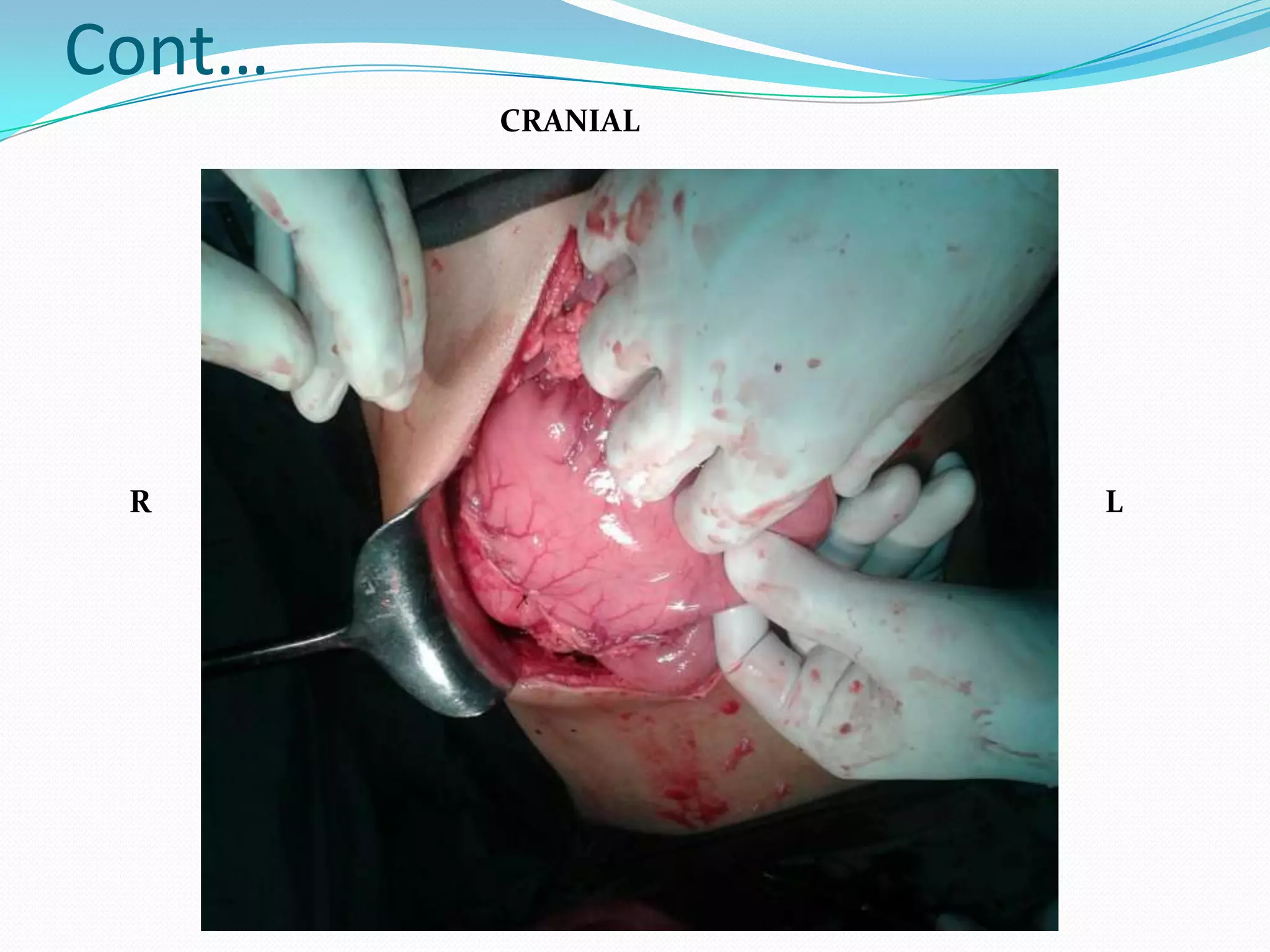
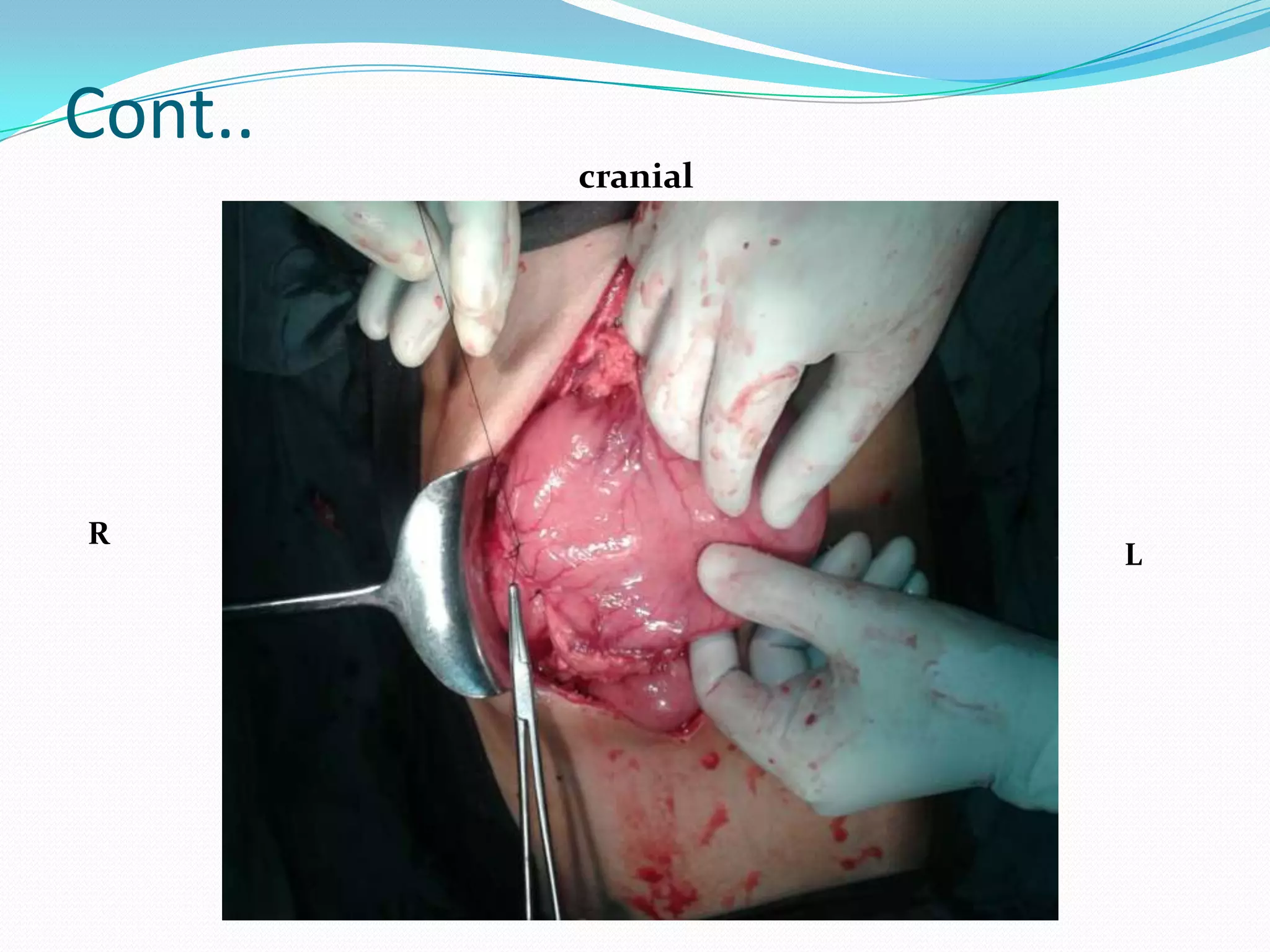
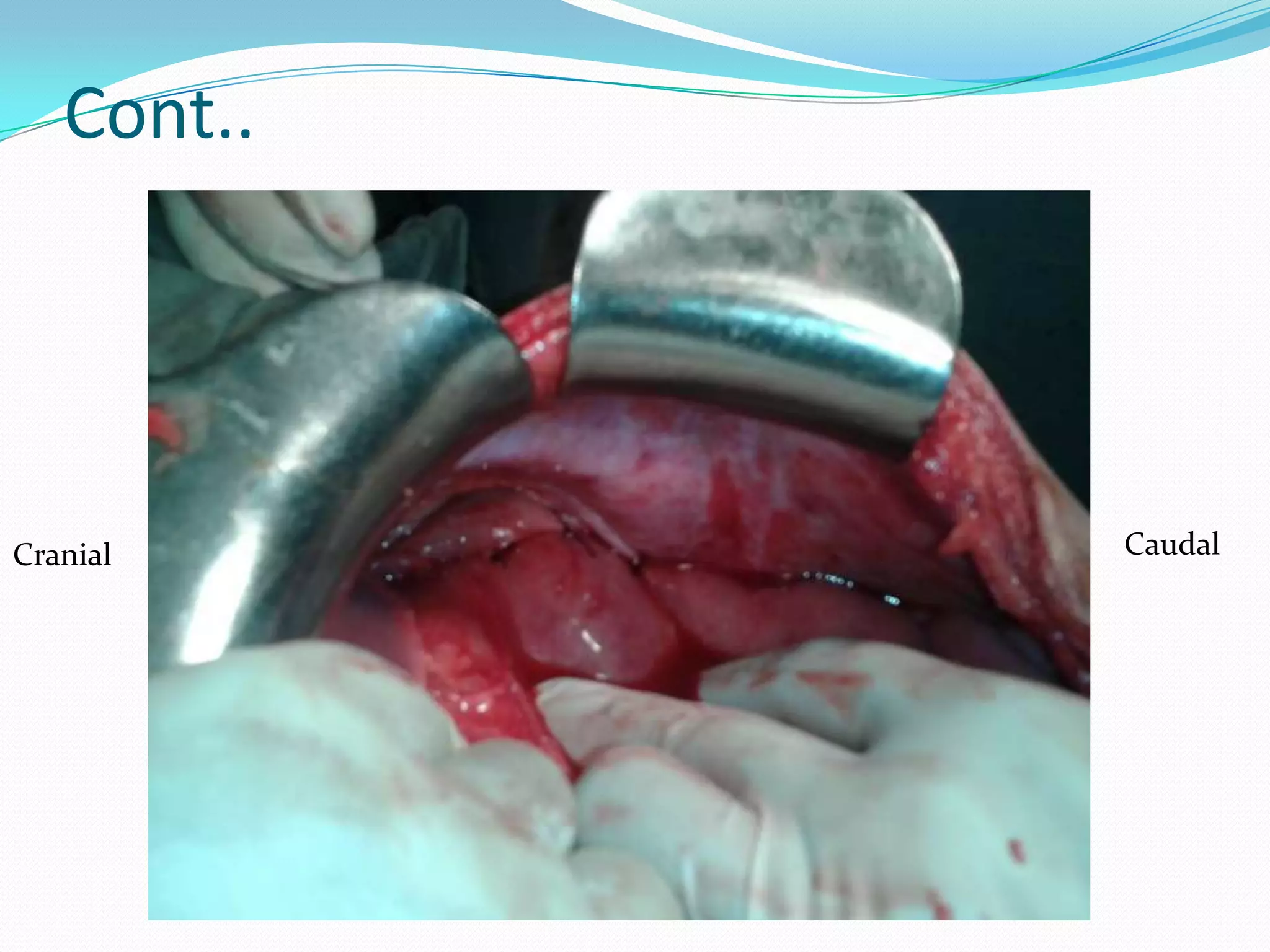
Procedure performed
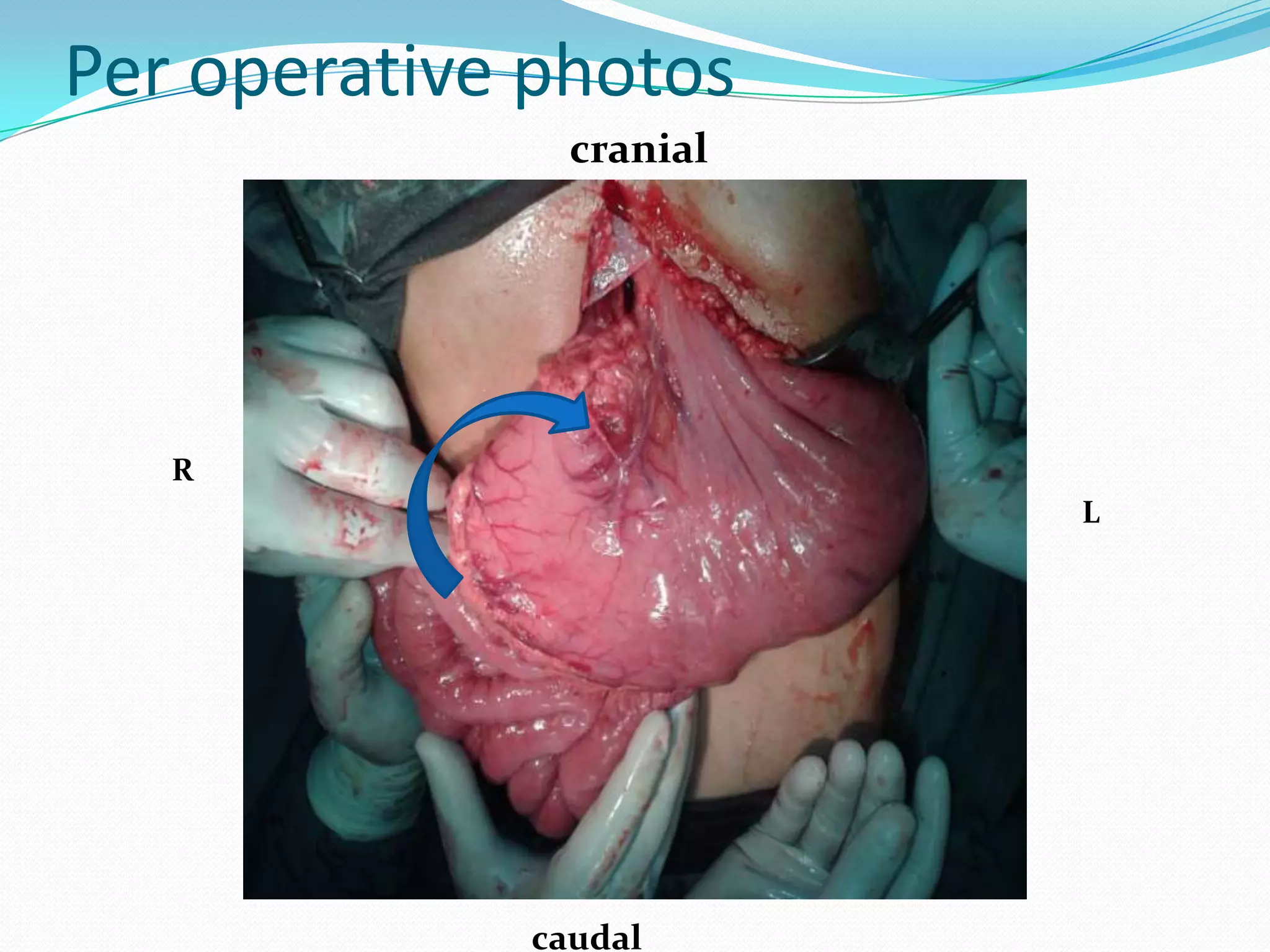
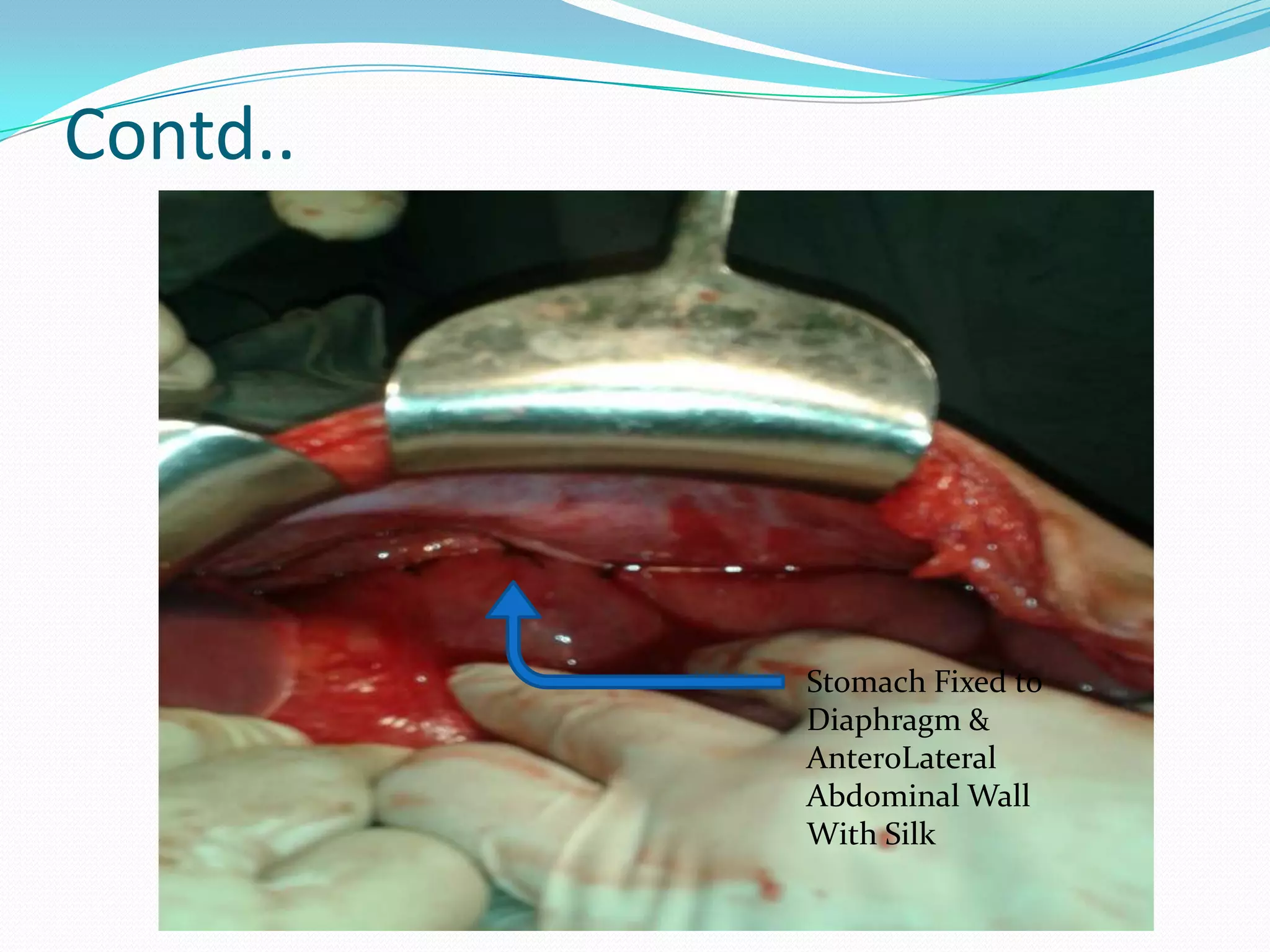
 Exploratory laparotomy with Gastropexy
Per operative photos
cranial

R
L

caudal
Cont…
CRANIAL

R

L
Cont..
cranial

R

L
Cont..

Cranial

Caudal
Contd..

Stomach Fixed to
Diaphragm &
AnteroLateral
Abdominal Wall
With Silk
Post operative follow up
 Vitals monitoring
 Input /output monitoring
 Chest physiotherapy
 Skin stitches removal-7th post op. day
 Discharge-8th post op. day
Discussion
 Definition

Gastric volvulus or volvulus of stomach a twisting of
all or part of the Stomach by more than 180 degrees
with obstruction of the flow of material through the
stomach, variable loss of blood supply and possible

tissue death.
Cont..
 Very uncommon clinical entity
 First described by Berti in 1866
 Seen in both children and elderly people
 Rare below fifth decades of life
Classification of gastric volvulus
On the basis of:
1)OnsetAcute
Chronic
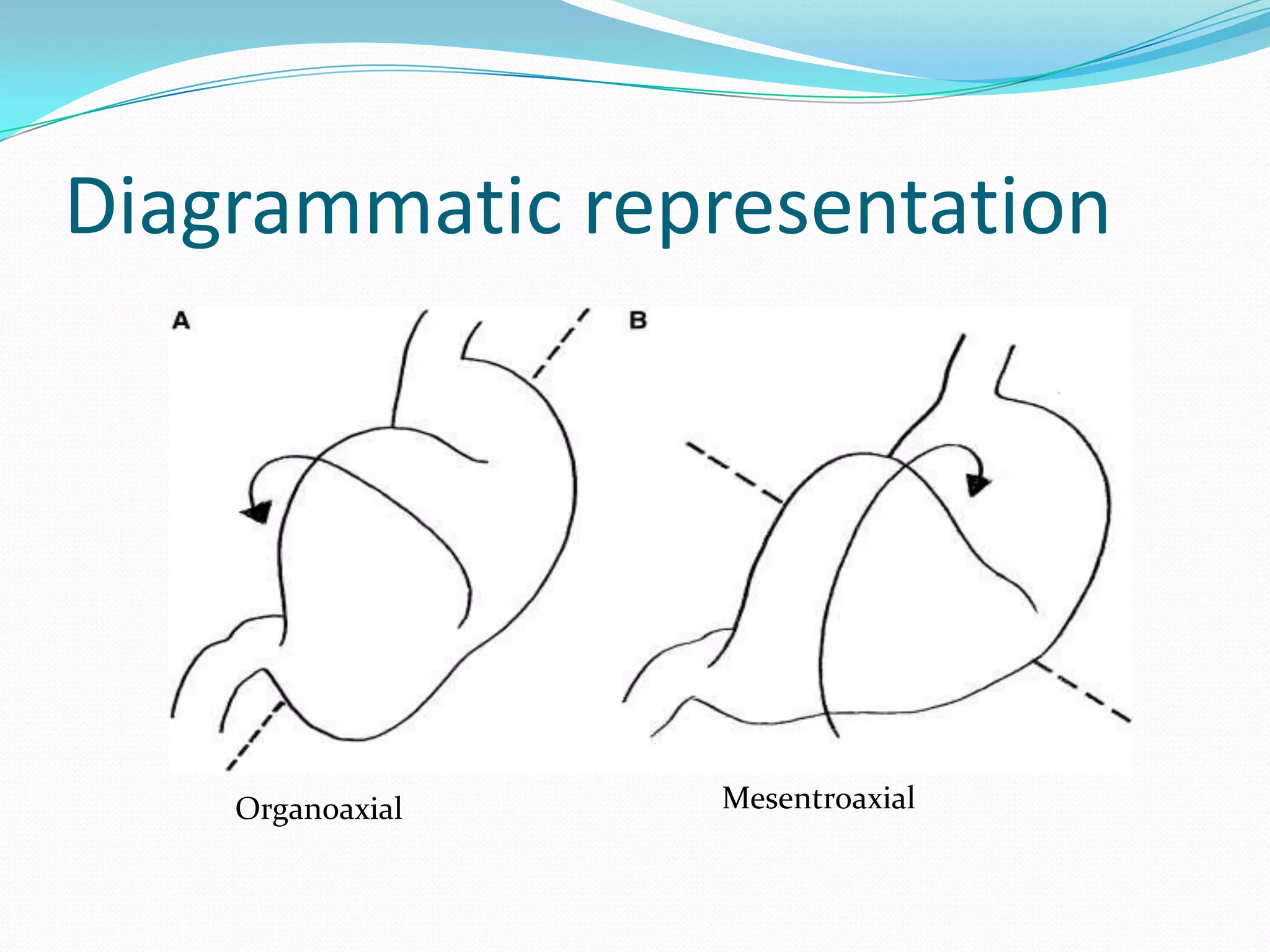
2)Axis of rotation Organoaxial
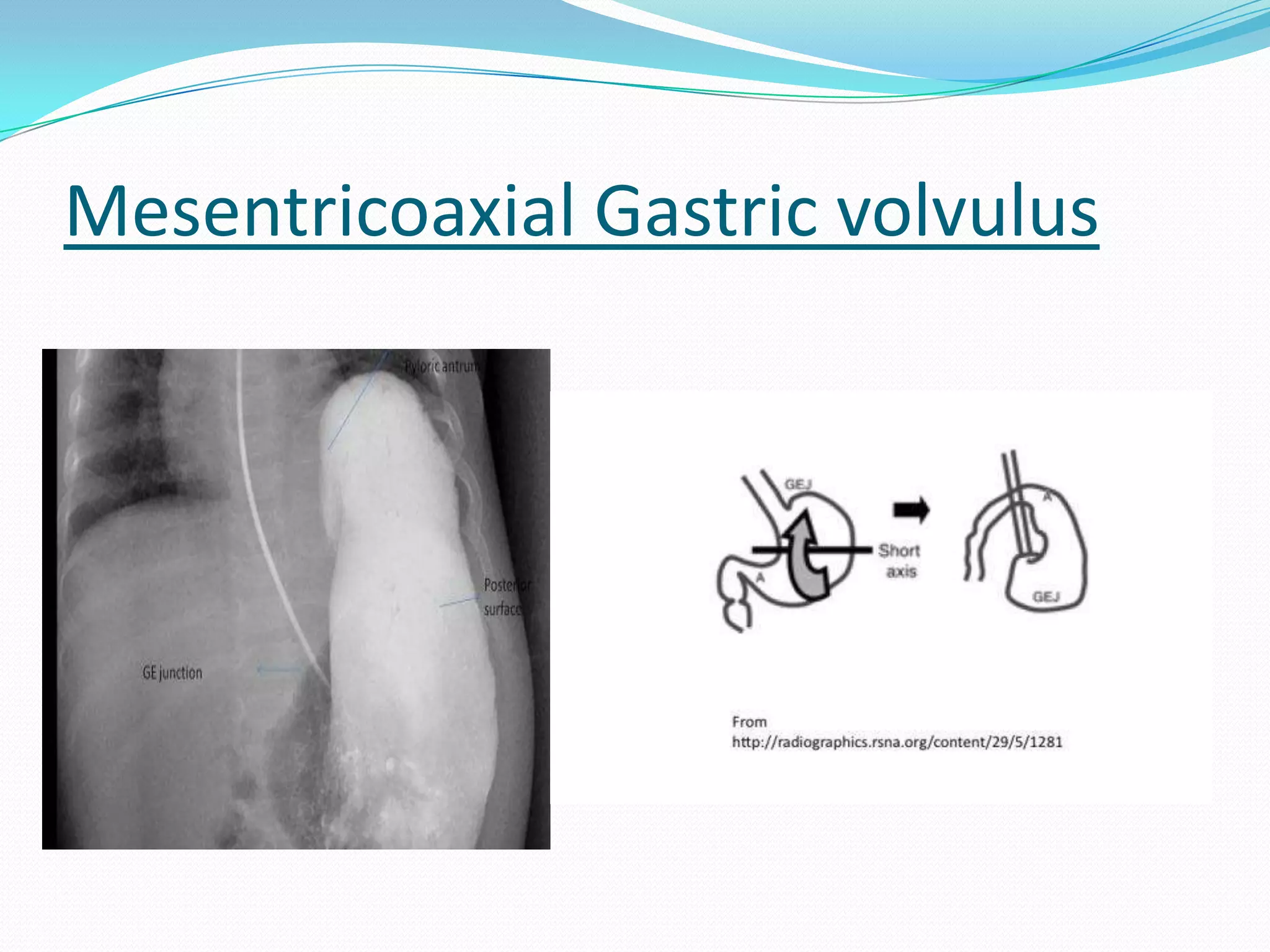
Mesentroaxial
Combined
Gastric volvulus
1. Organoaxial(along longitudinal axis-MC)
a)Acute presentation
b)associated with diaphragmatic defects
c)more common in adults
d)vascular compromise more common
2. Mesentroaxial (along vertical axis)
a) recurrent episodes of pain abdomen
b) Diaphragmatic defects are not seen
c) more common in children
3. Combined
Diagrammatic representation

Organoaxial

Mesentroaxial
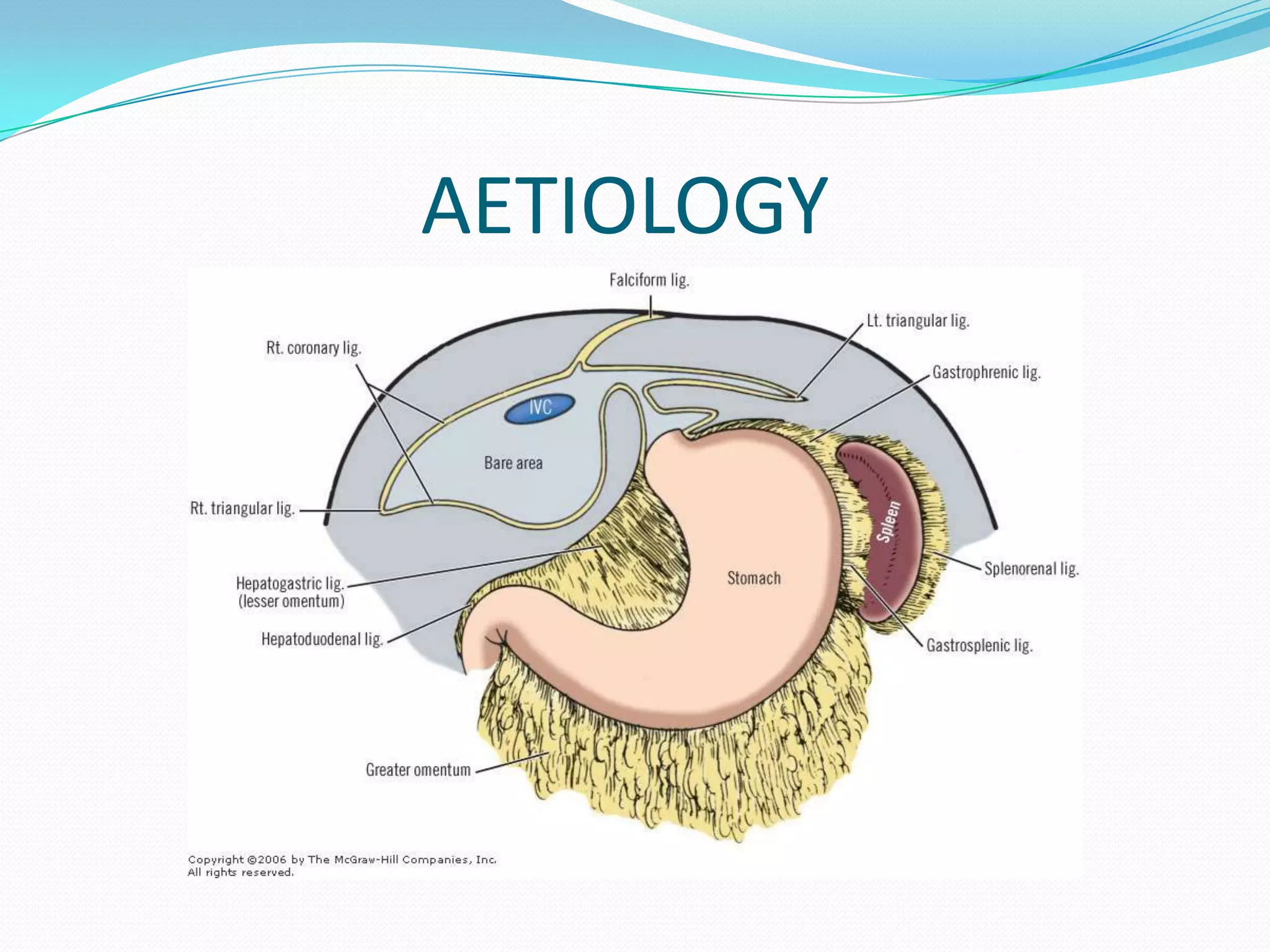
Aetiology
 Type 1 or Idiopathic gastric volvulus

comprises two thirds of cases and is presumably due to
abnormal laxity of the
gastrosplenic*, gastrocolic*, gastrophrenic and
gastrohepatic* ligaments.
Cont..
 Type 2 or secondary

Type 2 gastric volvulus is found in one third of patients and is
usually associated with congenital or acquired abnormalities
that result in abnormal mobility of the stomach
 Diaphragmatic defect
Eventration
Paraoesophagial hiatal defect
Trauma
Paralysis

 Congenital bands and adhesions

 Intestinal malrotation
 Pyloric stenosis and gastric distension
 Colon distention
AETIOLOGY
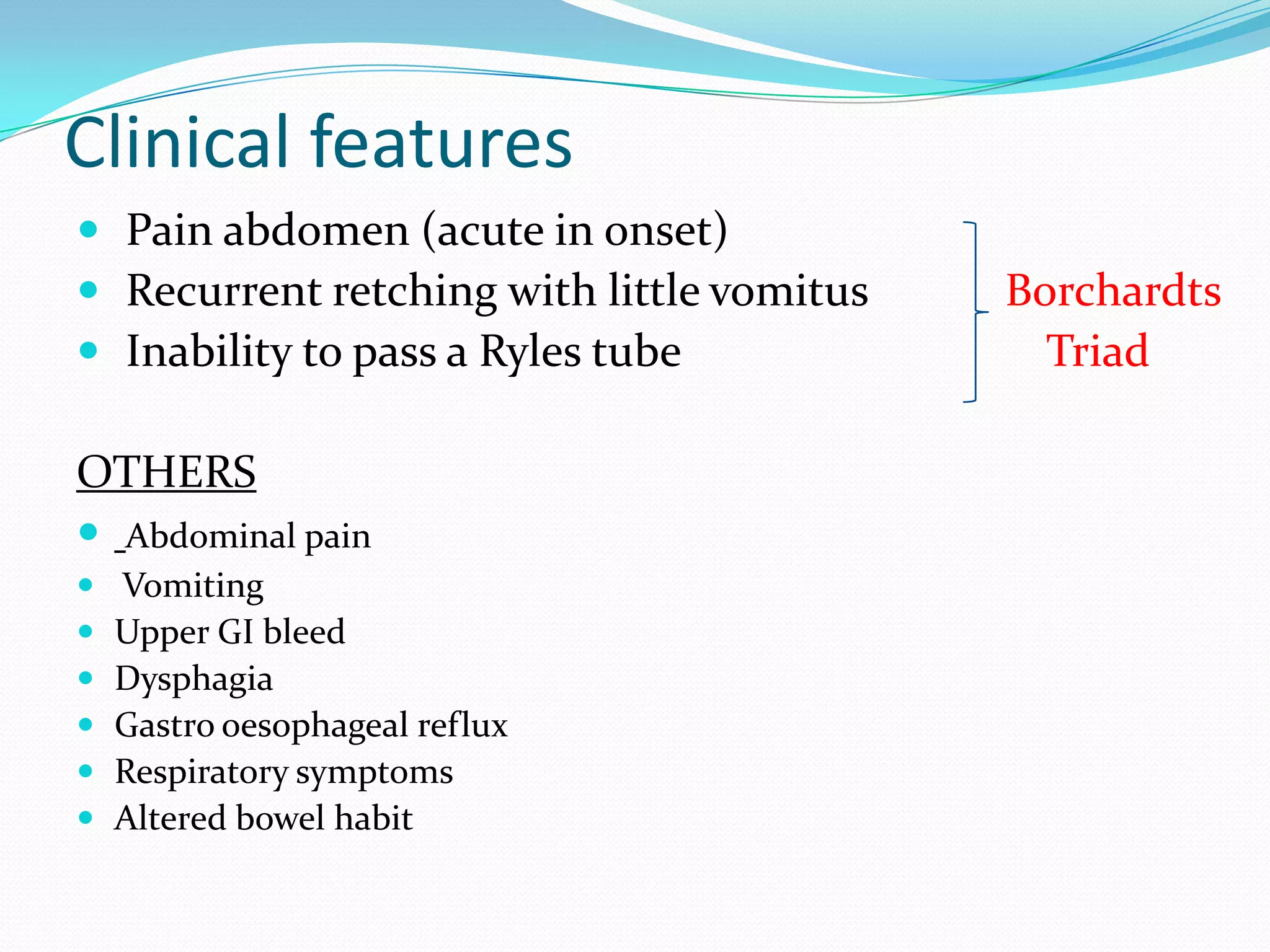
Clinical features
 Pain abdomen (acute in onset)
 Recurrent retching with little vomitus
 Inability to pass a Ryles tube

OTHERS
 Abdominal pain







Vomiting
Upper GI bleed
Dysphagia
Gastro oesophageal reflux
Respiratory symptoms
Altered bowel habit

Borchardts
Triad
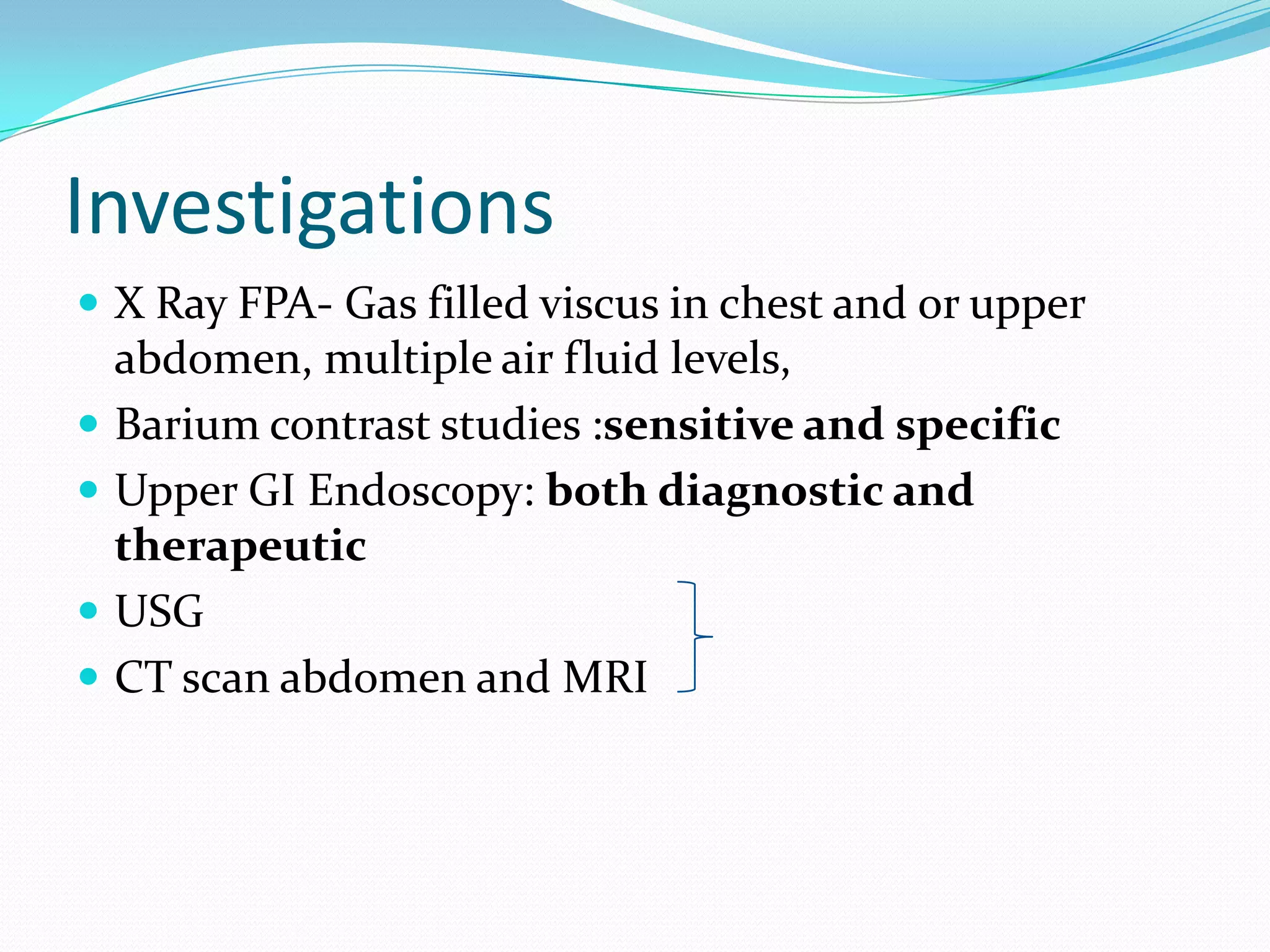
Investigations
 X Ray FPA- Gas filled viscus in chest and or upper





abdomen, multiple air fluid levels,
Barium contrast studies :sensitive and specific
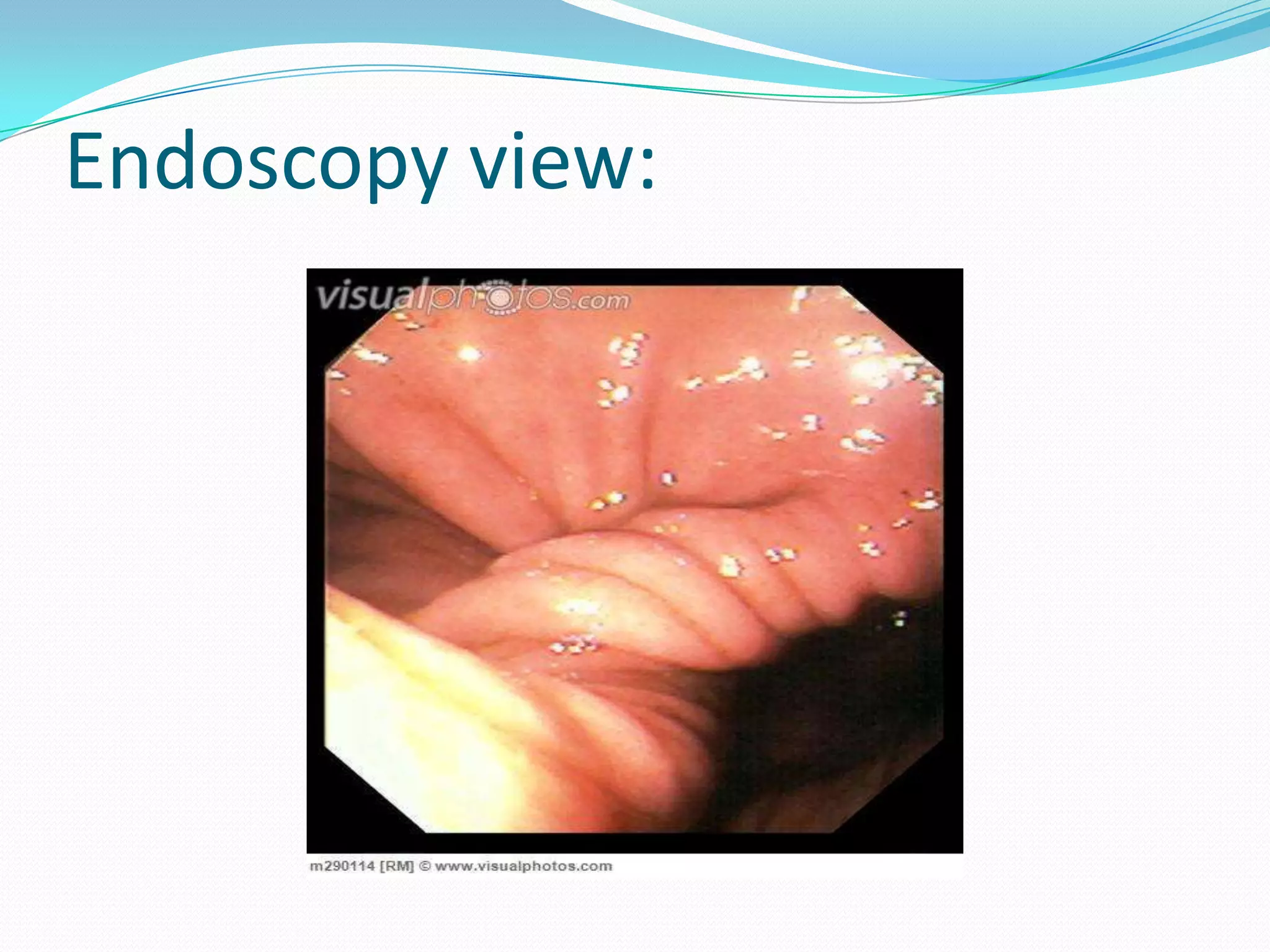
Upper GI Endoscopy: both diagnostic and
therapeutic
USG
CT scan abdomen and MRI
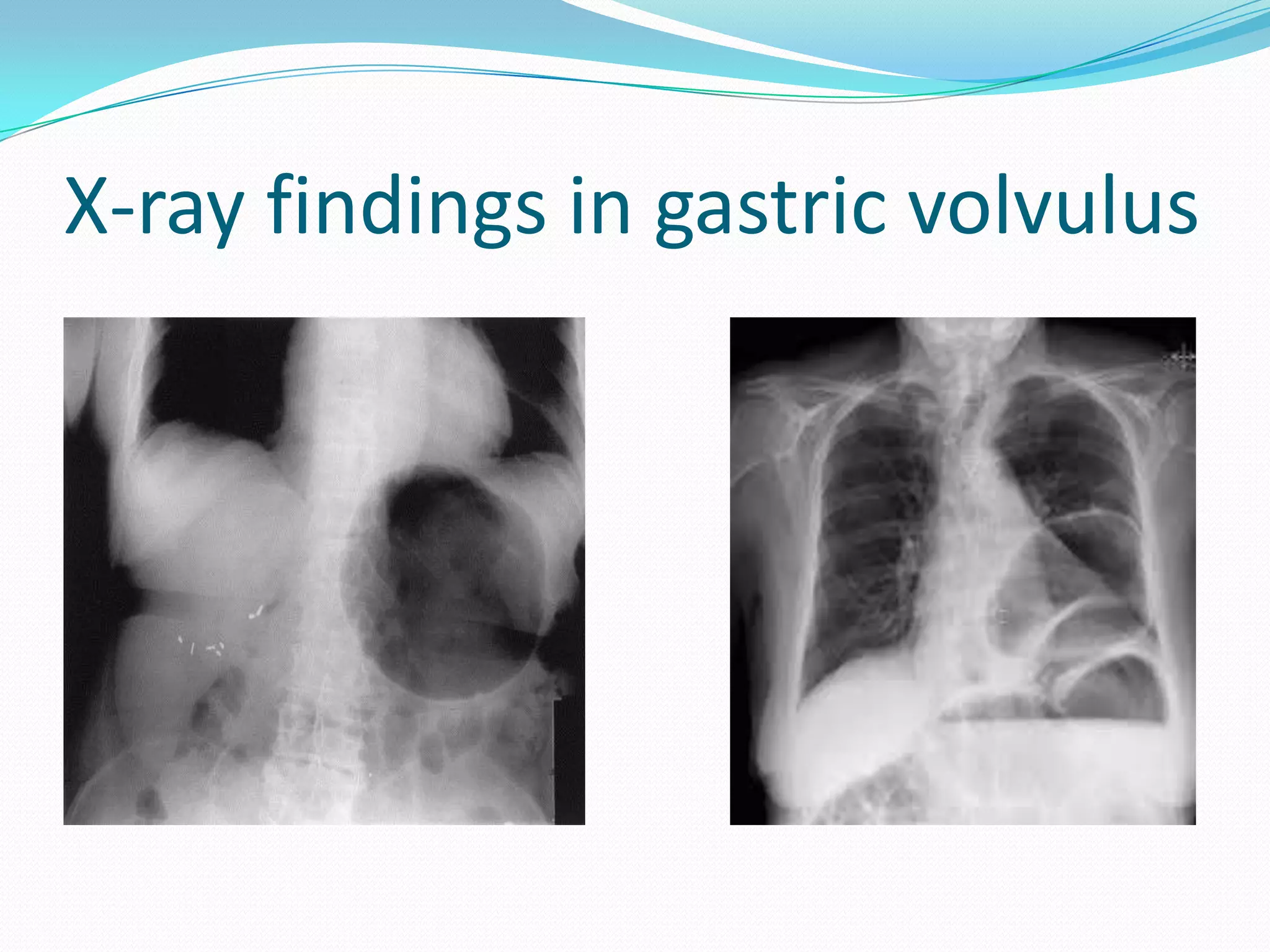
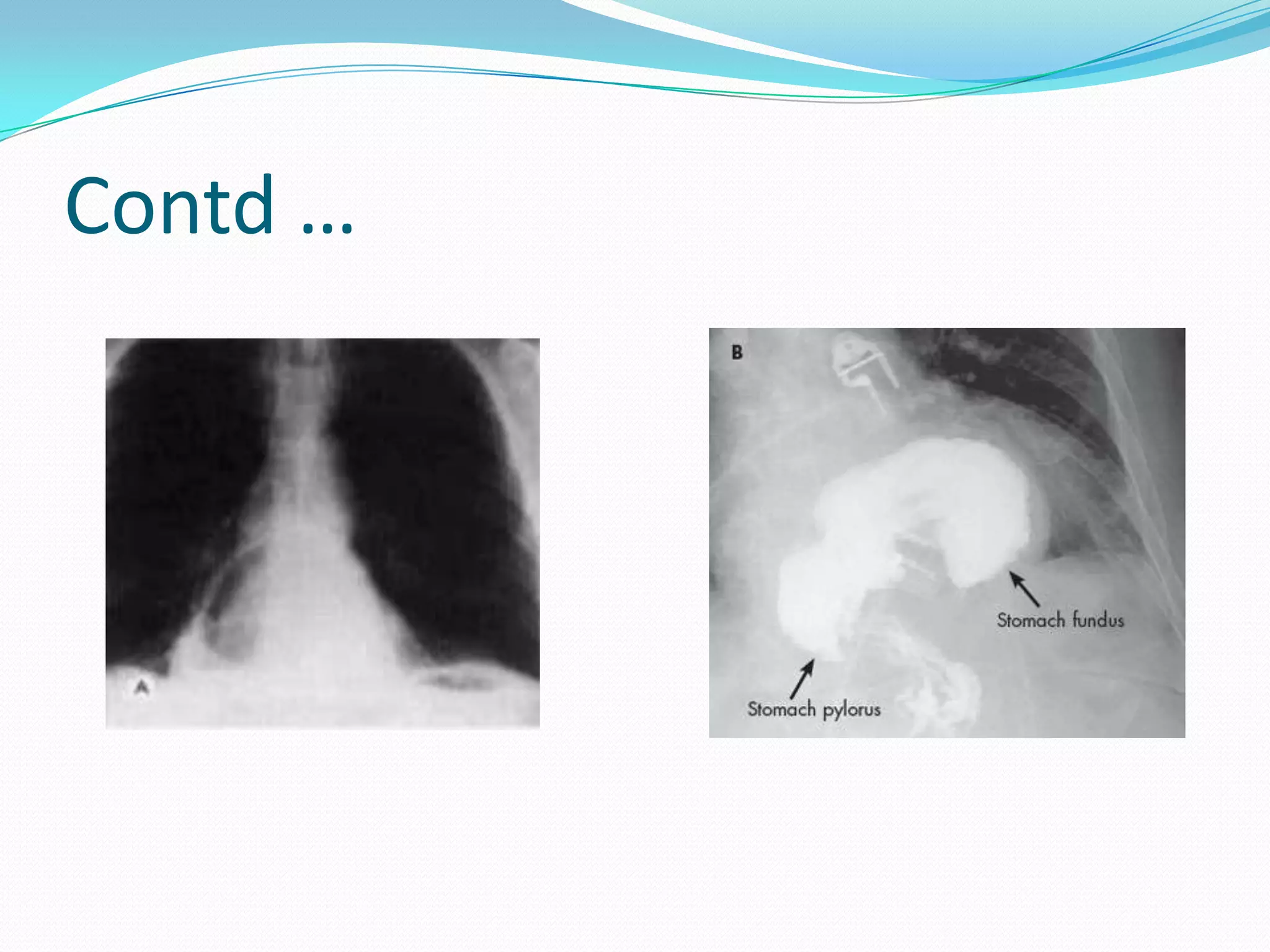
X-ray findings in gastric volvulus
Contd …
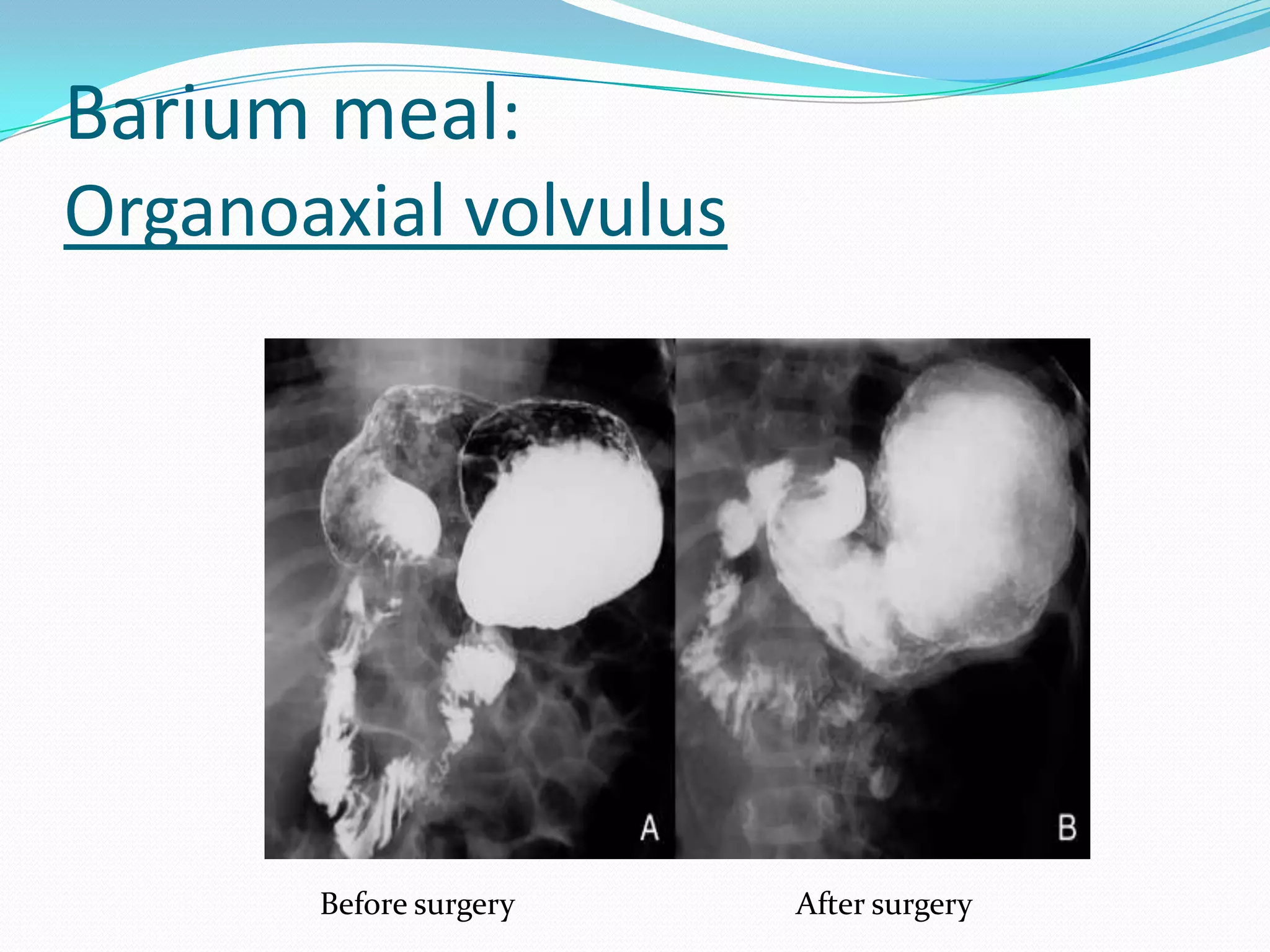
Barium meal:
Organoaxial volvulus

Before surgery

After surgery
Mesentricoaxial Gastric volvulus
Endoscopy view:
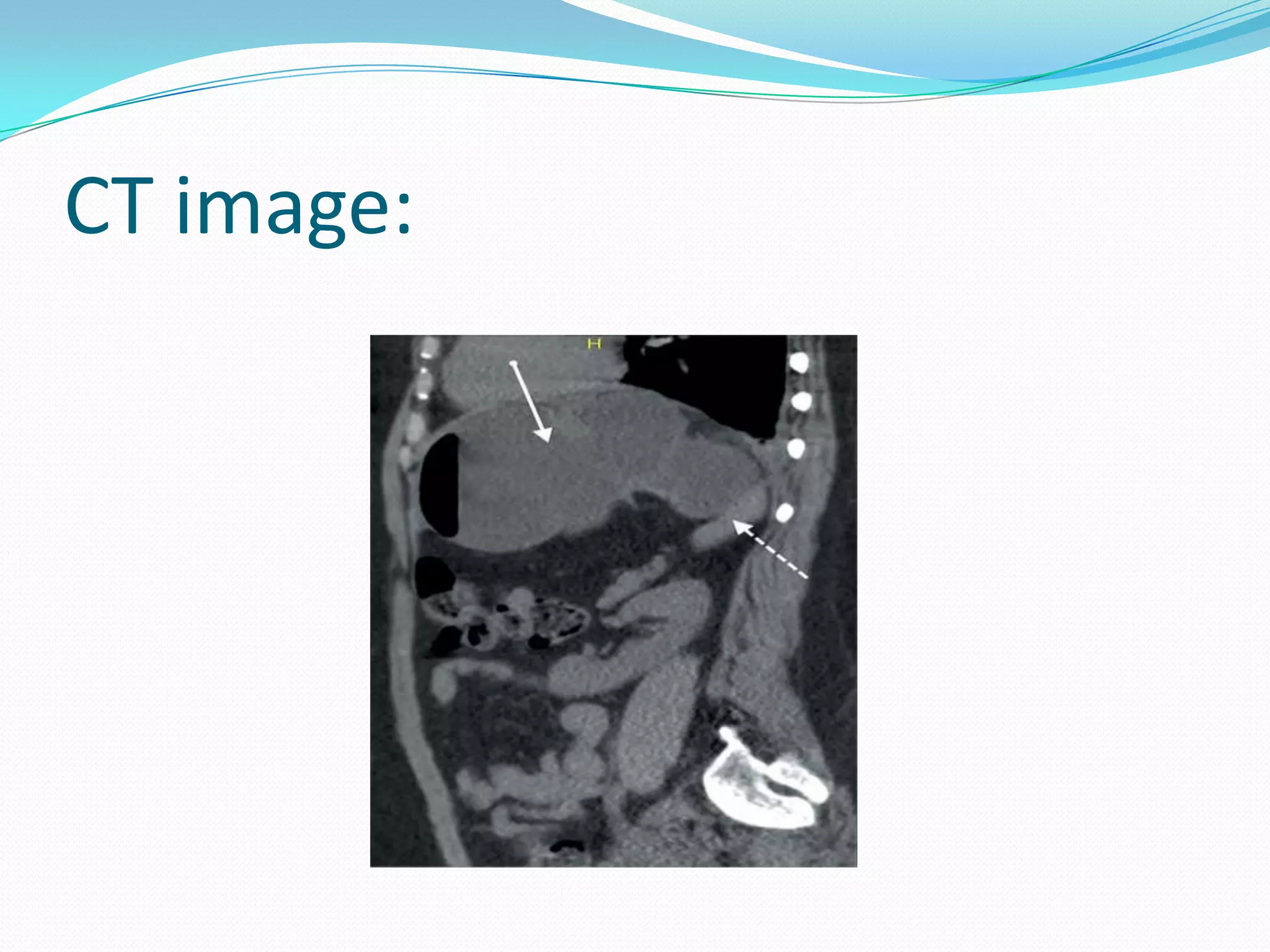
USG:
 Peanut sign in a case of chronic gastric volvulus.
 The ultrasonographic features consist of a constricted

segment of stomach, with 2 dilated segments located
above and below the constricted part, akin to a peanut.
 In several case reports, however, the ultrasonographic
evaluation of gastric volvulus showed normal findings.
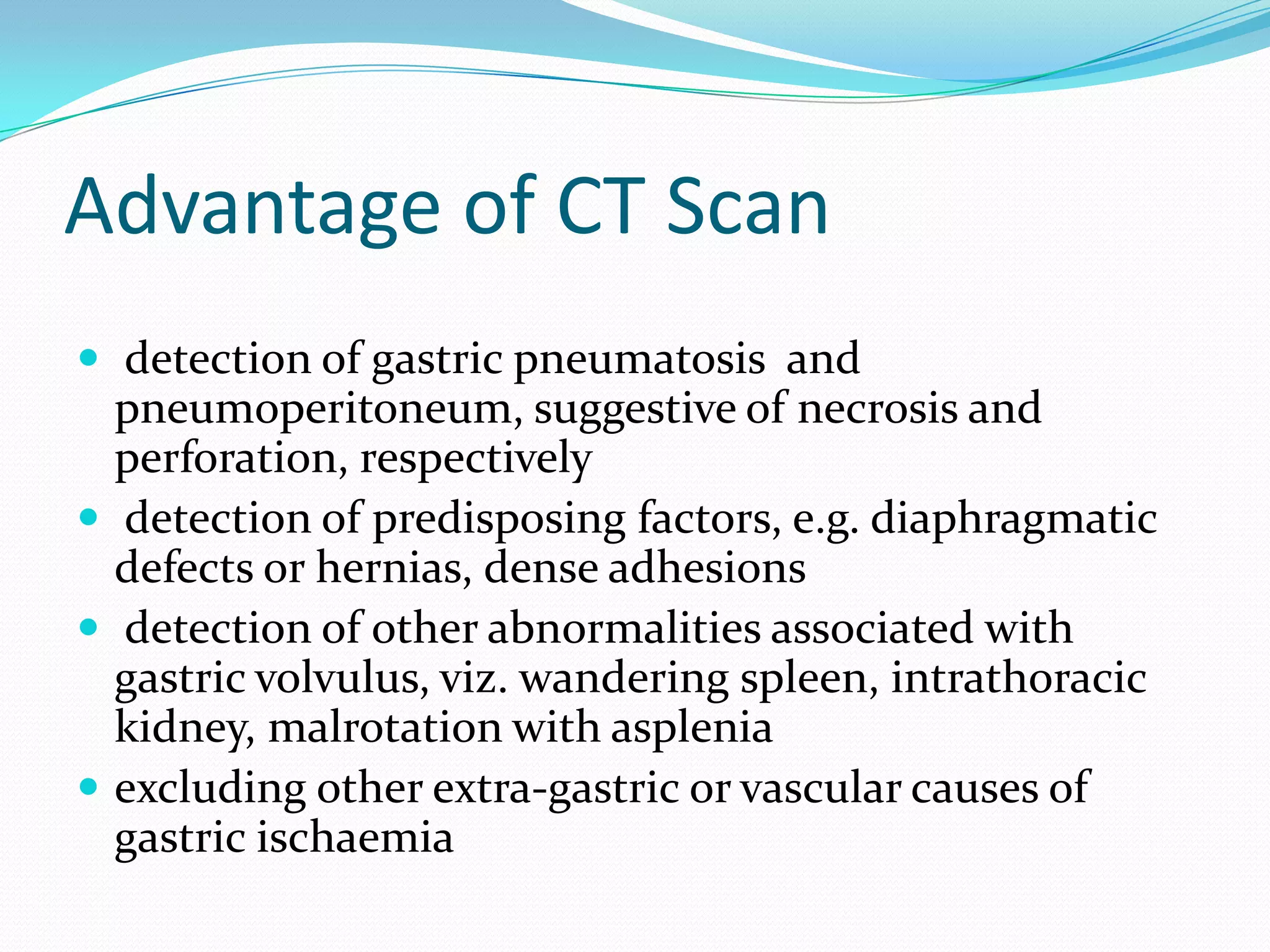
CT image:
Advantage of CT Scan
 detection of gastric pneumatosis and

pneumoperitoneum, suggestive of necrosis and
perforation, respectively
 detection of predisposing factors, e.g. diaphragmatic
defects or hernias, dense adhesions
 detection of other abnormalities associated with
gastric volvulus, viz. wandering spleen, intrathoracic
kidney, malrotation with asplenia
 excluding other extra-gastric or vascular causes of
gastric ischaemia
Limitation of Techniques
 Plain radiography may demonstrate findings that are

indistinguishable from those that are produced by
other causes of gastric atony or obstruction.
However, the modality is useful for excluding other
causes of the patient's symptoms, such as
pneumoperitoneum or pneumothorax.
 Barium study is highly sensitive and specific.
However, the diagnosis may be missed in cases of
intermittent torsion.
Treatment
 Aims:

1) Reduction of volvulus
2) Gastric fixation
3) Repair of predisposing factor
 Apporach:

Open
Endoscopic
Laproscopic
Combined (endoscopic + laproscopic)
Cont..
Open surgery:
 Diaphragmatic hernia repair
 Division of bands
 Gastropexy
 Partial gastrectomy(In case of necrosis)
 Gastrojejunostomy
 Repair of eventration of diaphragm
Surgical procedures
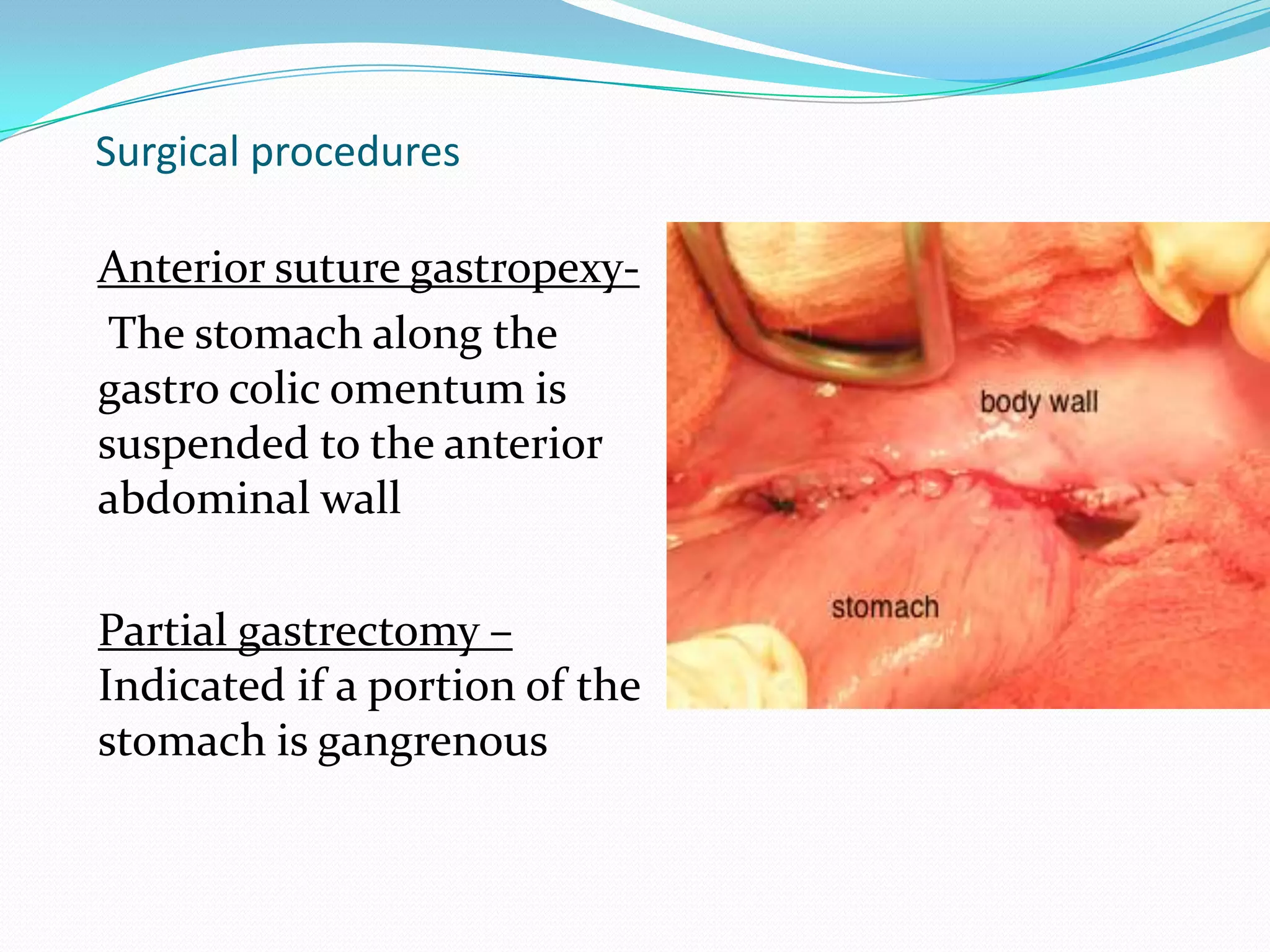
Anterior suture gastropexyThe stomach along the
gastro colic omentum is
suspended to the anterior
abdominal wall
Partial gastrectomy –
Indicated if a portion of the
stomach is gangrenous
Cont..
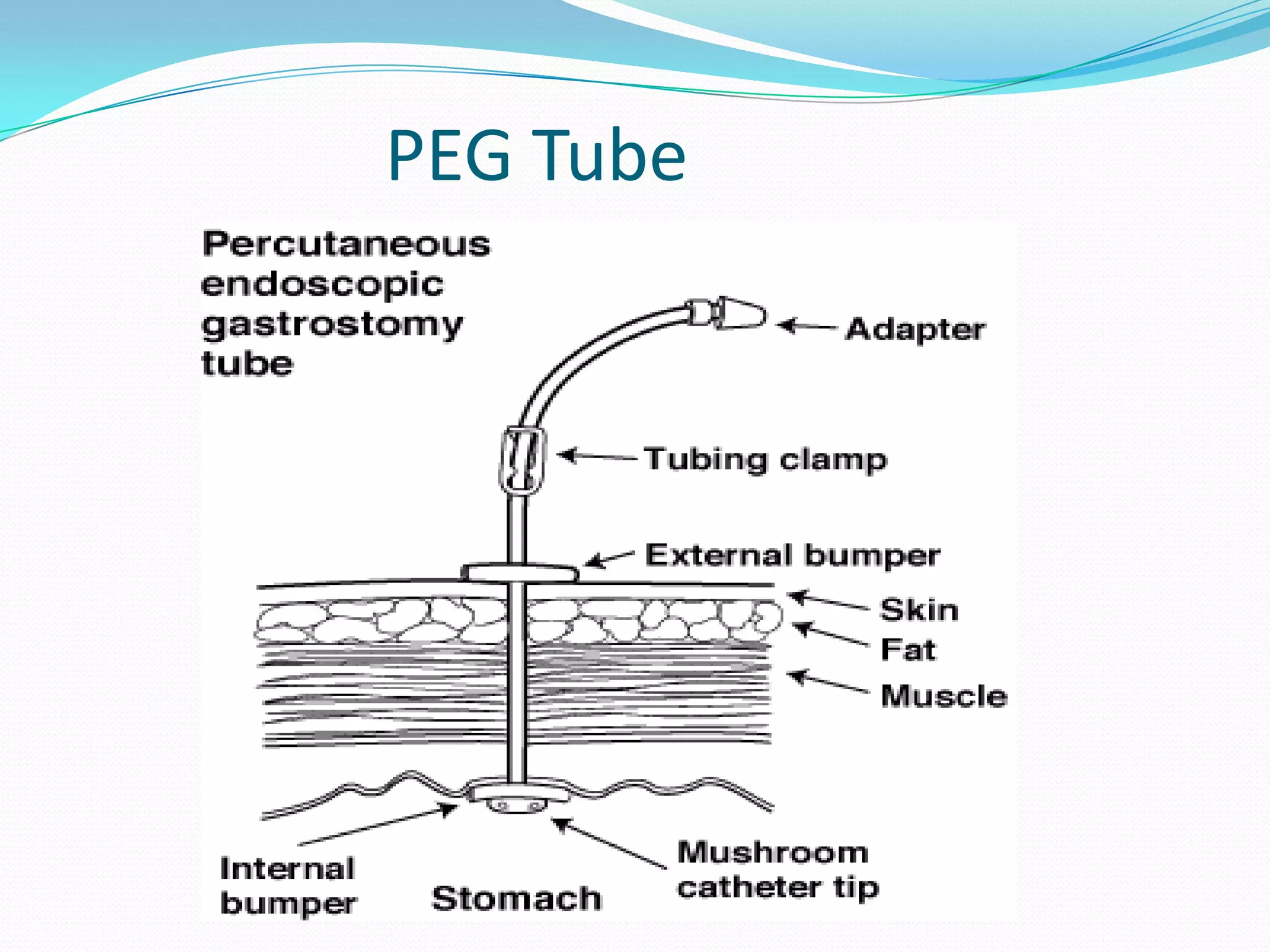
Endoscopic :
Reduction
 Alpha loop maneuver
 J type maneuver
With or without gastrostomy(for fixation of stomach)
(PEG)
PEG Tube
Cont..
Laproscopic
 Reduction of volvulus
 Anchoring fundus of stomach to diaphragm and

greater curvature of stomach to anterior abdominal
wall
 Repair of diaphragmatic defects
 fundoplication
Cont..
Combined approach
 Described by Arben Beqiri in 1997
 Less time consuming
 Endoscopic T-fasteners are used instead of PEG for

anchoring stomach
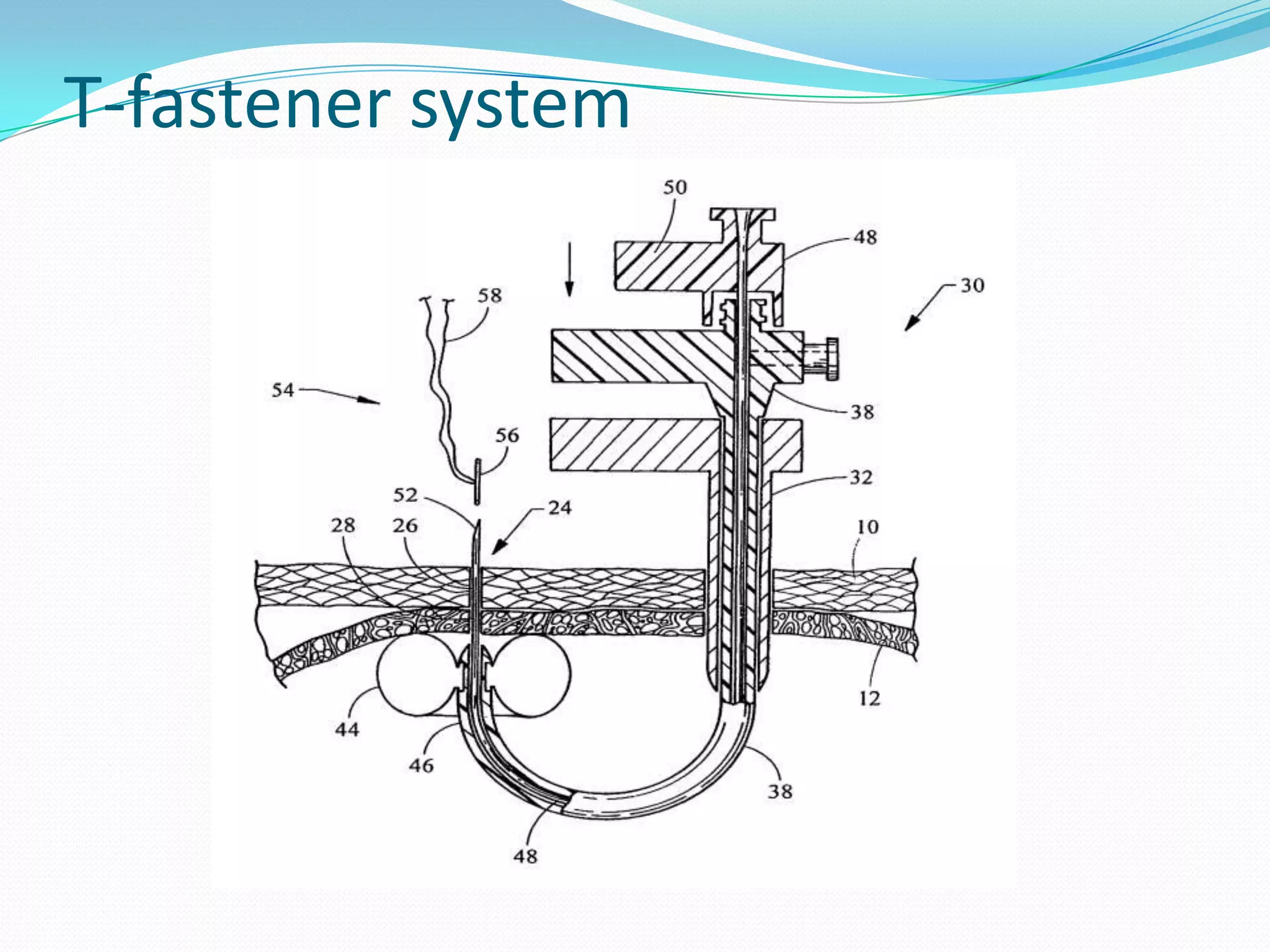
T-fastener system
Method for providing apposition of two
bodily walls
a) forming a puncture site through the two walls;
b) inserting an access cannula into the puncture site;
c) passing a guide tube through the access cannula, the guide tube
retroflexing after passing beyond a distal end of the access
cannula;
d) positioning a distal end of the guide tube proximate one of the
bodily walls;
e) passing a flexible puncturing device through the guide tube and
puncturing the two bodily walls at a second location;
f) connecting a fastener to the puncturing device;
g) retracting the puncturing device to draw the fastener through
the two bodily walls at the second location; and
h) securing the fastener to maintain apposition of the two walls at
the second location.
Follow up





Clinical:
Reflux symptoms
Recurrence
Removal of PEG Tube
Imaging:
Contrast study
Complications of volvulus
 Strangulation
 Necrosis
 Perforation of stomach
 Gastrointestinal haemorrhage

 Cardiopulmonary failure
Complications related to PEG Tube
 Wound infection
 Peritonitis
 Peristomal leakage
 Dislodgement

 Bowel perforation
 Gastrocolic fistula
Association
 Wandering spleen
 Congenital diaphragmatic hernia
 Diaphragmatic eventration
Chronic gastric volvulus
 Patient presents with recurrent episodes of vague

abdominal pain and discomfort
 Bloating
 Surgery is only indicated if the episodes of pain are
severe and disabling
 T/t of choice- conservative
 Operation of choice-anterior gastropexy
Gastric volvulus and other types of volvulus

Gastric volvulus and other types of volvulus

  • 1.
    Dr. Sudarshan Under Guidanceof Dr. B. L. Yadav Assistant Professor, Upgraded Department of Surgery
  • 2.
    History Name: Bhori singh Age& sex: 45 yrs ,male Resident :Baroli ,Bharatpur DOA:05/01/2013 Clinical presentation Pain abdomen: last 3 days Abdominal distention: last 3 days Not passing flatus motion: last 2 days No h/o fever No h/o vomiting
  • 3.
    Cont.. Past history:  Noh/o similar complaint  No h/o previous surgery  No h/o DM, TB, COPD, Hypertension , Bronchial Asthma Personal history  Smoker  Tobacco chewer  Non alcoholic  Normal bowel bladder habits
  • 4.
  • 5.
    P/A Inspection:  Abdomen distendedwith fullness present in upper abdomen  No visible pulsation , peristalsis Palpation:  Abdomen is tense, tender  Guarding present  No Rigidity Percussion:  Tympanic note present  Normal liver dullness and span  No shifting dullness Auscultation:  Bowel sounds absent
  • 6.
    Investigations          HB- 11.6 gm/dl TLC-1400 /mm3 PLT- 1.35 lakh/ml Serum urea/creatinine- 87/2.0 mg/dl S.Total bilirubin-1.2 mg/dl Direct- 0.5 mg/dl Indirect- 0.7 mg/dl SGOT/SGPT- 70/18 Serum amylase-175.0 u/lt Serum electrolytes- wnl X-Ray FPA- Multiple air fluid level with large single stomach gas shadow
  • 7.
    Provisional diagnosis:  Acuteintestinal obstruction  Perforation peritonitis Plan:  Exploratory Laparotomy
  • 8.
    Procedure performed  Exploratorylaparotomy with Gastropexy
  • 9.
  • 10.
  • 11.
  • 12.
  • 13.
    Contd.. Stomach Fixed to Diaphragm& AnteroLateral Abdominal Wall With Silk
  • 14.
    Post operative followup  Vitals monitoring  Input /output monitoring  Chest physiotherapy  Skin stitches removal-7th post op. day  Discharge-8th post op. day
  • 15.
    Discussion  Definition Gastric volvulusor volvulus of stomach a twisting of all or part of the Stomach by more than 180 degrees with obstruction of the flow of material through the stomach, variable loss of blood supply and possible tissue death.
  • 16.
    Cont..  Very uncommonclinical entity  First described by Berti in 1866  Seen in both children and elderly people  Rare below fifth decades of life
  • 17.
    Classification of gastricvolvulus On the basis of: 1)OnsetAcute Chronic 2)Axis of rotation Organoaxial Mesentroaxial Combined
  • 18.
    Gastric volvulus 1. Organoaxial(alonglongitudinal axis-MC) a)Acute presentation b)associated with diaphragmatic defects c)more common in adults d)vascular compromise more common 2. Mesentroaxial (along vertical axis) a) recurrent episodes of pain abdomen b) Diaphragmatic defects are not seen c) more common in children 3. Combined
  • 19.
  • 20.
    Aetiology  Type 1or Idiopathic gastric volvulus comprises two thirds of cases and is presumably due to abnormal laxity of the gastrosplenic*, gastrocolic*, gastrophrenic and gastrohepatic* ligaments.
  • 21.
    Cont..  Type 2or secondary Type 2 gastric volvulus is found in one third of patients and is usually associated with congenital or acquired abnormalities that result in abnormal mobility of the stomach  Diaphragmatic defect Eventration Paraoesophagial hiatal defect Trauma Paralysis  Congenital bands and adhesions  Intestinal malrotation  Pyloric stenosis and gastric distension  Colon distention
  • 22.
  • 23.
    Clinical features  Painabdomen (acute in onset)  Recurrent retching with little vomitus  Inability to pass a Ryles tube OTHERS  Abdominal pain       Vomiting Upper GI bleed Dysphagia Gastro oesophageal reflux Respiratory symptoms Altered bowel habit Borchardts Triad
  • 24.
    Investigations  X RayFPA- Gas filled viscus in chest and or upper     abdomen, multiple air fluid levels, Barium contrast studies :sensitive and specific Upper GI Endoscopy: both diagnostic and therapeutic USG CT scan abdomen and MRI
  • 25.
    X-ray findings ingastric volvulus
  • 26.
  • 27.
  • 28.
  • 29.
  • 30.
    USG:  Peanut signin a case of chronic gastric volvulus.  The ultrasonographic features consist of a constricted segment of stomach, with 2 dilated segments located above and below the constricted part, akin to a peanut.  In several case reports, however, the ultrasonographic evaluation of gastric volvulus showed normal findings.
  • 31.
  • 32.
    Advantage of CTScan  detection of gastric pneumatosis and pneumoperitoneum, suggestive of necrosis and perforation, respectively  detection of predisposing factors, e.g. diaphragmatic defects or hernias, dense adhesions  detection of other abnormalities associated with gastric volvulus, viz. wandering spleen, intrathoracic kidney, malrotation with asplenia  excluding other extra-gastric or vascular causes of gastric ischaemia
  • 33.
    Limitation of Techniques Plain radiography may demonstrate findings that are indistinguishable from those that are produced by other causes of gastric atony or obstruction. However, the modality is useful for excluding other causes of the patient's symptoms, such as pneumoperitoneum or pneumothorax.  Barium study is highly sensitive and specific. However, the diagnosis may be missed in cases of intermittent torsion.
  • 34.
    Treatment  Aims: 1) Reductionof volvulus 2) Gastric fixation 3) Repair of predisposing factor  Apporach: Open Endoscopic Laproscopic Combined (endoscopic + laproscopic)
  • 35.
    Cont.. Open surgery:  Diaphragmatichernia repair  Division of bands  Gastropexy  Partial gastrectomy(In case of necrosis)  Gastrojejunostomy  Repair of eventration of diaphragm
  • 36.
    Surgical procedures Anterior suturegastropexyThe stomach along the gastro colic omentum is suspended to the anterior abdominal wall Partial gastrectomy – Indicated if a portion of the stomach is gangrenous
  • 37.
    Cont.. Endoscopic : Reduction  Alphaloop maneuver  J type maneuver With or without gastrostomy(for fixation of stomach) (PEG)
  • 38.
  • 39.
    Cont.. Laproscopic  Reduction ofvolvulus  Anchoring fundus of stomach to diaphragm and greater curvature of stomach to anterior abdominal wall  Repair of diaphragmatic defects  fundoplication
  • 40.
    Cont.. Combined approach  Describedby Arben Beqiri in 1997  Less time consuming  Endoscopic T-fasteners are used instead of PEG for anchoring stomach
  • 41.
  • 42.
    Method for providingapposition of two bodily walls a) forming a puncture site through the two walls; b) inserting an access cannula into the puncture site; c) passing a guide tube through the access cannula, the guide tube retroflexing after passing beyond a distal end of the access cannula; d) positioning a distal end of the guide tube proximate one of the bodily walls; e) passing a flexible puncturing device through the guide tube and puncturing the two bodily walls at a second location; f) connecting a fastener to the puncturing device; g) retracting the puncturing device to draw the fastener through the two bodily walls at the second location; and h) securing the fastener to maintain apposition of the two walls at the second location.
  • 43.
  • 44.
    Complications of volvulus Strangulation  Necrosis  Perforation of stomach  Gastrointestinal haemorrhage  Cardiopulmonary failure
  • 45.
    Complications related toPEG Tube  Wound infection  Peritonitis  Peristomal leakage  Dislodgement  Bowel perforation  Gastrocolic fistula
  • 46.
    Association  Wandering spleen Congenital diaphragmatic hernia  Diaphragmatic eventration
  • 47.
    Chronic gastric volvulus Patient presents with recurrent episodes of vague abdominal pain and discomfort  Bloating  Surgery is only indicated if the episodes of pain are severe and disabling  T/t of choice- conservative  Operation of choice-anterior gastropexy