Traumatic Liver Injuries
             By
      Dr. Monsif Iqbal
       Surgical Unit II
CASE PRESENTATION
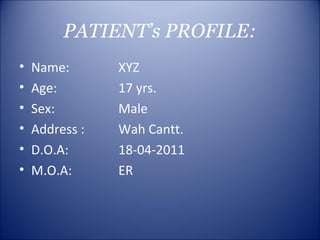
PATIENT’s PROFILE:
•   Name:       XYZ
•   Age:        17 yrs.
•   Sex:        Male
•   Address :   Wah Cantt.
•   D.O.A:      18-04-2011
•   M.O.A:      ER
PRESENTING COMPLAINTS
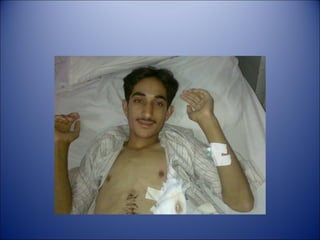
• H/O RTA, Patient while on motor bike struck
  against the concrete block of an electric pole –
  2 hrs
• Sustaining injury to the lower chest and
  abdomen
• Complain of severe chest and abdominal pain
• 2 episodes of Vomiting
• Drowsiness
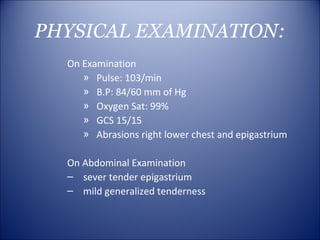
PHYSICAL EXAMINATION:
  On Examination
     » Pulse: 103/min
     » B.P: 84/60 mm of Hg
     » Oxygen Sat: 99%
     » GCS 15/15
     » Abrasions right lower chest and epigastrium

  On Abdominal Examination
  – sever tender epigastrium
  – mild generalized tenderness
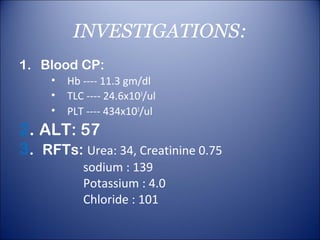
INVESTIGATIONS:
1. Blood CP:
     •   Hb ---- 11.3 gm/dl
     •   TLC ---- 24.6x10³/ul
     •   PLT ---- 434x103/ul
2. ALT: 57
3. RFTs: Urea: 34, Creatinine 0.75
            sodium : 139
            Potassium : 4.0
            Chloride : 101
Management
•   2 large bore IV lines
•   IV fluids rushed
•   IV antibiotics and Analgesics started
•   Blood sample sent for grouping and cross matching
•   Patient shifted to ITC, there B.P. 70/45mmHg, Pulse 125/min
•   USG FAST carried out
     – Gross intraperitoneal fluid collection
     – Left lobe of the liver ---- ill defined
     – Suspicion of liver injury
Management (cont.)
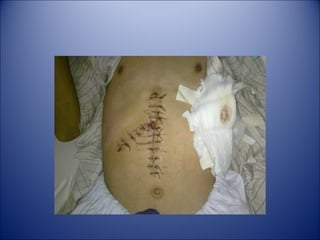
• Patient shifted to OT and urgent exploratory
  lapratomy carried out, the findings were
  – Laceration of the left lobe of the liver
  – Massive blood in the peritoneum
  – A 3 cm perforation in the left hemidiaphram
• Left lobectomy, bleeding vessels underun,
  perihepatic packing, perfortion in the diaphram
  sealed, drain put in RUQ, abdomen partially
  closed, and left sided chest intubation done
• 3 units of blood transfused peroperatively
Management (cont.)
• After 48 hours, the pateint was shifted again to
  OT, abdomen opened, perihepatic packs
  removed, no active bleeding, hemotama around
  the raw area,,,, the abdomen was closed in the
  layers and the drain remained there…
• The patient weaned off the ventilator support
  after 48 hours,the recovery uneventful, drain
  output NIL and removed at 7th day
  posoperatively..
Traumatic Liver Injuries
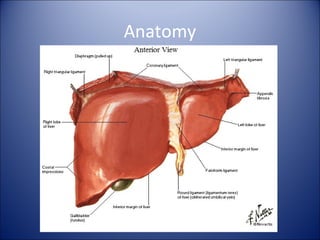
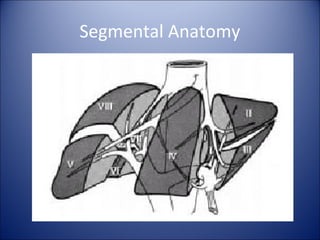
Anatomy
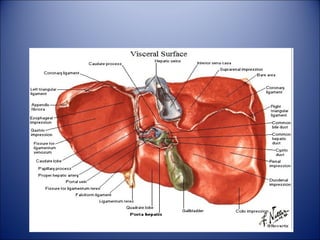
Segmental Anatomy
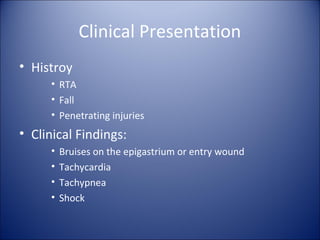
Clinical Presentation
• Histroy
     • RTA
     • Fall
     • Penetrating injuries
• Clinical Findings:
     •   Bruises on the epigastrium or entry wound
     •   Tachycardia
     •   Tachypnea
     •   Shock
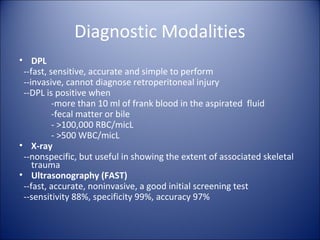
Diagnostic Modalities
• DPL
 --fast, sensitive, accurate and simple to perform
 --invasive, cannot diagnose retroperitoneal injury
 --DPL is positive when
          -more than 10 ml of frank blood in the aspirated fluid
          -fecal matter or bile
          - >100,000 RBC/micL
          - >500 WBC/micL
• X-ray
 --nonspecific, but useful in showing the extent of associated skeletal
    trauma
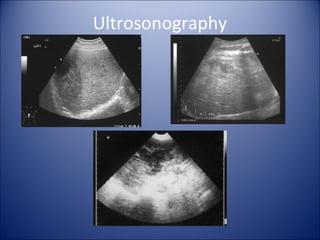
• Ultrasonography (FAST)
 --fast, accurate, noninvasive, a good initial screening test
 --sensitivity 88%, specificity 99%, accuracy 97%
Ultrosonography
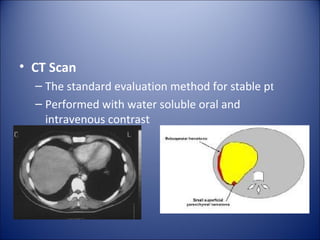
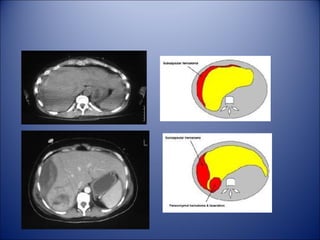
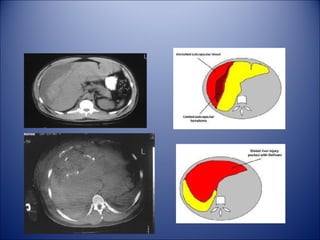
• CT Scan
  – The standard evaluation method for stable pt
  – Performed with water soluble oral and
    intravenous contrast
Management Algorithm
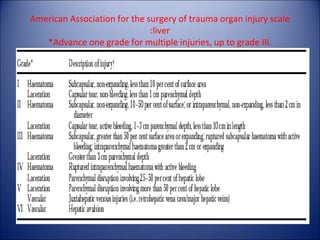
American Association for the surgery of trauma organ injury scale
                              :liver
   *Advance one grade for multiple injuries, up to grade III.
Management according to the Grade
• Grade I,II
 ---minor injuries, represent 80-90% of all
   injuries, require minimal or no operative
   treatment
• Grade III-V
  -- severe,require surgical intervention
• Grade VI
  --incompatible with survival
Non Operative Management
• Criteria
 --hemodynamically stable
 --absence of active hemorrhage
 --hemoperitoneum of less than 500ml
 --absence of peritoneal sign
 --absence of other peritoneal injuries that
  would otherwise require an operation
Non Operative Management
• Criteria (continued)
 --good quality CT scans
 --experienced radiologist
 --intensive care setting
• Currently believe that ultimate decisive factor
  should be the hemodynamic stability at
  presentation or after initial resuscitation,
  irrespective of the grade of injury on CT or the
  amount of hemoperitoneum
Non Operative Management
• Complications
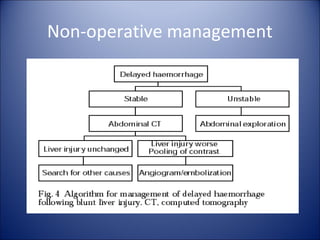
   --Delayed hemorrhage
 ‧ most common, usual indication for a delayed
      operation
   ‧under strict guidelines, the incidence ranges
      from 0-5%, and blood transfusions are
      required in fewer than 20%
   ‧ common errors:
                  (1)assuming that the hemorrhage is
                     not related to the liver
                  (2)multiple(more than
                    four)blood transfusions in the hope that it will stop
                  (3)misreading CT and underestimating
                     hemoperitoneum and active bleeding
Non-operative management
• Complications
  --biliary fistula and liver abscess
   ‧ranges from 0.5-20
   ‧nasobilaiary or percutaneous tranhepatic drainage or
   endoprothesis insertion
    . If fails, then needs surgical resection of affected segment
  --Hemobilia
   ‧1%, iatrogenic causes most common
   ‧injury causes communication between the
       biliary tract and blood vessels
   ‧abdominal trauma, jaundice, RUQ colicky pain and blood
       in vomitus or stool point to this diagnosis
   ‧managed by percutaneous selective hepatic a.
       embolization or surgical intervention
• Complications
 --bilihemia
  ‧rare complication of severe decelerationon injury, in which the
   hepatic venules and the intrahepatic bile ducts rupture
  ‧excessive bilirubin level
  ‧endoscopic sphincterotomy and biliary
      endostenting
 --Extrahepatic bile duct stricture
     ‧ Endobiliary ballon dilatation or stenting
    ‧ usually require surgical correction using Roux-en-Y
   hepatodochojejunostomy
• Mortality rate
 --7-13% with most resulting from associated injuries
 --0-0.4% resulting from liver itself
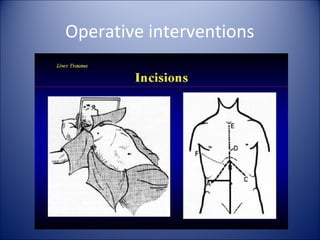
Operative interventions
• Initial control of bleeding achieved with
  temporary tamponade using packs, portal
  triad occlusion(Pringle manoeuvre), bimanual
  compression of the liver or even manual
  compression abdominal aorta above celiac
  trunk
• If hemorrhage is unaffected by portal triad
  occlusion(Pringle manoeuvre) by digital
  compression or vascular clamp, major vena
  cava injury or atypical vascular anatomy
  should be expected
Operative interventions (cont.)
Perihepatic packing
 --Indication:coagulopathy, irreversible shock from
   blood loss (10u), hypothermia(32C), acidosis(PH7.2),
   bilobar injury,large nonexpanding hematoma,
   capsular avulsion, vena cava or hepatic vein injuries
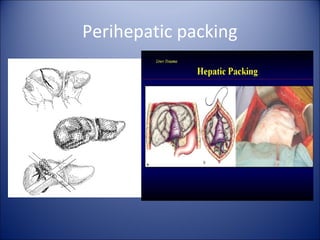
Perihepatic packing
Operative interventions (cont.)
• Hepatotomy with direct suture ligation
 --using the finger fracture technique,
  electrocautery or an ultrasonic dissector to
  expose damaged vessels and hepatic duct
  which ligated , clipped or repaired
 --low incidence of rebleeding, necrosis and
  sepsis
 --effectives following blunt liver trauma
  requires further evaluation
Operative interventions (cont.)
• Resection debridement
 --removal devitalized tissue
 --rapid compared with standard anatomical
  resection, which are more time consuming
  and remove more normal liver parenchyma
 --reduced risk of post-op sepsis secondary
  hemorrhage and bile leakage
Operative interventions (cont.)
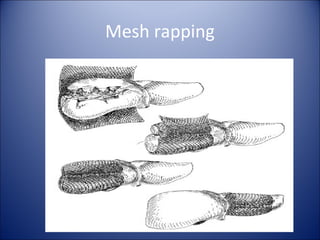
• Mesh rapping
 --new technique for grade III,IV laceration,
  tamponading large intrahepatic hematomas
 --not indicated where juxtacaval or hepatic vein
  injury is suspected
• Anatomical resection
 --reserved for deep laceration involving major
  vessels or bile ducts, extensive devascularization
  and major hepatic venous bleeding
Mesh rapping
Other Operative interventions
•  Omental packing
•  Intrahepatic tamponade with penrose drains
•  Fibrin glue
•  Retrohepatic venous injuries
  --Complete Vascular isolation of the liver
  --venovenous bypass
  --Atriocaval shunting
• Liver transplantation
Operative management
• Complications
  --Hemorrhage,sepsis
  --Biliary fistula
  --Respiratory problems
  --Liver failure
  --Hyperpyrexia
  --Acalculous cholecystitis
  --Pancreatic, duodenal or small bowel fistula
THANKS

Liver trauma

  • 1.
    Traumatic Liver Injuries By Dr. Monsif Iqbal Surgical Unit II
  • 2.
  • 3.
    PATIENT’s PROFILE: • Name: XYZ • Age: 17 yrs. • Sex: Male • Address : Wah Cantt. • D.O.A: 18-04-2011 • M.O.A: ER
  • 4.
    PRESENTING COMPLAINTS • H/ORTA, Patient while on motor bike struck against the concrete block of an electric pole – 2 hrs • Sustaining injury to the lower chest and abdomen • Complain of severe chest and abdominal pain • 2 episodes of Vomiting • Drowsiness
  • 5.
    PHYSICAL EXAMINATION: On Examination » Pulse: 103/min » B.P: 84/60 mm of Hg » Oxygen Sat: 99% » GCS 15/15 » Abrasions right lower chest and epigastrium On Abdominal Examination – sever tender epigastrium – mild generalized tenderness
  • 6.
    INVESTIGATIONS: 1. Blood CP: • Hb ---- 11.3 gm/dl • TLC ---- 24.6x10³/ul • PLT ---- 434x103/ul 2. ALT: 57 3. RFTs: Urea: 34, Creatinine 0.75 sodium : 139 Potassium : 4.0 Chloride : 101
  • 7.
    Management • 2 large bore IV lines • IV fluids rushed • IV antibiotics and Analgesics started • Blood sample sent for grouping and cross matching • Patient shifted to ITC, there B.P. 70/45mmHg, Pulse 125/min • USG FAST carried out – Gross intraperitoneal fluid collection – Left lobe of the liver ---- ill defined – Suspicion of liver injury
  • 8.
    Management (cont.) • Patientshifted to OT and urgent exploratory lapratomy carried out, the findings were – Laceration of the left lobe of the liver – Massive blood in the peritoneum – A 3 cm perforation in the left hemidiaphram • Left lobectomy, bleeding vessels underun, perihepatic packing, perfortion in the diaphram sealed, drain put in RUQ, abdomen partially closed, and left sided chest intubation done • 3 units of blood transfused peroperatively
  • 9.
    Management (cont.) • After48 hours, the pateint was shifted again to OT, abdomen opened, perihepatic packs removed, no active bleeding, hemotama around the raw area,,,, the abdomen was closed in the layers and the drain remained there… • The patient weaned off the ventilator support after 48 hours,the recovery uneventful, drain output NIL and removed at 7th day posoperatively..
  • 12.
  • 13.
  • 15.
  • 16.
    Clinical Presentation • Histroy • RTA • Fall • Penetrating injuries • Clinical Findings: • Bruises on the epigastrium or entry wound • Tachycardia • Tachypnea • Shock
  • 17.
    Diagnostic Modalities • DPL --fast, sensitive, accurate and simple to perform --invasive, cannot diagnose retroperitoneal injury --DPL is positive when -more than 10 ml of frank blood in the aspirated fluid -fecal matter or bile - >100,000 RBC/micL - >500 WBC/micL • X-ray --nonspecific, but useful in showing the extent of associated skeletal trauma • Ultrasonography (FAST) --fast, accurate, noninvasive, a good initial screening test --sensitivity 88%, specificity 99%, accuracy 97%
  • 18.
  • 19.
    • CT Scan – The standard evaluation method for stable pt – Performed with water soluble oral and intravenous contrast
  • 22.
  • 23.
    American Association forthe surgery of trauma organ injury scale :liver *Advance one grade for multiple injuries, up to grade III.
  • 24.
    Management according tothe Grade • Grade I,II ---minor injuries, represent 80-90% of all injuries, require minimal or no operative treatment • Grade III-V -- severe,require surgical intervention • Grade VI --incompatible with survival
  • 25.
    Non Operative Management •Criteria --hemodynamically stable --absence of active hemorrhage --hemoperitoneum of less than 500ml --absence of peritoneal sign --absence of other peritoneal injuries that would otherwise require an operation
  • 26.
    Non Operative Management •Criteria (continued) --good quality CT scans --experienced radiologist --intensive care setting • Currently believe that ultimate decisive factor should be the hemodynamic stability at presentation or after initial resuscitation, irrespective of the grade of injury on CT or the amount of hemoperitoneum
  • 27.
    Non Operative Management •Complications --Delayed hemorrhage ‧ most common, usual indication for a delayed operation ‧under strict guidelines, the incidence ranges from 0-5%, and blood transfusions are required in fewer than 20% ‧ common errors: (1)assuming that the hemorrhage is not related to the liver (2)multiple(more than four)blood transfusions in the hope that it will stop (3)misreading CT and underestimating hemoperitoneum and active bleeding
  • 28.
  • 29.
    • Complications --biliary fistula and liver abscess ‧ranges from 0.5-20 ‧nasobilaiary or percutaneous tranhepatic drainage or endoprothesis insertion . If fails, then needs surgical resection of affected segment --Hemobilia ‧1%, iatrogenic causes most common ‧injury causes communication between the biliary tract and blood vessels ‧abdominal trauma, jaundice, RUQ colicky pain and blood in vomitus or stool point to this diagnosis ‧managed by percutaneous selective hepatic a. embolization or surgical intervention
  • 30.
    • Complications --bilihemia ‧rare complication of severe decelerationon injury, in which the hepatic venules and the intrahepatic bile ducts rupture ‧excessive bilirubin level ‧endoscopic sphincterotomy and biliary endostenting --Extrahepatic bile duct stricture ‧ Endobiliary ballon dilatation or stenting ‧ usually require surgical correction using Roux-en-Y hepatodochojejunostomy • Mortality rate --7-13% with most resulting from associated injuries --0-0.4% resulting from liver itself
  • 31.
  • 32.
    Operative interventions • Initialcontrol of bleeding achieved with temporary tamponade using packs, portal triad occlusion(Pringle manoeuvre), bimanual compression of the liver or even manual compression abdominal aorta above celiac trunk • If hemorrhage is unaffected by portal triad occlusion(Pringle manoeuvre) by digital compression or vascular clamp, major vena cava injury or atypical vascular anatomy should be expected
  • 33.
    Operative interventions (cont.) Perihepaticpacking --Indication:coagulopathy, irreversible shock from blood loss (10u), hypothermia(32C), acidosis(PH7.2), bilobar injury,large nonexpanding hematoma, capsular avulsion, vena cava or hepatic vein injuries
  • 34.
  • 35.
    Operative interventions (cont.) •Hepatotomy with direct suture ligation --using the finger fracture technique, electrocautery or an ultrasonic dissector to expose damaged vessels and hepatic duct which ligated , clipped or repaired --low incidence of rebleeding, necrosis and sepsis --effectives following blunt liver trauma requires further evaluation
  • 36.
    Operative interventions (cont.) •Resection debridement --removal devitalized tissue --rapid compared with standard anatomical resection, which are more time consuming and remove more normal liver parenchyma --reduced risk of post-op sepsis secondary hemorrhage and bile leakage
  • 37.
    Operative interventions (cont.) •Mesh rapping --new technique for grade III,IV laceration, tamponading large intrahepatic hematomas --not indicated where juxtacaval or hepatic vein injury is suspected • Anatomical resection --reserved for deep laceration involving major vessels or bile ducts, extensive devascularization and major hepatic venous bleeding
  • 38.
  • 39.
    Other Operative interventions • Omental packing • Intrahepatic tamponade with penrose drains • Fibrin glue • Retrohepatic venous injuries --Complete Vascular isolation of the liver --venovenous bypass --Atriocaval shunting • Liver transplantation
  • 40.
    Operative management • Complications --Hemorrhage,sepsis --Biliary fistula --Respiratory problems --Liver failure --Hyperpyrexia --Acalculous cholecystitis --Pancreatic, duodenal or small bowel fistula
  • 41.