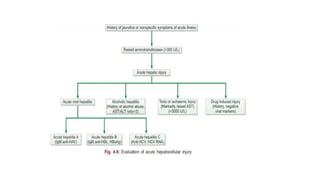
LIVER FUNCTION TEST
Presented by : Dr. MONIKA LUKKAD
Coordinated by : Dr. SEEMA MEENA
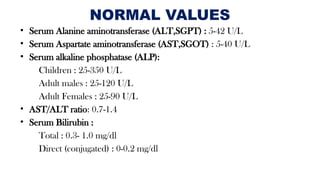
NORMAL VALUES
• Serum Alanine aminotransferase (ALT,SGPT) : 5-42 U/L
• Serum Aspartate aminotransferase (AST,SGOT) : 5-40 U/L
• Serum alkaline phosphatase (ALP):
Children : 25-350 U/L
Adult males : 25-120 U/L
Adult Females : 25-90 U/L
• AST/ALT ratio: 0.7-1.4
• Serum Bilirubin :
Total : 0.3- 1.0 mg/dl
Direct (conjugated) : 0-0.2 mg/dl
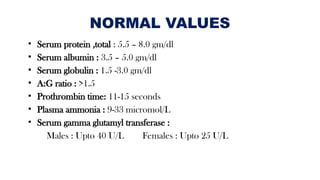
NORMAL VALUES
• Serum protein ,total : 5.5 – 8.0 gm/dl
• Serum albumin : 3.5 – 5.0 gm/dl
• Serum globulin : 1.5 -3.0 gm/dl
• A:G ratio : >1.5
• Prothrombin time: 11-15 seconds
• Plasma ammonia : 9-33 micromol/L
• Serum gamma glutamyl transferase :
Males : Upto 40 U/L Females : Upto 25 U/L
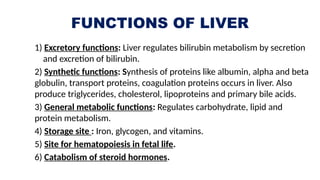
FUNCTIONS OF LIVER
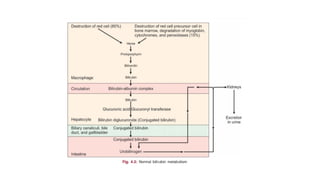
1) Excretory functions: Liver regulates bilirubin metabolism by secretion
and excretion of bilirubin.
2) Synthetic functions: Synthesis of proteins like albumin, alpha and beta
globulin, transport proteins, coagulation proteins occurs in liver. Also
produce triglycerides, cholesterol, lipoproteins and primary bile acids.
3) General metabolic functions: Regulates carbohydrate, lipid and
protein metabolism.
4) Storage site : Iron, glycogen, and vitamins.
5) Site for hematopoiesis in fetal life.
6) Catabolism of steroid hormones.
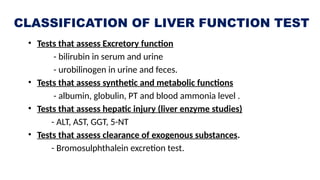
CLASSIFICATION OF LIVER FUNCTION TEST
• Tests that assess Excretory function
- bilirubin in serum and urine
- urobilinogen in urine and feces.
• Tests that assess synthetic and metabolic functions
- albumin, globulin, PT and blood ammonia level .
• Tests that assess hepatic injury (liver enzyme studies)
- ALT, AST, GGT, 5-NT
• Tests that assess clearance of exogenous substances.
- Bromosulphthalein excretion test.
1. Serum Bilirubin:
- normal value < 1mg/dl
- conjugated biliruBin </= 10% (water soluble form)
- unconjugated bilirubin >/= 90%
 Tests For estimation – Diazo method and spectrophotometry
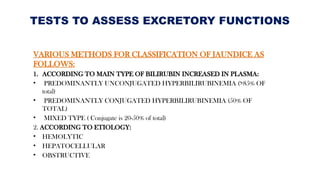
TESTS TO ASSESS EXCRETORY FUNCTIONS
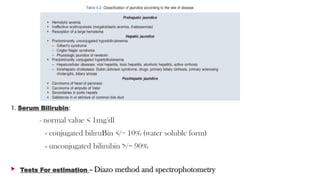
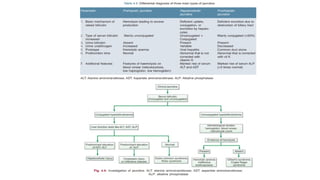
VARIOUS METHODS FOR CLASSIFICATION OF JAUNDICE AS
FOLLOWS:
1. ACCORDING TO MAIN TYPE OF BILIRUBIN INCREASED IN PLASMA:
• PREDOMINANTLY UNCONJUGATED HYPERBILIRUBINEMIA (>85% OF
total)
• PREDOMINANTLY CONJUGATED HYPERBILIRUBINEMIA (50% OF
TOTAL)
• MIXED TYPE ( Conjugate is 20-50% of total)
2. ACCORDING TO ETIOLOGY:
• HEMOLYTIC
• HEPATOCELLULAR
• OBSTRUCTIVE
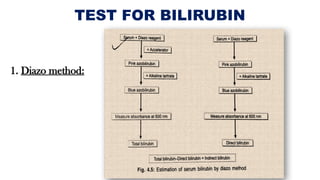
TEST FOR BILIRUBIN
1. Diazo method:
2. Direct spectroscopic estimation
- estimation of total serum bilirubin in newborns and infants.
- absorbance read at 454 nm .
- not done in adults and older children coz carotene and other
pigments interfere with absorbance.
TEST FOR DETECTION OF BILIRUBIN IN
URINE
• Tests for bilirubin includes:
1) Foam test
2) Gmelin’s test
3) Lugol iodine test
4) Fouchet’s test
5) Reagent strips or tablet impregnated with diazo
reagent.
TESTS THAT ASSESS SYNTHETIC &
METABOLIC FUNCTIONS OF LIVER
• Proteins.
Liver synthesize most of the plasma protein except gamma globulins (plasma
cells).
Total Protein : 5.5 – 8 gm/dl
Albumin comprises about 60% of total serum protein.
Total albumin 3.5 – 5 gm/dl
Tests for proteins include:
- Total proteins
- Albumin, A:G ratio (>1.5)
- serum protein electrophoresis
TOTAL SERUM PROTIENS
• TOTAL SERUM PROTEINS Include albumin, alpha1, alpha2, beta, gamma
globulins which can be estimated by two methods
1.Refractometer method:
- Refractive index varies mainly with concentration of proteins and is
affected very little by electrolytes and other molecules.
- Refractive index of the solution is measured and protein
concentration is read directly from the scale on the refractometer.
2. Biuret method :
- Copper ions react with peptide bonds of proteins and form violet
colored compound.
- measured colorimetrically
• Total serum protein level is affected by-
- albumin
- gamma globulins.
• In cirrhosis albumin is decreased and there is compensatory rise in
gamma globulins. Thus A:G ratio is reversed.
SERUM ALBUMIN
• Synthesized exclusively in liver and constitutes 60% of total plasma
proteins.
• Half life – 20days.
• Albumin is estimated by :
BROMOCRESOL GREEN METHOD
Bromocresol green dye ,when added to serum binds selectively and
tightly to albumin and becomes blue in colour. Absorbance @ 632 nm is
directly proportional to concentration of albumin.
CAUSES OF DECREASED ALBUMIN
• Decreased intake : Malnutrition
• Decreased absorption : Malabsorption syndromes
• Decreased synthesis : Liver d/s , c/c infections
• Increased catabolism : Thyrotoxicosis , fever, malignancy , infections.
• Increased loss : Nephrotic syndrome, severe burns, protein losing
enteropathies, ascites
• Increased blood volume: Pregnancy, CCF
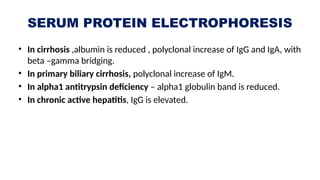
SERUM PROTEIN ELECTROPHORESIS
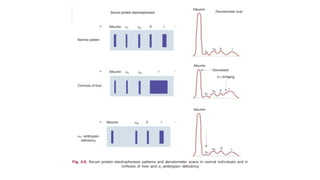
• In cirrhosis ,albumin is reduced , polyclonal increase of IgG and IgA, with
beta –gamma bridging.
• In primary biliary cirrhosis, polyclonal increase of IgM.
• In alpha1 antitrypsin deficiency – alpha1 globulin band is reduced.
• In chronic active hepatitis, IgG is elevated.
PROTHROMBIN TIME
• Vit K is required for the synthsesis of factors II, VII, IX and X.
• PT measures II ,VII, X.
• PT is increased in
-hepatocellular disease
- obstructive jaundice
• To distinguish between a prolonged PT due to hepatocellular d/s from that due
to cholestasis with fat malabsorption, PT is repeated after administration of
vitamin K.
Reduction of PT- cholestatic liver d/s
No reduction- hepatocellular d/s.
BLOOD AMMONIA
• Ammonia is derived from GIT. In liver , ammonia is
converted to non-toxic urea in urea cycle.
• Increased Ammonia is seen in :
- Fulminant hepatic failure
- Cirrhosis
- Reye’s syndrome
- shunting of portal blood to systemic circulation
- Gastrointestinal bleeding
- Inherited deficiencies of urea cycle enzymes.
• Raised ammonia level is indicative of hepatic
encephalopathy
TESTS TO ASSESS HEPATIC
INJURY(LIVER ENZYME STUDIES)
• Serum aspartate aminotransferase (AST)/ formerly SGOT
• Serum alanine aminotransferase (ALT) /formerly SGPT
• Serum alkaline phosphatase (ALP)
• Gamma glutamyl transferase (GGT)
• 5’-nucleotidase (5’-NT)
SERUM AMINOTRANSFERASES
• Sensitive markers of acute hepatocellular injury.
• ALT is cytosolic while AST is both cytosolic and mitochondrial
• AST/ALT ratio – 0.7 to 1.4 (normal)
- >2.0 ( alcoholic hepatitis)
- < 1.0 (acute viral hepatitis)
• ALT and AST are elevated in a/c viral hepatitis even before the
appearance of jaundice.
• In massive liver necrosis ,aminotransferase levels gradually decrease.
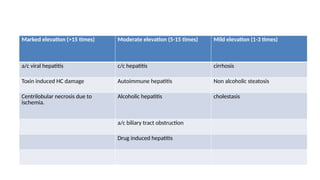
Marked elevation (>15 times) Moderate elevation (5-15 times) Mild elevation (1-3 times)
a/c viral hepatitis c/c hepatitis cirrhosis
Toxin induced HC damage Autoimmune hepatitis Non alcoholic steatosis
Centrilobular necrosis due to
ischemia.
Alcoholic hepatitis cholestasis
a/c biliary tract obstruction
Drug induced hepatitis
SERUM ALKALINE PHOSPHATASE (ALP)
• Distributed wildly in various tissues like liver, bones, placenta, intestine
and kidney.
• In liver ,ALP, GGT, 5’-NT are located on canalicular surface of
hepatocytes.
• In cholestasis ,accumulated bile acids damage the canalicular surface
resulting in release of these enzymes.
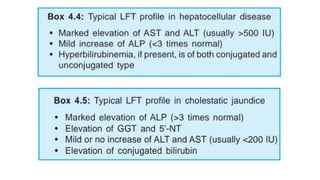
• ALP is helpful in differentiation of hepatocellular jaundice from
cholestatic jaundice.
CAUSES OF INCREASED SERUM ALKALINE
PHOSPHATASE (ALP)
• Hepatobiliary disease:
- simultaneous measurement of serum GGT and serum 5’-NT is
necessary
to ascertain the hepatic origin of ALP.
- Bile duct obstruction, primary biliary cirrhosis, primary sclerosing
cholangitis, infiltrative diseases of liver (TB, sarcoidosis, amyloidosis
etc.)
• Disease of bone
- ALP is present within osteoblasts
- Increased in conditions with increased osteoblastic activity (rickets,
osteomalacia, Paget’s ,osteoblastic metastatic ca .. Etc. )
• Pregnancy
- Due to secretion from placenta.
SERUM GAMMA GLUTAMYL TRANSFERASE
(GGT)
• Presents in liver pancreas, kidney and prostate.
• Levels are increased in :
1) Alcoholism : - Increased activity of the enzyme
- marked elevation of GGT in a/c alcoholic hepatitis
2)Cholestasis : - elevation of GGT parallels that of ALP and 5’-NT in liver
disease
3)Recovery in acute hepatitis :
- serum GGT is the last enzyme to return to normal following a/c
hepatits and its normalization is indicative of a favourable outcome.
5’ NUCLEOTIDASE (5’-NT)
• 5’-NT is present in liver as well as in various other tissues.
• Estimation of 5’-NT is helpful in deciding whether
increased ALP is due to liver disease or due to increased
osteoblastic activity in growing children.
TESTS THAT ASSESS CLEARANCE OF
EXOGENOUS SUBSTANCES FROM THE LIVER
• Some synthetic dyes ,when introduced into the body,are rapidly
removed from the blood stream by the liver and excreted into the
bile.
• 3 synthetic dyes are commonly used: - Bromosulphthalein (BSP)
- Indocyanine green
- Rose Bengal.
• With the advent of more sensitive tests for detection of liver disease,
dye excretion tests are nowadays rarely used.
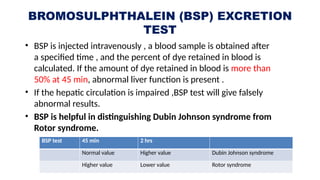
BROMOSULPHTHALEIN (BSP) EXCRETION
TEST
• BSP is injected intravenously , a blood sample is obtained after
a specified time , and the percent of dye retained in blood is
calculated. If the amount of dye retained in blood is more than
50% at 45 min, abnormal liver function is present .
• If the hepatic circulation is impaired ,BSP test will give falsely
abnormal results.
• BSP is helpful in distinguishing Dubin Johnson syndrome from
Rotor syndrome.
BSP test 45 min 2 hrs
Normal value Higher value Dubin Johnson syndrome
Higher value Lower value Rotor syndrome
INTERPRETATION OF LIVER FUNCTION
TESTS
• A STEPWISE APPROACH CONSISTS OF LABORATORY TESTS FOR:
1. Presence of liver disease: History, physical findings and liver function
tests.
2. nature of liver disease: whether hepatocellular (cell injury) or
cholestatic.
3. Specific causes of liver disease
4. assessment of severity of liver disease
LIVER BIOPSY
It is procedure in which a small piece of liver tissue is removed and examined
microscopically to determine cause and severity of disease.
Types of liver biopsy
1)Percutaneous liver biopsy
-percutaneous “blind”liver biopsy
-percutaneous guided liver biopsy
-percutaneous plugged liver biopsy
2)Transvenous(transjugular)liver biopsy
3)Laparoscopic liver biopsy
1) Percutaneous “blind”liver biopsy
Indicatons
1.Acute hepatitis of unknown cause
2.Chronic liver disease
3.Diagnosis of hemochromatosis and wilson`s disease
4.Alcoholic liver disease
5.Primary billiary cirrhosis and primary sclerosing cholangitis
6.Unexplained LFT`S
7.Pyrexia of unknown origin
8.Infection like TB
9.Focal hepatic lesions
10. Liver transplantation
Contraindications
1)Uncooperative patient
2)Extrahepatic billiary obstruction
3)Bleeding diathesis
4)Tense ascites
5)Hybdatid cyst of liver
6)Amyloidosis
Prerequisites-
-Prior imaging of liver
-Routine haemogram
-Coagulation profile
-Informed consent
-Blood grouping and cross matching
Method
-Patient lie in supine position
-Local anaesthetic is injected after site selection
-Small incision is made and biopsy needle is passed patient is asked to
hold his/her breadth in expiration
-after needle is removed patient lie supine on the right side
Complications-
-Pain
-Intraperitonial haemorrhage
-Billiary peritonitis
-Puncture of other organs
Percutaneous Guided liver biopsy-
In this biopsy needle is inserted into liver through abdomen or lower chest during real time imaging of liver
suitable for focal lesions
Percutaneous `plugged`liver biopsy-
In this method outer sheath of needle is left in place and obturator holding the liver biopsy tissue is
removed.A cannula is then introduced through outer sheath and gel is injected to seal or`plug` the
needle track in liver
Transvenous(Transjugular)liver biopsy-
A small catheter is inserted through the jugular vein in the neck and radiologically guided via right atrium ,ivc into
hepatic vein
-Suitable in severe coagulation disoders and in massive ascites
Laproscopic liver biopsy-
Useful when a focal lesion is incidenatally detected on diagnostic laproscopy of abdomen
THANK YOU

Liver function test(LFT) ppt MONIKA NEW.pptx

  • 1.
    LIVER FUNCTION TEST Presentedby : Dr. MONIKA LUKKAD Coordinated by : Dr. SEEMA MEENA
  • 2.
    NORMAL VALUES • SerumAlanine aminotransferase (ALT,SGPT) : 5-42 U/L • Serum Aspartate aminotransferase (AST,SGOT) : 5-40 U/L • Serum alkaline phosphatase (ALP): Children : 25-350 U/L Adult males : 25-120 U/L Adult Females : 25-90 U/L • AST/ALT ratio: 0.7-1.4 • Serum Bilirubin : Total : 0.3- 1.0 mg/dl Direct (conjugated) : 0-0.2 mg/dl
  • 3.
    NORMAL VALUES • Serumprotein ,total : 5.5 – 8.0 gm/dl • Serum albumin : 3.5 – 5.0 gm/dl • Serum globulin : 1.5 -3.0 gm/dl • A:G ratio : >1.5 • Prothrombin time: 11-15 seconds • Plasma ammonia : 9-33 micromol/L • Serum gamma glutamyl transferase : Males : Upto 40 U/L Females : Upto 25 U/L
  • 4.
    FUNCTIONS OF LIVER 1)Excretory functions: Liver regulates bilirubin metabolism by secretion and excretion of bilirubin. 2) Synthetic functions: Synthesis of proteins like albumin, alpha and beta globulin, transport proteins, coagulation proteins occurs in liver. Also produce triglycerides, cholesterol, lipoproteins and primary bile acids. 3) General metabolic functions: Regulates carbohydrate, lipid and protein metabolism. 4) Storage site : Iron, glycogen, and vitamins. 5) Site for hematopoiesis in fetal life. 6) Catabolism of steroid hormones.
  • 5.
    CLASSIFICATION OF LIVERFUNCTION TEST • Tests that assess Excretory function - bilirubin in serum and urine - urobilinogen in urine and feces. • Tests that assess synthetic and metabolic functions - albumin, globulin, PT and blood ammonia level . • Tests that assess hepatic injury (liver enzyme studies) - ALT, AST, GGT, 5-NT • Tests that assess clearance of exogenous substances. - Bromosulphthalein excretion test.
  • 7.
    1. Serum Bilirubin: -normal value < 1mg/dl - conjugated biliruBin </= 10% (water soluble form) - unconjugated bilirubin >/= 90%  Tests For estimation – Diazo method and spectrophotometry
  • 9.
    TESTS TO ASSESSEXCRETORY FUNCTIONS VARIOUS METHODS FOR CLASSIFICATION OF JAUNDICE AS FOLLOWS: 1. ACCORDING TO MAIN TYPE OF BILIRUBIN INCREASED IN PLASMA: • PREDOMINANTLY UNCONJUGATED HYPERBILIRUBINEMIA (>85% OF total) • PREDOMINANTLY CONJUGATED HYPERBILIRUBINEMIA (50% OF TOTAL) • MIXED TYPE ( Conjugate is 20-50% of total) 2. ACCORDING TO ETIOLOGY: • HEMOLYTIC • HEPATOCELLULAR • OBSTRUCTIVE
  • 10.
    TEST FOR BILIRUBIN 1.Diazo method:
  • 11.
    2. Direct spectroscopicestimation - estimation of total serum bilirubin in newborns and infants. - absorbance read at 454 nm . - not done in adults and older children coz carotene and other pigments interfere with absorbance.
  • 12.
    TEST FOR DETECTIONOF BILIRUBIN IN URINE • Tests for bilirubin includes: 1) Foam test 2) Gmelin’s test 3) Lugol iodine test 4) Fouchet’s test 5) Reagent strips or tablet impregnated with diazo reagent.
  • 13.
    TESTS THAT ASSESSSYNTHETIC & METABOLIC FUNCTIONS OF LIVER • Proteins. Liver synthesize most of the plasma protein except gamma globulins (plasma cells). Total Protein : 5.5 – 8 gm/dl Albumin comprises about 60% of total serum protein. Total albumin 3.5 – 5 gm/dl Tests for proteins include: - Total proteins - Albumin, A:G ratio (>1.5) - serum protein electrophoresis
  • 14.
    TOTAL SERUM PROTIENS •TOTAL SERUM PROTEINS Include albumin, alpha1, alpha2, beta, gamma globulins which can be estimated by two methods 1.Refractometer method: - Refractive index varies mainly with concentration of proteins and is affected very little by electrolytes and other molecules. - Refractive index of the solution is measured and protein concentration is read directly from the scale on the refractometer.
  • 15.
    2. Biuret method: - Copper ions react with peptide bonds of proteins and form violet colored compound. - measured colorimetrically • Total serum protein level is affected by- - albumin - gamma globulins. • In cirrhosis albumin is decreased and there is compensatory rise in gamma globulins. Thus A:G ratio is reversed.
  • 16.
    SERUM ALBUMIN • Synthesizedexclusively in liver and constitutes 60% of total plasma proteins. • Half life – 20days. • Albumin is estimated by : BROMOCRESOL GREEN METHOD Bromocresol green dye ,when added to serum binds selectively and tightly to albumin and becomes blue in colour. Absorbance @ 632 nm is directly proportional to concentration of albumin.
  • 17.
    CAUSES OF DECREASEDALBUMIN • Decreased intake : Malnutrition • Decreased absorption : Malabsorption syndromes • Decreased synthesis : Liver d/s , c/c infections • Increased catabolism : Thyrotoxicosis , fever, malignancy , infections. • Increased loss : Nephrotic syndrome, severe burns, protein losing enteropathies, ascites • Increased blood volume: Pregnancy, CCF
  • 18.
    SERUM PROTEIN ELECTROPHORESIS •In cirrhosis ,albumin is reduced , polyclonal increase of IgG and IgA, with beta –gamma bridging. • In primary biliary cirrhosis, polyclonal increase of IgM. • In alpha1 antitrypsin deficiency – alpha1 globulin band is reduced. • In chronic active hepatitis, IgG is elevated.
  • 20.
    PROTHROMBIN TIME • VitK is required for the synthsesis of factors II, VII, IX and X. • PT measures II ,VII, X. • PT is increased in -hepatocellular disease - obstructive jaundice • To distinguish between a prolonged PT due to hepatocellular d/s from that due to cholestasis with fat malabsorption, PT is repeated after administration of vitamin K. Reduction of PT- cholestatic liver d/s No reduction- hepatocellular d/s.
  • 21.
    BLOOD AMMONIA • Ammoniais derived from GIT. In liver , ammonia is converted to non-toxic urea in urea cycle. • Increased Ammonia is seen in : - Fulminant hepatic failure - Cirrhosis - Reye’s syndrome - shunting of portal blood to systemic circulation - Gastrointestinal bleeding - Inherited deficiencies of urea cycle enzymes. • Raised ammonia level is indicative of hepatic encephalopathy
  • 22.
    TESTS TO ASSESSHEPATIC INJURY(LIVER ENZYME STUDIES) • Serum aspartate aminotransferase (AST)/ formerly SGOT • Serum alanine aminotransferase (ALT) /formerly SGPT • Serum alkaline phosphatase (ALP) • Gamma glutamyl transferase (GGT) • 5’-nucleotidase (5’-NT)
  • 23.
    SERUM AMINOTRANSFERASES • Sensitivemarkers of acute hepatocellular injury. • ALT is cytosolic while AST is both cytosolic and mitochondrial • AST/ALT ratio – 0.7 to 1.4 (normal) - >2.0 ( alcoholic hepatitis) - < 1.0 (acute viral hepatitis) • ALT and AST are elevated in a/c viral hepatitis even before the appearance of jaundice. • In massive liver necrosis ,aminotransferase levels gradually decrease.
  • 24.
    Marked elevation (>15times) Moderate elevation (5-15 times) Mild elevation (1-3 times) a/c viral hepatitis c/c hepatitis cirrhosis Toxin induced HC damage Autoimmune hepatitis Non alcoholic steatosis Centrilobular necrosis due to ischemia. Alcoholic hepatitis cholestasis a/c biliary tract obstruction Drug induced hepatitis
  • 25.
    SERUM ALKALINE PHOSPHATASE(ALP) • Distributed wildly in various tissues like liver, bones, placenta, intestine and kidney. • In liver ,ALP, GGT, 5’-NT are located on canalicular surface of hepatocytes. • In cholestasis ,accumulated bile acids damage the canalicular surface resulting in release of these enzymes. • ALP is helpful in differentiation of hepatocellular jaundice from cholestatic jaundice.
  • 26.
    CAUSES OF INCREASEDSERUM ALKALINE PHOSPHATASE (ALP) • Hepatobiliary disease: - simultaneous measurement of serum GGT and serum 5’-NT is necessary to ascertain the hepatic origin of ALP. - Bile duct obstruction, primary biliary cirrhosis, primary sclerosing cholangitis, infiltrative diseases of liver (TB, sarcoidosis, amyloidosis etc.) • Disease of bone - ALP is present within osteoblasts - Increased in conditions with increased osteoblastic activity (rickets, osteomalacia, Paget’s ,osteoblastic metastatic ca .. Etc. ) • Pregnancy - Due to secretion from placenta.
  • 27.
    SERUM GAMMA GLUTAMYLTRANSFERASE (GGT) • Presents in liver pancreas, kidney and prostate. • Levels are increased in : 1) Alcoholism : - Increased activity of the enzyme - marked elevation of GGT in a/c alcoholic hepatitis 2)Cholestasis : - elevation of GGT parallels that of ALP and 5’-NT in liver disease 3)Recovery in acute hepatitis : - serum GGT is the last enzyme to return to normal following a/c hepatits and its normalization is indicative of a favourable outcome.
  • 28.
    5’ NUCLEOTIDASE (5’-NT) •5’-NT is present in liver as well as in various other tissues. • Estimation of 5’-NT is helpful in deciding whether increased ALP is due to liver disease or due to increased osteoblastic activity in growing children.
  • 29.
    TESTS THAT ASSESSCLEARANCE OF EXOGENOUS SUBSTANCES FROM THE LIVER • Some synthetic dyes ,when introduced into the body,are rapidly removed from the blood stream by the liver and excreted into the bile. • 3 synthetic dyes are commonly used: - Bromosulphthalein (BSP) - Indocyanine green - Rose Bengal. • With the advent of more sensitive tests for detection of liver disease, dye excretion tests are nowadays rarely used.
  • 30.
    BROMOSULPHTHALEIN (BSP) EXCRETION TEST •BSP is injected intravenously , a blood sample is obtained after a specified time , and the percent of dye retained in blood is calculated. If the amount of dye retained in blood is more than 50% at 45 min, abnormal liver function is present . • If the hepatic circulation is impaired ,BSP test will give falsely abnormal results. • BSP is helpful in distinguishing Dubin Johnson syndrome from Rotor syndrome. BSP test 45 min 2 hrs Normal value Higher value Dubin Johnson syndrome Higher value Lower value Rotor syndrome
  • 31.
    INTERPRETATION OF LIVERFUNCTION TESTS • A STEPWISE APPROACH CONSISTS OF LABORATORY TESTS FOR: 1. Presence of liver disease: History, physical findings and liver function tests. 2. nature of liver disease: whether hepatocellular (cell injury) or cholestatic. 3. Specific causes of liver disease 4. assessment of severity of liver disease
  • 34.
    LIVER BIOPSY It isprocedure in which a small piece of liver tissue is removed and examined microscopically to determine cause and severity of disease. Types of liver biopsy 1)Percutaneous liver biopsy -percutaneous “blind”liver biopsy -percutaneous guided liver biopsy -percutaneous plugged liver biopsy 2)Transvenous(transjugular)liver biopsy 3)Laparoscopic liver biopsy
  • 35.
    1) Percutaneous “blind”liverbiopsy Indicatons 1.Acute hepatitis of unknown cause 2.Chronic liver disease 3.Diagnosis of hemochromatosis and wilson`s disease 4.Alcoholic liver disease 5.Primary billiary cirrhosis and primary sclerosing cholangitis 6.Unexplained LFT`S 7.Pyrexia of unknown origin 8.Infection like TB 9.Focal hepatic lesions 10. Liver transplantation
  • 36.
    Contraindications 1)Uncooperative patient 2)Extrahepatic billiaryobstruction 3)Bleeding diathesis 4)Tense ascites 5)Hybdatid cyst of liver 6)Amyloidosis Prerequisites- -Prior imaging of liver -Routine haemogram -Coagulation profile -Informed consent -Blood grouping and cross matching
  • 37.
    Method -Patient lie insupine position -Local anaesthetic is injected after site selection -Small incision is made and biopsy needle is passed patient is asked to hold his/her breadth in expiration -after needle is removed patient lie supine on the right side Complications- -Pain -Intraperitonial haemorrhage -Billiary peritonitis -Puncture of other organs
  • 38.
    Percutaneous Guided liverbiopsy- In this biopsy needle is inserted into liver through abdomen or lower chest during real time imaging of liver suitable for focal lesions Percutaneous `plugged`liver biopsy- In this method outer sheath of needle is left in place and obturator holding the liver biopsy tissue is removed.A cannula is then introduced through outer sheath and gel is injected to seal or`plug` the needle track in liver Transvenous(Transjugular)liver biopsy- A small catheter is inserted through the jugular vein in the neck and radiologically guided via right atrium ,ivc into hepatic vein -Suitable in severe coagulation disoders and in massive ascites Laproscopic liver biopsy- Useful when a focal lesion is incidenatally detected on diagnostic laproscopy of abdomen
  • 39.