LIVER ANATOMY,FUNCTION
TESTS ,IMAGING
G.NARENDRA MS general
surgery
NRI HOSPITAL GUNTUR
embryology
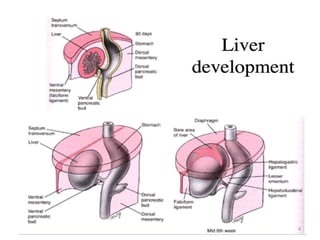
• Liver develops from endodermal bud from
ventral aspect of gut
• Between junction of foregut and midgut
• Bud grows into ventral mesogastrium and
passes through it into septum transversum
• Enlarges and divides into large cranial part-
pars hepatica
• Small caudal part- pars cystica
2
• Pars hepatica divides into right & left parts
• Pars hepatica enlarges & extend into septum
transversum
• Umbilical & vitelline veins which lie in septum
transversum break up to form sinusoids of liver
• Hepatic bud endoderm- parenchyma of liver , bile
capillaries
• Mesoderm of septum transversum-capsule of
liver
3
4
ANATOMY
• Largest organ in body
• 1500 gm
• In right upper abdomen ,beneath diaphragm
,protected by rib cartilage
• surrounded by a fibrous sheath known as
Glisson’s capsule.
5
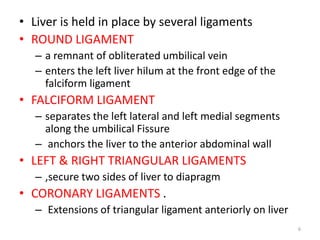
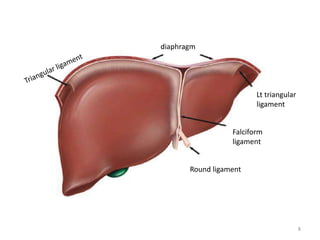
• Liver is held in place by several ligaments
• ROUND LIGAMENT
– a remnant of obliterated umbilical vein
– enters the left liver hilum at the front edge of the
falciform ligament
• FALCIFORM LIGAMENT
– separates the left lateral and left medial segments
along the umbilical Fissure
– anchors the liver to the anterior abdominal wall
• LEFT & RIGHT TRIANGULAR LIGAMENTS
– ,secure two sides of liver to diapragm
• CORONARY LIGAMENTS .
– Extensions of triangular ligament anteriorly on liver
6
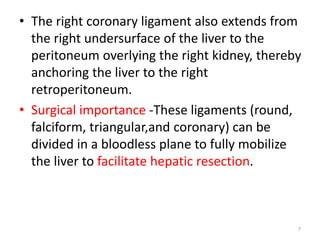
• The right coronary ligament also extends from
the right undersurface of the liver to the
peritoneum overlying the right kidney, thereby
anchoring the liver to the right
retroperitoneum.
• Surgical importance -These ligaments (round,
falciform, triangular,and coronary) can be
divided in a bloodless plane to fully mobilize
the liver to facilitate hepatic resection.
7
diaphragm
Lt triangular
ligament
Round ligament
Falciform
ligament
8
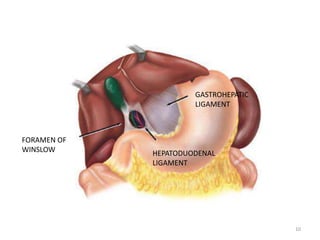
• just to the left of the gallbladder fossa, the liver
attaches via hepatoduodenal and the gastrohepatic
ligaments .
• The HEPATODODENAL LIGAMENT
– is known as the porta hepatis
– contains the common bile duct, the hepatic artery, and
the portal vein.,nerves & lymphatics
– From the right side and deep (dorsal) to the porta hepatis
is the foramen of Winslow, also known as the
epiploic foramen.
– anatomical relationship of thesestructures is for the bile
duct to be within the free edge, the hepatic artery to be
above and medial, and the portal vein to lie posteriorly.
– This passage connects directly to the lesser sac and allows
complete vascular inflow control to the liver when the
hepatoduodenal ligament is clamped using the Pringle
maneuver. 9
GASTROHEPATIC
LIGAMENT
HEPATODUODENAL
LIGAMENT
FORAMEN OF
WINSLOW
10
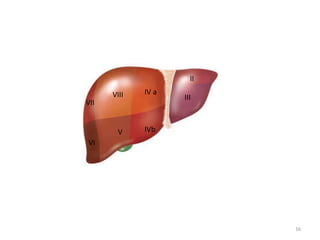
SEGMENTAL ANATOMY
• Liver is grossly seperated into right & left lobes
by cantlie line
• REX-CANTLIE’S line – plane from gall bladder
fossa anteriorly to IVC posteriorly passing
through middle hepatic vein
• Also known as scissura or portal fissure
11
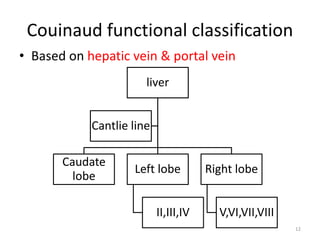
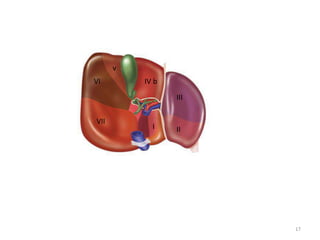
Couinaud functional classification
• Based on hepatic vein & portal vein
liver
Caudate
lobe
Left lobe
II,III,IV
Right lobe
V,VI,VII,VIII
Cantlie line
12
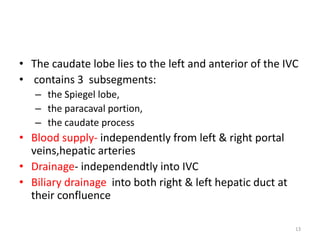
• The caudate lobe lies to the left and anterior of the IVC
• contains 3 subsegments:
– the Spiegel lobe,
– the paracaval portion,
– the caudate process
• Blood supply- independently from left & right portal
veins,hepatic arteries
• Drainage- independendtly into IVC
• Biliary drainage into both right & left hepatic duct at
their confluence
13
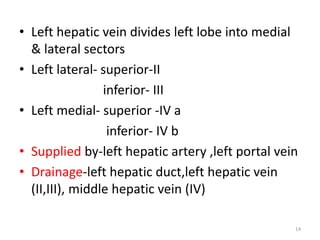
• Left hepatic vein divides left lobe into medial
& lateral sectors
• Left lateral- superior-II
inferior- III
• Left medial- superior -IV a
inferior- IV b
• Supplied by-left hepatic artery ,left portal vein
• Drainage-left hepatic duct,left hepatic vein
(II,III), middle hepatic vein (IV)
14
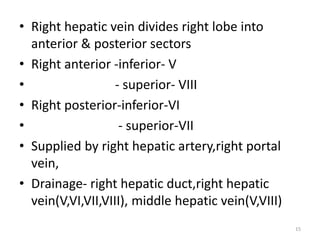
• Right hepatic vein divides right lobe into
anterior & posterior sectors
• Right anterior -inferior- V
• - superior- VIII
• Right posterior-inferior-VI
• - superior-VII
• Supplied by right hepatic artery,right portal
vein,
• Drainage- right hepatic duct,right hepatic
vein(V,VI,VII,VIII), middle hepatic vein(V,VIII)
15
II
III
IVb
IV aVIII
V
VI
VII
16
II
III
I
IV b
v
VI
VII
17
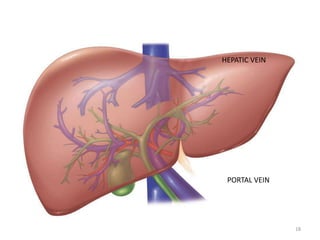
18
PORTAL VEIN
HEPATIC VEIN
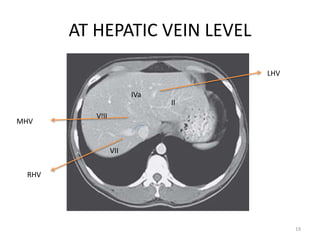
AT HEPATIC VEIN LEVEL
19
II
IVa
VIII
VII
LHV
MHV
RHV
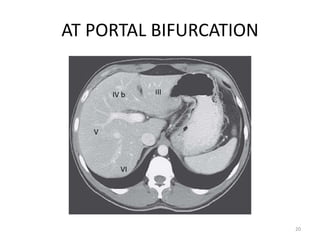
AT PORTAL BIFURCATION
20
IIIIV b
V
VI
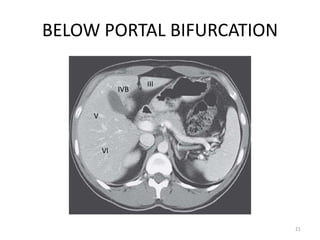
BELOW PORTAL BIFURCATION
21
III
IVB
V
VI
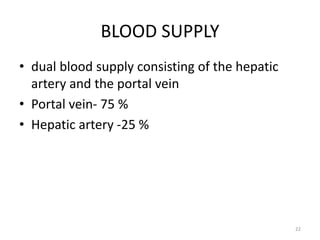
BLOOD SUPPLY
• dual blood supply consisting of the hepatic
artery and the portal vein
• Portal vein- 75 %
• Hepatic artery -25 %
22
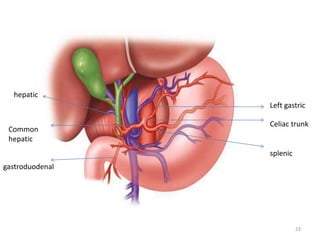
Celiac trunk
Left gastric
splenic
Common
hepatic
gastroduodenal
hepatic
23
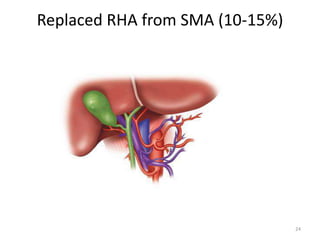
Replaced RHA from SMA (10-15%)
24
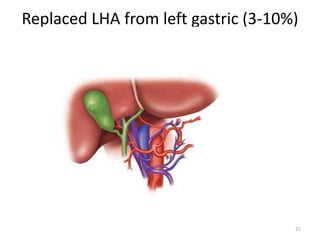
Replaced LHA from left gastric (3-10%)
25
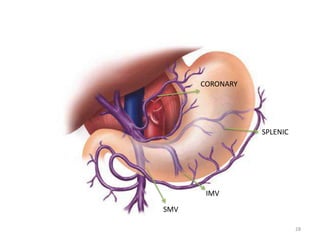
Portal vein
• formed by the confluence of the splenic vein
and the superior mesenteric vein.
• Traverses through porta hepatis
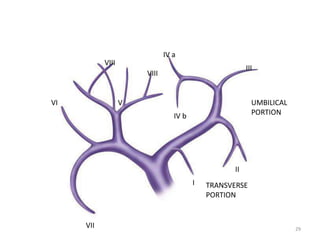
• Then left portal vein branches from main vein
,consists of transverse portion ,followed by 90
degree turn at umbilical fissure base,to
become umbilical portion
• Supplies II,III,IV and dominant supply to I lobe
26
• Right portal vein branches near to liver
parenchyma,
• Supplies V,VI,VII,VIII lobes
• Other branches- coronary/left gastric vein
• -superior pancreaticoduodenal
vein
27
28
SPLENIC
CORONARY
IMV
SMV
29
TRANSVERSE
PORTION
UMBILICAL
PORTION
I
II
III
IV a
IV b
V
VIII
VIII
VI
VII
• The portal vein drains the splanchnic blood from
the stomach,pancreas, spleen, small intestine,
and majority of the colon to the liver before
returning to the systemic circulation.
• The portal vein pressure in normal individual is 3
to 5 mmHg.
• The portal vein is valveless,
• in the setting of portal hypertension, the
pressure can be quite high (20 to 30 mmHg).
• This results in decompression of the systemic
circulation through portocaval anastomoses,
most commonly via the coronary (left gastric)
vein, which produces esophageal and gastric
varices with a propensity for major hemorrhage
30
Hepatic Veins and Inferior Vena Cava
• venous drain of liver is by 3 hepatic veins
• Right, middle & left hepatic veins & drain into
suprahepatic IVC
• RHV drains V,VI,VII,VIII segments
• MHV drains IV,V,VIII segments
• LHV drains II,III segments
• Segment I / caudate drains directly into IVC
31
• In 95 % Persons, LHV , RHV together forms a
common trunk & drain into IVC
• In 20 % people , accessory RHV may be present in
hepatocaval ligament
• This can be source of torrential bleed during right
hepatectomy
• umbilical vein is additional vein that runs under
the falciform ligament, between the left and
middle veins,and empties into the left hepatic
vein
32
• Hepatic vein bisects the portal branches in
liver parenchyma
• RHV runs between right anterior & posterior
portal veins
• MHV runs between right anterior & left portal
vein
• LHV runs between branches of left portal vein
supplying II,III segments
33
Bile ducts & hepatic ducts
• Intrahepatic bile ducts along with respective
portal vein & hepatic artery is known as portal
pedicle
• the bile duct branches are usually superior to the
portal vein, whereas the hepatic artery branches
run inferiorly
• Left hepatic duct –present at base of umbilical
fissure -drains II,III,IV segments,
• Right hepatic duct formed by anterior & posterior
branches- drains V,VI,VII,VIII segments
34
• Caudate lobe has its own biliary drainage both
into left & right hepatic ducts
• Longer left hepatic duct joins with right
hepatic duct to form confluence anterior to
right portal vein
• This forms common hepatic duct- 4mm
diameter
• Below cystic duct ,it is common bile duct-6mm
diameter
35
Nerve supply
• Parasympathetic innervation – by vagus
– Left vagus- anterior hepatic branch
– Right vagus- posterior hepatic branch
• Sympathetic innervation is by
– greater thoracic sphlanchnic nerves,
– celiac ganglion
• Source of reffered pain to right shoulder &
scapula is phrenic nerve stimulation due to
glisson capsule stretch or diaphragm irritation
36
Lymphatic drainage
• Lymph produced in liver
• Drains via perisinusoidal space of disse &
periportal clefts of mall to
• Cystic duct lymph node,CBD,hepatic
artery,retropancreatic & celiac lymph
nodes(along hepatic arteries)
• Also drains superiorly into cardiophrenic
lymph nodes(along hepatic veins)
37
Plate system of liver
• On the ventral surface of liver connective tissue
condenses & forms system of fibrous plates &
sheaths
• They extend into liver along with biliovascular
structures
• consists of a sheath which surrounds the bile duct
and blood vessels (hepatic artery and portal vein)
• continuous with the Glisson’s capsule intra-
hepatically
• the hepatoduodenal ligament extra-hepatically.
38
• system also contains a large number of
lymphatics, nerves and a small vascular
network.
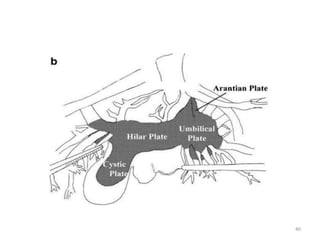
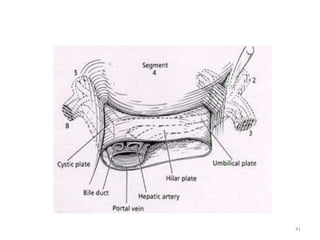
• Three plates are found in the hilar area:
– the hilar plate,
– the cystic plate and
– the umbilical plate.
39
40
41
• upper curved edge of the hilar plate is
dissected free from the undersurface of the
liver to expose the left hepatic duct, the biliary
ductal confluence and the right hepatic duct
when repairing a biliary stricture
42
• during cholecystectomy, the cystic plate is left
behind
• severe inflammation and fibrosis—
– , the cystic plate may become short and thick and
– the distance between the cystic plate and right portal
pedicle may be markedly reduced.
– the plane between the gallbladder and the cystic plate
may be obliterated
– may enter the plane behind the cystic plate.
• Continued dissection in this plane will eventually
reach the right portal pedicle and if the sheath of
the pedicle is breached, there is a very high risk
of injury to the right hepatic artery and right
portal vein
43
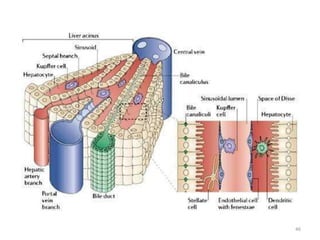
Microscopic anatomy
• Hepatic parenchyma organised into microscopic
functional units – acinus/lobule
• Lobule is formed bya central terminal hepatic
venule surrounded by 4 – 6 portal traids
• In between central venule and portal triad
hepatocytes are arranged in single layer
surrounded by sinusoids
• Blood flows from
• portal triad sinusoids central venule
44
• Bile flows from
• Hepatocyte terminal canaliculi bile ducts
portal triad
• Between portal triad & central venule there are 3
zones
• Zone 1 – periportal zone- rich in oxygen,nutrients
• Zone 2-intermediate zone
• Zone 3- perivenular zone-poor in
oxygen,nutrients
• Hence zone 3 more prone to ischemia & zone 1 to
toxic injury
45
46
LIVER FUNCTION TESTS
• SYNTHESIS FUNCTION
• Serum albumin
• Synthesized exclusively by hepatocyte 10 gm/day
• Half life – 20 days,hence not a marker for acute
dysfunction
• Low albumin-
– chronic liver disease
– neprotic syndrome
– protein malnutrition
– chronic infections
47
• Acute liver damage
• PT/INR
• All clotting factors except viii –syntesized in hepatocyte
• hAlf life 6hrs to 4 days
• 2,7,9,10 factors – collectively measured by serum
prothrombin time
• Elevated – hepatitis,cirrhosis,obstuctive jaundice, fat
malabsorption
• PT not correctable with parenteral vit k-
hepatitis,DIC,portal vein obstruction
48
• Serum enzymes that reflect damage to
hepatocytes
• Aminotransferases- within cytoplasm of
hepatocyte
• Aspartate aminotransferase AST / SGOT
• Alanine aminotransferase ALT / SGPT
• Normal levels < 20 u/L
• Upto 300 - nonspecific
49
• These enzymes are elevated in serum in great
amounts when there is damage to liver cell
membrane resulting in increased permeability
• > 1000 u/L - 1) viral hepatitis
• 2) ischemic liver injury
• 3)toxic / drug induced liver injury
• Also a sensitive indicator of transplant rejection
• AST/ALT > 2:1 – Alcohol liver disease
50
• Enzymes reflecting cholestasis
• Alkaline phosphatase
• 5 nucleotidase
• Gamma glutamyl transpeptidase
• ALP & 5 nucleotidase found in bile canalicular
membrane of hepatocytes
• GGT in bile duct epithelium & endoplasmi
reticulum of hepatocyte
51
• ALP – greater than a four fold rise of normal
value indicates cholestasis,liver
infiltration,amyloidosis,pagets disease
• Also present in bone and placenta
• Cannot differentiate intra or extrahepatic
biliary obstruction
52
• Serum bilurubin- produced in reticulo endothelial
system , breakdown product of eme containing protein
• Conjugated in in hepatocyte
• Excreted through bile
• Hepatocellular damage – both direct and indirect
bilurubin level increases
• Impaired excretion – increase in direct & total bilurubin
levels
• NORMAL serum bilurubin < 1mg/dl
• Direct – 30 % of normal
53
• DETOXIFICATION FUNCTION
– Liver converts ammonia to urea
– Normal < 60 mmol/L
– Raised levels – hepatic encephalopathy
• Serum ceruloplasmin
– Copper binding protein secreted by liver
– Decreased – wilson disease
• Alpha feto protein
• Pathognomonic for primary liver malignancy
54
IMAGING OF LIVER
55
ULTRASOUND
• Based on pulse- echo principle
• The ultrasound transducer converts electrical
energy to high-frequency sound energy that is
transmitted into tissue.
• waves are transmitted through the tissue, some
are reflected back,
• ultrasound image is produced when the receiver
detects those reflected waves.
• augmented by Doppler flow imaging.
• can detect the presence of blood vessels but also
can determine the direction and velocity of blood
flow 56
advantages
• inexpensive,
• widely available,
• no radiation exposure,
disadvantages
• Incomplete imaging ( at dome,beneath ribs,lesion
boundaries)
• Obesity & bowel gas reduce quality
• lower sensitivity and specificity of ultrasound
compared with CT and MRI
57
uses
• Liver size
• Detects lesions in liver
• Detects gall stones
• Detects biliary dilatation
• Differentiates solid from cystic masses
• Determines flow in vessels
• As a guide in percutaneous biopsy
• As a guide in aspiration of liver abscess
58
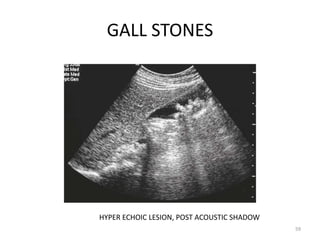
GALL STONES
59
HYPER ECHOIC LESION, POST ACOUSTIC SHADOW
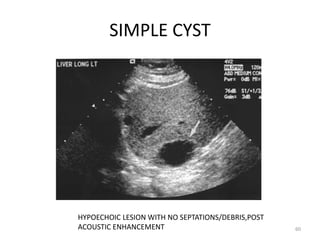
SIMPLE CYST
60
HYPOECHOIC LESION WITH NO SEPTATIONS/DEBRIS,POST
ACOUSTIC ENHANCEMENT
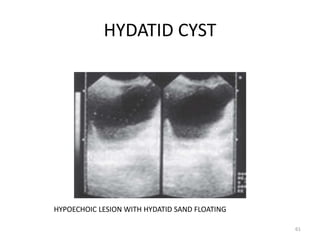
HYDATID CYST
61
HYPOECHOIC LESION WITH HYDATID SAND FLOATING
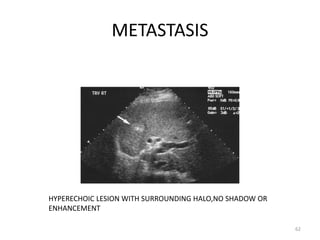
METASTASIS
62
HYPERECHOIC LESION WITH SURROUNDING HALO,NO SHADOW OR
ENHANCEMENT
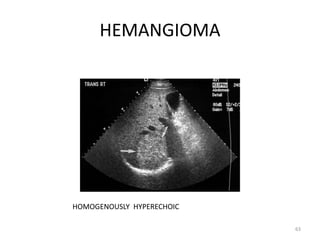
HEMANGIOMA
63
HOMOGENOUSLY HYPERECHOIC
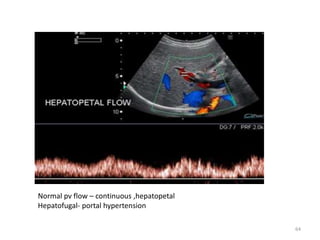
Normal pv flow – continuous ,hepatopetal
Hepatofugal- portal hypertension
64
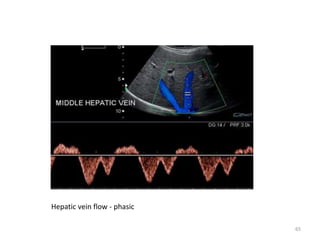
Hepatic vein flow - phasic
65
Contrast enhanced ultrasound
• Improved ability to differentiate among benign
and malignant lesions
• Contrast- gas microbubble agents
• Microbubbles are <10 μm
• improves delineation of liver lesions through
identification of dynamic enhancement patterns
and the vascular morphology of the lesion.
• some agents exhibit a late liver-specific phase
and accumulate in normal liver parenchyma after
the vascular enhancement has faded
66
Intra-operative ultrasound
• gold standard for detecting liver lesions
• tumor staging,
• visualization of intrahepatic vascular
structures ,
• guidance of resection plane by assessment of
the relationship of a mass to the vessels.
• biopsy of lesions and
• ablation of tumors
67
Ultrasound elastography
• used to assess the degree of fibrosis or cirrhosis in the
liver.
• Low-frequency vibrations transmitted through the liver
induce an elastic shear wave that is detected by
ultrasonography
• The velocity of the wave correlates with the stiffness of
the organ
• wave travels faster through fibrotic or cirrhotic tissues.
• Advantage over biopsy is that , it is non
invasive,rapid,aquires information from large surface
68
Computerised tomography
• Increased accuracy of diagnosis & staging
• CECT is widely used & best validated for liver
imaging
• Most of liver pathologies have similiar density
to liver parenchyma
• Liver has dual supply ,portal vein 75 % &
hepatic artery 25 %
• Many liver tumours recieve major supply from
hepatic artery
69
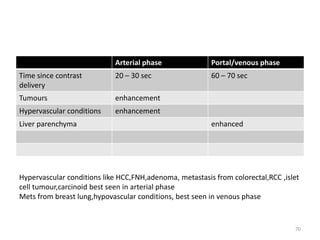
Arterial phase Portal/venous phase
Time since contrast
delivery
20 – 30 sec 60 – 70 sec
Tumours enhancement
Hypervascular conditions enhancement
Liver parenchyma enhanced
Hypervascular conditions like HCC,FNH,adenoma, metastasis from colorectal,RCC ,islet
cell tumour,carcinoid best seen in arterial phase
Mets from breast lung,hypovascular conditions, best seen in venous phase
70
MRI
• AS effective as CT
• Useful in case of allergy to iodinated contrast
• Biliary pathology
71
THANK YOU
72

Liver ANATOMY,LFT,LIVER IMAGING

  • 1.
    LIVER ANATOMY,FUNCTION TESTS ,IMAGING G.NARENDRAMS general surgery NRI HOSPITAL GUNTUR
  • 2.
    embryology • Liver developsfrom endodermal bud from ventral aspect of gut • Between junction of foregut and midgut • Bud grows into ventral mesogastrium and passes through it into septum transversum • Enlarges and divides into large cranial part- pars hepatica • Small caudal part- pars cystica 2
  • 3.
    • Pars hepaticadivides into right & left parts • Pars hepatica enlarges & extend into septum transversum • Umbilical & vitelline veins which lie in septum transversum break up to form sinusoids of liver • Hepatic bud endoderm- parenchyma of liver , bile capillaries • Mesoderm of septum transversum-capsule of liver 3
  • 4.
  • 5.
    ANATOMY • Largest organin body • 1500 gm • In right upper abdomen ,beneath diaphragm ,protected by rib cartilage • surrounded by a fibrous sheath known as Glisson’s capsule. 5
  • 6.
    • Liver isheld in place by several ligaments • ROUND LIGAMENT – a remnant of obliterated umbilical vein – enters the left liver hilum at the front edge of the falciform ligament • FALCIFORM LIGAMENT – separates the left lateral and left medial segments along the umbilical Fissure – anchors the liver to the anterior abdominal wall • LEFT & RIGHT TRIANGULAR LIGAMENTS – ,secure two sides of liver to diapragm • CORONARY LIGAMENTS . – Extensions of triangular ligament anteriorly on liver 6
  • 7.
    • The rightcoronary ligament also extends from the right undersurface of the liver to the peritoneum overlying the right kidney, thereby anchoring the liver to the right retroperitoneum. • Surgical importance -These ligaments (round, falciform, triangular,and coronary) can be divided in a bloodless plane to fully mobilize the liver to facilitate hepatic resection. 7
  • 8.
  • 9.
    • just tothe left of the gallbladder fossa, the liver attaches via hepatoduodenal and the gastrohepatic ligaments . • The HEPATODODENAL LIGAMENT – is known as the porta hepatis – contains the common bile duct, the hepatic artery, and the portal vein.,nerves & lymphatics – From the right side and deep (dorsal) to the porta hepatis is the foramen of Winslow, also known as the epiploic foramen. – anatomical relationship of thesestructures is for the bile duct to be within the free edge, the hepatic artery to be above and medial, and the portal vein to lie posteriorly. – This passage connects directly to the lesser sac and allows complete vascular inflow control to the liver when the hepatoduodenal ligament is clamped using the Pringle maneuver. 9
  • 10.
  • 11.
    SEGMENTAL ANATOMY • Liveris grossly seperated into right & left lobes by cantlie line • REX-CANTLIE’S line – plane from gall bladder fossa anteriorly to IVC posteriorly passing through middle hepatic vein • Also known as scissura or portal fissure 11
  • 12.
    Couinaud functional classification •Based on hepatic vein & portal vein liver Caudate lobe Left lobe II,III,IV Right lobe V,VI,VII,VIII Cantlie line 12
  • 13.
    • The caudatelobe lies to the left and anterior of the IVC • contains 3 subsegments: – the Spiegel lobe, – the paracaval portion, – the caudate process • Blood supply- independently from left & right portal veins,hepatic arteries • Drainage- independendtly into IVC • Biliary drainage into both right & left hepatic duct at their confluence 13
  • 14.
    • Left hepaticvein divides left lobe into medial & lateral sectors • Left lateral- superior-II inferior- III • Left medial- superior -IV a inferior- IV b • Supplied by-left hepatic artery ,left portal vein • Drainage-left hepatic duct,left hepatic vein (II,III), middle hepatic vein (IV) 14
  • 15.
    • Right hepaticvein divides right lobe into anterior & posterior sectors • Right anterior -inferior- V • - superior- VIII • Right posterior-inferior-VI • - superior-VII • Supplied by right hepatic artery,right portal vein, • Drainage- right hepatic duct,right hepatic vein(V,VI,VII,VIII), middle hepatic vein(V,VIII) 15
  • 16.
  • 17.
  • 18.
  • 19.
    AT HEPATIC VEINLEVEL 19 II IVa VIII VII LHV MHV RHV
  • 20.
  • 21.
  • 22.
    BLOOD SUPPLY • dualblood supply consisting of the hepatic artery and the portal vein • Portal vein- 75 % • Hepatic artery -25 % 22
  • 23.
  • 24.
    Replaced RHA fromSMA (10-15%) 24
  • 25.
    Replaced LHA fromleft gastric (3-10%) 25
  • 26.
    Portal vein • formedby the confluence of the splenic vein and the superior mesenteric vein. • Traverses through porta hepatis • Then left portal vein branches from main vein ,consists of transverse portion ,followed by 90 degree turn at umbilical fissure base,to become umbilical portion • Supplies II,III,IV and dominant supply to I lobe 26
  • 27.
    • Right portalvein branches near to liver parenchyma, • Supplies V,VI,VII,VIII lobes • Other branches- coronary/left gastric vein • -superior pancreaticoduodenal vein 27
  • 28.
  • 29.
  • 30.
    • The portalvein drains the splanchnic blood from the stomach,pancreas, spleen, small intestine, and majority of the colon to the liver before returning to the systemic circulation. • The portal vein pressure in normal individual is 3 to 5 mmHg. • The portal vein is valveless, • in the setting of portal hypertension, the pressure can be quite high (20 to 30 mmHg). • This results in decompression of the systemic circulation through portocaval anastomoses, most commonly via the coronary (left gastric) vein, which produces esophageal and gastric varices with a propensity for major hemorrhage 30
  • 31.
    Hepatic Veins andInferior Vena Cava • venous drain of liver is by 3 hepatic veins • Right, middle & left hepatic veins & drain into suprahepatic IVC • RHV drains V,VI,VII,VIII segments • MHV drains IV,V,VIII segments • LHV drains II,III segments • Segment I / caudate drains directly into IVC 31
  • 32.
    • In 95% Persons, LHV , RHV together forms a common trunk & drain into IVC • In 20 % people , accessory RHV may be present in hepatocaval ligament • This can be source of torrential bleed during right hepatectomy • umbilical vein is additional vein that runs under the falciform ligament, between the left and middle veins,and empties into the left hepatic vein 32
  • 33.
    • Hepatic veinbisects the portal branches in liver parenchyma • RHV runs between right anterior & posterior portal veins • MHV runs between right anterior & left portal vein • LHV runs between branches of left portal vein supplying II,III segments 33
  • 34.
    Bile ducts &hepatic ducts • Intrahepatic bile ducts along with respective portal vein & hepatic artery is known as portal pedicle • the bile duct branches are usually superior to the portal vein, whereas the hepatic artery branches run inferiorly • Left hepatic duct –present at base of umbilical fissure -drains II,III,IV segments, • Right hepatic duct formed by anterior & posterior branches- drains V,VI,VII,VIII segments 34
  • 35.
    • Caudate lobehas its own biliary drainage both into left & right hepatic ducts • Longer left hepatic duct joins with right hepatic duct to form confluence anterior to right portal vein • This forms common hepatic duct- 4mm diameter • Below cystic duct ,it is common bile duct-6mm diameter 35
  • 36.
    Nerve supply • Parasympatheticinnervation – by vagus – Left vagus- anterior hepatic branch – Right vagus- posterior hepatic branch • Sympathetic innervation is by – greater thoracic sphlanchnic nerves, – celiac ganglion • Source of reffered pain to right shoulder & scapula is phrenic nerve stimulation due to glisson capsule stretch or diaphragm irritation 36
  • 37.
    Lymphatic drainage • Lymphproduced in liver • Drains via perisinusoidal space of disse & periportal clefts of mall to • Cystic duct lymph node,CBD,hepatic artery,retropancreatic & celiac lymph nodes(along hepatic arteries) • Also drains superiorly into cardiophrenic lymph nodes(along hepatic veins) 37
  • 38.
    Plate system ofliver • On the ventral surface of liver connective tissue condenses & forms system of fibrous plates & sheaths • They extend into liver along with biliovascular structures • consists of a sheath which surrounds the bile duct and blood vessels (hepatic artery and portal vein) • continuous with the Glisson’s capsule intra- hepatically • the hepatoduodenal ligament extra-hepatically. 38
  • 39.
    • system alsocontains a large number of lymphatics, nerves and a small vascular network. • Three plates are found in the hilar area: – the hilar plate, – the cystic plate and – the umbilical plate. 39
  • 40.
  • 41.
  • 42.
    • upper curvededge of the hilar plate is dissected free from the undersurface of the liver to expose the left hepatic duct, the biliary ductal confluence and the right hepatic duct when repairing a biliary stricture 42
  • 43.
    • during cholecystectomy,the cystic plate is left behind • severe inflammation and fibrosis— – , the cystic plate may become short and thick and – the distance between the cystic plate and right portal pedicle may be markedly reduced. – the plane between the gallbladder and the cystic plate may be obliterated – may enter the plane behind the cystic plate. • Continued dissection in this plane will eventually reach the right portal pedicle and if the sheath of the pedicle is breached, there is a very high risk of injury to the right hepatic artery and right portal vein 43
  • 44.
    Microscopic anatomy • Hepaticparenchyma organised into microscopic functional units – acinus/lobule • Lobule is formed bya central terminal hepatic venule surrounded by 4 – 6 portal traids • In between central venule and portal triad hepatocytes are arranged in single layer surrounded by sinusoids • Blood flows from • portal triad sinusoids central venule 44
  • 45.
    • Bile flowsfrom • Hepatocyte terminal canaliculi bile ducts portal triad • Between portal triad & central venule there are 3 zones • Zone 1 – periportal zone- rich in oxygen,nutrients • Zone 2-intermediate zone • Zone 3- perivenular zone-poor in oxygen,nutrients • Hence zone 3 more prone to ischemia & zone 1 to toxic injury 45
  • 46.
  • 47.
    LIVER FUNCTION TESTS •SYNTHESIS FUNCTION • Serum albumin • Synthesized exclusively by hepatocyte 10 gm/day • Half life – 20 days,hence not a marker for acute dysfunction • Low albumin- – chronic liver disease – neprotic syndrome – protein malnutrition – chronic infections 47
  • 48.
    • Acute liverdamage • PT/INR • All clotting factors except viii –syntesized in hepatocyte • hAlf life 6hrs to 4 days • 2,7,9,10 factors – collectively measured by serum prothrombin time • Elevated – hepatitis,cirrhosis,obstuctive jaundice, fat malabsorption • PT not correctable with parenteral vit k- hepatitis,DIC,portal vein obstruction 48
  • 49.
    • Serum enzymesthat reflect damage to hepatocytes • Aminotransferases- within cytoplasm of hepatocyte • Aspartate aminotransferase AST / SGOT • Alanine aminotransferase ALT / SGPT • Normal levels < 20 u/L • Upto 300 - nonspecific 49
  • 50.
    • These enzymesare elevated in serum in great amounts when there is damage to liver cell membrane resulting in increased permeability • > 1000 u/L - 1) viral hepatitis • 2) ischemic liver injury • 3)toxic / drug induced liver injury • Also a sensitive indicator of transplant rejection • AST/ALT > 2:1 – Alcohol liver disease 50
  • 51.
    • Enzymes reflectingcholestasis • Alkaline phosphatase • 5 nucleotidase • Gamma glutamyl transpeptidase • ALP & 5 nucleotidase found in bile canalicular membrane of hepatocytes • GGT in bile duct epithelium & endoplasmi reticulum of hepatocyte 51
  • 52.
    • ALP –greater than a four fold rise of normal value indicates cholestasis,liver infiltration,amyloidosis,pagets disease • Also present in bone and placenta • Cannot differentiate intra or extrahepatic biliary obstruction 52
  • 53.
    • Serum bilurubin-produced in reticulo endothelial system , breakdown product of eme containing protein • Conjugated in in hepatocyte • Excreted through bile • Hepatocellular damage – both direct and indirect bilurubin level increases • Impaired excretion – increase in direct & total bilurubin levels • NORMAL serum bilurubin < 1mg/dl • Direct – 30 % of normal 53
  • 54.
    • DETOXIFICATION FUNCTION –Liver converts ammonia to urea – Normal < 60 mmol/L – Raised levels – hepatic encephalopathy • Serum ceruloplasmin – Copper binding protein secreted by liver – Decreased – wilson disease • Alpha feto protein • Pathognomonic for primary liver malignancy 54
  • 55.
  • 56.
    ULTRASOUND • Based onpulse- echo principle • The ultrasound transducer converts electrical energy to high-frequency sound energy that is transmitted into tissue. • waves are transmitted through the tissue, some are reflected back, • ultrasound image is produced when the receiver detects those reflected waves. • augmented by Doppler flow imaging. • can detect the presence of blood vessels but also can determine the direction and velocity of blood flow 56
  • 57.
    advantages • inexpensive, • widelyavailable, • no radiation exposure, disadvantages • Incomplete imaging ( at dome,beneath ribs,lesion boundaries) • Obesity & bowel gas reduce quality • lower sensitivity and specificity of ultrasound compared with CT and MRI 57
  • 58.
    uses • Liver size •Detects lesions in liver • Detects gall stones • Detects biliary dilatation • Differentiates solid from cystic masses • Determines flow in vessels • As a guide in percutaneous biopsy • As a guide in aspiration of liver abscess 58
  • 59.
    GALL STONES 59 HYPER ECHOICLESION, POST ACOUSTIC SHADOW
  • 60.
    SIMPLE CYST 60 HYPOECHOIC LESIONWITH NO SEPTATIONS/DEBRIS,POST ACOUSTIC ENHANCEMENT
  • 61.
    HYDATID CYST 61 HYPOECHOIC LESIONWITH HYDATID SAND FLOATING
  • 62.
    METASTASIS 62 HYPERECHOIC LESION WITHSURROUNDING HALO,NO SHADOW OR ENHANCEMENT
  • 63.
  • 64.
    Normal pv flow– continuous ,hepatopetal Hepatofugal- portal hypertension 64
  • 65.
    Hepatic vein flow- phasic 65
  • 66.
    Contrast enhanced ultrasound •Improved ability to differentiate among benign and malignant lesions • Contrast- gas microbubble agents • Microbubbles are <10 μm • improves delineation of liver lesions through identification of dynamic enhancement patterns and the vascular morphology of the lesion. • some agents exhibit a late liver-specific phase and accumulate in normal liver parenchyma after the vascular enhancement has faded 66
  • 67.
    Intra-operative ultrasound • goldstandard for detecting liver lesions • tumor staging, • visualization of intrahepatic vascular structures , • guidance of resection plane by assessment of the relationship of a mass to the vessels. • biopsy of lesions and • ablation of tumors 67
  • 68.
    Ultrasound elastography • usedto assess the degree of fibrosis or cirrhosis in the liver. • Low-frequency vibrations transmitted through the liver induce an elastic shear wave that is detected by ultrasonography • The velocity of the wave correlates with the stiffness of the organ • wave travels faster through fibrotic or cirrhotic tissues. • Advantage over biopsy is that , it is non invasive,rapid,aquires information from large surface 68
  • 69.
    Computerised tomography • Increasedaccuracy of diagnosis & staging • CECT is widely used & best validated for liver imaging • Most of liver pathologies have similiar density to liver parenchyma • Liver has dual supply ,portal vein 75 % & hepatic artery 25 % • Many liver tumours recieve major supply from hepatic artery 69
  • 70.
    Arterial phase Portal/venousphase Time since contrast delivery 20 – 30 sec 60 – 70 sec Tumours enhancement Hypervascular conditions enhancement Liver parenchyma enhanced Hypervascular conditions like HCC,FNH,adenoma, metastasis from colorectal,RCC ,islet cell tumour,carcinoid best seen in arterial phase Mets from breast lung,hypovascular conditions, best seen in venous phase 70
  • 71.
    MRI • AS effectiveas CT • Useful in case of allergy to iodinated contrast • Biliary pathology 71
  • 72.