Literature Circles
 Start to Finish


 Katie McKnight, Ph.D.
 Katie@KatherineMcKnight.com
  www.KatherineMcKnight.com
     Twitter: @LiteracyWorld
Facebook: Katie McKnight Literacy
Here’s the Plan Today

•  Some background information
   about literature circles.
•  Getting started with literature
   circles in your classroom
•  Creating and structuring mini
   lessons

                           3
Why Literature Circles?

•  It is a translation of the adult
   reading group.
•  Offers a genuine and
   authentic reading experience.
•  Literature Circles are also
   known as book clubs, and
   reading groups.
Literature Circle
        Consistent Elements
•  Students choose their reading materials.
•  Small Groups are formed, based on student
   choice.
•  Grouping is by text choices, not by
     ability or other tracking.
•  Groups meet on a regular schedule.
Literature Circle
 Consistent Elements (continued)

•  Different groups choose and read
   different books.
•  Members write notes that help
   guide both their reading and their
   discussion.
•  Teacher-Led Mini Lessons
   should be scheduled before and
   after literature circle meetings.
Literature Circle
 Consistent Elements (continued)

•  The teacher does not lead any
   book, but acts as a facilitator,
   fellow reader, and observer.
•  Personal responses, connections,
   and questions are the starting
   point of discussion.
Literature Circle
  Consistent Elements (continued)

•  The classroom has a spirit of
   playfulness, sharing, and
   collaboration.
•  When books are completed, the
   literature circles share highlights of
   their reading through presentations,
   reviews, dramatizations, book chats
   and other activities.
Literature Circle
 Consistent Elements (continued)

•  New groups are formed around
   new reading choices and the cycle
   begins again.
•  Assessment is by teacher
   observation and student self-
   evaluation.
Why Young
         Adult Literature?
•  http://www.adlit.org/media/mediatopics/
   youngadult/
Mini Lessons

•  All mini lessons can cover the following:
   –  TEAM BUILDING
   –  READING STRATEGIES
   –  LITERARY STRATEGIES
TEAM BUILDING

•  Obstacles
•  Overcoming the Obstacles
•  Mini Lessons that teach social skills so that
   the students can collaborate in a literature
   circle.

•  How do you build classroom community?
Reading and Literary Mini
           Lessons
Structure of an
Effective Reading or Literary Mini-Lesson

A mini lesson provides direct, explicit
instruction for one specific teaching point.
The teacher engages students in strategy with
a demonstration and modeling of skill using a
think aloud. The structure of an effective
mini lesson is as follows:
Reading or Literary Mini Lesson

1. Connect lesson with lesson from the day
   before stating what will be learned and
   setting the purpose.

2. Teach the new strategy using a mentor text
   and modeling with think aloud.  Be very
   explicit and model what proficient readers
   do to comprehend text.
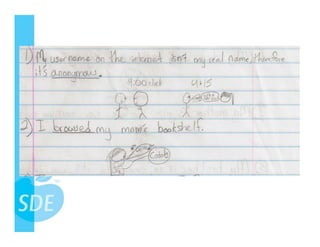
Reading Strategies

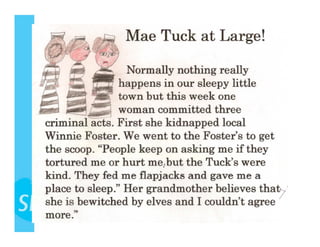
•  Visualize—Making pictures of mental images
   or sensory images as they read.
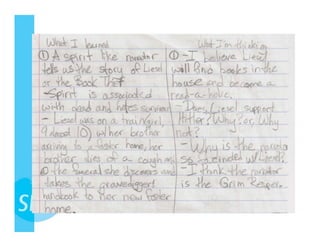
       Student Sample from Tuck Everlasting
•  Connect—The reader and experience
   connection.
     Student Sample from The Book Thief
•  Question—Interrogating the text.
•  Infer—predict, interpret, synthesize.
•  Evaluate—Critique and make judgments.
Reading Strategies (continued)

•  Analyze—Examining the author’s craft.
•  Recall—Retell, summarize, and remember.
•  Self Monitor—Using individual skill set to
   understand and interpret the text.
   Overcoming obstacles independently.
Sticky Notes

•  We want students to listen to the
   voice inside their head.
•  Comments, questions, connections.
•  Students record the “voice in the
   their head” on sticky notes.
•  *****Teaching Kids How to Use
   Sticky Notes----see this lesson

•  Teaching Student Annotation: Constructing
   Meaning Through Connections
•  http://www.readwritethink.org/lessons/
   lesson_view.asp?id=1132

•  This lesson teaches students how to annotate text
   and there are some excellent guides and
   assessments. There are also several student
   annotation samples
Stop and Write

•  Students stop and write.
•  First, they should summarize,
   What I read”.
•  Second, they should reflect,
     What I think .

(Sample    Stop and Write)
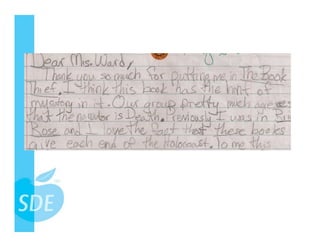
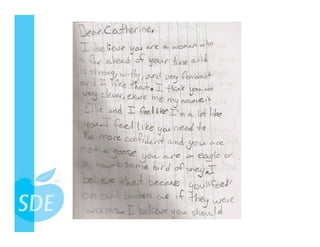
Literary Letters

•  Reader writes letters to teacher, other
   readers, or friends and relatives outside of
   the classroom.
•  Provides students with the opportunity to
   consider their own questions, comments,
   and connections with another person.
•  Here’s a sample….
Literary Mini Lesson

•    Story Cubes
•    Story Trails
•    Character Biographies
•    Character Questionnaire

Here are some more samples…
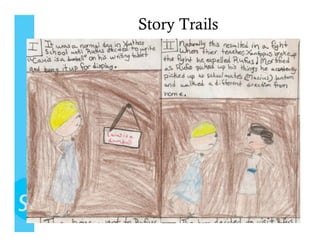
Story Trails
Topics for Mini Lessons

•  Let’s brainstorm mini lesson topics that we
   want to cover in our literature circles.
Literature Circle Demonstration


 •  http://www.ohiorc.org/adlit/video/
    videoClip.aspx?clipID=3&segmentID=8
Reading Logs (In addition to mini
           lessons)

 •  A reading log---What is it?
 •  Students should write in the log every time
    that they read. Emphasis is on analysis and
    discussion. Avoid excessive summarizing.
 •  The teacher or a student peer can respond to
    the reader s entries.
 (Sample Reading Log Entry)
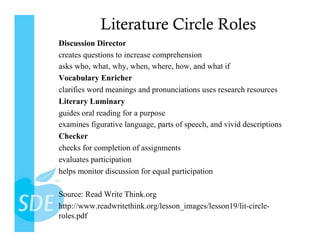
Literature Circle Roles
Discussion Director
creates questions to increase comprehension
asks who, what, why, when, where, how, and what if
Vocabulary Enricher
clarifies word meanings and pronunciations uses research resources
Literary Luminary
guides oral reading for a purpose
examines figurative language, parts of speech, and vivid descriptions
Checker
checks for completion of assignments
evaluates participation
helps monitor discussion for equal participation

Source: Read Write Think.org
http://www.readwritethink.org/lesson_images/lesson19/lit-circle-
roles.pdf
Scheduling

•  2.5 weeks is PLENTY of time for the
   students to read the assigned book.
•  5-15 minutes-introductory mini lesson
•  20-30 minutes-small group activity
•  5-15 minutes-sharing time and closing.
•  About 2-4 weeks is enough per book.
•  Meet about 3-6 times per 2-4 week cycle.
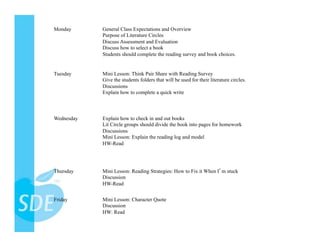
Monday      General Class Expectations and Overview
            Purpose of Literature Circles
            Discuss Assessment and Evaluation
            Discuss how to select a book
            Students should complete the reading survey and book choices.


Tuesday     Mini Lesson: Think Pair Share with Reading Survey
            Give the students folders that will be used for their literature circles.
            Discussions
            Explain how to complete a quick write


Wednesday   Explain how to check in and out books
            Lit Circle groups should divide the book into pages for homework
            Discussions
            Mini Lesson: Explain the reading log and model
            HW-Read


Thursday    Mini Lesson: Reading Strategies: How to Fix it When I m stuck
            Discussion
            HW-Read


Friday      Mini Lesson: Character Quote
            Discussion
            HW: Read
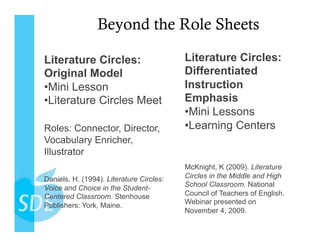
Beyond the Role Sheets

Literature Circles:                       Literature Circles:
Original Model                            Differentiated
• Mini Lesson                             Instruction
• Literature Circles Meet                 Emphasis
                                          • Mini Lessons
Roles: Connector, Director,               • Learning Centers
Vocabulary Enricher,
Illustrator
                                          McKnight, K (2009). Literature
Daniels, H. (1994). Literature Circles:   Circles in the Middle and High
                                          School Classroom. National
Voice and Choice in the Student-
Centered Classroom. Stenhouse             Council of Teachers of English.
                                          Webinar presented on
Publishers: York, Maine.
                                          November 4, 2009.
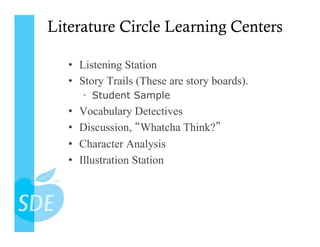
Literature Circle Learning Centers

   •  Listening Station
   •  Story Trails (These are story boards).
        •  Student Sample
   •    Vocabulary Detectives
   •    Discussion, Whatcha Think?
   •    Character Analysis
   •    Illustration Station
Assessment and Evaluation for
       Literature Circles
•  Contract
•  Rubrics
•  Teacher Notes from Conferencing (sample
   Rubric)
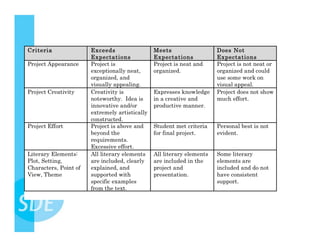
Both of these assessment rubrics are part of the READ WRITE THINK lesson:
Girls Read: Online Literature Circles
http://www.readwritethink.org/lessons/lesson_view.asp?id=970

In generations past, women met in quilting circles to share their dreams; today’s
girls share their thoughts in virtual communities. Multicultural literature with strong
female protagonists serves as the focus for e-mail exchanges and classroom
discussions in this lesson. Students select and read one of five novels presented by
the teacher, and discuss the novel in exchanges with e-mail pen pals and in
classroom literature circles. Students then participate in an online literacy
community where they can respond to questions and post reviews, allowing them to
expand their perspectives and converse with a wider audience.

This is a student self-assessment for Literature Circles:
http://www.readwritethink.org/lesson_images/lesson970/self.pdf

Here is a teacher self-assessment:

http://www.readwritethink.org/lesson_images/lesson970/teacher.pdf
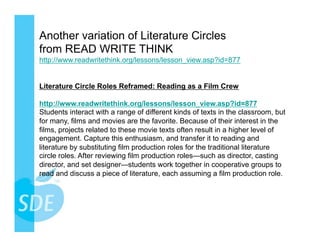
Another variation of Literature Circles
from READ WRITE THINK
http://www.readwritethink.org/lessons/lesson_view.asp?id=877


Literature Circle Roles Reframed: Reading as a Film Crew

http://www.readwritethink.org/lessons/lesson_view.asp?id=877
Students interact with a range of different kinds of texts in the classroom, but
for many, films and movies are the favorite. Because of their interest in the
films, projects related to these movie texts often result in a higher level of
engagement. Capture this enthusiasm, and transfer it to reading and
literature by substituting film production roles for the traditional literature
circle roles. After reviewing film production roles—such as director, casting
director, and set designer—students work together in cooperative groups to
read and discuss a piece of literature, each assuming a film production role.
Response Chart for Literature Circles
http://www.readwritethink.org/lesson_images/
lesson1136/responsechart.pdf

Student Sample Response Chart for
Literature Circles
http://www.readwritethink.org/lesson_images/
lesson1136/SampleResponses.pdf
I also recommend
Daniels, H. & Steineke, N. (2003). Mini-Lessons for
Literature Circles. Portsmouth, NH: Heinemann.
Looking for Books?
http://www.alan-ya.org
The Assembly on Literature for Adolescents is an
independent assembly of NCTE. Founded in November
1973, ALAN is made up of teachers, authors, librarians,
publishers, teacher-educators and their students, and
others who are particularly interested in the area of
young adult literature. ALAN, which is self-governing,
holds its annual meetings during the NCTE annual
convention in November and also publishes The ALAN
Review.
The website features authors and titles for adolescent
readers. The books are reviewed monthly.
How to Reach Me
•  Email: Katie@KatherineMcKnight.com
•  Website: www.KatherineMcKnight.com

•  Twitter: @literacyworld
•  Facebook: Katie McKnight Literacy
For more materials and updated powerpoint, see
my blog at www.KatherineMcKnight.com
and http://goo.gl/J242X for additional
 materials.
                                 42

Literature circles start to finish

  • 1.
    Literature Circles Startto Finish Katie McKnight, Ph.D. Katie@KatherineMcKnight.com www.KatherineMcKnight.com Twitter: @LiteracyWorld Facebook: Katie McKnight Literacy
  • 3.
    Here’s the PlanToday •  Some background information about literature circles. •  Getting started with literature circles in your classroom •  Creating and structuring mini lessons 3
  • 4.
    Why Literature Circles? • It is a translation of the adult reading group. •  Offers a genuine and authentic reading experience. •  Literature Circles are also known as book clubs, and reading groups.
  • 5.
    Literature Circle Consistent Elements •  Students choose their reading materials. •  Small Groups are formed, based on student choice. •  Grouping is by text choices, not by ability or other tracking. •  Groups meet on a regular schedule.
  • 6.
    Literature Circle ConsistentElements (continued) •  Different groups choose and read different books. •  Members write notes that help guide both their reading and their discussion. •  Teacher-Led Mini Lessons should be scheduled before and after literature circle meetings.
  • 7.
    Literature Circle ConsistentElements (continued) •  The teacher does not lead any book, but acts as a facilitator, fellow reader, and observer. •  Personal responses, connections, and questions are the starting point of discussion.
  • 8.
    Literature Circle Consistent Elements (continued) •  The classroom has a spirit of playfulness, sharing, and collaboration. •  When books are completed, the literature circles share highlights of their reading through presentations, reviews, dramatizations, book chats and other activities.
  • 9.
    Literature Circle ConsistentElements (continued) •  New groups are formed around new reading choices and the cycle begins again. •  Assessment is by teacher observation and student self- evaluation.
  • 10.
    Why Young Adult Literature? •  http://www.adlit.org/media/mediatopics/ youngadult/
  • 11.
    Mini Lessons •  Allmini lessons can cover the following: –  TEAM BUILDING –  READING STRATEGIES –  LITERARY STRATEGIES
  • 12.
    TEAM BUILDING •  Obstacles • Overcoming the Obstacles •  Mini Lessons that teach social skills so that the students can collaborate in a literature circle. •  How do you build classroom community?
  • 13.
    Reading and LiteraryMini Lessons Structure of an Effective Reading or Literary Mini-Lesson A mini lesson provides direct, explicit instruction for one specific teaching point. The teacher engages students in strategy with a demonstration and modeling of skill using a think aloud. The structure of an effective mini lesson is as follows:
  • 14.
    Reading or LiteraryMini Lesson 1. Connect lesson with lesson from the day before stating what will be learned and setting the purpose. 2. Teach the new strategy using a mentor text and modeling with think aloud.  Be very explicit and model what proficient readers do to comprehend text.
  • 15.
    Reading Strategies •  Visualize—Makingpictures of mental images or sensory images as they read. Student Sample from Tuck Everlasting •  Connect—The reader and experience connection. Student Sample from The Book Thief •  Question—Interrogating the text. •  Infer—predict, interpret, synthesize. •  Evaluate—Critique and make judgments.
  • 16.
    Reading Strategies (continued) • Analyze—Examining the author’s craft. •  Recall—Retell, summarize, and remember. •  Self Monitor—Using individual skill set to understand and interpret the text. Overcoming obstacles independently.
  • 17.
    Sticky Notes •  Wewant students to listen to the voice inside their head. •  Comments, questions, connections. •  Students record the “voice in the their head” on sticky notes.
  • 18.
    •  *****Teaching KidsHow to Use Sticky Notes----see this lesson •  Teaching Student Annotation: Constructing Meaning Through Connections •  http://www.readwritethink.org/lessons/ lesson_view.asp?id=1132 •  This lesson teaches students how to annotate text and there are some excellent guides and assessments. There are also several student annotation samples
  • 19.
    Stop and Write • Students stop and write. •  First, they should summarize, What I read”. •  Second, they should reflect, What I think . (Sample Stop and Write)
  • 21.
    Literary Letters •  Readerwrites letters to teacher, other readers, or friends and relatives outside of the classroom. •  Provides students with the opportunity to consider their own questions, comments, and connections with another person. •  Here’s a sample….
  • 23.
    Literary Mini Lesson •  Story Cubes •  Story Trails •  Character Biographies •  Character Questionnaire Here are some more samples…
  • 24.
  • 26.
    Topics for MiniLessons •  Let’s brainstorm mini lesson topics that we want to cover in our literature circles.
  • 27.
    Literature Circle Demonstration •  http://www.ohiorc.org/adlit/video/ videoClip.aspx?clipID=3&segmentID=8
  • 28.
    Reading Logs (Inaddition to mini lessons) •  A reading log---What is it? •  Students should write in the log every time that they read. Emphasis is on analysis and discussion. Avoid excessive summarizing. •  The teacher or a student peer can respond to the reader s entries. (Sample Reading Log Entry)
  • 31.
    Literature Circle Roles DiscussionDirector creates questions to increase comprehension asks who, what, why, when, where, how, and what if Vocabulary Enricher clarifies word meanings and pronunciations uses research resources Literary Luminary guides oral reading for a purpose examines figurative language, parts of speech, and vivid descriptions Checker checks for completion of assignments evaluates participation helps monitor discussion for equal participation Source: Read Write Think.org http://www.readwritethink.org/lesson_images/lesson19/lit-circle- roles.pdf
  • 32.
    Scheduling •  2.5 weeksis PLENTY of time for the students to read the assigned book. •  5-15 minutes-introductory mini lesson •  20-30 minutes-small group activity •  5-15 minutes-sharing time and closing. •  About 2-4 weeks is enough per book. •  Meet about 3-6 times per 2-4 week cycle.
  • 33.
    Monday General Class Expectations and Overview Purpose of Literature Circles Discuss Assessment and Evaluation Discuss how to select a book Students should complete the reading survey and book choices. Tuesday Mini Lesson: Think Pair Share with Reading Survey Give the students folders that will be used for their literature circles. Discussions Explain how to complete a quick write Wednesday Explain how to check in and out books Lit Circle groups should divide the book into pages for homework Discussions Mini Lesson: Explain the reading log and model HW-Read Thursday Mini Lesson: Reading Strategies: How to Fix it When I m stuck Discussion HW-Read Friday Mini Lesson: Character Quote Discussion HW: Read
  • 34.
    Beyond the RoleSheets Literature Circles: Literature Circles: Original Model Differentiated • Mini Lesson Instruction • Literature Circles Meet Emphasis • Mini Lessons Roles: Connector, Director, • Learning Centers Vocabulary Enricher, Illustrator McKnight, K (2009). Literature Daniels, H. (1994). Literature Circles: Circles in the Middle and High School Classroom. National Voice and Choice in the Student- Centered Classroom. Stenhouse Council of Teachers of English. Webinar presented on Publishers: York, Maine. November 4, 2009.
  • 35.
    Literature Circle LearningCenters •  Listening Station •  Story Trails (These are story boards). •  Student Sample •  Vocabulary Detectives •  Discussion, Whatcha Think? •  Character Analysis •  Illustration Station
  • 36.
    Assessment and Evaluationfor Literature Circles •  Contract •  Rubrics •  Teacher Notes from Conferencing (sample Rubric)
  • 38.
    Both of theseassessment rubrics are part of the READ WRITE THINK lesson: Girls Read: Online Literature Circles http://www.readwritethink.org/lessons/lesson_view.asp?id=970 In generations past, women met in quilting circles to share their dreams; today’s girls share their thoughts in virtual communities. Multicultural literature with strong female protagonists serves as the focus for e-mail exchanges and classroom discussions in this lesson. Students select and read one of five novels presented by the teacher, and discuss the novel in exchanges with e-mail pen pals and in classroom literature circles. Students then participate in an online literacy community where they can respond to questions and post reviews, allowing them to expand their perspectives and converse with a wider audience. This is a student self-assessment for Literature Circles: http://www.readwritethink.org/lesson_images/lesson970/self.pdf Here is a teacher self-assessment: http://www.readwritethink.org/lesson_images/lesson970/teacher.pdf
  • 39.
    Another variation ofLiterature Circles from READ WRITE THINK http://www.readwritethink.org/lessons/lesson_view.asp?id=877 Literature Circle Roles Reframed: Reading as a Film Crew http://www.readwritethink.org/lessons/lesson_view.asp?id=877 Students interact with a range of different kinds of texts in the classroom, but for many, films and movies are the favorite. Because of their interest in the films, projects related to these movie texts often result in a higher level of engagement. Capture this enthusiasm, and transfer it to reading and literature by substituting film production roles for the traditional literature circle roles. After reviewing film production roles—such as director, casting director, and set designer—students work together in cooperative groups to read and discuss a piece of literature, each assuming a film production role.
  • 40.
    Response Chart forLiterature Circles http://www.readwritethink.org/lesson_images/ lesson1136/responsechart.pdf Student Sample Response Chart for Literature Circles http://www.readwritethink.org/lesson_images/ lesson1136/SampleResponses.pdf
  • 41.
    I also recommend Daniels,H. & Steineke, N. (2003). Mini-Lessons for Literature Circles. Portsmouth, NH: Heinemann. Looking for Books? http://www.alan-ya.org The Assembly on Literature for Adolescents is an independent assembly of NCTE. Founded in November 1973, ALAN is made up of teachers, authors, librarians, publishers, teacher-educators and their students, and others who are particularly interested in the area of young adult literature. ALAN, which is self-governing, holds its annual meetings during the NCTE annual convention in November and also publishes The ALAN Review. The website features authors and titles for adolescent readers. The books are reviewed monthly.
  • 42.
    How to ReachMe •  Email: Katie@KatherineMcKnight.com •  Website: www.KatherineMcKnight.com •  Twitter: @literacyworld •  Facebook: Katie McKnight Literacy For more materials and updated powerpoint, see my blog at www.KatherineMcKnight.com and http://goo.gl/J242X for additional materials. 42