CREATIVE WRITING
WHAT IS CREATIVE
WRITING?
• “the art of making
things up”
• A vital part of modern
society
• Traditionally termed as
literature
• Original and self-
expressive.
PURPOSE OF
CREATIVE WRITING
• To entertain
• To share human
experience
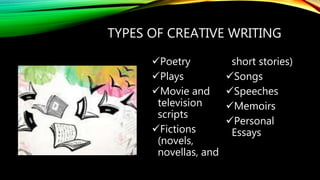
TYPES OF CREATIVE WRITING
Poetry
Plays
Movie and
television
scripts
Fictions
(novels,
novellas, and
short stories)
Songs
Speeches
Memoirs
Personal
Essays
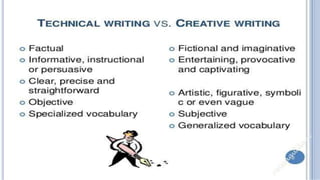
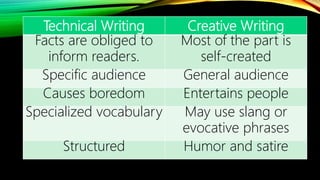
Technical Writing Creative Writing
Facts are obliged to
inform readers.
Most of the part is
self-created
Specific audience General audience
Causes boredom Entertains people
Specialized vocabulary May use slang or
evocative phrases
Structured Humor and satire
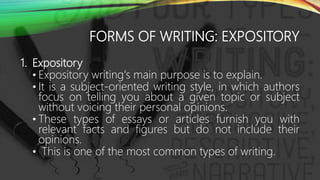
FORMS OF WRITING: EXPOSITORY
1. Expository
• Expository writing's main purpose is to explain.
• It is a subject-oriented writing style, in which authors
focus on telling you about a given topic or subject
without voicing their personal opinions.
• These types of essays or articles furnish you with
relevant facts and figures but do not include their
opinions.
• This is one of the most common types of writing.
FORMS OF WRITING: EXPOSITORY
Key Points:
• Usually explains something in a process.
• Is often equipped with facts and figures.
• Is usually in a logical order and sequence.
FORMS OF WRITING: EXPOSITORY
When You Would Use Expository Writing:
• Textbook writing.
• How-to articles.
• Recipes.
• News stories (not including opinion or editorial pieces).
• Business, technical, or scientific writing.
FORMS OF WRITING: DESCRIPTIVE
2. Descriptive
• Descriptive writing's main purpose is to describe
• It is a style of writing that focuses on describing a
character, an event, or a place in great detail.
• It can be poetic when the author takes the time to be
very specific in his or her descriptions.
FORMS OF WRITING: DESCRIPTIVE
Key Points:
• It is often poetic in nature
• It describes places, people, events, situations, or locations
in a highly-detailed manner.
• The author visualizes what he or she sees, hears, tastes,
smells, and feels.
FORMS OF WRITING: DESCRIPTIVE
When You Would Use Descriptive Writing:
• Poetry
• Journal or diary writing
• Nature writing
• Descriptive passages in fiction
FORMS OF WRITING: PERSUASIVE
3. Persuasive
• Persuasive writing's main purpose is to convince.
• Persuasive writing contains the opinions and biases of the
author.
• To convince others to agree with the author's point of
view, persuasive writing contains justifications and
reasons.
• It is often used in letters of complaint, advertisements or
commercials, affiliate marketing pitches, cover letters, and
newspaper opinion and editorial pieces.
FORMS OF WRITING: PERSUASIVE
Key Points:
• Persuasive writing is equipped with reasons,
arguments, and justifications.
• In persuasive writing, the author takes a stand and
asks you to agree with his or her point of view.
• It often asks for readers to do something about the
situation (this is called a call-to-action).
FORMS OF WRITING: PERSUASIVE
When You Would Use Persuasive Writing:
• Opinion and editorial newspaper pieces.
• Advertisements.
• Reviews (of books, music, movie, restaurants, etc.).
• Letter of recommendation.
• Letter of complaint.
• Cover letters
FORMS OF WRITING: NARRATIVE
4. Narrative
• Narrative writing's main purpose is to tell a story.
• The author will create different characters and tell you
what happens to them (sometimes the author writes
from the point of view of one of the characters—this
is known as first person narration).
FORMS OF WRITING: NARRATIVE
• Novels, short stories, novellas, poetry, and
biographies can all fall in the narrative writing style.
• Simply, narrative writing answers the question: “What
happened then?”
FORMS OF WRITING: NARRATIVE
Key Points:
• A person tells a story or event.
• Has characters and dialogue.
• Has definite and logical beginnings, intervals, and
endings.
• Often has situations like actions, motivational events,
and disputes or conflicts with their eventual solutions.
FORMS OF WRITING:
NARRATIVE
Examples of When You Would Use
Persuasive Writing:
• Novels
• Short stories
• Novellas
• Poetry
• Autobiographies or biographies
• Anecdotes
• Oral histories
WHAT IS
SENSORY
EXPERIENCE?
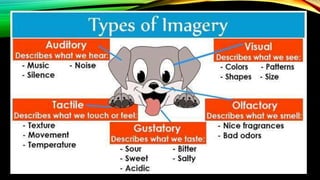
Writer’s ability to make a memorable story by
incorporating the use of the 5 senses.
Sensory details include sight, sound, touch,
smell, and taste. Writers employ the five
to engage a reader's interest.
Readers can personally experience what the
author is trying to describe, reminding them of
their own experiences.
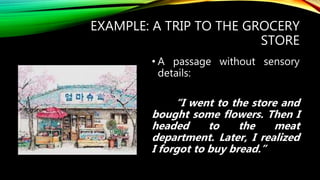
EXAMPLE: A TRIP TO THE GROCERY
STORE
• A passage without sensory
details:
“I went to the store and
bought some flowers. Then I
headed to the meat
department. Later, I realized
I forgot to buy bread.”
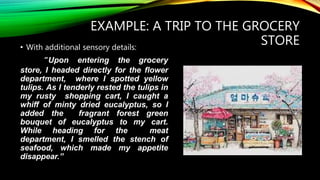
EXAMPLE: A TRIP TO THE GROCERY
STORE• With additional sensory details:
“Upon entering the grocery
store, I headed directly for the flower
department, where I spotted yellow
tulips. As I tenderly rested the tulips in
my rusty shopping cart, I caught a
whiff of minty dried eucalyptus, so I
added the fragrant forest green
bouquet of eucalyptus to my cart.
While heading for the meat
department, I smelled the stench of
seafood, which made my appetite
disappear.”
LANGUAGE OF CREATIVE
WRITING: IMAGERY
1. Imagery
• Language used by poets, novelists and other writers
to create images in the mind of the reader.
• Includes to figurative and metaphorical language
improve the reader’s experience through their senses.
IMAGERY USING VISUALS
“The night was black as ever, but bright stars lit up the sky in
beautiful and varied constellations which were sprinkled across
the astronomical landscape.”
IMAGERY USING SCENTS
(OLFACTORY)
“She smelled the scent of sweet hibiscus wafting
through the air, its tropical smell a reminder that she
was on vacation in a beautiful place.”
IMAGERY USING TASTE
(GUSTATORY)
“The candy melted in her mouth and swirls of
bittersweet chocolate and slightly sweet but salty
caramel blended together on her tongue.”
IMAGERY USING TOUCH (TACTILE)
“After the long run, he collapsed in the grass with tired
and burning muscles. The grass tickled his skin and
sweat cooled on his brow.”
IMAGERY USING SOUNDS
(AUDITORY)
“Silence was broken by the peal of piano keys as
Shannon began practicing her concerto.”
IMPORTANCE OF IMAGERY
• It allows readers to directly sympathize with
characters and narrators as they imagine having the
same sense experiences.
• Imagery is found throughout literature in poems, plays,
stories, novels and other creative compositions.
LANGUAGE OF CREATIVE
WRITING: FIGURES OF SPEECH
LANGUAGE OF CREATIVE
WRITING: DICTION
DICTION
• as style of speaking or writing,
determined by the choice of words
by a speakeror a writer.
• Diction, or choice of words, often
separates good writing from bad
writing.
TYPES OF DICTION
Individuals vary their diction depending on different contexts and settings.
Therefore, we come across various types of diction.
• Formal diction – formal words are used in formal situations, such as press
conferences and presentations.
• Informal diction – uses informal words and conversation, such as writing or
talking to friends.
• Colloquial diction – uses words common in everyday speech, which may be
different in different regions or communities.
• Slang diction – is the use of words that are newly coined, or even impolite.
FUNCTION OF DICTION
• In literature, writers choose words to create and convey a
typical mood, tone, and atmosphere to their readers.
• A writer’s choice of words, and his selection of graphic
words, not only affect the reader’s attitude, but also
conveys the writer’s feelings toward the literary work.
• Reference: Regh Ellorimo

Creative writing

  • 1.
  • 2.
    WHAT IS CREATIVE WRITING? •“the art of making things up” • A vital part of modern society • Traditionally termed as literature • Original and self- expressive.
  • 3.
    PURPOSE OF CREATIVE WRITING •To entertain • To share human experience
  • 4.
    TYPES OF CREATIVEWRITING Poetry Plays Movie and television scripts Fictions (novels, novellas, and short stories) Songs Speeches Memoirs Personal Essays
  • 6.
    Technical Writing CreativeWriting Facts are obliged to inform readers. Most of the part is self-created Specific audience General audience Causes boredom Entertains people Specialized vocabulary May use slang or evocative phrases Structured Humor and satire
  • 7.
    FORMS OF WRITING:EXPOSITORY 1. Expository • Expository writing's main purpose is to explain. • It is a subject-oriented writing style, in which authors focus on telling you about a given topic or subject without voicing their personal opinions. • These types of essays or articles furnish you with relevant facts and figures but do not include their opinions. • This is one of the most common types of writing.
  • 8.
    FORMS OF WRITING:EXPOSITORY Key Points: • Usually explains something in a process. • Is often equipped with facts and figures. • Is usually in a logical order and sequence.
  • 9.
    FORMS OF WRITING:EXPOSITORY When You Would Use Expository Writing: • Textbook writing. • How-to articles. • Recipes. • News stories (not including opinion or editorial pieces). • Business, technical, or scientific writing.
  • 10.
    FORMS OF WRITING:DESCRIPTIVE 2. Descriptive • Descriptive writing's main purpose is to describe • It is a style of writing that focuses on describing a character, an event, or a place in great detail. • It can be poetic when the author takes the time to be very specific in his or her descriptions.
  • 11.
    FORMS OF WRITING:DESCRIPTIVE Key Points: • It is often poetic in nature • It describes places, people, events, situations, or locations in a highly-detailed manner. • The author visualizes what he or she sees, hears, tastes, smells, and feels.
  • 12.
    FORMS OF WRITING:DESCRIPTIVE When You Would Use Descriptive Writing: • Poetry • Journal or diary writing • Nature writing • Descriptive passages in fiction
  • 13.
    FORMS OF WRITING:PERSUASIVE 3. Persuasive • Persuasive writing's main purpose is to convince. • Persuasive writing contains the opinions and biases of the author. • To convince others to agree with the author's point of view, persuasive writing contains justifications and reasons. • It is often used in letters of complaint, advertisements or commercials, affiliate marketing pitches, cover letters, and newspaper opinion and editorial pieces.
  • 14.
    FORMS OF WRITING:PERSUASIVE Key Points: • Persuasive writing is equipped with reasons, arguments, and justifications. • In persuasive writing, the author takes a stand and asks you to agree with his or her point of view. • It often asks for readers to do something about the situation (this is called a call-to-action).
  • 15.
    FORMS OF WRITING:PERSUASIVE When You Would Use Persuasive Writing: • Opinion and editorial newspaper pieces. • Advertisements. • Reviews (of books, music, movie, restaurants, etc.). • Letter of recommendation. • Letter of complaint. • Cover letters
  • 16.
    FORMS OF WRITING:NARRATIVE 4. Narrative • Narrative writing's main purpose is to tell a story. • The author will create different characters and tell you what happens to them (sometimes the author writes from the point of view of one of the characters—this is known as first person narration).

  • 17.
    FORMS OF WRITING:NARRATIVE • Novels, short stories, novellas, poetry, and biographies can all fall in the narrative writing style. • Simply, narrative writing answers the question: “What happened then?”
  • 18.
    FORMS OF WRITING:NARRATIVE Key Points: • A person tells a story or event. • Has characters and dialogue. • Has definite and logical beginnings, intervals, and endings. • Often has situations like actions, motivational events, and disputes or conflicts with their eventual solutions.
  • 19.
    FORMS OF WRITING: NARRATIVE Examplesof When You Would Use Persuasive Writing: • Novels • Short stories • Novellas • Poetry • Autobiographies or biographies • Anecdotes • Oral histories
  • 20.
    WHAT IS SENSORY EXPERIENCE? Writer’s abilityto make a memorable story by incorporating the use of the 5 senses. Sensory details include sight, sound, touch, smell, and taste. Writers employ the five to engage a reader's interest. Readers can personally experience what the author is trying to describe, reminding them of their own experiences.
  • 21.
    EXAMPLE: A TRIPTO THE GROCERY STORE • A passage without sensory details: “I went to the store and bought some flowers. Then I headed to the meat department. Later, I realized I forgot to buy bread.”
  • 22.
    EXAMPLE: A TRIPTO THE GROCERY STORE• With additional sensory details: “Upon entering the grocery store, I headed directly for the flower department, where I spotted yellow tulips. As I tenderly rested the tulips in my rusty shopping cart, I caught a whiff of minty dried eucalyptus, so I added the fragrant forest green bouquet of eucalyptus to my cart. While heading for the meat department, I smelled the stench of seafood, which made my appetite disappear.”
  • 23.
    LANGUAGE OF CREATIVE WRITING:IMAGERY 1. Imagery • Language used by poets, novelists and other writers to create images in the mind of the reader. • Includes to figurative and metaphorical language improve the reader’s experience through their senses.
  • 24.
    IMAGERY USING VISUALS “Thenight was black as ever, but bright stars lit up the sky in beautiful and varied constellations which were sprinkled across the astronomical landscape.”
  • 25.
    IMAGERY USING SCENTS (OLFACTORY) “Shesmelled the scent of sweet hibiscus wafting through the air, its tropical smell a reminder that she was on vacation in a beautiful place.”
  • 26.
    IMAGERY USING TASTE (GUSTATORY) “Thecandy melted in her mouth and swirls of bittersweet chocolate and slightly sweet but salty caramel blended together on her tongue.”
  • 27.
    IMAGERY USING TOUCH(TACTILE) “After the long run, he collapsed in the grass with tired and burning muscles. The grass tickled his skin and sweat cooled on his brow.”
  • 28.
    IMAGERY USING SOUNDS (AUDITORY) “Silencewas broken by the peal of piano keys as Shannon began practicing her concerto.”
  • 30.
    IMPORTANCE OF IMAGERY •It allows readers to directly sympathize with characters and narrators as they imagine having the same sense experiences. • Imagery is found throughout literature in poems, plays, stories, novels and other creative compositions.
  • 31.
  • 32.
    LANGUAGE OF CREATIVE WRITING:DICTION DICTION • as style of speaking or writing, determined by the choice of words by a speakeror a writer. • Diction, or choice of words, often separates good writing from bad writing.
  • 33.
    TYPES OF DICTION Individualsvary their diction depending on different contexts and settings. Therefore, we come across various types of diction. • Formal diction – formal words are used in formal situations, such as press conferences and presentations. • Informal diction – uses informal words and conversation, such as writing or talking to friends. • Colloquial diction – uses words common in everyday speech, which may be different in different regions or communities. • Slang diction – is the use of words that are newly coined, or even impolite.
  • 34.
    FUNCTION OF DICTION •In literature, writers choose words to create and convey a typical mood, tone, and atmosphere to their readers. • A writer’s choice of words, and his selection of graphic words, not only affect the reader’s attitude, but also conveys the writer’s feelings toward the literary work.
  • 35.

Editor's Notes

  • #25 Visual-uses eyes. -colors -shapes Sizes patterns