Literature Circles are small groups of
   students who meet together to talk about
   books they have read.
• Each member of the group has a job with certain
  responsibilities.
• If the group is to work effectively, each person
  must do his job.
• Participation and self-control are important
  ingredients in successful Literature Circles.
Discussion Director
Your job is to develop a list of questions that
your group w w to discuss about the
              ill ant
piece. Don’w t orry about the sm details;
                                  all
your job is to help people talk over the big
ideas in the reading and share feelings.
Usually the best questions com from your
                                  e
ow thoughts and ideas as you read.
   n
Sample Questions
•What was going through your mind as
 you read this piece?
•What was the topic or theme?
•Did anything surprise you?
•How did you feel about
 the characters?
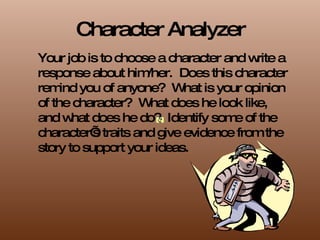
Character Analyzer
Your job is to choose a character and w a
                                        rite
response about him  /her. Does this character
rem you of anyone? W is your opinion
     ind                   hat
of the character? W does he look like,
                     hat
and w does he do? Identify som of the
       hat                          e
character’ traits and give evidence from the
           s
story to support your ideas.
A rtfu A rtis
                        l      t
Your job is to draw anything about the piece
you liked. You may also draw something as a
response to the reading.
     -Character
     -Setting
     -Problem
     -Exciting Part
     -Surprising Part

When your group meets, don’t say what your
drawing is. Let them guess and talk about it.
Then you can tell them about it.
Text Connector
Your job is to connect
the text to something
in life or to another
text. Does this story
remind you of
anything? Identify
whether your
connection is text to
text(TT) or text to life
(TL).
Summarizer
     Your job is to write a
     brief summary of the
     story. That means
     that you are retelling
     the key points in a
     shorter version.
     Include the main
     ideas, but leave out
     small details.
Word Finder
Write down any words you don’t know.
Also write down words the author used
that you think are especially interesting
or vivid. Use a dictionary to find word
meanings. When your group meets, help
your group members talk about the
words you have chosen.
Passage Picker
Y o u r jo b is t o p ic k p a r t s o f
t h e p ie c e t h a t y o u w a n t t o
r e a d a lo u d t o y o u r g r o u p .
Y o u m ig h t c h o o s e a :
   - G o o d P a rt             -
In t e r e s t in g P a r t
   - C o n f u s in g P a r t   - Fu n n y
P a rt
   - Im p o r t a n t P a r t   -
Re e b r:
  mm e
• Do your job with
excellence!
• Do your part to enable
your group to have a
meaningful conversation
about your book.
• Stay on topic as you talk.
• Share your ideas and enjoy

Literature Circles

  • 2.
    Literature Circles aresmall groups of students who meet together to talk about books they have read. • Each member of the group has a job with certain responsibilities. • If the group is to work effectively, each person must do his job. • Participation and self-control are important ingredients in successful Literature Circles.
  • 3.
    Discussion Director Your jobis to develop a list of questions that your group w w to discuss about the ill ant piece. Don’w t orry about the sm details; all your job is to help people talk over the big ideas in the reading and share feelings. Usually the best questions com from your e ow thoughts and ideas as you read. n
  • 4.
    Sample Questions •What wasgoing through your mind as you read this piece? •What was the topic or theme? •Did anything surprise you? •How did you feel about the characters?
  • 5.
    Character Analyzer Your jobis to choose a character and w a rite response about him /her. Does this character rem you of anyone? W is your opinion ind hat of the character? W does he look like, hat and w does he do? Identify som of the hat e character’ traits and give evidence from the s story to support your ideas.
  • 6.
    A rtfu Artis l t Your job is to draw anything about the piece you liked. You may also draw something as a response to the reading. -Character -Setting -Problem -Exciting Part -Surprising Part When your group meets, don’t say what your drawing is. Let them guess and talk about it. Then you can tell them about it.
  • 7.
    Text Connector Your jobis to connect the text to something in life or to another text. Does this story remind you of anything? Identify whether your connection is text to text(TT) or text to life (TL).
  • 8.
    Summarizer Your job is to write a brief summary of the story. That means that you are retelling the key points in a shorter version. Include the main ideas, but leave out small details.
  • 9.
    Word Finder Write downany words you don’t know. Also write down words the author used that you think are especially interesting or vivid. Use a dictionary to find word meanings. When your group meets, help your group members talk about the words you have chosen.
  • 10.
    Passage Picker Y ou r jo b is t o p ic k p a r t s o f t h e p ie c e t h a t y o u w a n t t o r e a d a lo u d t o y o u r g r o u p . Y o u m ig h t c h o o s e a : - G o o d P a rt - In t e r e s t in g P a r t - C o n f u s in g P a r t - Fu n n y P a rt - Im p o r t a n t P a r t -
  • 11.
    Re e br: mm e • Do your job with excellence! • Do your part to enable your group to have a meaningful conversation about your book. • Stay on topic as you talk. • Share your ideas and enjoy