

Reaching & Teaching
 Reluctant Readers


   Katie McKnight, Ph.D.
   Katie@KatherineMcKnight.com
    www.KatherineMcKnight.com
       Twitter: @LiteracyWorld
  Facebook: Katie McKnight Literacy
What do we know about
our students’ reading?


                   3
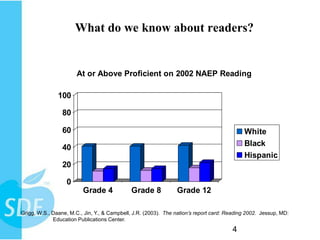
What do we know about readers?


                       At or Above Proficient on 2002 NAEP Reading

               100

                 80

                 60                                                                         White
                 40                                                                         Black
                                                                                            Hispanic
                 20

                  0
                         Grade 4             Grade 8            Grade 12

Grigg, W.S., Daane, M.C., Jin, Y., & Campbell, J.R. (2003). The nation’s report card: Reading 2002. Jessup, MD:
             Education Publications Center.
                                                                                       4
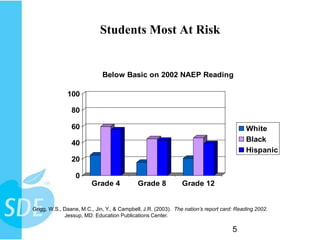
Students Most At Risk


                             Below Basic on 2002 NAEP Reading

              100

                80

                60                                                                       White
                40                                                                       Black
                                                                                         Hispanic
                20

                  0
                        Grade 4             Grade 8           Grade 12


Grigg, W.S., Daane, M.C., Jin, Y., & Campbell, J.R. (2003). The nation’s report card: Reading 2002.
             Jessup, MD: Education Publications Center.

                                                                                    5
Components of Reading
Alphabetics: understanding and using the sounds that
make up words (phonemic awareness) and the letters that
correspond to those sounds (decoding) and being able to
relate the letters and sounds to the particular words they
represent (word recognition)

Fluency: identifying words accurately in an effortless
manner and being able to read them in text with appropriate
intonation, stress and phrasing

Vocabulary: knowing and understanding the meanings of
words and using them with flexibility and precision

Comprehension: the process and product of constructing
meaning from what is read, involving an interaction between
a reader and a text, for a purpose and within a context
                                             6
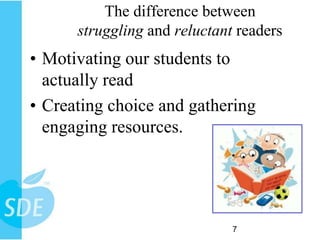
The difference between
      struggling and reluctant readers
• Motivating our students to
  actually read
• Creating choice and gathering
  engaging resources.


                              7
Let’s Look at Strategies

• Differentiated Instruction in
  Reading

• Getting Books in the Hands of
  Kids

• Multimodal Learning
                         8
Differentiation Strategies for
     Struggling Readers
• Provide readers who struggle to
  decode with opportunities to
  hear the text read aloud (tape
  assist)
• Give readers for whom word
  recognition is a problem
  supplemental materials that
  include visual clues to word
  meaning (or use manipulatives
  in math)
                        9
Differentiation Strategies for
        Struggling Readers
• Allot additional time for readers
  who struggle to complete
  assignments
• Encourage struggling readers to
  use the internet because often
  the symbols and icons that are
  quite bothersome to good
  readers provide a means for
  struggling readers to construct
  meaning
Reading and Recreational
            Reading
• “Reading ability is positively
  correlated with the extent to
  which students read
  recreationally.” -National
  Center for Education
  Statistics.


                        11
Activity
• Have you now or have you ever been a
  reluctant reader?


• What is your reading autobiography?


Please turn to 3-4 of your colleagues and
  discuss
                                  12
Why don’t kids read?
• By the time that kids reach middle school and
  high school, reluctant readers often:
   – Equate reading with failure
   – Connect reading to school-related
     tasks


                                  13
SOME STRATEGIES FOR
RELUCTANT READERS
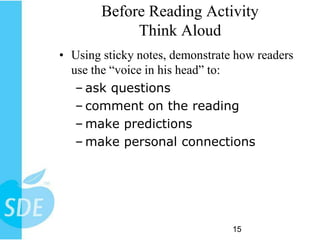
Before Reading Activity
             Think Aloud
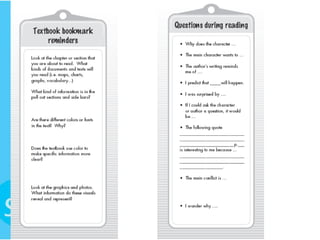
• Using sticky notes, demonstrate how readers
  use the “voice in his head” to:
   – ask questions
   – comment on the reading
   – make predictions
   – make personal connections


                                 15
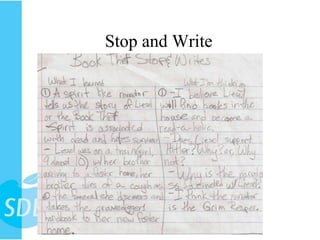
Stop and Write
Why Literature Circles?
It’s a translation of the adult reading group.
Offers a genuine and authentic reading
   experience.
Literature Circles are also known as book
   clubs, and reading groups.

(See my website for more materials on
  Literature Circles)


                                          18
Get Books in the Hands of Kids!

• Books that attract reluctant readers include:
  – A catchy cover
  – Print size is larger


                                           19
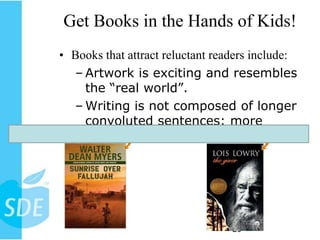
Get Books in the Hands of Kids!
• Books that attract reluctant readers include:
  – Artwork is exciting and resembles
    the “real world”.
  – Writing is not composed of longer
    convoluted sentences: more
    straightforward.


                                  20
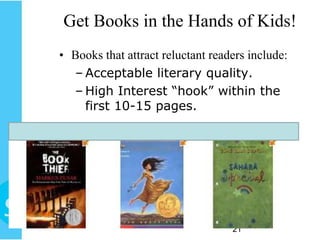
Get Books in the Hands of Kids!
• Books that attract reluctant readers include:
  – Acceptable literary quality.
  – High Interest “hook” within the
    first 10-15 pages.


                                   21
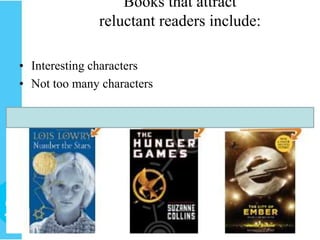
Books that attract
              reluctant readers include:

• Interesting characters
• Not too many characters


                                   22
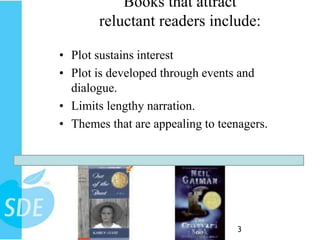
Books that attract
       reluctant readers include:

• Plot sustains interest
• Plot is developed through events and
  dialogue.
• Limits lengthy narration.
• Themes that are appealing to teenagers.


                                  23
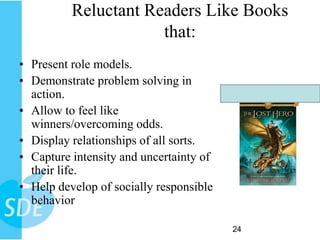
Reluctant Readers Like Books
                      that:
• Present role models.
• Demonstrate problem solving in
  action.
• Allow to feel like
  winners/overcoming odds.
• Display relationships of all sorts.
• Capture intensity and uncertainty of
  their life.
• Help develop of socially responsible
  behavior

                                         24
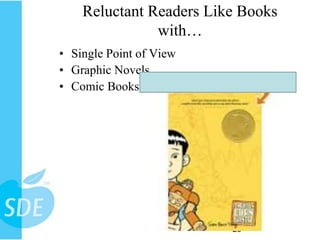
Reluctant Readers Like Books
               with…
• Single Point of View
• Graphic Novels
• Comic Books


                         25
Helping Reluctant Readers, Now
• Library Card
• Talking about books
• Talking about books in the classroom and in
  the school building
• Contests
• Allowing for Student Choice
• Keep current about books


                                 26
How to Reach Me
• Email: Katie@KatherineMcKnight.com
• Website: www.KatherineMcKnight.com

• Twitter: @literacyworld
• Facebook: Katie McKnight Literacy
For more materials and updated powerpoint, see
my blog at www.KatherineMcKnight.com
and http://goo.gl/J242X for additional
 materials.
                                 27

Reaching and Teaching Reluctant Readers

  • 1.
    Reaching & Teaching Reluctant Readers Katie McKnight, Ph.D. Katie@KatherineMcKnight.com www.KatherineMcKnight.com Twitter: @LiteracyWorld Facebook: Katie McKnight Literacy
  • 3.
    What do weknow about our students’ reading? 3
  • 4.
    What do weknow about readers? At or Above Proficient on 2002 NAEP Reading 100 80 60 White 40 Black Hispanic 20 0 Grade 4 Grade 8 Grade 12 Grigg, W.S., Daane, M.C., Jin, Y., & Campbell, J.R. (2003). The nation’s report card: Reading 2002. Jessup, MD: Education Publications Center. 4
  • 5.
    Students Most AtRisk Below Basic on 2002 NAEP Reading 100 80 60 White 40 Black Hispanic 20 0 Grade 4 Grade 8 Grade 12 Grigg, W.S., Daane, M.C., Jin, Y., & Campbell, J.R. (2003). The nation’s report card: Reading 2002. Jessup, MD: Education Publications Center. 5
  • 6.
    Components of Reading Alphabetics:understanding and using the sounds that make up words (phonemic awareness) and the letters that correspond to those sounds (decoding) and being able to relate the letters and sounds to the particular words they represent (word recognition) Fluency: identifying words accurately in an effortless manner and being able to read them in text with appropriate intonation, stress and phrasing Vocabulary: knowing and understanding the meanings of words and using them with flexibility and precision Comprehension: the process and product of constructing meaning from what is read, involving an interaction between a reader and a text, for a purpose and within a context 6
  • 7.
    The difference between struggling and reluctant readers • Motivating our students to actually read • Creating choice and gathering engaging resources. 7
  • 8.
    Let’s Look atStrategies • Differentiated Instruction in Reading • Getting Books in the Hands of Kids • Multimodal Learning 8
  • 9.
    Differentiation Strategies for Struggling Readers • Provide readers who struggle to decode with opportunities to hear the text read aloud (tape assist) • Give readers for whom word recognition is a problem supplemental materials that include visual clues to word meaning (or use manipulatives in math) 9
  • 10.
    Differentiation Strategies for Struggling Readers • Allot additional time for readers who struggle to complete assignments • Encourage struggling readers to use the internet because often the symbols and icons that are quite bothersome to good readers provide a means for struggling readers to construct meaning
  • 11.
    Reading and Recreational Reading • “Reading ability is positively correlated with the extent to which students read recreationally.” -National Center for Education Statistics. 11
  • 12.
    Activity • Have younow or have you ever been a reluctant reader? • What is your reading autobiography? Please turn to 3-4 of your colleagues and discuss 12
  • 13.
    Why don’t kidsread? • By the time that kids reach middle school and high school, reluctant readers often: – Equate reading with failure – Connect reading to school-related tasks 13
  • 14.
  • 15.
    Before Reading Activity Think Aloud • Using sticky notes, demonstrate how readers use the “voice in his head” to: – ask questions – comment on the reading – make predictions – make personal connections 15
  • 17.
  • 18.
    Why Literature Circles? It’sa translation of the adult reading group. Offers a genuine and authentic reading experience. Literature Circles are also known as book clubs, and reading groups. (See my website for more materials on Literature Circles) 18
  • 19.
    Get Books inthe Hands of Kids! • Books that attract reluctant readers include: – A catchy cover – Print size is larger 19
  • 20.
    Get Books inthe Hands of Kids! • Books that attract reluctant readers include: – Artwork is exciting and resembles the “real world”. – Writing is not composed of longer convoluted sentences: more straightforward. 20
  • 21.
    Get Books inthe Hands of Kids! • Books that attract reluctant readers include: – Acceptable literary quality. – High Interest “hook” within the first 10-15 pages. 21
  • 22.
    Books that attract reluctant readers include: • Interesting characters • Not too many characters 22
  • 23.
    Books that attract reluctant readers include: • Plot sustains interest • Plot is developed through events and dialogue. • Limits lengthy narration. • Themes that are appealing to teenagers. 23
  • 24.
    Reluctant Readers LikeBooks that: • Present role models. • Demonstrate problem solving in action. • Allow to feel like winners/overcoming odds. • Display relationships of all sorts. • Capture intensity and uncertainty of their life. • Help develop of socially responsible behavior 24
  • 25.
    Reluctant Readers LikeBooks with… • Single Point of View • Graphic Novels • Comic Books 25
  • 26.
    Helping Reluctant Readers,Now • Library Card • Talking about books • Talking about books in the classroom and in the school building • Contests • Allowing for Student Choice • Keep current about books 26
  • 27.
    How to ReachMe • Email: Katie@KatherineMcKnight.com • Website: www.KatherineMcKnight.com • Twitter: @literacyworld • Facebook: Katie McKnight Literacy For more materials and updated powerpoint, see my blog at www.KatherineMcKnight.com and http://goo.gl/J242X for additional materials. 27