INSTRUCTIONAL STRATEGY
NICOLE TERENZIO
EEX 4066
What are Literature Circles:
◦ "In literature circles, small groups of students gather together to
discuss a piece of literature in depth. The discussion is guided by
students' response to what they have read. You may hear talk about
events and characters in the book, the author's craft, or personal
experiences related to the story."
Schlick Noe, K. L. & Johnson. N.L., Getting Started with Literature
Circles , 1999 Christopher-Gordon Publishers, Inc. p. ix.
◦ http://olc.spsd.sk.ca/DE/PD/instr/strats/literaturecircles/index.html
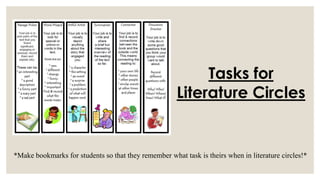
Tasks for
Literature Circles
*Make bookmarks for students so that they remember what task is theirs when in literature circles!*
Researcher:
◦ Literature circles were first implemented in the classroom in 1982 by Karen Smith at an elementary school in
Phoenix, Arizona.
◦ Once she created them she quickly forgot about them and never really used them. Her students however were
very interested in them. They formed reading groups on their own with no support from Ms. Smith and began
reading and eventually followed with a group discussion of what was read.
◦ They highlight discussion, student response, free choice, and collaboration, "providing a way for students to
engage in critical thinking and reflection" (Literature Circles Resource Center Schlick Noe, 2004).
◦ Research on literature circles is conducted primarily by Harvey Daniels (1994, 2002, 2004), Katherine L.
Schlick Noe (1995, 1999, 2001, 2003), Bonnie Campbell Hill (1995, 2001, 2003), and Nancy J. Johnson (1995,
1999, 2001); they are credited with most of the research and teacher resources around this approach to student
choice and reading; however, numerous other researchers, including Kathy Short and Kathryn Mitchell Pierce
(1990), Jerome Harste, Kathy Short and Carolyn Burke (1988), Katherine Samway (1991), Suzi Keegan and
Karen Shrake (1991) have conducted research and classroom-based studies. This approach to reading and
learning looks to some of the best practices and theory from collaborative learning and scaffolding
theory. Reader-response criticism, independent reading, and student-centered learning comprise most of the
theoretical underpinning of literature circles.
Content:
◦ Literature Circles can be used in all content areas of the classroom, based on the book
that is being read for the literature circles.
◦ Using literature circles for all content areas is a great idea. It will get the students
thinking about all different subjects and see the connection with reading is always
happening.
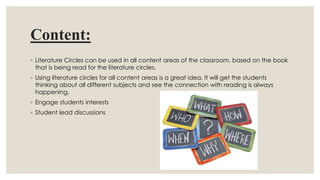
◦ Engage students interests
◦ Student lead discussions
Classroom Application:
◦ Children choose their own reading materials.
◦ Small temporary groups are formed, based on book choice.
◦ Different groups read different books
◦ Groups meet on a regular predictable schedule.
◦ Students use written or drawn notes to guide both their reading and
discussion.
◦ Discussion topics come from the students
◦ Group meetings aim to be open, natural conversations. Often the
conversations digress to topics relating to the students or loosely to the
books, but should eventually return to the novel.
◦ The teacher serves as a facilitator, observer, listener and often a fellow
reader, alongside the students. The teacher is not an instructor.
◦ Students are given roles or jobs to complete for each group meeting.
◦ The teacher should model how students should facilitate each role or job.
◦ Evaluation is by teacher observation and student self-evaluation and should
also include extension projects.
◦ A spirit of playfulness and fun pervades the room.
◦ New groups form around new reading choices.
Students are placed into literature circle
groups based on what they are interested in
reading. Teacher will pick a selection of
books to pitch to students and then students
will choose. They then are placed into those
groups where they will choose the job that
they want to do while in this group. This is a
way to help guide students discussions in
the groups until they are comfortable doing
it without the job cards. We basically want
students to be able to discuss and interact
with peers based on their views and
opinions of the book. How do they feel?
What did you think when this happened?
Asking lots of opinionated questions to
guide discussion.
Resources:
◦ http://olc.spsd.sk.ca/DE/PD/instr/strats/literaturecircles/index.html

Instructional strategy powerpoint terenzio

  • 1.
  • 2.
    What are LiteratureCircles: ◦ "In literature circles, small groups of students gather together to discuss a piece of literature in depth. The discussion is guided by students' response to what they have read. You may hear talk about events and characters in the book, the author's craft, or personal experiences related to the story." Schlick Noe, K. L. & Johnson. N.L., Getting Started with Literature Circles , 1999 Christopher-Gordon Publishers, Inc. p. ix. ◦ http://olc.spsd.sk.ca/DE/PD/instr/strats/literaturecircles/index.html
  • 3.
    Tasks for Literature Circles *Makebookmarks for students so that they remember what task is theirs when in literature circles!*
  • 4.
    Researcher: ◦ Literature circleswere first implemented in the classroom in 1982 by Karen Smith at an elementary school in Phoenix, Arizona. ◦ Once she created them she quickly forgot about them and never really used them. Her students however were very interested in them. They formed reading groups on their own with no support from Ms. Smith and began reading and eventually followed with a group discussion of what was read. ◦ They highlight discussion, student response, free choice, and collaboration, "providing a way for students to engage in critical thinking and reflection" (Literature Circles Resource Center Schlick Noe, 2004). ◦ Research on literature circles is conducted primarily by Harvey Daniels (1994, 2002, 2004), Katherine L. Schlick Noe (1995, 1999, 2001, 2003), Bonnie Campbell Hill (1995, 2001, 2003), and Nancy J. Johnson (1995, 1999, 2001); they are credited with most of the research and teacher resources around this approach to student choice and reading; however, numerous other researchers, including Kathy Short and Kathryn Mitchell Pierce (1990), Jerome Harste, Kathy Short and Carolyn Burke (1988), Katherine Samway (1991), Suzi Keegan and Karen Shrake (1991) have conducted research and classroom-based studies. This approach to reading and learning looks to some of the best practices and theory from collaborative learning and scaffolding theory. Reader-response criticism, independent reading, and student-centered learning comprise most of the theoretical underpinning of literature circles.
  • 5.
    Content: ◦ Literature Circlescan be used in all content areas of the classroom, based on the book that is being read for the literature circles. ◦ Using literature circles for all content areas is a great idea. It will get the students thinking about all different subjects and see the connection with reading is always happening. ◦ Engage students interests ◦ Student lead discussions
  • 6.
    Classroom Application: ◦ Childrenchoose their own reading materials. ◦ Small temporary groups are formed, based on book choice. ◦ Different groups read different books ◦ Groups meet on a regular predictable schedule. ◦ Students use written or drawn notes to guide both their reading and discussion. ◦ Discussion topics come from the students ◦ Group meetings aim to be open, natural conversations. Often the conversations digress to topics relating to the students or loosely to the books, but should eventually return to the novel. ◦ The teacher serves as a facilitator, observer, listener and often a fellow reader, alongside the students. The teacher is not an instructor. ◦ Students are given roles or jobs to complete for each group meeting. ◦ The teacher should model how students should facilitate each role or job. ◦ Evaluation is by teacher observation and student self-evaluation and should also include extension projects. ◦ A spirit of playfulness and fun pervades the room. ◦ New groups form around new reading choices. Students are placed into literature circle groups based on what they are interested in reading. Teacher will pick a selection of books to pitch to students and then students will choose. They then are placed into those groups where they will choose the job that they want to do while in this group. This is a way to help guide students discussions in the groups until they are comfortable doing it without the job cards. We basically want students to be able to discuss and interact with peers based on their views and opinions of the book. How do they feel? What did you think when this happened? Asking lots of opinionated questions to guide discussion.
  • 7.