Literature Circles
 
Literature Circles: Literature circles bring together two ideas: Independent reading Cooperative learning
What are Literature Circles? Literature Circles are small, temporary discussion groups of students who are reading the same piece of literature.
What are Literature Circles? Literature circles give students an opportunity to work independently (reading and activities) and cooperatively (discussion groups)
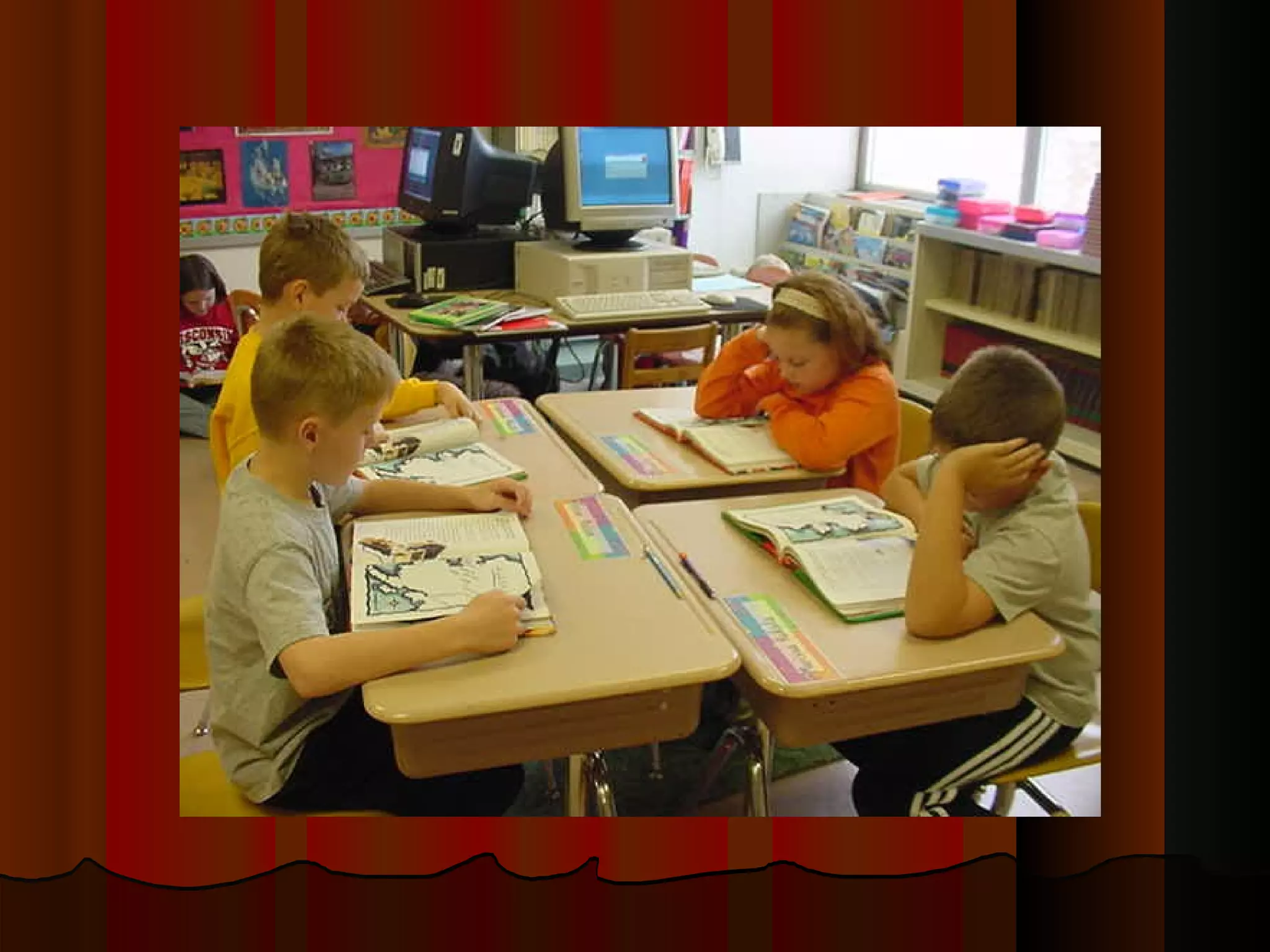
What do students do in literature circles? Read independently or with their group Participate in group discussions Each group member will have a specific responsibility during discussion sessions The circles will meet daily/weekly and the discussion roles change at each meeting
How do Literature Circles Work? Students all read the same text (in groups) The text genre can vary (short story, novel, textbooks, brochures, internet documents) Texts which evoke more than one interpretation or connection are usually more successful Everyone is free to offer comments and questions
Distinctive Features of Literature Circles: Students choose their own reading materials Small temporary groups are formed based on book choice Different groups read different books Groups meet on a regular, predictable schedule to discuss their reading Students use written or drawn notes to guide their reading and discussion Discussion topics come from students
Distinctive Features of Literature Circles: Group meetings are open, natural conversations about books Teacher is a facilitator, not a group member or instructor Evaluation is by teacher observation and student self-evaluation Readers share with their classmates when books are finished
Role of the Teacher The teacher is a model. The teacher helps students to participate in conversations. The teacher helps move the conversation forward.
Possible Discussion Roles: Summarizer Discussion Director Passage Master Word Wizard Connector Illustrator
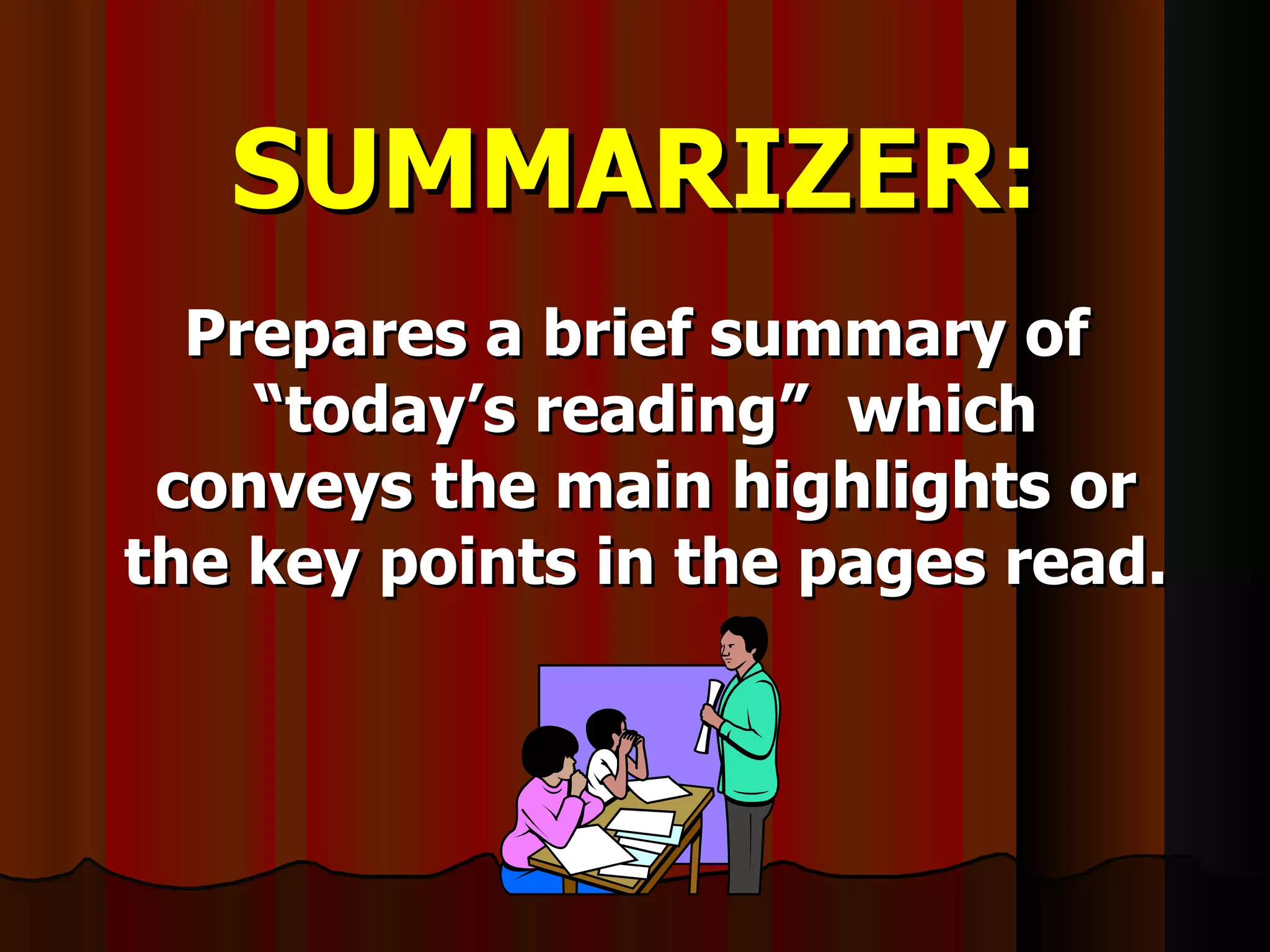
SUMMARIZER: Prepares a brief summary of  “today’s reading”  which conveys the main highlights or the key points in the pages read.
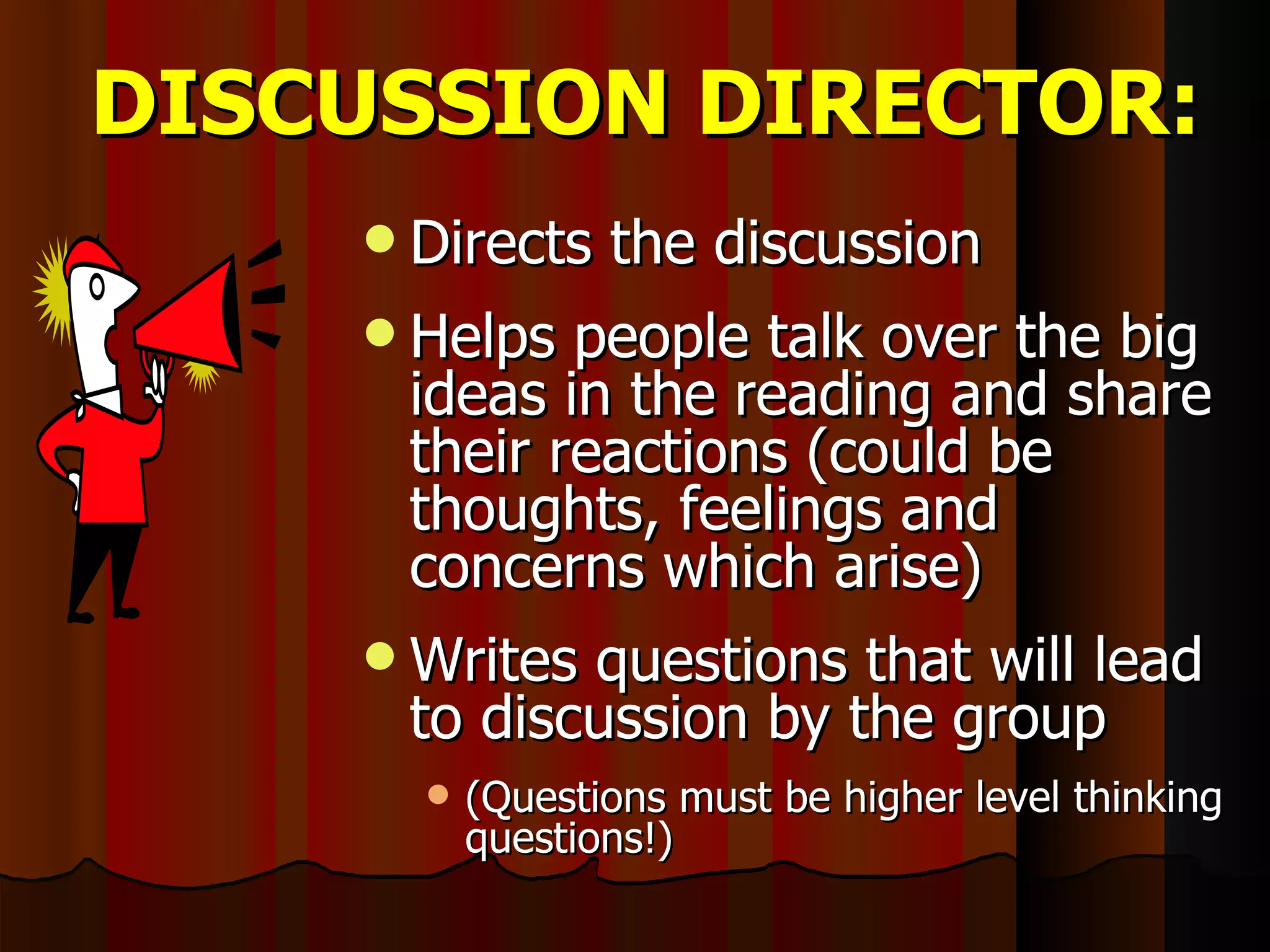
DISCUSSION DIRECTOR: Directs the discussion Helps people talk over the big ideas in the reading and share their reactions (could be thoughts, feelings and concerns which arise) Writes questions that will lead to discussion by the group (Questions must be higher level thinking questions!)
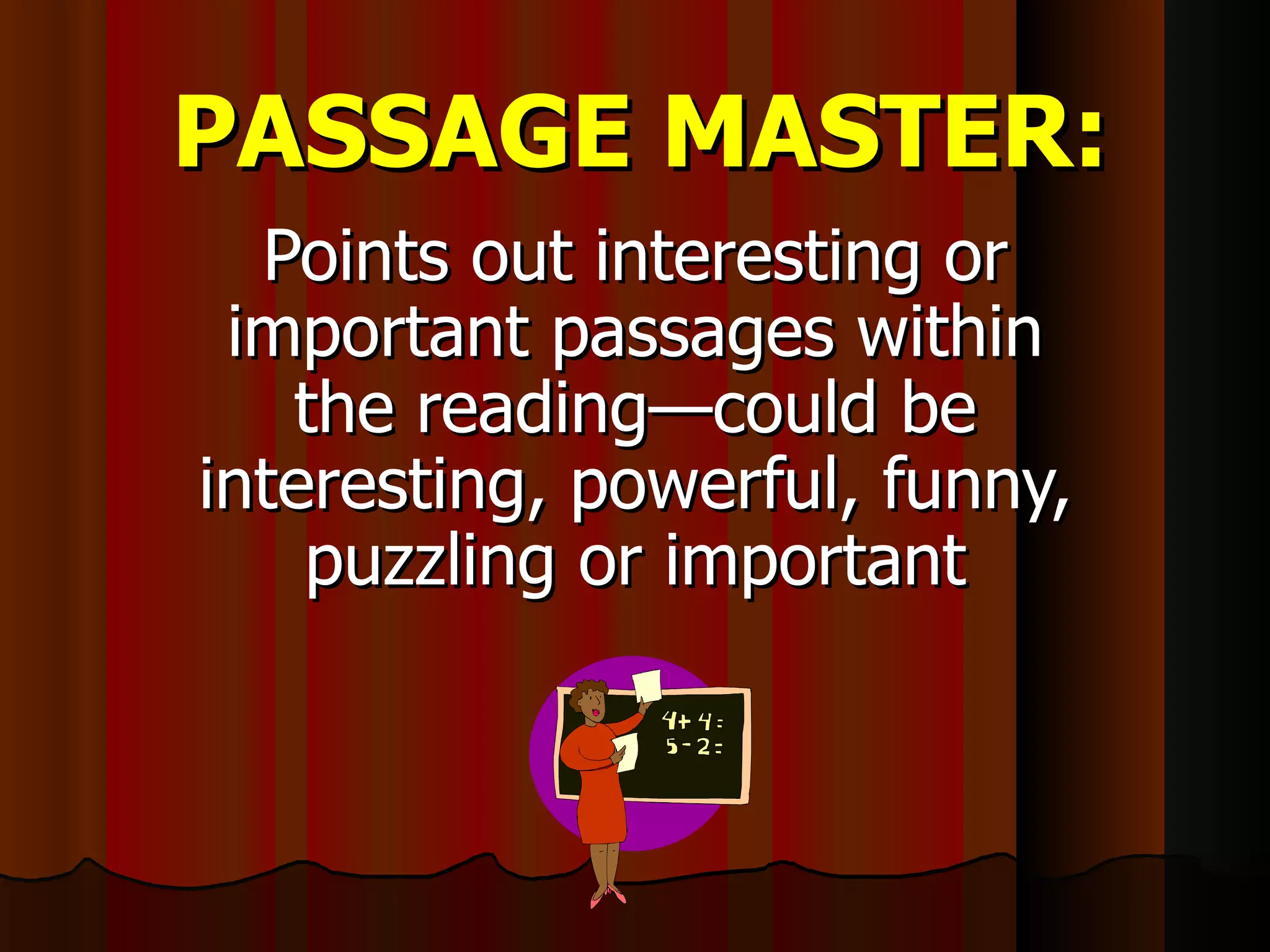
PASSAGE MASTER: Points out interesting or important passages within the reading—could be interesting, powerful, funny, puzzling or important
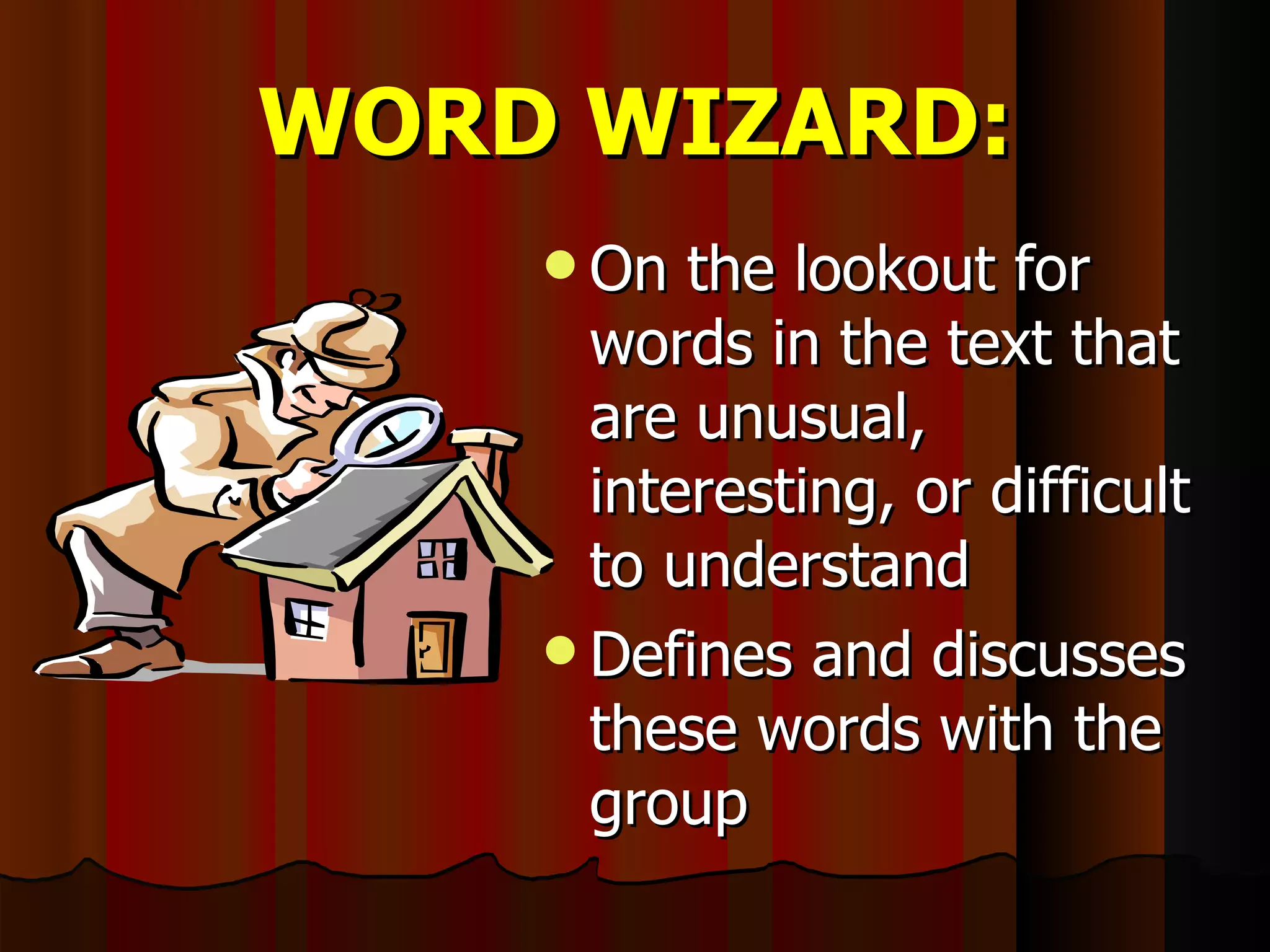
WORD WIZARD: On the lookout for words in the text that are unusual, interesting, or difficult to understand Defines and discusses these words with the group
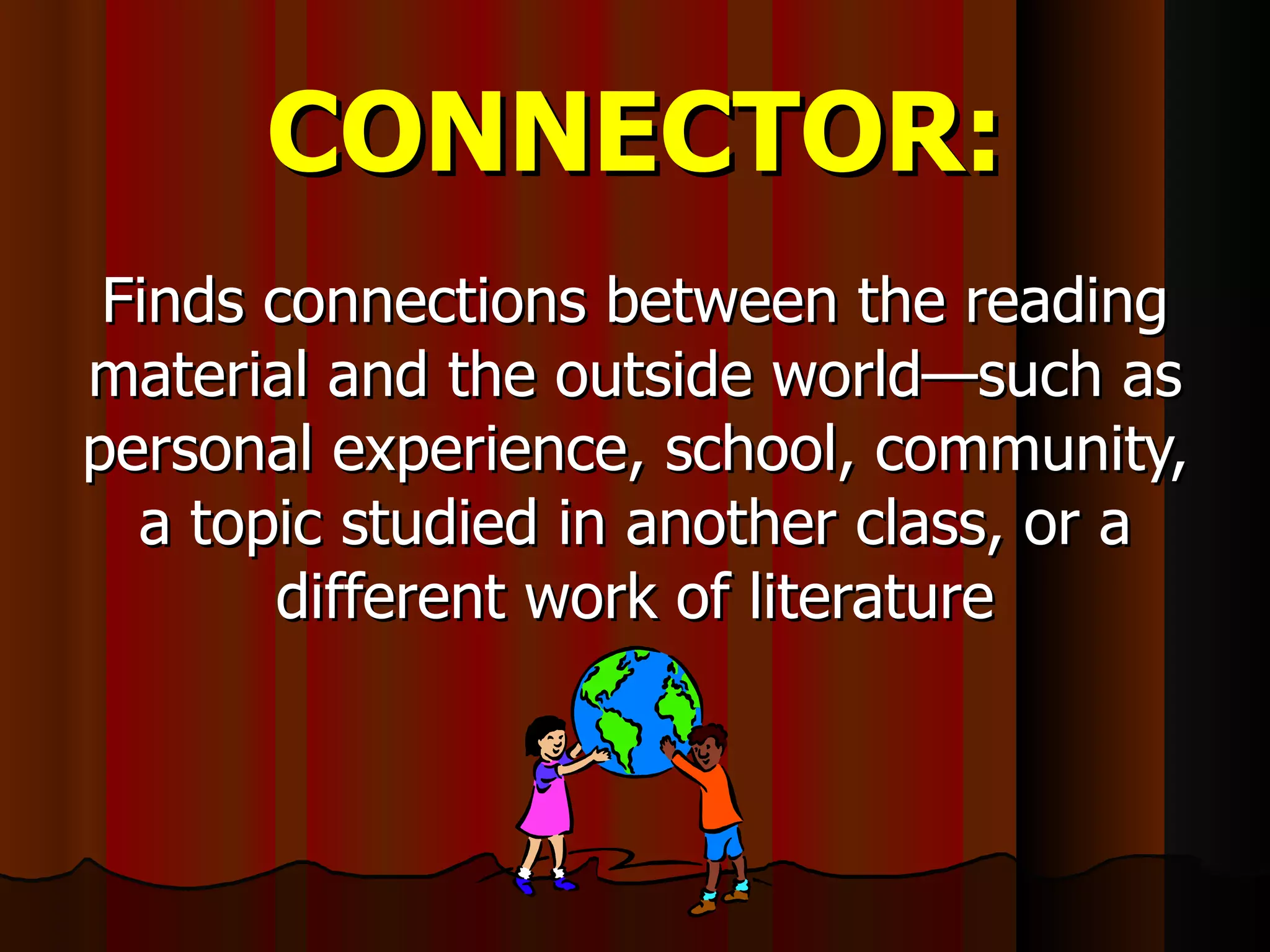
CONNECTOR: Finds connections between the reading material and the outside world—such as personal experience, school, community, a topic studied in another class, or a different work of literature
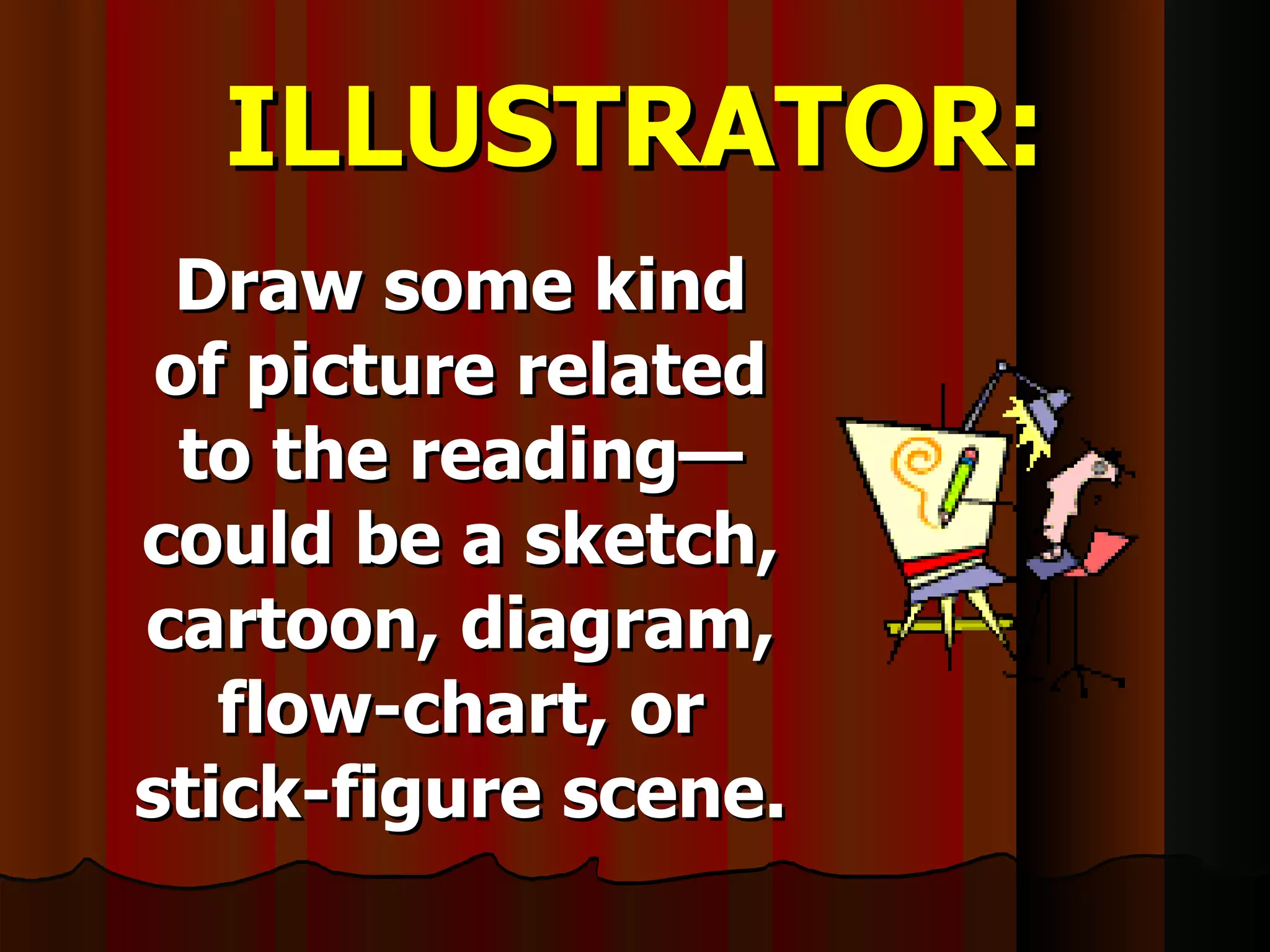
ILLUSTRATOR: Draw some kind of picture related to the reading—could be a sketch, cartoon, diagram, flow-chart, or stick-figure scene.
What are higher level thinking questions? Questions that cannot be answered with just yes or no Requires thought by each member of the group Goes beyond the “W” questions
Good Discussion Starters How did you feel about… What would you have done if… How are you like or unlike the main character?
Good Discussion Starters What would you have done differently than the main character? What did you think about… Which character do you best relate to and why?
What should students do in the discussion groups? STUDENTS SHOULD: Actively participate Explain their role to the group, ask group members questions, and answer questions from each group member Ask for clarification on any material that may have been confusing
How will class time be used? On literature circle day, the first 15-20 minutes will be spent in discussion groups to give the students the opportunity to share their job responsibilities with the group from the previous day’s reading. New jobs and reading assignments will be assigned for the next class meeting Reading the text individually or as a group Working on activities dealing with the text
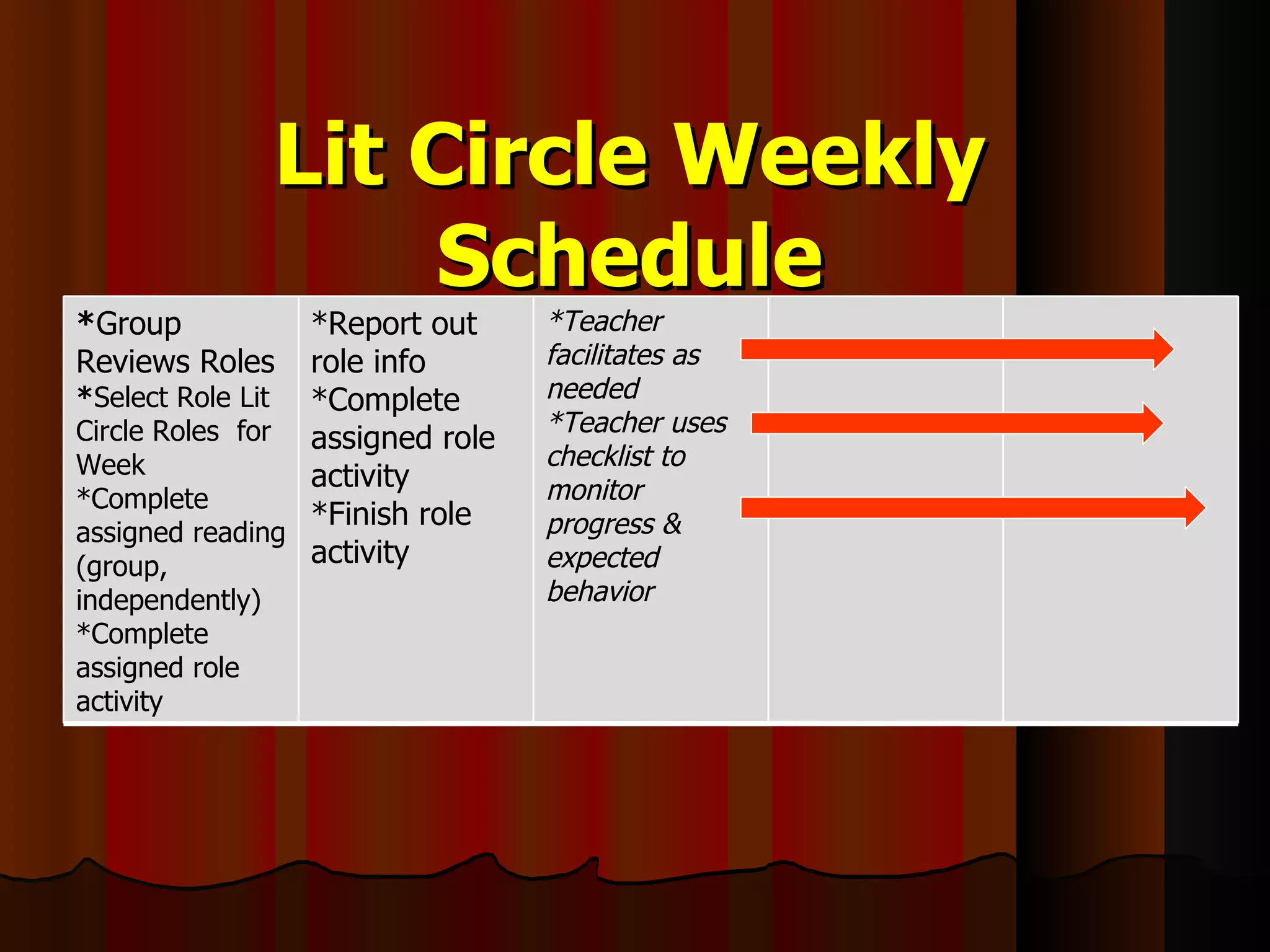
Lit Circle Weekly Schedule * Group Reviews Roles * Select Role Lit Circle Roles  for Week *Complete assigned reading (group, independently) *Complete assigned role activity *Report out role info *Complete assigned role activity *Finish role activity *Teacher facilitates as needed *Teacher uses checklist to monitor progress & expected behavior
How much time should be allowed for each book? It should take about 3-4 weeks for each book to be read
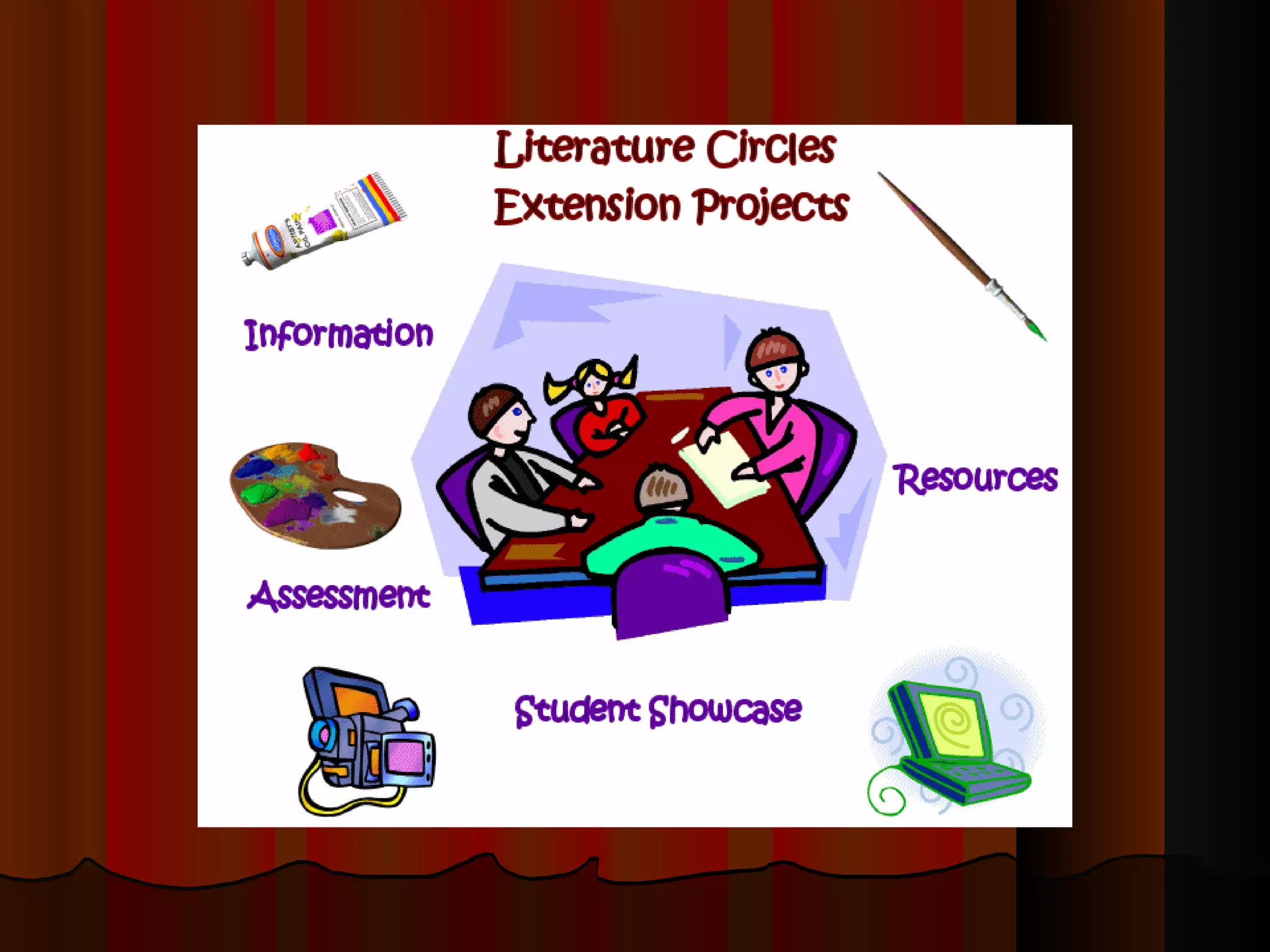
To achieve these outcomes, the students will: Choose a book Play a role in discussions of the book Keep a group folder to organize role assignments.  Each group will present a end product. (digital story, poster, book talk, picture book…)
How will students be graded? Students will be graded on: Daily job completion Group discussions Final project/presentation Self evaluate
It is important for students to: Participate!! Keep up with their reading assignments Keep up with their role in the group Respect others and their opinions Treat group members in a positive way—the way they want to be treated
 

Learning circles 5 6

  • 1.
  • 2.
  • 3.
    Literature Circles: Literaturecircles bring together two ideas: Independent reading Cooperative learning
  • 4.
    What are LiteratureCircles? Literature Circles are small, temporary discussion groups of students who are reading the same piece of literature.
  • 5.
    What are LiteratureCircles? Literature circles give students an opportunity to work independently (reading and activities) and cooperatively (discussion groups)
  • 6.
    What do studentsdo in literature circles? Read independently or with their group Participate in group discussions Each group member will have a specific responsibility during discussion sessions The circles will meet daily/weekly and the discussion roles change at each meeting
  • 7.
    How do LiteratureCircles Work? Students all read the same text (in groups) The text genre can vary (short story, novel, textbooks, brochures, internet documents) Texts which evoke more than one interpretation or connection are usually more successful Everyone is free to offer comments and questions
  • 8.
    Distinctive Features ofLiterature Circles: Students choose their own reading materials Small temporary groups are formed based on book choice Different groups read different books Groups meet on a regular, predictable schedule to discuss their reading Students use written or drawn notes to guide their reading and discussion Discussion topics come from students
  • 9.
    Distinctive Features ofLiterature Circles: Group meetings are open, natural conversations about books Teacher is a facilitator, not a group member or instructor Evaluation is by teacher observation and student self-evaluation Readers share with their classmates when books are finished
  • 10.
    Role of theTeacher The teacher is a model. The teacher helps students to participate in conversations. The teacher helps move the conversation forward.
  • 11.
    Possible Discussion Roles:Summarizer Discussion Director Passage Master Word Wizard Connector Illustrator
  • 12.
    SUMMARIZER: Prepares abrief summary of “today’s reading” which conveys the main highlights or the key points in the pages read.
  • 13.
    DISCUSSION DIRECTOR: Directsthe discussion Helps people talk over the big ideas in the reading and share their reactions (could be thoughts, feelings and concerns which arise) Writes questions that will lead to discussion by the group (Questions must be higher level thinking questions!)
  • 14.
    PASSAGE MASTER: Pointsout interesting or important passages within the reading—could be interesting, powerful, funny, puzzling or important
  • 15.
    WORD WIZARD: Onthe lookout for words in the text that are unusual, interesting, or difficult to understand Defines and discusses these words with the group
  • 16.
    CONNECTOR: Finds connectionsbetween the reading material and the outside world—such as personal experience, school, community, a topic studied in another class, or a different work of literature
  • 17.
    ILLUSTRATOR: Draw somekind of picture related to the reading—could be a sketch, cartoon, diagram, flow-chart, or stick-figure scene.
  • 18.
    What are higherlevel thinking questions? Questions that cannot be answered with just yes or no Requires thought by each member of the group Goes beyond the “W” questions
  • 19.
    Good Discussion StartersHow did you feel about… What would you have done if… How are you like or unlike the main character?
  • 20.
    Good Discussion StartersWhat would you have done differently than the main character? What did you think about… Which character do you best relate to and why?
  • 21.
    What should studentsdo in the discussion groups? STUDENTS SHOULD: Actively participate Explain their role to the group, ask group members questions, and answer questions from each group member Ask for clarification on any material that may have been confusing
  • 22.
    How will classtime be used? On literature circle day, the first 15-20 minutes will be spent in discussion groups to give the students the opportunity to share their job responsibilities with the group from the previous day’s reading. New jobs and reading assignments will be assigned for the next class meeting Reading the text individually or as a group Working on activities dealing with the text
  • 23.
    Lit Circle WeeklySchedule * Group Reviews Roles * Select Role Lit Circle Roles for Week *Complete assigned reading (group, independently) *Complete assigned role activity *Report out role info *Complete assigned role activity *Finish role activity *Teacher facilitates as needed *Teacher uses checklist to monitor progress & expected behavior
  • 24.
    How much timeshould be allowed for each book? It should take about 3-4 weeks for each book to be read
  • 25.
    To achieve theseoutcomes, the students will: Choose a book Play a role in discussions of the book Keep a group folder to organize role assignments. Each group will present a end product. (digital story, poster, book talk, picture book…)
  • 26.
    How will studentsbe graded? Students will be graded on: Daily job completion Group discussions Final project/presentation Self evaluate
  • 27.
    It is importantfor students to: Participate!! Keep up with their reading assignments Keep up with their role in the group Respect others and their opinions Treat group members in a positive way—the way they want to be treated
  • 28.