When I say “Graphic Novel”
What do you think of?
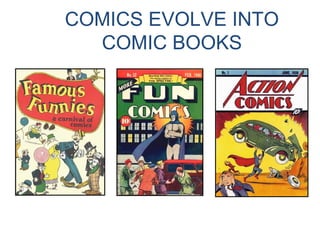
COMICS EVOLVE INTO
COMIC BOOKS
Grab a little attention . . .
Use Graphic Novels
In your classroom
Bayeux Tapestry
Graphic Novel or Comic Book?
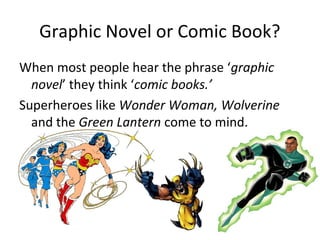
When most people hear the phrase ‘graphic
novel’ they think ‘comic books.’
Superheroes like Wonder Woman, Wolverine
and the Green Lantern come to mind.
CREATION AND EVOLUTION OF THE
GRAPHIC NOVEL GENRE
• Will Eisner receives credit for publishing the first
graphic novel “A Contract with God” in 1978.
• Eisner claims to have created the phrase “graphic
novel” as a spontaneous marketing term used to
convince his publisher to print his work. However,
the term is said to have been used by comic fans
in the 1960s.
• Art Spiegelman receives the Pulitzer Prize in 1992
for “Maus: A Survivor’s Tale” about his father’s
struggle to survive the Holocaust.
• “Road to Perdition” - possibly best known graphic
novel for Western audiences - published in 1998
and eventually made into major motion picture.
Graphic Novel or Comic Book?
Graphic Novels are different from Comic Books iN a
few important ways:
• Comic Books are usually a ‘series.’ That means they are
intended to come up with new stories every month.
• Graphic Novels are one story (told in perhaps two or more
volumes) that reach the end and stop.
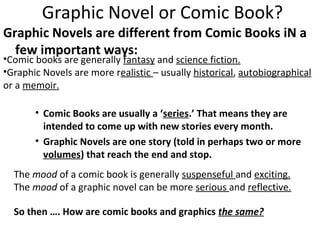
•Comic books are generally fantasy and science fiction.
•Graphic Novels are more realistic – usually historical, autobiographical
or a memoir.
The mood of a comic book is generally suspenseful and exciting.
The mood of a graphic novel can be more serious and reflective.
So then …. How are comic books and graphics the same?
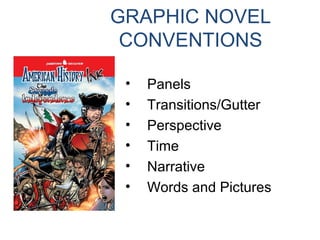
GRAPHIC NOVEL
CONVENTIONS
• Panels
• Transitions/Gutter
• Perspective
• Time
• Narrative
• Words and Pictures
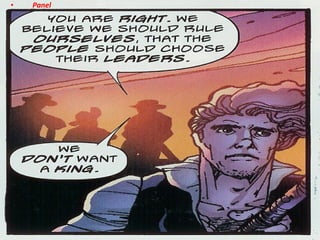
• Panel
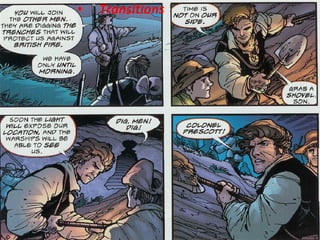
• Transitions
6 Types of Transitions
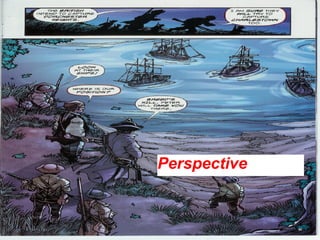
Perspective
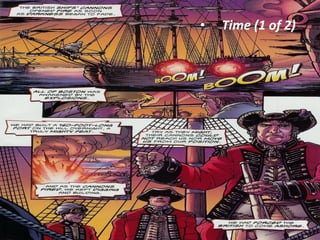
• Time (1 of 2)
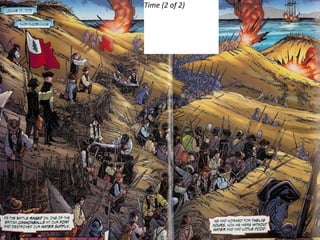
Time (2 of 2)
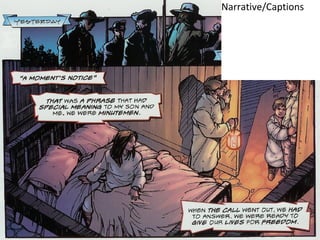
Narrative/Captions
Words and Pictures
Maus: The “Flow” of the Story
Graphic novels rely on pictures and words to tell
the story. These pictures and words are in
panels.
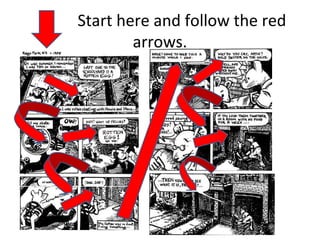
• Panels are the boxes in which the pictures and words
appear.
• The panels are read in sequence like the way you read
the words of a page in a regular book.
• Now you will look at two pages of MAUS – Don’t worry
about reading the words, just follow the directions so you
know how to move your eyes across the page.
Graphic novels are like regular stories. They have a
plot, characters , settings and all the other elements in
stories we read in regular books.
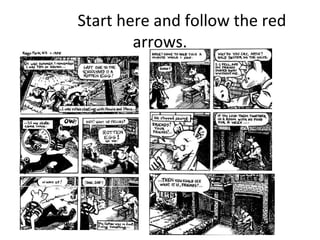
Start here and follow the red
arrows.
Start here and follow the red
arrows.
Graphic Novel: The Parts of the Story
• Graphic novels are like regular stories – they
have a plot, characters and all the other parts
of a regular story.
• A caption is information from the author that
gives us important information about the
setting or what a character is experiencing.
• Sometimes a “caption” can appear inside –or outside -
the panel.
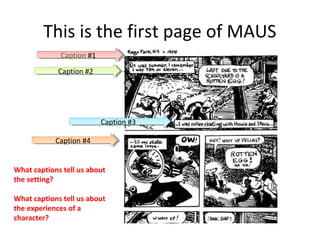
This is the first page of MAUS
Caption #1Caption #1
Caption #2Caption #2
Caption #3Caption #3
Caption #4Caption #4
What captions tell us about
the setting?
What captions tell us about
the experiences of a
character?
Graphic Novel: The Parts of the Story
• Another important part of a graphic novel is
dialogue.
– Dialogue is what characters say to each other.
Dialogue is conveyed through word balloons.
Each word balloon has a “tail” to let you know
what character is talking.
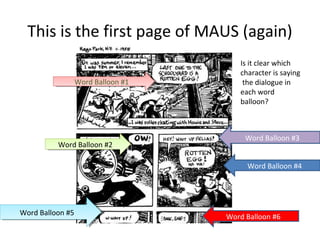
This is the first page of MAUS (again)
Word Balloon #1Word Balloon #1
Word Balloon #2Word Balloon #2
Word Balloon #5Word Balloon #5
Word Balloon #3
Word Balloon #4
Word Balloon #6
Is it clear which
character is saying
the dialogue in
each word
balloon?
MAUS: What to look for in words and
pictures
• In the captions and word balloons, some
words are emphasized by being bigger or
bolder.
• This lets the reader know that there is a lot of
emotion behind these words.
• Look at Page One again and identify the
emphasized words.
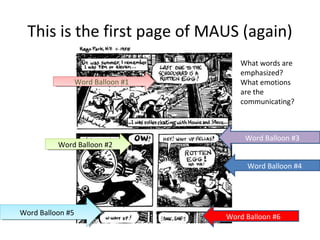
This is the first page of MAUS (again)
Word Balloon #1Word Balloon #1
Word Balloon #2Word Balloon #2
Word Balloon #5Word Balloon #5
Word Balloon #3
Word Balloon #4
Word Balloon #6
What words are
emphasized?
What emotions
are the
communicating?
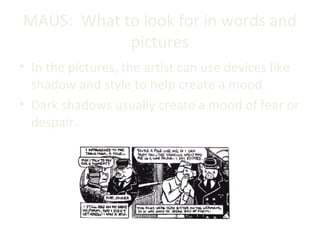
MAUS: What to look for in words and
pictures
• In the pictures, the artist can use devices like
shadow and style to help create a mood.
• Dark shadows usually create a mood of fear or
despair.
MAUS: What to look for in words and
pictures
• The style of the art can also help connect the
creator to the reader.
• In this story, we find out very early the
author’s mother killed herself.
• Later on, he tries to tell that story by
dramatically changing the style – the way – he
creates the art.
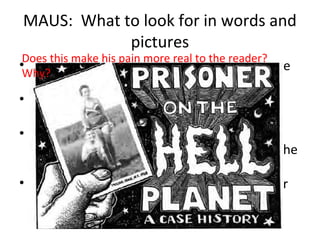
• He even uses an actual picture of his mother
with him when he was a small boy.
Does this make his pain more real to the reader?
Why?
Graphic novel
Graphic novel

Graphic novel

  • 1.
    When I say“Graphic Novel” What do you think of?
  • 2.
  • 3.
    Grab a littleattention . . . Use Graphic Novels In your classroom
  • 5.
  • 6.
    Graphic Novel orComic Book? When most people hear the phrase ‘graphic novel’ they think ‘comic books.’ Superheroes like Wonder Woman, Wolverine and the Green Lantern come to mind.
  • 7.
    CREATION AND EVOLUTIONOF THE GRAPHIC NOVEL GENRE • Will Eisner receives credit for publishing the first graphic novel “A Contract with God” in 1978. • Eisner claims to have created the phrase “graphic novel” as a spontaneous marketing term used to convince his publisher to print his work. However, the term is said to have been used by comic fans in the 1960s. • Art Spiegelman receives the Pulitzer Prize in 1992 for “Maus: A Survivor’s Tale” about his father’s struggle to survive the Holocaust. • “Road to Perdition” - possibly best known graphic novel for Western audiences - published in 1998 and eventually made into major motion picture.
  • 8.
    Graphic Novel orComic Book? Graphic Novels are different from Comic Books iN a few important ways: • Comic Books are usually a ‘series.’ That means they are intended to come up with new stories every month. • Graphic Novels are one story (told in perhaps two or more volumes) that reach the end and stop. •Comic books are generally fantasy and science fiction. •Graphic Novels are more realistic – usually historical, autobiographical or a memoir. The mood of a comic book is generally suspenseful and exciting. The mood of a graphic novel can be more serious and reflective. So then …. How are comic books and graphics the same?
  • 9.
    GRAPHIC NOVEL CONVENTIONS • Panels •Transitions/Gutter • Perspective • Time • Narrative • Words and Pictures
  • 10.
  • 11.
  • 12.
    6 Types ofTransitions
  • 13.
  • 14.
  • 15.
  • 16.
  • 18.
  • 19.
    Maus: The “Flow”of the Story Graphic novels rely on pictures and words to tell the story. These pictures and words are in panels. • Panels are the boxes in which the pictures and words appear. • The panels are read in sequence like the way you read the words of a page in a regular book. • Now you will look at two pages of MAUS – Don’t worry about reading the words, just follow the directions so you know how to move your eyes across the page. Graphic novels are like regular stories. They have a plot, characters , settings and all the other elements in stories we read in regular books.
  • 20.
    Start here andfollow the red arrows.
  • 21.
    Start here andfollow the red arrows.
  • 22.
    Graphic Novel: TheParts of the Story • Graphic novels are like regular stories – they have a plot, characters and all the other parts of a regular story. • A caption is information from the author that gives us important information about the setting or what a character is experiencing. • Sometimes a “caption” can appear inside –or outside - the panel.
  • 23.
    This is thefirst page of MAUS Caption #1Caption #1 Caption #2Caption #2 Caption #3Caption #3 Caption #4Caption #4 What captions tell us about the setting? What captions tell us about the experiences of a character?
  • 24.
    Graphic Novel: TheParts of the Story • Another important part of a graphic novel is dialogue. – Dialogue is what characters say to each other. Dialogue is conveyed through word balloons. Each word balloon has a “tail” to let you know what character is talking.
  • 25.
    This is thefirst page of MAUS (again) Word Balloon #1Word Balloon #1 Word Balloon #2Word Balloon #2 Word Balloon #5Word Balloon #5 Word Balloon #3 Word Balloon #4 Word Balloon #6 Is it clear which character is saying the dialogue in each word balloon?
  • 26.
    MAUS: What tolook for in words and pictures • In the captions and word balloons, some words are emphasized by being bigger or bolder. • This lets the reader know that there is a lot of emotion behind these words. • Look at Page One again and identify the emphasized words.
  • 27.
    This is thefirst page of MAUS (again) Word Balloon #1Word Balloon #1 Word Balloon #2Word Balloon #2 Word Balloon #5Word Balloon #5 Word Balloon #3 Word Balloon #4 Word Balloon #6 What words are emphasized? What emotions are the communicating?
  • 28.
    MAUS: What tolook for in words and pictures • In the pictures, the artist can use devices like shadow and style to help create a mood. • Dark shadows usually create a mood of fear or despair.
  • 29.
    MAUS: What tolook for in words and pictures • The style of the art can also help connect the creator to the reader. • In this story, we find out very early the author’s mother killed herself. • Later on, he tries to tell that story by dramatically changing the style – the way – he creates the art. • He even uses an actual picture of his mother with him when he was a small boy. Does this make his pain more real to the reader? Why?

Editor's Notes

  • #3 What is the difference between comic books and graphic novels? Graphic novels deal with complex and many times controversial issues.
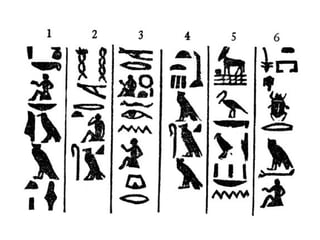
  • #4 Human beings have a long history of using graphics/pictures to communicate meaning. Graphic Novels rise out of this tradition.
  • #10 Understanding the conventions of a graphic novel helps both the student and teacher access the text and enjoy the story. Looking for conventions helps students hone their critical thinking skills and puts them into a learning relationship with the text they are reading.
  • #11 Panel – the story is told through a series of panels that contain bits of information; each panel represents a single moment in time and space.
  • #12 The space between panels is known as the gutter; panels transition from left to right and/or top to bottom; there are four main kinds of panel transitions. Make sure to point out here some variations of this theme – when smaller panels appear inside larger ones, when a two page spread is sometimes read across the top and then goes to the bottom. *Highlight the unique gutter on pages 3 and 19 used to show character going in and out of consciousness. moment to moment (same subject/ continuous movement) (There is not a good example in The Struggle for Independence. They will see this later in the seminar in UGRR.) action to action (same subject/ continuous action); (pg 6) subject to subject ( different subjects/ continuous scene); (pg 9) scene to scene (different or same subject/different scenes). (pg 4-5)
  • #13 The space between panels is known as the gutter; panels transition from left to right and/or top to bottom; there are four main kinds of panel transitions. Make sure to point out here some variations of this theme – when smaller panels appear inside larger ones, when a two page spread is sometimes read across the top and then goes to the bottom. *Highlight the unique gutter on pages 3 and 19 used to show character going in and out of consciousness. moment to moment (same subject/ continuous movement) (There is not a good example in The Struggle for Independence. They will see this later in the seminar in UGRR.) action to action (same subject/ continuous action); (pg 6) subject to subject ( different subjects/ continuous scene); (pg 9) scene to scene (different or same subject/different scenes). (pg 4-5)
  • #14 Perspective may be thought of as the angle at which we view the picture; it refers to the reader’s physical point of view such as looking down from above as seen on this page; changing perspective is a technique that the author or artist uses to maintain visual interest and for specific effects.
  • #15 The passage of time is suggested by changing the perspective of the panels and also by using color for a visual impact( note the colors of the sky in these panels then the change in the next panel.)
  • #16 The passage of time is suggested by changing the perspective of the panels and also by using color for a visual impact.
  • #17 Narrative has two parts: thought bubbles and speech bubbles; a thought bubble can be objective and is usually highlighted and answers the question who, what, or when, or the narrative discourse is subjective relating thoughts or feelings from a character. Different colors in thought bubbles can show thoughts of different characters.
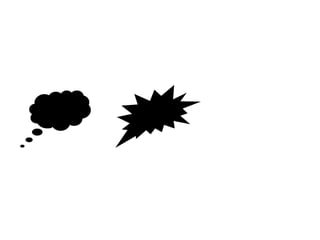
  • #18 Different types of speech bubbles (what does each indicate?) 1. thinking 2. explosive idea/anger 3. whispering
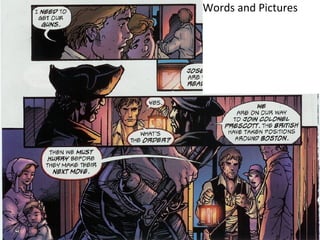
  • #19 The narrative is conveyed by the interplay of words and pictures; Words in a speech bubble carry a message and print type and font are used to express emotion; the words and pictures work together to provide a more complex message than either could alone.