Differentiated Instruction: Content
Literacy Centers for Mathematics,
          Social Science
            and Science

              Katie McKnight, Ph.D.
         Katie@KatherineMcKnight.com
What we will do in this
             session….
 Introduce learning centers as an instructional tool for
  mathematics, social science, and science.

 Examine a wide variety of content literacy focused
  learning centers for mathematics, social science, and
  science.

 Discuss assessment strategies for learning centers.
Some Reminders about
  Content Literacy
Assumptions Underlying Content
            Literacy


 Subject Matter
 Role of the Textbook
 Active Readers
 Independent Readers
What is Content Literacy?
 Generally defined as “the ability
 to use reading and writing for
 the acquisition of new content in
 a given discipline” (McKenna &
 Robinson, 1990, p. 184)
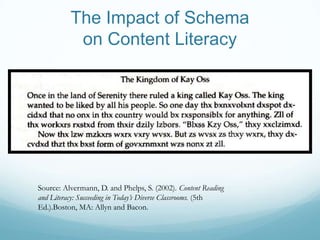
The Impact of Schema
           on Content Literacy


Source: Alvermann, D. and Phelps, S. (2002). Content Reading
and Literacy: Succeeding in Today’s Diverse Classrooms. (5th
Ed.).Boston, MA: Allyn and Bacon.
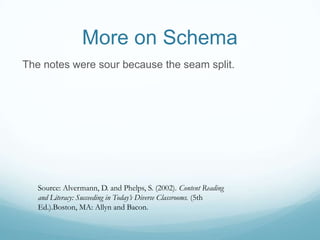
More on Schema
The notes were sour because the seam split.


   Source: Alvermann, D. and Phelps, S. (2002). Content Reading
   and Literacy: Succeeding in Today’s Diverse Classrooms. (5th
   Ed.).Boston, MA: Allyn and Bacon.
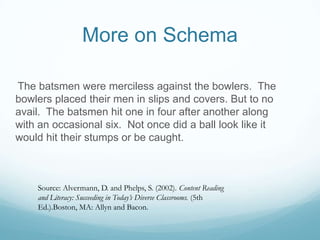
More on Schema

The batsmen were merciless against the bowlers. The
bowlers placed their men in slips and covers. But to no
avail. The batsmen hit one in four after another along
with an occasional six. Not once did a ball look like it
would hit their stumps or be caught.


    Source: Alvermann, D. and Phelps, S. (2002). Content Reading
    and Literacy: Succeeding in Today’s Diverse Classrooms. (5th
    Ed.).Boston, MA: Allyn and Bacon.
What do we know about
our students‟ reading?


                         9
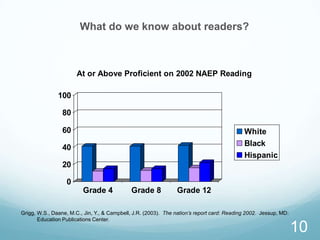
What do we know about readers?


                       At or Above Proficient on 2002 NAEP Reading

               100

                 80

                 60                                                                         White
                 40                                                                         Black
                                                                                            Hispanic
                 20

                  0
                         Grade 4             Grade 8            Grade 12

Grigg, W.S., Daane, M.C., Jin, Y., & Campbell, J.R. (2003). The nation’s report card: Reading 2002. Jessup, MD:
       Education Publications Center.

                                                                                                                  10
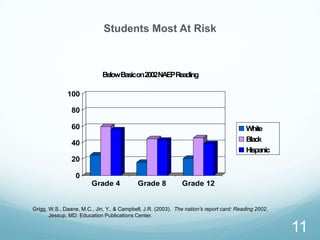
Students Most At Risk


                             BelowBasicon2002NAEPReading

              100

                80

                60                                                                       White
                40                                                                       Black
                                                                                         Hispanic
                20

                  0
                        Grade 4             Grade 8           Grade 12


Grigg, W.S., Daane, M.C., Jin, Y., & Campbell, J.R. (2003). The nation’s report card: Reading 2002.
       Jessup, MD: Education Publications Center.

                                                                                                      11
Components of Reading
Alphabetics: understanding and using the sounds that
make up words (phonemic awareness) and the letters that
correspond to those sounds (decoding) and being able to
relate the letters and sounds to the particular words they
represent (word recognition)

Fluency: identifying words accurately in an effortless
manner and being able to read them in text with appropriate
intonation, stress and phrasing

Vocabulary: knowing and understanding the meanings of
words and using them with flexibility and precision

Comprehension: the process and product of constructing
meaning from what is read, involving an interaction between
a reader and a text, for a purpose and within a context 12
What are Learning Centers?
 Synonymous with Learning Stations.
 Learning Stations are locations that a
 teacher designs for students to work in
 small groups or individually.
 Each center has a clearly articulated
 learning activity.
Getting Started: A Checklist
1. Write out all directions for the students for each
   station.

2. Explain procedures and have them written out and
   posted in your classroom.

3. Create a “make up station” at the end of the rotation
   so that students can complete any unfinished work.
   Review and revision are key in the development of
   literacy skills sets.


                                                           14
Getting Started: A Checklist
            (cont‟d)
4. The teacher should circulate among the groups to
    facilitate answers and questions about the work.
5. Formal assessment occurs when the students have
    finished the novel.
6. When possible, give students a choice at each station.
I like to make a poster for each station.


Let‟s look at a model for learning centers.


                                                       15
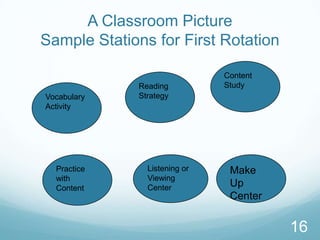
A Classroom Picture
Sample Stations for First Rotation

                              Content
             Reading          Study
Vocabulary   Strategy
Activity


  Practice     Listening or    Make
  with         Viewing
  Content      Center          Up
                               Center


                                        16
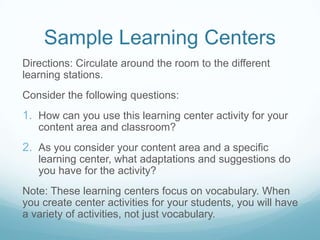
Sample Learning Centers
Directions: Circulate around the room to the different
learning stations.
Consider the following questions:
1. How can you use this learning center activity for your
   content area and classroom?
2. As you consider your content area and a specific
   learning center, what adaptations and suggestions do
   you have for the activity?
Note: These learning centers focus on vocabulary. When
you create center activities for your students, you will have
a variety of activities, not just vocabulary.
VOCABULARY AND TERMINILOGY
        CENTERS
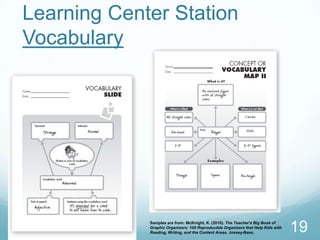
Learning Center Station
Vocabulary


             Samples are from: McKnight, K. (2010). The Teacher's Big Book of
             Graphic Organizers: 100 Reproducible Organizers that Help Kids with
             Reading, Writing, and the Content Areas. Jossey-Bass.                 19
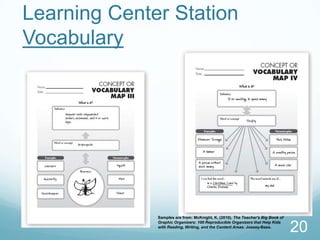
Learning Center Station
Vocabulary


              Samples are from: McKnight, K. (2010). The Teacher's Big Book of


                                                                                 20
              Graphic Organizers: 100 Reproducible Organizers that Help Kids
              with Reading, Writing, and the Content Areas. Jossey-Bass.
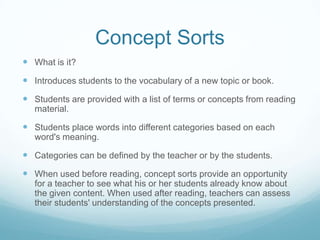
Concept Sorts
 What is it?
 Introduces students to the vocabulary of a new topic or book.
 Students are provided with a list of terms or concepts from reading
   material.

 Students place words into different categories based on each
   word's meaning.

 Categories can be defined by the teacher or by the students.
 When used before reading, concept sorts provide an opportunity
   for a teacher to see what his or her students already know about
   the given content. When used after reading, teachers can assess
   their students' understanding of the concepts presented.
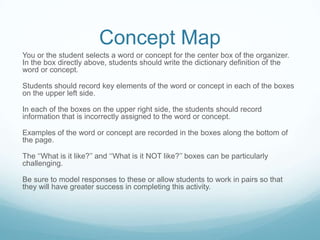
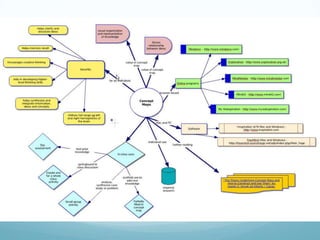
Concept Map
You or the student selects a word or concept for the center box of the organizer.
In the box directly above, students should write the dictionary definition of the
word or concept.

Students should record key elements of the word or concept in each of the boxes
on the upper left side.

In each of the boxes on the upper right side, the students should record
information that is incorrectly assigned to the word or concept.

Examples of the word or concept are recorded in the boxes along the bottom of
the page.

The „„What is it like?‟‟ and „„What is it NOT like?‟‟ boxes can be particularly
challenging.

Be sure to model responses to these or allow students to work in pairs so that
they will have greater success in completing this activity.
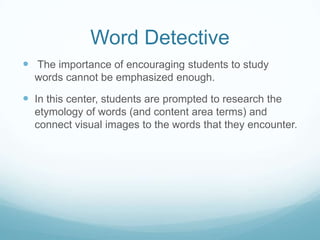
Word Detective
 The importance of encouraging students to study
  words cannot be emphasized enough.

 In this center, students are prompted to research the
  etymology of words (and content area terms) and
  connect visual images to the words that they encounter.
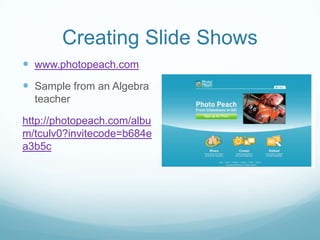
Creating Slide Shows
 www.photopeach.com
 Sample from an Algebra
  teacher

http://photopeach.com/albu
m/tculv0?invitecode=b684e
a3b5c
Vocabulary Demonstration
           Lesson

 http://www.adlit.org/media/mediatopics/vocab/


 http://www.adlit.org/media/mediatopics/vocab/
Sample Reading Activities
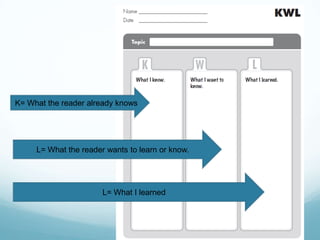
KWL


K= What the reader already knows


     L= What the reader wants to learn or know.


                       L= What I learned
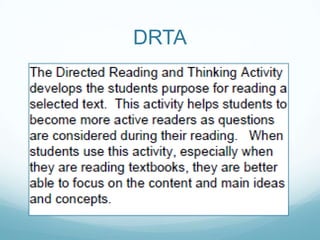
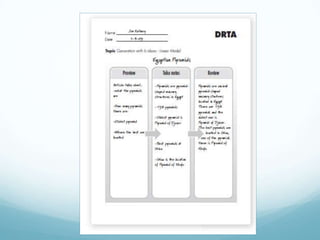
DRTA
DRTA
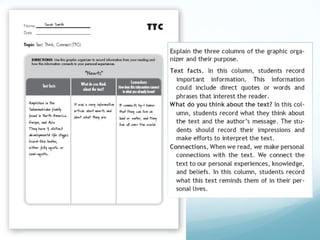
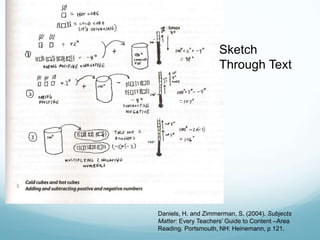
Sketch
                     Through Text


Daniels, H. and Zimmerman, S. (2004). Subjects
Matter: Every Teachers‟ Guide to Content –Area
Reading. Portsmouth, NH: Heinemann, p 121.
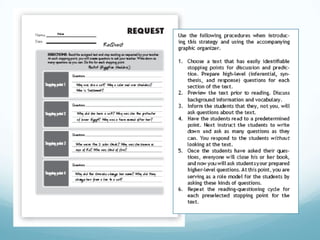
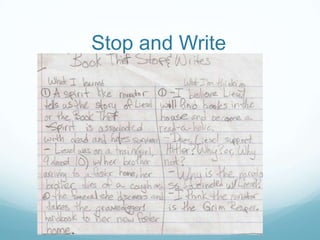
Stop and Write
Inquiry Chart
The Inquiry Chart (I-Chart) is a strategy that enables
students to generate meaningful questions about a topic
and organize their writing.

Students integrate prior knowledge or thoughts about the
topic with additional information found in several sources.

The I-Chart procedure is organized into three phases: (1)
Planning, (2) Interacting, and (3) Integrating/Evaluating.
Each phase consists of activities designed to engage
students in evaluating a topic.


 http://www.adlit.org/strategies/21826/
I Do, We Do, You Do
 http://www.adlit.org/media/mediatopics/comprehension/


 Comprehension Demonstration
Visuals
 Graphic Organizers and other visuals support student
  comprehension and understanding of text.

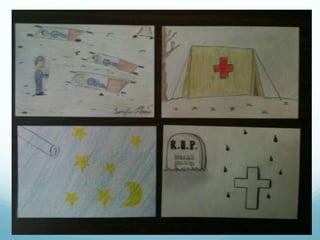
 Here is an example from a Social Studies teacher
 http://www.adlit.org/media/mediatopics/contentarea/
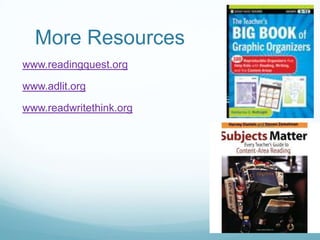
More Resources
www.readingquest.org

www.adlit.org

www.readwritethink.org
For Copies of
Today‟s Posters
  See this Website:


  http://goo.gl/J242X

Content area centers

  • 1.
    Differentiated Instruction: Content LiteracyCenters for Mathematics, Social Science and Science Katie McKnight, Ph.D. Katie@KatherineMcKnight.com
  • 2.
    What we willdo in this session….  Introduce learning centers as an instructional tool for mathematics, social science, and science.  Examine a wide variety of content literacy focused learning centers for mathematics, social science, and science.  Discuss assessment strategies for learning centers.
  • 3.
    Some Reminders about Content Literacy
  • 4.
    Assumptions Underlying Content Literacy  Subject Matter  Role of the Textbook  Active Readers  Independent Readers
  • 5.
    What is ContentLiteracy?  Generally defined as “the ability to use reading and writing for the acquisition of new content in a given discipline” (McKenna & Robinson, 1990, p. 184)
  • 6.
    The Impact ofSchema on Content Literacy Source: Alvermann, D. and Phelps, S. (2002). Content Reading and Literacy: Succeeding in Today’s Diverse Classrooms. (5th Ed.).Boston, MA: Allyn and Bacon.
  • 7.
    More on Schema Thenotes were sour because the seam split. Source: Alvermann, D. and Phelps, S. (2002). Content Reading and Literacy: Succeeding in Today’s Diverse Classrooms. (5th Ed.).Boston, MA: Allyn and Bacon.
  • 8.
    More on Schema Thebatsmen were merciless against the bowlers. The bowlers placed their men in slips and covers. But to no avail. The batsmen hit one in four after another along with an occasional six. Not once did a ball look like it would hit their stumps or be caught. Source: Alvermann, D. and Phelps, S. (2002). Content Reading and Literacy: Succeeding in Today’s Diverse Classrooms. (5th Ed.).Boston, MA: Allyn and Bacon.
  • 9.
    What do weknow about our students‟ reading? 9
  • 10.
    What do weknow about readers? At or Above Proficient on 2002 NAEP Reading 100 80 60 White 40 Black Hispanic 20 0 Grade 4 Grade 8 Grade 12 Grigg, W.S., Daane, M.C., Jin, Y., & Campbell, J.R. (2003). The nation’s report card: Reading 2002. Jessup, MD: Education Publications Center. 10
  • 11.
    Students Most AtRisk BelowBasicon2002NAEPReading 100 80 60 White 40 Black Hispanic 20 0 Grade 4 Grade 8 Grade 12 Grigg, W.S., Daane, M.C., Jin, Y., & Campbell, J.R. (2003). The nation’s report card: Reading 2002. Jessup, MD: Education Publications Center. 11
  • 12.
    Components of Reading Alphabetics:understanding and using the sounds that make up words (phonemic awareness) and the letters that correspond to those sounds (decoding) and being able to relate the letters and sounds to the particular words they represent (word recognition) Fluency: identifying words accurately in an effortless manner and being able to read them in text with appropriate intonation, stress and phrasing Vocabulary: knowing and understanding the meanings of words and using them with flexibility and precision Comprehension: the process and product of constructing meaning from what is read, involving an interaction between a reader and a text, for a purpose and within a context 12
  • 13.
    What are LearningCenters?  Synonymous with Learning Stations.  Learning Stations are locations that a teacher designs for students to work in small groups or individually.  Each center has a clearly articulated learning activity.
  • 14.
    Getting Started: AChecklist 1. Write out all directions for the students for each station. 2. Explain procedures and have them written out and posted in your classroom. 3. Create a “make up station” at the end of the rotation so that students can complete any unfinished work. Review and revision are key in the development of literacy skills sets. 14
  • 15.
    Getting Started: AChecklist (cont‟d) 4. The teacher should circulate among the groups to facilitate answers and questions about the work. 5. Formal assessment occurs when the students have finished the novel. 6. When possible, give students a choice at each station. I like to make a poster for each station. Let‟s look at a model for learning centers. 15
  • 16.
    A Classroom Picture SampleStations for First Rotation Content Reading Study Vocabulary Strategy Activity Practice Listening or Make with Viewing Content Center Up Center 16
  • 17.
    Sample Learning Centers Directions:Circulate around the room to the different learning stations. Consider the following questions: 1. How can you use this learning center activity for your content area and classroom? 2. As you consider your content area and a specific learning center, what adaptations and suggestions do you have for the activity? Note: These learning centers focus on vocabulary. When you create center activities for your students, you will have a variety of activities, not just vocabulary.
  • 18.
  • 19.
    Learning Center Station Vocabulary Samples are from: McKnight, K. (2010). The Teacher's Big Book of Graphic Organizers: 100 Reproducible Organizers that Help Kids with Reading, Writing, and the Content Areas. Jossey-Bass. 19
  • 20.
    Learning Center Station Vocabulary Samples are from: McKnight, K. (2010). The Teacher's Big Book of 20 Graphic Organizers: 100 Reproducible Organizers that Help Kids with Reading, Writing, and the Content Areas. Jossey-Bass.
  • 21.
    Concept Sorts  Whatis it?  Introduces students to the vocabulary of a new topic or book.  Students are provided with a list of terms or concepts from reading material.  Students place words into different categories based on each word's meaning.  Categories can be defined by the teacher or by the students.  When used before reading, concept sorts provide an opportunity for a teacher to see what his or her students already know about the given content. When used after reading, teachers can assess their students' understanding of the concepts presented.
  • 22.
    Concept Map You orthe student selects a word or concept for the center box of the organizer. In the box directly above, students should write the dictionary definition of the word or concept. Students should record key elements of the word or concept in each of the boxes on the upper left side. In each of the boxes on the upper right side, the students should record information that is incorrectly assigned to the word or concept. Examples of the word or concept are recorded in the boxes along the bottom of the page. The „„What is it like?‟‟ and „„What is it NOT like?‟‟ boxes can be particularly challenging. Be sure to model responses to these or allow students to work in pairs so that they will have greater success in completing this activity.
  • 24.
    Word Detective  Theimportance of encouraging students to study words cannot be emphasized enough.  In this center, students are prompted to research the etymology of words (and content area terms) and connect visual images to the words that they encounter.
  • 25.
    Creating Slide Shows www.photopeach.com  Sample from an Algebra teacher http://photopeach.com/albu m/tculv0?invitecode=b684e a3b5c
  • 26.
    Vocabulary Demonstration Lesson  http://www.adlit.org/media/mediatopics/vocab/  http://www.adlit.org/media/mediatopics/vocab/
  • 27.
  • 28.
    KWL K= What thereader already knows L= What the reader wants to learn or know. L= What I learned
  • 29.
  • 30.
  • 33.
    Sketch Through Text Daniels, H. and Zimmerman, S. (2004). Subjects Matter: Every Teachers‟ Guide to Content –Area Reading. Portsmouth, NH: Heinemann, p 121.
  • 34.
  • 35.
    Inquiry Chart The InquiryChart (I-Chart) is a strategy that enables students to generate meaningful questions about a topic and organize their writing. Students integrate prior knowledge or thoughts about the topic with additional information found in several sources. The I-Chart procedure is organized into three phases: (1) Planning, (2) Interacting, and (3) Integrating/Evaluating. Each phase consists of activities designed to engage students in evaluating a topic. http://www.adlit.org/strategies/21826/
  • 36.
    I Do, WeDo, You Do  http://www.adlit.org/media/mediatopics/comprehension/  Comprehension Demonstration
  • 38.
    Visuals  Graphic Organizersand other visuals support student comprehension and understanding of text.  Here is an example from a Social Studies teacher  http://www.adlit.org/media/mediatopics/contentarea/
  • 41.
  • 43.
    For Copies of Today‟sPosters See this Website: http://goo.gl/J242X