HOW DO TEACHERS ORGANIZE FOR INSTRUCTION?

• Literature focus units
• Literature circles
• Reading and writing workshops
• Thematic Units
You must combine direct
instruction, small groups, and
independent activities into your
plans.
WRITING WORKSHOP
Action: the main character does something
interesting.
Dialogue: main character says something
interesting.
Thought or question: main character
Shares something that he or she is
thinking
A sound: author begins with an interesting sound
related to the story.
LITERATURE FOCUS UNITS
As a class or in small groups, the students and the teacher respond
to one text together. Teachers choose the texts that are high quality
literature selection. After reading the texts, students explore the text
and apply their learning by creating projects.

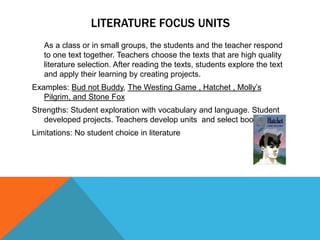
Examples: Bud not Buddy, The Westing Game , Hatchet , Molly’s
Pilgrim, and Stone Fox
Strengths: Student exploration with vocabulary and language. Student
developed projects. Teachers develop units and select books.
Limitations: No student choice in literature
COMPONENTS OF LITERATURE FOCUS UNITS
Reading: read together as a class
Responding: Students record their initial impressions about the
selection to develop their comprehension.

Teaching mini-lessons: Teachers teach minilessons on
language arts procedures, concepts, and connect their
instruction to the featured selection.
Mini-lessons must: 1) INTRODUCE THE TOPIC, 2) SHARE EXAMPLES, 3)
PROVIDE INFORMATION, 4) SUPERVISE PRACTICE, AND 5) ASSESS
LEARNING.

Creating projects
LITERATURE FOCUS UNITS-GROUP DISCUSSION
In a small group or with a partner, discuss the following:
1. Do you believe it is an effective strategy for students to write the quote
on the left side and the response on the right side? Why or why not?
2. If you were to teach a mini-lesson on root words and affixes, what type
of activities would you plan? Write a short lesson plan with a partner.
3. Using the graphic organizers and characterization dolls/organizers
provided, which organizers would you have used for this lesson? Why
or why not?
4. Do you have any other suggestions for projects?
LITERATURE CIRCLES
Teachers choose five or six books and collect multiple copies of each one.
Students choose the book they want to read and form book clubs. Students
develop their own schedules; teachers participates in some of the
discussions.

Strengths: Student motivation is high due to student selection of books and
materials. Student directed activities. Authentic literacy experiences.
Limitations: No teacher control. Students must be responsible, task oriented, and
good time keepers to be successful.
ROLES STUDENTS PLAY IN LITERATURE CIRCLES
Discussion director
Passage master
Word wizard
Connector
Summarizer
Illustrator
Investigator
LITERATURE CIRCLES –GROUP DISCUSSIONS
1. Pretend that your literature circle is reading The Outsider. How would
you introduce the book to the class?
READING AND WRITING WORKSHOP
Students choose books and read and respond to them independently
during reading workshop and write books on self selected topics during
writing workshop. Teachers monitor students through conferences.
Students share the books they read and the books they write with
classmates during a sharing period.
Strengths: Students read books that are appropriate for their reading
levels. Students have high motivation to read the books that they have
chosen. Teachers teach mini-lessons on reading strategies and skills.
Activities are student directed and students work at their own pace.
Limitations: Teachers may feel as they have lost control of students.
Students have to be task oriented.
COMPONENTS OF READING WORKSHOP
Reading and responding
Sharing
Teaching mini-lessons
COMPONENTS OF WRITING WORKSHOP
Writing
Sharing
Teaching mini-lessons
Writing workshop is usually 60-90 minute period per day.
GROUP DISCUSSION ON READING AND WRITING WORKSHOP
1. What types of questions would you ask students during a reading
conference?
2. What type of writing prompts would you provide for students if your
class, for example, was reading Charlotte’s Web?

3. Create a mini-lesson about : 1) using quotation marks, 2) identifying
nouns, or 3) your choice.
THEMATIC UNITS
Students study social studies or science topics. They use the 6 language
arts as they participate in activities and demonstrate learning. Students
also identify topics that they want to study.
Strengths: Students write in learning logs. Teachers and students create
clusters and other charts to organize information. Teachers scaffold
instruction as students work independently, small groups or together in
class. Students use technology to enhance learning. Students create
projects.
Limitations: Teachers must design thematic units and locate materials and
resources. Thematic units are time consuming.
ACTIVITIES WITHIN THEMATIC UNITS
Reading
Keeping learning logs
Making visual representation
Creating projects
Websites:
http://thematicunits.theteacherscorner.net/
http://www.thematic-units.com/

http://kiddyhouse.com/Themes/
http://www.ncwiseowl.org/
GROUP DISCUSSIONS ABOUT THEMATIC UNITS
1. What suggestions would you offer to improve a student’s spelling
and/or writing?
2. Discuss your plan to assist ESL learners.
3. Websites:
http://www.everythingesl.net/
http://www.eslcafe.com/search/Lesson_Plans/
http://www.usingenglish.com/teachers/lesson-plans/
http://www.esl-lounge.com/

http://www.internet4classrooms.com/esl.htm
www.brainpopesl.com
WHAT ABOUT TEACHING?
Direct instruction: teach mini-lessons, provide opportunities for
supervised practice, and have students apply what they have learned
through reading and writing activities.
Indirect instruction: usually occurs during conferences or working with
small groups.
Teacher roles during language arts instruction include the following:
organizer, facilitator, participant, instructor, model, manager,
diagnostician, evaluator, coordinator, and communicator.
Differentiating instruction by: offering choices, using small groups, setting
up centers, incorporating projects, and integrating all six language arts.
MEETING THE NEEDS OF ESL LEARNERS
Use SIOP model
Classroom environment
Grouping patterns
Mini-lessons
Visuals
Background knowledge
Oral language
Centers

Monitor students
SIOP
Websites:
http://www.siopinstitute.net/
http://www.cal.org/siop/about/index.html
http://eldstrategies.com/siopmodel.html
ASSESSING STUDENTS’ LEARNING
Assessment has five purposes: 1) document milestones’ in students’ language
and literacy development, 2) identify students’ strengths in order to plan
instruction, 3) to document students’ language arts activities and projects, 4) to
determine grades, and 5) to help teachers learn more about how students
become strategic readers and writers.
Assessments include classroom observations, anecdotal notes, conferences,
portfolios, rubrics, and checklists.
What are the benefits of using a portfolio?
What is the difference between an assessment and an evaluation?
With a partner, design an assessment for an elementary language arts class.
SUGGESTED WEBSITES
Literature Circles:
http://litcircles.org/
http://www.readwritethink.org/classroom-resources/lesson-plans/literaturecircles-getting-started-19.html
http://www.abcteach.com/directory/basics/reading/literature_circles/
http://www.funlessonplans.com/reading_lesson_plans/literature.htm
http://www.lessonplanet.com/search?keywords=literature+circle&media=le
sson
http://www.lessoncorner.com/English/Literature/
Other:
http://www.webenglishteacher.com/gardiner.html
MORE AND MORE WEBSITES
Hatchet:
http://www.mce.k12tn.net/survival/hatchet/hatchet.htm
Stone Fox: http://www.mce.k12tn.net/dogs/fox/stone_fox.htm,
http://www.teachervision.fen.com/fiction/lesson-plan/7.html,
http://library.thinkquest.org/CR0211900/fox/stone_fox_vocabulary.htm
Charlotte’s Web: http://www.gamequarium.com/charlottesweb.html,
http://teachnet.com/lessonplans/language-arts/charlottes-web-activites/,
http://www.cape.k12.mo.us/Blanchard/hicks/Reading%20Pages/Charlotte's%
20Web/Charlottes_Web.htm, http://www.scholastic.com/charlottesweb/
Roll of Thunder, Hear my Cry: http://www.webenglishteacher.com/mtaylor.html,
http://www.bookpunch.com/book_detail.php?book=Roll_of_Thunder,_Hear_M
y_Cry, http://ethemes.missouri.edu/themes/733

Lang arts in the e classrm chapter2

  • 2.
    HOW DO TEACHERSORGANIZE FOR INSTRUCTION? • Literature focus units • Literature circles • Reading and writing workshops • Thematic Units You must combine direct instruction, small groups, and independent activities into your plans.
  • 3.
    WRITING WORKSHOP Action: themain character does something interesting. Dialogue: main character says something interesting. Thought or question: main character Shares something that he or she is thinking A sound: author begins with an interesting sound related to the story.
  • 4.
    LITERATURE FOCUS UNITS Asa class or in small groups, the students and the teacher respond to one text together. Teachers choose the texts that are high quality literature selection. After reading the texts, students explore the text and apply their learning by creating projects. Examples: Bud not Buddy, The Westing Game , Hatchet , Molly’s Pilgrim, and Stone Fox Strengths: Student exploration with vocabulary and language. Student developed projects. Teachers develop units and select books. Limitations: No student choice in literature
  • 5.
    COMPONENTS OF LITERATUREFOCUS UNITS Reading: read together as a class Responding: Students record their initial impressions about the selection to develop their comprehension. Teaching mini-lessons: Teachers teach minilessons on language arts procedures, concepts, and connect their instruction to the featured selection. Mini-lessons must: 1) INTRODUCE THE TOPIC, 2) SHARE EXAMPLES, 3) PROVIDE INFORMATION, 4) SUPERVISE PRACTICE, AND 5) ASSESS LEARNING. Creating projects
  • 6.
    LITERATURE FOCUS UNITS-GROUPDISCUSSION In a small group or with a partner, discuss the following: 1. Do you believe it is an effective strategy for students to write the quote on the left side and the response on the right side? Why or why not? 2. If you were to teach a mini-lesson on root words and affixes, what type of activities would you plan? Write a short lesson plan with a partner. 3. Using the graphic organizers and characterization dolls/organizers provided, which organizers would you have used for this lesson? Why or why not? 4. Do you have any other suggestions for projects?
  • 7.
    LITERATURE CIRCLES Teachers choosefive or six books and collect multiple copies of each one. Students choose the book they want to read and form book clubs. Students develop their own schedules; teachers participates in some of the discussions. Strengths: Student motivation is high due to student selection of books and materials. Student directed activities. Authentic literacy experiences. Limitations: No teacher control. Students must be responsible, task oriented, and good time keepers to be successful.
  • 8.
    ROLES STUDENTS PLAYIN LITERATURE CIRCLES Discussion director Passage master Word wizard Connector Summarizer Illustrator Investigator
  • 9.
    LITERATURE CIRCLES –GROUPDISCUSSIONS 1. Pretend that your literature circle is reading The Outsider. How would you introduce the book to the class?
  • 10.
    READING AND WRITINGWORKSHOP Students choose books and read and respond to them independently during reading workshop and write books on self selected topics during writing workshop. Teachers monitor students through conferences. Students share the books they read and the books they write with classmates during a sharing period. Strengths: Students read books that are appropriate for their reading levels. Students have high motivation to read the books that they have chosen. Teachers teach mini-lessons on reading strategies and skills. Activities are student directed and students work at their own pace. Limitations: Teachers may feel as they have lost control of students. Students have to be task oriented.
  • 11.
    COMPONENTS OF READINGWORKSHOP Reading and responding Sharing Teaching mini-lessons
  • 12.
    COMPONENTS OF WRITINGWORKSHOP Writing Sharing Teaching mini-lessons Writing workshop is usually 60-90 minute period per day.
  • 13.
    GROUP DISCUSSION ONREADING AND WRITING WORKSHOP 1. What types of questions would you ask students during a reading conference? 2. What type of writing prompts would you provide for students if your class, for example, was reading Charlotte’s Web? 3. Create a mini-lesson about : 1) using quotation marks, 2) identifying nouns, or 3) your choice.
  • 14.
    THEMATIC UNITS Students studysocial studies or science topics. They use the 6 language arts as they participate in activities and demonstrate learning. Students also identify topics that they want to study. Strengths: Students write in learning logs. Teachers and students create clusters and other charts to organize information. Teachers scaffold instruction as students work independently, small groups or together in class. Students use technology to enhance learning. Students create projects. Limitations: Teachers must design thematic units and locate materials and resources. Thematic units are time consuming.
  • 15.
    ACTIVITIES WITHIN THEMATICUNITS Reading Keeping learning logs Making visual representation Creating projects Websites: http://thematicunits.theteacherscorner.net/ http://www.thematic-units.com/ http://kiddyhouse.com/Themes/ http://www.ncwiseowl.org/
  • 16.
    GROUP DISCUSSIONS ABOUTTHEMATIC UNITS 1. What suggestions would you offer to improve a student’s spelling and/or writing? 2. Discuss your plan to assist ESL learners. 3. Websites: http://www.everythingesl.net/ http://www.eslcafe.com/search/Lesson_Plans/ http://www.usingenglish.com/teachers/lesson-plans/ http://www.esl-lounge.com/ http://www.internet4classrooms.com/esl.htm www.brainpopesl.com
  • 17.
    WHAT ABOUT TEACHING? Directinstruction: teach mini-lessons, provide opportunities for supervised practice, and have students apply what they have learned through reading and writing activities. Indirect instruction: usually occurs during conferences or working with small groups. Teacher roles during language arts instruction include the following: organizer, facilitator, participant, instructor, model, manager, diagnostician, evaluator, coordinator, and communicator. Differentiating instruction by: offering choices, using small groups, setting up centers, incorporating projects, and integrating all six language arts.
  • 18.
    MEETING THE NEEDSOF ESL LEARNERS Use SIOP model Classroom environment Grouping patterns Mini-lessons Visuals Background knowledge Oral language Centers Monitor students
  • 19.
  • 20.
    ASSESSING STUDENTS’ LEARNING Assessmenthas five purposes: 1) document milestones’ in students’ language and literacy development, 2) identify students’ strengths in order to plan instruction, 3) to document students’ language arts activities and projects, 4) to determine grades, and 5) to help teachers learn more about how students become strategic readers and writers. Assessments include classroom observations, anecdotal notes, conferences, portfolios, rubrics, and checklists. What are the benefits of using a portfolio? What is the difference between an assessment and an evaluation? With a partner, design an assessment for an elementary language arts class.
  • 21.
  • 22.
    MORE AND MOREWEBSITES Hatchet: http://www.mce.k12tn.net/survival/hatchet/hatchet.htm Stone Fox: http://www.mce.k12tn.net/dogs/fox/stone_fox.htm, http://www.teachervision.fen.com/fiction/lesson-plan/7.html, http://library.thinkquest.org/CR0211900/fox/stone_fox_vocabulary.htm Charlotte’s Web: http://www.gamequarium.com/charlottesweb.html, http://teachnet.com/lessonplans/language-arts/charlottes-web-activites/, http://www.cape.k12.mo.us/Blanchard/hicks/Reading%20Pages/Charlotte's% 20Web/Charlottes_Web.htm, http://www.scholastic.com/charlottesweb/ Roll of Thunder, Hear my Cry: http://www.webenglishteacher.com/mtaylor.html, http://www.bookpunch.com/book_detail.php?book=Roll_of_Thunder,_Hear_M y_Cry, http://ethemes.missouri.edu/themes/733