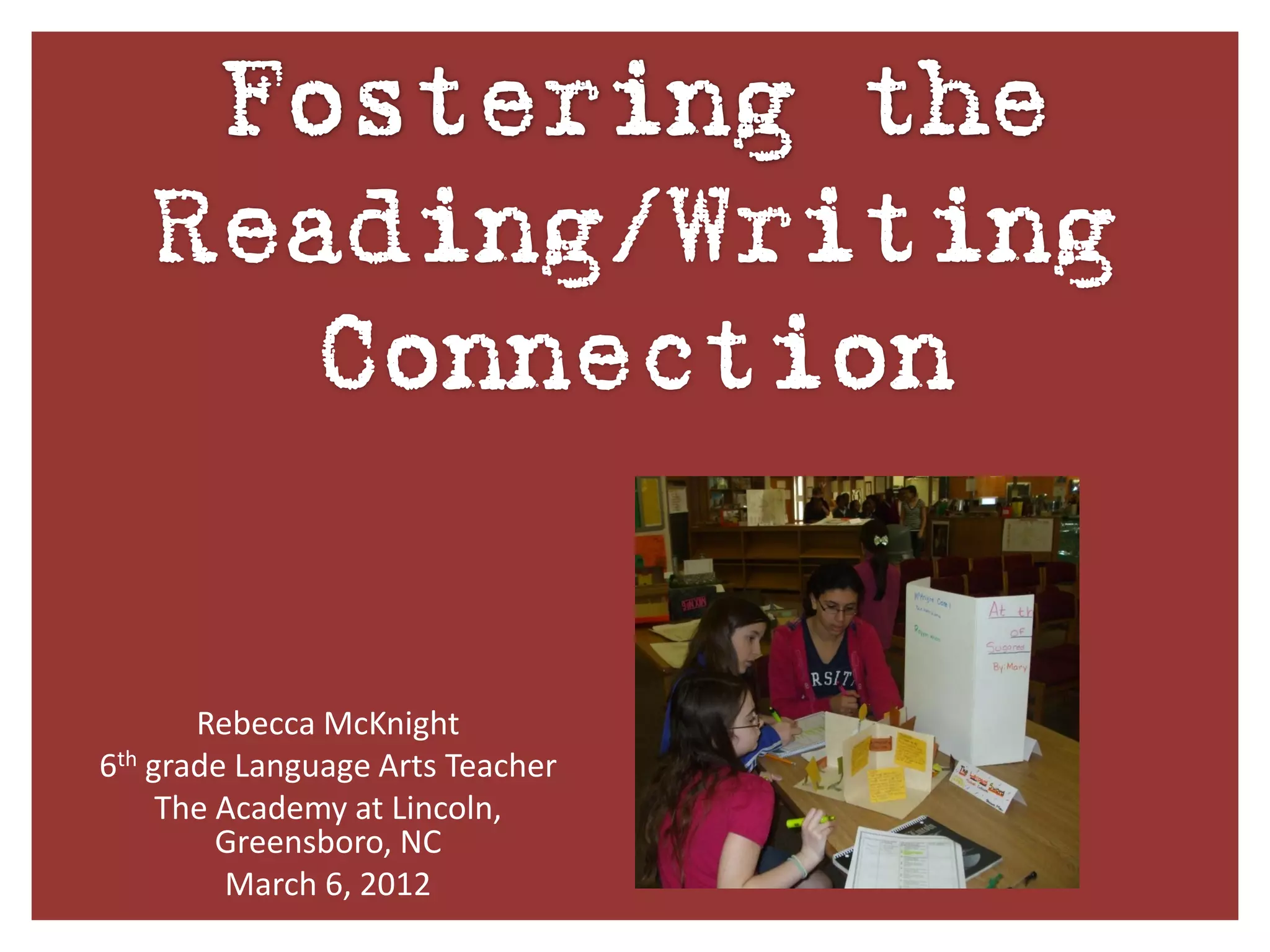
Rebecca McKnight
6th grade Language Arts Teacher
     The Academy at Lincoln,
         Greensboro, NC
         March 6, 2012
When we are done, we will …..
                Answer our essential
                 questions
                Generate a list of
                 adolescent literature for
                 our students to read
                Participate in some
                 activities to help foster
                 the reading/writing
                 connection
Agenda
         Introduction
     Goals for the session
 Define Reading and Writing
Activities to foster connections
Questions, comments, concerns
Info about me…
 I love to read!
 I have a master’s degree in Education from
  UNCG and a bachelor’s degree from the
  College of William and Mary
 This will be my 15th year in Guilford County. I
  have taught at several middle schools
  including the Academy at Lincoln.
 I have worked as a school-based Curriculum
  Facilitator and as a Curriculum Specialist for
  the school system.
 I am teaching, now, because I love to work with
  students.
Session Objectives
    (Essential Questions)
• How can we get students to see
  the connections between what
  they read and what they write?
• How important is student choice
  in the reading/writing process?
• What tools can be used to
  encourage students to read and
  write?
Common
   Core
Standards
What is the value of fostering the
connection between Reading and Writing in
             middle school?
• Improved retention of    • Stimulate creativity

  information              • Increase student

• Deepen Understanding       responsibility for learning

• Application of current   • Meet developmental needs

  research                 • Resolve management issues

• Build community          • Renew enthusiasm for
                             teaching
• Create equity
Education is the
lighting of a fire, not
    the filling of a
       bucket.

           William Butler Yeats
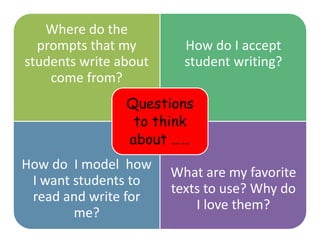
Where do the
  prompts that my        How do I accept
students write about     student writing?
    come from?
                Questions
                 to think
                about ……
How do I model how
                       What are my favorite
 I want students to
                       texts to use? Why do
 read and write for
                           I love them?
        me?
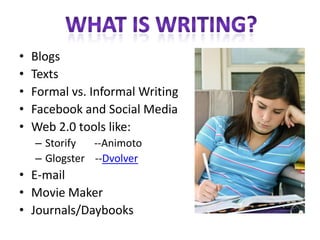
•   Blogs
•   Texts
•   Formal vs. Informal Writing
•   Facebook and Social Media
•   Web 2.0 tools like:
    – Storify  --Animoto
    – Glogster --Dvolver
• E-mail
• Movie Maker
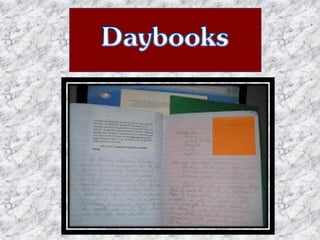
• Journals/Daybooks
Reading Strategies Brainstorm
Placemat: Reading Strategies
         Brainstorm
What types of strategies and
  materials do you use to
teach reading to students in
      your classroom?
Literacy Skills
• Setting a purpose for reading
• Finding the main idea and supporting
  details
• Summarizing/paraphrasing
• Developing vocabulary
• Activating prior knowledge
• Recognizing the author’s point of
  view
• Making predictions
Literacy Skills continued….
• Recognizing text structures
• Using text features to connect with
  and guide through the reading
• Making inferences
• Questioning what you read
• Visualizing what you read
• Making connections
Reading
  Strategies
should lead to
   writing.
    Writing
   strategies
     should
   encourage
further reading.
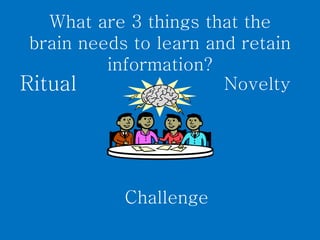
What are 3 things that the
 brain needs to learn and retain
          information?
Ritual                  Novelty


            Challenge
Reading
Response Cards
      &
 Connections
    Charts
Literature Circles/Book Clubs
•   What are they?
•   How do you organize them?
•   What is their value in use of informational text?
•   Resources for organizing your own
•   Book Club resources
    – http://www.abcteach.com/directory/basics/reading/lit
      erature_circles/: Samples of role sheets and forms
    – http://www.litcircles.org/: Some additional
      information and forms
    – http://www.npatterson.net/reading.html: Role sheets
It is the supreme
art of the teacher
  to awaken joy in
creative expression
  and knowledge.”
       Albert Einstein
• Battle of the Books list
• Journals and
  magazines
• Young Adult Literature
• Poetry books
• Picture books
• Professional resources
• Short Stories
• Basal readers
• Internet
• Picture Books
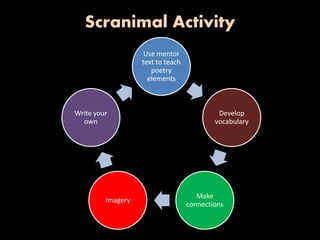
Scranimal Activity
                    Use mentor
                   text to teach
                      poetry
                     elements


Write your                                  Develop
  own                                      vocabulary


                                      Make
         Imagery
                                   connections
Technology
• Web 2.0 tools like…..
  – Wordle
  – Glogster
  – Wallwisher (pre-writing
    ideas)
  – Dvolver
  – Tagxedo
  – Google docs
  – Gaggle
  – Animoto
  – Wobooks

• Blogs
• E-mail
Dvolver Summaries
       – http://www.dvolver.com/live/movies
         -623246

       – http://www.dvolver.com/live/movies
         -623243

       – http://www.dvolver.com/live/movies
         -623221
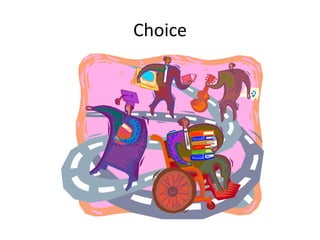
Choice
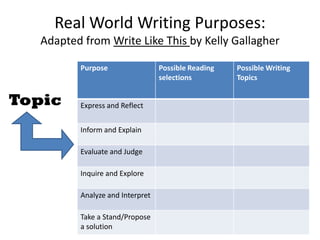
Real World Writing Purposes:
   Adapted from Write Like This by Kelly Gallagher

          Purpose                 Possible Reading   Possible Writing
                                  selections         Topics


Topic     Express and Reflect


          Inform and Explain

          Evaluate and Judge

          Inquire and Explore

          Analyze and Interpret

          Take a Stand/Propose
          a solution
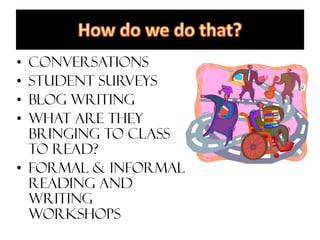
• Conversations
• Student Surveys
• Blog writing
• What are they
  bringing to class
  to read?
• Formal & Informal
  Reading and
  Writing
  workshops
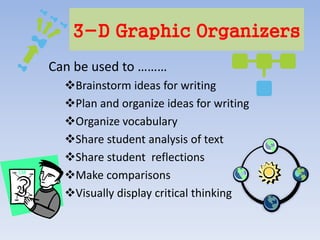
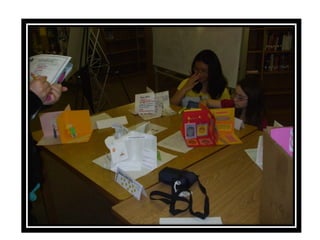
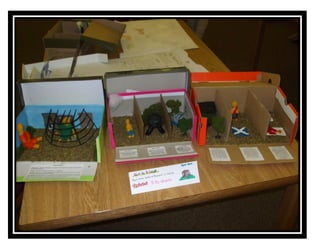
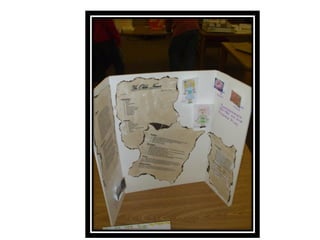
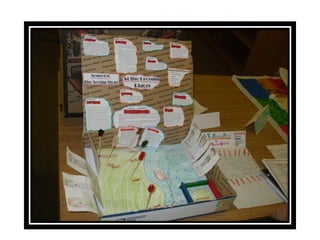
3-D Graphic Organizers
Can be used to ………
  Brainstorm ideas for writing
  Plan and organize ideas for writing
  Organize vocabulary
  Share student analysis of text
  Share student reflections
  Make comparisons
  Visually display critical thinking
How can 3-D graphic organizers help to
  engage writers and readers in my
        writing instruction?
 • Hands-on way to manipulate and
   organize information
 • Allows and encourages creativity
 • Help spatial learners make
   connections
 • Small enough to fit into daybooks or
   writing/reading journals
 • They are fun!
Middle School
Reading/Writing
Teacher’s Pledge
Resources for strategies and ideas
               • Teaching Blogs
                 – The Organized Classroom
                 – Secondary Solutions
                 – Laura Candler
                 – Teaching Blog Addict
               • Websites
               • Colleagues
               • Professional Resources
Questions, Comments,
      Concerns
Ticket out the Door
 Please fill out 3-2-1
session TOD and give it
to me before you leave.
   Thanks for coming
Contact me at
    mcknigr@gcsnc.com
             Or
On my cell [(336) 420-6205

Fostering the Reading and Writing Connection

  • 1.
    Rebecca McKnight 6th gradeLanguage Arts Teacher The Academy at Lincoln, Greensboro, NC March 6, 2012
  • 2.
    When we aredone, we will …..  Answer our essential questions  Generate a list of adolescent literature for our students to read  Participate in some activities to help foster the reading/writing connection
  • 3.
    Agenda Introduction Goals for the session Define Reading and Writing Activities to foster connections Questions, comments, concerns
  • 4.
    Info about me… I love to read!  I have a master’s degree in Education from UNCG and a bachelor’s degree from the College of William and Mary  This will be my 15th year in Guilford County. I have taught at several middle schools including the Academy at Lincoln.  I have worked as a school-based Curriculum Facilitator and as a Curriculum Specialist for the school system.  I am teaching, now, because I love to work with students.
  • 5.
    Session Objectives (Essential Questions) • How can we get students to see the connections between what they read and what they write? • How important is student choice in the reading/writing process? • What tools can be used to encourage students to read and write?
  • 6.
    Common Core Standards
  • 7.
    What is thevalue of fostering the connection between Reading and Writing in middle school? • Improved retention of • Stimulate creativity information • Increase student • Deepen Understanding responsibility for learning • Application of current • Meet developmental needs research • Resolve management issues • Build community • Renew enthusiasm for teaching • Create equity
  • 8.
    Education is the lightingof a fire, not the filling of a bucket. William Butler Yeats
  • 9.
    Where do the prompts that my How do I accept students write about student writing? come from? Questions to think about …… How do I model how What are my favorite I want students to texts to use? Why do read and write for I love them? me?
  • 10.
    Blogs • Texts • Formal vs. Informal Writing • Facebook and Social Media • Web 2.0 tools like: – Storify --Animoto – Glogster --Dvolver • E-mail • Movie Maker • Journals/Daybooks
  • 11.
    Reading Strategies Brainstorm Placemat:Reading Strategies Brainstorm What types of strategies and materials do you use to teach reading to students in your classroom?
  • 12.
    Literacy Skills • Settinga purpose for reading • Finding the main idea and supporting details • Summarizing/paraphrasing • Developing vocabulary • Activating prior knowledge • Recognizing the author’s point of view • Making predictions
  • 13.
    Literacy Skills continued…. •Recognizing text structures • Using text features to connect with and guide through the reading • Making inferences • Questioning what you read • Visualizing what you read • Making connections
  • 14.
    Reading Strategies shouldlead to writing. Writing strategies should encourage further reading.
  • 15.
    What are 3things that the brain needs to learn and retain information? Ritual Novelty Challenge
  • 17.
    Reading Response Cards & Connections Charts
  • 18.
    Literature Circles/Book Clubs • What are they? • How do you organize them? • What is their value in use of informational text? • Resources for organizing your own • Book Club resources – http://www.abcteach.com/directory/basics/reading/lit erature_circles/: Samples of role sheets and forms – http://www.litcircles.org/: Some additional information and forms – http://www.npatterson.net/reading.html: Role sheets
  • 19.
    It is thesupreme art of the teacher to awaken joy in creative expression and knowledge.” Albert Einstein
  • 20.
    • Battle ofthe Books list • Journals and magazines • Young Adult Literature • Poetry books • Picture books • Professional resources • Short Stories • Basal readers • Internet • Picture Books
  • 21.
    Scranimal Activity Use mentor text to teach poetry elements Write your Develop own vocabulary Make Imagery connections
  • 22.
    Technology • Web 2.0tools like….. – Wordle – Glogster – Wallwisher (pre-writing ideas) – Dvolver – Tagxedo – Google docs – Gaggle – Animoto – Wobooks • Blogs • E-mail
  • 23.
    Dvolver Summaries – http://www.dvolver.com/live/movies -623246 – http://www.dvolver.com/live/movies -623243 – http://www.dvolver.com/live/movies -623221
  • 24.
  • 25.
    Real World WritingPurposes: Adapted from Write Like This by Kelly Gallagher Purpose Possible Reading Possible Writing selections Topics Topic Express and Reflect Inform and Explain Evaluate and Judge Inquire and Explore Analyze and Interpret Take a Stand/Propose a solution
  • 26.
    • Conversations • StudentSurveys • Blog writing • What are they bringing to class to read? • Formal & Informal Reading and Writing workshops
  • 27.
    3-D Graphic Organizers Canbe used to ……… Brainstorm ideas for writing Plan and organize ideas for writing Organize vocabulary Share student analysis of text Share student reflections Make comparisons Visually display critical thinking
  • 28.
    How can 3-Dgraphic organizers help to engage writers and readers in my writing instruction? • Hands-on way to manipulate and organize information • Allows and encourages creativity • Help spatial learners make connections • Small enough to fit into daybooks or writing/reading journals • They are fun!
  • 33.
  • 34.
    Resources for strategiesand ideas • Teaching Blogs – The Organized Classroom – Secondary Solutions – Laura Candler – Teaching Blog Addict • Websites • Colleagues • Professional Resources
  • 35.
  • 36.
    Ticket out theDoor Please fill out 3-2-1 session TOD and give it to me before you leave. Thanks for coming
  • 37.
    Contact me at mcknigr@gcsnc.com Or On my cell [(336) 420-6205