Literature Circles
Jessica Xiarhos
EEX 4066-BW61
Summer 2013
Literature Circles
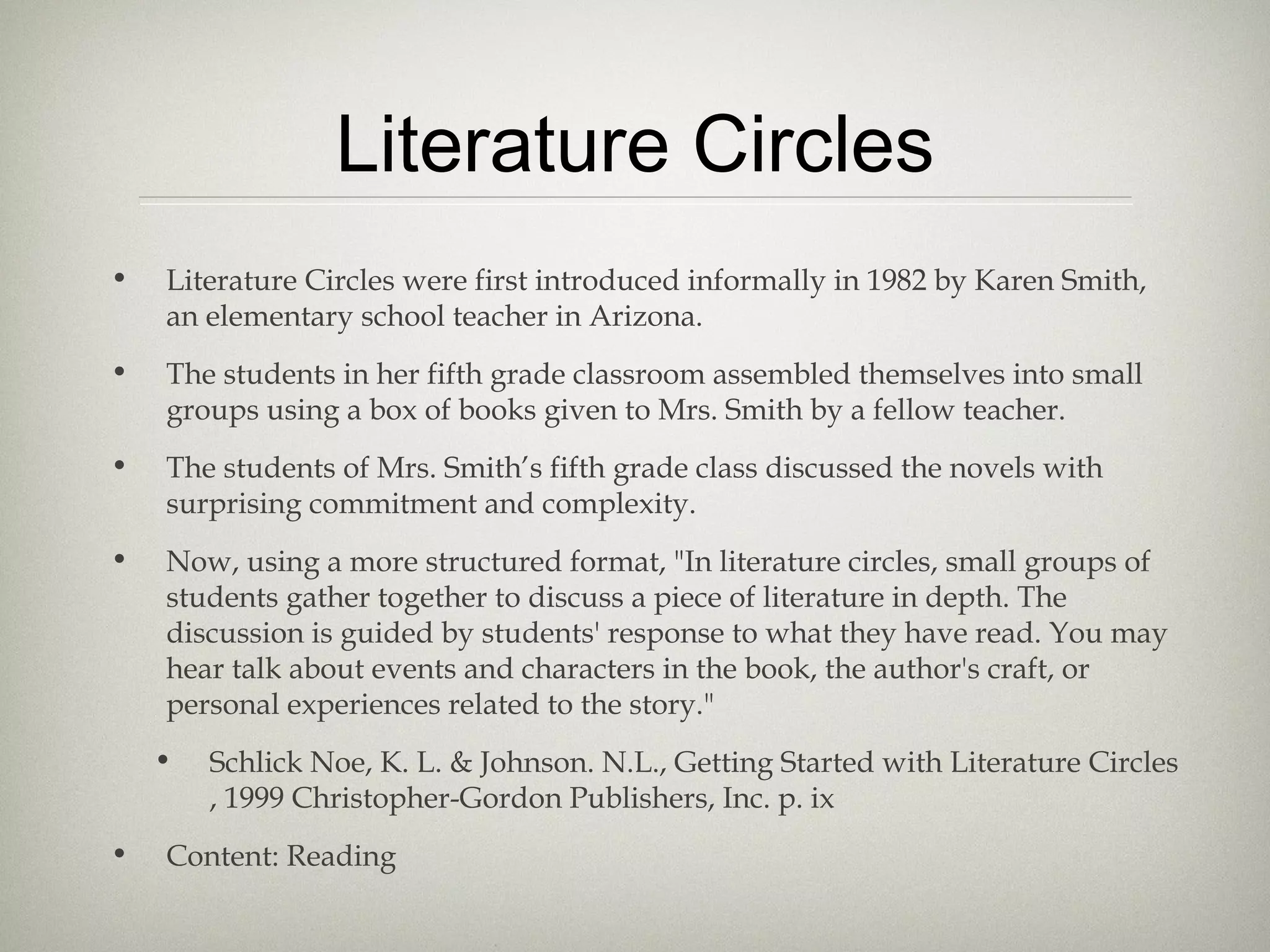
• Literature Circles were first introduced informally in 1982 by Karen Smith,
an elementary school teacher in Arizona.
• The students in her fifth grade classroom assembled themselves into small
groups using a box of books given to Mrs. Smith by a fellow teacher.
• The students of Mrs. Smith’s fifth grade class discussed the novels with
surprising commitment and complexity.
• Now, using a more structured format, "In literature circles, small groups of
students gather together to discuss a piece of literature in depth. The
discussion is guided by students' response to what they have read. You may
hear talk about events and characters in the book, the author's craft, or
personal experiences related to the story."
• Schlick Noe, K. L. & Johnson. N.L., Getting Started with Literature Circles
, 1999 Christopher-Gordon Publishers, Inc. p. ix
• Content: Reading
Standards Related To
Literature Circles
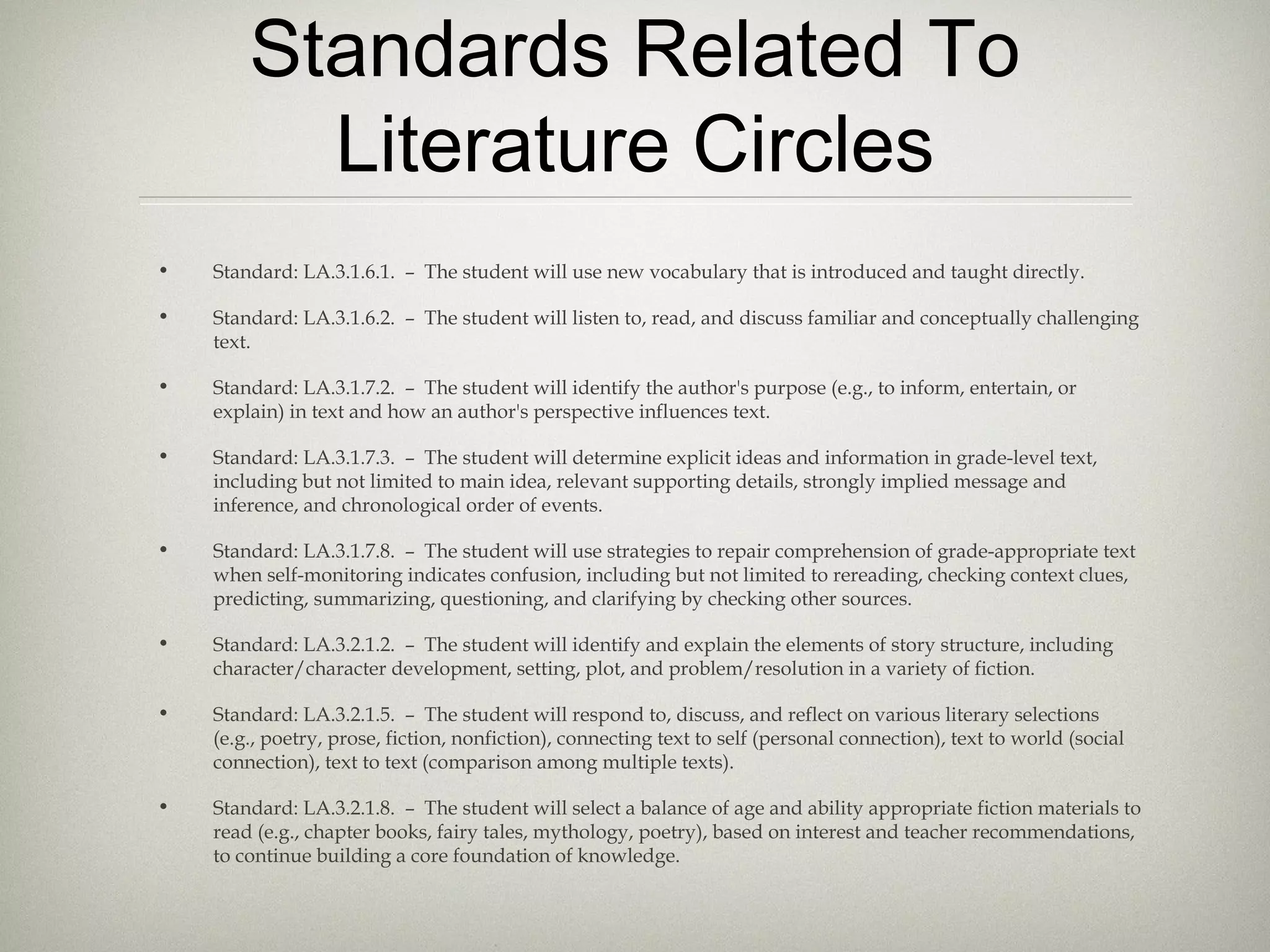
• Standard: LA.3.1.6.1.  –  The student will use new vocabulary that is introduced and taught directly.
• Standard: LA.3.1.6.2.  –  The student will listen to, read, and discuss familiar and conceptually challenging
text.
• Standard: LA.3.1.7.2.  –  The student will identify the author's purpose (e.g., to inform, entertain, or
explain) in text and how an author's perspective influences text.
• Standard: LA.3.1.7.3.  –  The student will determine explicit ideas and information in grade-level text,
including but not limited to main idea, relevant supporting details, strongly implied message and
inference, and chronological order of events.
• Standard: LA.3.1.7.8.  –  The student will use strategies to repair comprehension of grade-appropriate text
when self-monitoring indicates confusion, including but not limited to rereading, checking context clues,
predicting, summarizing, questioning, and clarifying by checking other sources.
• Standard: LA.3.2.1.2.  –  The student will identify and explain the elements of story structure, including
character/character development, setting, plot, and problem/resolution in a variety of fiction.
• Standard: LA.3.2.1.5.  –  The student will respond to, discuss, and reflect on various literary selections
(e.g., poetry, prose, fiction, nonfiction), connecting text to self (personal connection), text to world (social
connection), text to text (comparison among multiple texts).
• Standard: LA.3.2.1.8.  –  The student will select a balance of age and ability appropriate fiction materials to
read (e.g., chapter books, fairy tales, mythology, poetry), based on interest and teacher recommendations,
to continue building a core foundation of knowledge.
How To Implement
Literature Circles
• Steps:
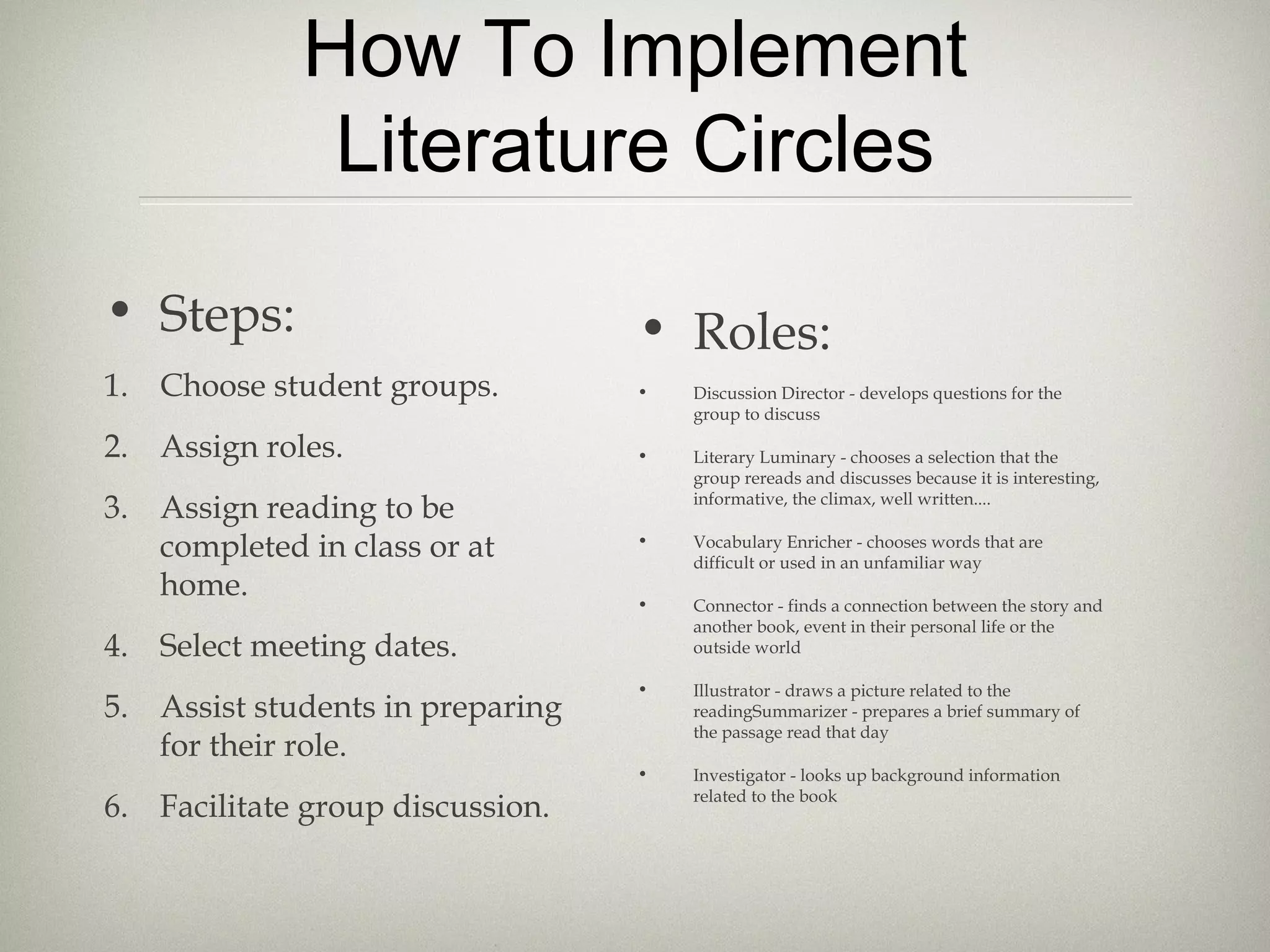
1. Choose student groups.
2. Assign roles.
3. Assign reading to be
completed in class or at
home.
4. Select meeting dates.
5. Assist students in preparing
for their role.
6. Facilitate group discussion.
• Roles:
• Discussion Director - develops questions for the
group to discuss
• Literary Luminary - chooses a selection that the
group rereads and discusses because it is interesting,
informative, the climax, well written....
• Vocabulary Enricher - chooses words that are
difficult or used in an unfamiliar way
• Connector - finds a connection between the story and
another book, event in their personal life or the
outside world
• Illustrator - draws a picture related to the
readingSummarizer - prepares a brief summary of
the passage read that day
• Investigator - looks up background information
related to the book
Resources
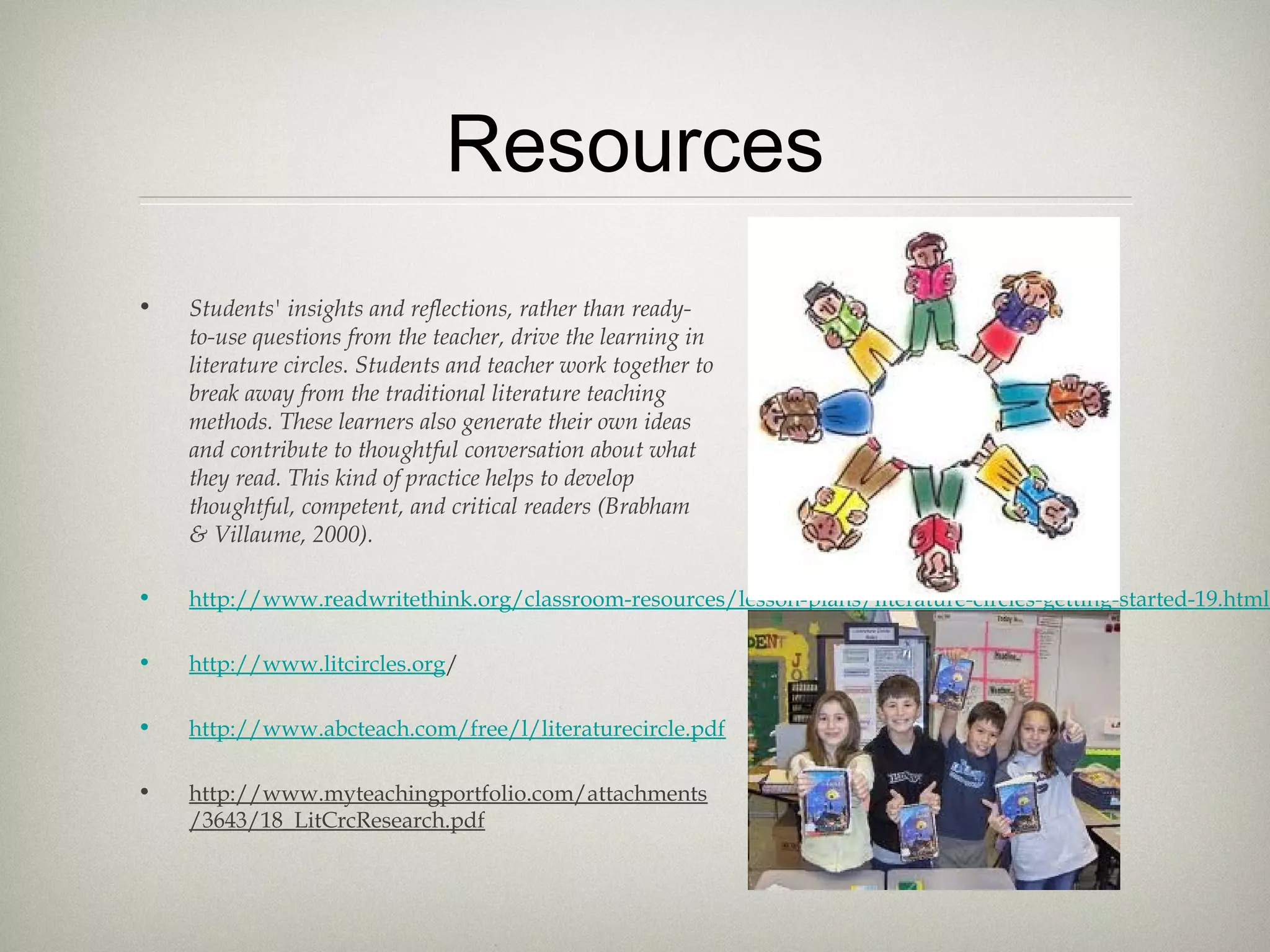
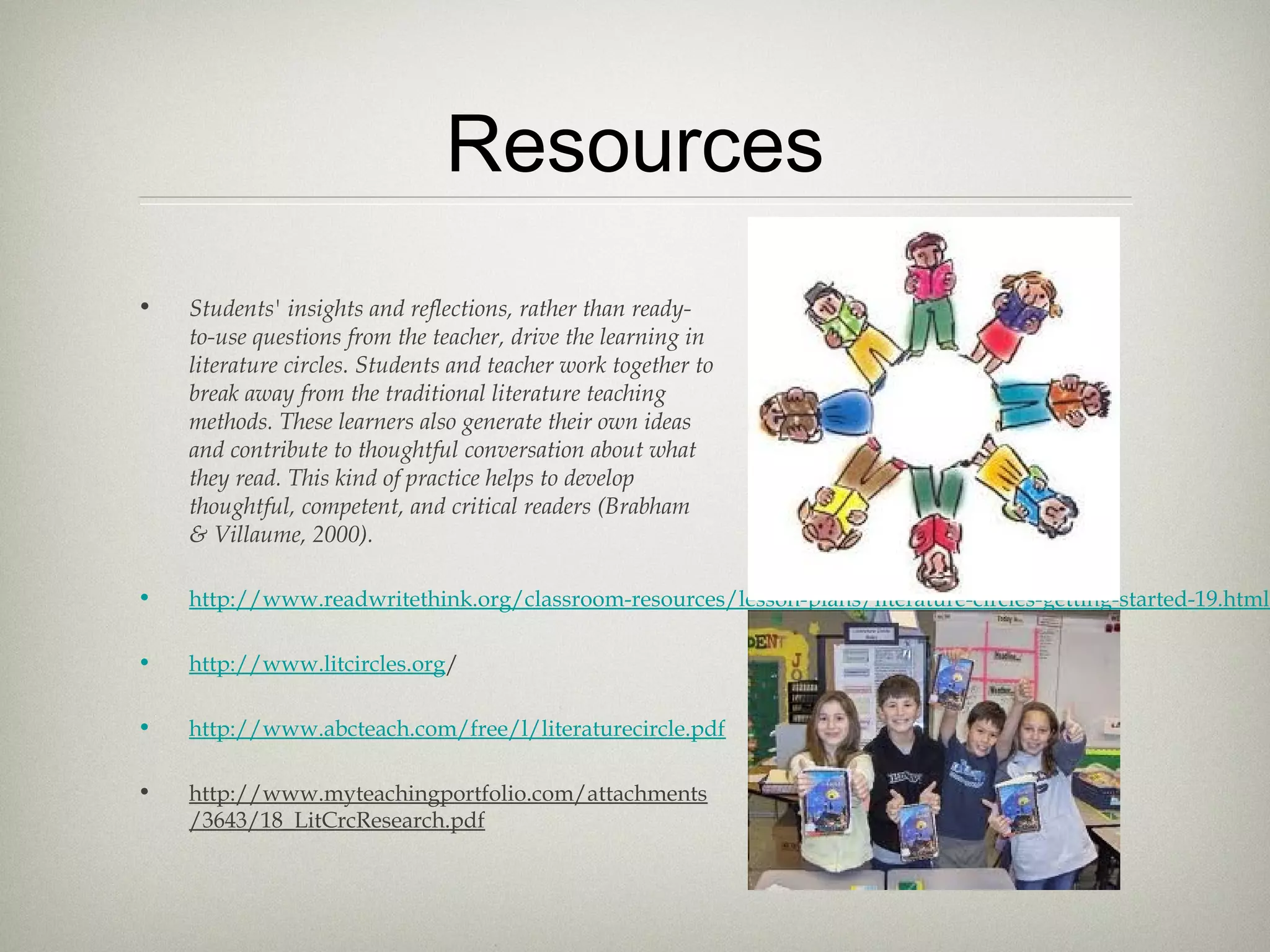
• Students' insights and reflections, rather than ready-
to-use questions from the teacher, drive the learning in
literature circles. Students and teacher work together to
break away from the traditional literature teaching
methods. These learners also generate their own ideas
and contribute to thoughtful conversation about what
they read. This kind of practice helps to develop
thoughtful, competent, and critical readers (Brabham
& Villaume, 2000).
• http://www.readwritethink.org/classroom-resources/lesson-plans/literature-circles-getting-started-19.html
• http://www.litcircles.org/
• http://www.abcteach.com/free/l/literaturecircle.pdf
• http://www.myteachingportfolio.com/attachments
/3643/18_LitCrcResearch.pdf
Resources
• Students' insights and reflections, rather than ready-
to-use questions from the teacher, drive the learning in
literature circles. Students and teacher work together to
break away from the traditional literature teaching
methods. These learners also generate their own ideas
and contribute to thoughtful conversation about what
they read. This kind of practice helps to develop
thoughtful, competent, and critical readers (Brabham
& Villaume, 2000).
• http://www.readwritethink.org/classroom-resources/lesson-plans/literature-circles-getting-started-19.html
• http://www.litcircles.org/
• http://www.abcteach.com/free/l/literaturecircle.pdf
• http://www.myteachingportfolio.com/attachments
/3643/18_LitCrcResearch.pdf

Instructional Strategy-EEX 4066

  • 1.
  • 2.
    Literature Circles • LiteratureCircles were first introduced informally in 1982 by Karen Smith, an elementary school teacher in Arizona. • The students in her fifth grade classroom assembled themselves into small groups using a box of books given to Mrs. Smith by a fellow teacher. • The students of Mrs. Smith’s fifth grade class discussed the novels with surprising commitment and complexity. • Now, using a more structured format, "In literature circles, small groups of students gather together to discuss a piece of literature in depth. The discussion is guided by students' response to what they have read. You may hear talk about events and characters in the book, the author's craft, or personal experiences related to the story." • Schlick Noe, K. L. & Johnson. N.L., Getting Started with Literature Circles , 1999 Christopher-Gordon Publishers, Inc. p. ix • Content: Reading
  • 3.
    Standards Related To LiteratureCircles • Standard: LA.3.1.6.1.  –  The student will use new vocabulary that is introduced and taught directly. • Standard: LA.3.1.6.2.  –  The student will listen to, read, and discuss familiar and conceptually challenging text. • Standard: LA.3.1.7.2.  –  The student will identify the author's purpose (e.g., to inform, entertain, or explain) in text and how an author's perspective influences text. • Standard: LA.3.1.7.3.  –  The student will determine explicit ideas and information in grade-level text, including but not limited to main idea, relevant supporting details, strongly implied message and inference, and chronological order of events. • Standard: LA.3.1.7.8.  –  The student will use strategies to repair comprehension of grade-appropriate text when self-monitoring indicates confusion, including but not limited to rereading, checking context clues, predicting, summarizing, questioning, and clarifying by checking other sources. • Standard: LA.3.2.1.2.  –  The student will identify and explain the elements of story structure, including character/character development, setting, plot, and problem/resolution in a variety of fiction. • Standard: LA.3.2.1.5.  –  The student will respond to, discuss, and reflect on various literary selections (e.g., poetry, prose, fiction, nonfiction), connecting text to self (personal connection), text to world (social connection), text to text (comparison among multiple texts). • Standard: LA.3.2.1.8.  –  The student will select a balance of age and ability appropriate fiction materials to read (e.g., chapter books, fairy tales, mythology, poetry), based on interest and teacher recommendations, to continue building a core foundation of knowledge.
  • 4.
    How To Implement LiteratureCircles • Steps: 1. Choose student groups. 2. Assign roles. 3. Assign reading to be completed in class or at home. 4. Select meeting dates. 5. Assist students in preparing for their role. 6. Facilitate group discussion. • Roles: • Discussion Director - develops questions for the group to discuss • Literary Luminary - chooses a selection that the group rereads and discusses because it is interesting, informative, the climax, well written.... • Vocabulary Enricher - chooses words that are difficult or used in an unfamiliar way • Connector - finds a connection between the story and another book, event in their personal life or the outside world • Illustrator - draws a picture related to the readingSummarizer - prepares a brief summary of the passage read that day • Investigator - looks up background information related to the book
  • 5.
    Resources • Students' insightsand reflections, rather than ready- to-use questions from the teacher, drive the learning in literature circles. Students and teacher work together to break away from the traditional literature teaching methods. These learners also generate their own ideas and contribute to thoughtful conversation about what they read. This kind of practice helps to develop thoughtful, competent, and critical readers (Brabham & Villaume, 2000). • http://www.readwritethink.org/classroom-resources/lesson-plans/literature-circles-getting-started-19.html • http://www.litcircles.org/ • http://www.abcteach.com/free/l/literaturecircle.pdf • http://www.myteachingportfolio.com/attachments /3643/18_LitCrcResearch.pdf
  • 6.
    Resources • Students' insightsand reflections, rather than ready- to-use questions from the teacher, drive the learning in literature circles. Students and teacher work together to break away from the traditional literature teaching methods. These learners also generate their own ideas and contribute to thoughtful conversation about what they read. This kind of practice helps to develop thoughtful, competent, and critical readers (Brabham & Villaume, 2000). • http://www.readwritethink.org/classroom-resources/lesson-plans/literature-circles-getting-started-19.html • http://www.litcircles.org/ • http://www.abcteach.com/free/l/literaturecircle.pdf • http://www.myteachingportfolio.com/attachments /3643/18_LitCrcResearch.pdf