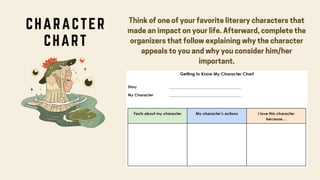
Think of one of your favorite literary characters that
made an impact on your life. Afterward, complete the
organizers that follow explaining why the character
appeals to you and why you consider him/her
important.
CHARACTER
CHART
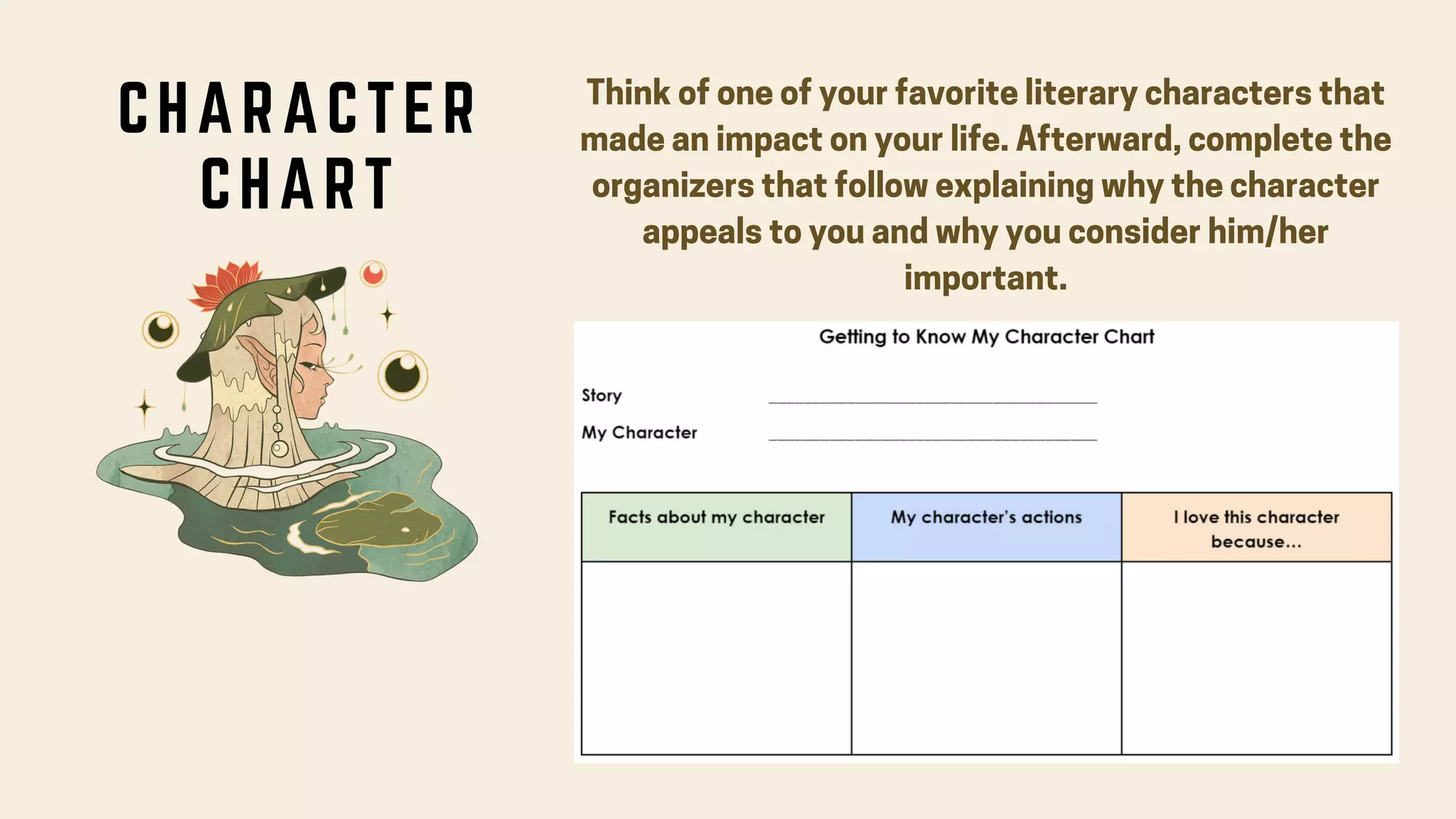
My Character Chart
Katniss protected and
saved her sister,
Primrose, from being
reaped as tribute in the
cruel game played by the
Capitol.
Determined, fearless
and focused. Katniss
overcomes the immense
challenges thrown at
her by thinking
strategically.
Facts about my
character My Character's
Action
She's independent
and self-sufficient.
I love this character
because...
MOTIVATION
Story: The Hunger Games
My Character: Katniss Everdeen
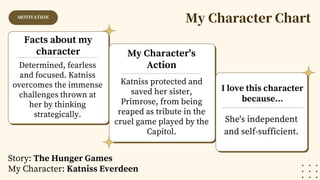
LITERARY CRITICISM
WEEK 9: Day 1
Meeting Objectives:
Identify the following approaches:
structuralist/formalist, moralist,
marxist, feminist, historical and
reader-response.
Critique a literary selection.
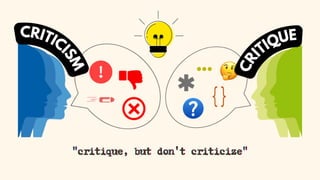
CRITICI
S
M
C
R
I
TIQUE
"critique, but don't criticize"
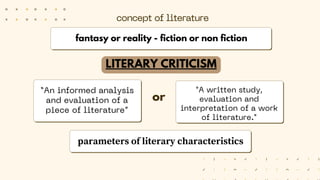
concept of literature
fantasy or reality - fiction or non fiction
LITERARY CRITICISM
“An informed analysis
and evaluation of a
piece of literature”
"A written study,
evaluation and
interpretation of a work
of literature."
or
parameters of literary characteristics
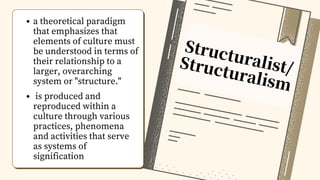
Structuralist/
Structuralism
a theoretical paradigm
that emphasizes that
elements of culture must
be understood in terms of
their relationship to a
larger, overarching
system or "structure."
is produced and
reproduced within a
culture through various
practices, phenomena
and activities that serve
as systems of
signification
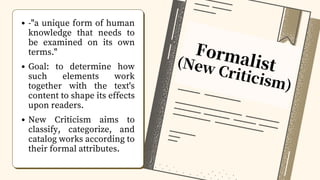
Formalist
(New Criticism)
-"a unique form of human
knowledge that needs to
be examined on its own
terms."
Goal: to determine how
such elements work
together with the text's
content to shape its effects
upon readers.
New Criticism aims to
classify, categorize, and
catalog works according to
their formal attributes.
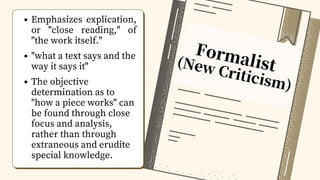
Formalist
(New Criticism)
Emphasizes explication,
or "close reading," of
"the work itself."
"what a text says and the
way it says it"
The objective
determination as to
"how a piece works" can
be found through close
focus and analysis,
rather than through
extraneous and erudite
special knowledge.
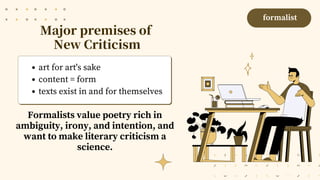
Major premises of
New Criticism
art for art's sake
content = form
texts exist in and for themselves
formalist
Formalists value poetry rich in
ambiguity, irony, and intention, and
want to make literary criticism a
science.
Moralist
Examines poetry and art
works against standard
ethical and civil criteria;
humanistic, societal
impact, tolerance,
equality, social justice
and sensitivity.
Evaluates the impact
and influence of works
of literature in a
stringent moral context.
It focuses on the
economic and political
elements of art, often
emphasizing the
ideological content of
literature.
Hold that human
societies develop
through class struggle
between ruling classes
that controls the means
of production and
working classes.
Marxist
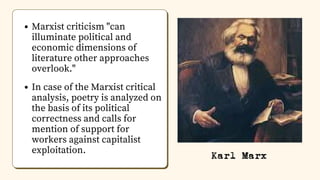
Marxist criticism "can
illuminate political and
economic dimensions of
literature other approaches
overlook."
In case of the Marxist critical
analysis, poetry is analyzed on
the basis of its political
correctness and calls for
mention of support for
workers against capitalist
exploitation.
Karl Marx
Feminist
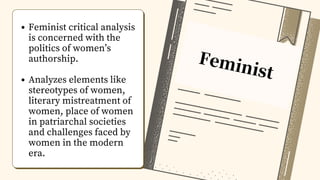
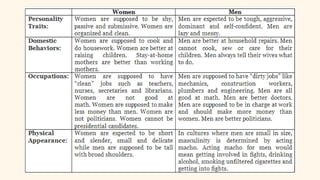
Feminist critical analysis
is concerned with the
politics of women’s
authorship.
Analyzes elements like
stereotypes of women,
literary mistreatment of
women, place of women
in patriarchal societies
and challenges faced by
women in the modern
era.
Historical
"seeks to understand a
literary work by
investigating the social,
cultural, and
intellectual context that
produced it—a context
that necessarily
includes the artist's
biography and milieu."
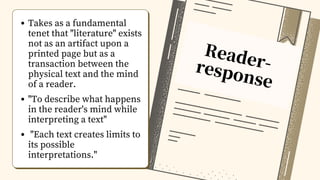
Reader-
response
Takes as a fundamental
tenet that "literature" exists
not as an artifact upon a
printed page but as a
transaction between the
physical text and the mind
of a reader.
"To describe what happens
in the reader's mind while
interpreting a text"
"Each text creates limits to
its possible
interpretations."
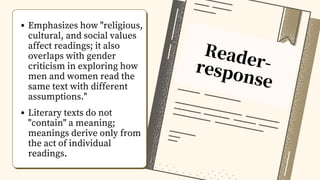
Reader-
response
Emphasizes how "religious,
cultural, and social values
affect readings; it also
overlaps with gender
criticism in exploring how
men and women read the
same text with different
assumptions."
Literary texts do not
"contain" a meaning;
meanings derive only from
the act of individual
readings.
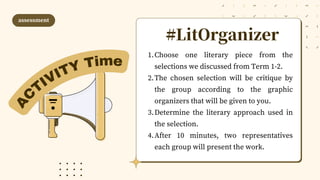
#LitOrganizer
Choose one literary piece from the
selections we discussed from Term 1-2.
The chosen selection will be critique by
the group according to the graphic
organizers that will be given to you.
Determine the literary approach used in
the selection.
After 10 minutes, two representatives
each group will present the work.
1.
2.
3.
4.
assessment
A
C
TIVITY Time
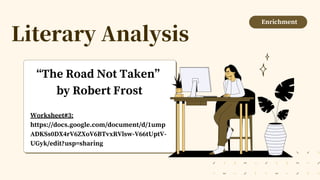
Literary Analysis
“The Road Not Taken”
by Robert Frost
Worksheet#3:
https://docs.google.com/document/d/1ump
ADKSs0DX4rV6ZXoV6BTvxRVlsw-V66tUptV-
UGyk/edit?usp=sharing
Enrichment
Closure
Why is it essential
to critique and
assess literary
selections using
different
approaches?

Literary Criticism

  • 1.
    Think of oneof your favorite literary characters that made an impact on your life. Afterward, complete the organizers that follow explaining why the character appeals to you and why you consider him/her important. CHARACTER CHART
  • 2.
    My Character Chart Katnissprotected and saved her sister, Primrose, from being reaped as tribute in the cruel game played by the Capitol. Determined, fearless and focused. Katniss overcomes the immense challenges thrown at her by thinking strategically. Facts about my character My Character's Action She's independent and self-sufficient. I love this character because... MOTIVATION Story: The Hunger Games My Character: Katniss Everdeen
  • 3.
    LITERARY CRITICISM WEEK 9:Day 1 Meeting Objectives: Identify the following approaches: structuralist/formalist, moralist, marxist, feminist, historical and reader-response. Critique a literary selection.
  • 4.
    CRITICI S M C R I TIQUE "critique, but don'tcriticize" "critique, but don't criticize" "critique, but don't criticize"
  • 5.
    concept of literature fantasyor reality - fiction or non fiction LITERARY CRITICISM “An informed analysis and evaluation of a piece of literature” "A written study, evaluation and interpretation of a work of literature." or parameters of literary characteristics
  • 6.
    Structuralist/ Structuralism a theoretical paradigm thatemphasizes that elements of culture must be understood in terms of their relationship to a larger, overarching system or "structure." is produced and reproduced within a culture through various practices, phenomena and activities that serve as systems of signification
  • 7.
    Formalist (New Criticism) -"a uniqueform of human knowledge that needs to be examined on its own terms." Goal: to determine how such elements work together with the text's content to shape its effects upon readers. New Criticism aims to classify, categorize, and catalog works according to their formal attributes.
  • 8.
    Formalist (New Criticism) Emphasizes explication, or"close reading," of "the work itself." "what a text says and the way it says it" The objective determination as to "how a piece works" can be found through close focus and analysis, rather than through extraneous and erudite special knowledge.
  • 9.
    Major premises of NewCriticism art for art's sake content = form texts exist in and for themselves formalist Formalists value poetry rich in ambiguity, irony, and intention, and want to make literary criticism a science.
  • 10.
    Moralist Examines poetry andart works against standard ethical and civil criteria; humanistic, societal impact, tolerance, equality, social justice and sensitivity. Evaluates the impact and influence of works of literature in a stringent moral context.
  • 11.
    It focuses onthe economic and political elements of art, often emphasizing the ideological content of literature. Hold that human societies develop through class struggle between ruling classes that controls the means of production and working classes. Marxist
  • 12.
    Marxist criticism "can illuminatepolitical and economic dimensions of literature other approaches overlook." In case of the Marxist critical analysis, poetry is analyzed on the basis of its political correctness and calls for mention of support for workers against capitalist exploitation. Karl Marx
  • 13.
    Feminist Feminist critical analysis isconcerned with the politics of women’s authorship. Analyzes elements like stereotypes of women, literary mistreatment of women, place of women in patriarchal societies and challenges faced by women in the modern era.
  • 15.
    Historical "seeks to understanda literary work by investigating the social, cultural, and intellectual context that produced it—a context that necessarily includes the artist's biography and milieu."
  • 16.
    Reader- response Takes as afundamental tenet that "literature" exists not as an artifact upon a printed page but as a transaction between the physical text and the mind of a reader. "To describe what happens in the reader's mind while interpreting a text" "Each text creates limits to its possible interpretations."
  • 17.
    Reader- response Emphasizes how "religious, cultural,and social values affect readings; it also overlaps with gender criticism in exploring how men and women read the same text with different assumptions." Literary texts do not "contain" a meaning; meanings derive only from the act of individual readings.
  • 18.
    #LitOrganizer Choose one literarypiece from the selections we discussed from Term 1-2. The chosen selection will be critique by the group according to the graphic organizers that will be given to you. Determine the literary approach used in the selection. After 10 minutes, two representatives each group will present the work. 1. 2. 3. 4. assessment A C TIVITY Time
  • 19.
    Literary Analysis “The RoadNot Taken” by Robert Frost Worksheet#3: https://docs.google.com/document/d/1ump ADKSs0DX4rV6ZXoV6BTvxRVlsw-V66tUptV- UGyk/edit?usp=sharing Enrichment
  • 20.
    Closure Why is itessential to critique and assess literary selections using different approaches?