Layered Questioning Techniques
for Diverse Learners
Caryn Lewis
Riverside County Office of Education
Session Outcomes
• Discuss effective questioning techniques can
improve comprehension in students with
limited English proficiency.
• Distinguish between instructional strategies
and questioning techniques that can be used
before, during and after the reading of the
text.
• Identify questions that may be generated by
the student and/or the teacher and apply
them to different types of text.
Research/Application/Practice
Let’s take a look
at instruction!
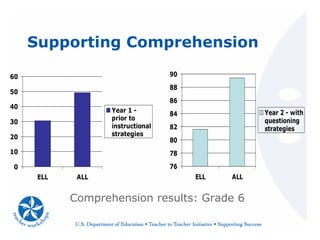
Supporting Comprehension
0
10
20
30
40
50
60
ELL ALL
Year 1 -
prior to
instructional
strategies
76
78
80
82
84
86
88
90
ELL ALL
Year 2 - with
questioning
strategies
Comprehension results: Grade 6
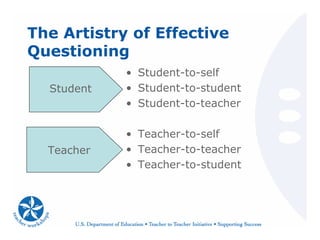
The Artistry of Effective
Questioning
Student
• Student-to-self
• Student-to-student
• Student-to-teacher
• Teacher-to-self
• Teacher-to-teacher
• Teacher-to-student
Teacher
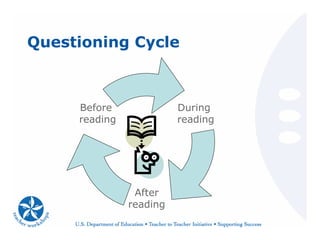
Questioning Cycle
During
reading
After
reading
Before
reading
Effective Questioning
• Encourages cooperative learning
• Promotes group discussion
• Builds on prior knowledge
• Allows for choral response
• Uses differentiation techniques
• Develops increasing levels of cognition
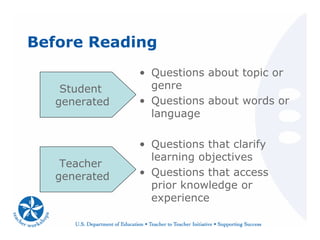
Before Reading
• Questions about topic or
genre
• Questions about words or
language
• Questions that clarify
learning objectives
• Questions that access
prior knowledge or
experience
Student
generated
Teacher
generated
Learning Objectives
• Content objective: Based on academic content
standards
What do I want them to do?
• Language objective: Based on English
language development standards
How do I want them to do it?
J. Echevarria, M. Vogt & D.J. Short, Making Content Comprehensible for English Language Learners:
The SIOP Model (Boston: Allyn and Bacon, 2000)
Stages of Language
Acquisition
• Beginning (pre-production)
• Beginning (early production)
• Beginning (early speech emergence)
• Early intermediate
• Intermediate
• Early advanced
• Advanced
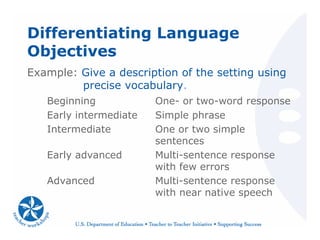
Differentiating Language
Objectives
Example: Give a description of the setting using
precise vocabulary.
Beginning One- or two-word response
Early intermediate Simple phrase
Intermediate One or two simple
sentences
Early advanced Multi-sentence response
with few errors
Advanced Multi-sentence response
with near native speech
Teacher-Focused Questions
• What are the learning objectives?
• Do my students have the prerequisite skills
necessary to complete this task?
• What academic language or vocabulary will I
need to preteach?
• What language will I require the students to
use during the lesson?
• What will the final student product be?
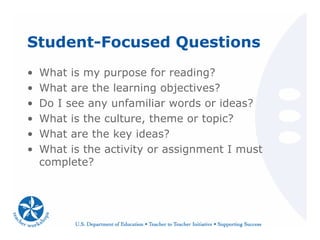
Student-Focused Questions
• What is my purpose for reading?
• What are the learning objectives?
• Do I see any unfamiliar words or ideas?
• What is the culture, theme or topic?
• What are the key ideas?
• What is the activity or assignment I must
complete?
Plan-Prepare-Present
With your table group, fill out the questioning
log. Look at the application process from both
the teacher and student perspectives. How will
the lesson be different with this questioning
process?
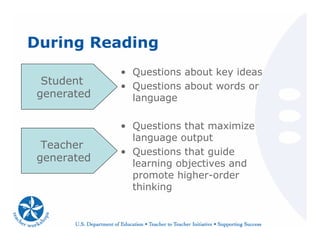
During Reading
• Questions about key ideas
• Questions about words or
language
• Questions that maximize
language output
• Questions that guide
learning objectives and
promote higher-order
thinking
Student
generated
Teacher
generated
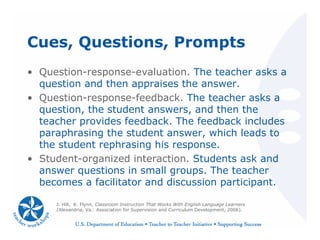
Cues, Questions, Prompts
• Question-response-evaluation. The teacher asks a
question and then appraises the answer.
• Question-response-feedback. The teacher asks a
question, the student answers, and then the
teacher provides feedback. The feedback includes
paraphrasing the student answer, which leads to
the student rephrasing his response.
• Student-organized interaction. Students ask and
answer questions in small groups. The teacher
becomes a facilitator and discussion participant.
J. Hill, K. Flynn, Classroom Instruction That Works With English Language Learners
(Alexandria, Va.: Association for Supervision and Curriculum Development, 2006).
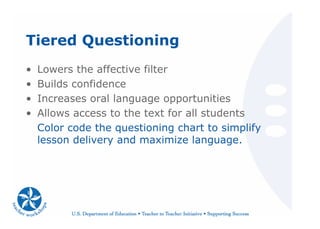
Tiered Questioning
• Lowers the affective filter
• Builds confidence
• Increases oral language opportunities
• Allows access to the text for all students
Color code the questioning chart to simplify
lesson delivery and maximize language.
Text Walk-Text Talk
With your table group, use the text to design a
series of questions that focus specifically on
language output. What do you notice about
these questions? How does the questioning chart
help to facilitate lesson delivery?
Question
• Student generated
• Literal: Who, what, where, when
• Inferential: Why, how, what if
Question-Answer Relationship
• Teach the four types of questions:
– Right there
– Think and search
– Author and you
– On your own
• Use non-linguistic representation to support
student understanding and practice
• Use scaffolding model to build success
- Taffy Raphael, 1982
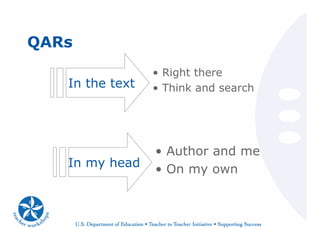
QARs
In the text
In my head
• Right there
• Think and search
• Author and me
• On my own
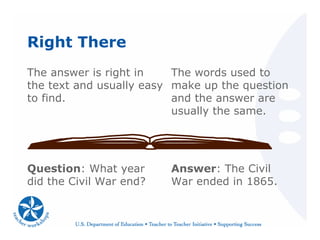
Right There
The answer is right in
the text and usually easy
to find.
The words used to
make up the question
and the answer are
usually the same.
Question: What year
did the Civil War end?
Answer: The Civil
War ended in 1865.
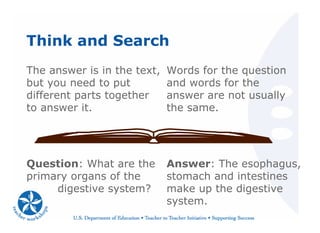
Think and Search
The answer is in the text,
but you need to put
different parts together
to answer it.
Words for the question
and words for the
answer are not usually
the same.
Question: What are the
primary organs of the
digestive system?
Answer: The esophagus,
stomach and intestines
make up the digestive
system.
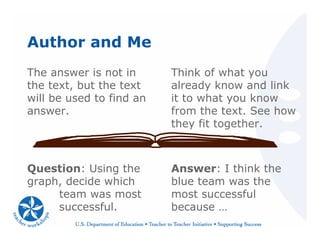
Author and Me
The answer is not in
the text, but the text
will be used to find an
answer.
Think of what you
already know and link
it to what you know
from the text. See how
they fit together.
Question: Using the
graph, decide which
team was most
successful.
Answer: I think the
blue team was the
most successful
because …
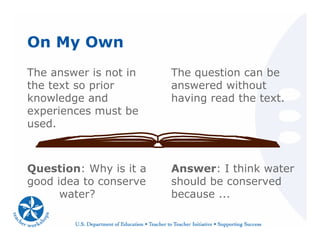
On My Own
The answer is not in
the text so prior
knowledge and
experiences must be
used.
The question can be
answered without
having read the text.
Question: Why is it a
good idea to conserve
water?
Answer: I think water
should be conserved
because ...
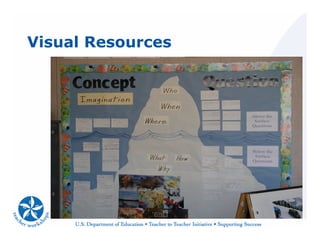
Visual Resources
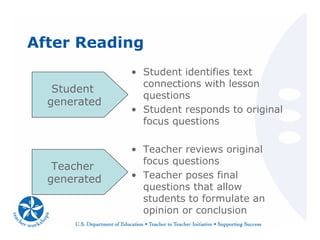
After Reading
• Student identifies text
connections with lesson
questions
• Student responds to original
focus questions
• Teacher reviews original
focus questions
• Teacher poses final
questions that allow
students to formulate an
opinion or conclusion
Student
generated
Teacher
generated
Instructional Strategies for
Questioning in Grades 3-8
• Focus questions
• Question-answer relationship (QAR)
• Reciprocal reading
• Tiered questioning
• Central question diagram
• Question the author
• Question tree and sea
• Question frames
Management Strategies
• Give up the lecture!
• Ask interactive questions.
• Increase oral language opportunities.
• Allow for choral response.
• Encourage cooperative learning.
• Use questioning frames.
• Pair students with alternate ranking.
• PRETEACH!
Caryn Lewis
clewis@rcoe.us
Implementation Activities
• With a team of teachers, select a language arts or
content area lesson and identify the learning
objectives for both academic content and language.
• Use the lesson map to create a plan for questioning
that will take place before, during, and after a text-
based lesson.
• Create a system for easy recognition of levels of
English proficiency with the students in your
classroom, or school site. Color code the student
names to correlate with the stages of language
acquisition.

Effrective qs

  • 1.
    Layered Questioning Techniques forDiverse Learners Caryn Lewis Riverside County Office of Education
  • 2.
    Session Outcomes • Discusseffective questioning techniques can improve comprehension in students with limited English proficiency. • Distinguish between instructional strategies and questioning techniques that can be used before, during and after the reading of the text. • Identify questions that may be generated by the student and/or the teacher and apply them to different types of text.
  • 3.
  • 4.
    Supporting Comprehension 0 10 20 30 40 50 60 ELL ALL Year1 - prior to instructional strategies 76 78 80 82 84 86 88 90 ELL ALL Year 2 - with questioning strategies Comprehension results: Grade 6
  • 5.
    The Artistry ofEffective Questioning Student • Student-to-self • Student-to-student • Student-to-teacher • Teacher-to-self • Teacher-to-teacher • Teacher-to-student Teacher
  • 6.
  • 7.
    Effective Questioning • Encouragescooperative learning • Promotes group discussion • Builds on prior knowledge • Allows for choral response • Uses differentiation techniques • Develops increasing levels of cognition
  • 8.
    Before Reading • Questionsabout topic or genre • Questions about words or language • Questions that clarify learning objectives • Questions that access prior knowledge or experience Student generated Teacher generated
  • 9.
    Learning Objectives • Contentobjective: Based on academic content standards What do I want them to do? • Language objective: Based on English language development standards How do I want them to do it? J. Echevarria, M. Vogt & D.J. Short, Making Content Comprehensible for English Language Learners: The SIOP Model (Boston: Allyn and Bacon, 2000)
  • 10.
    Stages of Language Acquisition •Beginning (pre-production) • Beginning (early production) • Beginning (early speech emergence) • Early intermediate • Intermediate • Early advanced • Advanced
  • 11.
    Differentiating Language Objectives Example: Givea description of the setting using precise vocabulary. Beginning One- or two-word response Early intermediate Simple phrase Intermediate One or two simple sentences Early advanced Multi-sentence response with few errors Advanced Multi-sentence response with near native speech
  • 12.
    Teacher-Focused Questions • Whatare the learning objectives? • Do my students have the prerequisite skills necessary to complete this task? • What academic language or vocabulary will I need to preteach? • What language will I require the students to use during the lesson? • What will the final student product be?
  • 13.
    Student-Focused Questions • Whatis my purpose for reading? • What are the learning objectives? • Do I see any unfamiliar words or ideas? • What is the culture, theme or topic? • What are the key ideas? • What is the activity or assignment I must complete?
  • 14.
    Plan-Prepare-Present With your tablegroup, fill out the questioning log. Look at the application process from both the teacher and student perspectives. How will the lesson be different with this questioning process?
  • 15.
    During Reading • Questionsabout key ideas • Questions about words or language • Questions that maximize language output • Questions that guide learning objectives and promote higher-order thinking Student generated Teacher generated
  • 16.
    Cues, Questions, Prompts •Question-response-evaluation. The teacher asks a question and then appraises the answer. • Question-response-feedback. The teacher asks a question, the student answers, and then the teacher provides feedback. The feedback includes paraphrasing the student answer, which leads to the student rephrasing his response. • Student-organized interaction. Students ask and answer questions in small groups. The teacher becomes a facilitator and discussion participant. J. Hill, K. Flynn, Classroom Instruction That Works With English Language Learners (Alexandria, Va.: Association for Supervision and Curriculum Development, 2006).
  • 17.
    Tiered Questioning • Lowersthe affective filter • Builds confidence • Increases oral language opportunities • Allows access to the text for all students Color code the questioning chart to simplify lesson delivery and maximize language.
  • 18.
    Text Walk-Text Talk Withyour table group, use the text to design a series of questions that focus specifically on language output. What do you notice about these questions? How does the questioning chart help to facilitate lesson delivery?
  • 19.
    Question • Student generated •Literal: Who, what, where, when • Inferential: Why, how, what if
  • 20.
    Question-Answer Relationship • Teachthe four types of questions: – Right there – Think and search – Author and you – On your own • Use non-linguistic representation to support student understanding and practice • Use scaffolding model to build success - Taffy Raphael, 1982
  • 21.
    QARs In the text Inmy head • Right there • Think and search • Author and me • On my own
  • 22.
    Right There The answeris right in the text and usually easy to find. The words used to make up the question and the answer are usually the same. Question: What year did the Civil War end? Answer: The Civil War ended in 1865.
  • 23.
    Think and Search Theanswer is in the text, but you need to put different parts together to answer it. Words for the question and words for the answer are not usually the same. Question: What are the primary organs of the digestive system? Answer: The esophagus, stomach and intestines make up the digestive system.
  • 24.
    Author and Me Theanswer is not in the text, but the text will be used to find an answer. Think of what you already know and link it to what you know from the text. See how they fit together. Question: Using the graph, decide which team was most successful. Answer: I think the blue team was the most successful because …
  • 25.
    On My Own Theanswer is not in the text so prior knowledge and experiences must be used. The question can be answered without having read the text. Question: Why is it a good idea to conserve water? Answer: I think water should be conserved because ...
  • 27.
  • 28.
    After Reading • Studentidentifies text connections with lesson questions • Student responds to original focus questions • Teacher reviews original focus questions • Teacher poses final questions that allow students to formulate an opinion or conclusion Student generated Teacher generated
  • 29.
    Instructional Strategies for Questioningin Grades 3-8 • Focus questions • Question-answer relationship (QAR) • Reciprocal reading • Tiered questioning • Central question diagram • Question the author • Question tree and sea • Question frames
  • 30.
    Management Strategies • Giveup the lecture! • Ask interactive questions. • Increase oral language opportunities. • Allow for choral response. • Encourage cooperative learning. • Use questioning frames. • Pair students with alternate ranking. • PRETEACH!
  • 31.
  • 32.
    Implementation Activities • Witha team of teachers, select a language arts or content area lesson and identify the learning objectives for both academic content and language. • Use the lesson map to create a plan for questioning that will take place before, during, and after a text- based lesson. • Create a system for easy recognition of levels of English proficiency with the students in your classroom, or school site. Color code the student names to correlate with the stages of language acquisition.