Chapter 2
Becoming a Professional Teacher
What does professionalism mean to you?
Fundamentals of Teaching
 Adhere to professional and ethical standards of
teaching.
 Engage in reflective teaching
Both are key elements in the professional life of a
teacher
 Teachers are the most important factor in determining
the quality of an early childhood program.
 Knowing about professional standards helps students in
their own teaching
 An evaluation process is critical in helping teachers
become the best they can be.
National Association of the Education of the Young Child
has written a set of initiatives to make the
work more understandable and
articulates those objectives to both those
in the profession and adults outside the
classroom.
NAEYC
NAEYC
Is the world’s largest ECE organization. Nearly 80,000 strong, NAEYC has a
network of local, state, and regional affiliates with these goals.
To support excellent early childhood education
To improve teaching and learning
To build profession
To promote public support and policies
Pass out NAEYC Standards
How do student teachers develop
teaching skills?
There are many proven strategies to improve your
practice;
‘TRY, reflect, and try again approach
Asking advice from a supervising teacher and faculty
instructor
Talking to other student teachers
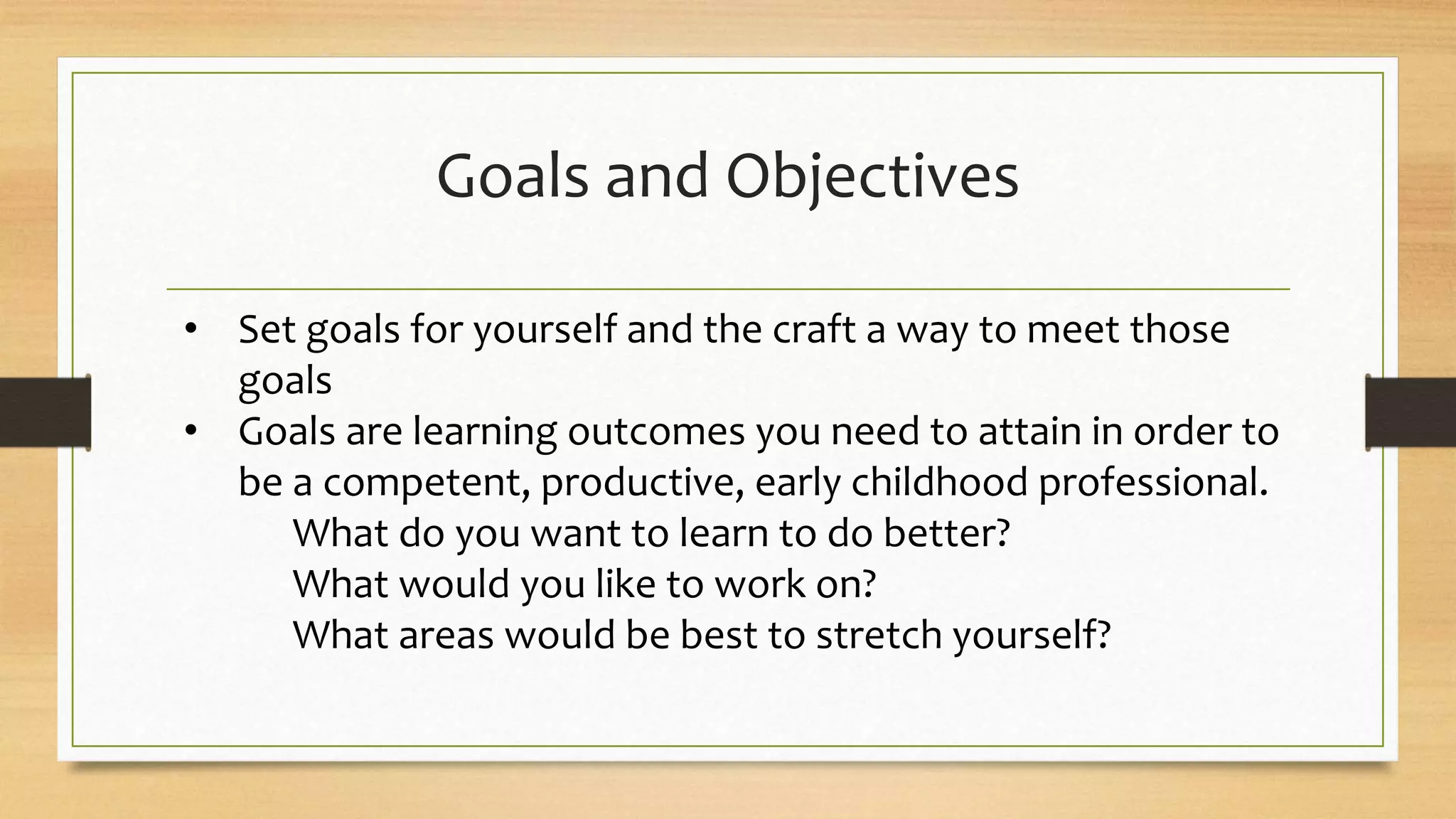
Goals and Objectives
• Set goals for yourself and the craft a way to meet those
goals
• Goals are learning outcomes you need to attain in order to
be a competent, productive, early childhood professional.
What do you want to learn to do better?
What would you like to work on?
What areas would be best to stretch yourself?
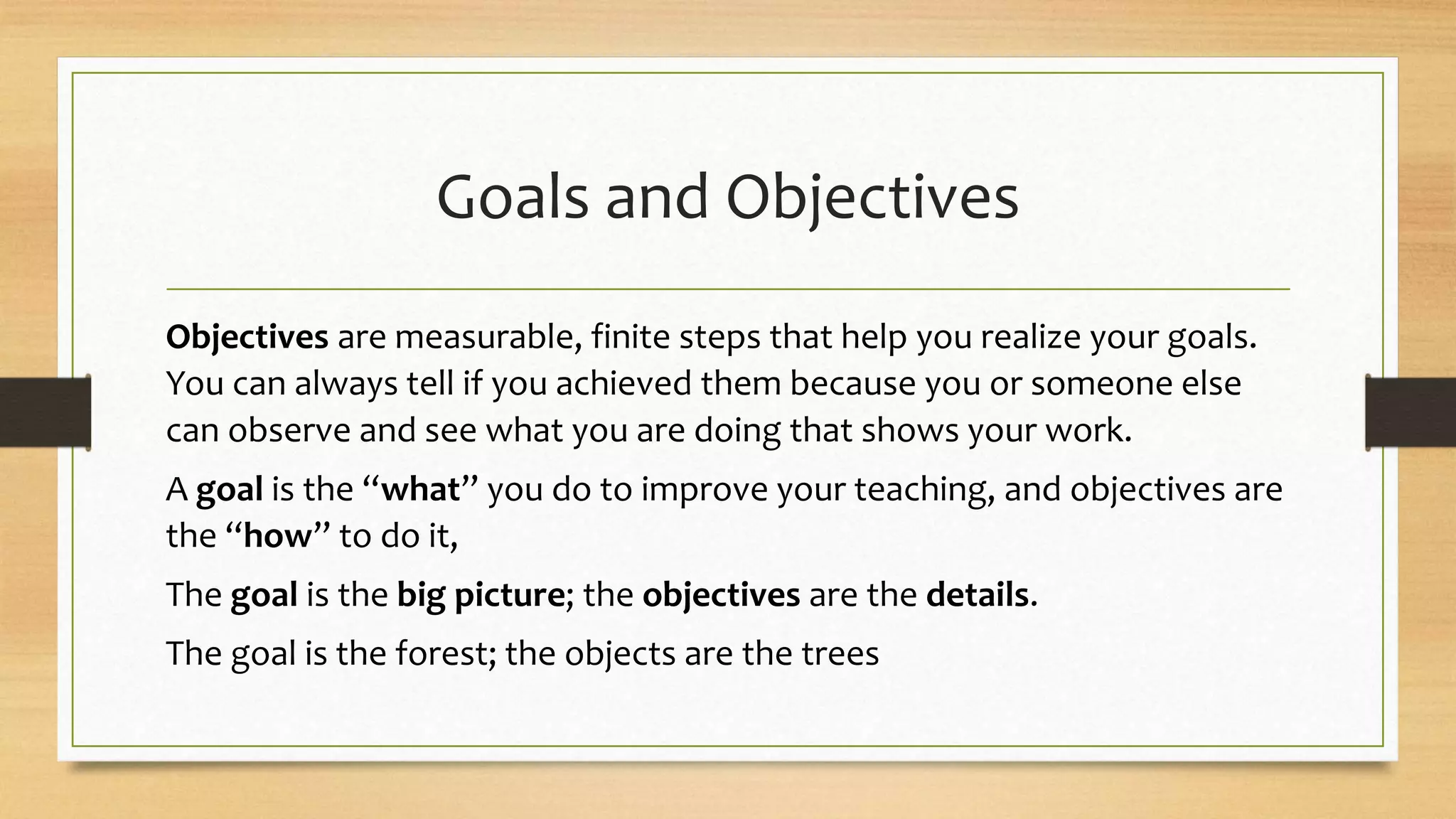
Goals and Objectives
Objectives are measurable, finite steps that help you realize your goals.
You can always tell if you achieved them because you or someone else
can observe and see what you are doing that shows your work.
A goal is the “what” you do to improve your teaching, and objectives are
the “how” to do it,
The goal is the big picture; the objectives are the details.
The goal is the forest; the objects are the trees
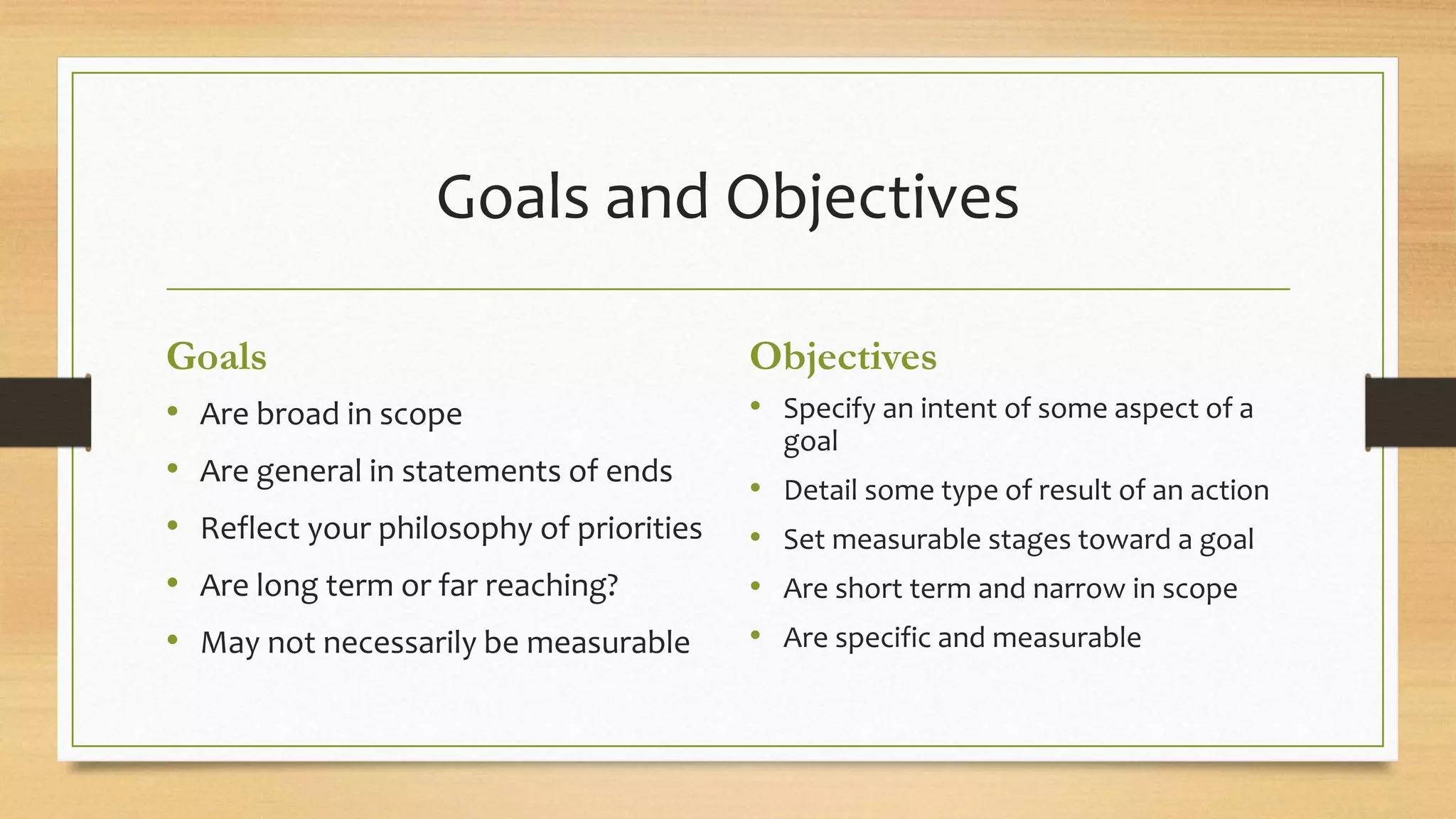
Goals and Objectives
Goals
• Are broad in scope
• Are general in statements of ends
• Reflect your philosophy of priorities
• Are long term or far reaching?
• May not necessarily be measurable
Objectives
• Specify an intent of some aspect of a
goal
• Detail some type of result of an action
• Set measurable stages toward a goal
• Are short term and narrow in scope
• Are specific and measurable
Basic Teaching Skills
Figure 2.3
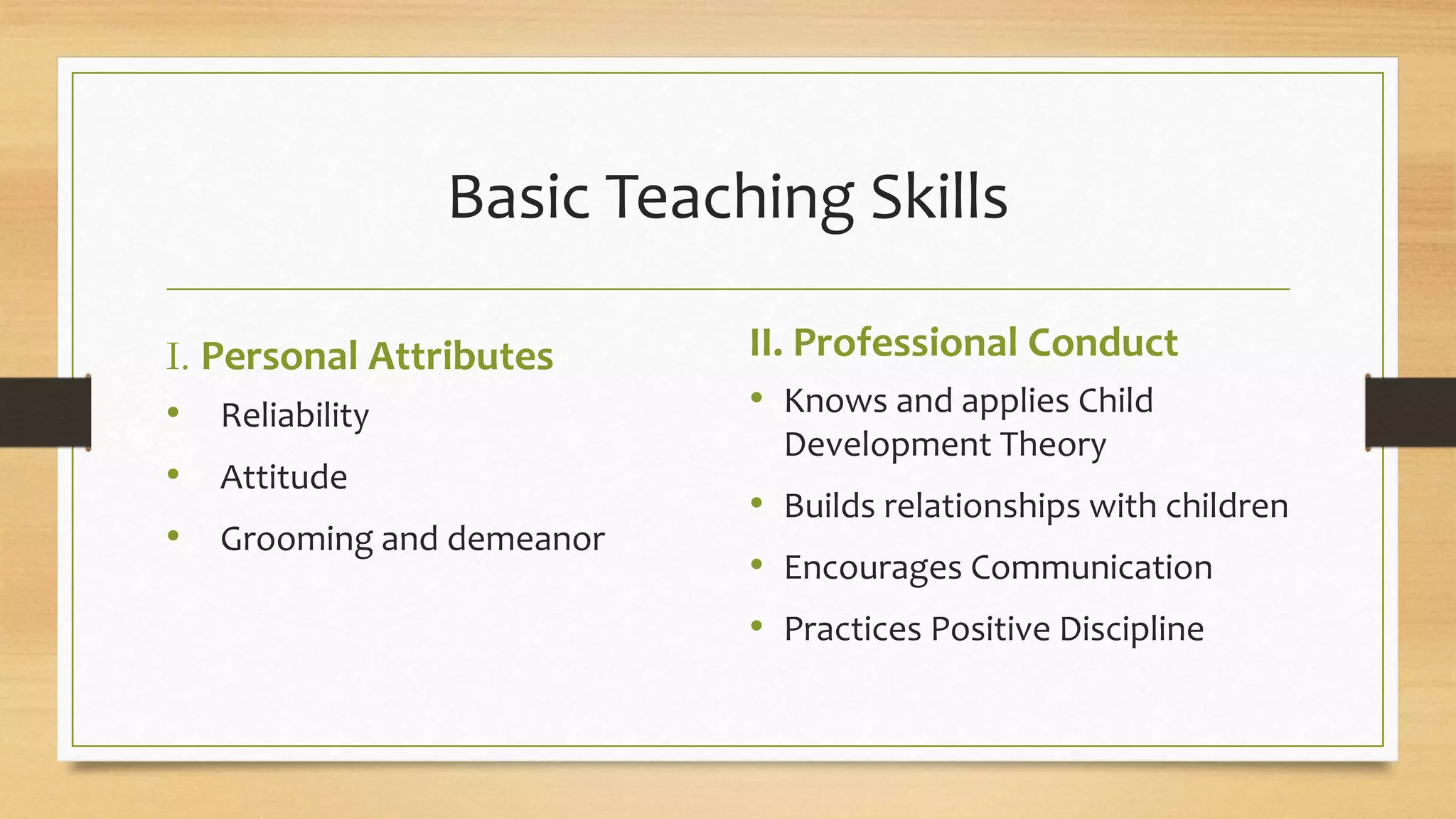
Basic Teaching Skills
I. Personal Attributes
• Reliability
• Attitude
• Grooming and demeanor
II. Professional Conduct
• Knows and applies Child
Development Theory
• Builds relationships with children
• Encourages Communication
• Practices Positive Discipline
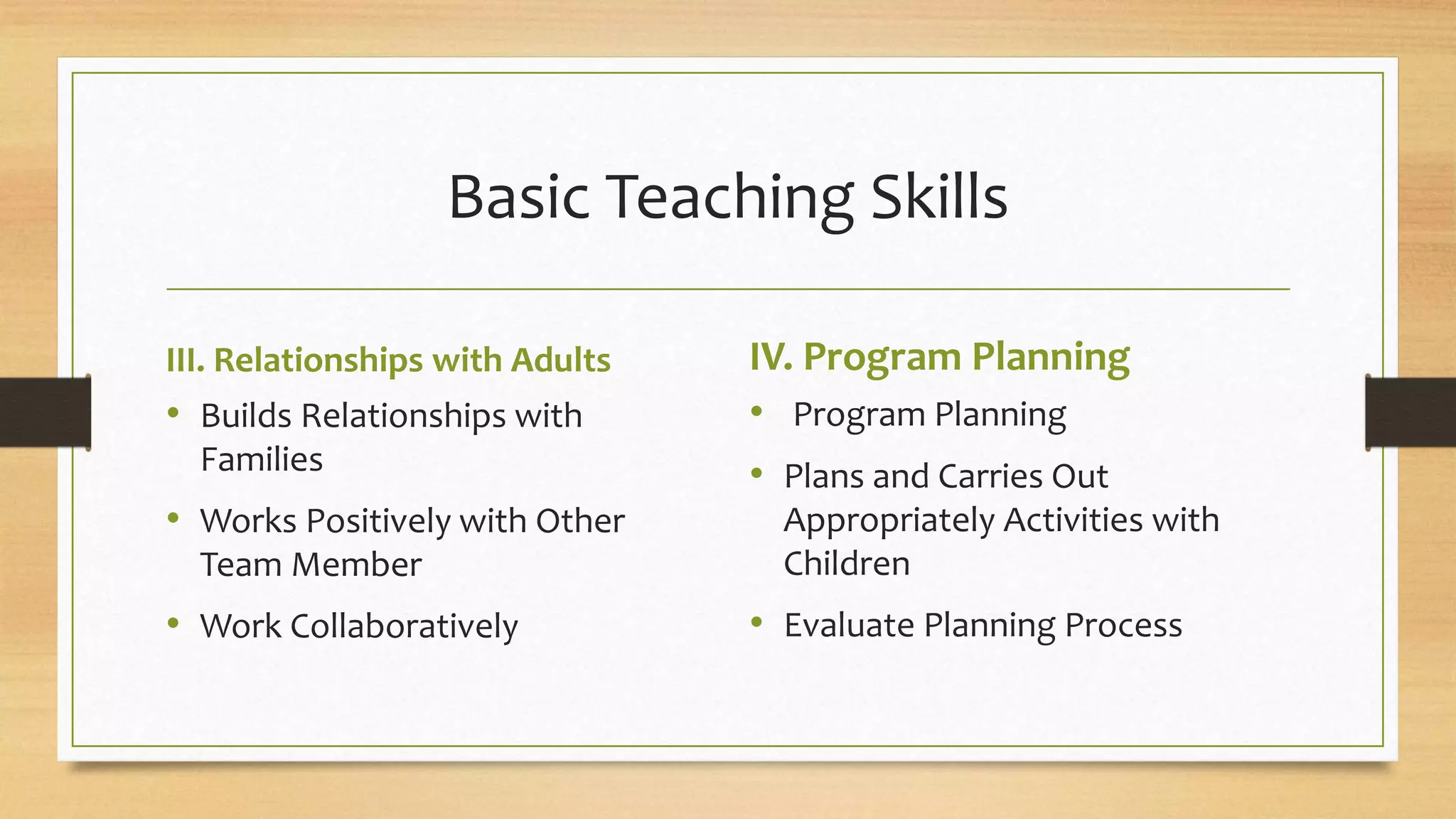
Basic Teaching Skills
III. Relationships with Adults
• Builds Relationships with
Families
• Works Positively with Other
Team Member
• Work Collaboratively
IV. Program Planning
• Program Planning
• Plans and Carries Out
Appropriately Activities with
Children
• Evaluate Planning Process
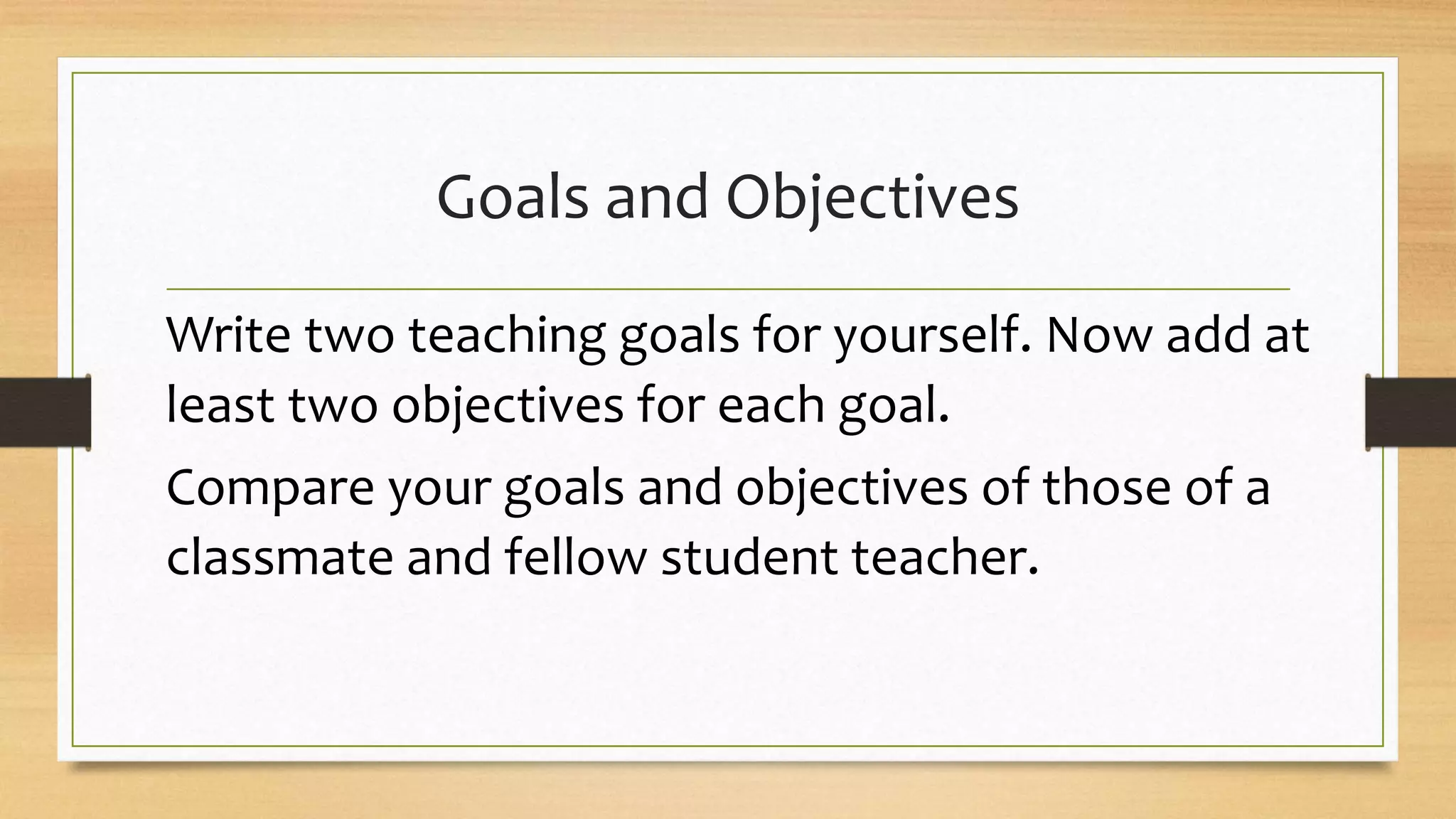
Goals and Objectives
Write two teaching goals for yourself. Now add at
least two objectives for each goal.
Compare your goals and objectives of those of a
classmate and fellow student teacher.
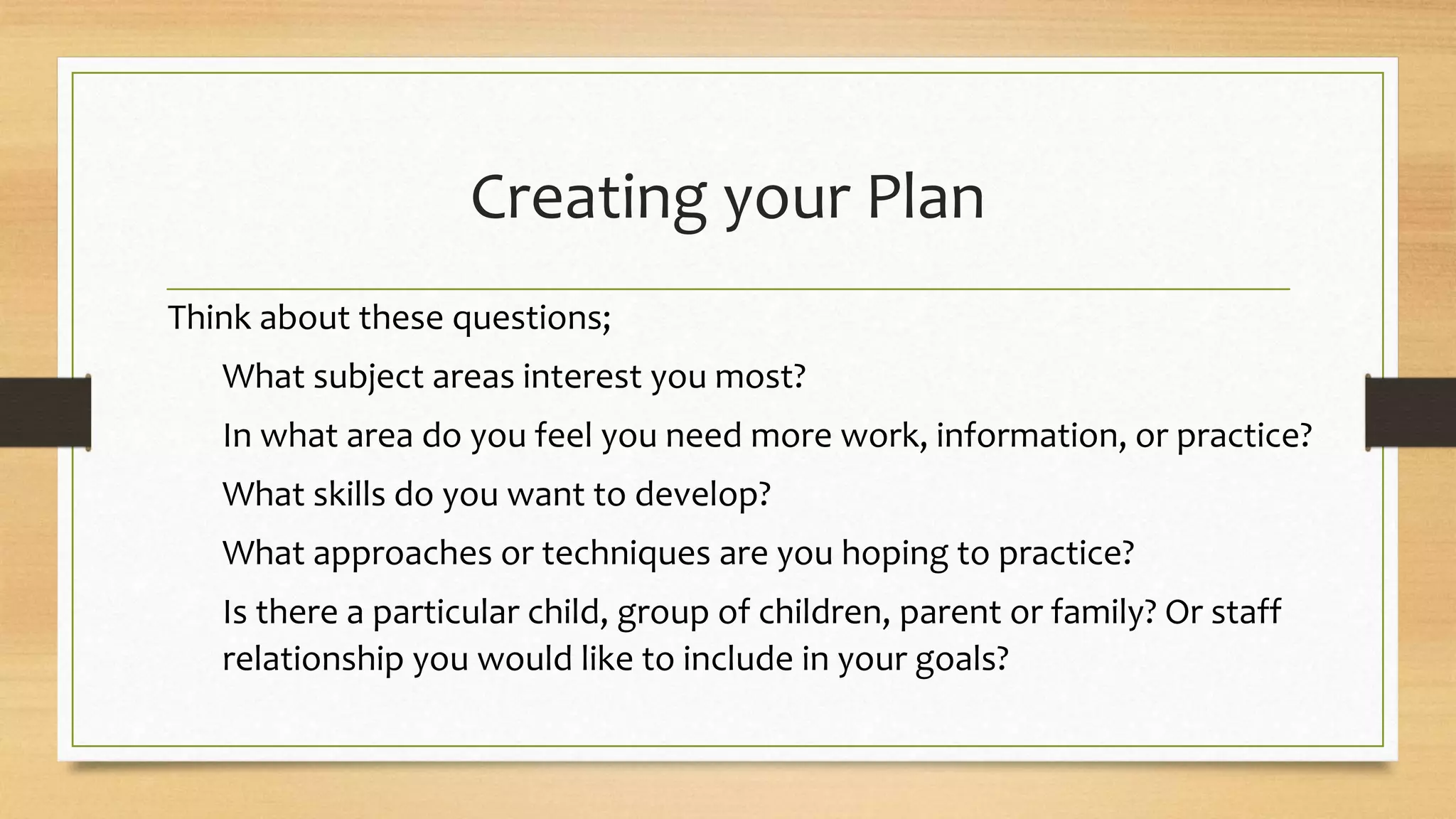
Creating your Plan
Think about these questions;
What subject areas interest you most?
In what area do you feel you need more work, information, or practice?
What skills do you want to develop?
What approaches or techniques are you hoping to practice?
Is there a particular child, group of children, parent or family? Or staff
relationship you would like to include in your goals?
Creating Your Plan cont.
Are there particular strategies that you want to explore further?
What can be reasonably accomplished in the time of your practicum
fieldwork?
How will you measure whether you accomplished your objectives and
met or made progress on your
How can your teaching team and/or supervisor assist and support your
goals?
Define A Time Frame
Be realistic about what you think you can accomplish in your student teaching experience
At the end of your established time frame;
Summarize your accomplishment and /or progress toward each goal and objective.
Describe any challenges or obstacles you faced and how you overcame them.
Give examples of any success or setbacks
Discuss the accomplishment you are most proud of and in which area(s) you feel you need more practice
or experience.
Explain how you worked with your teaching team or supervisor in meeting your goals and objectives.
Discuss how your feedback helped you and contributed to your overall professional and personal
growth.
Teacher Assessment and Evaluation
Assessment and evaluation are part of the professional life of an early childhood educator for many
reasons.
Most programs have an annual performance is a professional requirement.
Evaluation is the road map to follow as you work toward your goals
For once you set your goals, your mentor (master teacher) observes your behavior and offer you
feedback.
The student teacher evaluation helps you identify areas of strength and areas needing improvement
You then revise your goals
The evaluation process promotes objective assessment based on criteria that was given to you at
the beginning of your student teaching.
Evaluations
Self- Evaluation
• You, the student teacher are the critical part of assessing your teaching
skills.
• An evaluation of your work is critical to your progress toward
competence
Supervisor Evaluations
• Student Teachers need feedback from their master teacher and
instructor as well.
Evaluations
Informal
• In the moment while on the floor with children
• In preparation of at the end of an activity
• Weekly meetings
Formal
• Written evaluation by the master teacher at the end of an activity
• Written evaluation by college instructor after site visit
Anticipating an evaluation can be anxiety producing. Getting feedback helps you
become a better teacher.
CLASS
(Classroom Assessment Scoring System)
Is an observation instrument developed to assess classroom quality in preschool
through kindergarten classrooms, a revised version for infant toddler classrooms is in
progress
The CLASS dimensions are based on development theory and research suggesting
that interactions between students and adults are the primary mechanism of
student development and learning. The CLASS dimensions are based solely on
interactions between teachers and students in classrooms; this system does not
evaluate the presence of materials, the physical environment or safety, or adoption
of a specific curriculum.
California Early Childhood Mentor Program
The California Early Childhood Mentor Program provides resources and support to aspiring and
experienced teachers and administrators in programs serving children birth to five and before-
and after-school programs. Through Federal and local funding the Mentor Program provides
stipends and professional development support to
Mentor Teachers who guide college students in Early Care & Education
Director Mentors who provide resources and expertise to new directors and administrators
facing new challenges
Respect, recognition, and opportunities for growth are powerful incentives for excellent
teachers and administrators to stay in the field and provide quality care to children and families
of California!
Code of Ethics
Start Code of Ethics Power point
Career Options
Planning a career in Early Childhood Education (ECE)
To prepare for any new adventure, you have to start at the beginning, decide
where you want to go, how you will get there, and what you will need along the
way. When you prepare for your professional career it requires the same steps.
This guide will help put you on the right path to begin your career in Early
Childhood Education.
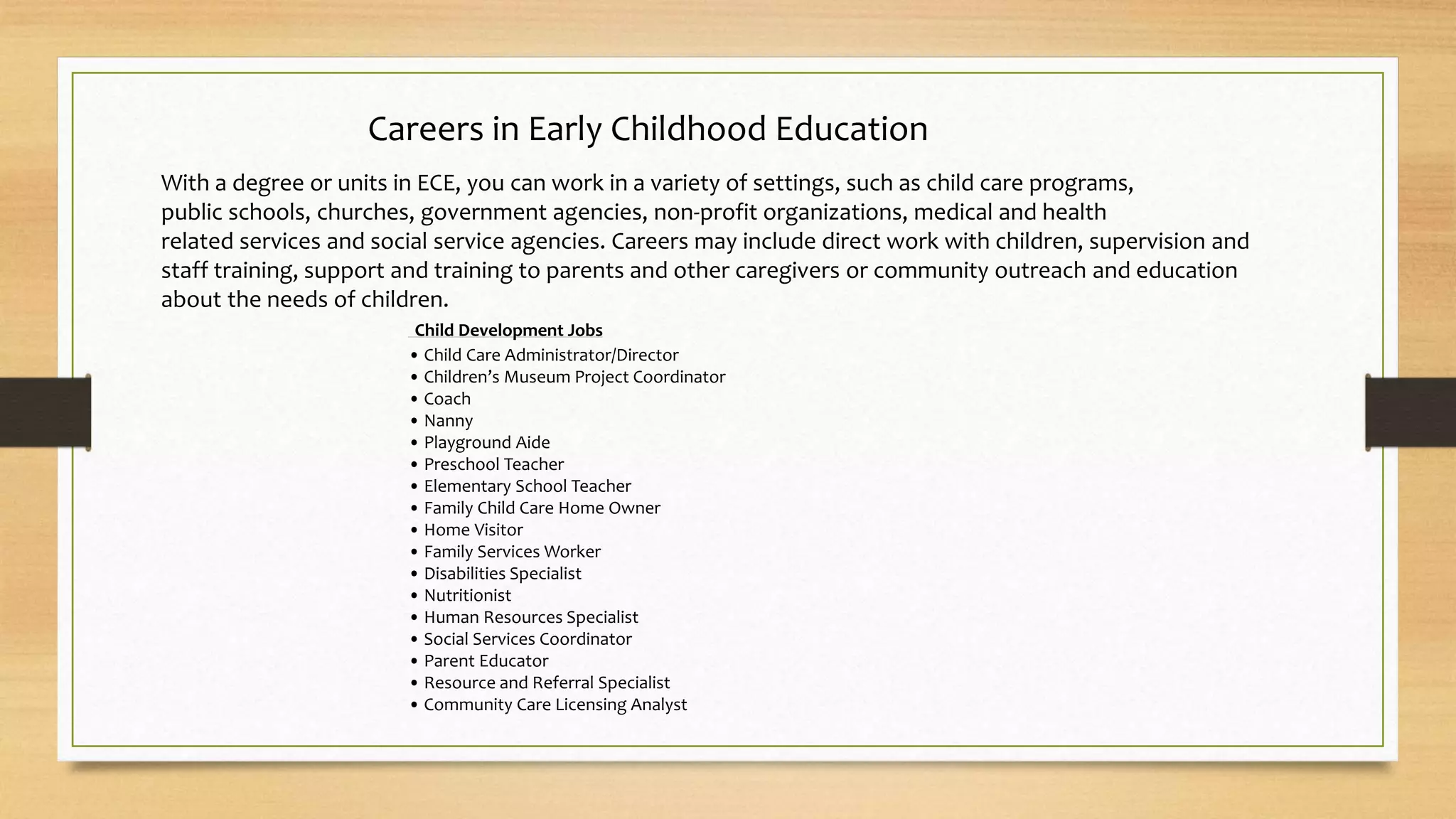
Careers in Early Childhood Education
With a degree or units in ECE, you can work in a variety of settings, such as child care programs,
public schools, churches, government agencies, non-profit organizations, medical and health
related services and social service agencies. Careers may include direct work with children, supervision and
staff training, support and training to parents and other caregivers or community outreach and education
about the needs of children.
Child Development Jobs
• Child Care Administrator/Director
• Children’s Museum Project Coordinator
• Coach
• Nanny
• Playground Aide
• Preschool Teacher
• Elementary School Teacher
• Family Child Care Home Owner
• Home Visitor
• Family Services Worker
• Disabilities Specialist
• Nutritionist
• Human Resources Specialist
• Social Services Coordinator
• Parent Educator
• Resource and Referral Specialist
• Community Care Licensing Analyst
Professionalism
Professionalism as a commitment to the field includes
advocating for young children, for quality programs in
the early years, and for support in working conditions
and compensation.
Professional Portfolios
Is an innovative way to collect and present yourself as a professional?
A portfolio is a tool that helps teachers make sense of their experiences that
contribute to your competence
It tracks their professional development and provides work samples for
others to view.
It’s an effective vehicle to you to demonstrate to others in a meaning way
the skills and knowledge you have gained
Working Portfolios
Demonstrate your work in progress and is more inclusive than
the presentation portfolio
Presentation Portfolio
• Subset of the working portfolio used in professional
interaction of others (job interview)
• Creating a portfolio takes time and personal reflection
Portfolios
Keep a box or large notebook that you will hold your work samples artifacts divided into sections
Establish a filing system, become a packrat (see Figure 2.11)
Academic
Conferences and workshop
Leadership
Creative endeavors
Personal Statements
References and Recommendations
Review often for gaps, so you can see what you need to work on.
Wherever you work or volunteer ask for a letter of recommendation
Teaching Credential and Incentives
Each state has it’s own credentials and often sponsors incentive
programs to recruit and retain teachers. Many states offer
certificate programs through postsecondary education, either at
community college or 4-year level universities.

Chapter 2 Becoming a Professional Teacher ppt (1)

  • 1.
    Chapter 2 Becoming aProfessional Teacher
  • 2.
  • 3.
    Fundamentals of Teaching Adhere to professional and ethical standards of teaching.  Engage in reflective teaching Both are key elements in the professional life of a teacher
  • 4.
     Teachers arethe most important factor in determining the quality of an early childhood program.  Knowing about professional standards helps students in their own teaching  An evaluation process is critical in helping teachers become the best they can be.
  • 5.
    National Association ofthe Education of the Young Child has written a set of initiatives to make the work more understandable and articulates those objectives to both those in the profession and adults outside the classroom.
  • 6.
    NAEYC NAEYC Is the world’slargest ECE organization. Nearly 80,000 strong, NAEYC has a network of local, state, and regional affiliates with these goals. To support excellent early childhood education To improve teaching and learning To build profession To promote public support and policies
  • 7.
    Pass out NAEYCStandards
  • 8.
    How do studentteachers develop teaching skills? There are many proven strategies to improve your practice; ‘TRY, reflect, and try again approach Asking advice from a supervising teacher and faculty instructor Talking to other student teachers
  • 9.
    Goals and Objectives •Set goals for yourself and the craft a way to meet those goals • Goals are learning outcomes you need to attain in order to be a competent, productive, early childhood professional. What do you want to learn to do better? What would you like to work on? What areas would be best to stretch yourself?
  • 10.
    Goals and Objectives Objectivesare measurable, finite steps that help you realize your goals. You can always tell if you achieved them because you or someone else can observe and see what you are doing that shows your work. A goal is the “what” you do to improve your teaching, and objectives are the “how” to do it, The goal is the big picture; the objectives are the details. The goal is the forest; the objects are the trees
  • 11.
    Goals and Objectives Goals •Are broad in scope • Are general in statements of ends • Reflect your philosophy of priorities • Are long term or far reaching? • May not necessarily be measurable Objectives • Specify an intent of some aspect of a goal • Detail some type of result of an action • Set measurable stages toward a goal • Are short term and narrow in scope • Are specific and measurable
  • 12.
  • 13.
    Basic Teaching Skills I.Personal Attributes • Reliability • Attitude • Grooming and demeanor II. Professional Conduct • Knows and applies Child Development Theory • Builds relationships with children • Encourages Communication • Practices Positive Discipline
  • 14.
    Basic Teaching Skills III.Relationships with Adults • Builds Relationships with Families • Works Positively with Other Team Member • Work Collaboratively IV. Program Planning • Program Planning • Plans and Carries Out Appropriately Activities with Children • Evaluate Planning Process
  • 15.
    Goals and Objectives Writetwo teaching goals for yourself. Now add at least two objectives for each goal. Compare your goals and objectives of those of a classmate and fellow student teacher.
  • 16.
    Creating your Plan Thinkabout these questions; What subject areas interest you most? In what area do you feel you need more work, information, or practice? What skills do you want to develop? What approaches or techniques are you hoping to practice? Is there a particular child, group of children, parent or family? Or staff relationship you would like to include in your goals?
  • 17.
    Creating Your Plancont. Are there particular strategies that you want to explore further? What can be reasonably accomplished in the time of your practicum fieldwork? How will you measure whether you accomplished your objectives and met or made progress on your How can your teaching team and/or supervisor assist and support your goals?
  • 18.
    Define A TimeFrame Be realistic about what you think you can accomplish in your student teaching experience At the end of your established time frame; Summarize your accomplishment and /or progress toward each goal and objective. Describe any challenges or obstacles you faced and how you overcame them. Give examples of any success or setbacks Discuss the accomplishment you are most proud of and in which area(s) you feel you need more practice or experience. Explain how you worked with your teaching team or supervisor in meeting your goals and objectives. Discuss how your feedback helped you and contributed to your overall professional and personal growth.
  • 19.
    Teacher Assessment andEvaluation Assessment and evaluation are part of the professional life of an early childhood educator for many reasons. Most programs have an annual performance is a professional requirement. Evaluation is the road map to follow as you work toward your goals For once you set your goals, your mentor (master teacher) observes your behavior and offer you feedback. The student teacher evaluation helps you identify areas of strength and areas needing improvement You then revise your goals The evaluation process promotes objective assessment based on criteria that was given to you at the beginning of your student teaching.
  • 20.
    Evaluations Self- Evaluation • You,the student teacher are the critical part of assessing your teaching skills. • An evaluation of your work is critical to your progress toward competence Supervisor Evaluations • Student Teachers need feedback from their master teacher and instructor as well.
  • 21.
    Evaluations Informal • In themoment while on the floor with children • In preparation of at the end of an activity • Weekly meetings Formal • Written evaluation by the master teacher at the end of an activity • Written evaluation by college instructor after site visit Anticipating an evaluation can be anxiety producing. Getting feedback helps you become a better teacher.
  • 22.
    CLASS (Classroom Assessment ScoringSystem) Is an observation instrument developed to assess classroom quality in preschool through kindergarten classrooms, a revised version for infant toddler classrooms is in progress The CLASS dimensions are based on development theory and research suggesting that interactions between students and adults are the primary mechanism of student development and learning. The CLASS dimensions are based solely on interactions between teachers and students in classrooms; this system does not evaluate the presence of materials, the physical environment or safety, or adoption of a specific curriculum.
  • 23.
    California Early ChildhoodMentor Program The California Early Childhood Mentor Program provides resources and support to aspiring and experienced teachers and administrators in programs serving children birth to five and before- and after-school programs. Through Federal and local funding the Mentor Program provides stipends and professional development support to Mentor Teachers who guide college students in Early Care & Education Director Mentors who provide resources and expertise to new directors and administrators facing new challenges Respect, recognition, and opportunities for growth are powerful incentives for excellent teachers and administrators to stay in the field and provide quality care to children and families of California!
  • 24.
    Code of Ethics StartCode of Ethics Power point
  • 25.
    Career Options Planning acareer in Early Childhood Education (ECE) To prepare for any new adventure, you have to start at the beginning, decide where you want to go, how you will get there, and what you will need along the way. When you prepare for your professional career it requires the same steps. This guide will help put you on the right path to begin your career in Early Childhood Education.
  • 26.
    Careers in EarlyChildhood Education With a degree or units in ECE, you can work in a variety of settings, such as child care programs, public schools, churches, government agencies, non-profit organizations, medical and health related services and social service agencies. Careers may include direct work with children, supervision and staff training, support and training to parents and other caregivers or community outreach and education about the needs of children. Child Development Jobs • Child Care Administrator/Director • Children’s Museum Project Coordinator • Coach • Nanny • Playground Aide • Preschool Teacher • Elementary School Teacher • Family Child Care Home Owner • Home Visitor • Family Services Worker • Disabilities Specialist • Nutritionist • Human Resources Specialist • Social Services Coordinator • Parent Educator • Resource and Referral Specialist • Community Care Licensing Analyst
  • 27.
    Professionalism Professionalism as acommitment to the field includes advocating for young children, for quality programs in the early years, and for support in working conditions and compensation.
  • 28.
    Professional Portfolios Is aninnovative way to collect and present yourself as a professional? A portfolio is a tool that helps teachers make sense of their experiences that contribute to your competence It tracks their professional development and provides work samples for others to view. It’s an effective vehicle to you to demonstrate to others in a meaning way the skills and knowledge you have gained
  • 29.
    Working Portfolios Demonstrate yourwork in progress and is more inclusive than the presentation portfolio Presentation Portfolio • Subset of the working portfolio used in professional interaction of others (job interview) • Creating a portfolio takes time and personal reflection
  • 30.
    Portfolios Keep a boxor large notebook that you will hold your work samples artifacts divided into sections Establish a filing system, become a packrat (see Figure 2.11) Academic Conferences and workshop Leadership Creative endeavors Personal Statements References and Recommendations Review often for gaps, so you can see what you need to work on. Wherever you work or volunteer ask for a letter of recommendation
  • 31.
    Teaching Credential andIncentives Each state has it’s own credentials and often sponsors incentive programs to recruit and retain teachers. Many states offer certificate programs through postsecondary education, either at community college or 4-year level universities.