Introduction to Nondestructive
            Testing
Outline
• Introduction to NDT
• Common NDT Methods
• Selected Applications
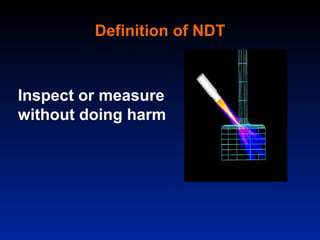
Definition of NDT


Inspect or measure
without doing harm
When are NDE Methods Used?
There are NDE application at almost any stage
in the production or life cycle of a component.
 – To assist in product development
 – To monitor, improve or control
   manufacturing processes
 – To inspect for in-service damage
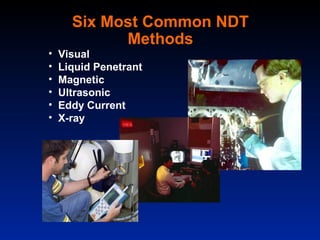
Six Most Common NDT
            Methods
•   Visual
•   Liquid Penetrant
•   Magnetic
•   Ultrasonic
•   Eddy Current
•   X-ray
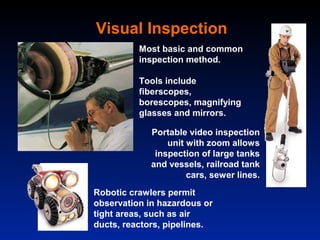
Visual Inspection
          Most basic and common
          inspection method.

          Tools include
          fiberscopes,
          borescopes, magnifying
          glasses and mirrors.

             Portable video inspection
                 unit with zoom allows
              inspection of large tanks
             and vessels, railroad tank
                      cars, sewer lines.
Robotic crawlers permit
observation in hazardous or
tight areas, such as air
ducts, reactors, pipelines.
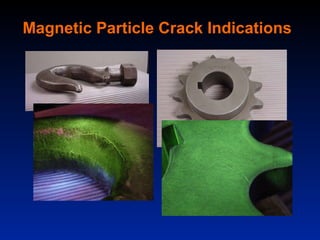
Magnetic Particle Crack Indications
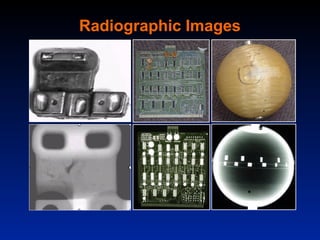
Radiographic Images
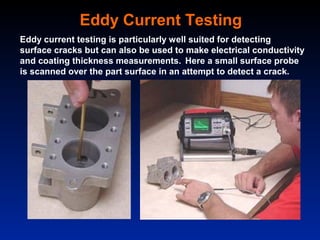
Eddy Current Testing
Eddy current testing is particularly well suited for detecting
surface cracks but can also be used to make electrical conductivity
and coating thickness measurements. Here a small surface probe
is scanned over the part surface in an attempt to detect a crack.
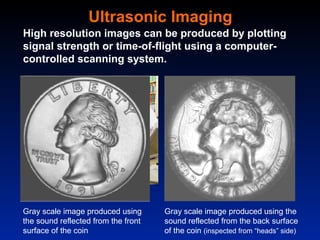
Ultrasonic Imaging
High resolution images can be produced by plotting
signal strength or time-of-flight using a computer-
controlled scanning system.


Gray scale image produced using      Gray scale image produced using the
the sound reflected from the front   sound reflected from the back surface
surface of the coin                  of the coin (inspected from “heads” side)
Inspection Following
       Secondary Processing
• Machining
• Welding
• Grinding
• Heat treating
• Plating
• etc.
Inspection For
        In-Service Damage

• Cracking
• Corrosion
• Erosion/Wear
• Heat Damage
• etc.
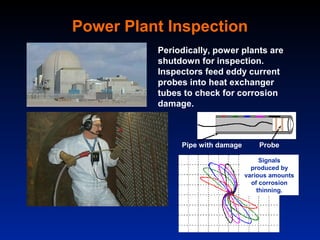
Power Plant Inspection
          Periodically, power plants are
          shutdown for inspection.
          Inspectors feed eddy current
          probes into heat exchanger
          tubes to check for corrosion
          damage.


               Pipe with damage       Probe

                                       Signals
                                    produced by
                                  various amounts
                                    of corrosion
                                      thinning.
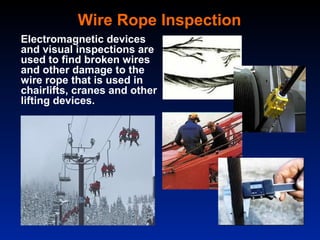
Wire Rope Inspection
Electromagnetic devices
and visual inspections are
used to find broken wires
and other damage to the
wire rope that is used in
chairlifts, cranes and other
lifting devices.
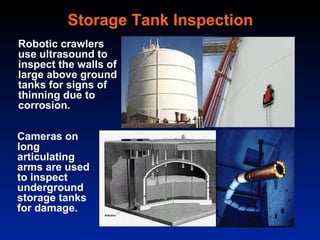
Storage Tank Inspection
Robotic crawlers
use ultrasound to
inspect the walls of
large above ground
tanks for signs of
thinning due to
corrosion.

Cameras on
long
articulating
arms are used
to inspect
underground
storage tanks
for damage.
Aircraft Inspection
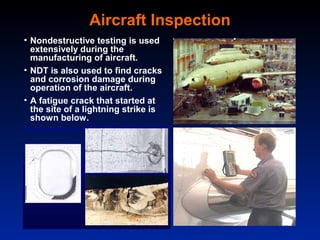
• Nondestructive testing is used
  extensively during the
  manufacturing of aircraft.
• NDT is also used to find cracks
  and corrosion damage during
  operation of the aircraft.
• A fatigue crack that started at
  the site of a lightning strike is
  shown below.
Bridge Inspection
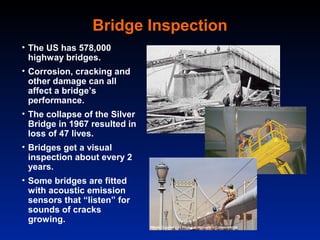
• The US has 578,000
  highway bridges.
• Corrosion, cracking and
  other damage can all
  affect a bridge’s
  performance.
• The collapse of the Silver
  Bridge in 1967 resulted in
  loss of 47 lives.
• Bridges get a visual
  inspection about every 2
  years.
• Some bridges are fitted
  with acoustic emission
  sensors that “listen” for
  sounds of cracks
  growing.
Pipeline Inspection
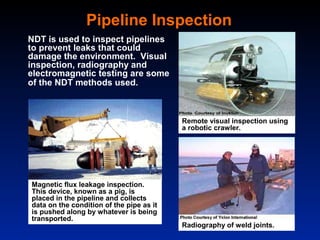
NDT is used to inspect pipelines
to prevent leaks that could
damage the environment. Visual
inspection, radiography and
electromagnetic testing are some
of the NDT methods used.


                                          Remote visual inspection using
                                          a robotic crawler.


Magnetic flux leakage inspection.
This device, known as a pig, is
placed in the pipeline and collects
data on the condition of the pipe as it
is pushed along by whatever is being
transported.
                                          Radiography of weld joints.
Special Measurements
Boeing employees in Philadelphia were given the privilege of
evaluating the Liberty Bell for damage using NDT techniques.
Eddy current methods were used to measure the electrical
conductivity of the Bell's bronze casing at various points to
evaluate its uniformity.

Bridge NDT Presentation

  • 1.
  • 2.
    Outline • Introduction toNDT • Common NDT Methods • Selected Applications
  • 3.
    Definition of NDT Inspector measure without doing harm
  • 4.
    When are NDEMethods Used? There are NDE application at almost any stage in the production or life cycle of a component. – To assist in product development – To monitor, improve or control manufacturing processes – To inspect for in-service damage
  • 5.
    Six Most CommonNDT Methods • Visual • Liquid Penetrant • Magnetic • Ultrasonic • Eddy Current • X-ray
  • 6.
    Visual Inspection Most basic and common inspection method. Tools include fiberscopes, borescopes, magnifying glasses and mirrors. Portable video inspection unit with zoom allows inspection of large tanks and vessels, railroad tank cars, sewer lines. Robotic crawlers permit observation in hazardous or tight areas, such as air ducts, reactors, pipelines.
  • 7.
  • 8.
  • 9.
    Eddy Current Testing Eddycurrent testing is particularly well suited for detecting surface cracks but can also be used to make electrical conductivity and coating thickness measurements. Here a small surface probe is scanned over the part surface in an attempt to detect a crack.
  • 10.
    Ultrasonic Imaging High resolutionimages can be produced by plotting signal strength or time-of-flight using a computer- controlled scanning system. Gray scale image produced using Gray scale image produced using the the sound reflected from the front sound reflected from the back surface surface of the coin of the coin (inspected from “heads” side)
  • 11.
    Inspection Following Secondary Processing • Machining • Welding • Grinding • Heat treating • Plating • etc.
  • 12.
    Inspection For In-Service Damage • Cracking • Corrosion • Erosion/Wear • Heat Damage • etc.
  • 13.
    Power Plant Inspection Periodically, power plants are shutdown for inspection. Inspectors feed eddy current probes into heat exchanger tubes to check for corrosion damage. Pipe with damage Probe Signals produced by various amounts of corrosion thinning.
  • 14.
    Wire Rope Inspection Electromagneticdevices and visual inspections are used to find broken wires and other damage to the wire rope that is used in chairlifts, cranes and other lifting devices.
  • 15.
    Storage Tank Inspection Roboticcrawlers use ultrasound to inspect the walls of large above ground tanks for signs of thinning due to corrosion. Cameras on long articulating arms are used to inspect underground storage tanks for damage.
  • 16.
    Aircraft Inspection • Nondestructivetesting is used extensively during the manufacturing of aircraft. • NDT is also used to find cracks and corrosion damage during operation of the aircraft. • A fatigue crack that started at the site of a lightning strike is shown below.
  • 17.
    Bridge Inspection • TheUS has 578,000 highway bridges. • Corrosion, cracking and other damage can all affect a bridge’s performance. • The collapse of the Silver Bridge in 1967 resulted in loss of 47 lives. • Bridges get a visual inspection about every 2 years. • Some bridges are fitted with acoustic emission sensors that “listen” for sounds of cracks growing.
  • 18.
    Pipeline Inspection NDT isused to inspect pipelines to prevent leaks that could damage the environment. Visual inspection, radiography and electromagnetic testing are some of the NDT methods used. Remote visual inspection using a robotic crawler. Magnetic flux leakage inspection. This device, known as a pig, is placed in the pipeline and collects data on the condition of the pipe as it is pushed along by whatever is being transported. Radiography of weld joints.
  • 19.
    Special Measurements Boeing employeesin Philadelphia were given the privilege of evaluating the Liberty Bell for damage using NDT techniques. Eddy current methods were used to measure the electrical conductivity of the Bell's bronze casing at various points to evaluate its uniformity.

Editor's Notes

  • #2 This presentation was developed by the Collaboration for NDT Education to provide students and other audiences with a general introduction to nondestructive testing. The material by itself is not intended to train individuals to perform NDT functions, but rather to acquaint individuals with some of the common NDT methods and their uses. All rights are reserved by the authors but the material may be freely used by individuals and organizations for educational purposes. The materials may not be sold commercially, or used in commercial products or services. Comments are welcome at NDT-ed@cnde.iastate.edu.
  • #18 The US has 578,000 highway bridges, which are the lifelines of US commerce. Corrosion, cracking and other damage can all affect the bridges load carrying capacity. Therefore, all of the elements that directly affect performance of the bridge including the footing, substructure, deck, and superstructure must be periodically inspected or monitored. Visual inspection is the primary NDE method used to evaluate the condition of the majority of the nation's highway bridges. Inspectors periodically (about every two years) pay each bridge a visit to assess its condition. However, it is not uncommon for a fisherman, canoeist and other passerby to alert officials to major damage that may have occurred between inspections. The potential penalties for ineffective inspection of bridges can be very severe. Instances of major bridge collapse are very rare, but the results are truly catastrophic. The collapse of the famous Silver Bridge at Point Pleasant, Ohio in 1967 resulted in loss of 47 lives. The cost of this disaster was 175 million dollars but some experts estimate the same occurrence today would cost between 2.1 and 5.6 billion dollars. Furthermore, these cost figures do not take into account factors such as loss of business resulting from loss of access or detours, the cost resulting from blockage of a major river shipping channel, and potential environmental damage due to hazardous materials being transported over the bridge at the time of collapse. Fatigue cracking and corrosion will become increasingly important considerations as we go beyond the 75 year life expectancy and current visual inspection techniques will not suffice. The life extension approach will require increased use of NDE in a coordinated effort to obtain reliability assurance for these structures. NDE techniques such as magnetic particle inspection and ultrasonic inspection are being used with greater frequency. One of the newer NDE technologies being used is acoustic emission (AE) monitoring. Some bridges are being fitted with AE instruments that listen to the sounds that a bridge makes. These sophisticated systems can detect the sound energy produced when a crack grows and alert the inspector to the cracks presence. Sensors can be permanently fixed to the bridge and the data transmitted back to the lab so that continuous bridge condition monitoring is possible. The image provided here shows field engineers installing an AE monitoring system on the lift cables of the Ben Franklin Bridge in Philadelphia, PA