Contents
1. Introduction, Definition
2. Lipsticks
3. Shampoo
4. Cold Cream
5. Vanishing Cream
6. Shaving Cream
7. Tooth pastes
8. Hair Dyes
9. sunscreen Lotion
Introduction
Cosmetic is a greek word which means adorn.
As per the Drug and cosmetic act 1940, “cosmetic” means any article
intended to be rubbed, poured, sprinkled or sprayed on, or
introduced into, or otherwise applicated to, the human body or any
part there of for cleansing, beautifying, promoting attractiveness, or
altering the appearance
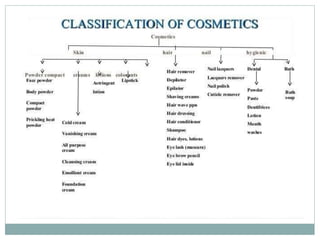
Examples of cosmetics: Skin-care creams, powder, lotion, lipstick, nail-
polish, eye and face make-up, deoderants, baby-makeup hair colourants
and spray.
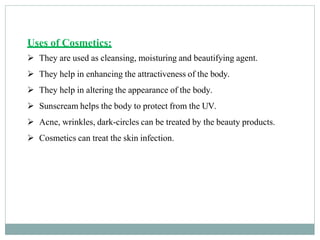
Uses of Cosmetics:
 They are used as cleansing, moisturing and beautifying agent.
 They help in enhancing the attractiveness of the body.
 They help in altering the appearance of the body.
 Sunscream helps the body to protect from the UV.
 Acne, wrinkles, dark-circles can be treated by the beauty products.
 Cosmetics can treat the skin infection.
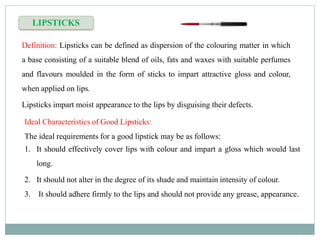
LIPSTICKS
Definition: Lipsticks can be defined as dispersion of the colouring matter in which
a base consisting of a suitable blend of oils, fats and waxes with suitable perfumes
and flavours moulded in the form of sticks to impart attractive gloss and colour,
when applied on lips.
Lipsticks impart moist appearance to the lips by disguising their defects.
Ideal Characteristics of Good Lipsticks:
The ideal requirements for a good lipstick may be as follows:
1. It should effectively cover lips with colour and impart a gloss which would last
long.
2. It should not alter in the degree of its shade and maintain intensity of colour.
3. It should adhere firmly to the lips and should not provide any grease, appearance.
4. It should possess good shear thinning property so as to deposit the colour with
minimum pressure.
5. It should possess required plasticity and be able to maintain all the properties
throughout the storage period.
6. It should be easily dried.
7. The stick should possess even firmness and should maintain its strength at
varying temperatures up to 55°C.
8. The stick should not dry or break easily.
9. The lipstick should possess a nice aroma and a good flavour.
10. It should be safe and non-irritating to the lips.
11. It should not result in blooming or sweating of the lips.
Formulation of Lipstick Composition:
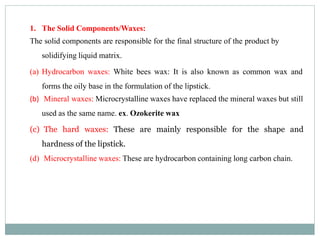
1. The Solid Components/Waxes:
The solid components are responsible for the final structure of the product by
solidifying liquid matrix.
(a) Hydrocarbon waxes: White bees wax: It is also known as common wax and
forms the oily base in the formulation of the lipstick.
(b) Mineral waxes: Microcrystalline waxes have replaced the mineral waxes but still
used as the same name. ex. Ozokerite wax
(c) The hard waxes: These are mainly responsible for the shape and
hardness of the lipstick.
(d) Microcrystalline waxes: These are hydrocarbon containing long carbon chain.
2. The Liquid Components: These are mostly constituted by oil such as mineral oil,
vegetable oil, castor oil, alcohol, etc.
a) Minerals oils :
• Contain blend of hydrocarbon from the petroleum source.
• Available as light mineral or heavy mineral oil.
b) Vegetable oil: sesame oil and olive oil may be used.
c) Castor oil: Obtained from the castor plant, Ricinus communis.
• Forms valuable lipstick base.
• High viscosity and good dissolving power.
• Posses stability towards oxidation.
• Easily compatible with other ingredients.
3. The Softening Agents: They are used to increase the spread ability by softening the
lipstick. The most commonly used softening agents include.
4. Colouring Agents: Colour may be imparted to the lips either by staining the lip with
a dye stuff colour or by covering the lips with coloring layers.
5. Pearlescent Pigments: They are used to impart nacreous or a pearl like appearance to
the product when applied on the lips.
6. Opacifying Agent: It is used for Opacifying or whitening of lipsticks. It can also alter
the basic shade of the pigment.
7. Perfumeries: Light floral fragrances can be used in lipsticks. They include rose oil,
cinnamon oil, lavender oil etc.
8. MiscellaneousAgents: PreservativeAntioxidants etc.
Method of Preparation:
1. The colour paste is passed through the triple roller mill until it become soft and free
from grittle particle.
2. All ingredients are then arranged in increasing order of their melting point.
3. This mixture is remilled until it is perfectly smooth.
4. Preservative and anti-oxidant are mixed in the remaining oil.
5. Finally perfume is added and mass is stirred.
6. Automatic ejection mould is preferred for the large scale production.
7. The mould is lubricated with liquid paraffin or isopropyl myristate before pouring
mass into mould.
8. It is important to prevent settling down of colouring mass when moulds are cooled.
9. Lubrication facilitates the easy removal of the stick.
Evaluation of Lipsticks
1. Melting point determination test
2. Microbiological test:
3. Test for rancidity:
4. Test for the application force:
5. Breaking Load Point Test:
6. Storage stability:
7. Determination of surface characteristics:
8. Determination of colour dispersion:
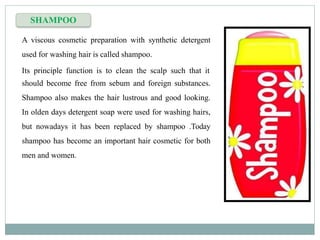
SHAMPOO
A viscous cosmetic preparation with synthetic detergent
used for washing hair is called shampoo.
Its principle function is to clean the scalp such that it
should become free from sebum and foreign substances.
Shampoo also makes the hair lustrous and good looking.
In olden days detergent soap were used for washing hairs,
but nowadays it has been replaced by shampoo .Today
shampoo has become an important hair cosmetic for both
men and women.
1. It should have optimum viscosity such that it facilitates ease during application.
2. It should have good spreading properties.
3. It should produce sufficient lather after application.
4. It should be able to remove waste material such as debris, soil, sebum, dead cells,
salts (due to sweat) etc., from the scalp.
5. It should not form any kind of film on scalp.
6. It should rinse out completely after washing.
7. It should produce lather with both hot and cold water.
8. After drying, the hair should not give rough appearance.
9. It should provide lustre to the hair..
10. It should not produce any kind of irritation or itching to the scalp.
11. It should not support any microbial growth.
12. It should be economical.
Ideal Properties:
Formulation of Shampoo:
Formula Quantity for 100 g
Sodium lauryl sulphate (surfactant) 38 g
Cetyl alcohol (builder) 7 g
Perfume, colour, preservative q. s.
Water 55 g
Preparation of Shampoo:
a) Initially, a solution of detergent and water are heated to about 80°C.
b) The wax is heated separately in a container at 80o C which facilitates the melting of
wax.
c) Both the solution are kept at 80°C and mixed. Uniform mixing is achieved by
constant and gentle stirring.
d) The solution is allowed to cool about 40 to 45°C
e) Finally under warm condition mixture is transferred to suitable condition.
Evaluation of Shampoo
Shampoos are evaluated for the following aspects.
1. Evaluation of safety
a) Draize test :
Safety is determined by using Draise test which suggests two separate methods for
testing skin and eye toxicity.
The following steps are involved in the test:
(i) Six albino rabbits were selected weighing 2 kg.
(ii) Round patch is made on each of the rabbit skin by removing hair.
(iii) Apply dilute preparation of shampoo on each patch.
(iv) Shampoo will react for 2-3 hr and then it is removed.
(v) After washing the skin is examined for any irritation
(vi) Based on result obtained shampoo is evaluated as safe or toxic.
(b) Eye-toxicity test :
The following steps are involved in the test:
(i) Six adult albino rabbit are selected
(ii) One eye is considered as test and another as control eye.
(iii) To each eye the product is applied.
(iv) Washing is done with tap water for 20 seconds.
(v) Eye are rewashed after 5 minutes and then after 24 hours.
(vi)The control eye is also washed on first day and then after 24 hours.
(vii)The test eyes are observed at 1, 24, 48 and 72 hours respectively.
(viii) The product is considered to be toxic if there is development of iris and
corneal lesions which remain for more than 7 days.
2. Evaluation ofAnti-microbialActivity:
Shampoo is liable to microbial growth because they are liquid or viscous preparation.
So preservative is usually added to stop such growth.
Procedure for Challenge Study:
(a) Species like pseudomonas are selected.
(b) Aculture of any one of the test organism is prepared.
(c) The product is inoculated in culture media for a period of 10-12 weeks.
(d) Inoculums usually contain 5 lakhs to 1 crore microorganisms.
(e) Two types of samples are prepared, one with preservative and one without
preservative.
(f) The test come to the conclusion only when it has been proven that product has not
supported the microbial growth.
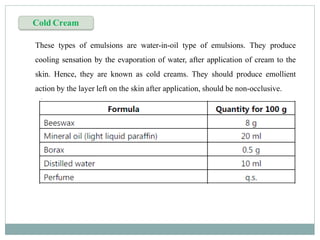
Cold Cream
These types of emulsions are water-in-oil type of emulsions. They produce
cooling sensation by the evaporation of water, after application of cream to the
skin. Hence, they are known as cold creams. They should produce emollient
action by the layer left on the skin after application, should be non-occlusive.
Method of Preparation of Cold Cream:
1. Beeswax is melted in a container by using water bath to temperature of about 70°C.
2. The mineral oil is added to the melted beeswax. This is mixtureA.
3. In another container water is heated to the temperature of about 70°C and borax is
dissolved in it. This is mixture B.
4. Mixture B is added slowly to the mixtureAalong with stirring.
5. Finally perfume is added to the formulation.
Vanishing Cream
They are oil in type of emulsion. When applied on the surface of the skin,
they spread as thin oil less film which is not visible to the naked eye. Hence,
they are called as vanishing creams. They are used to hold powder on the skin
as well as to improve adhesion.
Properties of Vanishing Creams
1. It should have high melting point.
2. It should be pure white in colour.
3. It should posses very little odour.
4. It should have less number of iodine.
Formulation/ Ingredients of Vanishing Creams
Method of Preparation of Vanishing Creams
1. Stearic acid melted in container by using water bath.
2. Potassium hydroxide dissolved in water and glycerine is added and heated to the
temperature of 75°C.this is called aqueous phase.
3. Slowly aqueous phase is added to the melted stearic acid
4. Perfume is added to the preparation when it attains 40°C.
Evaluation of Vanishing Creams
1. Determination of Organoleptic properties
The appearance of the cream was judged by its color, pearlscence and
roughness and graded
2. Determination of pH
Accurately weighed 5 g of the sample was dispersed in 45 ml. of water. The pH
of the suspension was determined at 27°C using digital pH meter .
3. Determination of homogeneity
The formulations were tested for the homogeneity by visual appearance and by
touch
4. Determination of wetness
It was determined by applying cream on skin surface of human volunteer.
5. Determination of type of smear
It was determined by applying the cream on the skin surface of human
volunteer.After application of cream, the type of film or smear formed on the
skin were checked
6. Determination of emolliency
Emolliency, slipperiness and amount of residue left after the application
of fixed amounts of cream was checked.
7. Determination of type of emulsion
a) Dilution test
In this test the emulsion is diluted either with oil or water. If the emulsion is o/w
type and it is diluted with water, it will remain stable as water is the dispersion
medium" but if it is diluted with oil, the emulsion will break as oil and water are
not miscible with each other. Oil in water emulsion can easily be diluted with an
aqueous solvent, whereas water in oil emulsion can be diluted with an oily liquid.
b) Dye solubility test
In this test an emulsion is mixed with a water soluble dye (amaranth) and observed
under the microscope. If the continuous phase appears red, it means that the
emulsion is o/w type as the water is in the external phase and the dye will dissolve
in it to give color. If the scattered globules appear red and continuous phase
colorless, then it is w/o type. Similarly, if an oil soluble dye (Scarlet red C or Sudan
III) is added to an emulsion and the continuous phase appears red, then it is w/o
emulsion
TOOTH PASTES
Dentrifrices such as toothpaste, toothpowder, and tooth gel are meant for cleaning the
surface of the teeth by removing the food debris and plaque adhered to the surface of the
teeth which is the main cause for tooth problem.
Ideal properties of toothpaste:
 Good abrasive effect
 Non irritant and non toxic
 Impart no stain in tooth
 Keep the mouth fresh and clean
 Prolonged effect
 Cheap and easily available
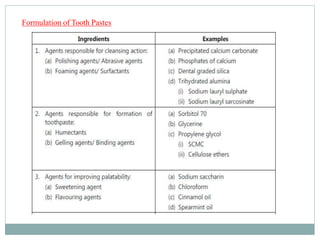
Formulation of Tooth Pastes
1. PolishingAgents/AbrasiveAgents:
(a) Precipitated calcium carbonate: Also known as precipitated chalk and is
available in a number of grades.
(b) Phosphates of calcium: Alarge variety of insoluble calcium phosphate are
used as abrasive agents.
(c) Dental grade silica: These are polymers of silica which are used as abrasive
agent in formulation of toothpaste in large quantities. These are available in two
forms:
(i) Abrasive form of silica.
(ii) Thickening form of silica.
(d) Trihydrated alumina: It is available as suspension or crystalline powder.
2. FoamingAgents/ Surfactants:
These are also known as wetting agents. The mechanism of cleansing action is by
reducing the surface tension at the interface of the adhered material and enamel of the teeth.
The properties of the surfactant are as follows:
• Should be compatible with other ingredients of the formulation.
•Should possess good surface active property.
The most commonly used surfactants are:
(a) Sodium lauryl sulphate.
(b) Sodium lauryl sarcosinate.
3. Humectants:
Humectants are used in order to prevent the rapid drying of dentifrices. They prevent
excessive moisture loss from product. They may additionally impart plasticity to the final
product.
Ex. Sorbitol 70, Glycerin, Propylene glycol
Preparation of Toothpaste
Toothpastes are prepared by following methods:
1. Dry gum method
2. Wet gum method
1. Dry Gum Method:
(a) All solid components except surfactants are mixed together in a dry mixer.
(b) The liquid components such as humectants and water are gradually added to the dry mix.
(c) The mixing is carried out till smooth paste is formed.
(d)The remaining ingredient such as surfactant and flavouring agents are added to
paste under vacuum.
2. Wet Gum Method:
(a) All liquid components are mixed to form liquid phase.
(b) The binding agent is the mixed with liquid phase with uniform stirring.
(c) The solid ingredients excluding the surfactants are the gradually added to the mucilage
with uniform mixing in an agitation mixer, in order to form homogeneous paste.
(d) The remaining ingredients i.e. surfactants, flavouring agent, colouring agents are added
under vacuum to the homogeneous paste.
Evaluation of Toothpaste
1. Tests forAbrasive Character:
The cleansing action of dentifrices mainly depends on their abrasive property. The
abrasion should not lead to any damage to the enamel and hence the test for checking
abrasion has been done on the extracted teeth.
2.Determination of particle size: The particle size is determined by the
microscopical techniques or by involving the method of sieving.
3.Test for cleansing property: In this the tooth cleanser such as powder, paste are
brushed onto polyester film and the change in reflectance character of lacquer coating is
measured.
4. Determination of the consistency of the product: For the maintenance of the flow
property all throughout the storage period, determination of the consistency is done.
5.Determination of pH of the product: 10% solution of the paste in water is made and
pH of the dispersion is measured using pH meter the pH should be in the range of 4.4 to
6.8 in order to maintain the consistency of the product.
6. Microbiological studies
In present work, antibacterial activity of paste was tested by used against causative
microorganism on agar plates. By taking microorganism such as E. coli, candida
albicans, staphylococcus aureus.

Cosmatics.pptx

  • 2.
    Contents 1. Introduction, Definition 2.Lipsticks 3. Shampoo 4. Cold Cream 5. Vanishing Cream 6. Shaving Cream 7. Tooth pastes 8. Hair Dyes 9. sunscreen Lotion
  • 3.
    Introduction Cosmetic is agreek word which means adorn. As per the Drug and cosmetic act 1940, “cosmetic” means any article intended to be rubbed, poured, sprinkled or sprayed on, or introduced into, or otherwise applicated to, the human body or any part there of for cleansing, beautifying, promoting attractiveness, or altering the appearance Examples of cosmetics: Skin-care creams, powder, lotion, lipstick, nail- polish, eye and face make-up, deoderants, baby-makeup hair colourants and spray.
  • 4.
    Uses of Cosmetics: They are used as cleansing, moisturing and beautifying agent.  They help in enhancing the attractiveness of the body.  They help in altering the appearance of the body.  Sunscream helps the body to protect from the UV.  Acne, wrinkles, dark-circles can be treated by the beauty products.  Cosmetics can treat the skin infection.
  • 6.
    LIPSTICKS Definition: Lipsticks canbe defined as dispersion of the colouring matter in which a base consisting of a suitable blend of oils, fats and waxes with suitable perfumes and flavours moulded in the form of sticks to impart attractive gloss and colour, when applied on lips. Lipsticks impart moist appearance to the lips by disguising their defects. Ideal Characteristics of Good Lipsticks: The ideal requirements for a good lipstick may be as follows: 1. It should effectively cover lips with colour and impart a gloss which would last long. 2. It should not alter in the degree of its shade and maintain intensity of colour. 3. It should adhere firmly to the lips and should not provide any grease, appearance.
  • 7.
    4. It shouldpossess good shear thinning property so as to deposit the colour with minimum pressure. 5. It should possess required plasticity and be able to maintain all the properties throughout the storage period. 6. It should be easily dried. 7. The stick should possess even firmness and should maintain its strength at varying temperatures up to 55°C. 8. The stick should not dry or break easily. 9. The lipstick should possess a nice aroma and a good flavour. 10. It should be safe and non-irritating to the lips. 11. It should not result in blooming or sweating of the lips.
  • 8.
  • 9.
    1. The SolidComponents/Waxes: The solid components are responsible for the final structure of the product by solidifying liquid matrix. (a) Hydrocarbon waxes: White bees wax: It is also known as common wax and forms the oily base in the formulation of the lipstick. (b) Mineral waxes: Microcrystalline waxes have replaced the mineral waxes but still used as the same name. ex. Ozokerite wax (c) The hard waxes: These are mainly responsible for the shape and hardness of the lipstick. (d) Microcrystalline waxes: These are hydrocarbon containing long carbon chain.
  • 10.
    2. The LiquidComponents: These are mostly constituted by oil such as mineral oil, vegetable oil, castor oil, alcohol, etc. a) Minerals oils : • Contain blend of hydrocarbon from the petroleum source. • Available as light mineral or heavy mineral oil. b) Vegetable oil: sesame oil and olive oil may be used. c) Castor oil: Obtained from the castor plant, Ricinus communis. • Forms valuable lipstick base. • High viscosity and good dissolving power. • Posses stability towards oxidation. • Easily compatible with other ingredients.
  • 11.
    3. The SofteningAgents: They are used to increase the spread ability by softening the lipstick. The most commonly used softening agents include. 4. Colouring Agents: Colour may be imparted to the lips either by staining the lip with a dye stuff colour or by covering the lips with coloring layers. 5. Pearlescent Pigments: They are used to impart nacreous or a pearl like appearance to the product when applied on the lips. 6. Opacifying Agent: It is used for Opacifying or whitening of lipsticks. It can also alter the basic shade of the pigment. 7. Perfumeries: Light floral fragrances can be used in lipsticks. They include rose oil, cinnamon oil, lavender oil etc. 8. MiscellaneousAgents: PreservativeAntioxidants etc.
  • 12.
    Method of Preparation: 1.The colour paste is passed through the triple roller mill until it become soft and free from grittle particle. 2. All ingredients are then arranged in increasing order of their melting point. 3. This mixture is remilled until it is perfectly smooth. 4. Preservative and anti-oxidant are mixed in the remaining oil. 5. Finally perfume is added and mass is stirred. 6. Automatic ejection mould is preferred for the large scale production. 7. The mould is lubricated with liquid paraffin or isopropyl myristate before pouring mass into mould. 8. It is important to prevent settling down of colouring mass when moulds are cooled. 9. Lubrication facilitates the easy removal of the stick.
  • 13.
    Evaluation of Lipsticks 1.Melting point determination test 2. Microbiological test: 3. Test for rancidity: 4. Test for the application force: 5. Breaking Load Point Test: 6. Storage stability: 7. Determination of surface characteristics: 8. Determination of colour dispersion:
  • 14.
    SHAMPOO A viscous cosmeticpreparation with synthetic detergent used for washing hair is called shampoo. Its principle function is to clean the scalp such that it should become free from sebum and foreign substances. Shampoo also makes the hair lustrous and good looking. In olden days detergent soap were used for washing hairs, but nowadays it has been replaced by shampoo .Today shampoo has become an important hair cosmetic for both men and women.
  • 15.
    1. It shouldhave optimum viscosity such that it facilitates ease during application. 2. It should have good spreading properties. 3. It should produce sufficient lather after application. 4. It should be able to remove waste material such as debris, soil, sebum, dead cells, salts (due to sweat) etc., from the scalp. 5. It should not form any kind of film on scalp. 6. It should rinse out completely after washing. 7. It should produce lather with both hot and cold water. 8. After drying, the hair should not give rough appearance. 9. It should provide lustre to the hair.. 10. It should not produce any kind of irritation or itching to the scalp. 11. It should not support any microbial growth. 12. It should be economical. Ideal Properties:
  • 16.
    Formulation of Shampoo: FormulaQuantity for 100 g Sodium lauryl sulphate (surfactant) 38 g Cetyl alcohol (builder) 7 g Perfume, colour, preservative q. s. Water 55 g Preparation of Shampoo: a) Initially, a solution of detergent and water are heated to about 80°C. b) The wax is heated separately in a container at 80o C which facilitates the melting of wax. c) Both the solution are kept at 80°C and mixed. Uniform mixing is achieved by constant and gentle stirring. d) The solution is allowed to cool about 40 to 45°C e) Finally under warm condition mixture is transferred to suitable condition.
  • 17.
    Evaluation of Shampoo Shampoosare evaluated for the following aspects. 1. Evaluation of safety a) Draize test : Safety is determined by using Draise test which suggests two separate methods for testing skin and eye toxicity. The following steps are involved in the test: (i) Six albino rabbits were selected weighing 2 kg. (ii) Round patch is made on each of the rabbit skin by removing hair. (iii) Apply dilute preparation of shampoo on each patch. (iv) Shampoo will react for 2-3 hr and then it is removed. (v) After washing the skin is examined for any irritation (vi) Based on result obtained shampoo is evaluated as safe or toxic.
  • 18.
    (b) Eye-toxicity test: The following steps are involved in the test: (i) Six adult albino rabbit are selected (ii) One eye is considered as test and another as control eye. (iii) To each eye the product is applied. (iv) Washing is done with tap water for 20 seconds. (v) Eye are rewashed after 5 minutes and then after 24 hours. (vi)The control eye is also washed on first day and then after 24 hours. (vii)The test eyes are observed at 1, 24, 48 and 72 hours respectively. (viii) The product is considered to be toxic if there is development of iris and corneal lesions which remain for more than 7 days.
  • 19.
    2. Evaluation ofAnti-microbialActivity: Shampoois liable to microbial growth because they are liquid or viscous preparation. So preservative is usually added to stop such growth. Procedure for Challenge Study: (a) Species like pseudomonas are selected. (b) Aculture of any one of the test organism is prepared. (c) The product is inoculated in culture media for a period of 10-12 weeks. (d) Inoculums usually contain 5 lakhs to 1 crore microorganisms. (e) Two types of samples are prepared, one with preservative and one without preservative. (f) The test come to the conclusion only when it has been proven that product has not supported the microbial growth.
  • 20.
    Cold Cream These typesof emulsions are water-in-oil type of emulsions. They produce cooling sensation by the evaporation of water, after application of cream to the skin. Hence, they are known as cold creams. They should produce emollient action by the layer left on the skin after application, should be non-occlusive.
  • 21.
    Method of Preparationof Cold Cream: 1. Beeswax is melted in a container by using water bath to temperature of about 70°C. 2. The mineral oil is added to the melted beeswax. This is mixtureA. 3. In another container water is heated to the temperature of about 70°C and borax is dissolved in it. This is mixture B. 4. Mixture B is added slowly to the mixtureAalong with stirring. 5. Finally perfume is added to the formulation.
  • 22.
    Vanishing Cream They areoil in type of emulsion. When applied on the surface of the skin, they spread as thin oil less film which is not visible to the naked eye. Hence, they are called as vanishing creams. They are used to hold powder on the skin as well as to improve adhesion. Properties of Vanishing Creams 1. It should have high melting point. 2. It should be pure white in colour. 3. It should posses very little odour. 4. It should have less number of iodine.
  • 23.
  • 25.
    Method of Preparationof Vanishing Creams 1. Stearic acid melted in container by using water bath. 2. Potassium hydroxide dissolved in water and glycerine is added and heated to the temperature of 75°C.this is called aqueous phase. 3. Slowly aqueous phase is added to the melted stearic acid 4. Perfume is added to the preparation when it attains 40°C.
  • 26.
    Evaluation of VanishingCreams 1. Determination of Organoleptic properties The appearance of the cream was judged by its color, pearlscence and roughness and graded 2. Determination of pH Accurately weighed 5 g of the sample was dispersed in 45 ml. of water. The pH of the suspension was determined at 27°C using digital pH meter . 3. Determination of homogeneity The formulations were tested for the homogeneity by visual appearance and by touch 4. Determination of wetness It was determined by applying cream on skin surface of human volunteer.
  • 27.
    5. Determination oftype of smear It was determined by applying the cream on the skin surface of human volunteer.After application of cream, the type of film or smear formed on the skin were checked 6. Determination of emolliency Emolliency, slipperiness and amount of residue left after the application of fixed amounts of cream was checked.
  • 28.
    7. Determination oftype of emulsion a) Dilution test In this test the emulsion is diluted either with oil or water. If the emulsion is o/w type and it is diluted with water, it will remain stable as water is the dispersion medium" but if it is diluted with oil, the emulsion will break as oil and water are not miscible with each other. Oil in water emulsion can easily be diluted with an aqueous solvent, whereas water in oil emulsion can be diluted with an oily liquid. b) Dye solubility test In this test an emulsion is mixed with a water soluble dye (amaranth) and observed under the microscope. If the continuous phase appears red, it means that the emulsion is o/w type as the water is in the external phase and the dye will dissolve in it to give color. If the scattered globules appear red and continuous phase colorless, then it is w/o type. Similarly, if an oil soluble dye (Scarlet red C or Sudan III) is added to an emulsion and the continuous phase appears red, then it is w/o emulsion
  • 30.
    TOOTH PASTES Dentrifrices suchas toothpaste, toothpowder, and tooth gel are meant for cleaning the surface of the teeth by removing the food debris and plaque adhered to the surface of the teeth which is the main cause for tooth problem. Ideal properties of toothpaste:  Good abrasive effect  Non irritant and non toxic  Impart no stain in tooth  Keep the mouth fresh and clean  Prolonged effect  Cheap and easily available
  • 31.
  • 33.
    1. PolishingAgents/AbrasiveAgents: (a) Precipitatedcalcium carbonate: Also known as precipitated chalk and is available in a number of grades. (b) Phosphates of calcium: Alarge variety of insoluble calcium phosphate are used as abrasive agents. (c) Dental grade silica: These are polymers of silica which are used as abrasive agent in formulation of toothpaste in large quantities. These are available in two forms: (i) Abrasive form of silica. (ii) Thickening form of silica. (d) Trihydrated alumina: It is available as suspension or crystalline powder.
  • 34.
    2. FoamingAgents/ Surfactants: Theseare also known as wetting agents. The mechanism of cleansing action is by reducing the surface tension at the interface of the adhered material and enamel of the teeth. The properties of the surfactant are as follows: • Should be compatible with other ingredients of the formulation. •Should possess good surface active property. The most commonly used surfactants are: (a) Sodium lauryl sulphate. (b) Sodium lauryl sarcosinate. 3. Humectants: Humectants are used in order to prevent the rapid drying of dentifrices. They prevent excessive moisture loss from product. They may additionally impart plasticity to the final product. Ex. Sorbitol 70, Glycerin, Propylene glycol
  • 35.
    Preparation of Toothpaste Toothpastesare prepared by following methods: 1. Dry gum method 2. Wet gum method 1. Dry Gum Method: (a) All solid components except surfactants are mixed together in a dry mixer. (b) The liquid components such as humectants and water are gradually added to the dry mix. (c) The mixing is carried out till smooth paste is formed. (d)The remaining ingredient such as surfactant and flavouring agents are added to paste under vacuum.
  • 36.
    2. Wet GumMethod: (a) All liquid components are mixed to form liquid phase. (b) The binding agent is the mixed with liquid phase with uniform stirring. (c) The solid ingredients excluding the surfactants are the gradually added to the mucilage with uniform mixing in an agitation mixer, in order to form homogeneous paste. (d) The remaining ingredients i.e. surfactants, flavouring agent, colouring agents are added under vacuum to the homogeneous paste.
  • 37.
    Evaluation of Toothpaste 1.Tests forAbrasive Character: The cleansing action of dentifrices mainly depends on their abrasive property. The abrasion should not lead to any damage to the enamel and hence the test for checking abrasion has been done on the extracted teeth. 2.Determination of particle size: The particle size is determined by the microscopical techniques or by involving the method of sieving.
  • 38.
    3.Test for cleansingproperty: In this the tooth cleanser such as powder, paste are brushed onto polyester film and the change in reflectance character of lacquer coating is measured. 4. Determination of the consistency of the product: For the maintenance of the flow property all throughout the storage period, determination of the consistency is done. 5.Determination of pH of the product: 10% solution of the paste in water is made and pH of the dispersion is measured using pH meter the pH should be in the range of 4.4 to 6.8 in order to maintain the consistency of the product. 6. Microbiological studies In present work, antibacterial activity of paste was tested by used against causative microorganism on agar plates. By taking microorganism such as E. coli, candida albicans, staphylococcus aureus.