Liposomal Gene Delivery
By : Mr. Kiran Ankushrao Tengse
M. Pharm 1st Year
University Department of Pharmaceutical sciences RTMNU Nagpur
Introduction
 Delivery of the exogenous DNA,RNA and Oligonucleotides has great impact on the treatment of
many diseases.
 Gene therapy is a cure of diseases by fixing gene for gene inhibition , gene augmentation or gene
replacement .
 Gene therapy are of two types i.e.
1.Somatic cell gene therapy
2.Germ line gene therapy
Gene therapy has applied two different vector classes as gene delivery system
1. viral
2. non viral
Vectors for Gene Delivery
 A]Viral Vectors
e.g. i]retroviruses
Ii]lentiviruses
iii]adenoviruses
iv]adeno-associated viruses
v]herpes simplex virus
Advntage – gene transfer efficiency is high
Disadvantage – safty issues –like mutagenesis ,carcinogenesis ,and
Immunogencity
 B] Non - viral vectors
i]Naked DNA Injection
ii]Cationic Liposomes
iii]Cationic polymers
iv] Lipoplexes
v] solvoplex
vi]Ultrasound Facilitated delivery
vii]Photochemical Transfection
Advantages : Less or Non-toxic
Disadvantages : low gene transfer efficiency
Liposomal gene delivery
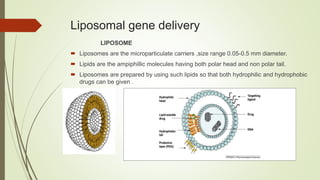
LIPOSOME
 Liposomes are the microparticulate carriers ,size range 0.05-0.5 mm diameter.
 Lipids are the ampiphillic molecules having both polar head and non polar tail.
 Liposomes are prepared by using such lipids so that both hydrophilic and hydrophobic
drugs can be given .
Cationic Liposomes
 For the delivery of gene by liposomes we choose the cationic lipids because –
- the phosphate group on the DNA has negative charge
- An amine group is present in the cationic lipid molecule which have
positive charge
-this acts as the binding site for the DNA molecule
-and also responsible for the condensation of DNA molecule to form
lipoplex.
-this complex can easily enter the cell.
 Cationic lipids used for the liposomal gene delivery
a]monovalent lipids
1. DOTMA : N-[1-(2,3-dioleyloxy) propyl]-N,N,N-trimethylammonium chloride
2. DOTAP : [1,2-bis(oleoyloxy)-3-(trimethylammonio) propane]
b]Multivalent lipids
3. DOSPA
4. DOGS
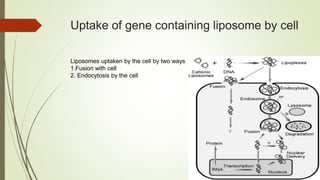
Uptake of gene containing liposome by cell
Liposomes uptaken by the cell by two ways
1.Fusion with cell
2. Endocytosis by the cell
Conclusion
 Gene delivered by eighter viral or non-viral vector .
 Liposomal gene delivery is the important gene delivery as a non -viral vector
delivery .
 Cationic lipids required for effective gene delivery .
 Cationic liposomes or lipoplexes uptaken by the cell by two ways i.e.fusion and
endocytosis .
 Delivered gene helps to synthesize normal proteins and cure the disease.
REFERENCES
 N . K. Jain ,Controlled and novel drug delivery ,CBS Publishers and Distributors
,New Delhi , First edition 1997.
 Daniel A. Balazs et al. Liposomes for Use in Gene Delivery , Journal of Drug
Delivery, Article ID 326497 ,Volume 2011.
Thank you!!!

Liposomal gene delivery

  • 1.
    Liposomal Gene Delivery By: Mr. Kiran Ankushrao Tengse M. Pharm 1st Year University Department of Pharmaceutical sciences RTMNU Nagpur
  • 2.
    Introduction  Delivery ofthe exogenous DNA,RNA and Oligonucleotides has great impact on the treatment of many diseases.  Gene therapy is a cure of diseases by fixing gene for gene inhibition , gene augmentation or gene replacement .  Gene therapy are of two types i.e. 1.Somatic cell gene therapy 2.Germ line gene therapy Gene therapy has applied two different vector classes as gene delivery system 1. viral 2. non viral
  • 3.
    Vectors for GeneDelivery  A]Viral Vectors e.g. i]retroviruses Ii]lentiviruses iii]adenoviruses iv]adeno-associated viruses v]herpes simplex virus Advntage – gene transfer efficiency is high Disadvantage – safty issues –like mutagenesis ,carcinogenesis ,and Immunogencity
  • 4.
     B] Non- viral vectors i]Naked DNA Injection ii]Cationic Liposomes iii]Cationic polymers iv] Lipoplexes v] solvoplex vi]Ultrasound Facilitated delivery vii]Photochemical Transfection Advantages : Less or Non-toxic Disadvantages : low gene transfer efficiency
  • 5.
    Liposomal gene delivery LIPOSOME Liposomes are the microparticulate carriers ,size range 0.05-0.5 mm diameter.  Lipids are the ampiphillic molecules having both polar head and non polar tail.  Liposomes are prepared by using such lipids so that both hydrophilic and hydrophobic drugs can be given .
  • 6.
    Cationic Liposomes  Forthe delivery of gene by liposomes we choose the cationic lipids because – - the phosphate group on the DNA has negative charge - An amine group is present in the cationic lipid molecule which have positive charge -this acts as the binding site for the DNA molecule -and also responsible for the condensation of DNA molecule to form lipoplex. -this complex can easily enter the cell.
  • 7.
     Cationic lipidsused for the liposomal gene delivery a]monovalent lipids 1. DOTMA : N-[1-(2,3-dioleyloxy) propyl]-N,N,N-trimethylammonium chloride 2. DOTAP : [1,2-bis(oleoyloxy)-3-(trimethylammonio) propane] b]Multivalent lipids 3. DOSPA 4. DOGS
  • 8.
    Uptake of genecontaining liposome by cell Liposomes uptaken by the cell by two ways 1.Fusion with cell 2. Endocytosis by the cell
  • 9.
    Conclusion  Gene deliveredby eighter viral or non-viral vector .  Liposomal gene delivery is the important gene delivery as a non -viral vector delivery .  Cationic lipids required for effective gene delivery .  Cationic liposomes or lipoplexes uptaken by the cell by two ways i.e.fusion and endocytosis .  Delivered gene helps to synthesize normal proteins and cure the disease.
  • 10.
    REFERENCES  N .K. Jain ,Controlled and novel drug delivery ,CBS Publishers and Distributors ,New Delhi , First edition 1997.  Daniel A. Balazs et al. Liposomes for Use in Gene Delivery , Journal of Drug Delivery, Article ID 326497 ,Volume 2011.
  • 11.