NON VIRAL DELIVERY SYSTEMS FOR GENE
THERAPY
INTRODUCTION
• Non viral vs viral systems
• Encompass chemical and physical methods of DNA
delivery
• Promising future option for gene therapy
CHEMICAL NON VIRAL DELIVERY SYSTEMS:
PRINCIPLES
• Polycationic entities cause compaction of –vely charged
nucleic acids forming nanometric complexes
• Cationic liposome/micelle based: lipoplexes
• Cationic polymer based: polyplexes
• Protect bound NA
• Have a net +ve charge
• Enter cell by endocytosis by non specific interactions
between complex and proteoglycans on adherent cells
• Following entry, DNA can escape endosome and perform its
function
• Instability towards aggregation under physiological salt
conditions
• Unstable in the presence of body fluids
• Heterogeneous and polydisperse
• Transfection takes long time
• Inability to escape endosome
• Difficulty to access nucleus
CHEMICAL NON VIRAL DELIVERY SYSTEMS:
PROBLEMS
Efforts to develop many cationic entities
No effort to develop one with all properties
CATIONIC LIPOSOME/MICELLE BASED NON
VIRAL DELIVERY SYSTEMS
• Most effective chemical NVDSs
• Formed from
• A single synthetic cationic amphiphile (cytofectin)
• Combination of a cytofection and a neutral lipid (e.g.,
DOPE)
• Currently >30 lipoplex systems
• Cytofectin is the key component
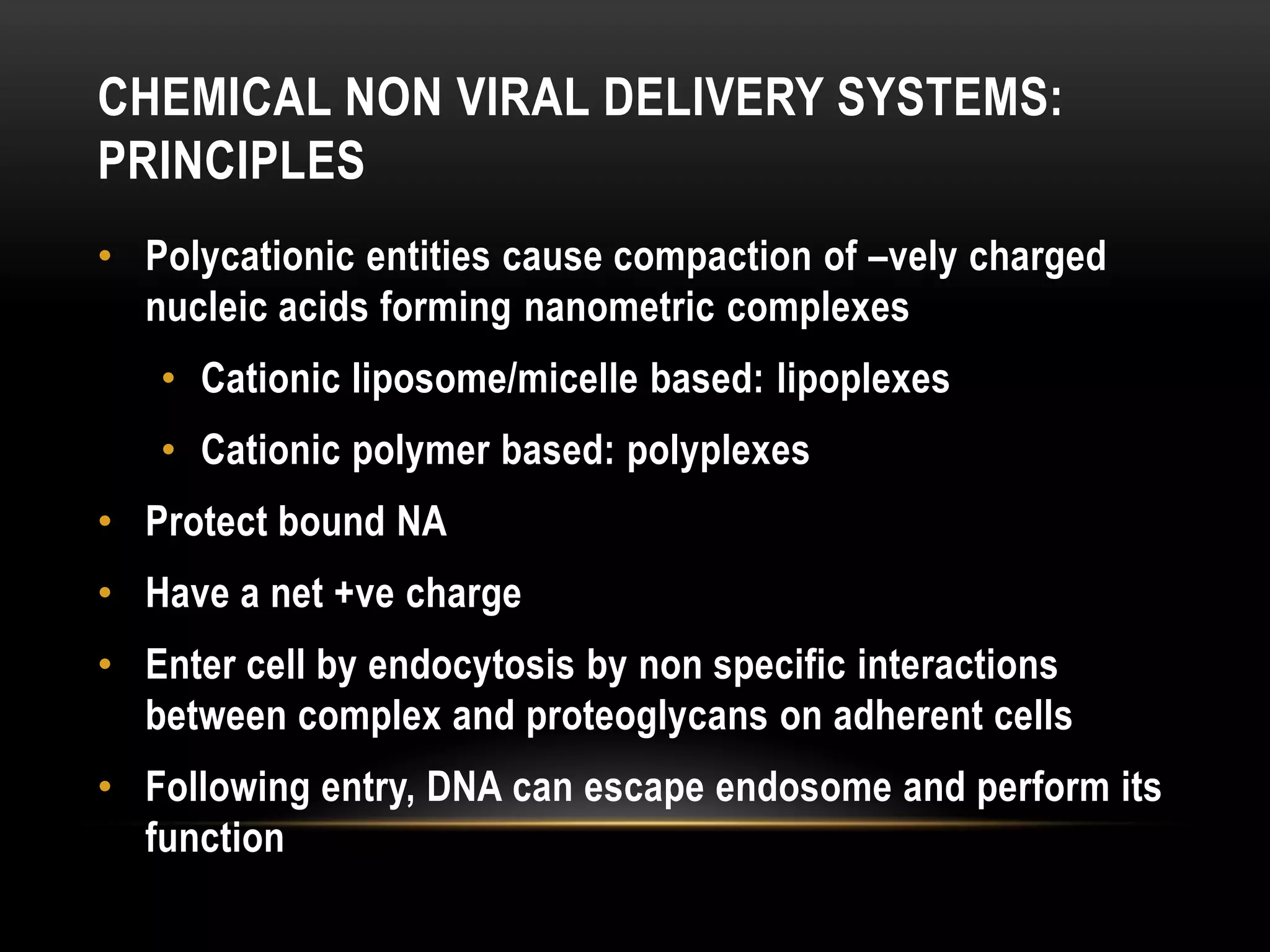
• Induction to unilamellar vesicles (cytofection+lipid)
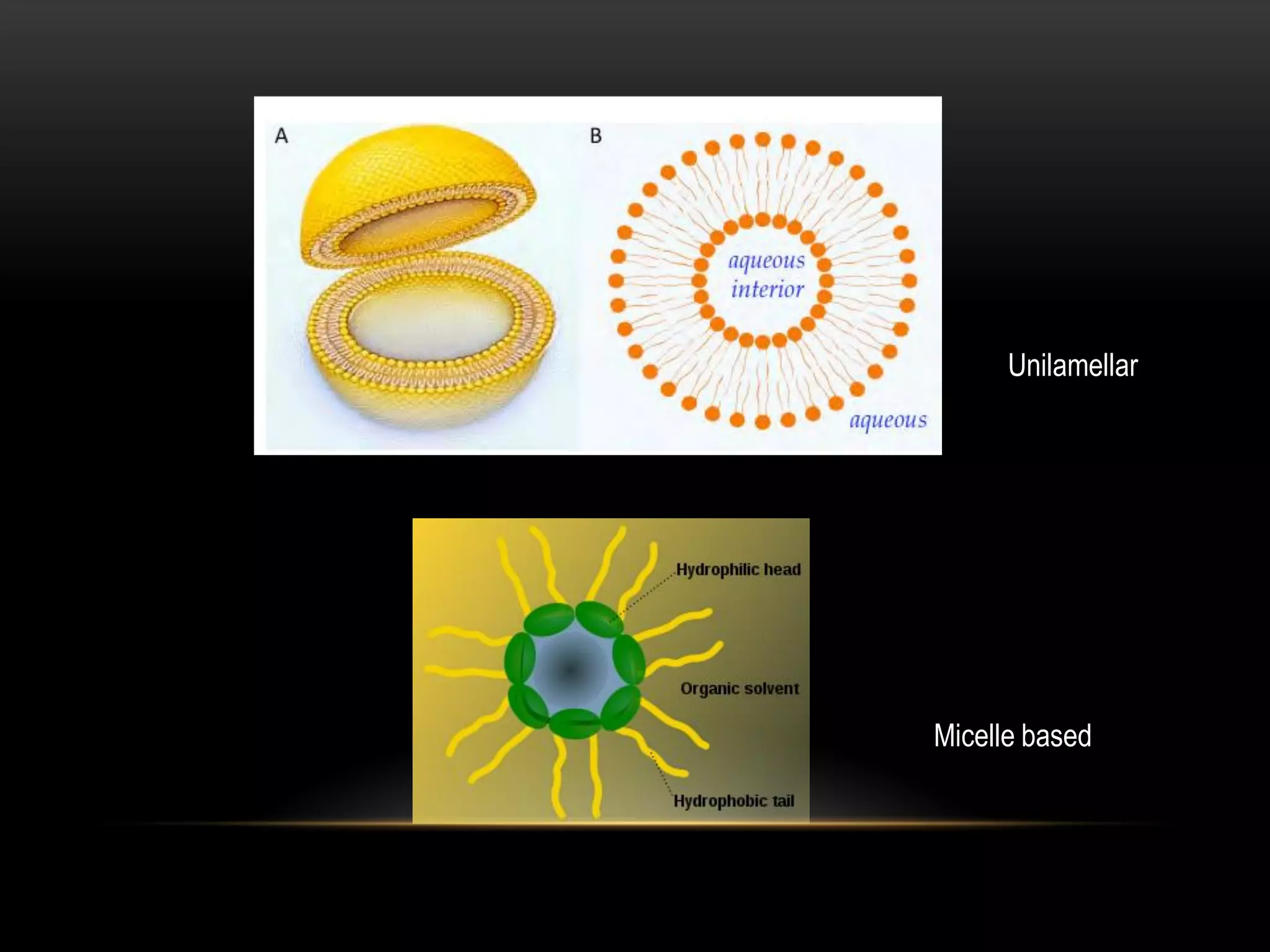
• Assembly into micellar structures (single cytofection)
• Combining the above with DNA
• Delivery to the cell
Unilamellar
Micelle based
• Optimum in vivo delivery when the mol ratio of cationic
liposome to DNA is such that the +ve to –ve charge ratio is
1.
• Heterogeneous and polydisperse
• Multilamellar complexes with DNA on the surface
• Thin lipid coated DNA strands
• Free nucleic acids
• Which actually delivers DNA?
CATIONIC LIPOSOME/MICELLE BASED NON
VIRAL DELIVERY SYSTEMS
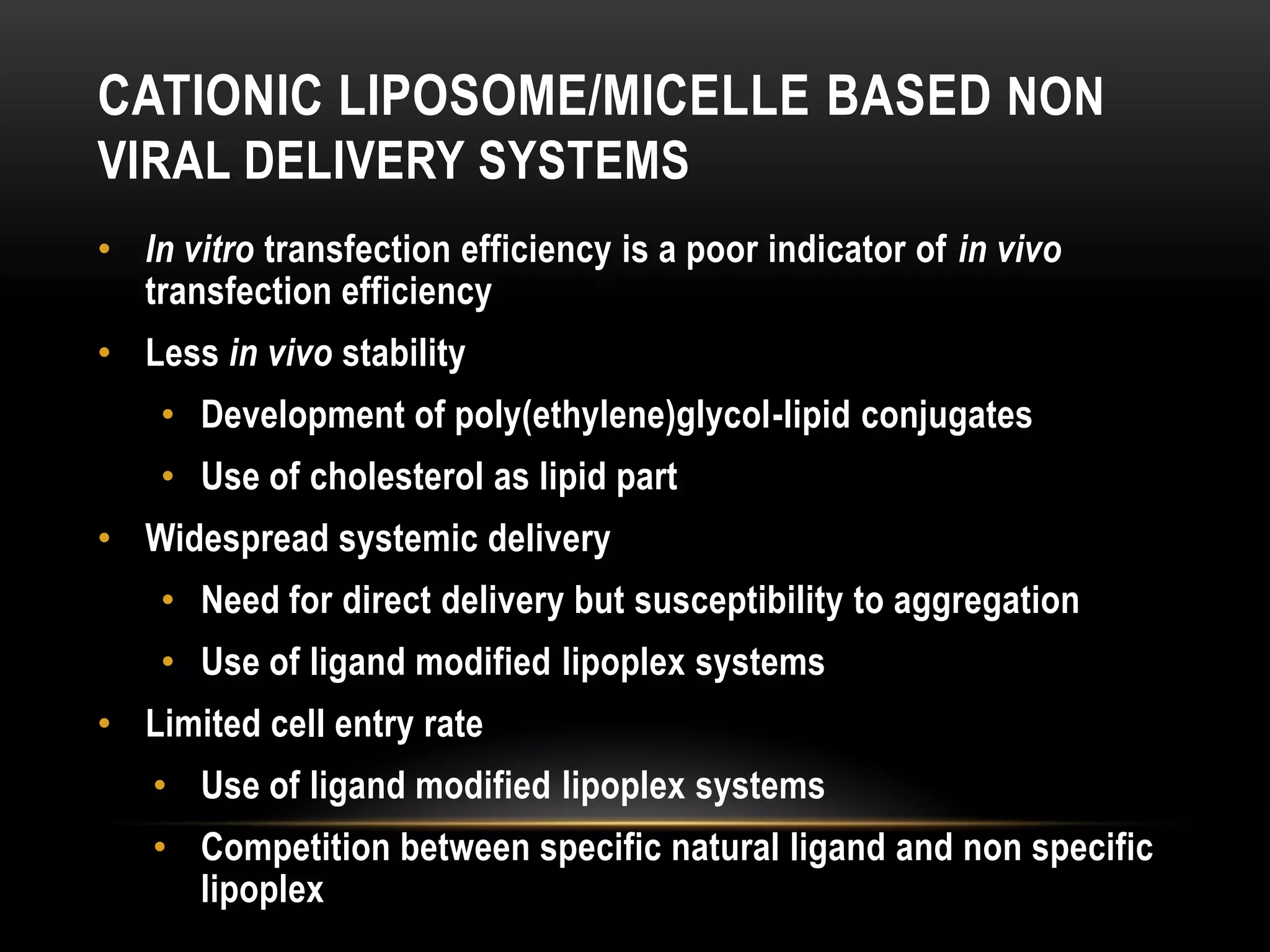
• In vitro transfection efficiency is a poor indicator of in vivo
transfection efficiency
• Less in vivo stability
• Development of poly(ethylene)glycol-lipid conjugates
• Use of cholesterol as lipid part
• Widespread systemic delivery
• Need for direct delivery but susceptibility to aggregation
• Use of ligand modified lipoplex systems
• Limited cell entry rate
• Use of ligand modified lipoplex systems
• Competition between specific natural ligand and non specific
lipoplex
CATIONIC LIPOSOME/MICELLE BASED NON
VIRAL DELIVERY SYSTEMS
• Serum inactivation
• Increasing +ve to –ve charge ratio
• Introducing a lipoplex time dependent maturation
• Immune and inflammatory responses
• Use of stabilizing agents
• Low rate of endosome escape
• Use of low pH activated membrane active peptides
• Use of pH sensitive liposomes
• Development of hybrid liposome complexes
CATIONIC LIPOSOME/MICELLE BASED NON
VIRAL DELIVERY SYSTEMS
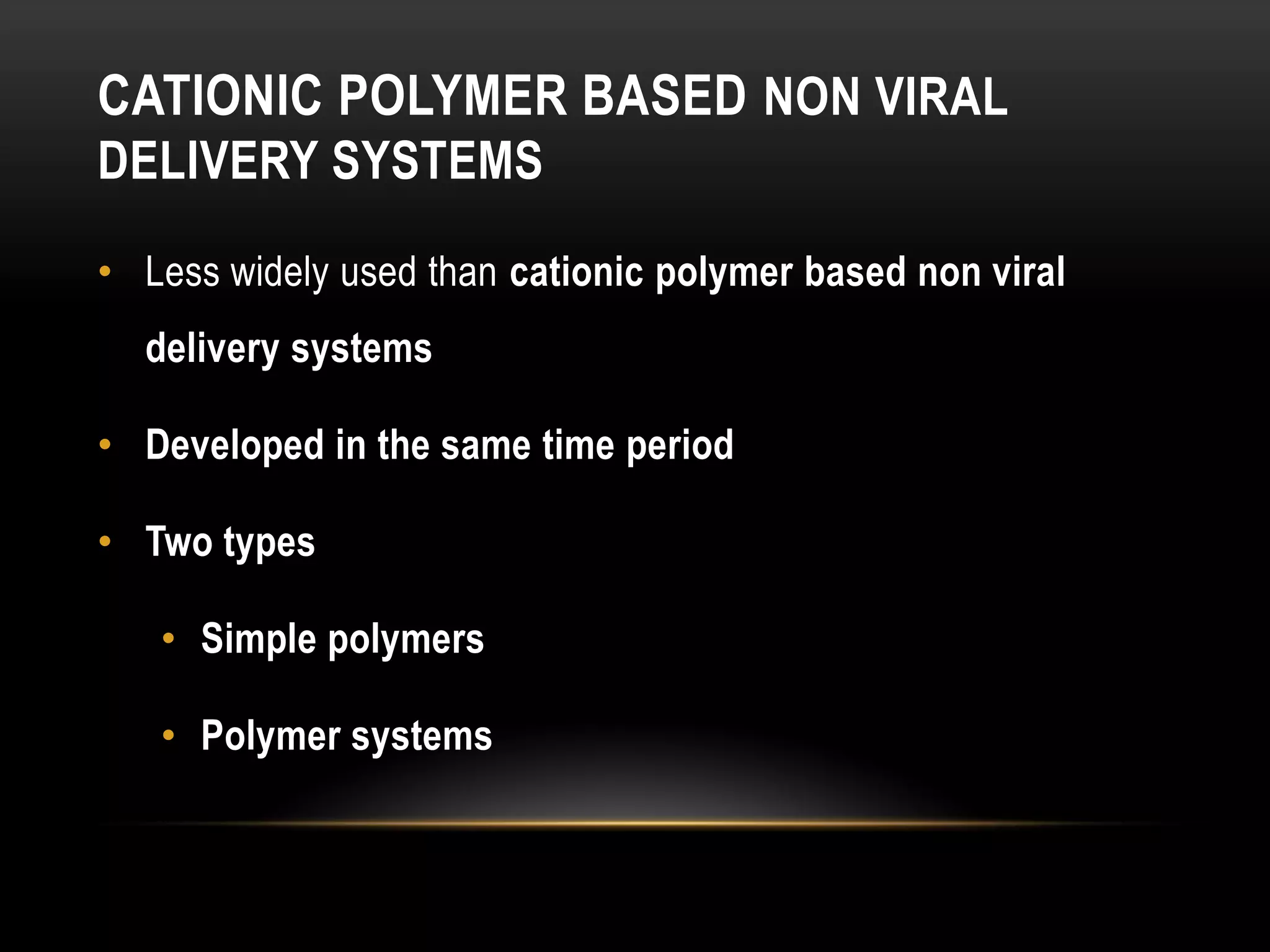
• Less widely used than cationic polymer based non viral
delivery systems
• Developed in the same time period
• Two types
• Simple polymers
• Polymer systems
CATIONIC POLYMER BASED NON VIRAL
DELIVERY SYSTEMS
SIMPLE POLYMERS
• Use of poly-L-lysine (pLL), a linear polymer
• Can be produced in different mol.wt (19-1116 aa)
• Conflict between optimal sizes for NA condensation and for gene
delivery
• Need of an assisting agent for efficient gene delivery
• Use of EGF peptide or transferrin for facilitating cellular uptake
• Less endosome escape
• Use of fusogenic peptides or defective viral particles
• Generally prone to aggregation
• Too much additions needed for efficient output
• APL polycat-57: glucaramide nonpeptide, nonlipid polymer
• Rapid interaction with plasmid DNA
• Resistant to serum inhibition
• Efficient gene delivery
• Poly(N-ethyl-4-vinylpyridinium bromide, PEVP)
• Copolymers
• Peptoid polymers
• Using DNA as template for polymer generation
POLYMERS SYSTEMS

Non viral delivery systems for gene therapy (1)

  • 1.
    NON VIRAL DELIVERYSYSTEMS FOR GENE THERAPY
  • 2.
    INTRODUCTION • Non viralvs viral systems • Encompass chemical and physical methods of DNA delivery • Promising future option for gene therapy
  • 3.
    CHEMICAL NON VIRALDELIVERY SYSTEMS: PRINCIPLES • Polycationic entities cause compaction of –vely charged nucleic acids forming nanometric complexes • Cationic liposome/micelle based: lipoplexes • Cationic polymer based: polyplexes • Protect bound NA • Have a net +ve charge • Enter cell by endocytosis by non specific interactions between complex and proteoglycans on adherent cells • Following entry, DNA can escape endosome and perform its function
  • 4.
    • Instability towardsaggregation under physiological salt conditions • Unstable in the presence of body fluids • Heterogeneous and polydisperse • Transfection takes long time • Inability to escape endosome • Difficulty to access nucleus CHEMICAL NON VIRAL DELIVERY SYSTEMS: PROBLEMS Efforts to develop many cationic entities No effort to develop one with all properties
  • 6.
    CATIONIC LIPOSOME/MICELLE BASEDNON VIRAL DELIVERY SYSTEMS • Most effective chemical NVDSs • Formed from • A single synthetic cationic amphiphile (cytofectin) • Combination of a cytofection and a neutral lipid (e.g., DOPE) • Currently >30 lipoplex systems • Cytofectin is the key component • Induction to unilamellar vesicles (cytofection+lipid) • Assembly into micellar structures (single cytofection) • Combining the above with DNA • Delivery to the cell
  • 7.
  • 8.
    • Optimum invivo delivery when the mol ratio of cationic liposome to DNA is such that the +ve to –ve charge ratio is 1. • Heterogeneous and polydisperse • Multilamellar complexes with DNA on the surface • Thin lipid coated DNA strands • Free nucleic acids • Which actually delivers DNA? CATIONIC LIPOSOME/MICELLE BASED NON VIRAL DELIVERY SYSTEMS
  • 9.
    • In vitrotransfection efficiency is a poor indicator of in vivo transfection efficiency • Less in vivo stability • Development of poly(ethylene)glycol-lipid conjugates • Use of cholesterol as lipid part • Widespread systemic delivery • Need for direct delivery but susceptibility to aggregation • Use of ligand modified lipoplex systems • Limited cell entry rate • Use of ligand modified lipoplex systems • Competition between specific natural ligand and non specific lipoplex CATIONIC LIPOSOME/MICELLE BASED NON VIRAL DELIVERY SYSTEMS
  • 10.
    • Serum inactivation •Increasing +ve to –ve charge ratio • Introducing a lipoplex time dependent maturation • Immune and inflammatory responses • Use of stabilizing agents • Low rate of endosome escape • Use of low pH activated membrane active peptides • Use of pH sensitive liposomes • Development of hybrid liposome complexes CATIONIC LIPOSOME/MICELLE BASED NON VIRAL DELIVERY SYSTEMS
  • 12.
    • Less widelyused than cationic polymer based non viral delivery systems • Developed in the same time period • Two types • Simple polymers • Polymer systems CATIONIC POLYMER BASED NON VIRAL DELIVERY SYSTEMS
  • 13.
    SIMPLE POLYMERS • Useof poly-L-lysine (pLL), a linear polymer • Can be produced in different mol.wt (19-1116 aa) • Conflict between optimal sizes for NA condensation and for gene delivery • Need of an assisting agent for efficient gene delivery • Use of EGF peptide or transferrin for facilitating cellular uptake • Less endosome escape • Use of fusogenic peptides or defective viral particles • Generally prone to aggregation • Too much additions needed for efficient output
  • 14.
    • APL polycat-57:glucaramide nonpeptide, nonlipid polymer • Rapid interaction with plasmid DNA • Resistant to serum inhibition • Efficient gene delivery • Poly(N-ethyl-4-vinylpyridinium bromide, PEVP) • Copolymers • Peptoid polymers • Using DNA as template for polymer generation POLYMERS SYSTEMS