Gene transfer
 Deliberate insertion of genes into cells
 Way of conferring transgenes to host cells in protein
production
 Means of carrying out gene therapy
 Cell membrane does not allow DNA to pass through
Methods of gene transfer
 Vector/viral mediated transfer: involve use of
recombinant viruses to insert genes ito host cells
 Non viral/Direct gene transfer :divided into two
broad categories--physical and chemical
 Physical methods involve taking plasmids and
forcing them into cells,electroporation, sonoporation,
or particle bombardment.
 Chemical methods use lipids, polymers, or proteins
that will complex with DNA, condensing it into
particles and directing it to the cells
advantages
Non viral Viral
 Allows delivery of large genes
 Inexpensive and easy to
manufacture
 Rarely cause immmune
responses
 Target specific
 High transformation
efficiency
 Can infect cells that are not
dividing
Direct methods
 Chemical methods
 Particle gun
 Electroporation
 Microinjection
 Lipofection
 Magnetofection
Vector mediated
 Agrobacterium mediated
 Viral mediated
Viral mediated
 deliver their genes to human cells in a pathogenic
manner.
 Retroviruses - A class of viruses that can create
double-stranded DNA copies of their RNA genomes.
 Adenoviruses - A class of viruses with double-
stranded DNA genomes that cause respiratory,
intestinal, and eye infections in humans.
 Adeno-associated viruses
 Herpes simplex viruses
Viral mediated
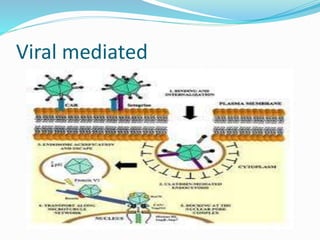
 DNA of interest is inserted into the viral DNA
 Host cell is infected with the constructed virus
 These particles are consisting of a DNA or RNA
genome contained within a protein coat.
 They infect host cells incorporate viral DNA into the
host genome, replicating as part of the host (lysogenic
cycle), or multiply inside the host cell before releasing
phage particles by budding from the membrane or
actively lysing the cell (lytic cycle)
 Target specific
Viral mediated
Chemical methods
 rely on cationic carriers to complex with negatively
charged nucleic acids for their uptake by cells
 dilution/preparation of the carrier
 formation of DNA/carrier complexes
 addition to cells, and subsequent removal of the non-
endocytosed excess complexes.
 The first-generation transfection reagents included
calcium phosphate and diethylamino ethanol (DEAE)–
dextran
Chemical methods
 Prepare solutions. Mix calcium chloride (in phosphate
buffer) and DNA.
 Allow precipitation of extremely small, insoluble particles
containing condensed DNA.
 Add complexes to cell culture and incubate. Complexes
adhere to cell membranes, and enter into the cytoplasm by
endocytosis.
 DEAE-Dextran and polybrene: Positive-charged polymers
complex with negatively charged DNA molecules to enable
binding to the cell surface.
 Remove complexes from cells, wash, and add fresh culture
medium.
 Assay for gene expression.
Disadvantages/advantages
 Simple and inexpensive
 low cost and reproducible
 Low transfection effieciency
 Insufficient protection of transgenes
 Sometimes toxic to the cells
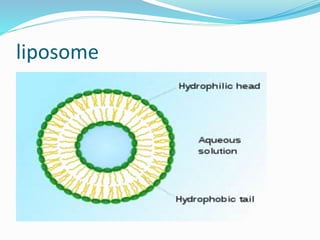
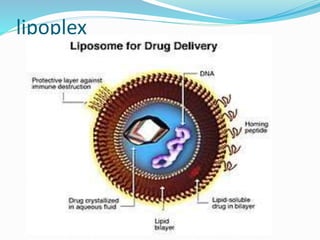
liposome
 is an artificially-prepared vesicle composed of a lipid bilayer. The
liposome can be used as a vehicle for administration of nutrients and
drugs
 cationic carrier molecules complex with DNA and neutralise its
electrostatic charge promoting cell-membrane–DNA interaction
 A liposome encapsulates a region of aqueous solution inside a
hydrophobic membrane
 To deliver the molecules to sites of action, the lipid bilayer fuse with
other bilayers, cell membrane, thus delivering the liposome contents.
By making liposomes in a solution of DNA or drugs (which would
normally be unable to diffuse through the membrane) they can be
delivered past the lipid bilayer
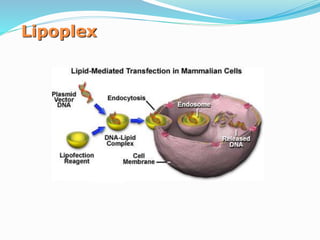
 Complexes formed by selfassembly of DNA with liposomes are
generically known as lipoplexes
 Lipoplexes are internalised by endocytosis although fusion with the cell
membrane has also been proposed
liposome
lipoplex
Lipoplex
lipoplexes
 Once inside the cell, fusion with lysosomes can occur
destroying the insert(no gene expression)
 If the endosome is not destroyed DNA trafficking to
the nucleus is made possible and expression occurs
 lipoplexes often show high levels of transgene
expression
 their nonspecific membrane activity usually precludes
cell-selective targeting
 poor efficiency at transfecting nonproliferating cells
Particle gun
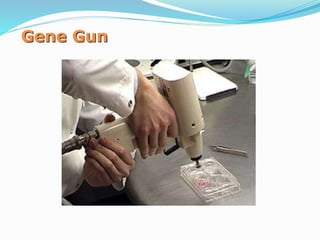
Gene gun
Gene Gun
Particle gun
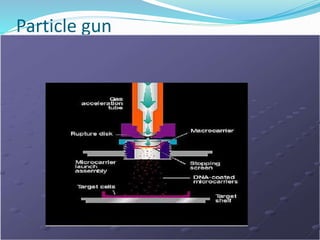
 Gene gun, biolistics, particle bombardment
 a device for injecting cells with genetic information
 original method utilised a gunpowder acceleration system
to propel DNA-coated tungsten particles at recipient cell
 Penetration of the cell membrane result in intracellular
expression of genes encoded by the exogenous DN
 helium driven have been developed, in which a helium
pulse is used to accelerate DNA-coated gold microparticles
through the cell membrane
 Has a higher transformation efficiency than most nonviral
Gene Gun
 Advantages:
◦ Can be used in any cell type
 Disadvantages:
◦ Damage of a significant number of cells
◦ Reproducibility problems
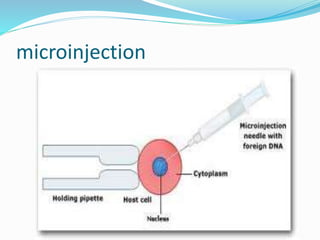
microinjection
 mechanical process in which a needle roughly 0.5 to 5
micrometers in diameter penetrates the cell
membrane and/or the nuclear envelope.
 desired contents are then injected into the desired
sub-cellular compartment and the needle is removed
 Consists of a low power disecting microscope and two
micromanipulators
 One is a glass micropipette to hold the cell by partial
suction
 The other a glass injection tube to inject DNA into the
cell
microinjection
microinjection
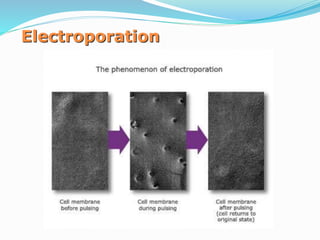
Electroporation
Electroporation
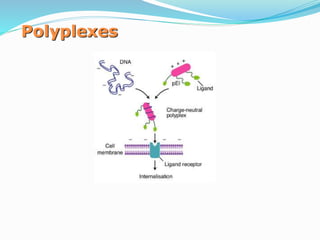
Polyplexes
 They are complexes of cationic polymers with nucleic
acids
 Ployplex formation is regulated by electrostatic
interaction, which is affected by:
 pH of the media
 Ionic strength
 Cationic density
Polyplexes
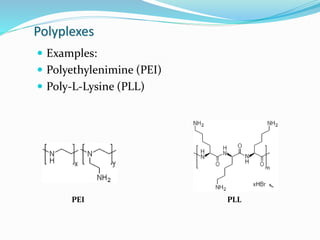
 Examples:
 Polyethylenimine (PEI)
 Poly-L-Lysine (PLL)
PEI PLL
Polyplexes
Polyplexes
 Advantages:
◦ Easy to formulate
◦ Simple chemical modification
 Disadvantages:
◦ Cytotoxicity
◦ Stability problems
Retroviral Vectors
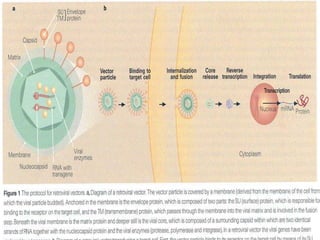
 RNA viruses can carry out efficient gene transfer into many cell
types and can stably integrate into the host cell genome
 Replace viral genes with therapeutic gene
 – Limited size (<8 kb)
 – Specific cellular receptors
 High efficiency
 Stable integration into genome
 – Potential for insertional mutagenesis
 Most are non pathogenic except, human immunodeficiency
viruses (HIV) and human T-cell lymphotropic viruses (HTLV)
murine leukemia virus (MULV)
 vectors themselves have all of the viral genes removed, can
accept up to about 8 kilobases (kb) of exogenous DNA.
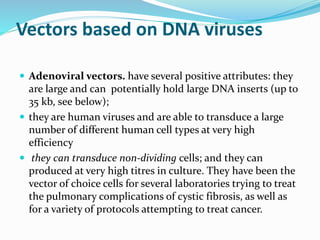
Vectors based on DNA viruses
 Adenoviral vectors. have several positive attributes: they
are large and can potentially hold large DNA inserts (up to
35 kb, see below);
 they are human viruses and are able to transduce a large
number of different human cell types at very high
efficiency
 they can transduce non-dividing cells; and they can
produced at very high titres in culture. They have been the
vector of choice cells for several laboratories trying to treat
the pulmonary complications of cystic fibrosis, as well as
for a variety of protocols attempting to treat cancer.
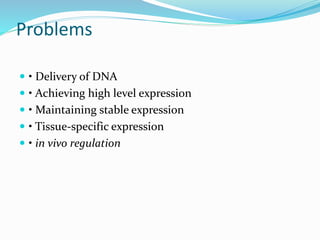
Problems
 • Delivery of DNA
 • Achieving high level expression
 • Maintaining stable expression
 • Tissue-specific expression
 • in vivo regulation
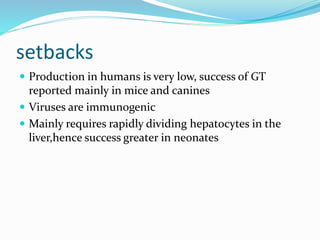
setbacks
 Production in humans is very low, success of GT
reported mainly in mice and canines
 Viruses are immunogenic
 Mainly requires rapidly dividing hepatocytes in the
liver,hence success greater in neonates

lecture 3 - gene transfer.pptx

  • 1.
    Gene transfer  Deliberateinsertion of genes into cells  Way of conferring transgenes to host cells in protein production  Means of carrying out gene therapy  Cell membrane does not allow DNA to pass through
  • 2.
    Methods of genetransfer  Vector/viral mediated transfer: involve use of recombinant viruses to insert genes ito host cells  Non viral/Direct gene transfer :divided into two broad categories--physical and chemical  Physical methods involve taking plasmids and forcing them into cells,electroporation, sonoporation, or particle bombardment.  Chemical methods use lipids, polymers, or proteins that will complex with DNA, condensing it into particles and directing it to the cells
  • 3.
    advantages Non viral Viral Allows delivery of large genes  Inexpensive and easy to manufacture  Rarely cause immmune responses  Target specific  High transformation efficiency  Can infect cells that are not dividing
  • 4.
    Direct methods  Chemicalmethods  Particle gun  Electroporation  Microinjection  Lipofection  Magnetofection
  • 5.
    Vector mediated  Agrobacteriummediated  Viral mediated
  • 6.
    Viral mediated  delivertheir genes to human cells in a pathogenic manner.  Retroviruses - A class of viruses that can create double-stranded DNA copies of their RNA genomes.  Adenoviruses - A class of viruses with double- stranded DNA genomes that cause respiratory, intestinal, and eye infections in humans.  Adeno-associated viruses  Herpes simplex viruses
  • 7.
    Viral mediated  DNAof interest is inserted into the viral DNA  Host cell is infected with the constructed virus  These particles are consisting of a DNA or RNA genome contained within a protein coat.  They infect host cells incorporate viral DNA into the host genome, replicating as part of the host (lysogenic cycle), or multiply inside the host cell before releasing phage particles by budding from the membrane or actively lysing the cell (lytic cycle)  Target specific
  • 9.
  • 10.
    Chemical methods  relyon cationic carriers to complex with negatively charged nucleic acids for their uptake by cells  dilution/preparation of the carrier  formation of DNA/carrier complexes  addition to cells, and subsequent removal of the non- endocytosed excess complexes.  The first-generation transfection reagents included calcium phosphate and diethylamino ethanol (DEAE)– dextran
  • 11.
    Chemical methods  Preparesolutions. Mix calcium chloride (in phosphate buffer) and DNA.  Allow precipitation of extremely small, insoluble particles containing condensed DNA.  Add complexes to cell culture and incubate. Complexes adhere to cell membranes, and enter into the cytoplasm by endocytosis.  DEAE-Dextran and polybrene: Positive-charged polymers complex with negatively charged DNA molecules to enable binding to the cell surface.  Remove complexes from cells, wash, and add fresh culture medium.  Assay for gene expression.
  • 12.
    Disadvantages/advantages  Simple andinexpensive  low cost and reproducible  Low transfection effieciency  Insufficient protection of transgenes  Sometimes toxic to the cells
  • 13.
    liposome  is anartificially-prepared vesicle composed of a lipid bilayer. The liposome can be used as a vehicle for administration of nutrients and drugs  cationic carrier molecules complex with DNA and neutralise its electrostatic charge promoting cell-membrane–DNA interaction  A liposome encapsulates a region of aqueous solution inside a hydrophobic membrane  To deliver the molecules to sites of action, the lipid bilayer fuse with other bilayers, cell membrane, thus delivering the liposome contents. By making liposomes in a solution of DNA or drugs (which would normally be unable to diffuse through the membrane) they can be delivered past the lipid bilayer  Complexes formed by selfassembly of DNA with liposomes are generically known as lipoplexes  Lipoplexes are internalised by endocytosis although fusion with the cell membrane has also been proposed
  • 14.
  • 15.
  • 16.
  • 17.
    lipoplexes  Once insidethe cell, fusion with lysosomes can occur destroying the insert(no gene expression)  If the endosome is not destroyed DNA trafficking to the nucleus is made possible and expression occurs  lipoplexes often show high levels of transgene expression  their nonspecific membrane activity usually precludes cell-selective targeting  poor efficiency at transfecting nonproliferating cells
  • 18.
  • 19.
  • 20.
  • 21.
    Particle gun  Genegun, biolistics, particle bombardment  a device for injecting cells with genetic information  original method utilised a gunpowder acceleration system to propel DNA-coated tungsten particles at recipient cell  Penetration of the cell membrane result in intracellular expression of genes encoded by the exogenous DN  helium driven have been developed, in which a helium pulse is used to accelerate DNA-coated gold microparticles through the cell membrane  Has a higher transformation efficiency than most nonviral
  • 22.
    Gene Gun  Advantages: ◦Can be used in any cell type  Disadvantages: ◦ Damage of a significant number of cells ◦ Reproducibility problems
  • 23.
    microinjection  mechanical processin which a needle roughly 0.5 to 5 micrometers in diameter penetrates the cell membrane and/or the nuclear envelope.  desired contents are then injected into the desired sub-cellular compartment and the needle is removed  Consists of a low power disecting microscope and two micromanipulators  One is a glass micropipette to hold the cell by partial suction  The other a glass injection tube to inject DNA into the cell
  • 24.
  • 25.
  • 27.
  • 28.
  • 29.
    Polyplexes  They arecomplexes of cationic polymers with nucleic acids  Ployplex formation is regulated by electrostatic interaction, which is affected by:  pH of the media  Ionic strength  Cationic density
  • 30.
    Polyplexes  Examples:  Polyethylenimine(PEI)  Poly-L-Lysine (PLL) PEI PLL
  • 31.
  • 32.
    Polyplexes  Advantages: ◦ Easyto formulate ◦ Simple chemical modification  Disadvantages: ◦ Cytotoxicity ◦ Stability problems
  • 33.
    Retroviral Vectors  RNAviruses can carry out efficient gene transfer into many cell types and can stably integrate into the host cell genome  Replace viral genes with therapeutic gene  – Limited size (<8 kb)  – Specific cellular receptors  High efficiency  Stable integration into genome  – Potential for insertional mutagenesis  Most are non pathogenic except, human immunodeficiency viruses (HIV) and human T-cell lymphotropic viruses (HTLV) murine leukemia virus (MULV)  vectors themselves have all of the viral genes removed, can accept up to about 8 kilobases (kb) of exogenous DNA.
  • 35.
    Vectors based onDNA viruses  Adenoviral vectors. have several positive attributes: they are large and can potentially hold large DNA inserts (up to 35 kb, see below);  they are human viruses and are able to transduce a large number of different human cell types at very high efficiency  they can transduce non-dividing cells; and they can produced at very high titres in culture. They have been the vector of choice cells for several laboratories trying to treat the pulmonary complications of cystic fibrosis, as well as for a variety of protocols attempting to treat cancer.
  • 36.
    Problems  • Deliveryof DNA  • Achieving high level expression  • Maintaining stable expression  • Tissue-specific expression  • in vivo regulation
  • 38.
    setbacks  Production inhumans is very low, success of GT reported mainly in mice and canines  Viruses are immunogenic  Mainly requires rapidly dividing hepatocytes in the liver,hence success greater in neonates