Non viral delivery in gene
therapy
Dr. Thoria Donia
Faculty of Science, Tanta University
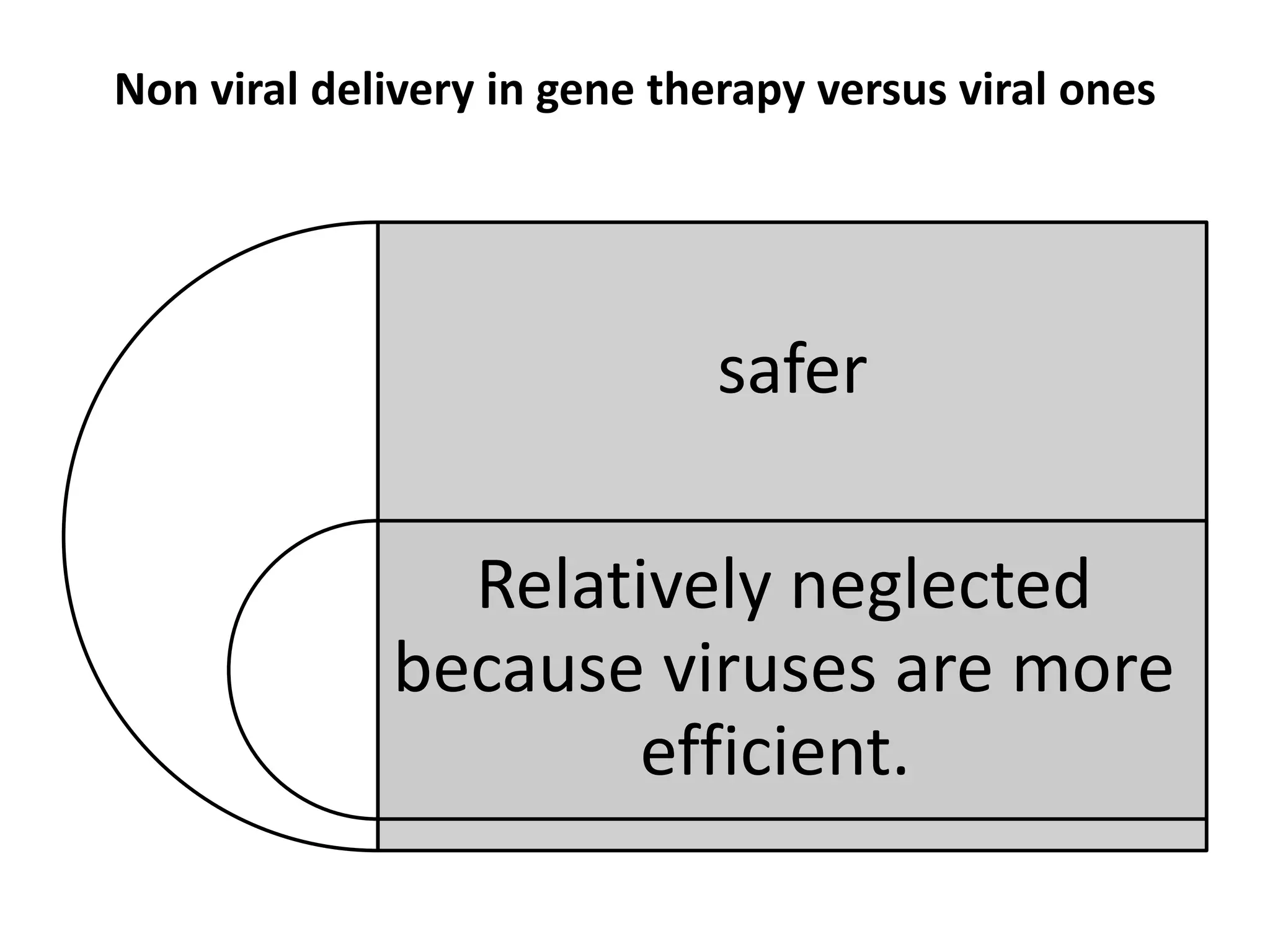
Non viral delivery in gene therapy versus viral ones
safer
Relatively neglected
because viruses are more
efficient.
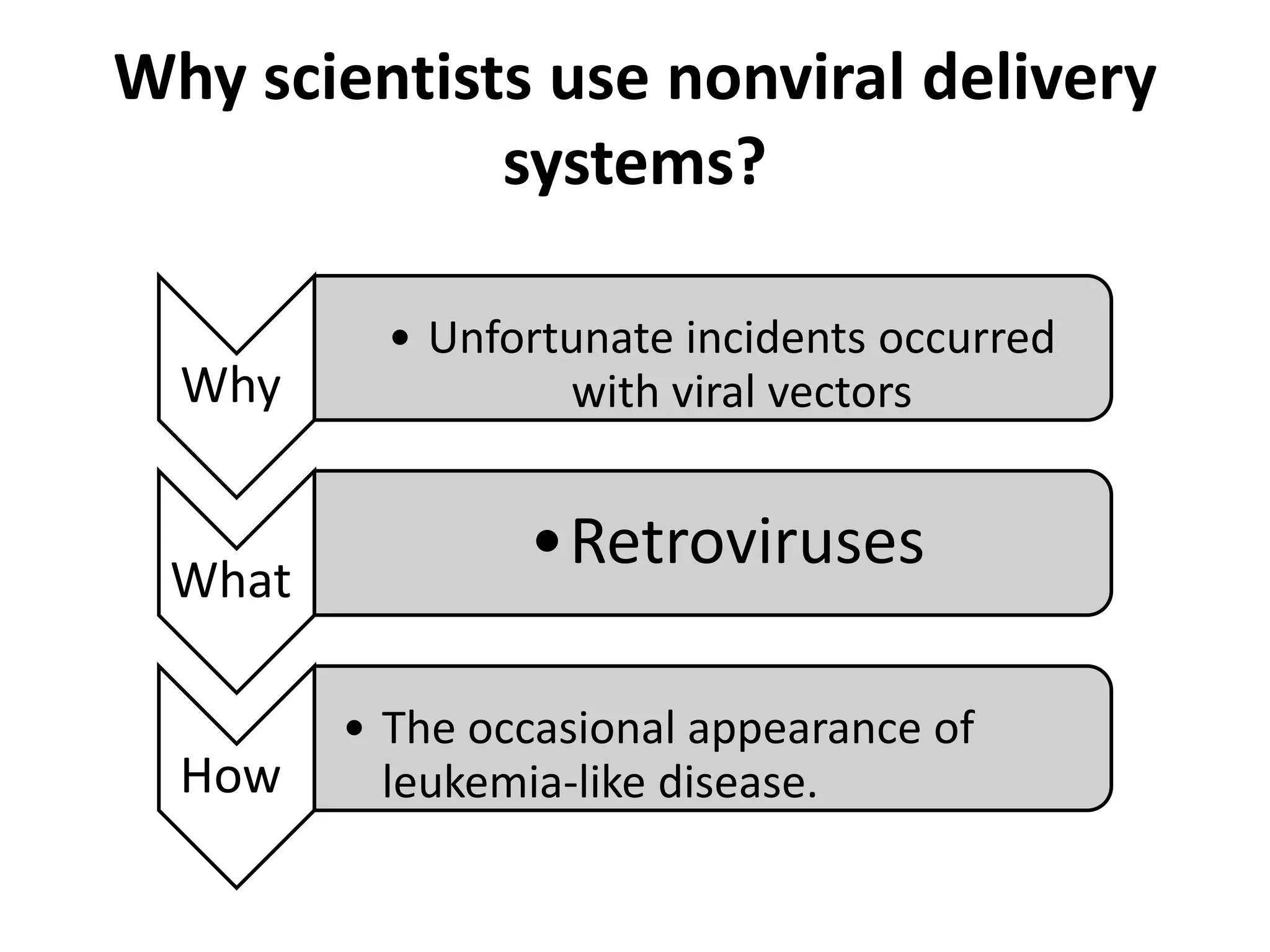
Why scientists use nonviral delivery
systems?
Why
• Unfortunate incidents occurred
with viral vectors
What
•Retroviruses
How
• The occasional appearance of
leukemia-like disease.
Non viral approaches to get foreign DNA into target
cells.
Liposomes
Naked DNA
DNA bound to artificial polymers or proteins
Particle bombardment
Encapsulated whole cells
(a) Naked nucleic acid (DNA or less
often RNA).
Purified DNA
•Transform many
animal cells
The therapeutic gene
inserted into a
plasmid
•Used directly
Unprotected DNA
• 10-20% of gene
therapy trials
(b)Liposomes
spherical vesicles
composed of
phospholipid.
10% of gene
therapy
Liposomes and lipofection in gene
therapy
• Hollow microscopic spheres of phospholipid can
be filled with DNA or other molecules during
assembly.
• The liposomes will merge with the membranes
surrounding most animal cells, and the contents
of the liposome end up inside the cell a process
known as lipofection.
• Lipofection works well but nonspecific because
liposomes tend to merge with the membranes of
any cell.
Delivery of anticancer agent by
lipofection
Uses of liposomes
• To get foreign DNA specifically into cancer
cells in anticancer gene therapy
• Lipofection is a promising approach because
“armed” liposomes can be injected directly
into tumor tissue.
Lipofectamine protocol
Advantage of liposomes over viruses
• Used more in delivering proteins than DNA
• For example, toxic proteins such as tumor
necrosis factor (TNF) can be packaged inside
liposomes and injected into tumor tissue.
• The liposomes merge with the cancer cell
membranes, and the lethal proteins are then
released inside the cancer cells.
(C) Particle bombardment
• DNA is fired (an acceleration process
using helium gas discharge under high
pressure) through the cell walls and
membranes on metal particles.
• It was developed to get DNA into plants.
• Used to make transgenic animals and is
occasionally used for humans.
• 5% or less of trials
Plant transformation process using
particle bombardment
Use of bioballistics as a plasmid DNA
carrier.
(d) Receptor-mediated uptake.
• DNA attached to a protein
……Recognized by cell surface
receptor …………The protein enters
the cell, the DNA is taken in with it.
(e) Polymer-complexed DNA
• Binding to a positively charged polymer
(polyethyleneimine), protects the negatively
charged DNA.
• DNA –PEI complexes ……Taken up by cells in
culture
• May be used for ex vivo gene therapy.
(f) Encapsulated cells.
• Whole cells engineered to express and secrete a
needed protein may be encapsulated in a porous
polymeric coat and injected locally.
• Example: Foreign cells excreting nerve growth
factor have been injected into the brains of aging
rats. The rats showed some improvement in
cognitive ability, suggesting that this approach
may be of value in treating neurological
conditions such as Alzheimer’s disease.

Non viral delivery in gene therapy

  • 1.
    Non viral deliveryin gene therapy Dr. Thoria Donia Faculty of Science, Tanta University
  • 2.
    Non viral deliveryin gene therapy versus viral ones safer Relatively neglected because viruses are more efficient.
  • 3.
    Why scientists usenonviral delivery systems? Why • Unfortunate incidents occurred with viral vectors What •Retroviruses How • The occasional appearance of leukemia-like disease.
  • 4.
    Non viral approachesto get foreign DNA into target cells. Liposomes Naked DNA DNA bound to artificial polymers or proteins Particle bombardment Encapsulated whole cells
  • 5.
    (a) Naked nucleicacid (DNA or less often RNA). Purified DNA •Transform many animal cells The therapeutic gene inserted into a plasmid •Used directly Unprotected DNA • 10-20% of gene therapy trials
  • 6.
  • 7.
    Liposomes and lipofectionin gene therapy • Hollow microscopic spheres of phospholipid can be filled with DNA or other molecules during assembly. • The liposomes will merge with the membranes surrounding most animal cells, and the contents of the liposome end up inside the cell a process known as lipofection. • Lipofection works well but nonspecific because liposomes tend to merge with the membranes of any cell.
  • 8.
    Delivery of anticanceragent by lipofection
  • 9.
    Uses of liposomes •To get foreign DNA specifically into cancer cells in anticancer gene therapy • Lipofection is a promising approach because “armed” liposomes can be injected directly into tumor tissue.
  • 10.
  • 11.
    Advantage of liposomesover viruses • Used more in delivering proteins than DNA • For example, toxic proteins such as tumor necrosis factor (TNF) can be packaged inside liposomes and injected into tumor tissue. • The liposomes merge with the cancer cell membranes, and the lethal proteins are then released inside the cancer cells.
  • 12.
    (C) Particle bombardment •DNA is fired (an acceleration process using helium gas discharge under high pressure) through the cell walls and membranes on metal particles. • It was developed to get DNA into plants. • Used to make transgenic animals and is occasionally used for humans. • 5% or less of trials
  • 13.
    Plant transformation processusing particle bombardment
  • 14.
    Use of bioballisticsas a plasmid DNA carrier.
  • 15.
    (d) Receptor-mediated uptake. •DNA attached to a protein ……Recognized by cell surface receptor …………The protein enters the cell, the DNA is taken in with it.
  • 16.
    (e) Polymer-complexed DNA •Binding to a positively charged polymer (polyethyleneimine), protects the negatively charged DNA. • DNA –PEI complexes ……Taken up by cells in culture • May be used for ex vivo gene therapy.
  • 17.
    (f) Encapsulated cells. •Whole cells engineered to express and secrete a needed protein may be encapsulated in a porous polymeric coat and injected locally. • Example: Foreign cells excreting nerve growth factor have been injected into the brains of aging rats. The rats showed some improvement in cognitive ability, suggesting that this approach may be of value in treating neurological conditions such as Alzheimer’s disease.