
STUDY MATERIAL
ON
AMINO ACID METABOLISM
Presented By:
Ms. Sayali Dilip Powar
(M. Pharm )
Department of Pharmaceutical Chemistry,
@ Tatyasaheb Kore College of Pharmacy,
Warananagar
3/22/2020 1
General reactions of amino acid metabolism:
Transamination, deamination & decarboxylation,
urea cycle and its disorders
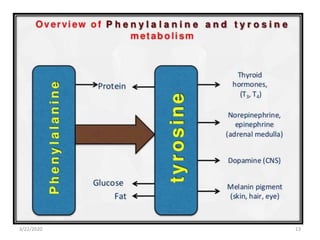
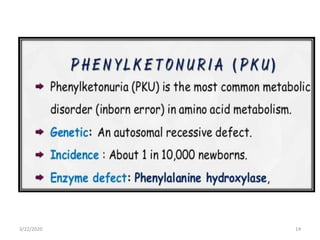
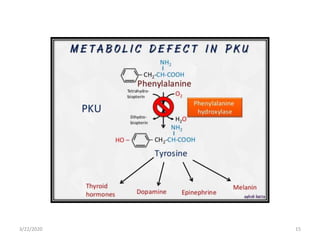
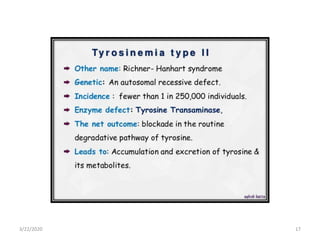
Catabolism of phenylalanine and tyrosine and their
metabolic disorders (Phenyketonuria, Albinism,
alkeptonuria, tyrosinemia)
Synthesis and significance of biological
substances; 5-HT, melatonin, dopamine,
noradrenaline, adrenaline
Catabolism of heme; hyperbilirubinemia and
jaundice
3/22/2020 2
Transamination
• The transfer of an amino ( NH2) group from
an amino acid to a keto acid is known as
transamination. This process involves the
interconversion of a pair of amino acids
and a pair of keto acids, catalysed by a
group of enzymes called transaminases
(recently, aminotransferases)
3/22/2020 3
Salient features of transamination
• All transaminases require pyridoxal phosphate
(PLP), a coenzyme derived from vitamin B6.
• Specific transaminases exist for each pair of
amino and keto acids. However, only two—
namely, aspartate transaminase and alanine
transaminase—make a significant contribution
for transamination.
• There is no free NH3 liberated, only the transfer
of amino group occurs.
• Transamination is reversible
3/22/2020 4
Deamination
• The removal of amino group from the amino
acids as NH3 is deamination.
3/22/2020 5
Decarboxylation
• Decarboxylation reaction is defined as a
chemical reaction that eliminates a carboxyl
group or carbon group.
3/22/2020 6
Urea cycle and its disorders
• Urea is the end product of protein
metabolism.
• The nitrogen of amino acids, converted to ammonia
which is toxic to the body. It is converted to urea and
detoxified. As such, urea accounts for 80-90% of the
nitrogen containing substances excreted in urine.
• Urea is synthesized in liver and transported to
kidneys for excretion in urine.
• Urea cycle is the first metabolic cycle that was
elucidated by Hans Krebs and Kurt Henseleit (1932),
hence it is known as Krebs-Henseleit cycle.3/22/2020 7
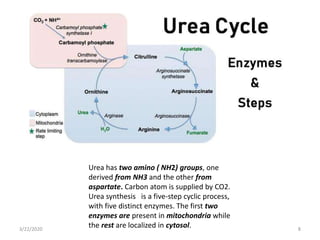
Urea has two amino ( NH2) groups, one
derived from NH3 and the other from
aspartate. Carbon atom is supplied by CO2.
Urea synthesis is a five-step cyclic process,
with five distinct enzymes. The first two
enzymes are present in mitochondria while
the rest are localized in cytosol.3/22/2020 8
1. Synthesis of carbamoyl phosphate : Carbamoyl phosphate synthase I (CPS I) of
mitochondria catalyses the condensation of acetylglutamate for its activity.
Another enzyme, carbamoyl phosphate synthase II (CPS II)— involved in
pyrimidine synthesis—is present in cytosol. It accepts amino group from glutamine
and does not require N-acetylglutamate for its activity.
2. Formation of citrulline : Citrulline is synthesized from carbamoyl phosphate and
ornithine by ornithine transcarbamoylase. Ornithine is regenerated and used in
urea cycle. Therefore, its role is comparable to that of oxaloacetate in citric acid
cycle. Ornithine and citrulline are basic amino acids. (They are never found in
protein structure due to lack of codons). Citrulline produced in this reaction is
transported to cytosol by a transporter system.
3. Synthesis of arginosuccinate : Argino- succinate synthase condenses citrulline with
aspartate to produce arginosuccinate. The second amino group of urea is
incorporated in this reaction. This step requires ATP which is cleaved to AMP and
pyrophosphate (PPi). The latter is immediately broken down to inorganic
phosphate (Pi).
3/22/2020 9
4. Cleavage of arginosuccinate :Argino- succinase
cleaves arginosuccinate to give arginine and
fumarate. Arginine is the immediate precursor for
urea. Fumarate liberated here provides a
connecting link with TCA cycle, gluconeogenesis
etc.
5.Formation of urea : Arginase is the fifth and final
enzyme that cleaves arginine to yield urea and
ornithine. Ornithine, so regenerated, enters
mitochondria for its reuse in the urea cycle.
3/22/2020 10
Metabolic defects in urea cycle
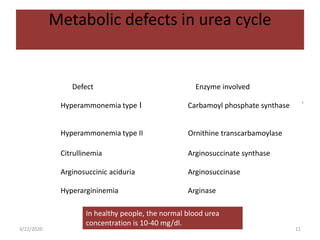
• TABLE 15.1 Metabolic defects in urea
cycle Defect Enzyme involved
Hyperammonemia type I Carbamoyl phosphate synthase
I
Hyperammonemia type II Ornithine transcarbamoylase
Citrullinemia Arginosuccinate synthase
Arginosuccinic aciduria Arginosuccinase
Hyperargininemia Arginase
In healthy people, the normal blood urea
concentration is 10-40 mg/dl.
3/22/2020 11
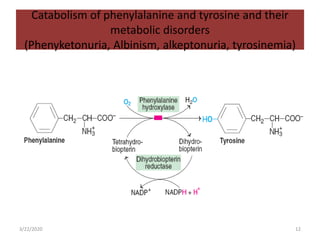
Catabolism of phenylalanine and tyrosine and their
metabolic disorders
(Phenyketonuria, Albinism, alkeptonuria, tyrosinemia)
3/22/2020 12
3/22/2020 13
3/22/2020 14
3/22/2020 15
3/22/2020 16
3/22/2020 17
3/22/2020 18
3/22/2020 19
3/22/2020 20
3/22/2020 21
3/22/2020 22
3/22/2020 23

Amino acid

  • 1.
    STUDY MATERIAL ON AMINO ACIDMETABOLISM Presented By: Ms. Sayali Dilip Powar (M. Pharm ) Department of Pharmaceutical Chemistry, @ Tatyasaheb Kore College of Pharmacy, Warananagar 3/22/2020 1
  • 2.
    General reactions ofamino acid metabolism: Transamination, deamination & decarboxylation, urea cycle and its disorders Catabolism of phenylalanine and tyrosine and their metabolic disorders (Phenyketonuria, Albinism, alkeptonuria, tyrosinemia) Synthesis and significance of biological substances; 5-HT, melatonin, dopamine, noradrenaline, adrenaline Catabolism of heme; hyperbilirubinemia and jaundice 3/22/2020 2
  • 3.
    Transamination • The transferof an amino ( NH2) group from an amino acid to a keto acid is known as transamination. This process involves the interconversion of a pair of amino acids and a pair of keto acids, catalysed by a group of enzymes called transaminases (recently, aminotransferases) 3/22/2020 3
  • 4.
    Salient features oftransamination • All transaminases require pyridoxal phosphate (PLP), a coenzyme derived from vitamin B6. • Specific transaminases exist for each pair of amino and keto acids. However, only two— namely, aspartate transaminase and alanine transaminase—make a significant contribution for transamination. • There is no free NH3 liberated, only the transfer of amino group occurs. • Transamination is reversible 3/22/2020 4
  • 5.
    Deamination • The removalof amino group from the amino acids as NH3 is deamination. 3/22/2020 5
  • 6.
    Decarboxylation • Decarboxylation reactionis defined as a chemical reaction that eliminates a carboxyl group or carbon group. 3/22/2020 6
  • 7.
    Urea cycle andits disorders • Urea is the end product of protein metabolism. • The nitrogen of amino acids, converted to ammonia which is toxic to the body. It is converted to urea and detoxified. As such, urea accounts for 80-90% of the nitrogen containing substances excreted in urine. • Urea is synthesized in liver and transported to kidneys for excretion in urine. • Urea cycle is the first metabolic cycle that was elucidated by Hans Krebs and Kurt Henseleit (1932), hence it is known as Krebs-Henseleit cycle.3/22/2020 7
  • 8.
    Urea has twoamino ( NH2) groups, one derived from NH3 and the other from aspartate. Carbon atom is supplied by CO2. Urea synthesis is a five-step cyclic process, with five distinct enzymes. The first two enzymes are present in mitochondria while the rest are localized in cytosol.3/22/2020 8
  • 9.
    1. Synthesis ofcarbamoyl phosphate : Carbamoyl phosphate synthase I (CPS I) of mitochondria catalyses the condensation of acetylglutamate for its activity. Another enzyme, carbamoyl phosphate synthase II (CPS II)— involved in pyrimidine synthesis—is present in cytosol. It accepts amino group from glutamine and does not require N-acetylglutamate for its activity. 2. Formation of citrulline : Citrulline is synthesized from carbamoyl phosphate and ornithine by ornithine transcarbamoylase. Ornithine is regenerated and used in urea cycle. Therefore, its role is comparable to that of oxaloacetate in citric acid cycle. Ornithine and citrulline are basic amino acids. (They are never found in protein structure due to lack of codons). Citrulline produced in this reaction is transported to cytosol by a transporter system. 3. Synthesis of arginosuccinate : Argino- succinate synthase condenses citrulline with aspartate to produce arginosuccinate. The second amino group of urea is incorporated in this reaction. This step requires ATP which is cleaved to AMP and pyrophosphate (PPi). The latter is immediately broken down to inorganic phosphate (Pi). 3/22/2020 9
  • 10.
    4. Cleavage ofarginosuccinate :Argino- succinase cleaves arginosuccinate to give arginine and fumarate. Arginine is the immediate precursor for urea. Fumarate liberated here provides a connecting link with TCA cycle, gluconeogenesis etc. 5.Formation of urea : Arginase is the fifth and final enzyme that cleaves arginine to yield urea and ornithine. Ornithine, so regenerated, enters mitochondria for its reuse in the urea cycle. 3/22/2020 10
  • 11.
    Metabolic defects inurea cycle • TABLE 15.1 Metabolic defects in urea cycle Defect Enzyme involved Hyperammonemia type I Carbamoyl phosphate synthase I Hyperammonemia type II Ornithine transcarbamoylase Citrullinemia Arginosuccinate synthase Arginosuccinic aciduria Arginosuccinase Hyperargininemia Arginase In healthy people, the normal blood urea concentration is 10-40 mg/dl. 3/22/2020 11
  • 12.
    Catabolism of phenylalanineand tyrosine and their metabolic disorders (Phenyketonuria, Albinism, alkeptonuria, tyrosinemia) 3/22/2020 12
  • 13.
  • 14.
  • 15.
  • 16.
  • 17.
  • 18.
  • 19.
  • 20.
  • 21.
  • 22.
  • 23.