Lipid metabolism
Daeyang University
BSc in Nursing and Midwifery
Date:24.10.2022
Lipid Metabolism
Learning objectives
By the end of this lesson learners must
know
• How fatty acids are activated and
transported into mitochondria for
oxidation
• Hormones that are involved in fatty acid
metabolism
• The functions of fatty acids
• The fate of triacylglycerol
Introduction
• Reserves of stored triglycerides are
mobilized as needed for energy
production.
• Fat mobilization is stimulated by
epinephrine. The triglycerides are
hydrolyzed to fatty acids and glycerol
and enter the blood stream.
• Glycerol is converted to glycerol- 3
phosphate and then to
dihydroxyacetone phospahte, which
enters glycolysis for energy production.
Introduction..
• Free fatty acids are converted to fatty
acyl CoA molecules, which are broken
down to acetyl CoA by beta oxidation.
The acetyl CoA may be used for energy
production by way of the citric acid cycle
and the electron transport chain
Fatty acid oxidation
• Fatty acids are degraded to acetyl CoA
• Fatty acids enter tissue cells in need of
energy. Fatty acids must pass through
the mitochondrial membrane to be
oxidized and to produce energy. The
passage cannot occur until the fatty acid
is converted to its thioester with CoA.
The product of this reaction is fatty acyl
CoA. The reaction is:
Fatty acid oxidation..
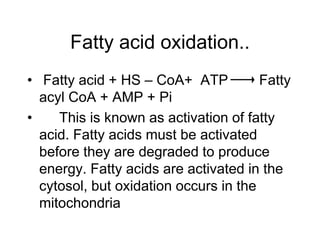
• Fatty acid + HS – CoA+ ATP Fatty
acyl CoA + AMP + Pi
• This is known as activation of fatty
acid. Fatty acids must be activated
before they are degraded to produce
energy. Fatty acids are activated in the
cytosol, but oxidation occurs in the
mitochondria
Overview
Fatty acids (F.A.s) are taken up by cells.
They may serve as:
•precursors in synthesis of other
compounds
•fuels for energy production
•substrates for ketone body synthesis
Ketone bodies may be exported to other
tissues: used for energy production.
Some cells synthesize fatty acids for
storage or export.
Energy
Fats are an important source of calories.
Typically 30-40% of calories in American diet
are from fat.
Fat is the major form of energy storage.
Typical body fuel reserves are:
fat: 100,000 kcal.
protein: 25,000 kcal.
carbohydrate: 650 kcal.
Provides 60% of energy needs for body at
rest.TAG reserves would enable someone to
survive starvation for ~30 days
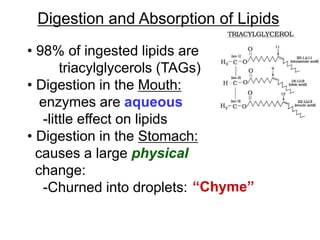
Digestion and Absorption of Lipids
• 98% of ingested lipids are
triacylglycerols (TAGs)
• Digestion in the Mouth:
enzymes are aqueous
-little effect on lipids
• Digestion in the Stomach:
causes a large physical
change:
-Churned into droplets: “Chyme”
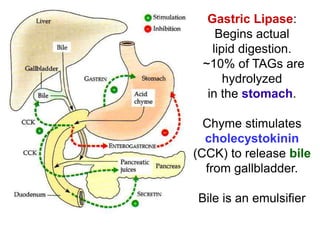
Gastric Lipase:
Begins actual
lipid digestion.
~10% of TAGs are
hydrolyzed
in the stomach.
Chyme stimulates
cholecystokinin
(CCK) to release bile
from gallbladder.
Bile is an emulsifier
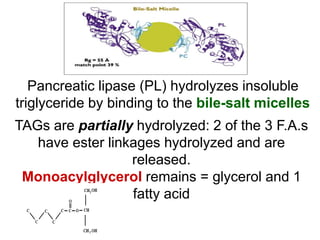
Pancreatic lipase (PL) hydrolyzes insoluble
triglyceride by binding to the bile-salt micelles
TAGs are partially hydrolyzed: 2 of the 3 F.A.s
have ester linkages hydrolyzed and are
released.
Monoacylglycerol remains = glycerol and 1
fatty acid
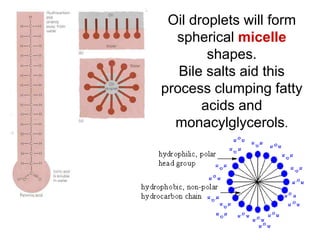
Oil droplets will form
spherical micelle
shapes.
Bile salts aid this
process clumping fatty
acids and
monacylglycerols.
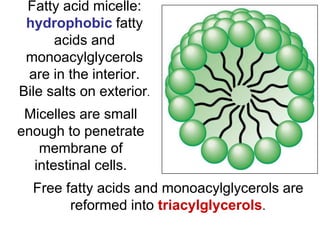
Fatty acid micelle:
hydrophobic fatty
acids and
monoacylglycerols
are in the interior.
Bile salts on exterior.
Micelles are small
enough to penetrate
membrane of
intestinal cells.
Free fatty acids and monoacylglycerols are
reformed into triacylglycerols.
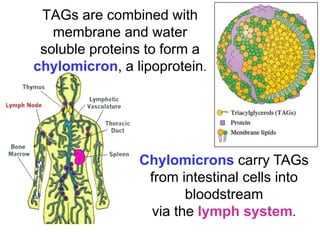
TAGs are combined with
membrane and water
soluble proteins to form a
chylomicron, a lipoprotein.
Chylomicrons carry TAGs
from intestinal cells into
bloodstream
via the lymph system.
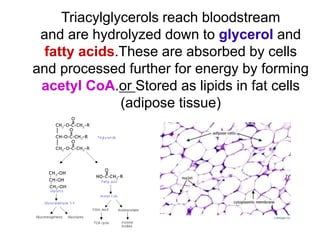
Triacylglycerols reach bloodstream
and are hydrolyzed down to glycerol and
fatty acids.These are absorbed by cells
and processed further for energy by forming
acetyl CoA.or Stored as lipids in fat cells
(adipose tissue)
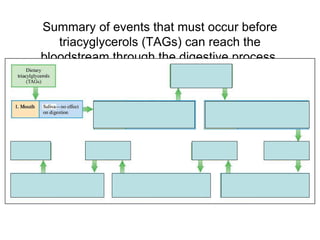
Summary of events that must occur before
triacyglycerols (TAGs) can reach the
bloodstream through the digestive process.
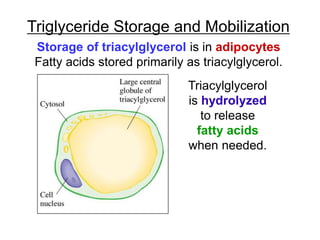
Triglyceride Storage and Mobilization
Storage of triacylglycerol is in adipocytes
Fatty acids stored primarily as triacylglycerol.
Triacylglycerol
is hydrolyzed
to release
fatty acids
when needed.
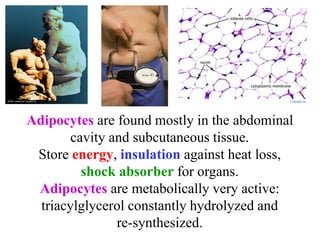
Adipocytes are found mostly in the abdominal
cavity and subcutaneous tissue.
Store energy, insulation against heat loss,
shock absorber for organs.
Adipocytes are metabolically very active:
triacylglycerol constantly hydrolyzed and
re-synthesized.
Hormonal control of lipolysis
The breakdown of triglycerides by lipases
is under hormonal control.
Hormones involved are:
Epinephrine, glucagon, and insulin.
Epinephrine and glucagon:
promote breakdown of fat (lipolysis)
Insulin:
inhibits lipolysis.
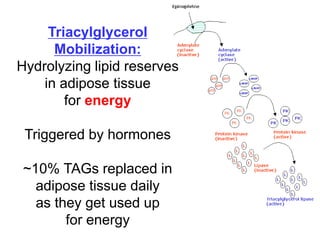
Triacylglycerol
Mobilization:
Hydrolyzing lipid reserves
in adipose tissue
for energy
Triggered by hormones
~10% TAGs replaced in
adipose tissue daily
as they get used up
for energy
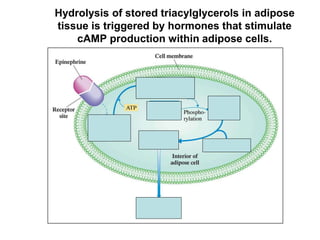
Hydrolysis of stored triacylglycerols in adipose
tissue is triggered by hormones that stimulate
cAMP production within adipose cells.
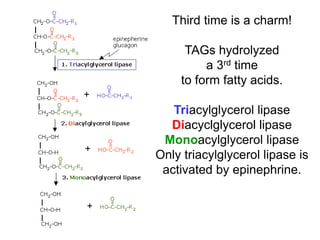
Third time is a charm!
TAGs hydrolyzed
a 3rd time
to form fatty acids.
Triacylglycerol lipase
Diacyclglycerol lipase
Monoacylglycerol lipase
Only triacylglycerol lipase is
activated by epinephrine.
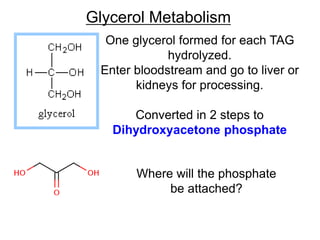
Glycerol Metabolism
One glycerol formed for each TAG
hydrolyzed.
Enter bloodstream and go to liver or
kidneys for processing.
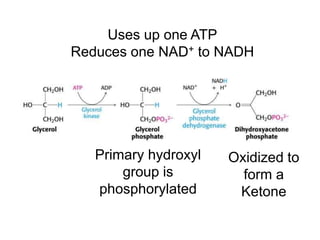
Converted in 2 steps to
Dihydroxyacetone phosphate
Where will the phosphate
be attached?
Uses up one ATP
Reduces one NAD+ to NADH
Oxidized to
form a
Ketone
Primary hydroxyl
group is
phosphorylated
Dihydroxyacetone phosphate
is an intermediate for both
Glycolysis:
converted to Pyruvate, then to Acetyl CoA, and
eventually to CO2, releasing its energy.
Gluconeogenesis:
creates Glucose from non-carbohydrate source
Lipid metabolism and carbohydrate metabolism
are connected.
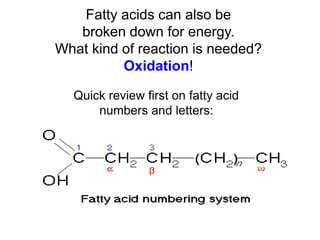
Fatty acids can also be
broken down for energy.
What kind of reaction is needed?
Oxidation!
Quick review first on fatty acid
numbers and letters:
Questions
• How are fatty acids activated and
transported into mitochondria for
oxidation?
• Which hormones are involved in fatty
acid metabolism?
• What are the functions of fatty acids?
• Explain the fate of triacylglycerol
• Thank you

lecture12.lipid.metabolism.ppt

  • 1.
    Lipid metabolism Daeyang University BScin Nursing and Midwifery Date:24.10.2022
  • 2.
  • 3.
    Learning objectives By theend of this lesson learners must know • How fatty acids are activated and transported into mitochondria for oxidation • Hormones that are involved in fatty acid metabolism • The functions of fatty acids • The fate of triacylglycerol
  • 4.
    Introduction • Reserves ofstored triglycerides are mobilized as needed for energy production. • Fat mobilization is stimulated by epinephrine. The triglycerides are hydrolyzed to fatty acids and glycerol and enter the blood stream. • Glycerol is converted to glycerol- 3 phosphate and then to dihydroxyacetone phospahte, which enters glycolysis for energy production.
  • 5.
    Introduction.. • Free fattyacids are converted to fatty acyl CoA molecules, which are broken down to acetyl CoA by beta oxidation. The acetyl CoA may be used for energy production by way of the citric acid cycle and the electron transport chain
  • 6.
    Fatty acid oxidation •Fatty acids are degraded to acetyl CoA • Fatty acids enter tissue cells in need of energy. Fatty acids must pass through the mitochondrial membrane to be oxidized and to produce energy. The passage cannot occur until the fatty acid is converted to its thioester with CoA. The product of this reaction is fatty acyl CoA. The reaction is:
  • 7.
    Fatty acid oxidation.. •Fatty acid + HS – CoA+ ATP Fatty acyl CoA + AMP + Pi • This is known as activation of fatty acid. Fatty acids must be activated before they are degraded to produce energy. Fatty acids are activated in the cytosol, but oxidation occurs in the mitochondria
  • 8.
    Overview Fatty acids (F.A.s)are taken up by cells. They may serve as: •precursors in synthesis of other compounds •fuels for energy production •substrates for ketone body synthesis Ketone bodies may be exported to other tissues: used for energy production. Some cells synthesize fatty acids for storage or export.
  • 9.
    Energy Fats are animportant source of calories. Typically 30-40% of calories in American diet are from fat. Fat is the major form of energy storage. Typical body fuel reserves are: fat: 100,000 kcal. protein: 25,000 kcal. carbohydrate: 650 kcal. Provides 60% of energy needs for body at rest.TAG reserves would enable someone to survive starvation for ~30 days
  • 10.
    Digestion and Absorptionof Lipids • 98% of ingested lipids are triacylglycerols (TAGs) • Digestion in the Mouth: enzymes are aqueous -little effect on lipids • Digestion in the Stomach: causes a large physical change: -Churned into droplets: “Chyme”
  • 11.
    Gastric Lipase: Begins actual lipiddigestion. ~10% of TAGs are hydrolyzed in the stomach. Chyme stimulates cholecystokinin (CCK) to release bile from gallbladder. Bile is an emulsifier
  • 12.
    Pancreatic lipase (PL)hydrolyzes insoluble triglyceride by binding to the bile-salt micelles TAGs are partially hydrolyzed: 2 of the 3 F.A.s have ester linkages hydrolyzed and are released. Monoacylglycerol remains = glycerol and 1 fatty acid
  • 13.
    Oil droplets willform spherical micelle shapes. Bile salts aid this process clumping fatty acids and monacylglycerols.
  • 14.
    Fatty acid micelle: hydrophobicfatty acids and monoacylglycerols are in the interior. Bile salts on exterior. Micelles are small enough to penetrate membrane of intestinal cells. Free fatty acids and monoacylglycerols are reformed into triacylglycerols.
  • 15.
    TAGs are combinedwith membrane and water soluble proteins to form a chylomicron, a lipoprotein. Chylomicrons carry TAGs from intestinal cells into bloodstream via the lymph system.
  • 16.
    Triacylglycerols reach bloodstream andare hydrolyzed down to glycerol and fatty acids.These are absorbed by cells and processed further for energy by forming acetyl CoA.or Stored as lipids in fat cells (adipose tissue)
  • 17.
    Summary of eventsthat must occur before triacyglycerols (TAGs) can reach the bloodstream through the digestive process.
  • 18.
    Triglyceride Storage andMobilization Storage of triacylglycerol is in adipocytes Fatty acids stored primarily as triacylglycerol. Triacylglycerol is hydrolyzed to release fatty acids when needed.
  • 19.
    Adipocytes are foundmostly in the abdominal cavity and subcutaneous tissue. Store energy, insulation against heat loss, shock absorber for organs. Adipocytes are metabolically very active: triacylglycerol constantly hydrolyzed and re-synthesized.
  • 20.
    Hormonal control oflipolysis The breakdown of triglycerides by lipases is under hormonal control. Hormones involved are: Epinephrine, glucagon, and insulin. Epinephrine and glucagon: promote breakdown of fat (lipolysis) Insulin: inhibits lipolysis.
  • 21.
    Triacylglycerol Mobilization: Hydrolyzing lipid reserves inadipose tissue for energy Triggered by hormones ~10% TAGs replaced in adipose tissue daily as they get used up for energy
  • 22.
    Hydrolysis of storedtriacylglycerols in adipose tissue is triggered by hormones that stimulate cAMP production within adipose cells.
  • 23.
    Third time isa charm! TAGs hydrolyzed a 3rd time to form fatty acids. Triacylglycerol lipase Diacyclglycerol lipase Monoacylglycerol lipase Only triacylglycerol lipase is activated by epinephrine.
  • 24.
    Glycerol Metabolism One glycerolformed for each TAG hydrolyzed. Enter bloodstream and go to liver or kidneys for processing. Converted in 2 steps to Dihydroxyacetone phosphate Where will the phosphate be attached?
  • 25.
    Uses up oneATP Reduces one NAD+ to NADH Oxidized to form a Ketone Primary hydroxyl group is phosphorylated
  • 26.
    Dihydroxyacetone phosphate is anintermediate for both Glycolysis: converted to Pyruvate, then to Acetyl CoA, and eventually to CO2, releasing its energy. Gluconeogenesis: creates Glucose from non-carbohydrate source Lipid metabolism and carbohydrate metabolism are connected.
  • 27.
    Fatty acids canalso be broken down for energy. What kind of reaction is needed? Oxidation! Quick review first on fatty acid numbers and letters:
  • 28.
    Questions • How arefatty acids activated and transported into mitochondria for oxidation? • Which hormones are involved in fatty acid metabolism? • What are the functions of fatty acids? • Explain the fate of triacylglycerol
  • 29.