1 
Lipids 
Types of Lipids 
Fatty Acids 
Fats, and Oils 
Chemical Properties of Triglycerides
2 
Types of Lipids 
• Lipids with fatty acids 
Waxes 
Fats and oils (trigycerides) 
Phospholipids 
Sphingolipids 
• Lipids without fatty acids 
Steroids
3 
Fatty Acids 
• Long-chain carboxylic acids 
• Insoluble in water 
• Typically 12-18 carbon atoms (even number) 
• Some contain double bonds 
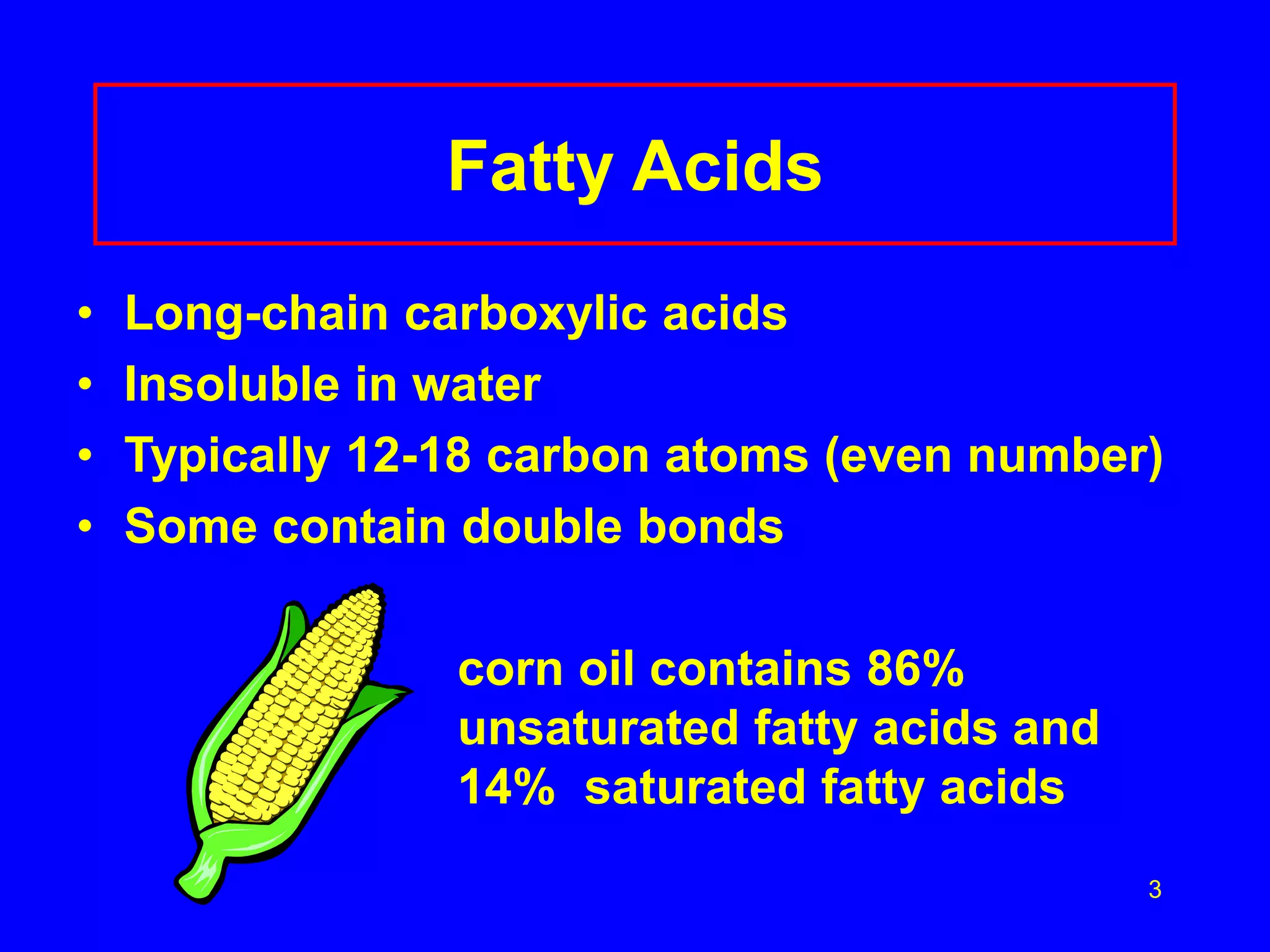
corn oil contains 86% 
unsaturated fatty acids and 
14% saturated fatty acids
4 
Saturated and Unsaturated 
Fatty Acids 
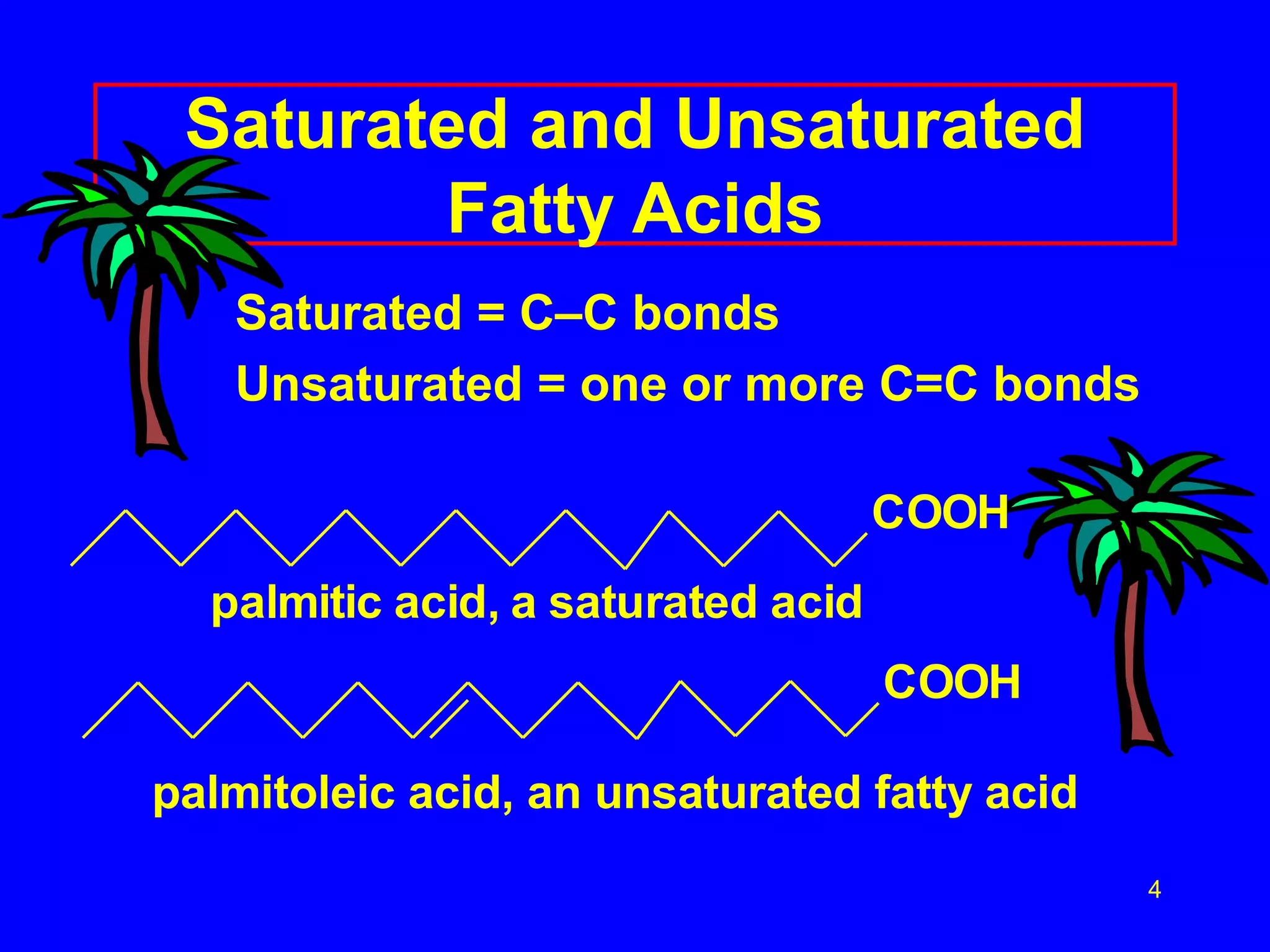
Saturated = C–C bonds 
Unsaturated = one or more C=C bonds 
COOH 
COOH 
palmitic acid, a saturated acid 
palmitoleic acid, an unsaturated fatty acid
5 
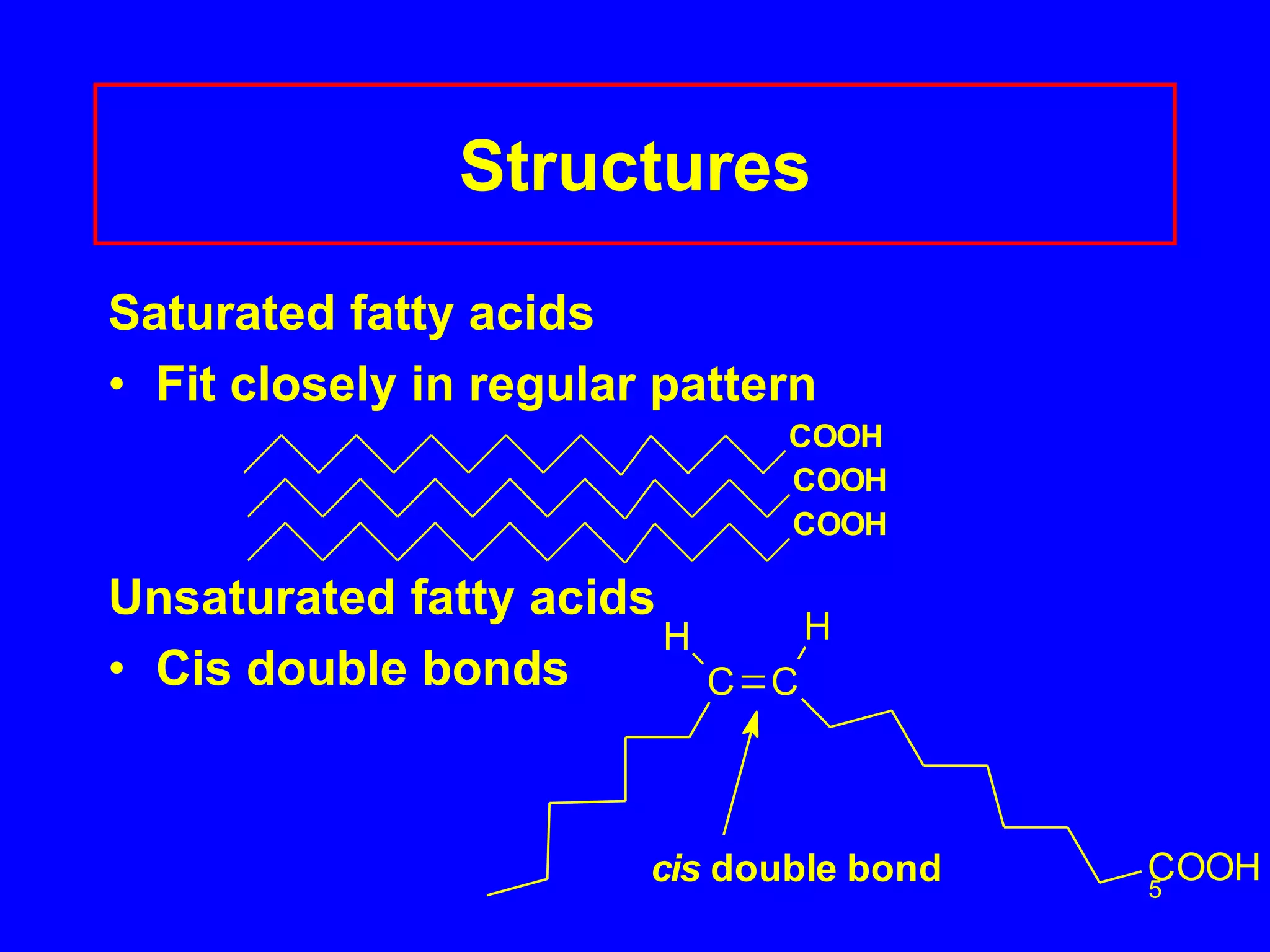
Structures 
Saturated fatty acids 
• Fit closely in regular pattern 
Unsaturated fatty acids 
• Cis double bonds 
COOH 
COOH 
COOH 
H H 
C C 
cis double bond COOH
6 
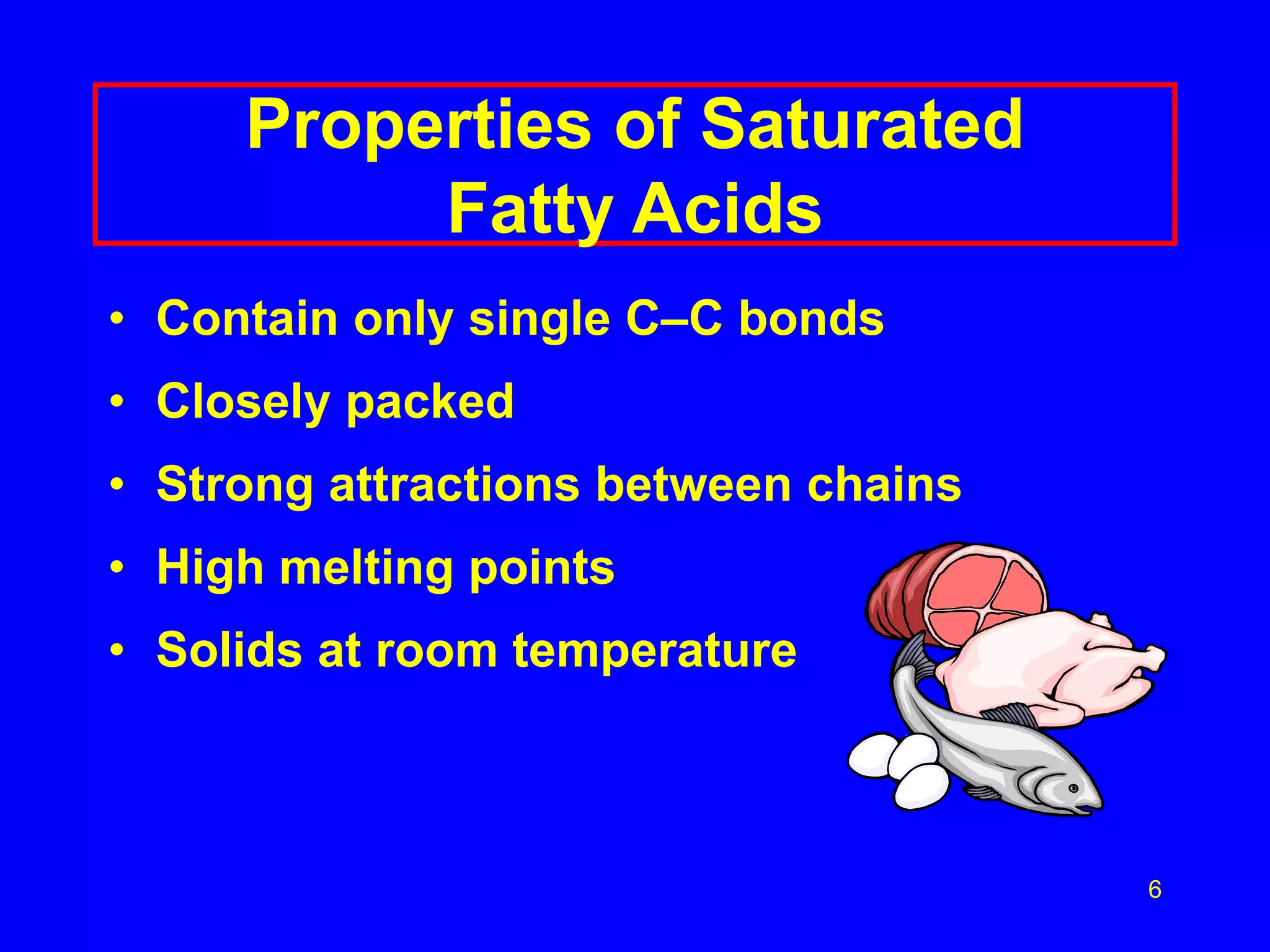
Properties of Saturated 
Fatty Acids 
• Contain only single C–C bonds 
• Closely packed 
• Strong attractions between chains 
• High melting points 
• Solids at room temperature
7 
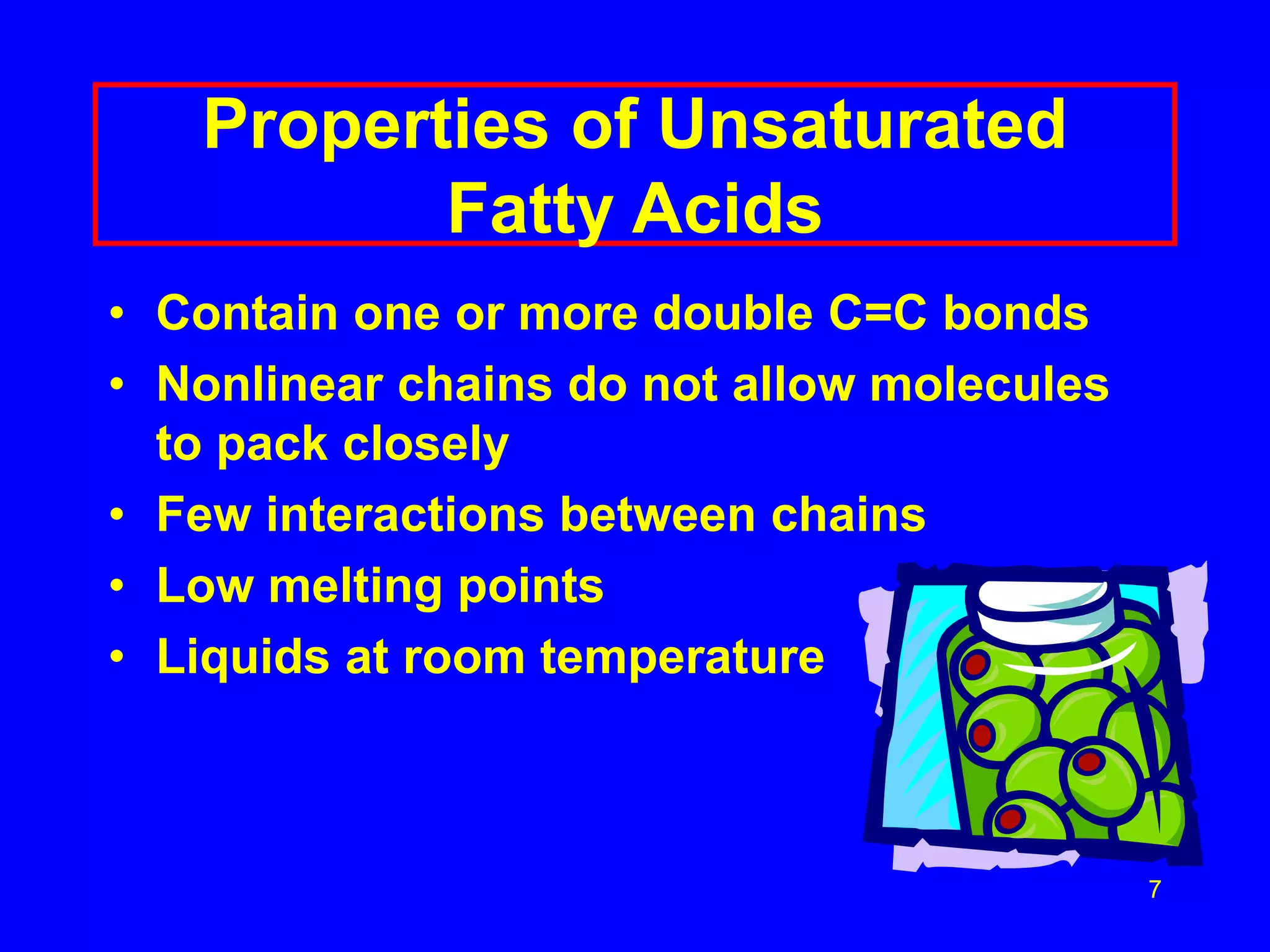
Properties of Unsaturated 
Fatty Acids 
• Contain one or more double C=C bonds 
• Nonlinear chains do not allow molecules 
to pack closely 
• Few interactions between chains 
• Low melting points 
• Liquids at room temperature
8 
Learning Check L1 
How would the melting point of stearic 
acid compare to the melting points of oleic 
acid and linoleic acid? Assign the melting 
points of –17°C, 13°C, and 69°C to the 
correct fatty acid. Explain. 
stearic acid (18 C) saturated 
oleic acid (18 C) one double bond 
linoleic acid (18 C) two double bonds
9 
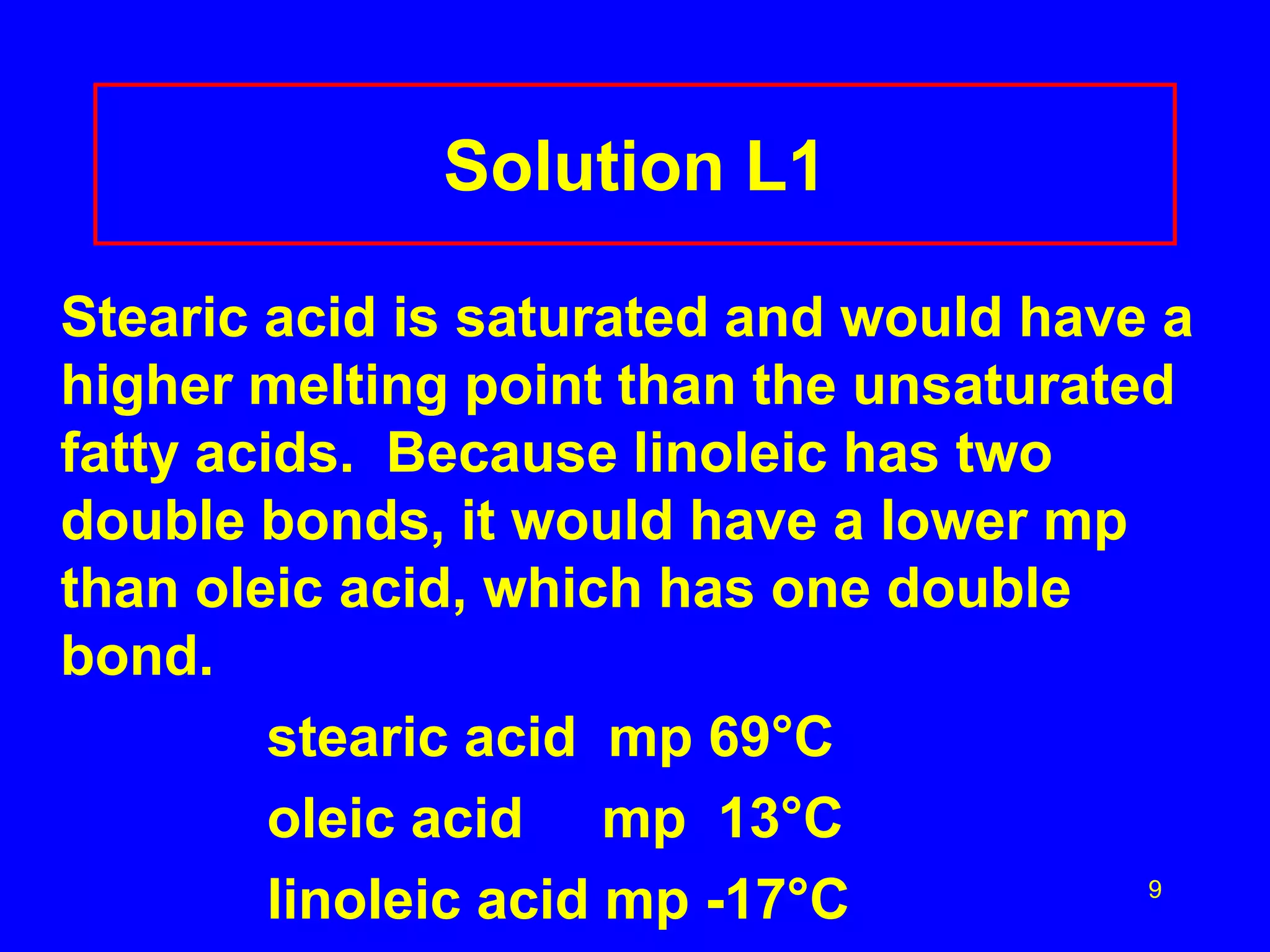
Solution L1 
Stearic acid is saturated and would have a 
higher melting point than the unsaturated 
fatty acids. Because linoleic has two 
double bonds, it would have a lower mp 
than oleic acid, which has one double 
bond. 
stearic acid mp 69°C 
oleic acid mp 13°C 
linoleic acid mp -17°C
10 
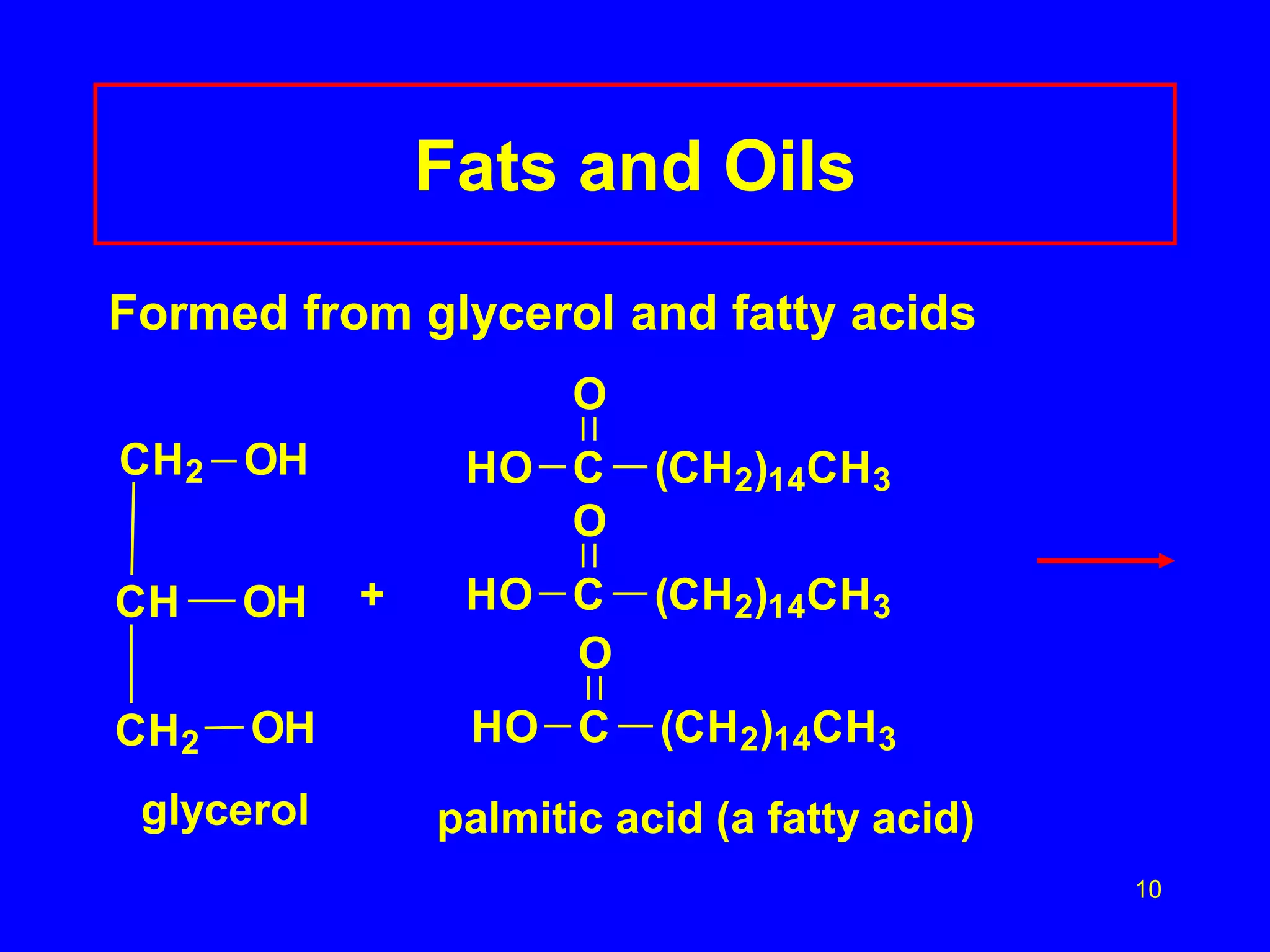
Fats and Oils 
Formed from glycerol and fatty acids 
+ 
O 
HO C (CH2)14CH3 
O 
HO C (CH2)14CH3 
O 
HO C (CH2)14CH3 
CH2 OH 
CH 
OH 
CH2 OH 
glycerol palmitic acid (a fatty acid)
11 
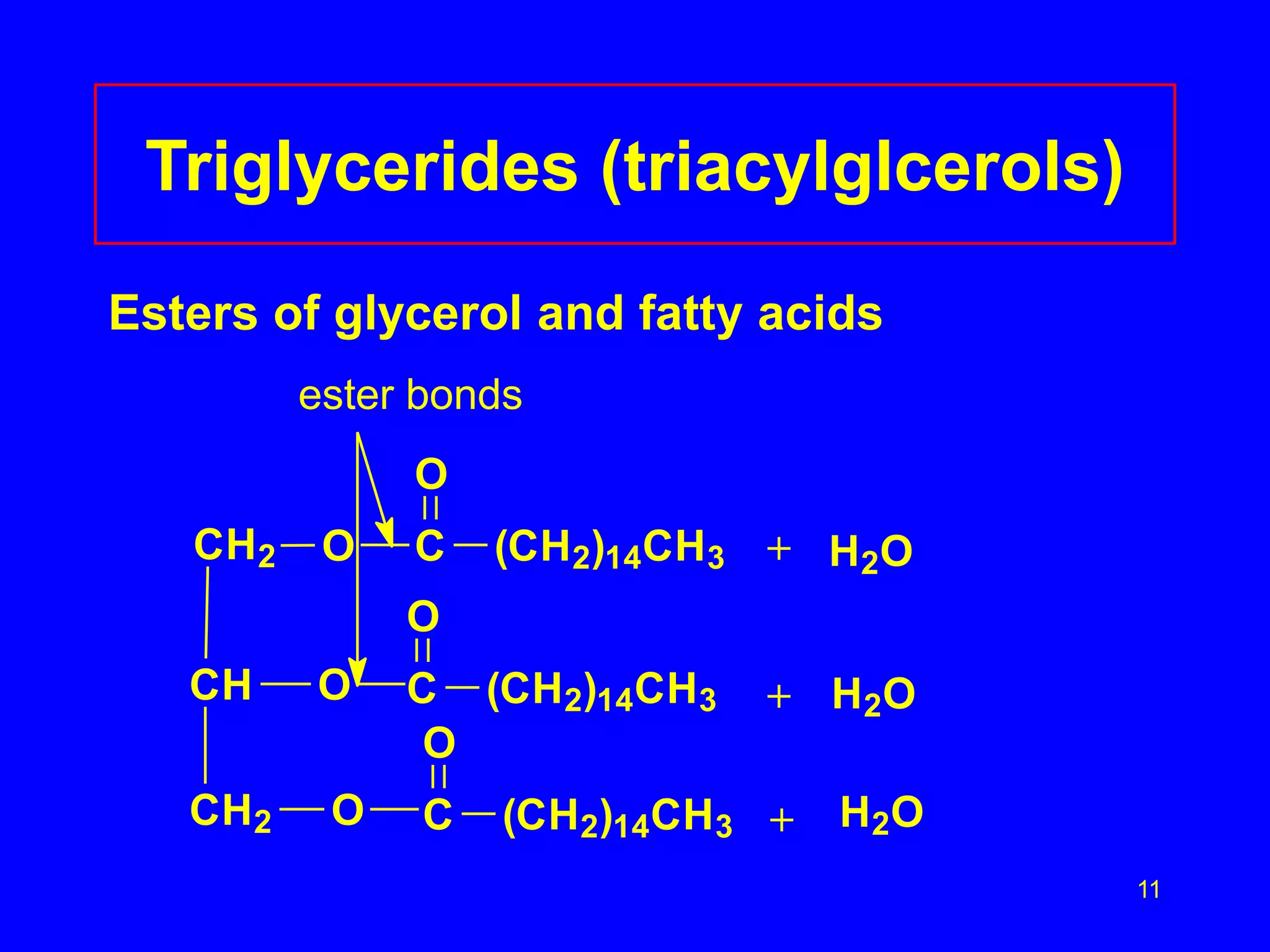
Triglycerides (triacylglcerols) 
Esters of glycerol and fatty acids 
ester bonds 
CH2 O 
CH 
CH2 
O 
O 
O 
C (CH2)14CH3 
O 
C (CH2)14CH3 
O 
C (CH2)14CH3 
+ 
+ 
+ 
H2O 
H2O 
H2O
12 
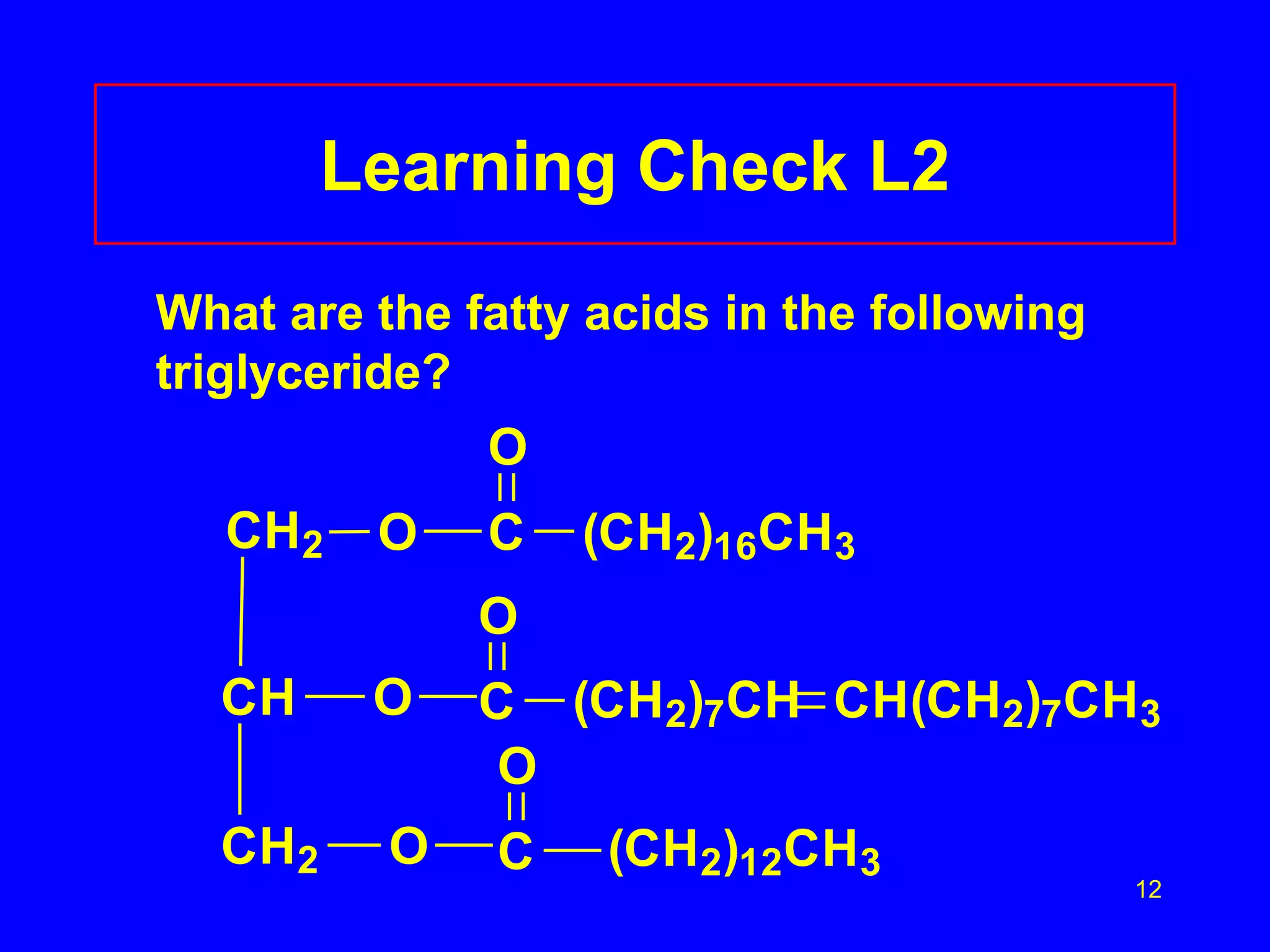
Learning Check L2 
What are the fatty acids in the following 
triglyceride? 
CH2 O 
CH 
CH2 
O 
O 
O 
C (CH2)16CH3 
O 
C 
(CH2)7CH CH(CH2)7CH3 
O 
C 
(CH2)12CH3
Stearic acid 
13 
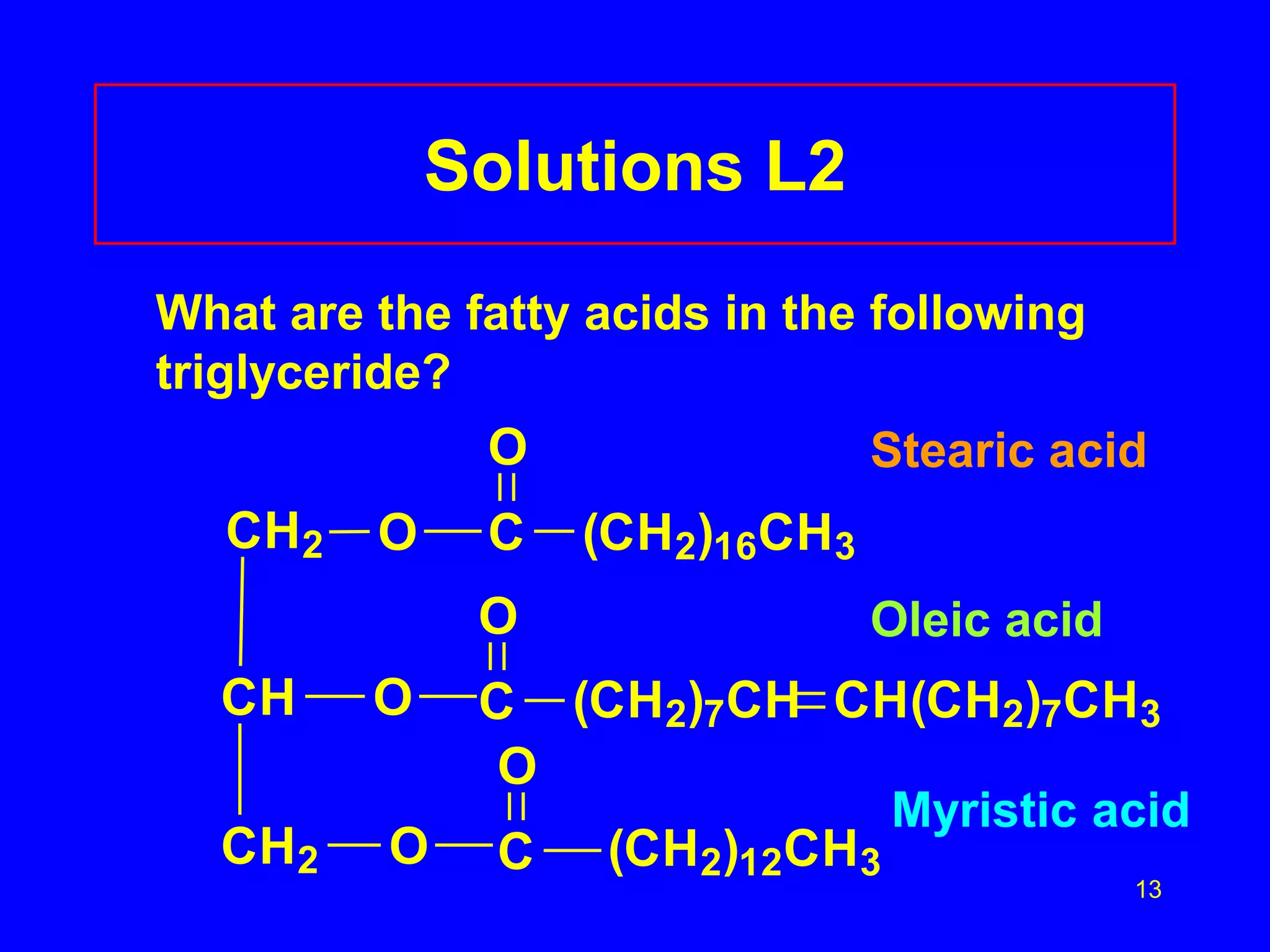
Solutions L2 
What are the fatty acids in the following 
triglyceride? 
CH2 O 
CH 
CH2 
O 
O 
O 
C (CH2)16CH3 
O 
C 
Oleic acid 
(CH2)7CH CH(CH2)7CH3 
O 
C 
(CH2)12CH3 
Myristic acid
14 
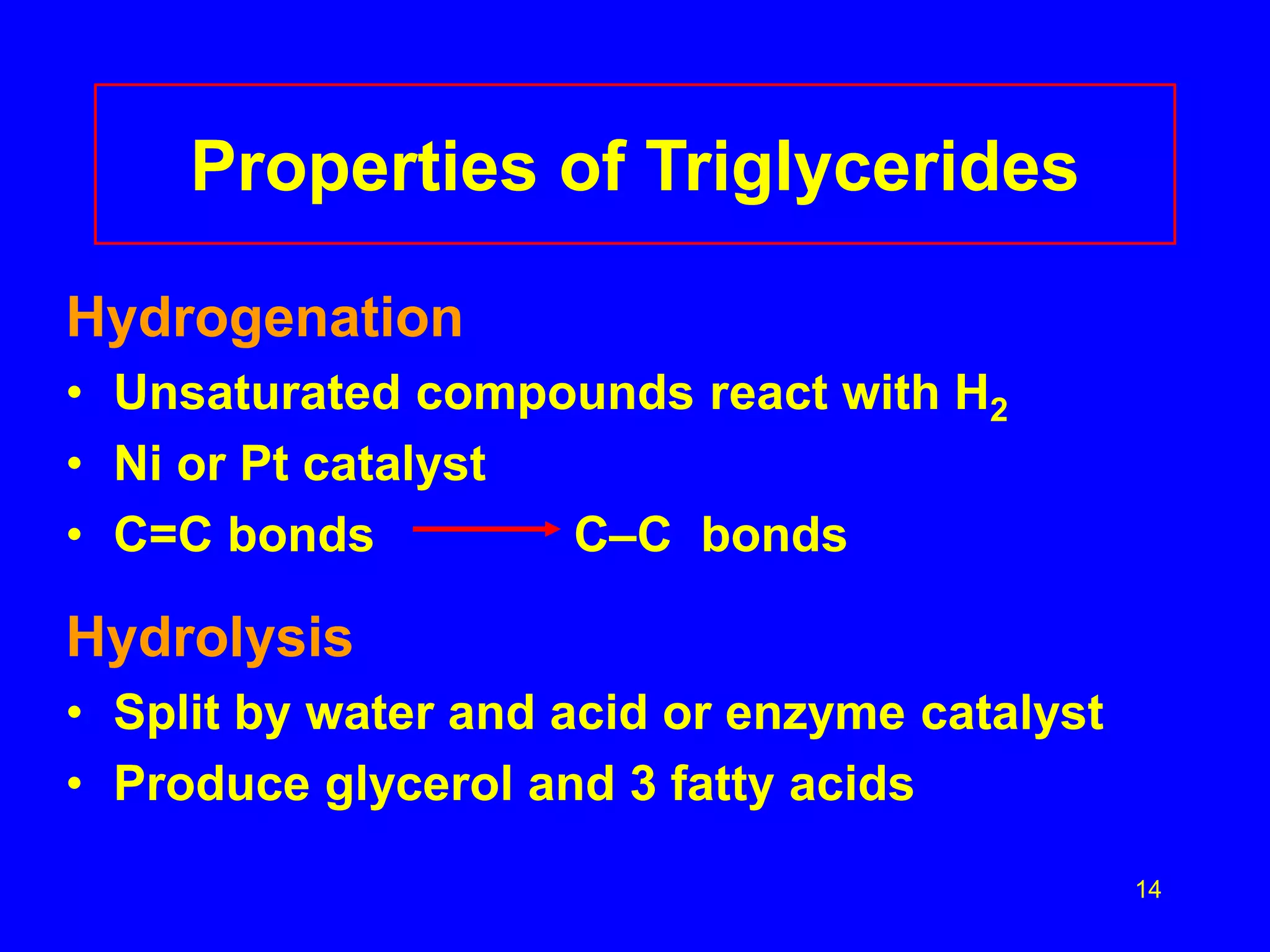
Properties of Triglycerides 
Hydrogenation 
• Unsaturated compounds react with H2 
• Ni or Pt catalyst 
• C=C bonds C–C bonds 
Hydrolysis 
• Split by water and acid or enzyme catalyst 
• Produce glycerol and 3 fatty acids
15 
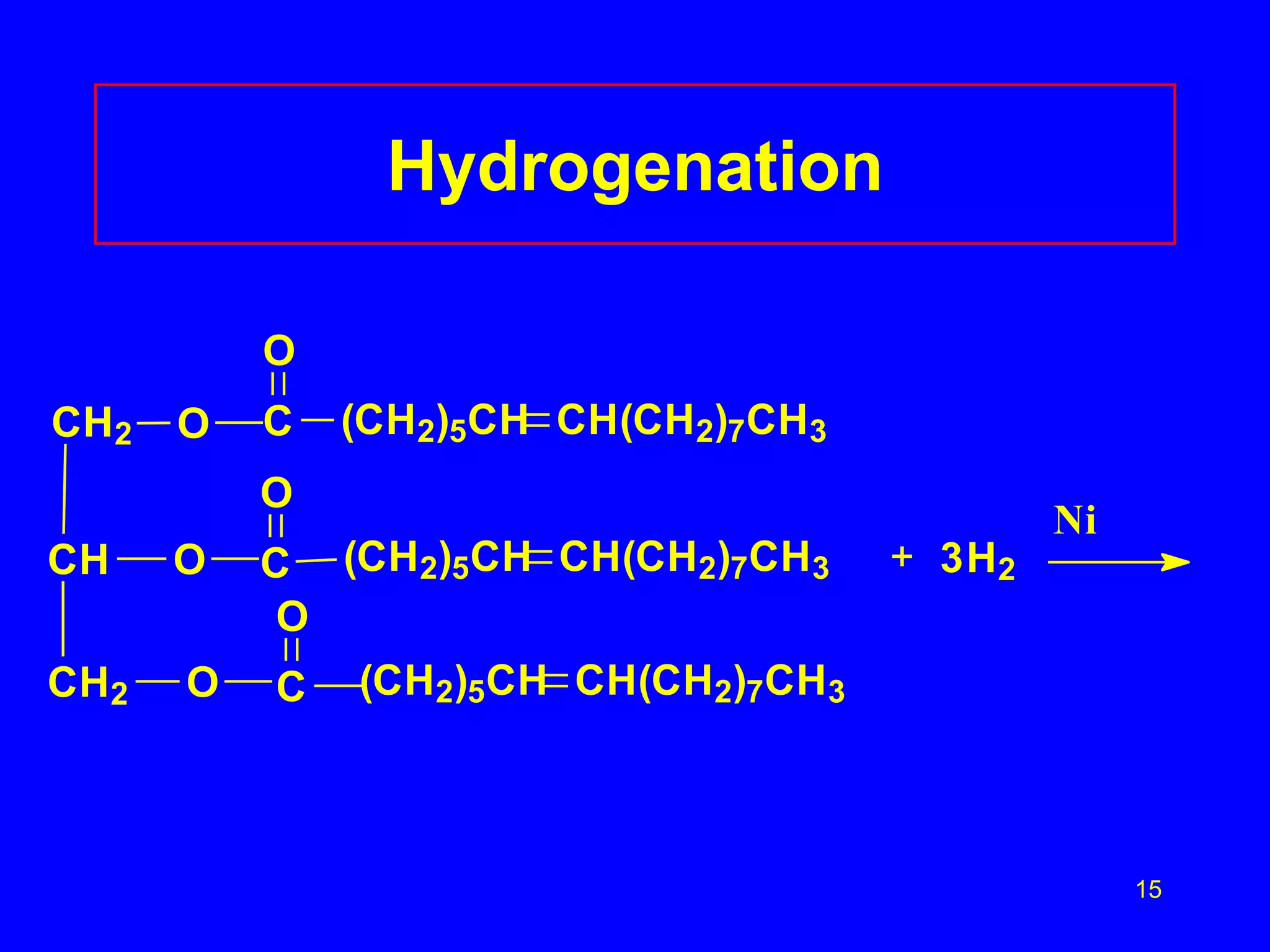
Hydrogenation 
CH2 O 
CH 
CH2 
O 
O 
O 
C 
(CH2)5CH CH(CH2)7CH3 
O 
C 
(CH2)5CH CH(CH2)7CH3 
O 
C 
+ 
(CH2)5CH CH(CH2)7C H 3 
3H2 
Ni
16 
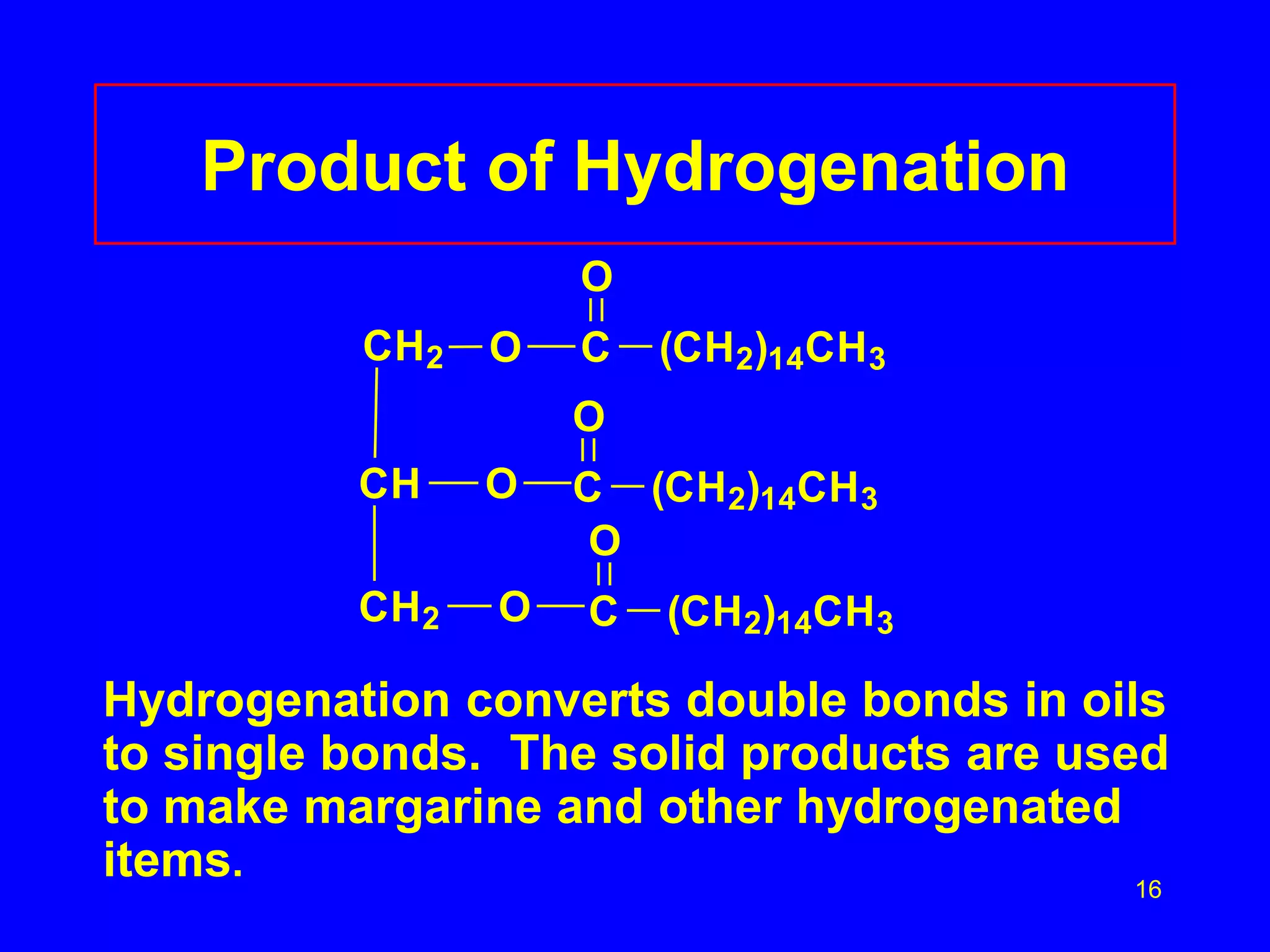
Product of Hydrogenation 
CH2 O 
CH 
CH2 
O 
O 
O 
C (CH2)14CH3 
O 
C (CH2)14CH3 
O 
C (CH2)14CH3 
Hydrogenation converts double bonds in oils 
to single bonds. The solid products are used 
to make margarine and other hydrogenated 
items.
17 
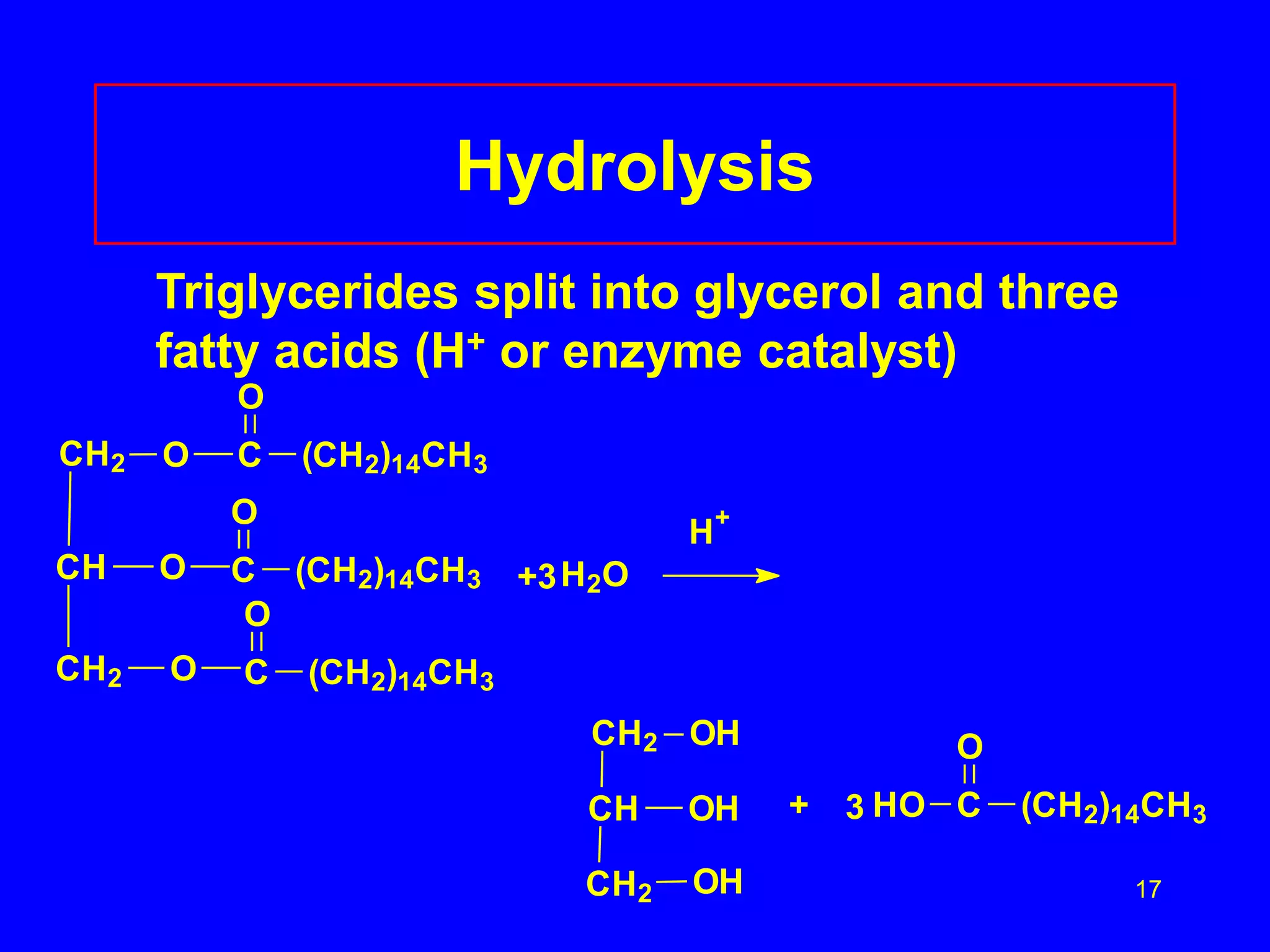
Hydrolysis 
Triglycerides split into glycerol and three 
fat t y acids (H+ or enzyme catalyst) 
CH2 O 
CH 
CH2 
O 
O 
O 
C (CH2)14CH3 
O 
C (CH2)14CH3 
O 
C (CH2)14CH3 
+3 H2O 
O 
+ 3 HO C (CH2)14CH3 
H+ 
CH2 OH 
CH 
OH 
CH2 OH
18 
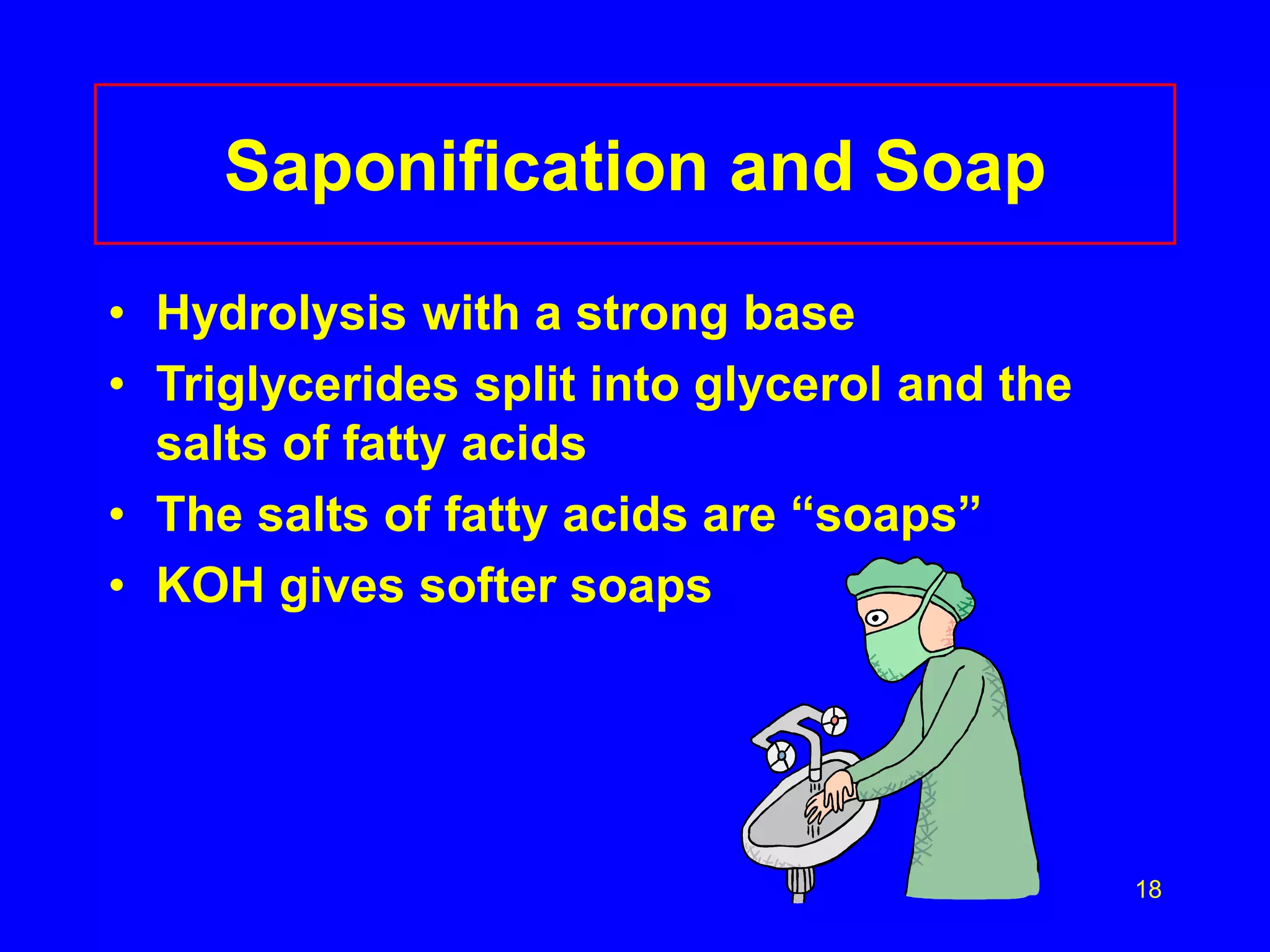
Saponification and Soap 
• Hydrolysis with a strong base 
• Triglycerides split into glycerol and the 
salts of fatty acids 
• The salts of fatty acids are “soaps” 
• KOH gives softer soaps
19 
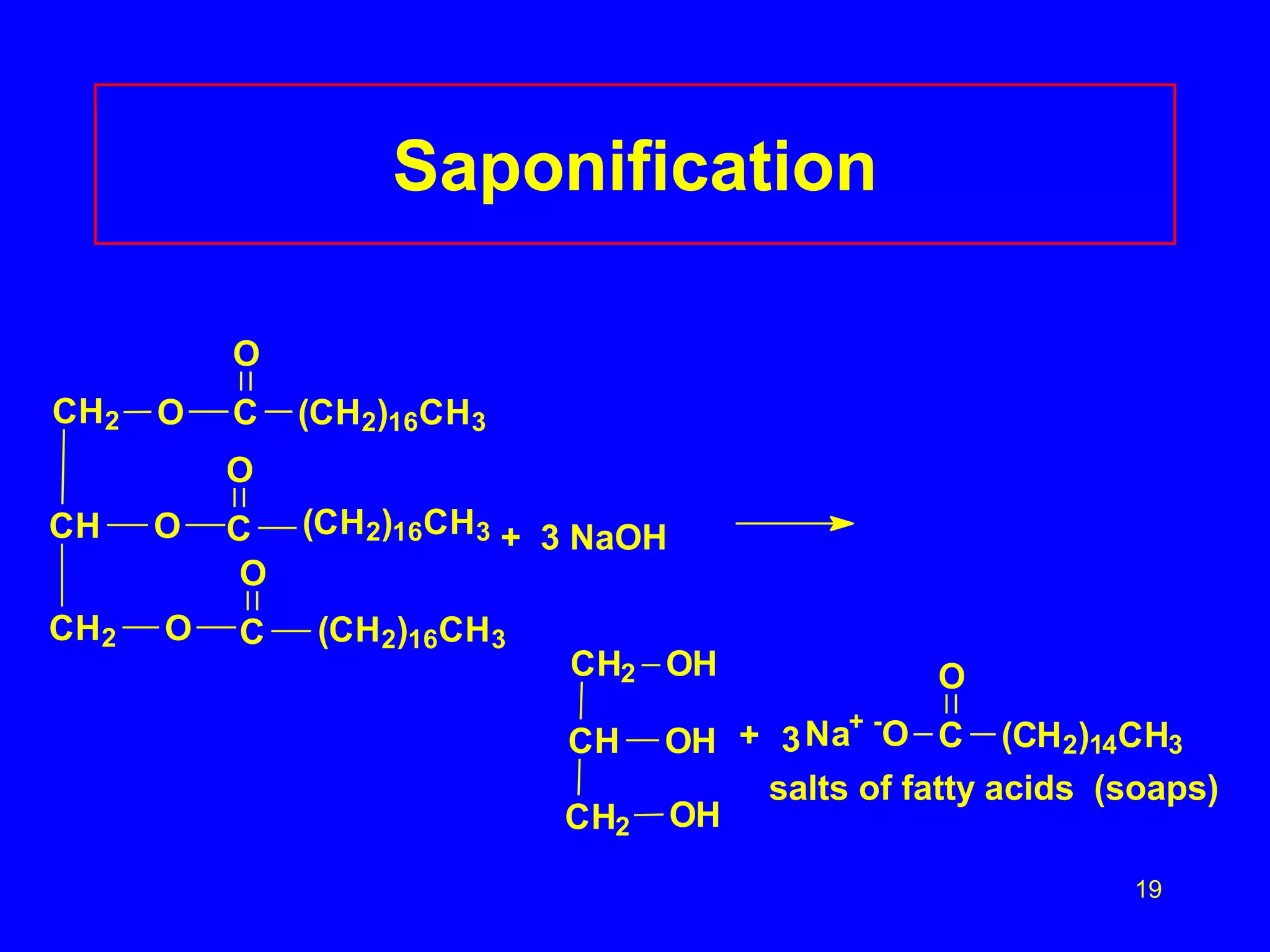
Saponification 
O 
+ 3Na+ -O C (CH2)14CH3 
CH2 OH 
CH 
OH 
CH2 OH 
CH2 O 
CH 
CH2 
O 
O 
O 
C (CH2)16CH3 
C (CH2)16CH3 
O 
C 
(CH2)16CH3 
O 
+ 3 NaOH 
salts of fatty acids (soaps)
20 
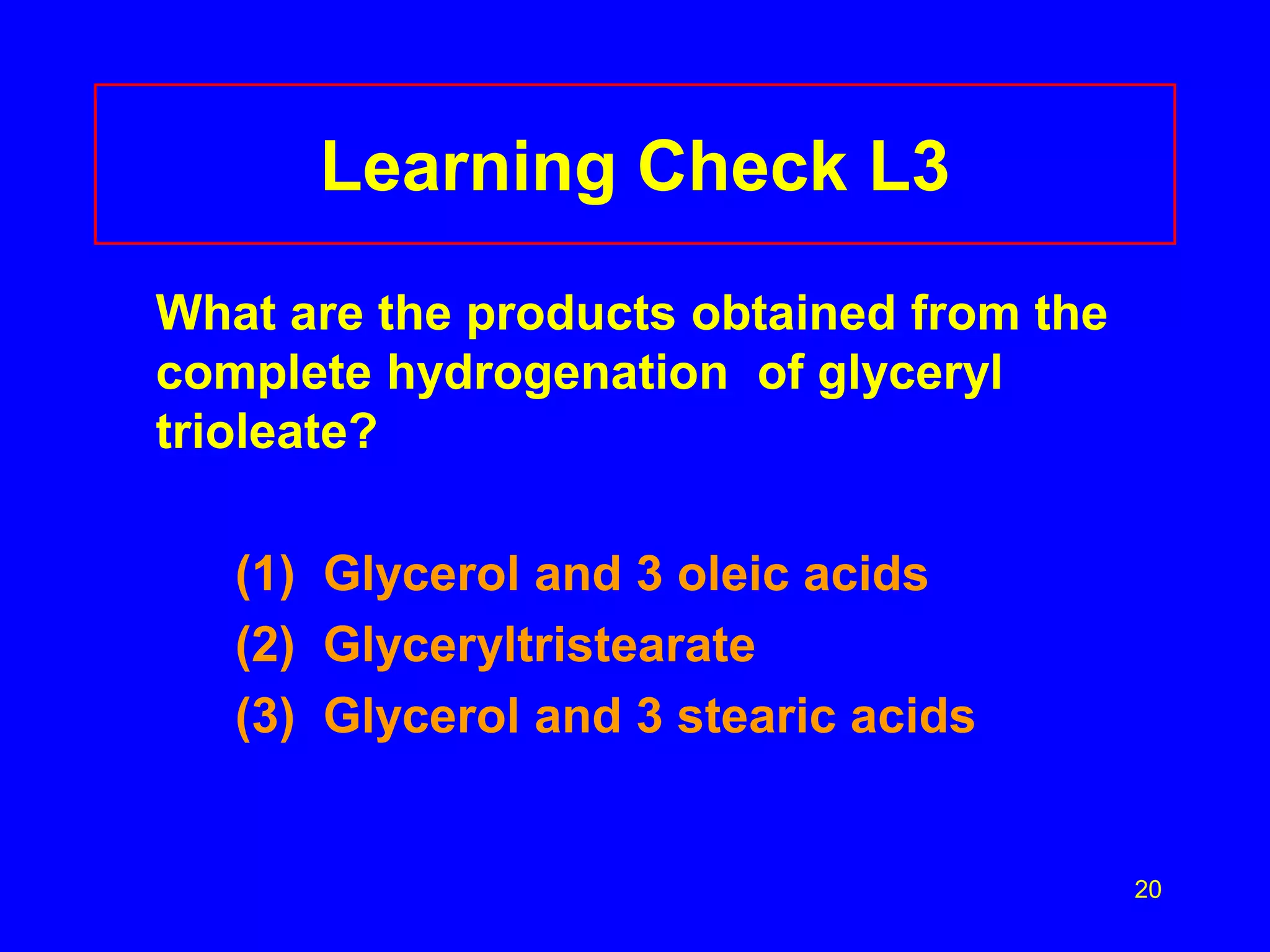
Learning Check L3 
What are the products obtained from the 
complete hydrogenation of glyceryl 
trioleate? 
(1) Glycerol and 3 oleic acids 
(2) Glyceryltristearate 
(3) Glycerol and 3 stearic acids
21 
Solution L3 
What are the products obtained from the 
complete hydrogenation of glyceryl 
trioleate? 
2. Glyceryltristearate

Lipids can be taught

  • 1.
    1 Lipids Typesof Lipids Fatty Acids Fats, and Oils Chemical Properties of Triglycerides
  • 2.
    2 Types ofLipids • Lipids with fatty acids Waxes Fats and oils (trigycerides) Phospholipids Sphingolipids • Lipids without fatty acids Steroids
  • 3.
    3 Fatty Acids • Long-chain carboxylic acids • Insoluble in water • Typically 12-18 carbon atoms (even number) • Some contain double bonds corn oil contains 86% unsaturated fatty acids and 14% saturated fatty acids
  • 4.
    4 Saturated andUnsaturated Fatty Acids Saturated = C–C bonds Unsaturated = one or more C=C bonds COOH COOH palmitic acid, a saturated acid palmitoleic acid, an unsaturated fatty acid
  • 5.
    5 Structures Saturatedfatty acids • Fit closely in regular pattern Unsaturated fatty acids • Cis double bonds COOH COOH COOH H H C C cis double bond COOH
  • 6.
    6 Properties ofSaturated Fatty Acids • Contain only single C–C bonds • Closely packed • Strong attractions between chains • High melting points • Solids at room temperature
  • 7.
    7 Properties ofUnsaturated Fatty Acids • Contain one or more double C=C bonds • Nonlinear chains do not allow molecules to pack closely • Few interactions between chains • Low melting points • Liquids at room temperature
  • 8.
    8 Learning CheckL1 How would the melting point of stearic acid compare to the melting points of oleic acid and linoleic acid? Assign the melting points of –17°C, 13°C, and 69°C to the correct fatty acid. Explain. stearic acid (18 C) saturated oleic acid (18 C) one double bond linoleic acid (18 C) two double bonds
  • 9.
    9 Solution L1 Stearic acid is saturated and would have a higher melting point than the unsaturated fatty acids. Because linoleic has two double bonds, it would have a lower mp than oleic acid, which has one double bond. stearic acid mp 69°C oleic acid mp 13°C linoleic acid mp -17°C
  • 10.
    10 Fats andOils Formed from glycerol and fatty acids + O HO C (CH2)14CH3 O HO C (CH2)14CH3 O HO C (CH2)14CH3 CH2 OH CH OH CH2 OH glycerol palmitic acid (a fatty acid)
  • 11.
    11 Triglycerides (triacylglcerols) Esters of glycerol and fatty acids ester bonds CH2 O CH CH2 O O O C (CH2)14CH3 O C (CH2)14CH3 O C (CH2)14CH3 + + + H2O H2O H2O
  • 12.
    12 Learning CheckL2 What are the fatty acids in the following triglyceride? CH2 O CH CH2 O O O C (CH2)16CH3 O C (CH2)7CH CH(CH2)7CH3 O C (CH2)12CH3
  • 13.
    Stearic acid 13 Solutions L2 What are the fatty acids in the following triglyceride? CH2 O CH CH2 O O O C (CH2)16CH3 O C Oleic acid (CH2)7CH CH(CH2)7CH3 O C (CH2)12CH3 Myristic acid
  • 14.
    14 Properties ofTriglycerides Hydrogenation • Unsaturated compounds react with H2 • Ni or Pt catalyst • C=C bonds C–C bonds Hydrolysis • Split by water and acid or enzyme catalyst • Produce glycerol and 3 fatty acids
  • 15.
    15 Hydrogenation CH2O CH CH2 O O O C (CH2)5CH CH(CH2)7CH3 O C (CH2)5CH CH(CH2)7CH3 O C + (CH2)5CH CH(CH2)7C H 3 3H2 Ni
  • 16.
    16 Product ofHydrogenation CH2 O CH CH2 O O O C (CH2)14CH3 O C (CH2)14CH3 O C (CH2)14CH3 Hydrogenation converts double bonds in oils to single bonds. The solid products are used to make margarine and other hydrogenated items.
  • 17.
    17 Hydrolysis Triglyceridessplit into glycerol and three fat t y acids (H+ or enzyme catalyst) CH2 O CH CH2 O O O C (CH2)14CH3 O C (CH2)14CH3 O C (CH2)14CH3 +3 H2O O + 3 HO C (CH2)14CH3 H+ CH2 OH CH OH CH2 OH
  • 18.
    18 Saponification andSoap • Hydrolysis with a strong base • Triglycerides split into glycerol and the salts of fatty acids • The salts of fatty acids are “soaps” • KOH gives softer soaps
  • 19.
    19 Saponification O + 3Na+ -O C (CH2)14CH3 CH2 OH CH OH CH2 OH CH2 O CH CH2 O O O C (CH2)16CH3 C (CH2)16CH3 O C (CH2)16CH3 O + 3 NaOH salts of fatty acids (soaps)
  • 20.
    20 Learning CheckL3 What are the products obtained from the complete hydrogenation of glyceryl trioleate? (1) Glycerol and 3 oleic acids (2) Glyceryltristearate (3) Glycerol and 3 stearic acids
  • 21.
    21 Solution L3 What are the products obtained from the complete hydrogenation of glyceryl trioleate? 2. Glyceryltristearate