Fats, Oils and Detergents
By : Shriya Tiwari
Fats, Oils and Detergents
Fats and Oils
● Natural fats
● Edible and industrial oils of vegetable
origin
● Glycerides
● Common fatty acids
● Physical properties
● Chemical properties :
1. Hydrolysis(Saponification)
2. Hydrogenation
Important Chemical Constants
● Acid value
● Saponification value
● Iodine value
Soaps and Detergents
● Soaps
● Synthetic detergents
● Typical synthetic detergents
1) Alkyl sulphonates
2) Aryl sulphonates
Fats and Oils
Fats and Oils
Chemically, they are esters of higher
aliphatic monocarboxylic acids with
glycerol and are :- also called
triacylygylcerols(triglycerides/glyc
erides).
Triacylygylcerols which are solid at
room temperature are called fats
while those which are liquid, called
oils.
Fats and Oils
Fats and oils are also known as
lipids , i. e, naturally occurring
biomolecules which are insoluble in
water but soluble in organic
solvents.
Occurrence
1) Natural Fats
Obtained from animal sources such
as (a) butter (from milk of cows and
Buffaloes) , (b) tallow(from sheep,
goats etc), (c) lard(from pigs).
Fats and Oils
2) Edible oils of vegetable origin:-
Produced from vegetable sources
Example:-coconut oil, corn oil,
groundnut oil, olive oil, palm oil,
peanut oil, soybean oil, sunflower oil
etc.
3) Industrial oills of vegetable origin:
Used in industries such as-
Soap, paints, varnishes, lacquers
Structure
Fats and oils are triesters of glycerol with long chain carboxylic acids.
GLYCERIDES
Simple glycerides
Same alkyl groups (R, R’
, R’’
)
Example:
Mixed glycerides
Different alkyl groups (R, R’
, R’’
)
Example:
Glyceryl tripalmitate Glyceral palmitodistearate
Common fatty
acids
The monocarboxylic acids obtained
by the hydrolysis of fats and oils are
called as fatty acids,
Common saturated fatty acids:-
● Palmutic acid(C15
H31
COOH)
● Stearic acid(C17
H35
COOH)
Common unsaturated fatty acids:-
● Oleic acid (C17
H33
COOH)
Physical
Properties
● Physical state and solubility:-
1. Natural fats and oils are
generally colourless, odourless
and tasteless solids or liquids
when pure.
2. They are largely soluble in
organic solvents (benzene,
chloroform and petroleum
ether).
● Melting point:-
1) Fats containing a high
proportion of saturated acif
groups un glycerides have
relatively high m. p. but the
presence of unsaturated acid
units lowers the m. p.
Chemical
Properties
● Hydrolysis
In their chemical behavior oils and
fats resemble the simple ethers and
exhibit their usual reactions.
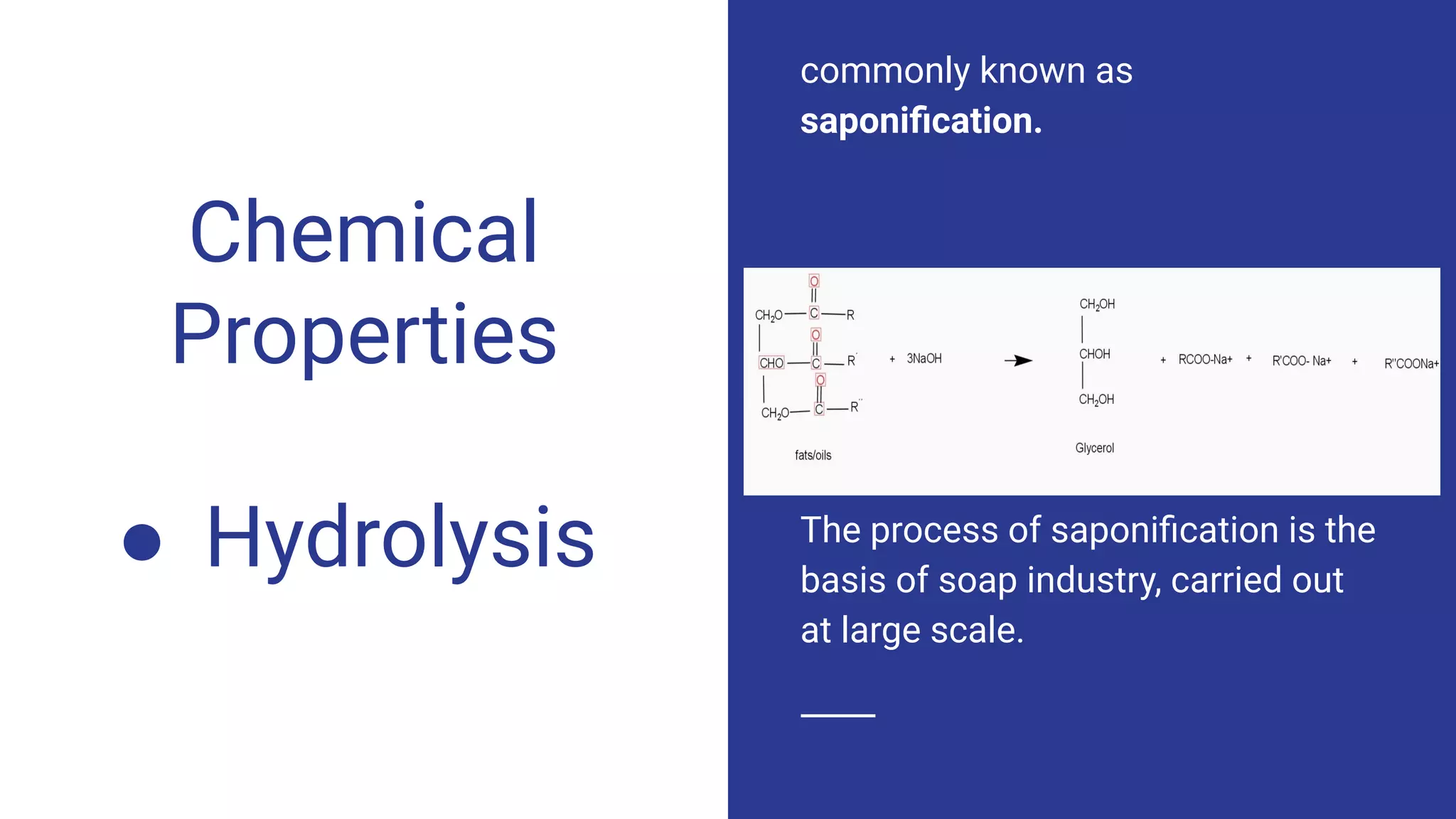
1. Hydrolysis
Fats and oils can be readily
hydrolyzed by treatment with
superheated steam or mineral
acids or alkalies.
Hydrolysis in presence of
steam or mineral acids
provides
Chemical
Properties
● Hydrolysis
a mixture of free fatty acids and
glycerol.
Hydrolysis of alkalies gives rise to a
mixture of salts of fatty acids and
glycerol. Since, the salts of fatty
acids thus formed are used as
soap, alkaline hydrolysis is
commonly known as
saponification.
The process of saponification is the
basis of soap industry, carried out
at large scale.
Chemical
Properties
● Hydrolysis
Chemical
properties
● Hydrogenation
Oils containing a large proportion of
unsaturated acid part in their
glycerides add on hydrogen
(becomes saturated) in presence of
finally divided nickel and change
into solid fats.
This process is called
hydrogenation or hardening of oils.
Hydrogenation is used
commercially in the manufacturing
Chemical
properties
● Hydrogenation
of vegetable ghee from cotton
seed, coconut, groundnut or pea nut
oils.
Important chemical
constants
Acid value
Definition:-Itis defined as number
of milligrams of KOH required to
neutralize the free fatty acids
present in one gram of fats/oils.
It is determined by dissolving a
known quantity qof fats or oils in
pure alcohol and titrating against
standard KOH solution using
phenolphthalein as indicator.
The acid value indicates the amount
of free acids present in given fats
/oils.
Saponification
value
The number of mg of KOH required
to completely sponify 1g of fat/oil.
The saponification value gives an
idea about the molecular weight of
fat/oil.
Smaller the saponification value,
higher the molecular weight.
Iodine value
It is the number of grams of iodine
which combines with 100g of
fat/oil.
It is the measure of the extent of
unsaturation in fat/oil and gives an
idea of its “drying” character.
Higher the iodine value, more
unsaturated is the oil/fat.
Soaps and
Detergents
Soaps
Definition:-Soaps are organic
compounds obtained from natural
fats or oils which are used as
cleaning agents for various
purposes.
Ordinary soaps:- It is a mixture of
sodium salts of higher acids like
stearic acid, palmitic acid and oleic
acid. It is obtained by hydrolysis of
oils and fats by sodium hydroxide
(saponification).
Synthetic
detergents
Synthetic detergents or soapless
soaps are synthetic substances.
Unlike soaps, detergents can be
used even in hard water since they
do not form curd like ppts.
Detergents are similar to soaps as
their molecules also have a large
non-polar hydrocarbon end (oil
soluble) and an ionic end(water
soluble).
Typical synthetic detergents
Alkyl sulphates
They consists of sodium alkyl sulphates
obtained from long chain alcohols.
Aryl sulphates
The most commonly used detergents these
days are linear alkyl benzenesulphonates(LAS),
such as sodium dodecylbenzenesulphonates
which are prepared as under:-
Thank you

Fats, oils and detergents

  • 1.
    Fats, Oils andDetergents By : Shriya Tiwari
  • 2.
    Fats, Oils andDetergents
  • 3.
    Fats, Oils andDetergents Fats and Oils ● Natural fats ● Edible and industrial oils of vegetable origin ● Glycerides ● Common fatty acids ● Physical properties ● Chemical properties : 1. Hydrolysis(Saponification) 2. Hydrogenation Important Chemical Constants ● Acid value ● Saponification value ● Iodine value Soaps and Detergents ● Soaps ● Synthetic detergents ● Typical synthetic detergents 1) Alkyl sulphonates 2) Aryl sulphonates
  • 4.
  • 5.
    Fats and Oils Chemically,they are esters of higher aliphatic monocarboxylic acids with glycerol and are :- also called triacylygylcerols(triglycerides/glyc erides). Triacylygylcerols which are solid at room temperature are called fats while those which are liquid, called oils.
  • 6.
    Fats and Oils Fatsand oils are also known as lipids , i. e, naturally occurring biomolecules which are insoluble in water but soluble in organic solvents. Occurrence 1) Natural Fats Obtained from animal sources such as (a) butter (from milk of cows and Buffaloes) , (b) tallow(from sheep, goats etc), (c) lard(from pigs).
  • 7.
    Fats and Oils 2)Edible oils of vegetable origin:- Produced from vegetable sources Example:-coconut oil, corn oil, groundnut oil, olive oil, palm oil, peanut oil, soybean oil, sunflower oil etc. 3) Industrial oills of vegetable origin: Used in industries such as- Soap, paints, varnishes, lacquers
  • 8.
    Structure Fats and oilsare triesters of glycerol with long chain carboxylic acids.
  • 9.
    GLYCERIDES Simple glycerides Same alkylgroups (R, R’ , R’’ ) Example: Mixed glycerides Different alkyl groups (R, R’ , R’’ ) Example: Glyceryl tripalmitate Glyceral palmitodistearate
  • 10.
    Common fatty acids The monocarboxylicacids obtained by the hydrolysis of fats and oils are called as fatty acids, Common saturated fatty acids:- ● Palmutic acid(C15 H31 COOH) ● Stearic acid(C17 H35 COOH) Common unsaturated fatty acids:- ● Oleic acid (C17 H33 COOH)
  • 11.
    Physical Properties ● Physical stateand solubility:- 1. Natural fats and oils are generally colourless, odourless and tasteless solids or liquids when pure. 2. They are largely soluble in organic solvents (benzene, chloroform and petroleum ether). ● Melting point:- 1) Fats containing a high proportion of saturated acif groups un glycerides have relatively high m. p. but the presence of unsaturated acid units lowers the m. p.
  • 12.
    Chemical Properties ● Hydrolysis In theirchemical behavior oils and fats resemble the simple ethers and exhibit their usual reactions. 1. Hydrolysis Fats and oils can be readily hydrolyzed by treatment with superheated steam or mineral acids or alkalies. Hydrolysis in presence of steam or mineral acids provides
  • 13.
    Chemical Properties ● Hydrolysis a mixtureof free fatty acids and glycerol. Hydrolysis of alkalies gives rise to a mixture of salts of fatty acids and glycerol. Since, the salts of fatty acids thus formed are used as soap, alkaline hydrolysis is
  • 14.
    commonly known as saponification. Theprocess of saponification is the basis of soap industry, carried out at large scale. Chemical Properties ● Hydrolysis
  • 15.
    Chemical properties ● Hydrogenation Oils containinga large proportion of unsaturated acid part in their glycerides add on hydrogen (becomes saturated) in presence of finally divided nickel and change into solid fats. This process is called hydrogenation or hardening of oils. Hydrogenation is used commercially in the manufacturing
  • 16.
    Chemical properties ● Hydrogenation of vegetableghee from cotton seed, coconut, groundnut or pea nut oils.
  • 17.
  • 18.
    Acid value Definition:-Itis definedas number of milligrams of KOH required to neutralize the free fatty acids present in one gram of fats/oils. It is determined by dissolving a known quantity qof fats or oils in pure alcohol and titrating against standard KOH solution using phenolphthalein as indicator. The acid value indicates the amount of free acids present in given fats /oils.
  • 19.
    Saponification value The number ofmg of KOH required to completely sponify 1g of fat/oil. The saponification value gives an idea about the molecular weight of fat/oil. Smaller the saponification value, higher the molecular weight.
  • 20.
    Iodine value It isthe number of grams of iodine which combines with 100g of fat/oil. It is the measure of the extent of unsaturation in fat/oil and gives an idea of its “drying” character. Higher the iodine value, more unsaturated is the oil/fat.
  • 21.
  • 22.
    Soaps Definition:-Soaps are organic compoundsobtained from natural fats or oils which are used as cleaning agents for various purposes. Ordinary soaps:- It is a mixture of sodium salts of higher acids like stearic acid, palmitic acid and oleic acid. It is obtained by hydrolysis of oils and fats by sodium hydroxide (saponification).
  • 23.
    Synthetic detergents Synthetic detergents orsoapless soaps are synthetic substances. Unlike soaps, detergents can be used even in hard water since they do not form curd like ppts. Detergents are similar to soaps as their molecules also have a large non-polar hydrocarbon end (oil soluble) and an ionic end(water soluble).
  • 24.
    Typical synthetic detergents Alkylsulphates They consists of sodium alkyl sulphates obtained from long chain alcohols. Aryl sulphates The most commonly used detergents these days are linear alkyl benzenesulphonates(LAS), such as sodium dodecylbenzenesulphonates which are prepared as under:-
  • 25.