1
Lipids
Lipids
Copyright Š 2007 by Pearson Education, Inc.
Publishing as Benjamin Cummings
2
Lipids
Lipids are
 Biomolecules that contain fatty acids or a steroid
nucleus.
 Soluble in organic solvents but not in water.
 Named for the Greek word lipos, which means “fat.”
 Extracted from cells using organic solvents.
3
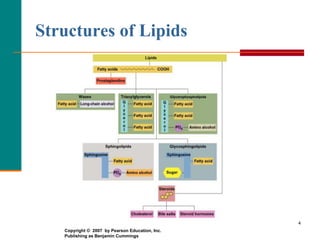
Types of Lipids
The types of lipids containing fatty acids are
 Waxes.
 Fats and oils (triacylglycerols).
 Glycerophospholipids.
 Prostaglandins.
 Not steroids, as they do not contain fatty acids.
4
Structures of Lipids
Copyright Š 2007 by Pearson Education, Inc.
Publishing as Benjamin Cummings
5
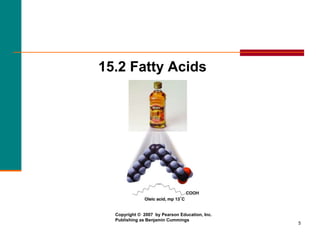
15.2 Fatty Acids
Copyright Š 2007 by Pearson Education, Inc.
Publishing as Benjamin Cummings
6
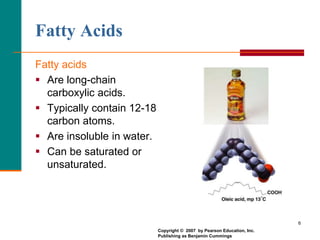
Fatty Acids
Fatty acids
 Are long-chain
carboxylic acids.
 Typically contain 12-18
carbon atoms.
 Are insoluble in water.
 Can be saturated or
unsaturated.
Copyright Š 2007 by Pearson Education, Inc.
Publishing as Benjamin Cummings
7
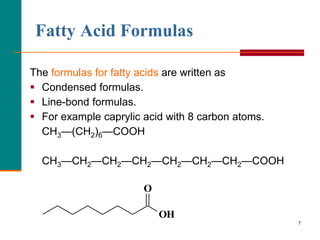
Fatty Acid Formulas
The formulas for fatty acids are written as
 Condensed formulas.
 Line-bond formulas.
 For example caprylic acid with 8 carbon atoms.
CH3—(CH2)6—COOH
CH3—CH2—CH2—CH2—CH2—CH2—CH2—COOH
OH
O
8
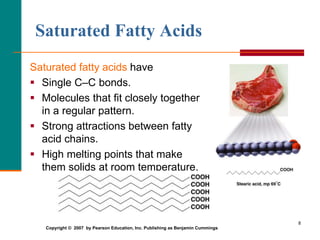
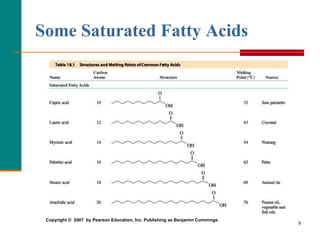
Saturated fatty acids have
 Single C–C bonds.
 Molecules that fit closely together
in a regular pattern.
 Strong attractions between fatty
acid chains.
 High melting points that make
them solids at room temperature.
Saturated Fatty Acids
Copyright Š 2007 by Pearson Education, Inc. Publishing as Benjamin Cummings
9
Some Saturated Fatty Acids
Copyright Š 2007 by Pearson Education, Inc. Publishing as Benjamin Cummings
10
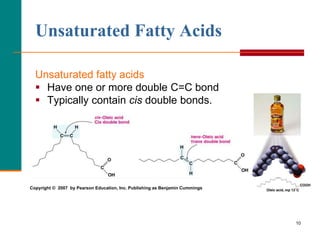
Unsaturated Fatty Acids
Unsaturated fatty acids
 Have one or more double C=C bond
 Typically contain cis double bonds.
Copyright Š 2007 by Pearson Education, Inc. Publishing as Benjamin Cummings
11
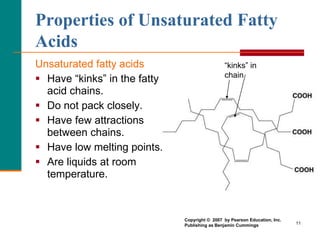
Properties of Unsaturated Fatty
Acids
Unsaturated fatty acids
 Have “kinks” in the fatty
acid chains.
 Do not pack closely.
 Have few attractions
between chains.
 Have low melting points.
 Are liquids at room
temperature.
“kinks” in
chain
Copyright Š 2007 by Pearson Education, Inc.
Publishing as Benjamin Cummings
12
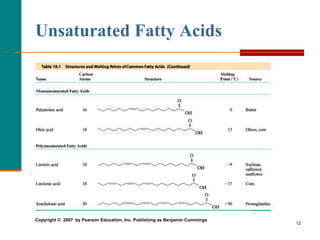
Unsaturated Fatty Acids
Copyright Š 2007 by Pearson Education, Inc. Publishing as Benjamin Cummings
13
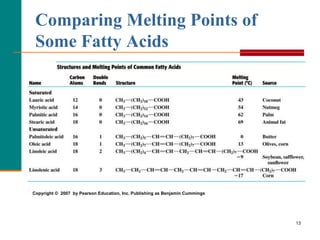
Comparing Melting Points of
Some Fatty Acids
Copyright Š 2007 by Pearson Education, Inc. Publishing as Benjamin Cummings
14
Learning Check
Assign the melting points of –17°C, 13°C, and 69°C
to the correct fatty acid. Explain.
stearic acid (18 C) saturated
oleic acid (18 C) one double bond
linoleic acid (18 C) two double bonds
15
Solution
Stearic acid is saturated and would have a higher
melting point than the unsaturated fatty acids.
Because linoleic has two double bonds, it would have
a lower mp than oleic acid, which has one double
bond.
stearic acid mp 69°C saturated
oleic acid mp 13°C
linoleic acid mp -17°C most unsaturated
16
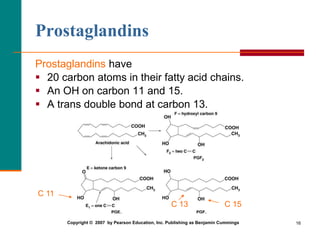
Prostaglandins
Prostaglandins have
 20 carbon atoms in their fatty acid chains.
 An OH on carbon 11 and 15.
 A trans double bond at carbon 13.
Copyright Š 2007 by Pearson Education, Inc. Publishing as Benjamin Cummings
C 11
C 15
C 13
17
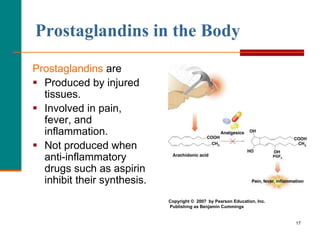
Prostaglandins in the Body
Prostaglandins are
 Produced by injured
tissues.
 Involved in pain,
fever, and
inflammation.
 Not produced when
anti-inflammatory
drugs such as aspirin
inhibit their synthesis.
Copyright Š 2007 by Pearson Education, Inc.
Publishing as Benjamin Cummings
18
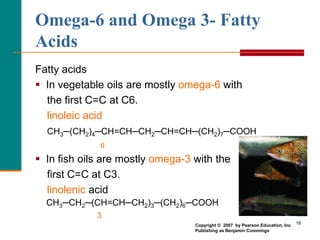
Omega-6 and Omega 3- Fatty
Acids
Fatty acids
 In vegetable oils are mostly omega-6 with
the first C=C at C6.
linoleic acid
CH3─(CH2)4─CH=CH─CH2─CH=CH─(CH2)7─COOH
6
 In fish oils are mostly omega-3 with the
first C=C at C3.
linolenic acid
CH3─CH2─(CH=CH─CH2)3─(CH2)6─COOH
3
Copyright Š 2007 by Pearson Education, Inc.
Publishing as Benjamin Cummings
19
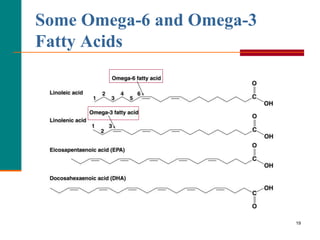
Some Omega-6 and Omega-3
Fatty Acids
20
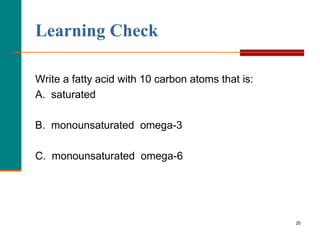
Learning Check
Write a fatty acid with 10 carbon atoms that is:
A. saturated
B. monounsaturated omega-3
C. monounsaturated omega-6
21
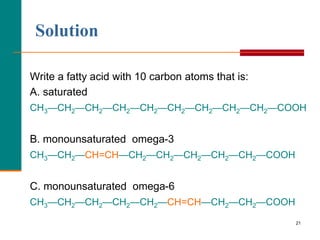
Solution
Write a fatty acid with 10 carbon atoms that is:
A. saturated
CH3—CH2—CH2—CH2—CH2—CH2—CH2—CH2—CH2—COOH
B. monounsaturated omega-3
CH3—CH2—CH=CH—CH2—CH2—CH2—CH2—CH2—COOH
C. monounsaturated omega-6
CH3—CH2—CH2—CH2—CH2—CH=CH—CH2—CH2—COOH
22
Waxes, Fats, and Oils
Copyright Š 2007 by Pearson Education, Inc.
Publishing as Benjamin Cummings
23
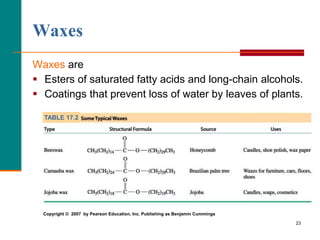
Waxes
Waxes are
 Esters of saturated fatty acids and long-chain alcohols.
 Coatings that prevent loss of water by leaves of plants.
TABLE 17.2
Copyright Š 2007 by Pearson Education, Inc. Publishing as Benjamin Cummings
24
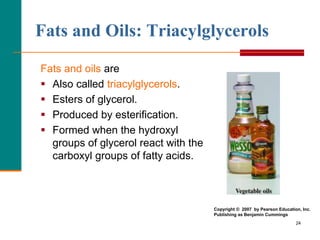
Fats and Oils: Triacylglycerols
Fats and oils are
 Also called triacylglycerols.
 Esters of glycerol.
 Produced by esterification.
 Formed when the hydroxyl
groups of glycerol react with the
carboxyl groups of fatty acids.
Copyright Š 2007 by Pearson Education, Inc.
Publishing as Benjamin Cummings
25
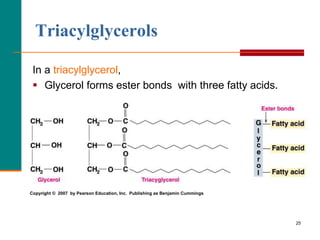
In a triacylglycerol,
 Glycerol forms ester bonds with three fatty acids.
Triacylglycerols
Copyright Š 2007 by Pearson Education, Inc. Publishing as Benjamin Cummings
26
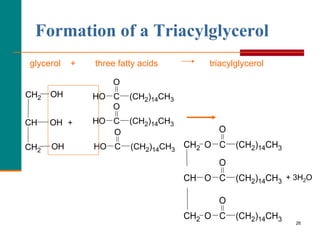
Formation of a Triacylglycerol
glycerol + three fatty acids triacylglycerol
OH
CH2
OH
OH
CH2
CH
O
(CH2)14CH3
C
HO
O
(CH2)14CH3
C
HO
O
(CH2)14CH3
C
HO
+ 3H2O
O
O
C (CH2)14CH3
CH O
O
C (CH2)14CH3
CH2 O
O
C (CH2)14CH3
CH2
+
27
Olive Oil
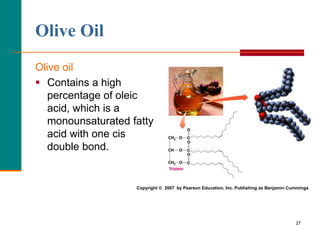
Olive oil
 Contains a high
percentage of oleic
acid, which is a
monounsaturated fatty
acid with one cis
double bond.
Copyright Š 2007 by Pearson Education, Inc. Publishing as Benjamin Cummings
28
Learning Check
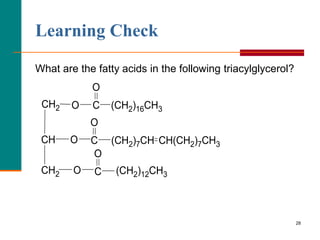
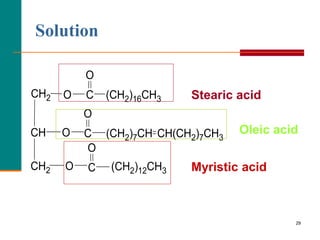
What are the fatty acids in the following triacylglycerol?
(CH2)12CH3
O
C
CH(CH2)7CH3
(CH2)7CH
O
C
O
(CH2)16CH3
C
O
O
O
CH2
CH2
CH
29
Solution
Stearic acid
Oleic acid
Myristic acid
(CH2)12CH3
O
C
CH(CH2)7CH3
(CH2)7CH
O
C
O
(CH2)16CH3
C
O
O
O
CH2
CH2
CH
30
Melting Points of Fats and Oils
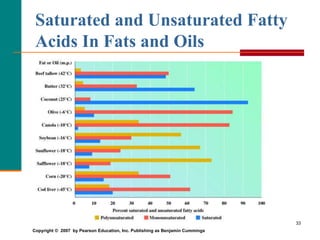
A triacylglycerol that is a fat
 Is solid at room temperature.
 Is prevalent in meats, whole milk, butter, and cheese.
A triacylglycerol that is an oil
 Is liquid at room temperature.
 Is prevalent in plants such as olive and safflower.
31
Oils with Unsaturated Fatty Acids
Oils
 Have more unsaturated fats.
 Have cis double bonds that cause “kinks” in the
fatty acid chains.
 Cannot pack triacylglycerol molecules as close
together as in fats.
 Have lower melting points than saturated fats.
 Are liquids at room temperature.
32
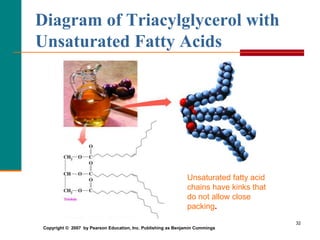
Diagram of Triacylglycerol with
Unsaturated Fatty Acids
Unsaturated fatty acid
chains have kinks that
do not allow close
packing.
Copyright Š 2007 by Pearson Education, Inc. Publishing as Benjamin Cummings
33
Saturated and Unsaturated Fatty
Acids In Fats and Oils
Copyright Š 2007 by Pearson Education, Inc. Publishing as Benjamin Cummings
34
Chemical Properties of
Triacylglycerols
Copyright Š 2007 by Pearson Education, Inc.
Publishing as Benjamin Cummings
35
The chemical reactions of triacylglycerols are similar
to those of alkenes and esters.
 In hydrogenation, double bonds in unsaturated
fatty acids react with H2 in the presence of a Ni or
Pt catalyst.
 In hydrolysis, ester bonds are split by water in the
presence of an acid, a base, or an enzyme.
Chemical Properties of
Triacylglycerols
36
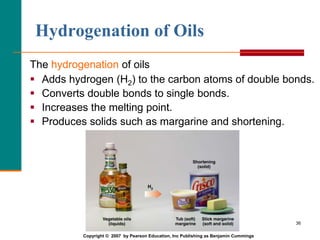
Hydrogenation of Oils
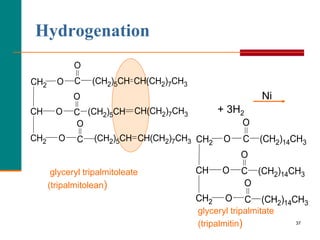
The hydrogenation of oils
 Adds hydrogen (H2) to the carbon atoms of double bonds.
 Converts double bonds to single bonds.
 Increases the melting point.
 Produces solids such as margarine and shortening.
Copyright Š 2007 by Pearson Education, Inc Publishing as Benjamin Cummings
37
Hydrogenation
Ni
+ 3H2
glyceryl tripalmitoleate
(tripalmitolean)
glyceryl tripalmitate
(tripalmitin)
O
(CH2)14CH3
C
O
(CH2)14CH3
C
O
(CH2)14CH3
C
O
O
O
CH2
CH2
CH
CH(CH2)7CH3
(CH2)5CH
O
C
CH(CH2)7CH3
(CH2)5CH
O
C
CH(CH2)7CH3
(CH2)5CH
O
C
O
O
O
CH2
CH2
CH
38
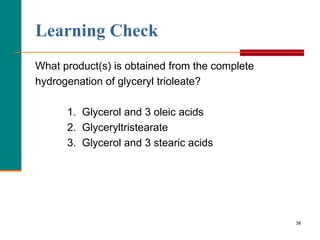
What product(s) is obtained from the complete
hydrogenation of glyceryl trioleate?
1. Glycerol and 3 oleic acids
2. Glyceryltristearate
3. Glycerol and 3 stearic acids
Learning Check
39
What product(s) is obtained from the complete
hydrogenation of glyceryl trioleate?
2. Glyceryltristearate
Solution
40
Olestra, A Fat Substitute
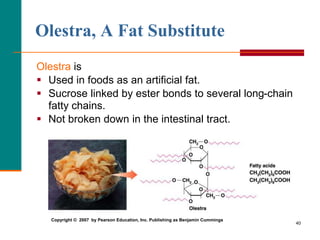
Olestra is
 Used in foods as an artificial fat.
 Sucrose linked by ester bonds to several long-chain
fatty chains.
 Not broken down in the intestinal tract.
Copyright Š 2007 by Pearson Education, Inc. Publishing as Benjamin Cummings
41
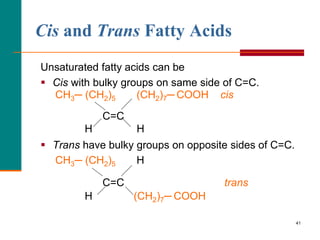
Cis and Trans Fatty Acids
Unsaturated fatty acids can be
 Cis with bulky groups on same side of C=C.
CH3─ (CH2)5 (CH2)7─ COOH cis
C=C
H H
 Trans have bulky groups on opposite sides of C=C.
CH3─ (CH2)5 H
C=C trans
H (CH2)7─ COOH
42
Trans Fatty Acids and
Hydrogenation
Trans fatty acids
 Are formed during hydrogenation when cis double
bonds are converted to trans double bonds.
 In the body behave like saturated fatty acids.
 Are estimated to make up 2-4% of our total
Calories.
 Are reported in several studies reported to raise
LDL-cholesterol and lower HDL-cholesterol.
43
Learning Check
(1) True or (2) False
A. There are more unsaturated fats in vegetable oils.
B. Vegetable oils have higher melting points than fats.
C. Hydrogenation of oils converts some cis-double
bonds to trans- double bonds.
D. Animal fats have more saturated fats.
44
Solution
(1) True or (2) False
A. T There are more unsaturated fats in vegetable oils.
B. F Vegetable oils have higher melting points than fats.
C. T Hydrogenation of oils converts some cis-double
bonds to trans- double bonds.
D. T Animal fats have more saturated fats.
45
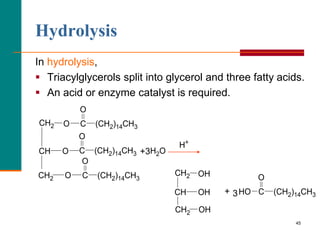
Hydrolysis
In hydrolysis,
 Triacylglycerols split into glycerol and three fatty acids.
 An acid or enzyme catalyst is required.
O
CH2
O
CH
O
CH2
OH
CH2
OH
CH
OH
CH2 O
(CH2)14CH3
C
HO
H2O
O
(CH2)14CH3
C
O
(CH2)14CH3
C
O
(CH2)14CH3
C
H+
+3
+ 3
46
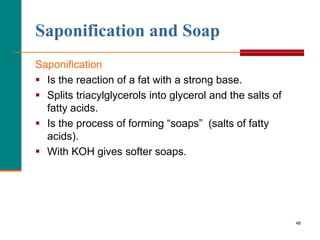
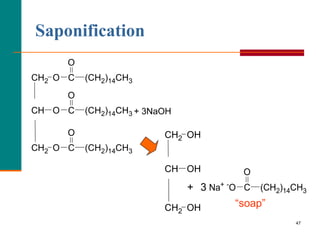
Saponification and Soap
Saponification
 Is the reaction of a fat with a strong base.
 Splits triacylglycerols into glycerol and the salts of
fatty acids.
 Is the process of forming “soaps” (salts of fatty
acids).
 With KOH gives softer soaps.
47
Saponification
O
O
C (CH2)14CH3
CH O
O
C (CH2)14CH3
CH2 O
O
C (CH2)14CH3
CH2
+ 3NaOH
Na+ -
O
O
C (CH2)14CH3
3
OH
CH OH
CH2 OH
CH2
+
“soap”
48
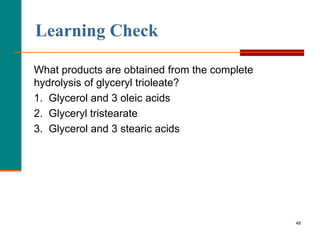
What products are obtained from the complete
hydrolysis of glyceryl trioleate?
1. Glycerol and 3 oleic acids
2. Glyceryl tristearate
3. Glycerol and 3 stearic acids
Learning Check
49
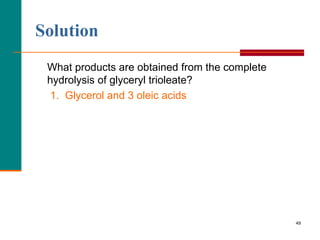
What products are obtained from the complete
hydrolysis of glyceryl trioleate?
1. Glycerol and 3 oleic acids
Solution
50
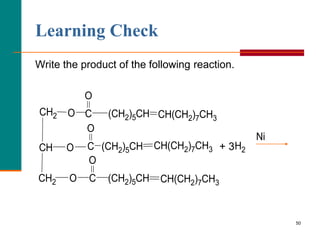
Learning Check
Write the product of the following reaction.
O
CH2
O
O
CH2
CH
CH(CH2)7CH3
(CH2)5CH
O
C
O
CH(CH2)7CH3
(CH2)5CH
C
O
C CH(CH2)7CH3
(CH2)5CH
H2
Ni
+ 3
51
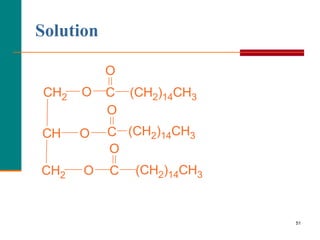
Solution
O
O
CH2
CH
O
CH2
(CH2)14CH3
O
C
O
(CH2)14CH3
C
(CH2)14CH3
O
C
52
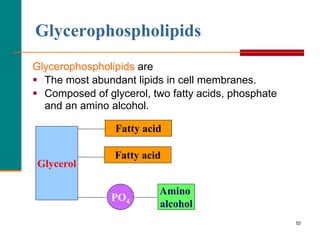
Glycerophospholipids are
 The most abundant lipids in cell membranes.
 Composed of glycerol, two fatty acids, phosphate
and an amino alcohol.
Glycerol
PO4
Amino
alcohol
Glycerophospholipids
Fatty acid
Fatty acid
53
Glycerophospholipids Are Polar
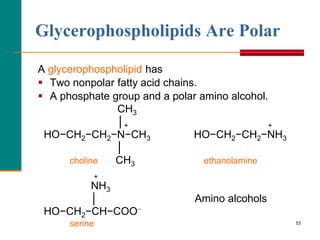
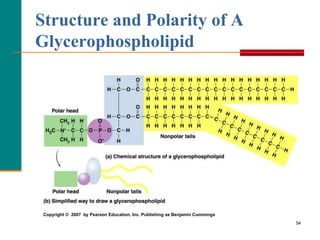
A glycerophospholipid has
 Two nonpolar fatty acid chains.
 A phosphate group and a polar amino alcohol.
CH3
│+ +
HO−CH2−CH2−N−CH3 HO−CH2−CH2−NH3
│
choline CH3 ethanolamine
+
NH3
│ Amino alcohols
HO−CH2−CH−COO−
serine
54
Structure and Polarity of A
Glycerophospholipid
Copyright Š 2007 by Pearson Education, Inc. Publishing as Benjamin Cummings
55
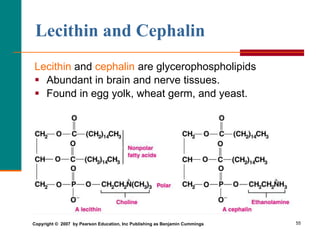
Lecithin and cephalin are glycerophospholipids
 Abundant in brain and nerve tissues.
 Found in egg yolk, wheat germ, and yeast.
Lecithin and Cephalin
Copyright Š 2007 by Pearson Education, Inc Publishing as Benjamin Cummings
56
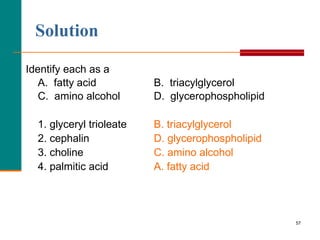
Learning Check
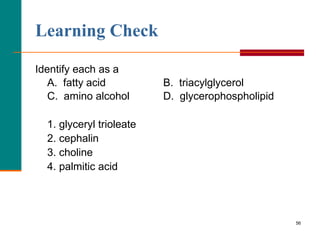
Identify each as a
A. fatty acid B. triacylglycerol
C. amino alcohol D. glycerophospholipid
1. glyceryl trioleate
2. cephalin
3. choline
4. palmitic acid
57
Solution
Identify each as a
A. fatty acid B. triacylglycerol
C. amino alcohol D. glycerophospholipid
1. glyceryl trioleate B. triacylglycerol
2. cephalin D. glycerophospholipid
3. choline C. amino alcohol
4. palmitic acid A. fatty acid
58
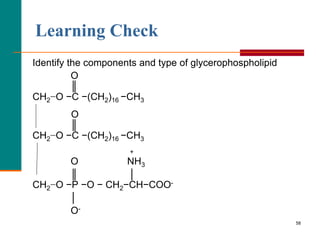
Learning Check
Identify the components and type of glycerophospholipid
O
║
CH2−O −C −(CH2)16 −CH3
O
║
CH2−O −C −(CH2)16 −CH3
+
O NH3
║ │
CH2−O −P −O − CH2−CH−COO-
│
O-
59
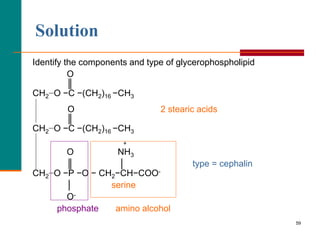
Solution
Identify the components and type of glycerophospholipid
O
║
CH2−O −C −(CH2)16 −CH3
O 2 stearic acids
║
CH2−O −C −(CH2)16 −CH3
+
O NH3
║ │ type = cephalin
CH2−O −P −O − CH2−CH−COO-
│ serine
O-
phosphate amino alcohol
60
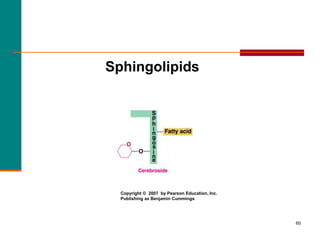
Sphingolipids
Copyright Š 2007 by Pearson Education, Inc.
Publishing as Benjamin Cummings
61
Sphingolipids
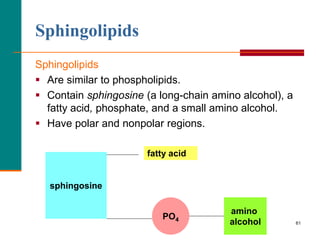
Sphingolipids
 Are similar to phospholipids.
 Contain sphingosine (a long-chain amino alcohol), a
fatty acid, phosphate, and a small amino alcohol.
 Have polar and nonpolar regions.
sphingosine
PO4
amino
alcohol
fatty acid
62
Sphingosine
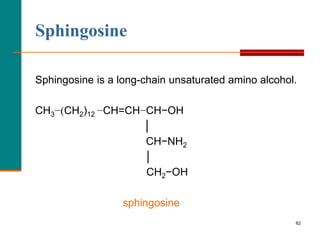
Sphingosine is a long-chain unsaturated amino alcohol.
CH3−(CH2)12 −CH=CH−CH−OH
│
CH−NH2
│
CH2−OH
sphingosine
63
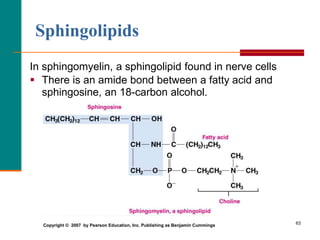
In sphingomyelin, a sphingolipid found in nerve cells
 There is an amide bond between a fatty acid and
sphingosine, an 18-carbon alcohol.
Sphingolipids
Copyright Š 2007 by Pearson Education, Inc. Publishing as Benjamin Cummings
64
Glycosphingolipids
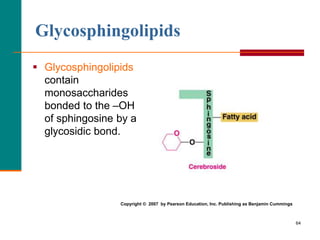
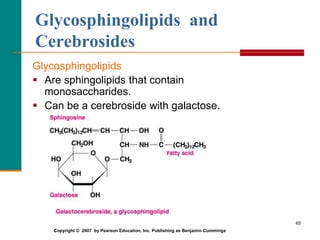
 Glycosphingolipids
contain
monosaccharides
bonded to the –OH
of sphingosine by a
glycosidic bond.
Copyright Š 2007 by Pearson Education, Inc. Publishing as Benjamin Cummings
65
Glycosphingolipids and
Cerebrosides
Glycosphingolipids
 Are sphingolipids that contain
monosaccharides.
 Can be a cerebroside with galactose.
Copyright Š 2007 by Pearson Education, Inc. Publishing as Benjamin Cummings
66
Gangliosides
Gangliosides
 Are similar to cerebrosides, but contain two or
more monosaccharides.
 Are important in neurons.
 Act as receptor for hormones and viruses.
 Can accumulate and cause genetic diseases.
67
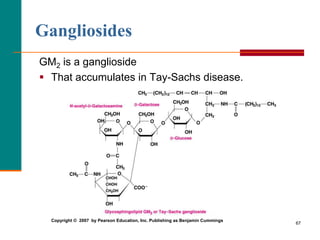
Gangliosides
GM2 is a ganglioside
 That accumulates in Tay-Sachs disease.
Copyright Š 2007 by Pearson Education, Inc. Publishing as Benjamin Cummings
68
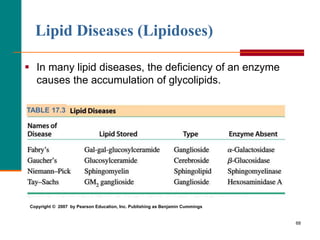
Lipid Diseases (Lipidoses)
 In many lipid diseases, the deficiency of an enzyme
causes the accumulation of glycolipids.
Copyright Š 2007 by Pearson Education, Inc. Publishing as Benjamin Cummings
TABLE 17.3
69
Learning Check
Identify each as a
1) Fatty acid 2) Triacylglycerol
3) Amino alcohol 4) Glycerophospholipid
5) Glycosphingolipid
A. Glyceryl trioleate
B. Cephalin
C. Choline
D. Galactocerebroside
E. Palmitic acid
70
Solution
A. Glyceryl trioleate 2) Triacylglycerol
B. Cephalin 4) Glycerophospholipid
C. Choline 3) Amino alcohol
D. Galactocerebroside 5) Glycosphingolipid
E. Palmitic acid 1) Fatty acid
71
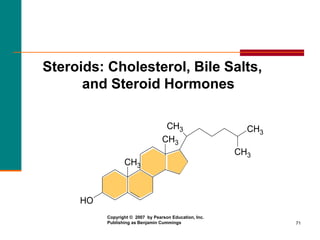
Steroids: Cholesterol, Bile Salts,
and Steroid Hormones
CH3
CH3
CH3
CH3
HO
CH3
Copyright Š 2007 by Pearson Education, Inc.
Publishing as Benjamin Cummings
72
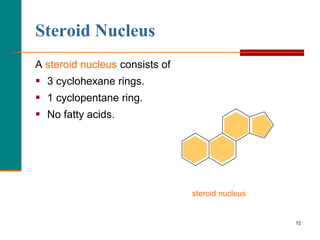
Steroid Nucleus
A steroid nucleus consists of
 3 cyclohexane rings.
 1 cyclopentane ring.
 No fatty acids.
steroid nucleus
73
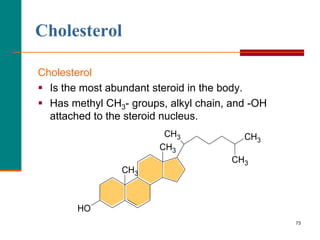
Cholesterol
Cholesterol
 Is the most abundant steroid in the body.
 Has methyl CH3- groups, alkyl chain, and -OH
attached to the steroid nucleus.
CH3
CH3
CH3
CH3
HO
CH3
74
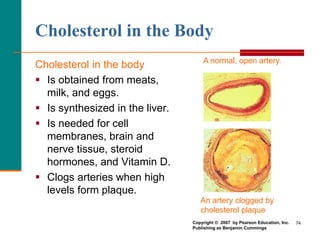
Cholesterol in the Body
Cholesterol in the body
 Is obtained from meats,
milk, and eggs.
 Is synthesized in the liver.
 Is needed for cell
membranes, brain and
nerve tissue, steroid
hormones, and Vitamin D.
 Clogs arteries when high
levels form plaque.
A normal, open artery.
Copyright Š 2007 by Pearson Education, Inc.
Publishing as Benjamin Cummings
An artery clogged by
cholesterol plaque
75
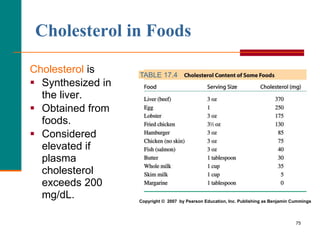
Cholesterol in Foods
Cholesterol is
 Synthesized in
the liver.
 Obtained from
foods.
 Considered
elevated if
plasma
cholesterol
exceeds 200
mg/dL.
TABLE 17.4
Copyright Š 2007 by Pearson Education, Inc. Publishing as Benjamin Cummings
76
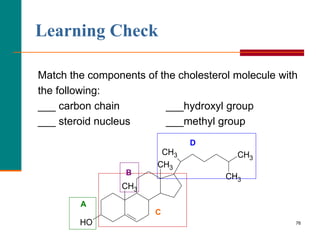
Learning Check
Match the components of the cholesterol molecule with
the following:
___ carbon chain ___hydroxyl group
___ steroid nucleus ___methyl group
CH3
CH3
CH3
CH3
HO
CH3
A
C
B
D
77
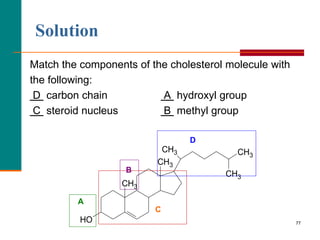
Solution
Match the components of the cholesterol molecule with
the following:
D carbon chain A hydroxyl group
C steroid nucleus B methyl group
CH3
CH3
CH3
CH3
HO
CH3
A
C
B
D
78
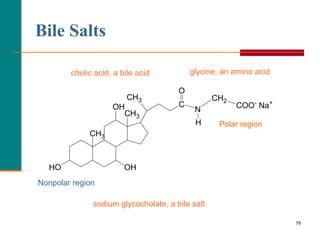
Bile Salts
Bile salts
 Are synthesized in the liver from cholesterol.
 Are stored in the gallbladder.
 Are secreted into the small intestine.
 Have a polar and a nonpolar region
 Mix with fats to break them part.
 Emulsify fat particles to provide large surface area.
79
Bile Salts
OH
COO-
Na+
CH2
H
N
O
C
OH
CH3
CH3
HO
CH3
glycine, an amino acid
cholic acid, a bile acid
sodium glycocholate, a bile salt
Nonpolar region
Polar region
80
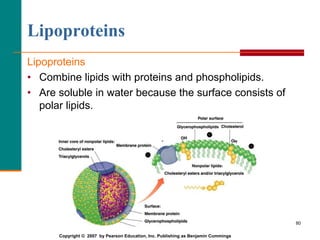
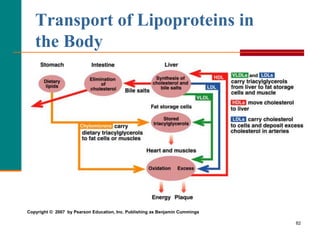
Lipoproteins
Lipoproteins
• Combine lipids with proteins and phospholipids.
• Are soluble in water because the surface consists of
polar lipids.
Copyright Š 2007 by Pearson Education, Inc. Publishing as Benjamin Cummings
81
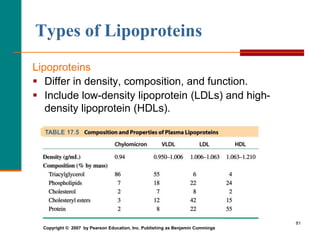
Types of Lipoproteins
Lipoproteins
 Differ in density, composition, and function.
 Include low-density lipoprotein (LDLs) and high-
density lipoprotein (HDLs).
TABLE 17.5
Copyright Š 2007 by Pearson Education, Inc. Publishing as Benjamin Cummings
82
Transport of Lipoproteins in
the Body
Copyright Š 2007 by Pearson Education, Inc. Publishing as Benjamin Cummings
83
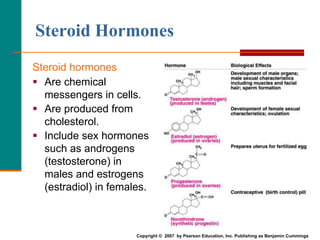
Steroid Hormones
Steroid hormones
 Are chemical
messengers in cells.
 Are produced from
cholesterol.
 Include sex hormones
such as androgens
(testosterone) in
males and estrogens
(estradiol) in females.
Copyright Š 2007 by Pearson Education, Inc. Publishing as Benjamin Cummings
84
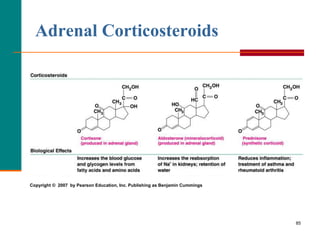
Adrenal Corticosteroids
Adrenal corticosteroids are steroid hormones that
 Are produced by the adrenal glands located on
the top of each kidney.
 Include aldosterone, which regulates electrolytes
and water balance by the kidneys.
 Include cortisone, a glucocorticoid, which
increases blood glucose level and stimulates the
synthesis of glycogen in the liver.
85
Adrenal Corticosteroids
Copyright Š 2007 by Pearson Education, Inc. Publishing as Benjamin Cummings
86
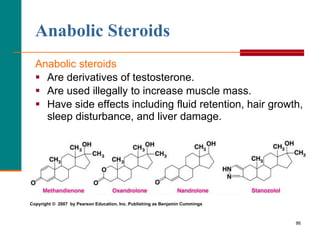
Anabolic Steroids
Anabolic steroids
 Are derivatives of testosterone.
 Are used illegally to increase muscle mass.
 Have side effects including fluid retention, hair growth,
sleep disturbance, and liver damage.
Copyright Š 2007 by Pearson Education, Inc. Publishing as Benjamin Cummings
87
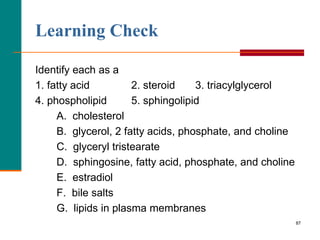
Learning Check
Identify each as a
1. fatty acid 2. steroid 3. triacylglycerol
4. phospholipid 5. sphingolipid
A. cholesterol
B. glycerol, 2 fatty acids, phosphate, and choline
C. glyceryl tristearate
D. sphingosine, fatty acid, phosphate, and choline
E. estradiol
F. bile salts
G. lipids in plasma membranes
88
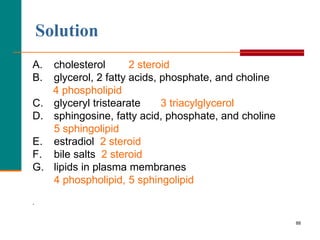
Solution
A. cholesterol 2 steroid
B. glycerol, 2 fatty acids, phosphate, and choline
4 phospholipid
C. glyceryl tristearate 3 triacylglycerol
D. sphingosine, fatty acid, phosphate, and choline
5 sphingolipid
E. estradiol 2 steroid
F. bile salts 2 steroid
G. lipids in plasma membranes
4 phospholipid, 5 sphingolipid
.
89
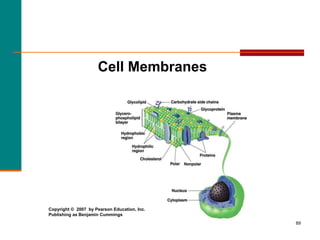
Cell Membranes
Copyright Š 2007 by Pearson Education, Inc.
Publishing as Benjamin Cummings
90
Cell Membranes
Cell membranes
 Separate cellular contents from the external
environment.
 Consist of a lipid bilayer made of two rows of
phospholipids.
 Have an inner portion made of the nonpolar tails of
phospholipids with the polar heads at the outer
and inner surfaces.
91
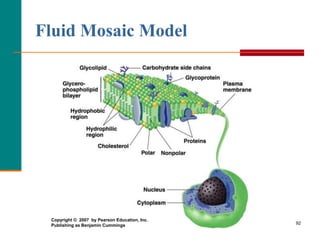
Fluid Mosaic Model of Cell
Membranes
The lipid bilayer
 Contains proteins, carbohydrates, and
cholesterol.
 Has unsaturated fatty acids that make cell
membranes fluid-like rather than rigid.
 Has proteins and carbohydrates on the surface
that communicate with hormones and
neurotransmitters.
92
Fluid Mosaic Model
Copyright Š 2007 by Pearson Education, Inc.
Publishing as Benjamin Cummings
93
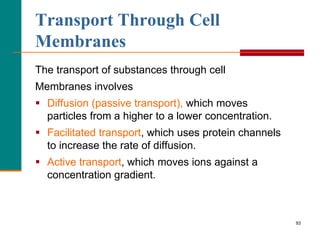
Transport Through Cell
Membranes
The transport of substances through cell
Membranes involves
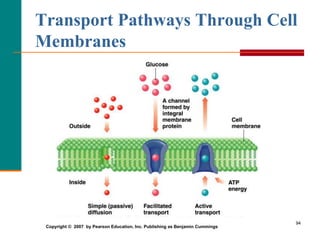
 Diffusion (passive transport), which moves
particles from a higher to a lower concentration.
 Facilitated transport, which uses protein channels
to increase the rate of diffusion.
 Active transport, which moves ions against a
concentration gradient.
94
Transport Pathways Through Cell
Membranes
Copyright Š 2007 by Pearson Education, Inc. Publishing as Benjamin Cummings
95
Learning Check
The transport of particles across a cell membrane from
high concentration to low concentration is called
1. Facilitated transport
2. Diffusion
3. Active transport
96
Solution
The transport of particles across a cell membrane from
high concentration to low concentration is called
2. Diffusion

2-12-2012.ppt

  • 1.
    1 Lipids Lipids Copyright Š 2007by Pearson Education, Inc. Publishing as Benjamin Cummings
  • 2.
    2 Lipids Lipids are  Biomoleculesthat contain fatty acids or a steroid nucleus.  Soluble in organic solvents but not in water.  Named for the Greek word lipos, which means “fat.”  Extracted from cells using organic solvents.
  • 3.
    3 Types of Lipids Thetypes of lipids containing fatty acids are  Waxes.  Fats and oils (triacylglycerols).  Glycerophospholipids.  Prostaglandins.  Not steroids, as they do not contain fatty acids.
  • 4.
    4 Structures of Lipids CopyrightŠ 2007 by Pearson Education, Inc. Publishing as Benjamin Cummings
  • 5.
    5 15.2 Fatty Acids CopyrightŠ 2007 by Pearson Education, Inc. Publishing as Benjamin Cummings
  • 6.
    6 Fatty Acids Fatty acids Are long-chain carboxylic acids.  Typically contain 12-18 carbon atoms.  Are insoluble in water.  Can be saturated or unsaturated. Copyright © 2007 by Pearson Education, Inc. Publishing as Benjamin Cummings
  • 7.
    7 Fatty Acid Formulas Theformulas for fatty acids are written as  Condensed formulas.  Line-bond formulas.  For example caprylic acid with 8 carbon atoms. CH3—(CH2)6—COOH CH3—CH2—CH2—CH2—CH2—CH2—CH2—COOH OH O
  • 8.
    8 Saturated fatty acidshave  Single C–C bonds.  Molecules that fit closely together in a regular pattern.  Strong attractions between fatty acid chains.  High melting points that make them solids at room temperature. Saturated Fatty Acids Copyright © 2007 by Pearson Education, Inc. Publishing as Benjamin Cummings
  • 9.
    9 Some Saturated FattyAcids Copyright Š 2007 by Pearson Education, Inc. Publishing as Benjamin Cummings
  • 10.
    10 Unsaturated Fatty Acids Unsaturatedfatty acids  Have one or more double C=C bond  Typically contain cis double bonds. Copyright © 2007 by Pearson Education, Inc. Publishing as Benjamin Cummings
  • 11.
    11 Properties of UnsaturatedFatty Acids Unsaturated fatty acids  Have “kinks” in the fatty acid chains.  Do not pack closely.  Have few attractions between chains.  Have low melting points.  Are liquids at room temperature. “kinks” in chain Copyright © 2007 by Pearson Education, Inc. Publishing as Benjamin Cummings
  • 12.
    12 Unsaturated Fatty Acids CopyrightŠ 2007 by Pearson Education, Inc. Publishing as Benjamin Cummings
  • 13.
    13 Comparing Melting Pointsof Some Fatty Acids Copyright Š 2007 by Pearson Education, Inc. Publishing as Benjamin Cummings
  • 14.
    14 Learning Check Assign themelting points of –17°C, 13°C, and 69°C to the correct fatty acid. Explain. stearic acid (18 C) saturated oleic acid (18 C) one double bond linoleic acid (18 C) two double bonds
  • 15.
    15 Solution Stearic acid issaturated and would have a higher melting point than the unsaturated fatty acids. Because linoleic has two double bonds, it would have a lower mp than oleic acid, which has one double bond. stearic acid mp 69°C saturated oleic acid mp 13°C linoleic acid mp -17°C most unsaturated
  • 16.
    16 Prostaglandins Prostaglandins have  20carbon atoms in their fatty acid chains.  An OH on carbon 11 and 15.  A trans double bond at carbon 13. Copyright © 2007 by Pearson Education, Inc. Publishing as Benjamin Cummings C 11 C 15 C 13
  • 17.
    17 Prostaglandins in theBody Prostaglandins are  Produced by injured tissues.  Involved in pain, fever, and inflammation.  Not produced when anti-inflammatory drugs such as aspirin inhibit their synthesis. Copyright © 2007 by Pearson Education, Inc. Publishing as Benjamin Cummings
  • 18.
    18 Omega-6 and Omega3- Fatty Acids Fatty acids  In vegetable oils are mostly omega-6 with the first C=C at C6. linoleic acid CH3─(CH2)4─CH=CH─CH2─CH=CH─(CH2)7─COOH 6  In fish oils are mostly omega-3 with the first C=C at C3. linolenic acid CH3─CH2─(CH=CH─CH2)3─(CH2)6─COOH 3 Copyright © 2007 by Pearson Education, Inc. Publishing as Benjamin Cummings
  • 19.
    19 Some Omega-6 andOmega-3 Fatty Acids
  • 20.
    20 Learning Check Write afatty acid with 10 carbon atoms that is: A. saturated B. monounsaturated omega-3 C. monounsaturated omega-6
  • 21.
    21 Solution Write a fattyacid with 10 carbon atoms that is: A. saturated CH3—CH2—CH2—CH2—CH2—CH2—CH2—CH2—CH2—COOH B. monounsaturated omega-3 CH3—CH2—CH=CH—CH2—CH2—CH2—CH2—CH2—COOH C. monounsaturated omega-6 CH3—CH2—CH2—CH2—CH2—CH=CH—CH2—CH2—COOH
  • 22.
    22 Waxes, Fats, andOils Copyright Š 2007 by Pearson Education, Inc. Publishing as Benjamin Cummings
  • 23.
    23 Waxes Waxes are  Estersof saturated fatty acids and long-chain alcohols.  Coatings that prevent loss of water by leaves of plants. TABLE 17.2 Copyright © 2007 by Pearson Education, Inc. Publishing as Benjamin Cummings
  • 24.
    24 Fats and Oils:Triacylglycerols Fats and oils are  Also called triacylglycerols.  Esters of glycerol.  Produced by esterification.  Formed when the hydroxyl groups of glycerol react with the carboxyl groups of fatty acids. Copyright © 2007 by Pearson Education, Inc. Publishing as Benjamin Cummings
  • 25.
    25 In a triacylglycerol, Glycerol forms ester bonds with three fatty acids. Triacylglycerols Copyright © 2007 by Pearson Education, Inc. Publishing as Benjamin Cummings
  • 26.
    26 Formation of aTriacylglycerol glycerol + three fatty acids triacylglycerol OH CH2 OH OH CH2 CH O (CH2)14CH3 C HO O (CH2)14CH3 C HO O (CH2)14CH3 C HO + 3H2O O O C (CH2)14CH3 CH O O C (CH2)14CH3 CH2 O O C (CH2)14CH3 CH2 +
  • 27.
    27 Olive Oil Olive oil Contains a high percentage of oleic acid, which is a monounsaturated fatty acid with one cis double bond. Copyright © 2007 by Pearson Education, Inc. Publishing as Benjamin Cummings
  • 28.
    28 Learning Check What arethe fatty acids in the following triacylglycerol? (CH2)12CH3 O C CH(CH2)7CH3 (CH2)7CH O C O (CH2)16CH3 C O O O CH2 CH2 CH
  • 29.
    29 Solution Stearic acid Oleic acid Myristicacid (CH2)12CH3 O C CH(CH2)7CH3 (CH2)7CH O C O (CH2)16CH3 C O O O CH2 CH2 CH
  • 30.
    30 Melting Points ofFats and Oils A triacylglycerol that is a fat  Is solid at room temperature.  Is prevalent in meats, whole milk, butter, and cheese. A triacylglycerol that is an oil  Is liquid at room temperature.  Is prevalent in plants such as olive and safflower.
  • 31.
    31 Oils with UnsaturatedFatty Acids Oils  Have more unsaturated fats.  Have cis double bonds that cause “kinks” in the fatty acid chains.  Cannot pack triacylglycerol molecules as close together as in fats.  Have lower melting points than saturated fats.  Are liquids at room temperature.
  • 32.
    32 Diagram of Triacylglycerolwith Unsaturated Fatty Acids Unsaturated fatty acid chains have kinks that do not allow close packing. Copyright Š 2007 by Pearson Education, Inc. Publishing as Benjamin Cummings
  • 33.
    33 Saturated and UnsaturatedFatty Acids In Fats and Oils Copyright Š 2007 by Pearson Education, Inc. Publishing as Benjamin Cummings
  • 34.
    34 Chemical Properties of Triacylglycerols CopyrightŠ 2007 by Pearson Education, Inc. Publishing as Benjamin Cummings
  • 35.
    35 The chemical reactionsof triacylglycerols are similar to those of alkenes and esters.  In hydrogenation, double bonds in unsaturated fatty acids react with H2 in the presence of a Ni or Pt catalyst.  In hydrolysis, ester bonds are split by water in the presence of an acid, a base, or an enzyme. Chemical Properties of Triacylglycerols
  • 36.
    36 Hydrogenation of Oils Thehydrogenation of oils  Adds hydrogen (H2) to the carbon atoms of double bonds.  Converts double bonds to single bonds.  Increases the melting point.  Produces solids such as margarine and shortening. Copyright © 2007 by Pearson Education, Inc Publishing as Benjamin Cummings
  • 37.
    37 Hydrogenation Ni + 3H2 glyceryl tripalmitoleate (tripalmitolean) glyceryltripalmitate (tripalmitin) O (CH2)14CH3 C O (CH2)14CH3 C O (CH2)14CH3 C O O O CH2 CH2 CH CH(CH2)7CH3 (CH2)5CH O C CH(CH2)7CH3 (CH2)5CH O C CH(CH2)7CH3 (CH2)5CH O C O O O CH2 CH2 CH
  • 38.
    38 What product(s) isobtained from the complete hydrogenation of glyceryl trioleate? 1. Glycerol and 3 oleic acids 2. Glyceryltristearate 3. Glycerol and 3 stearic acids Learning Check
  • 39.
    39 What product(s) isobtained from the complete hydrogenation of glyceryl trioleate? 2. Glyceryltristearate Solution
  • 40.
    40 Olestra, A FatSubstitute Olestra is  Used in foods as an artificial fat.  Sucrose linked by ester bonds to several long-chain fatty chains.  Not broken down in the intestinal tract. Copyright © 2007 by Pearson Education, Inc. Publishing as Benjamin Cummings
  • 41.
    41 Cis and TransFatty Acids Unsaturated fatty acids can be  Cis with bulky groups on same side of C=C. CH3─ (CH2)5 (CH2)7─ COOH cis C=C H H  Trans have bulky groups on opposite sides of C=C. CH3─ (CH2)5 H C=C trans H (CH2)7─ COOH
  • 42.
    42 Trans Fatty Acidsand Hydrogenation Trans fatty acids  Are formed during hydrogenation when cis double bonds are converted to trans double bonds.  In the body behave like saturated fatty acids.  Are estimated to make up 2-4% of our total Calories.  Are reported in several studies reported to raise LDL-cholesterol and lower HDL-cholesterol.
  • 43.
    43 Learning Check (1) Trueor (2) False A. There are more unsaturated fats in vegetable oils. B. Vegetable oils have higher melting points than fats. C. Hydrogenation of oils converts some cis-double bonds to trans- double bonds. D. Animal fats have more saturated fats.
  • 44.
    44 Solution (1) True or(2) False A. T There are more unsaturated fats in vegetable oils. B. F Vegetable oils have higher melting points than fats. C. T Hydrogenation of oils converts some cis-double bonds to trans- double bonds. D. T Animal fats have more saturated fats.
  • 45.
    45 Hydrolysis In hydrolysis,  Triacylglycerolssplit into glycerol and three fatty acids.  An acid or enzyme catalyst is required. O CH2 O CH O CH2 OH CH2 OH CH OH CH2 O (CH2)14CH3 C HO H2O O (CH2)14CH3 C O (CH2)14CH3 C O (CH2)14CH3 C H+ +3 + 3
  • 46.
    46 Saponification and Soap Saponification Is the reaction of a fat with a strong base.  Splits triacylglycerols into glycerol and the salts of fatty acids.  Is the process of forming “soaps” (salts of fatty acids).  With KOH gives softer soaps.
  • 47.
    47 Saponification O O C (CH2)14CH3 CH O O C(CH2)14CH3 CH2 O O C (CH2)14CH3 CH2 + 3NaOH Na+ - O O C (CH2)14CH3 3 OH CH OH CH2 OH CH2 + “soap”
  • 48.
    48 What products areobtained from the complete hydrolysis of glyceryl trioleate? 1. Glycerol and 3 oleic acids 2. Glyceryl tristearate 3. Glycerol and 3 stearic acids Learning Check
  • 49.
    49 What products areobtained from the complete hydrolysis of glyceryl trioleate? 1. Glycerol and 3 oleic acids Solution
  • 50.
    50 Learning Check Write theproduct of the following reaction. O CH2 O O CH2 CH CH(CH2)7CH3 (CH2)5CH O C O CH(CH2)7CH3 (CH2)5CH C O C CH(CH2)7CH3 (CH2)5CH H2 Ni + 3
  • 51.
  • 52.
    52 Glycerophospholipids are  Themost abundant lipids in cell membranes.  Composed of glycerol, two fatty acids, phosphate and an amino alcohol. Glycerol PO4 Amino alcohol Glycerophospholipids Fatty acid Fatty acid
  • 53.
    53 Glycerophospholipids Are Polar Aglycerophospholipid has  Two nonpolar fatty acid chains.  A phosphate group and a polar amino alcohol. CH3 │+ + HO−CH2−CH2−N−CH3 HO−CH2−CH2−NH3 │ choline CH3 ethanolamine + NH3 │ Amino alcohols HO−CH2−CH−COO− serine
  • 54.
    54 Structure and Polarityof A Glycerophospholipid Copyright Š 2007 by Pearson Education, Inc. Publishing as Benjamin Cummings
  • 55.
    55 Lecithin and cephalinare glycerophospholipids  Abundant in brain and nerve tissues.  Found in egg yolk, wheat germ, and yeast. Lecithin and Cephalin Copyright © 2007 by Pearson Education, Inc Publishing as Benjamin Cummings
  • 56.
    56 Learning Check Identify eachas a A. fatty acid B. triacylglycerol C. amino alcohol D. glycerophospholipid 1. glyceryl trioleate 2. cephalin 3. choline 4. palmitic acid
  • 57.
    57 Solution Identify each asa A. fatty acid B. triacylglycerol C. amino alcohol D. glycerophospholipid 1. glyceryl trioleate B. triacylglycerol 2. cephalin D. glycerophospholipid 3. choline C. amino alcohol 4. palmitic acid A. fatty acid
  • 58.
    58 Learning Check Identify thecomponents and type of glycerophospholipid O ║ CH2−O −C −(CH2)16 −CH3 O ║ CH2−O −C −(CH2)16 −CH3 + O NH3 ║ │ CH2−O −P −O − CH2−CH−COO- │ O-
  • 59.
    59 Solution Identify the componentsand type of glycerophospholipid O ║ CH2−O −C −(CH2)16 −CH3 O 2 stearic acids ║ CH2−O −C −(CH2)16 −CH3 + O NH3 ║ │ type = cephalin CH2−O −P −O − CH2−CH−COO- │ serine O- phosphate amino alcohol
  • 60.
    60 Sphingolipids Copyright Š 2007by Pearson Education, Inc. Publishing as Benjamin Cummings
  • 61.
    61 Sphingolipids Sphingolipids  Are similarto phospholipids.  Contain sphingosine (a long-chain amino alcohol), a fatty acid, phosphate, and a small amino alcohol.  Have polar and nonpolar regions. sphingosine PO4 amino alcohol fatty acid
  • 62.
    62 Sphingosine Sphingosine is along-chain unsaturated amino alcohol. CH3−(CH2)12 −CH=CH−CH−OH │ CH−NH2 │ CH2−OH sphingosine
  • 63.
    63 In sphingomyelin, asphingolipid found in nerve cells  There is an amide bond between a fatty acid and sphingosine, an 18-carbon alcohol. Sphingolipids Copyright © 2007 by Pearson Education, Inc. Publishing as Benjamin Cummings
  • 64.
    64 Glycosphingolipids  Glycosphingolipids contain monosaccharides bonded tothe –OH of sphingosine by a glycosidic bond. Copyright © 2007 by Pearson Education, Inc. Publishing as Benjamin Cummings
  • 65.
    65 Glycosphingolipids and Cerebrosides Glycosphingolipids  Aresphingolipids that contain monosaccharides.  Can be a cerebroside with galactose. Copyright © 2007 by Pearson Education, Inc. Publishing as Benjamin Cummings
  • 66.
    66 Gangliosides Gangliosides  Are similarto cerebrosides, but contain two or more monosaccharides.  Are important in neurons.  Act as receptor for hormones and viruses.  Can accumulate and cause genetic diseases.
  • 67.
    67 Gangliosides GM2 is aganglioside  That accumulates in Tay-Sachs disease. Copyright © 2007 by Pearson Education, Inc. Publishing as Benjamin Cummings
  • 68.
    68 Lipid Diseases (Lipidoses) In many lipid diseases, the deficiency of an enzyme causes the accumulation of glycolipids. Copyright © 2007 by Pearson Education, Inc. Publishing as Benjamin Cummings TABLE 17.3
  • 69.
    69 Learning Check Identify eachas a 1) Fatty acid 2) Triacylglycerol 3) Amino alcohol 4) Glycerophospholipid 5) Glycosphingolipid A. Glyceryl trioleate B. Cephalin C. Choline D. Galactocerebroside E. Palmitic acid
  • 70.
    70 Solution A. Glyceryl trioleate2) Triacylglycerol B. Cephalin 4) Glycerophospholipid C. Choline 3) Amino alcohol D. Galactocerebroside 5) Glycosphingolipid E. Palmitic acid 1) Fatty acid
  • 71.
    71 Steroids: Cholesterol, BileSalts, and Steroid Hormones CH3 CH3 CH3 CH3 HO CH3 Copyright Š 2007 by Pearson Education, Inc. Publishing as Benjamin Cummings
  • 72.
    72 Steroid Nucleus A steroidnucleus consists of  3 cyclohexane rings.  1 cyclopentane ring.  No fatty acids. steroid nucleus
  • 73.
    73 Cholesterol Cholesterol  Is themost abundant steroid in the body.  Has methyl CH3- groups, alkyl chain, and -OH attached to the steroid nucleus. CH3 CH3 CH3 CH3 HO CH3
  • 74.
    74 Cholesterol in theBody Cholesterol in the body  Is obtained from meats, milk, and eggs.  Is synthesized in the liver.  Is needed for cell membranes, brain and nerve tissue, steroid hormones, and Vitamin D.  Clogs arteries when high levels form plaque. A normal, open artery. Copyright © 2007 by Pearson Education, Inc. Publishing as Benjamin Cummings An artery clogged by cholesterol plaque
  • 75.
    75 Cholesterol in Foods Cholesterolis  Synthesized in the liver.  Obtained from foods.  Considered elevated if plasma cholesterol exceeds 200 mg/dL. TABLE 17.4 Copyright © 2007 by Pearson Education, Inc. Publishing as Benjamin Cummings
  • 76.
    76 Learning Check Match thecomponents of the cholesterol molecule with the following: ___ carbon chain ___hydroxyl group ___ steroid nucleus ___methyl group CH3 CH3 CH3 CH3 HO CH3 A C B D
  • 77.
    77 Solution Match the componentsof the cholesterol molecule with the following: D carbon chain A hydroxyl group C steroid nucleus B methyl group CH3 CH3 CH3 CH3 HO CH3 A C B D
  • 78.
    78 Bile Salts Bile salts Are synthesized in the liver from cholesterol.  Are stored in the gallbladder.  Are secreted into the small intestine.  Have a polar and a nonpolar region  Mix with fats to break them part.  Emulsify fat particles to provide large surface area.
  • 79.
    79 Bile Salts OH COO- Na+ CH2 H N O C OH CH3 CH3 HO CH3 glycine, anamino acid cholic acid, a bile acid sodium glycocholate, a bile salt Nonpolar region Polar region
  • 80.
    80 Lipoproteins Lipoproteins • Combine lipidswith proteins and phospholipids. • Are soluble in water because the surface consists of polar lipids. Copyright © 2007 by Pearson Education, Inc. Publishing as Benjamin Cummings
  • 81.
    81 Types of Lipoproteins Lipoproteins Differ in density, composition, and function.  Include low-density lipoprotein (LDLs) and high- density lipoprotein (HDLs). TABLE 17.5 Copyright © 2007 by Pearson Education, Inc. Publishing as Benjamin Cummings
  • 82.
    82 Transport of Lipoproteinsin the Body Copyright Š 2007 by Pearson Education, Inc. Publishing as Benjamin Cummings
  • 83.
    83 Steroid Hormones Steroid hormones Are chemical messengers in cells.  Are produced from cholesterol.  Include sex hormones such as androgens (testosterone) in males and estrogens (estradiol) in females. Copyright © 2007 by Pearson Education, Inc. Publishing as Benjamin Cummings
  • 84.
    84 Adrenal Corticosteroids Adrenal corticosteroidsare steroid hormones that  Are produced by the adrenal glands located on the top of each kidney.  Include aldosterone, which regulates electrolytes and water balance by the kidneys.  Include cortisone, a glucocorticoid, which increases blood glucose level and stimulates the synthesis of glycogen in the liver.
  • 85.
    85 Adrenal Corticosteroids Copyright Š2007 by Pearson Education, Inc. Publishing as Benjamin Cummings
  • 86.
    86 Anabolic Steroids Anabolic steroids Are derivatives of testosterone.  Are used illegally to increase muscle mass.  Have side effects including fluid retention, hair growth, sleep disturbance, and liver damage. Copyright © 2007 by Pearson Education, Inc. Publishing as Benjamin Cummings
  • 87.
    87 Learning Check Identify eachas a 1. fatty acid 2. steroid 3. triacylglycerol 4. phospholipid 5. sphingolipid A. cholesterol B. glycerol, 2 fatty acids, phosphate, and choline C. glyceryl tristearate D. sphingosine, fatty acid, phosphate, and choline E. estradiol F. bile salts G. lipids in plasma membranes
  • 88.
    88 Solution A. cholesterol 2steroid B. glycerol, 2 fatty acids, phosphate, and choline 4 phospholipid C. glyceryl tristearate 3 triacylglycerol D. sphingosine, fatty acid, phosphate, and choline 5 sphingolipid E. estradiol 2 steroid F. bile salts 2 steroid G. lipids in plasma membranes 4 phospholipid, 5 sphingolipid .
  • 89.
    89 Cell Membranes Copyright Š2007 by Pearson Education, Inc. Publishing as Benjamin Cummings
  • 90.
    90 Cell Membranes Cell membranes Separate cellular contents from the external environment.  Consist of a lipid bilayer made of two rows of phospholipids.  Have an inner portion made of the nonpolar tails of phospholipids with the polar heads at the outer and inner surfaces.
  • 91.
    91 Fluid Mosaic Modelof Cell Membranes The lipid bilayer  Contains proteins, carbohydrates, and cholesterol.  Has unsaturated fatty acids that make cell membranes fluid-like rather than rigid.  Has proteins and carbohydrates on the surface that communicate with hormones and neurotransmitters.
  • 92.
    92 Fluid Mosaic Model CopyrightŠ 2007 by Pearson Education, Inc. Publishing as Benjamin Cummings
  • 93.
    93 Transport Through Cell Membranes Thetransport of substances through cell Membranes involves  Diffusion (passive transport), which moves particles from a higher to a lower concentration.  Facilitated transport, which uses protein channels to increase the rate of diffusion.  Active transport, which moves ions against a concentration gradient.
  • 94.
    94 Transport Pathways ThroughCell Membranes Copyright Š 2007 by Pearson Education, Inc. Publishing as Benjamin Cummings
  • 95.
    95 Learning Check The transportof particles across a cell membrane from high concentration to low concentration is called 1. Facilitated transport 2. Diffusion 3. Active transport
  • 96.
    96 Solution The transport ofparticles across a cell membrane from high concentration to low concentration is called 2. Diffusion