
Amino Acids, Proteins, and 
1 
Enzymes 
Primary and Secondary Structure 
Tertiary and Quaternary Structure 
Protein Hydrolysis and Denaturation
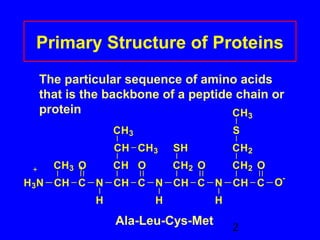
Primary Structure of Proteins 
The particular sequence of amino acids 
that is the backbone of a peptide chain or 
protein 
CH3 
S 
CH2 
2 
CH3 
H3N CH 
O 
C 
N 
H 
O 
CH3 
CH C 
N 
H 
O 
SH 
CH C 
N 
H 
O 
CH C O-CH 
CH CH3 
CH2 
CH2 
+ 
Ala-Leu-Cys-Met
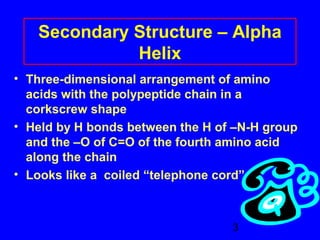
Secondary Structure – Alpha 
3 
Helix 
• Three-dimensional arrangement of amino 
acids with the polypeptide chain in a 
corkscrew shape 
• Held by H bonds between the H of –N-H group 
and the –O of C=O of the fourth amino acid 
along the chain 
• Looks like a coiled “telephone cord”
Secondary Structure – Beta 
4 
Pleated Sheet 
• Polypeptide chains are 
arranged side by side 
• Hydrogen bonds form 
between chains 
• R groups of extend above and 
below the sheet 
• Typical of fibrous proteins 
such as silk
Secondary Structure – Triple 
5 
Helix 
• Three polypeptide chains 
woven together 
• Glycine, proline, hydroxy 
proline and hydroxylysine 
• H bonding between –OH 
groups gives a strong 
structure 
• Typical of collagen, connective 
tissue, skin, tendons, and 
cartilage
Learning Check P1 
Indicate the type of structure as 
(1) primary (2) alpha helix 
(3) beta pleated sheet (4) triple helix 
A. Polypeptide chain held side by side by H bonds 
B. Sequence of amino acids in a polypeptide chain 
C. Corkscrew shape with H bonds between amino 
6 
acids 
D. Three peptide chains woven like a rope
7 
Solution P1 
Indicate the type of structure as 
(1) primary (2) alpha helix 
(3) beta pleated sheet (4) triple helix 
A. 3 Polypeptide chain held side by side by H bonds 
B. 1 Sequence of amino acids in a polypeptide chain 
C. 2 Corkscrew shape with H bonds between amino 
acids 
D. 4 Three peptide chains woven like a rope
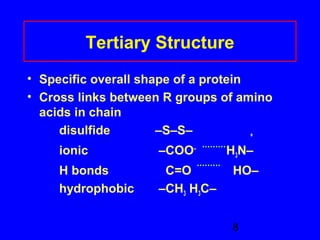
Tertiary Structure 
• Specific overall shape of a protein 
• Cross links between R groups of amino 
acids in chain 
disulfide –S–S– + 
ionic –COO– H3N– 
H bonds C=O HO– 
hydrophobic –CH3 H3C– 
8
Learning Check P2 
Select the type of tertiary interaction as 
(1) disulfide (2) ionic 
(3) H bonds (4) hydrophobic 
9 
A. Leucine and valine 
B. Two cysteines 
C. Aspartic acid and lysine 
D. Serine and threonine
10 
Solution P2 
Select the type of tertiary interaction as 
(1) disulfide (2) ionic 
(3) H bonds (4) hydrophobic 
A. 4 Leucine and valine 
B. 1 Two cysteines 
C. 2 Aspartic acid and lysine 
D. 3 Serine and threonine
Globular and Fibrous Proteins 
Globular proteins Fibrous proteins 
“spherical” shape long, thin fibers 
Insulin Hair 
Hemoglobin Wool 
Enzymes Skin 
Antibodies Nails 
11
Quaternary Structure 
• Proteins with two or more chains 
• Example is hemoglobin 
Carries oxygen in blood 
Four polypeptide chains 
Each chain has a heme group to 
12 
bind oxygen
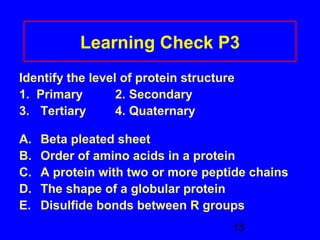
Learning Check P3 
Identify the level of protein structure 
1. Primary 2. Secondary 
3. Tertiary 4. Quaternary 
A. Beta pleated sheet 
B. Order of amino acids in a protein 
C. A protein with two or more peptide chains 
D. The shape of a globular protein 
E. Disulfide bonds between R groups 
13
14 
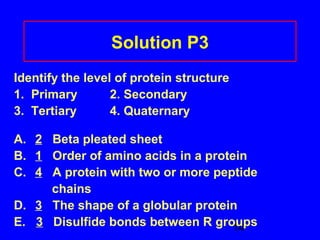
Solution P3 
Identify the level of protein structure 
1. Primary 2. Secondary 
3. Tertiary 4. Quaternary 
A. 2 Beta pleated sheet 
B. 1 Order of amino acids in a protein 
C. 4 A protein with two or more peptide 
chains 
D. 3 The shape of a globular protein 
E. 3 Disulfide bonds between R groups
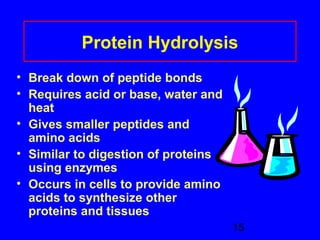
Protein Hydrolysis 
15 
• Break down of peptide bonds 
• Requires acid or base, water and 
heat 
• Gives smaller peptides and 
amino acids 
• Similar to digestion of proteins 
using enzymes 
• Occurs in cells to provide amino 
acids to synthesize other 
proteins and tissues
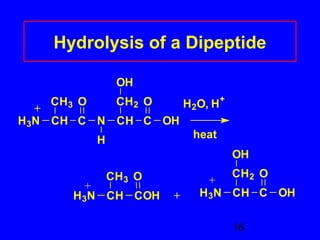
Hydrolysis of a Dipeptide 
OH 
CH2 O 
16 
CH3 
H3N CH 
O 
C 
N 
H 
OH 
CH2 O 
CH C 
OH 
+ 
CH3 
heat 
+ + 
H3N CH 
O 
COH 
H2O, H+ 
+ CH C 
H3N OH
17 
Denaturation 
Disruption of secondary, tertiary and quaternary protein 
structure by 
heat/organics 
Break apart H bonds and disrupt hydrophobic 
attractions 
acids/ bases 
Break H bonds between polar R groups and 
ionic bonds 
heavy metal ions 
React with S-S bonds to form solids 
agitation 
Stretches chains until bonds break
Applications of Denaturation 
• Hard boiling an egg 
• Wiping the skin with alcohol swab for 
injection 
• Cooking food to destroy E. coli. 
• Heat used to cauterize blood vessels 
• Autoclave sterilizes instruments 
• Milk is heated to make yogurt 
18
Learning Check P4 
What are the products of the complete 
hydrolysis of Ala-Ser-Val? 
19
20 
Solution P4 
The products of the complete hydrolysis 
of Ala-Ser-Val are 
alanine 
serine 
valine
Learning Check P5 
Tannic acid is used to form a scab on a 
burn. An egg becomes hard boiled when 
placed in hot water. What is similar about 
these two events? 
21
22 
Solution P5 
Acid and heat cause a denaturation of 
protein. They both break bonds in the 
secondary and tertiary structure of 
protein.

Protein structure

  • 1.
    Amino Acids, Proteins,and 1 Enzymes Primary and Secondary Structure Tertiary and Quaternary Structure Protein Hydrolysis and Denaturation
  • 2.
    Primary Structure ofProteins The particular sequence of amino acids that is the backbone of a peptide chain or protein CH3 S CH2 2 CH3 H3N CH O C N H O CH3 CH C N H O SH CH C N H O CH C O-CH CH CH3 CH2 CH2 + Ala-Leu-Cys-Met
  • 3.
    Secondary Structure –Alpha 3 Helix • Three-dimensional arrangement of amino acids with the polypeptide chain in a corkscrew shape • Held by H bonds between the H of –N-H group and the –O of C=O of the fourth amino acid along the chain • Looks like a coiled “telephone cord”
  • 4.
    Secondary Structure –Beta 4 Pleated Sheet • Polypeptide chains are arranged side by side • Hydrogen bonds form between chains • R groups of extend above and below the sheet • Typical of fibrous proteins such as silk
  • 5.
    Secondary Structure –Triple 5 Helix • Three polypeptide chains woven together • Glycine, proline, hydroxy proline and hydroxylysine • H bonding between –OH groups gives a strong structure • Typical of collagen, connective tissue, skin, tendons, and cartilage
  • 6.
    Learning Check P1 Indicate the type of structure as (1) primary (2) alpha helix (3) beta pleated sheet (4) triple helix A. Polypeptide chain held side by side by H bonds B. Sequence of amino acids in a polypeptide chain C. Corkscrew shape with H bonds between amino 6 acids D. Three peptide chains woven like a rope
  • 7.
    7 Solution P1 Indicate the type of structure as (1) primary (2) alpha helix (3) beta pleated sheet (4) triple helix A. 3 Polypeptide chain held side by side by H bonds B. 1 Sequence of amino acids in a polypeptide chain C. 2 Corkscrew shape with H bonds between amino acids D. 4 Three peptide chains woven like a rope
  • 8.
    Tertiary Structure •Specific overall shape of a protein • Cross links between R groups of amino acids in chain disulfide –S–S– + ionic –COO– H3N– H bonds C=O HO– hydrophobic –CH3 H3C– 8
  • 9.
    Learning Check P2 Select the type of tertiary interaction as (1) disulfide (2) ionic (3) H bonds (4) hydrophobic 9 A. Leucine and valine B. Two cysteines C. Aspartic acid and lysine D. Serine and threonine
  • 10.
    10 Solution P2 Select the type of tertiary interaction as (1) disulfide (2) ionic (3) H bonds (4) hydrophobic A. 4 Leucine and valine B. 1 Two cysteines C. 2 Aspartic acid and lysine D. 3 Serine and threonine
  • 11.
    Globular and FibrousProteins Globular proteins Fibrous proteins “spherical” shape long, thin fibers Insulin Hair Hemoglobin Wool Enzymes Skin Antibodies Nails 11
  • 12.
    Quaternary Structure •Proteins with two or more chains • Example is hemoglobin Carries oxygen in blood Four polypeptide chains Each chain has a heme group to 12 bind oxygen
  • 13.
    Learning Check P3 Identify the level of protein structure 1. Primary 2. Secondary 3. Tertiary 4. Quaternary A. Beta pleated sheet B. Order of amino acids in a protein C. A protein with two or more peptide chains D. The shape of a globular protein E. Disulfide bonds between R groups 13
  • 14.
    14 Solution P3 Identify the level of protein structure 1. Primary 2. Secondary 3. Tertiary 4. Quaternary A. 2 Beta pleated sheet B. 1 Order of amino acids in a protein C. 4 A protein with two or more peptide chains D. 3 The shape of a globular protein E. 3 Disulfide bonds between R groups
  • 15.
    Protein Hydrolysis 15 • Break down of peptide bonds • Requires acid or base, water and heat • Gives smaller peptides and amino acids • Similar to digestion of proteins using enzymes • Occurs in cells to provide amino acids to synthesize other proteins and tissues
  • 16.
    Hydrolysis of aDipeptide OH CH2 O 16 CH3 H3N CH O C N H OH CH2 O CH C OH + CH3 heat + + H3N CH O COH H2O, H+ + CH C H3N OH
  • 17.
    17 Denaturation Disruptionof secondary, tertiary and quaternary protein structure by heat/organics Break apart H bonds and disrupt hydrophobic attractions acids/ bases Break H bonds between polar R groups and ionic bonds heavy metal ions React with S-S bonds to form solids agitation Stretches chains until bonds break
  • 18.
    Applications of Denaturation • Hard boiling an egg • Wiping the skin with alcohol swab for injection • Cooking food to destroy E. coli. • Heat used to cauterize blood vessels • Autoclave sterilizes instruments • Milk is heated to make yogurt 18
  • 19.
    Learning Check P4 What are the products of the complete hydrolysis of Ala-Ser-Val? 19
  • 20.
    20 Solution P4 The products of the complete hydrolysis of Ala-Ser-Val are alanine serine valine
  • 21.
    Learning Check P5 Tannic acid is used to form a scab on a burn. An egg becomes hard boiled when placed in hot water. What is similar about these two events? 21
  • 22.
    22 Solution P5 Acid and heat cause a denaturation of protein. They both break bonds in the secondary and tertiary structure of protein.