LIPID 
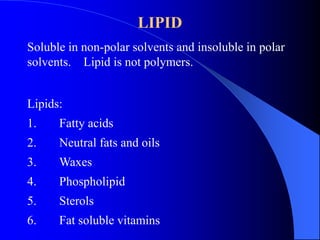
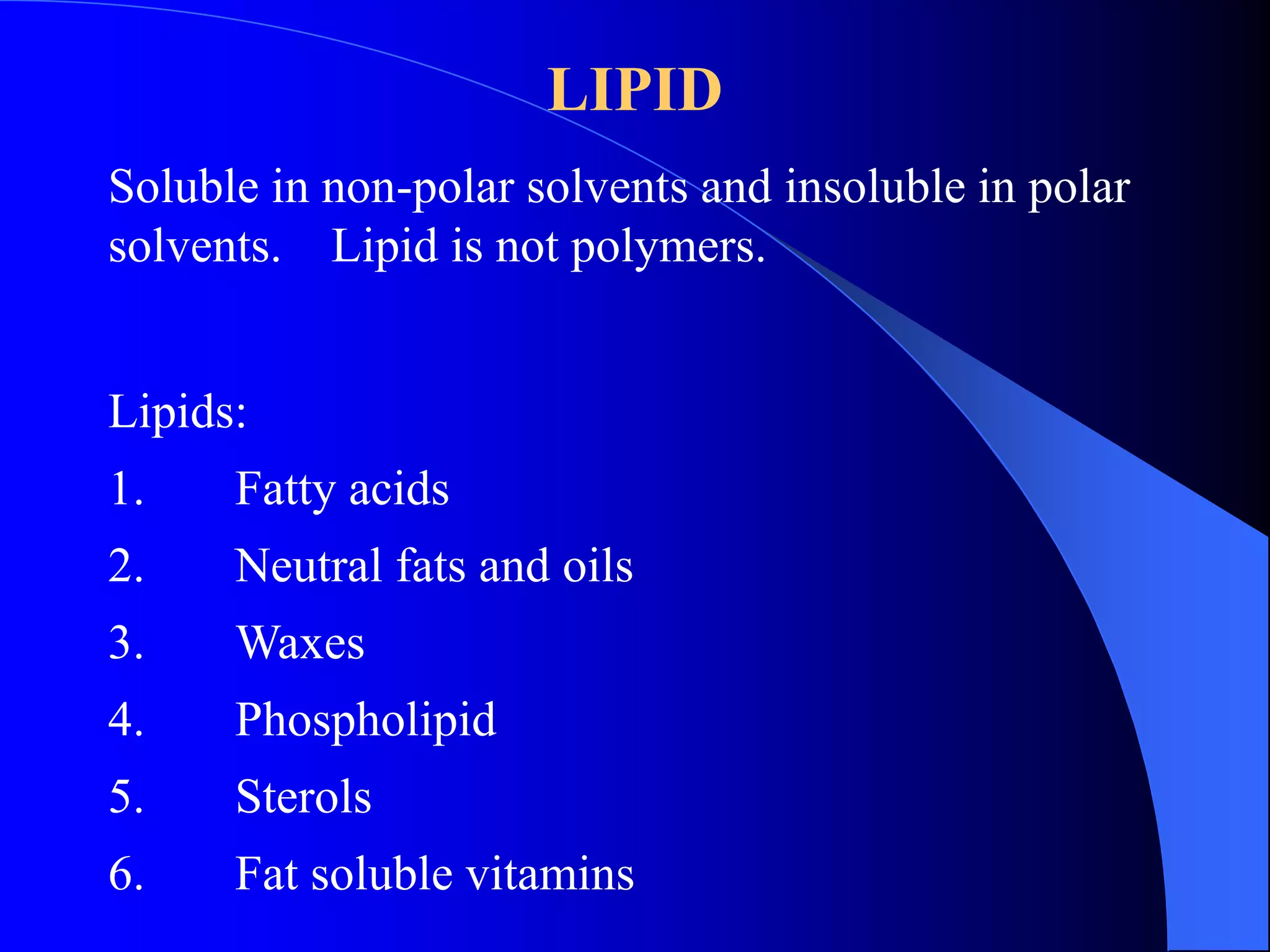
Soluble in non-polar solvents and insoluble in polar 
solvents. Lipid is not polymers. 
Lipids: 
1. Fatty acids 
2. Neutral fats and oils 
3. Waxes 
4. Phospholipid 
5. Sterols 
6. Fat soluble vitamins
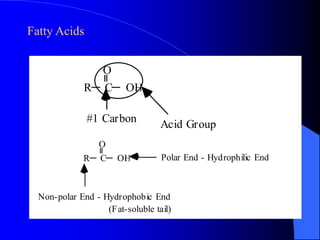
Fatty Acids 
O 
R C OH 
#1 Carbon 
Acid Group 
O 
R C OH 
Polar End - Hydrophilic End 
Non-polar End - Hydrophobic End 
(Fat-soluble tail)
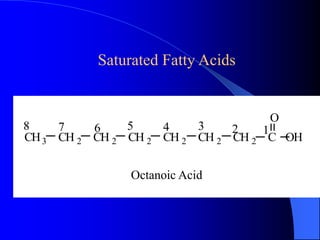
Saturated Fatty Acids 
O 
8 7 6 5 4 3 2 1 
CH3 CH 2 CH 2 CH 2 CH 2 CH 2 CH 2 C OH 
Octanoic Acid
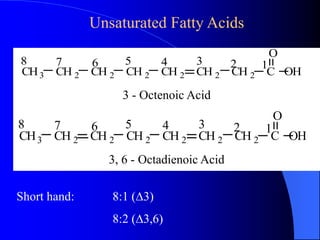
Unsaturated Fatty Acids 
O 
8 7 6 5 4 3 2 1 
CH3 CH 2 CH 2 CH 2 CH 2 CH 2 CH 2 C OH 
O 
3 - Octenoic Acid 
8 7 6 5 4 3 2 1 
CH3 CH 2 CH 2 CH 2 CH 2 CH 2 CH 2 C OH 
3, 6 - Octadienoic Acid 
Short hand: 8:1 (D3) 
8:2 (D3,6)
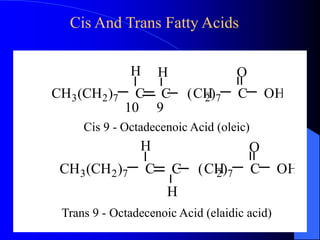
Cis And Trans Fatty Acids 
O 
H H 
CH3(CH2)7 C C (CH2)7 C OH 
10 9 
Cis 9 - Octadecenoic Acid (oleic) 
O 
H 
CH3(CH2)7 C C (CH2)7 C OH 
H 
Trans 9 - Octadecenoic Acid (elaidic acid)
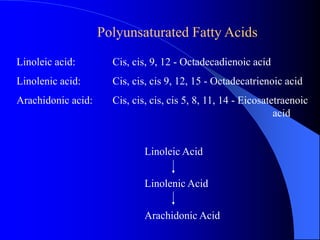
Polyunsaturated Fatty Acids 
Linoleic acid: Cis, cis, 9, 12 - Octadecadienoic acid 
Linolenic acid: Cis, cis, cis 9, 12, 15 - Octadecatrienoic acid 
Arachidonic acid: Cis, cis, cis, cis 5, 8, 11, 14 - Eicosatetraenoic 
acid 
Linoleic Acid 
Linolenic Acid 
Arachidonic Acid
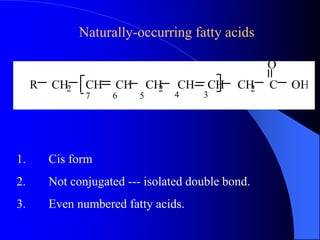
Naturally-occurring fatty acids 
O 
R CH2 CH CH CH2 CH CH CH2 C OH 
7 6 5 4 3 
1. Cis form 
2. Not conjugated --- isolated double bond. 
3. Even numbered fatty acids.
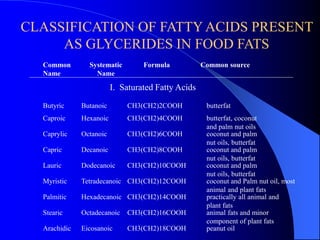
CLASSIFICATION OF FATTY ACIDS PRESENT 
AS GLYCERIDES IN FOOD FATS 
Systematic 
Name 
Formula Common source 
I. Saturated Fatty Acids 
Common 
Name 
Butyric Butanoic CH3(CH2)2COOH butterfat 
Caproic Hexanoic CH3(CH2)4COOH butterfat, coconut 
and palm nut oils 
Caprylic Octanoic CH3(CH2)6COOH coconut and palm 
nut oils, butterfat 
Capric Decanoic CH3(CH2)8COOH coconut and palm 
nut oils, butterfat 
Lauric Dodecanoic CH3(CH2)10COOH coconut and palm 
nut oils, butterfat 
Myristic Tetradecanoic CH3(CH2)12COOH coconut and Palm nut oil, most 
animal and plant fats 
Palmitic Hexadecanoic CH3(CH2)14COOH practically all animal and 
plant fats 
Stearic Octadecanoic CH3(CH2)16COOH animal fats and minor 
component of plant fats 
Arachidic Eicosanoic CH3(CH2)18COOH peanut oil
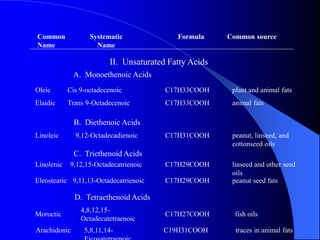
Common 
Name 
Systematic 
Name 
Formula Common source 
II. Unsaturated Fatty Acids 
A. Monoethenoic Acids 
Oleic Cis 9-octadecenoic C17H33COOH plant and animal fats 
Elaidic Trans 9-Octadecenoic C17H33COOH animal fats 
B. Diethenoic Acids 
Linoleic 9,12-Octadecadienoic C17H31COOH peanut, linseed, and 
cottonseed oils 
C. Triethenoid Acids 
Linolenic 9,12,15-Octadecatrienoic C17H29COOH linseed and other seed 
oils 
Eleostearic 9,11,13-Octadecatrienoic C17H29COOH peanut seed fats 
D. Tetraethenoid Acids 
Moroctic 
4,8,12,15- 
Octadecatetraenoic 
C17H27COOH fish oils 
Arachidonic 5,8,11,14- 
Eicosatetraenoic 
C19H31COOH traces in animal fats
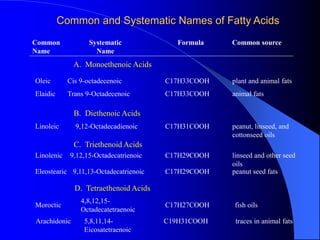
Common and Systematic Names of Fatty Acids 
Common 
Name 
Systematic 
Name 
Formula Common source 
A. Monoethenoic Acids 
Oleic Cis 9-octadecenoic C17H33COOH plant and animal fats 
Elaidic Trans 9-Octadecenoic C17H33COOH animal fats 
B. Diethenoic Acids 
Linoleic 9,12-Octadecadienoic C17H31COOH peanut, linseed, and 
cottonseed oils 
C. Triethenoid Acids 
Linolenic 9,12,15-Octadecatrienoic C17H29COOH linseed and other seed 
oils 
Eleostearic 9,11,13-Octadecatrienoic C17H29COOH peanut seed fats 
D. Tetraethenoid Acids 
Moroctic 
4,8,12,15- 
Octadecatetraenoic 
C17H27COOH fish oils 
Arachidonic 5,8,11,14- 
Eicosatetraenoic 
C19H31COOH traces in animal fats
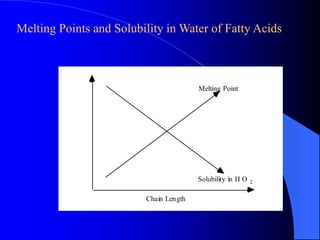
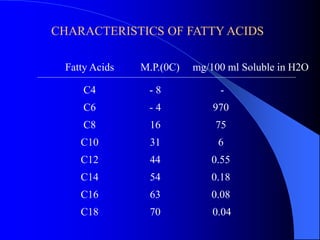
Melting Points and Solubility in Water of Fatty Acids 
Solubility in H O 
Chain Length 
2 
Melting Point
CHARACTERISTICS OF FATTY ACIDS 
Fatty Acids M.P.(0C) mg/100 ml Soluble in H2O 
C4 - 8 - 
C6 - 4 970 
C8 16 75 
C10 31 6 
C12 44 0.55 
C14 54 0.18 
C16 63 0.08 
C18 70 0.04
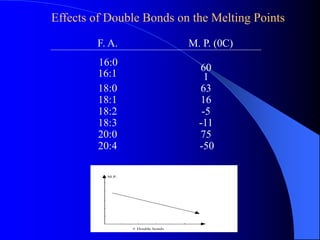
Effects of Double Bonds on the Melting Points 
F. A. M. P. (0C) 
16:0 
60 
16:1 1 
18:0 63 
18:1 16 
18:2 -5 
18:3 -11 
20:0 75 
20:4 -50 
M.P. 
# Double bonds
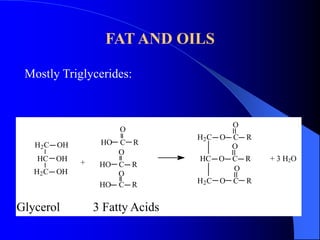
FAT AND OILS 
Mostly Triglycerides: 
O 
H2C OH 
HC OH 
H2C OH 
O 
HO C R 
O 
HO C R 
O 
HO C R 
H2C O C R 
O 
HC O C R 
O 
H2C O C R 
+ 
+ 3 H2O 
Glycerol 3 Fatty Acids
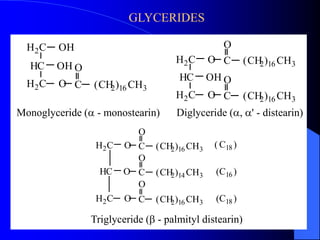
GLYCERIDES 
H2C OH 
HC OH 
H2C O 
O 
C (CH2)16CH3 
H2C O 
HC OH 
H2C O 
O 
C (CH2)16CH3 
O 
C (CH2)16CH3 
Monoglyceride (a - monostearin) Diglyceride (a, a' - distearin) 
H2C O 
HC O 
H2C O 
O 
C (CH2)16CH3 
O 
C (CH2)14CH3 
O 
C (CH2)16CH3 
(C18 ) 
(C16 ) 
(C18 ) 
Triglyceride (b - palmityl distearin)
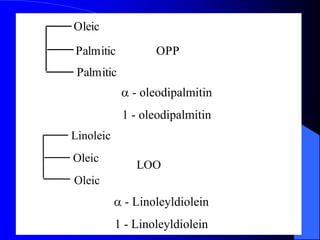
a - oleodipalmitin 
1 - oleodipalmitin 
Oleic 
Palmitic 
Palmitic 
OPP 
a - Linoleyldiolein 
1 - Linoleyldiolein 
Linoleic 
Oleic 
Oleic 
LOO
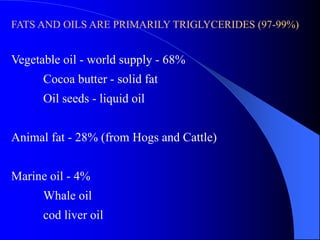
FATS AND OILS ARE PRIMARILY TRIGLYCERIDES (97-99%) 
Vegetable oil - world supply - 68% 
Cocoa butter - solid fat 
Oil seeds - liquid oil 
Animal fat - 28% (from Hogs and Cattle) 
Marine oil - 4% 
Whale oil 
cod liver oil
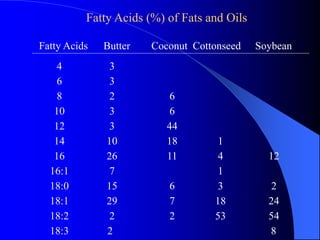
Fatty Acids (%) of Fats and Oils 
Fatty Acids Butter Coconut Cottonseed Soybean 
4 3 
6 3 
8 2 6 
10 3 6 
12 3 44 
14 10 18 1 
16 26 11 4 12 
16:1 7 1 
18:0 15 6 3 2 
18:1 29 7 18 24 
18:2 2 2 53 54 
18:3 2 8
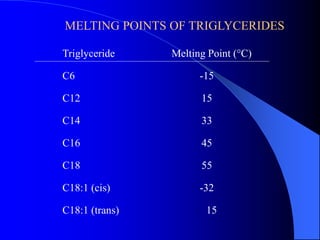
MELTING POINTS OF TRIGLYCERIDES 
Triglyceride Melting Point (°C) 
C6 -15 
C12 15 
C14 33 
C16 45 
C18 55 
C18:1 (cis) -32 
C18:1 (trans) 15
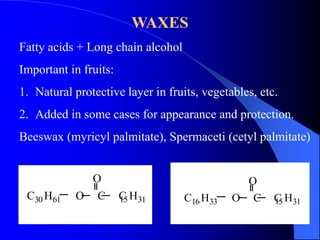
WAXES 
Fatty acids + Long chain alcohol 
Important in fruits: 
1. Natural protective layer in fruits, vegetables, etc. 
2. Added in some cases for appearance and protection. 
Beeswax (myricyl palmitate), Spermaceti (cetyl palmitate) 
O 
C30H61 O C C15H31 
O 
C16H33 O C C15H31
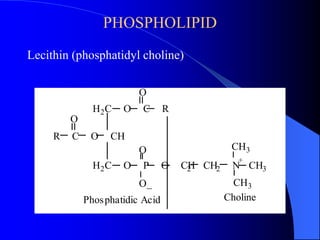
PHOSPHOLIPID 
Lecithin (phosphatidyl choline) 
O 
H2C O C R 
O 
O 
R C O CH 
CH3 
+ 
CH3 
CH3 
H2C O P O CH2 CH2 N 
O_ 
Phosphatidic Acid Choline
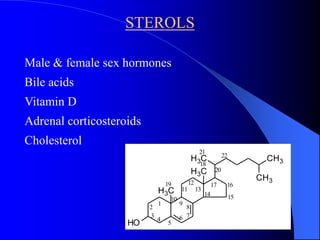
STEROLS 
Male & female sex hormones 
Bile acids 
Vitamin D 
Adrenal corticosteroids 
Cholesterol 
HO 
H3C 
21 
22 
H3C CH3 
18 
H3C 
CH3 
1 
2 
3 
4 
5 
8 
9 
6 7 
10 
11 
12 
13 
17 16 
14 15 
19 
20
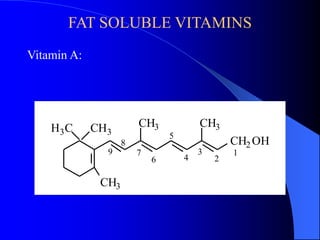
FAT SOLUBLE VITAMINS 
Vitamin A: 
CH2OH 
CH3 CH3 
H3C CH3 
CH3 
1 
2 
3 
4 
5 
6 
7 
8 
9
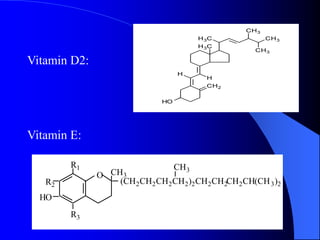
Vitamin D2: 
Vitamin E: 
HO 
H3C CH3 
H3C 
CH2 
H 
H 
CH3 
CH3 
O 
R1 
R2 
HO 
R3 
CH3 
CH3 
(CH2CH2CH2CH2)2CH2CH2CH2CH(CH3)2
ANALYTICAL METHODS TO MEASURE THE 
CONSTANTS OF FATS AND OILS 
1. Acid Value 
2. Saponification Value 
3. Iodine Value 
4. Gas Chromatographic Analysis for Fatty Acids 
5. Liquid Chromatography 
6. Cholesterol Determination
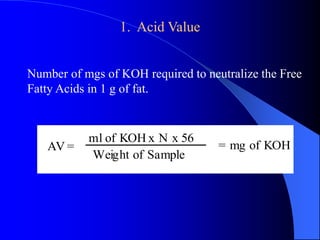
1. Acid Value 
Number of mgs of KOH required to neutralize the Free 
Fatty Acids in 1 g of fat. 
AV = 
ml of KOH x N x 56 
Weight of Sample 
= mg of KOH
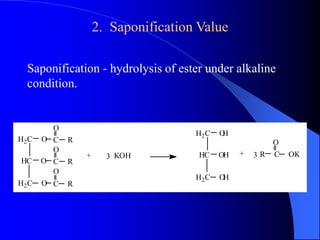
2. Saponification Value 
Saponification - hydrolysis of ester under alkaline 
condition. 
O 
O 
C R 
O 
C R 
O 
C R 
H2C O 
HC O 
H2C O 
+ 3 KOH 
+ 3 R C OK 
H2C O 
H 
HC O 
H 
H2C O 
H
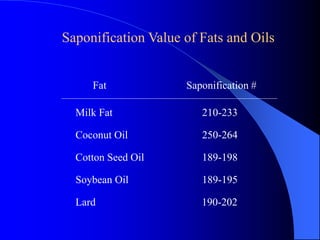
Saponification Value of Fats and Oils 
Fat Saponification # 
Milk Fat 210-233 
Coconut Oil 250-264 
Cotton Seed Oil 189-198 
Soybean Oil 189-195 
Lard 190-202
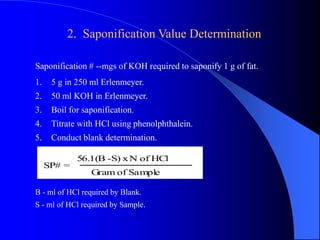
2. Saponification Value Determination 
Saponification # --mgs of KOH required to saponify 1 g of fat. 
1. 5 g in 250 ml Erlenmeyer. 
2. 50 ml KOH in Erlenmeyer. 
3. Boil for saponification. 
4. Titrate with HCl using phenolphthalein. 
5. Conduct blank determination. 
SP# = 
56.1(B -S) x N of HCl 
Gram of Sample 
B - ml of HCl required by Blank. 
S - ml of HCl required by Sample.
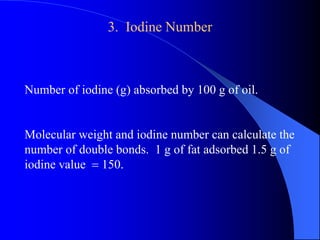
3. Iodine Number 
Number of iodine (g) absorbed by 100 g of oil. 
Molecular weight and iodine number can calculate the 
number of double bonds. 1 g of fat adsorbed 1.5 g of 
iodine value = 150.
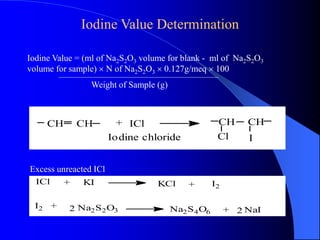
Iodine Value Determination 
Iodine Value = (ml of Na2S2O3 volume for blank - ml of Na2S2O3 
volume for sample)  N of Na2S2O3  0.127g/meq  100 
Weight of Sample (g) 
CH CH CH CH 
Cl I 
ICl 
+ 
Iodine chloride 
Excess unreacted ICl 
ICl KI KCl 
I2 
I2 
+ 
Na2S2O3 Na2S4O6 NaI 
+ 
+ 2 + 2
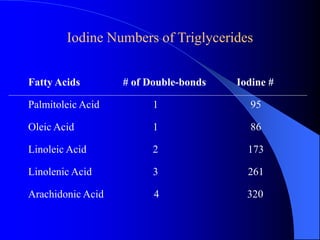
Iodine Numbers of Triglycerides 
Fatty Acids # of Double-bonds Iodine # 
Palmitoleic Acid 1 95 
Oleic Acid 1 86 
Linoleic Acid 2 173 
Linolenic Acid 3 261 
Arachidonic Acid 4 320
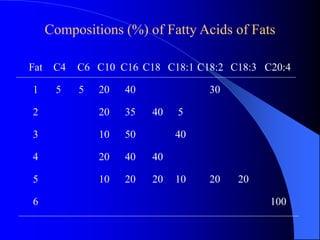
Compositions (%) of Fatty Acids of Fats 
Fat C4 C6 C10 C16 C18 C18:1 C18:2 C18:3 C20:4 
1 5 5 20 40 30 
2 20 35 40 5 
3 10 50 40 
4 20 40 40 
5 10 20 20 10 20 20 
6 100
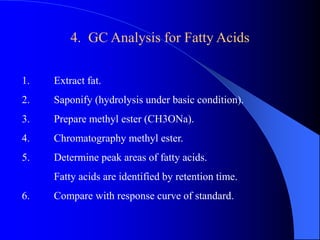
4. GC Analysis for Fatty Acids 
1. Extract fat. 
2. Saponify (hydrolysis under basic condition). 
3. Prepare methyl ester (CH3ONa). 
4. Chromatography methyl ester. 
5. Determine peak areas of fatty acids. 
Fatty acids are identified by retention time. 
6. Compare with response curve of standard.
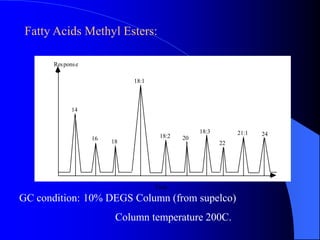
Fatty Acids Methyl Esters: 
14 
18:1 
18:2 20 
18:3 
22 
21:1 24 
16 
18 
Time 
Response 
GC condition: 10% DEGS Column (from supelco) 
Column temperature 200C.
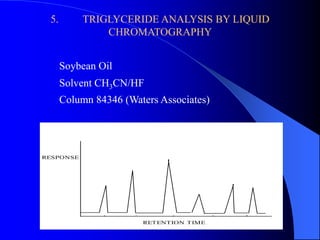
5. TRIGLYCERIDE ANALYSIS BY LIQUID 
CHROMATOGRAPHY 
Soybean Oil 
Solvent CH3CN/HF 
Column 84346 (Waters Associates) 
RESPONSE 
RETENTION TIME
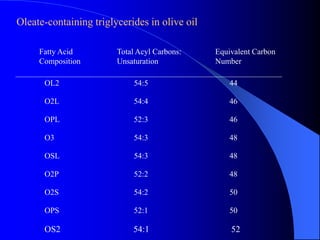
Oleate-containing triglycerides in olive oil 
Fatty Acid 
Composition 
Total Acyl Carbons: 
Unsaturation 
Equivalent Carbon 
Number 
OL2 54:5 44 
O2L 54:4 46 
OPL 52:3 46 
O3 54:3 48 
OSL 54:3 48 
O2P 52:2 48 
O2S 54:2 50 
OPS 52:1 50 
OS2 54:1 52
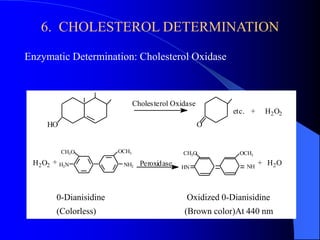
6. CHOLESTEROL DETERMINATION 
Enzymatic Determination: Cholesterol Oxidase 
HO O 
H2O2 
Choles terol Oxidase 
etc. + 
H2O2 
CH3O OCH3 
CH3O OCH3 
+ Peroxidase + H2O 
H2N NH2 HN NH 
0-Dianisidine Oxidized 0-Dianisidine 
(Colorless) (Brown color)At 440 nm
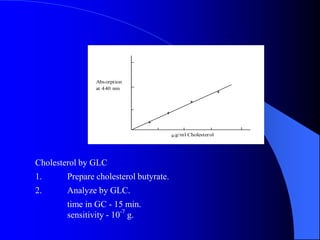
Cholesterol by GLC 
1. Prepare cholesterol butyrate. 
2. Analyze by GLC. 
time in GC - 15 min. 
sensitivity - 10-7 g. 
g/ml Cholesterol 
Absorption 
at 440 nm
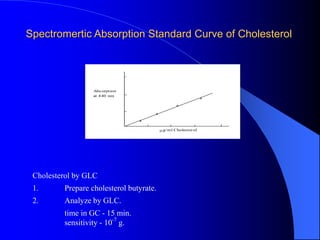
Spectromertic Absorption Standard Curve of Cholesterol 
Cholesterol by GLC 
1. Prepare cholesterol butyrate. 
2. Analyze by GLC. 
time in GC - 15 min. 
sensitivity - 10-7 g. 
g/ml Cholesterol 
Absorption 
at 440 nm
LIPID CONTENT ANALYSES 
1. Gravimetric Method 
(1) Wet extraction - Roese Gottliegb & Mojonnier. 
(2) Dry extraction - Soxhlet Method. 
2. Volumetric Methods (Babcock, Gerber Methods)
1. Gravimetric Method 
(1) Wet Extraction - Roese Gottlieb & Mojonnier. 
For Milk: 
1) 10 g milk + 1.25 ml NH4OH mix. solubilizes 
protein and neutralizes. 
2) + 10 ml EtOH - shake. Begins extraction, prevents 
gelation of proteins. 
3) + 25 ml Et2O - shake and mix. 
4) + 25 ml petroleum ether, mix and shake.
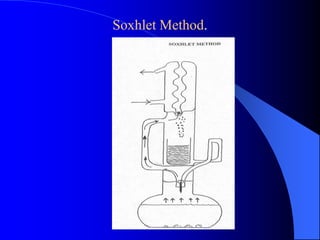
(2) Dry Extraction - Soxhlet Method. 
Sample in thimble is continuously extracted with ether 
using Soxhlet condenser. After extraction, direct 
measurement of fat 
- evaporate ether and weigh the flask. 
Indirect measurement - dry thimble and weigh thimble and 
sample.
Soxhlet Method.
2. Volumetric Method (Babcock, Gerber Methods) 
Theory: 
1. Treat sample with H2SO4 or detergent. 
2. Centrifuge to separate fat layer. 
3. Measure the fat content using specially calibrated bottles. 
Methods: 
1. Known weight sample. 
2. H2SO4 - digest protein, liquefy fat. 
3. Add H2O so that fat will be in graduated part of bottle. 
4. centrifuge to separate fat from other materials completely.
REACTIONS OF FATS 
Hydrolytic Rancidity: 
1. Triglyceride -> Fatty acids 
Specially C4 butyric acid (or other short chain fatty 
acids) are the real problem. 
2. By lipase.
LIPID OXIDATION 
Major flavor problems in food during storage are mainly 
due to the oxidation of lipid. 
Lipid Oxidation - free radical reactions. 
1. Initiation. 
2. Propagation. 
3. Termination.
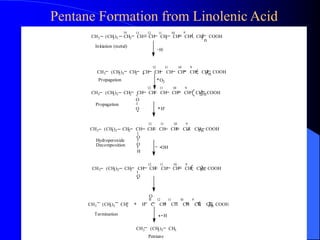
Pentane Formation from Linolenic Acid 
14 13 12 11 10 9 
CH3 (CH2)3 CH2 CH CH CH2 CH CH CH2 COOH 
- . 
12 11 10 9 
CH3 (CH2)3 CH2 CH CH CH CH CH CH2 COOH 
+ 
12 11 10 9 
12 11 10 9 
CH3 (CH2)3 CH2 CH CH CH CH CH CH2 COOH 
+ 
_ 
+ . 
12 11 10 9 
12 11 10 9 
+ 
O 
O 
. 
H 
. 
CH3 (CH2)3 CH2 CH CH CH CH CH CH2 COOH 
O 
O 
H 
CH3 (CH2)3 CH2 CH CH CH CH CH CH2 COOH 
O 
Initiation (metal) 
Propagation 
Propagation 
. 
O2 
H 
OH . 
Hydroperoxide 
Decomposition 
O 
CH3 (CH2)3 CH2 H C CH CH CH CH C2H COOH 
CH3 (CH2)3 CH3 
. 
H Termination . 
Pentane 
n 
n 
n 
- n 
n 
n
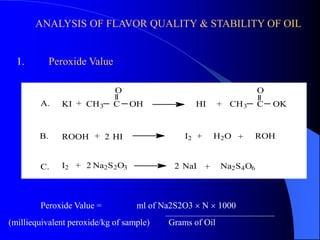
ANALYSIS OF FLAVOR QUALITY & STABILITY OF OIL 
1. Peroxide Value 
O O 
KI CH3 C OH HI CH3 C OK 
ROOH HI I2 H2O ROH 
I2 Na2S2O3 NaI Na2S4O6 
A. 
B. 
C. 
+ 
+ 
+ 
+ 
+ 
+ 
+ 
2 
2 
2 
Peroxide Value = ml of Na2S2O3  N  1000 
(milliequivalent peroxide/kg of sample) Grams of Oil
2. Active Oxygen Method (AOM) 
Determined the time required to obtain certain 
peroxide value under specific experimental conditions. 
The larger the AOM value, the better the flavor 
stability of the oil.
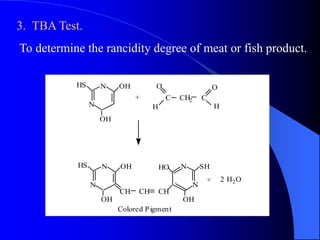
3. TBA Test. 
To determine the rancidity degree of meat or fish product. 
N 
N 
HS 
OH 
OH 
C CH2 C 
O 
O 
H 
H 
OH 
OH 
HS 
N 
N 
OH 
SH 
N 
N 
HO 
+ 
CH CH CH 
H2O 
Colored Pigment 
+ 2

Lipid

  • 1.
    LIPID Soluble innon-polar solvents and insoluble in polar solvents. Lipid is not polymers. Lipids: 1. Fatty acids 2. Neutral fats and oils 3. Waxes 4. Phospholipid 5. Sterols 6. Fat soluble vitamins
  • 2.
    Fatty Acids O R C OH #1 Carbon Acid Group O R C OH Polar End - Hydrophilic End Non-polar End - Hydrophobic End (Fat-soluble tail)
  • 3.
    Saturated Fatty Acids O 8 7 6 5 4 3 2 1 CH3 CH 2 CH 2 CH 2 CH 2 CH 2 CH 2 C OH Octanoic Acid
  • 4.
    Unsaturated Fatty Acids O 8 7 6 5 4 3 2 1 CH3 CH 2 CH 2 CH 2 CH 2 CH 2 CH 2 C OH O 3 - Octenoic Acid 8 7 6 5 4 3 2 1 CH3 CH 2 CH 2 CH 2 CH 2 CH 2 CH 2 C OH 3, 6 - Octadienoic Acid Short hand: 8:1 (D3) 8:2 (D3,6)
  • 5.
    Cis And TransFatty Acids O H H CH3(CH2)7 C C (CH2)7 C OH 10 9 Cis 9 - Octadecenoic Acid (oleic) O H CH3(CH2)7 C C (CH2)7 C OH H Trans 9 - Octadecenoic Acid (elaidic acid)
  • 6.
    Polyunsaturated Fatty Acids Linoleic acid: Cis, cis, 9, 12 - Octadecadienoic acid Linolenic acid: Cis, cis, cis 9, 12, 15 - Octadecatrienoic acid Arachidonic acid: Cis, cis, cis, cis 5, 8, 11, 14 - Eicosatetraenoic acid Linoleic Acid Linolenic Acid Arachidonic Acid
  • 7.
    Naturally-occurring fatty acids O R CH2 CH CH CH2 CH CH CH2 C OH 7 6 5 4 3 1. Cis form 2. Not conjugated --- isolated double bond. 3. Even numbered fatty acids.
  • 8.
    CLASSIFICATION OF FATTYACIDS PRESENT AS GLYCERIDES IN FOOD FATS Systematic Name Formula Common source I. Saturated Fatty Acids Common Name Butyric Butanoic CH3(CH2)2COOH butterfat Caproic Hexanoic CH3(CH2)4COOH butterfat, coconut and palm nut oils Caprylic Octanoic CH3(CH2)6COOH coconut and palm nut oils, butterfat Capric Decanoic CH3(CH2)8COOH coconut and palm nut oils, butterfat Lauric Dodecanoic CH3(CH2)10COOH coconut and palm nut oils, butterfat Myristic Tetradecanoic CH3(CH2)12COOH coconut and Palm nut oil, most animal and plant fats Palmitic Hexadecanoic CH3(CH2)14COOH practically all animal and plant fats Stearic Octadecanoic CH3(CH2)16COOH animal fats and minor component of plant fats Arachidic Eicosanoic CH3(CH2)18COOH peanut oil
  • 9.
    Common Name Systematic Name Formula Common source II. Unsaturated Fatty Acids A. Monoethenoic Acids Oleic Cis 9-octadecenoic C17H33COOH plant and animal fats Elaidic Trans 9-Octadecenoic C17H33COOH animal fats B. Diethenoic Acids Linoleic 9,12-Octadecadienoic C17H31COOH peanut, linseed, and cottonseed oils C. Triethenoid Acids Linolenic 9,12,15-Octadecatrienoic C17H29COOH linseed and other seed oils Eleostearic 9,11,13-Octadecatrienoic C17H29COOH peanut seed fats D. Tetraethenoid Acids Moroctic 4,8,12,15- Octadecatetraenoic C17H27COOH fish oils Arachidonic 5,8,11,14- Eicosatetraenoic C19H31COOH traces in animal fats
  • 10.
    Common and SystematicNames of Fatty Acids Common Name Systematic Name Formula Common source A. Monoethenoic Acids Oleic Cis 9-octadecenoic C17H33COOH plant and animal fats Elaidic Trans 9-Octadecenoic C17H33COOH animal fats B. Diethenoic Acids Linoleic 9,12-Octadecadienoic C17H31COOH peanut, linseed, and cottonseed oils C. Triethenoid Acids Linolenic 9,12,15-Octadecatrienoic C17H29COOH linseed and other seed oils Eleostearic 9,11,13-Octadecatrienoic C17H29COOH peanut seed fats D. Tetraethenoid Acids Moroctic 4,8,12,15- Octadecatetraenoic C17H27COOH fish oils Arachidonic 5,8,11,14- Eicosatetraenoic C19H31COOH traces in animal fats
  • 11.
    Melting Points andSolubility in Water of Fatty Acids Solubility in H O Chain Length 2 Melting Point
  • 12.
    CHARACTERISTICS OF FATTYACIDS Fatty Acids M.P.(0C) mg/100 ml Soluble in H2O C4 - 8 - C6 - 4 970 C8 16 75 C10 31 6 C12 44 0.55 C14 54 0.18 C16 63 0.08 C18 70 0.04
  • 13.
    Effects of DoubleBonds on the Melting Points F. A. M. P. (0C) 16:0 60 16:1 1 18:0 63 18:1 16 18:2 -5 18:3 -11 20:0 75 20:4 -50 M.P. # Double bonds
  • 14.
    FAT AND OILS Mostly Triglycerides: O H2C OH HC OH H2C OH O HO C R O HO C R O HO C R H2C O C R O HC O C R O H2C O C R + + 3 H2O Glycerol 3 Fatty Acids
  • 15.
    GLYCERIDES H2C OH HC OH H2C O O C (CH2)16CH3 H2C O HC OH H2C O O C (CH2)16CH3 O C (CH2)16CH3 Monoglyceride (a - monostearin) Diglyceride (a, a' - distearin) H2C O HC O H2C O O C (CH2)16CH3 O C (CH2)14CH3 O C (CH2)16CH3 (C18 ) (C16 ) (C18 ) Triglyceride (b - palmityl distearin)
  • 16.
    a - oleodipalmitin 1 - oleodipalmitin Oleic Palmitic Palmitic OPP a - Linoleyldiolein 1 - Linoleyldiolein Linoleic Oleic Oleic LOO
  • 17.
    FATS AND OILSARE PRIMARILY TRIGLYCERIDES (97-99%) Vegetable oil - world supply - 68% Cocoa butter - solid fat Oil seeds - liquid oil Animal fat - 28% (from Hogs and Cattle) Marine oil - 4% Whale oil cod liver oil
  • 18.
    Fatty Acids (%)of Fats and Oils Fatty Acids Butter Coconut Cottonseed Soybean 4 3 6 3 8 2 6 10 3 6 12 3 44 14 10 18 1 16 26 11 4 12 16:1 7 1 18:0 15 6 3 2 18:1 29 7 18 24 18:2 2 2 53 54 18:3 2 8
  • 19.
    MELTING POINTS OFTRIGLYCERIDES Triglyceride Melting Point (°C) C6 -15 C12 15 C14 33 C16 45 C18 55 C18:1 (cis) -32 C18:1 (trans) 15
  • 20.
    WAXES Fatty acids+ Long chain alcohol Important in fruits: 1. Natural protective layer in fruits, vegetables, etc. 2. Added in some cases for appearance and protection. Beeswax (myricyl palmitate), Spermaceti (cetyl palmitate) O C30H61 O C C15H31 O C16H33 O C C15H31
  • 21.
    PHOSPHOLIPID Lecithin (phosphatidylcholine) O H2C O C R O O R C O CH CH3 + CH3 CH3 H2C O P O CH2 CH2 N O_ Phosphatidic Acid Choline
  • 22.
    STEROLS Male &female sex hormones Bile acids Vitamin D Adrenal corticosteroids Cholesterol HO H3C 21 22 H3C CH3 18 H3C CH3 1 2 3 4 5 8 9 6 7 10 11 12 13 17 16 14 15 19 20
  • 23.
    FAT SOLUBLE VITAMINS Vitamin A: CH2OH CH3 CH3 H3C CH3 CH3 1 2 3 4 5 6 7 8 9
  • 24.
    Vitamin D2: VitaminE: HO H3C CH3 H3C CH2 H H CH3 CH3 O R1 R2 HO R3 CH3 CH3 (CH2CH2CH2CH2)2CH2CH2CH2CH(CH3)2
  • 25.
    ANALYTICAL METHODS TOMEASURE THE CONSTANTS OF FATS AND OILS 1. Acid Value 2. Saponification Value 3. Iodine Value 4. Gas Chromatographic Analysis for Fatty Acids 5. Liquid Chromatography 6. Cholesterol Determination
  • 26.
    1. Acid Value Number of mgs of KOH required to neutralize the Free Fatty Acids in 1 g of fat. AV = ml of KOH x N x 56 Weight of Sample = mg of KOH
  • 27.
    2. Saponification Value Saponification - hydrolysis of ester under alkaline condition. O O C R O C R O C R H2C O HC O H2C O + 3 KOH + 3 R C OK H2C O H HC O H H2C O H
  • 28.
    Saponification Value ofFats and Oils Fat Saponification # Milk Fat 210-233 Coconut Oil 250-264 Cotton Seed Oil 189-198 Soybean Oil 189-195 Lard 190-202
  • 29.
    2. Saponification ValueDetermination Saponification # --mgs of KOH required to saponify 1 g of fat. 1. 5 g in 250 ml Erlenmeyer. 2. 50 ml KOH in Erlenmeyer. 3. Boil for saponification. 4. Titrate with HCl using phenolphthalein. 5. Conduct blank determination. SP# = 56.1(B -S) x N of HCl Gram of Sample B - ml of HCl required by Blank. S - ml of HCl required by Sample.
  • 30.
    3. Iodine Number Number of iodine (g) absorbed by 100 g of oil. Molecular weight and iodine number can calculate the number of double bonds. 1 g of fat adsorbed 1.5 g of iodine value = 150.
  • 31.
    Iodine Value Determination Iodine Value = (ml of Na2S2O3 volume for blank - ml of Na2S2O3 volume for sample)  N of Na2S2O3  0.127g/meq  100 Weight of Sample (g) CH CH CH CH Cl I ICl + Iodine chloride Excess unreacted ICl ICl KI KCl I2 I2 + Na2S2O3 Na2S4O6 NaI + + 2 + 2
  • 32.
    Iodine Numbers ofTriglycerides Fatty Acids # of Double-bonds Iodine # Palmitoleic Acid 1 95 Oleic Acid 1 86 Linoleic Acid 2 173 Linolenic Acid 3 261 Arachidonic Acid 4 320
  • 33.
    Compositions (%) ofFatty Acids of Fats Fat C4 C6 C10 C16 C18 C18:1 C18:2 C18:3 C20:4 1 5 5 20 40 30 2 20 35 40 5 3 10 50 40 4 20 40 40 5 10 20 20 10 20 20 6 100
  • 34.
    4. GC Analysisfor Fatty Acids 1. Extract fat. 2. Saponify (hydrolysis under basic condition). 3. Prepare methyl ester (CH3ONa). 4. Chromatography methyl ester. 5. Determine peak areas of fatty acids. Fatty acids are identified by retention time. 6. Compare with response curve of standard.
  • 35.
    Fatty Acids MethylEsters: 14 18:1 18:2 20 18:3 22 21:1 24 16 18 Time Response GC condition: 10% DEGS Column (from supelco) Column temperature 200C.
  • 36.
    5. TRIGLYCERIDE ANALYSISBY LIQUID CHROMATOGRAPHY Soybean Oil Solvent CH3CN/HF Column 84346 (Waters Associates) RESPONSE RETENTION TIME
  • 37.
    Oleate-containing triglycerides inolive oil Fatty Acid Composition Total Acyl Carbons: Unsaturation Equivalent Carbon Number OL2 54:5 44 O2L 54:4 46 OPL 52:3 46 O3 54:3 48 OSL 54:3 48 O2P 52:2 48 O2S 54:2 50 OPS 52:1 50 OS2 54:1 52
  • 38.
    6. CHOLESTEROL DETERMINATION Enzymatic Determination: Cholesterol Oxidase HO O H2O2 Choles terol Oxidase etc. + H2O2 CH3O OCH3 CH3O OCH3 + Peroxidase + H2O H2N NH2 HN NH 0-Dianisidine Oxidized 0-Dianisidine (Colorless) (Brown color)At 440 nm
  • 39.
    Cholesterol by GLC 1. Prepare cholesterol butyrate. 2. Analyze by GLC. time in GC - 15 min. sensitivity - 10-7 g. g/ml Cholesterol Absorption at 440 nm
  • 40.
    Spectromertic Absorption StandardCurve of Cholesterol Cholesterol by GLC 1. Prepare cholesterol butyrate. 2. Analyze by GLC. time in GC - 15 min. sensitivity - 10-7 g. g/ml Cholesterol Absorption at 440 nm
  • 41.
    LIPID CONTENT ANALYSES 1. Gravimetric Method (1) Wet extraction - Roese Gottliegb & Mojonnier. (2) Dry extraction - Soxhlet Method. 2. Volumetric Methods (Babcock, Gerber Methods)
  • 42.
    1. Gravimetric Method (1) Wet Extraction - Roese Gottlieb & Mojonnier. For Milk: 1) 10 g milk + 1.25 ml NH4OH mix. solubilizes protein and neutralizes. 2) + 10 ml EtOH - shake. Begins extraction, prevents gelation of proteins. 3) + 25 ml Et2O - shake and mix. 4) + 25 ml petroleum ether, mix and shake.
  • 43.
    (2) Dry Extraction- Soxhlet Method. Sample in thimble is continuously extracted with ether using Soxhlet condenser. After extraction, direct measurement of fat - evaporate ether and weigh the flask. Indirect measurement - dry thimble and weigh thimble and sample.
  • 44.
  • 45.
    2. Volumetric Method(Babcock, Gerber Methods) Theory: 1. Treat sample with H2SO4 or detergent. 2. Centrifuge to separate fat layer. 3. Measure the fat content using specially calibrated bottles. Methods: 1. Known weight sample. 2. H2SO4 - digest protein, liquefy fat. 3. Add H2O so that fat will be in graduated part of bottle. 4. centrifuge to separate fat from other materials completely.
  • 46.
    REACTIONS OF FATS Hydrolytic Rancidity: 1. Triglyceride -> Fatty acids Specially C4 butyric acid (or other short chain fatty acids) are the real problem. 2. By lipase.
  • 47.
    LIPID OXIDATION Majorflavor problems in food during storage are mainly due to the oxidation of lipid. Lipid Oxidation - free radical reactions. 1. Initiation. 2. Propagation. 3. Termination.
  • 48.
    Pentane Formation fromLinolenic Acid 14 13 12 11 10 9 CH3 (CH2)3 CH2 CH CH CH2 CH CH CH2 COOH - . 12 11 10 9 CH3 (CH2)3 CH2 CH CH CH CH CH CH2 COOH + 12 11 10 9 12 11 10 9 CH3 (CH2)3 CH2 CH CH CH CH CH CH2 COOH + _ + . 12 11 10 9 12 11 10 9 + O O . H . CH3 (CH2)3 CH2 CH CH CH CH CH CH2 COOH O O H CH3 (CH2)3 CH2 CH CH CH CH CH CH2 COOH O Initiation (metal) Propagation Propagation . O2 H OH . Hydroperoxide Decomposition O CH3 (CH2)3 CH2 H C CH CH CH CH C2H COOH CH3 (CH2)3 CH3 . H Termination . Pentane n n n - n n n
  • 49.
    ANALYSIS OF FLAVORQUALITY & STABILITY OF OIL 1. Peroxide Value O O KI CH3 C OH HI CH3 C OK ROOH HI I2 H2O ROH I2 Na2S2O3 NaI Na2S4O6 A. B. C. + + + + + + + 2 2 2 Peroxide Value = ml of Na2S2O3  N  1000 (milliequivalent peroxide/kg of sample) Grams of Oil
  • 50.
    2. Active OxygenMethod (AOM) Determined the time required to obtain certain peroxide value under specific experimental conditions. The larger the AOM value, the better the flavor stability of the oil.
  • 51.
    3. TBA Test. To determine the rancidity degree of meat or fish product. N N HS OH OH C CH2 C O O H H OH OH HS N N OH SH N N HO + CH CH CH H2O Colored Pigment + 2