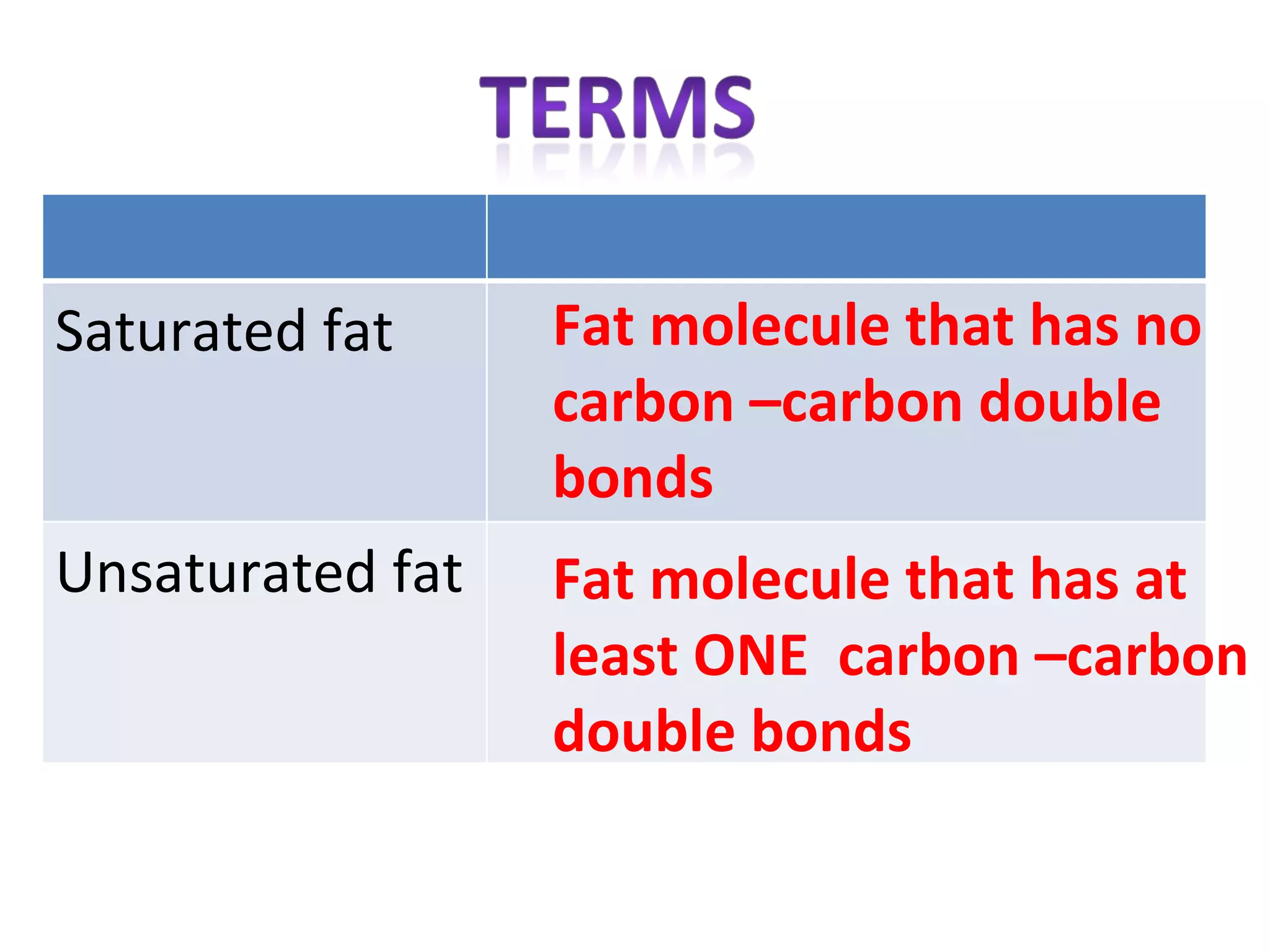
Saturated fat     Fat molecule that has no
                  carbon –carbon double
                  bonds
Unsaturated fat   Fat molecule that has at
                  least ONE carbon –carbon
                  double bonds
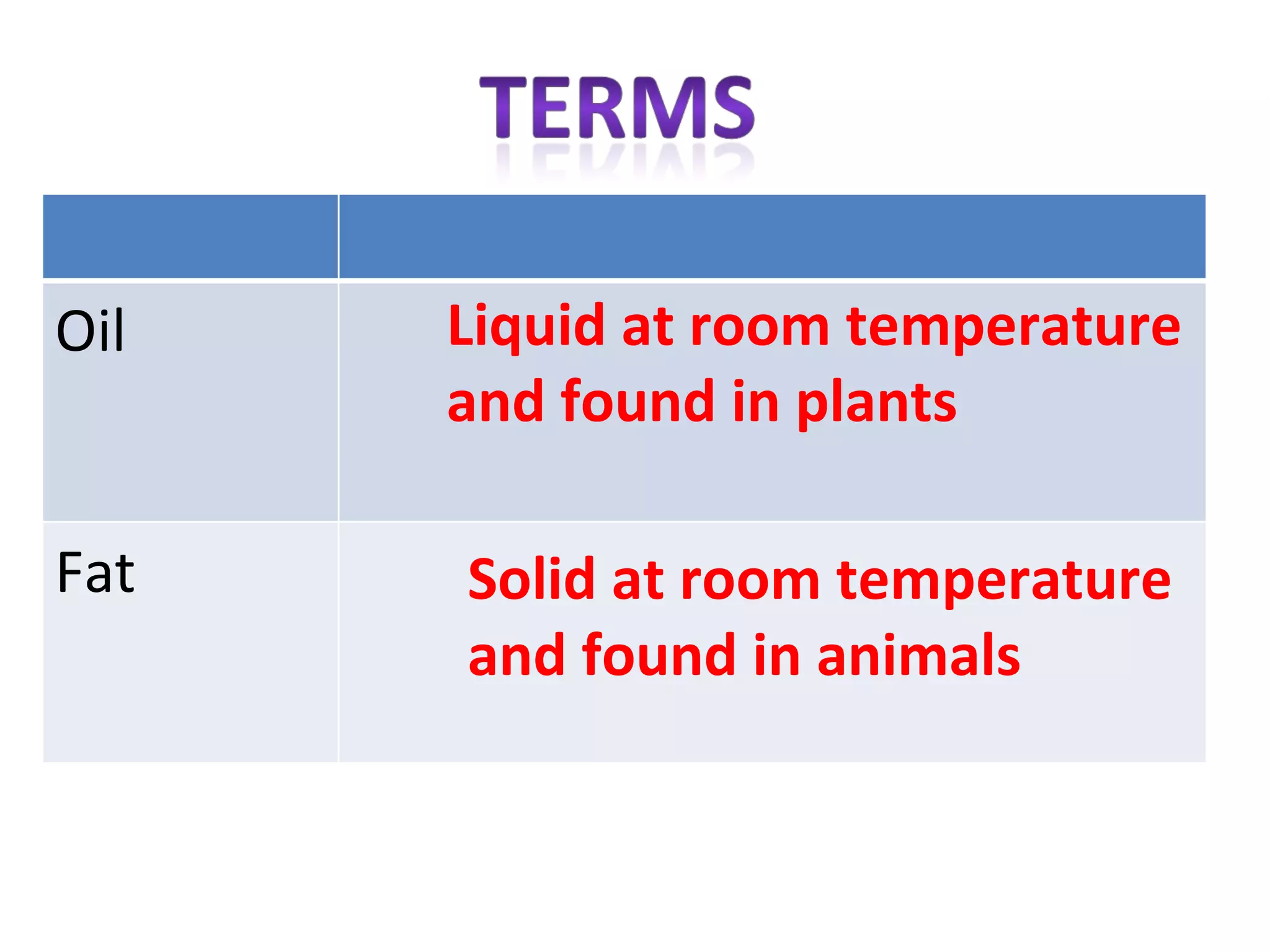
Oil   Liquid at room temperature
      and found in plants

Fat   Solid at room temperature
      and found in animals
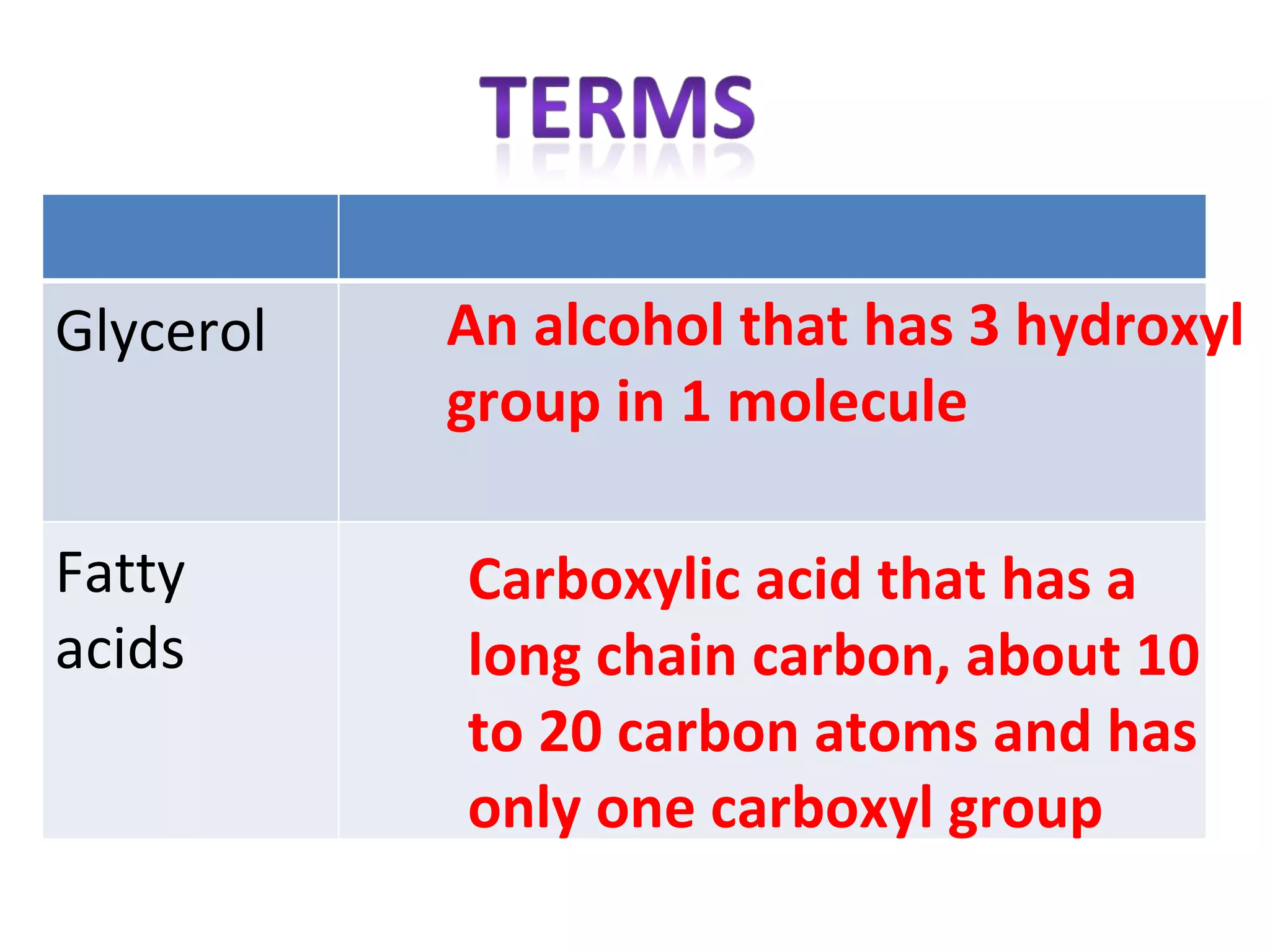
Glycerol   An alcohol that has 3 hydroxyl
           group in 1 molecule

Fatty      Carboxylic acid that has a
acids      long chain carbon, about 10
           to 20 carbon atoms and has
           only one carboxyl group
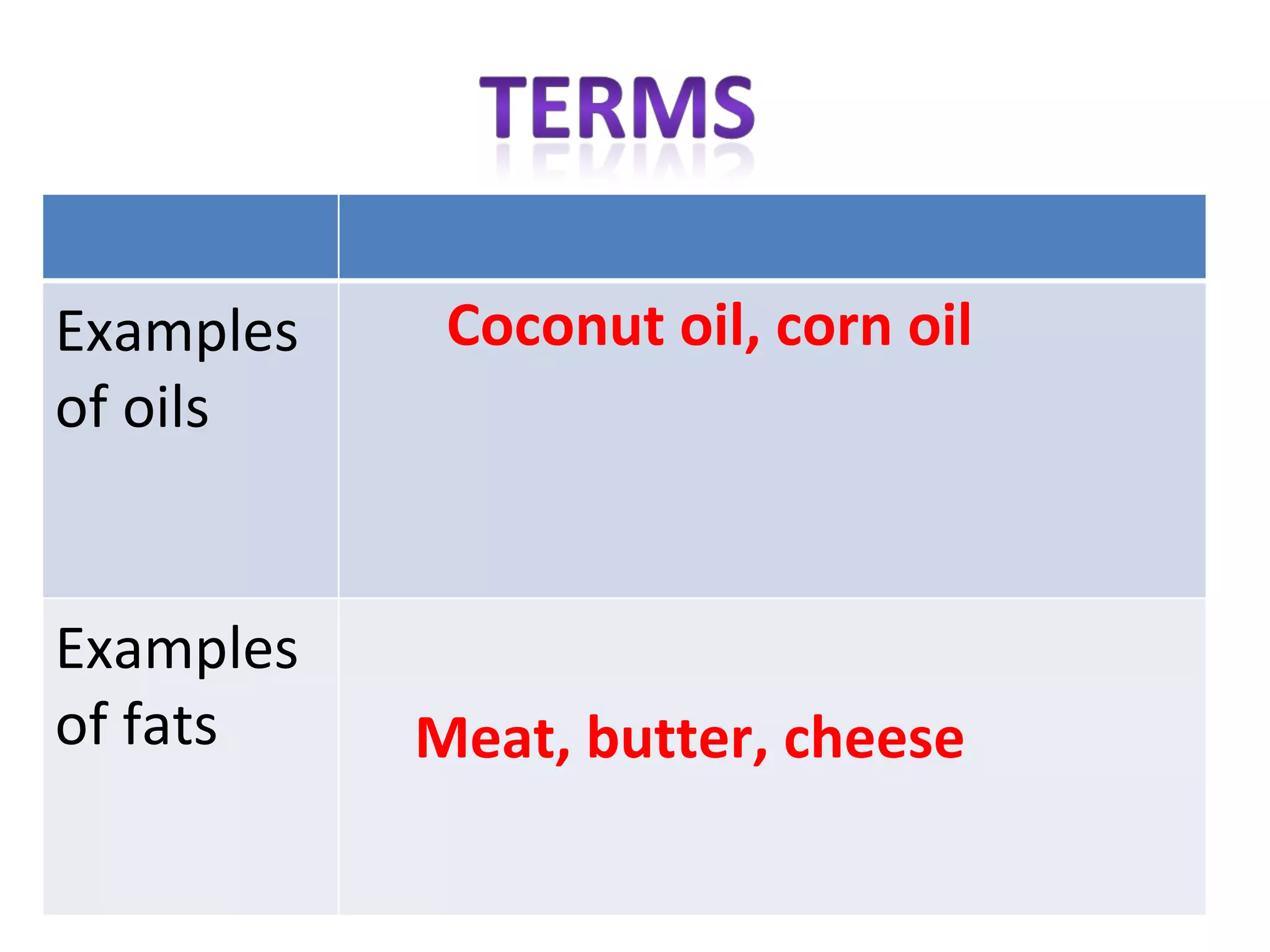
Examples    Coconut oil, corn oil
of oils

Examples
of fats    Meat, butter, cheese
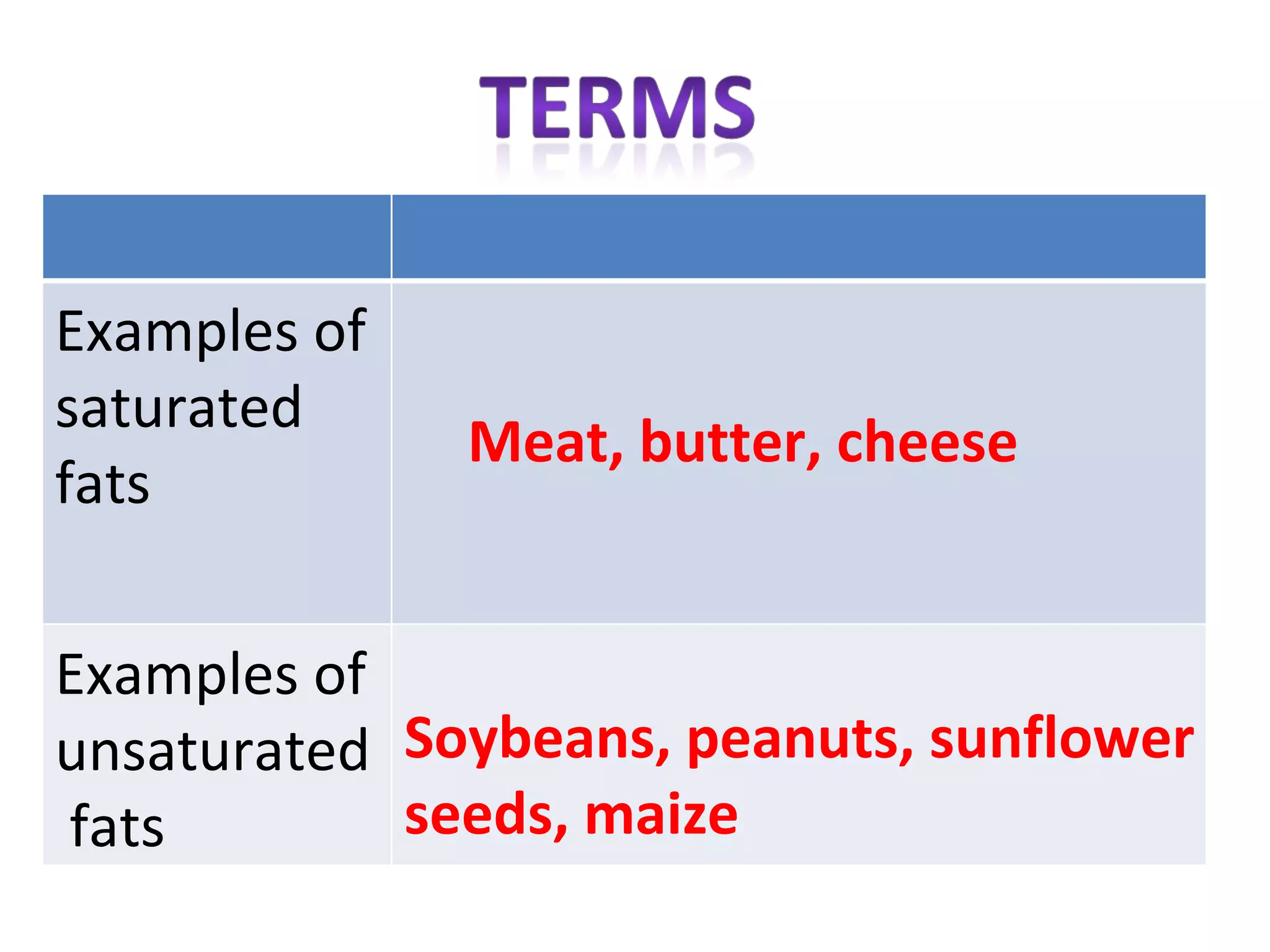
Examples of
saturated
              Meat, butter, cheese
fats


Examples of
unsaturated Soybeans, peanuts, sunflower
fats        seeds, maize
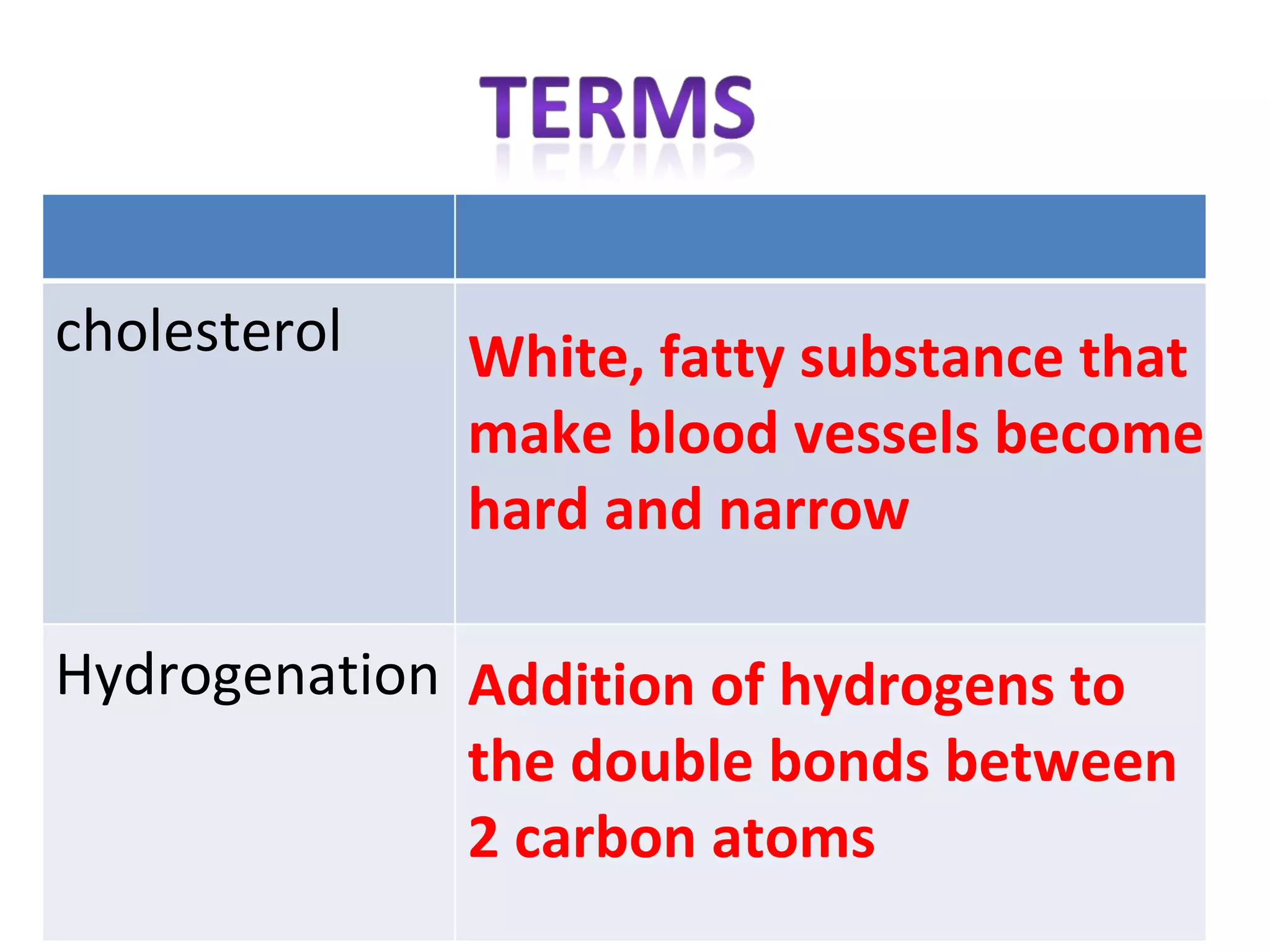
cholesterol   White, fatty substance that
              make blood vessels become
              hard and narrow

Hydrogenation Addition of hydrogens to
              the double bonds between
              2 carbon atoms
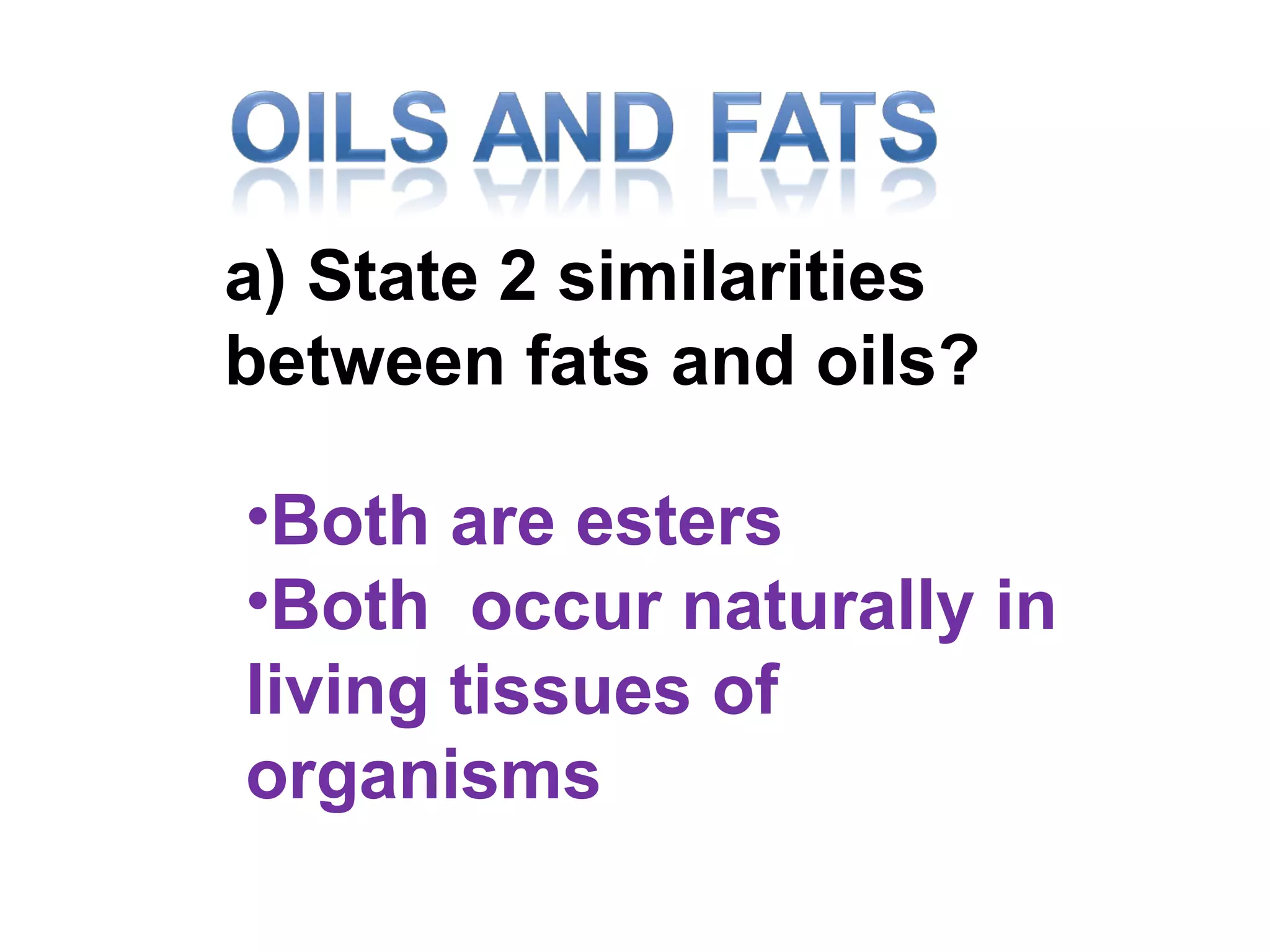
a) State 2 similarities
between fats and oils?

•Both are esters
•Both occur naturally in
living tissues of
organisms
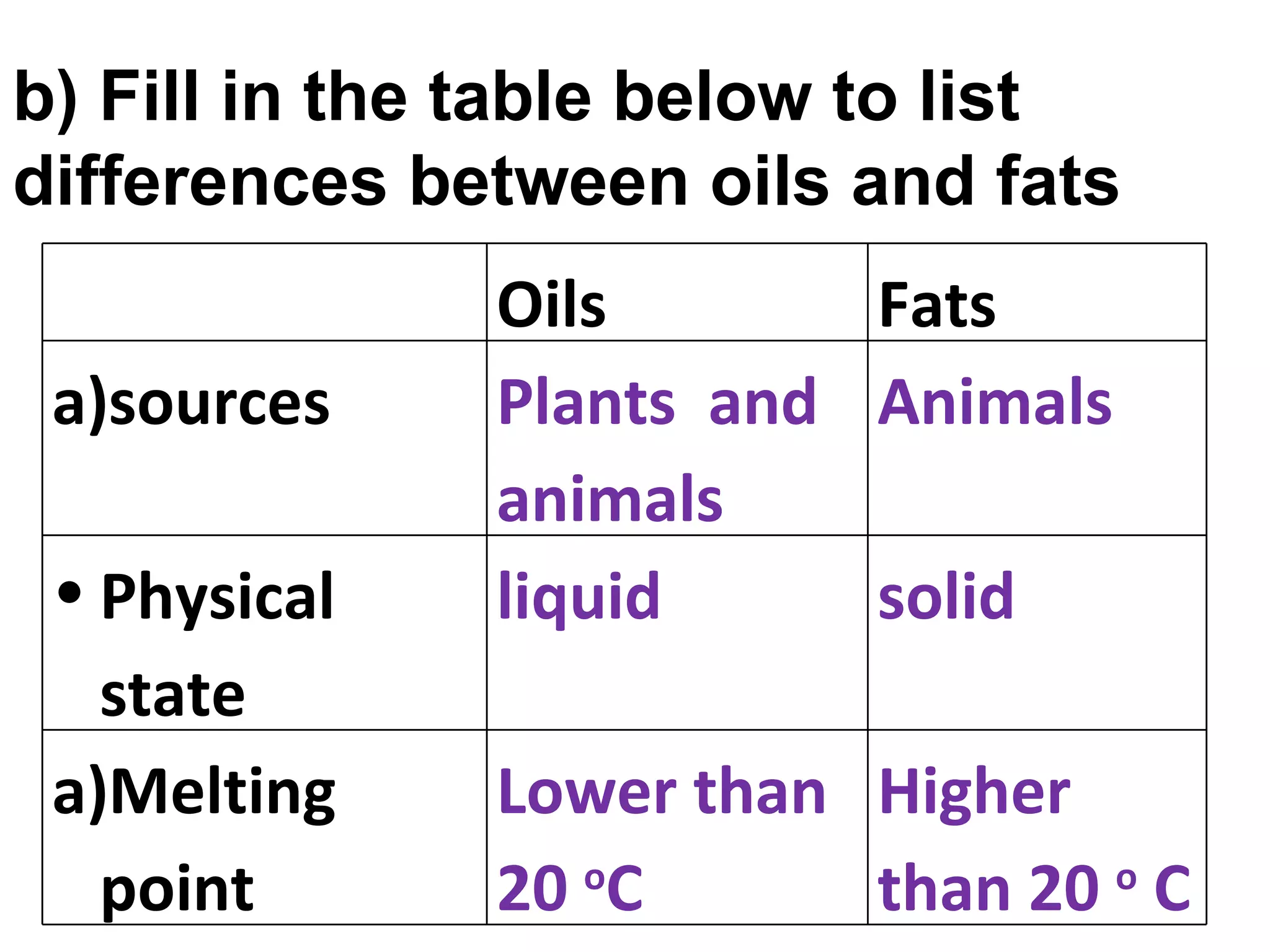
b) Fill in the table below to list
differences between oils and fats
              Oils       Fats
 a)sources    Plants and Animals
              animals
 • Physical   liquid     solid
   state
 a)Melting    Lower than Higher
   point      20 oC      than 20 o C
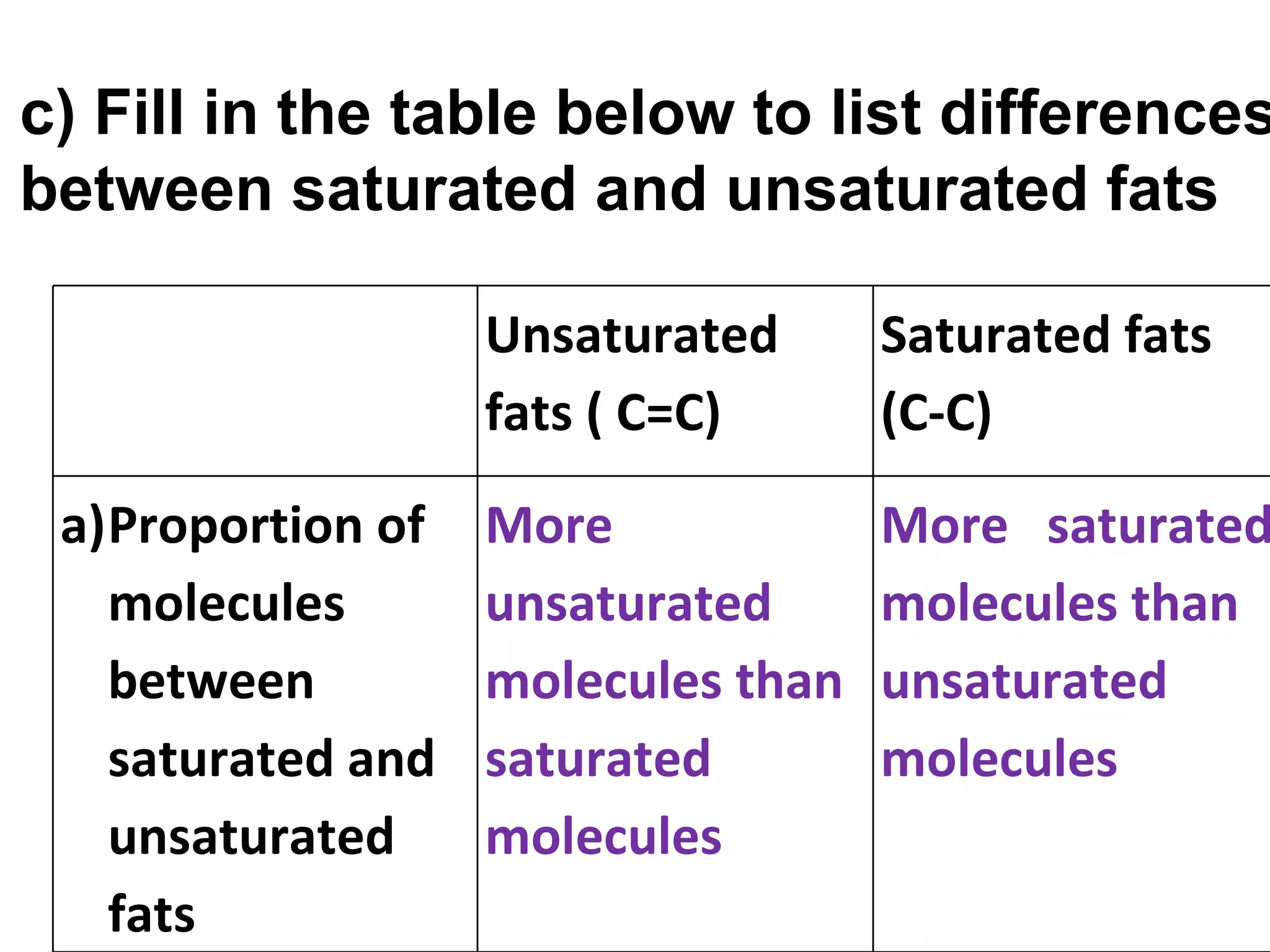
c) Fill in the table below to list differences
between saturated and unsaturated fats

                   Unsaturated      Saturated fats
                   fats ( C=C)      (C-C)
 a)Proportion of   More             More saturated
   molecules       unsaturated      molecules than
   between         molecules than   unsaturated
   saturated and   saturated        molecules
   unsaturated     molecules
   fats
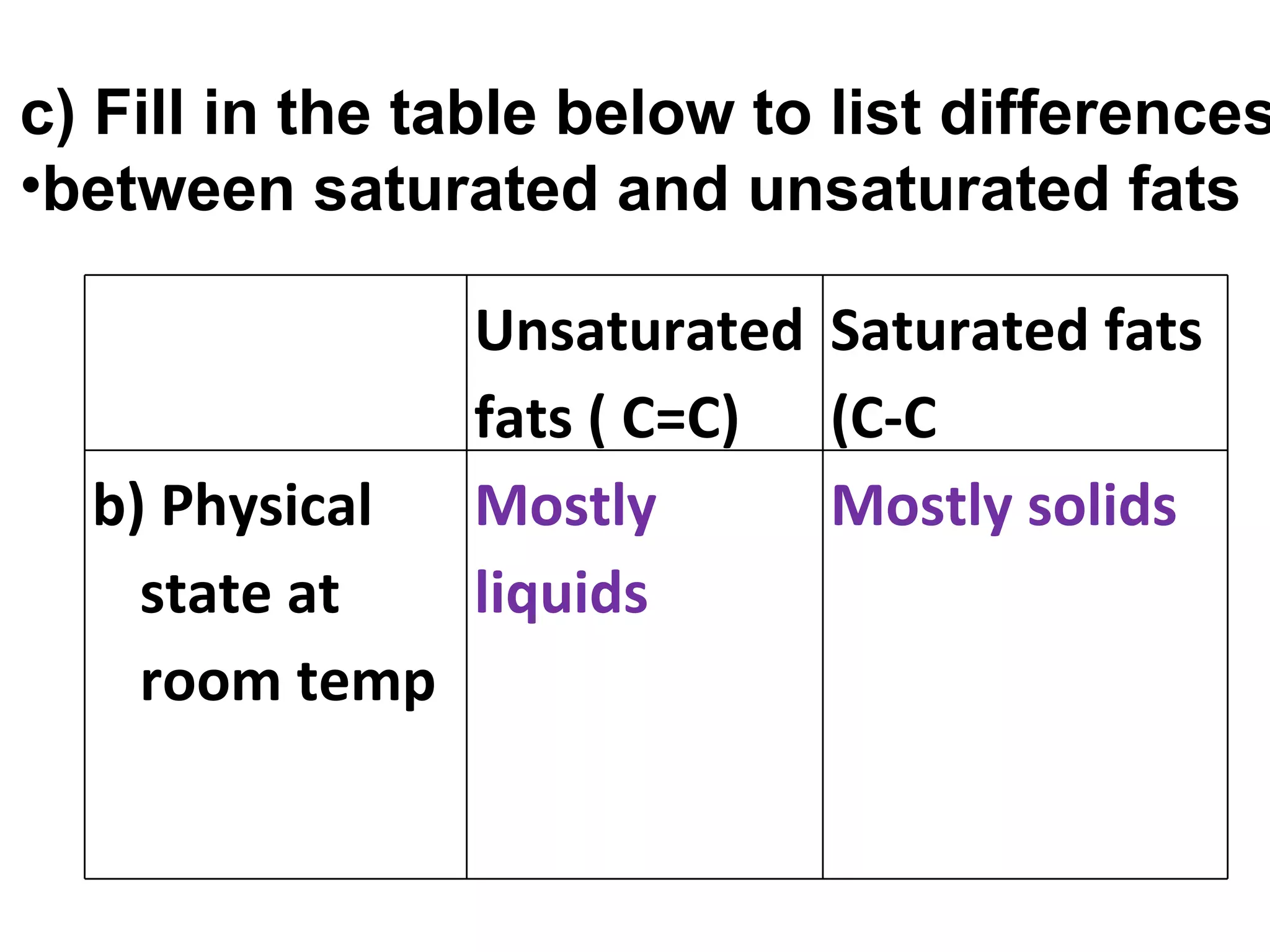
c) Fill in the table below to list differences
•between saturated and unsaturated fats

                Unsaturated Saturated fats
                fats ( C=C) (C-C
  b) Physical   Mostly      Mostly solids
    state at    liquids
    room temp
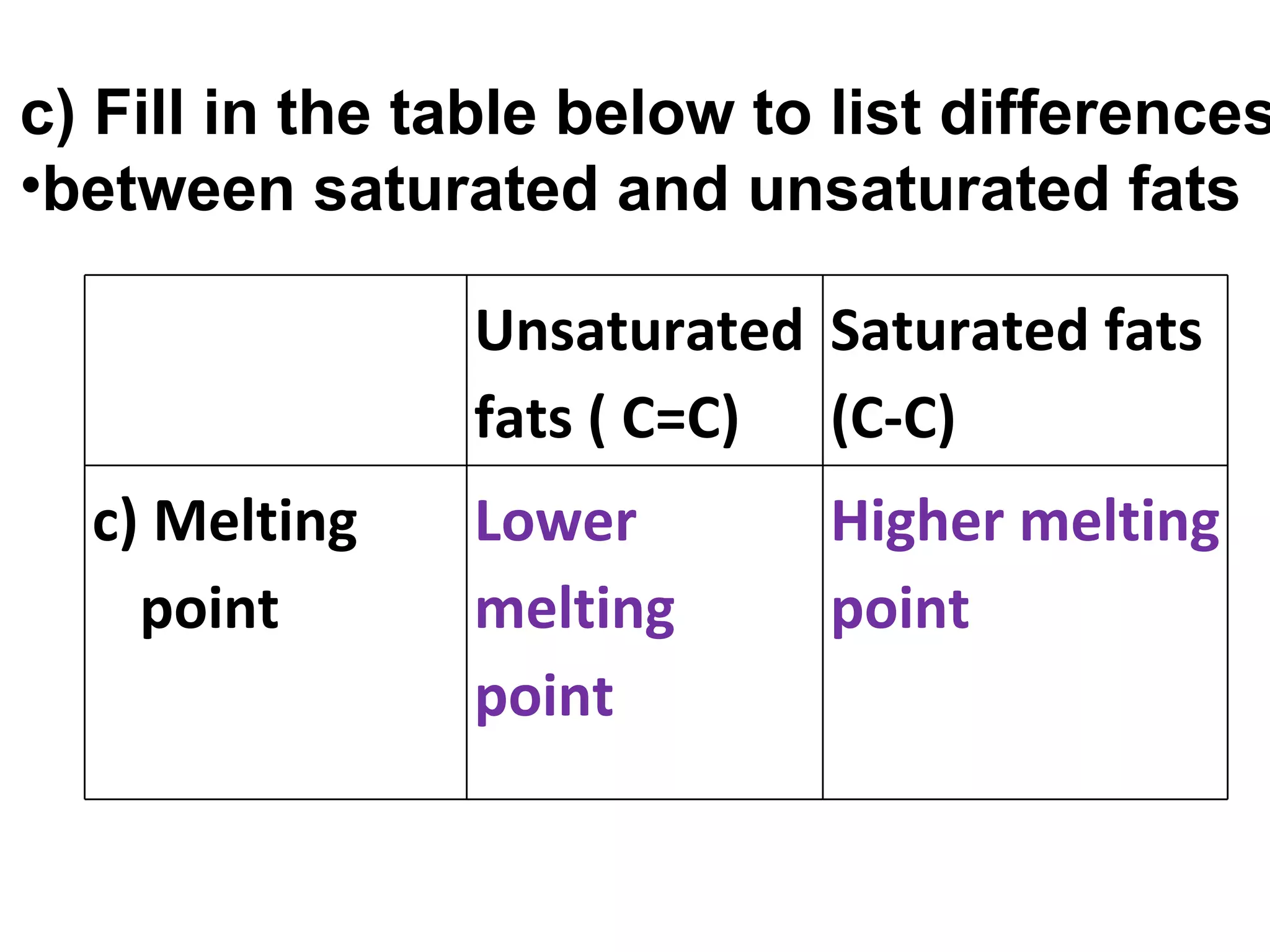
c) Fill in the table below to list differences
•between saturated and unsaturated fats

                Unsaturated Saturated fats
                fats ( C=C) (C-C)
  c) Melting    Lower        Higher melting
    point       melting      point
                point
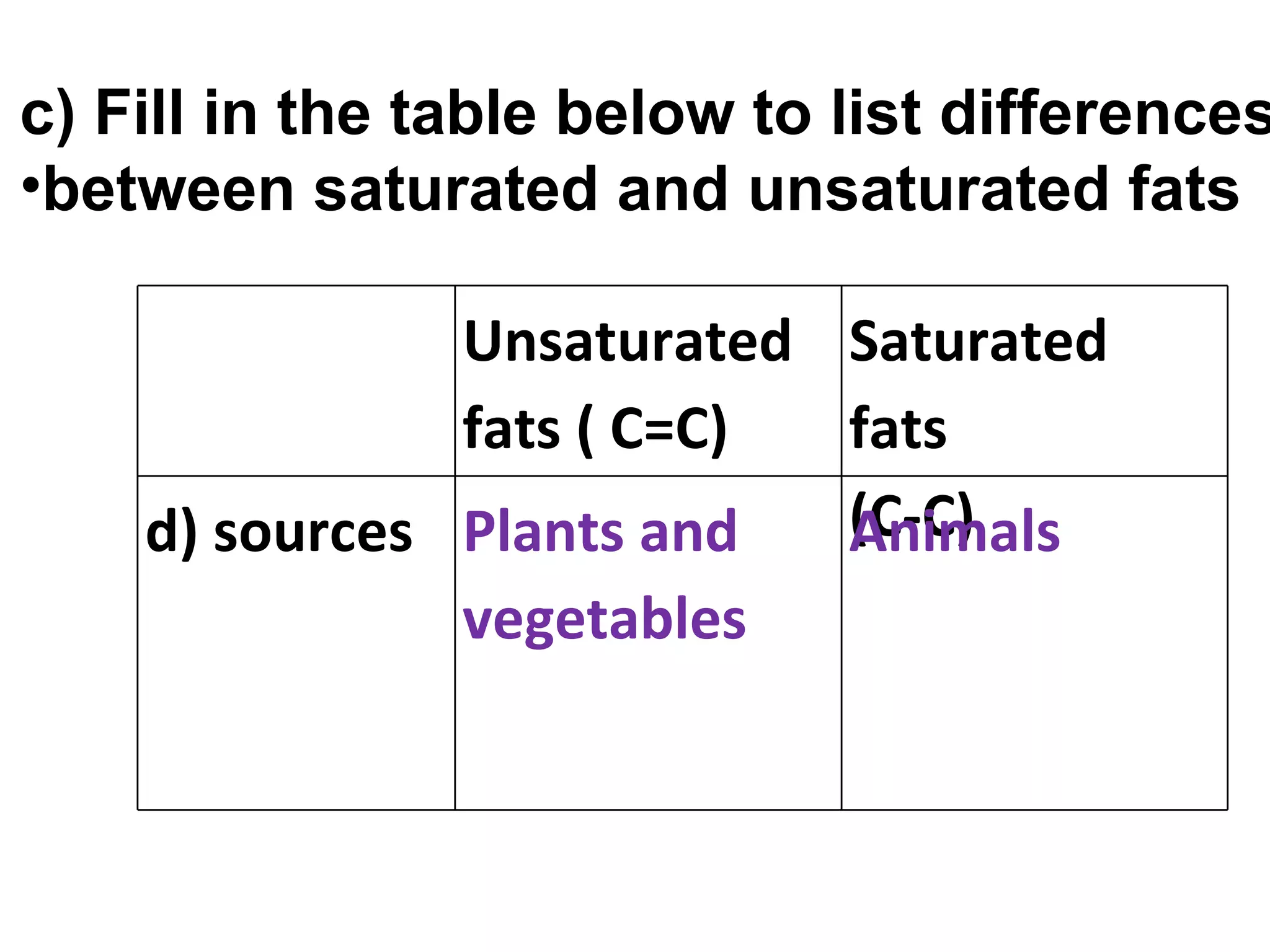
c) Fill in the table below to list differences
•between saturated and unsaturated fats

               Unsaturated Saturated
               fats ( C=C) fats
    d) sources Plants and  (C-C)
                           Animals
               vegetables
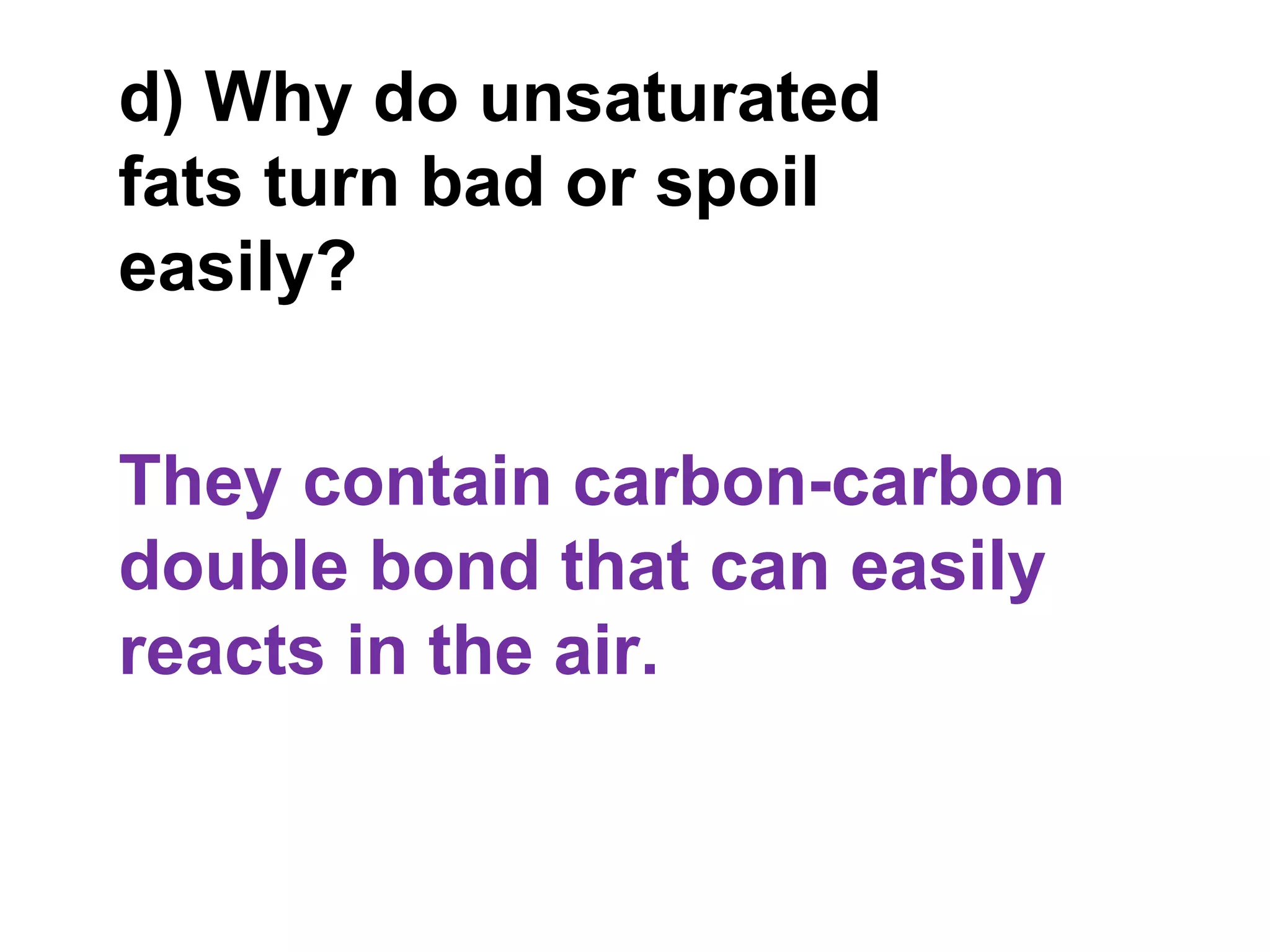
d) Why do unsaturated
fats turn bad or spoil
easily?


They contain carbon-carbon
double bond that can easily
reacts in the air.
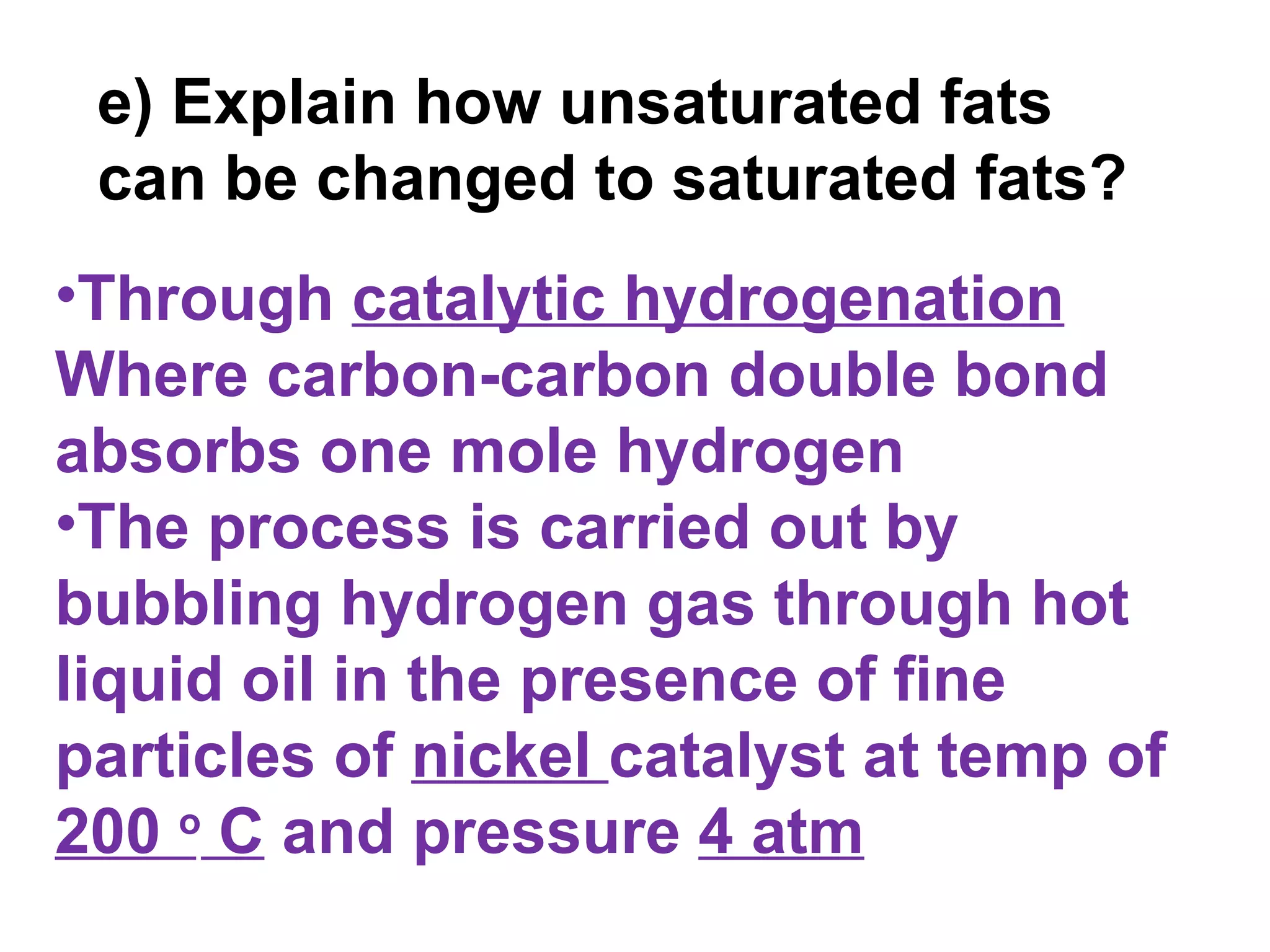
e) Explain how unsaturated fats
 can be changed to saturated fats?
•Through catalytic hydrogenation
Where carbon-carbon double bond
absorbs one mole hydrogen
•The process is carried out by
bubbling hydrogen gas through hot
liquid oil in the presence of fine
particles of nickel catalyst at temp of
200 o C and pressure 4 atm
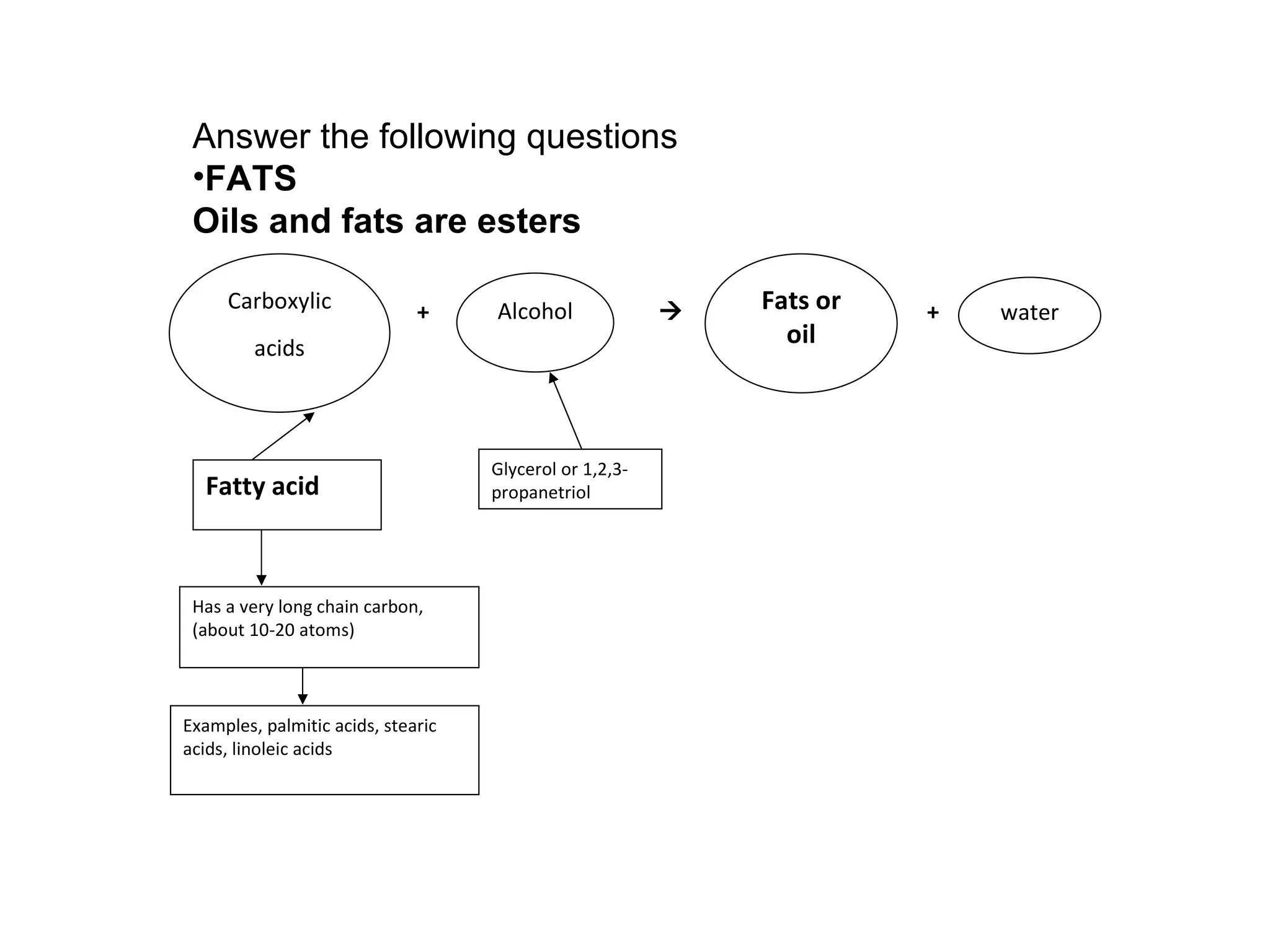
Answer the following questions
 •FATS
 Oils and fats are esters

     Carboxylic               +     Alcohol                 Fats or   +   water
         acids
                                                               oil


                                    Glycerol or 1,2,3-
  Fatty acid                        propanetriol


 Has a very long chain carbon,
 (about 10-20 atoms)


Examples, palmitic acids, stearic
acids, linoleic acids
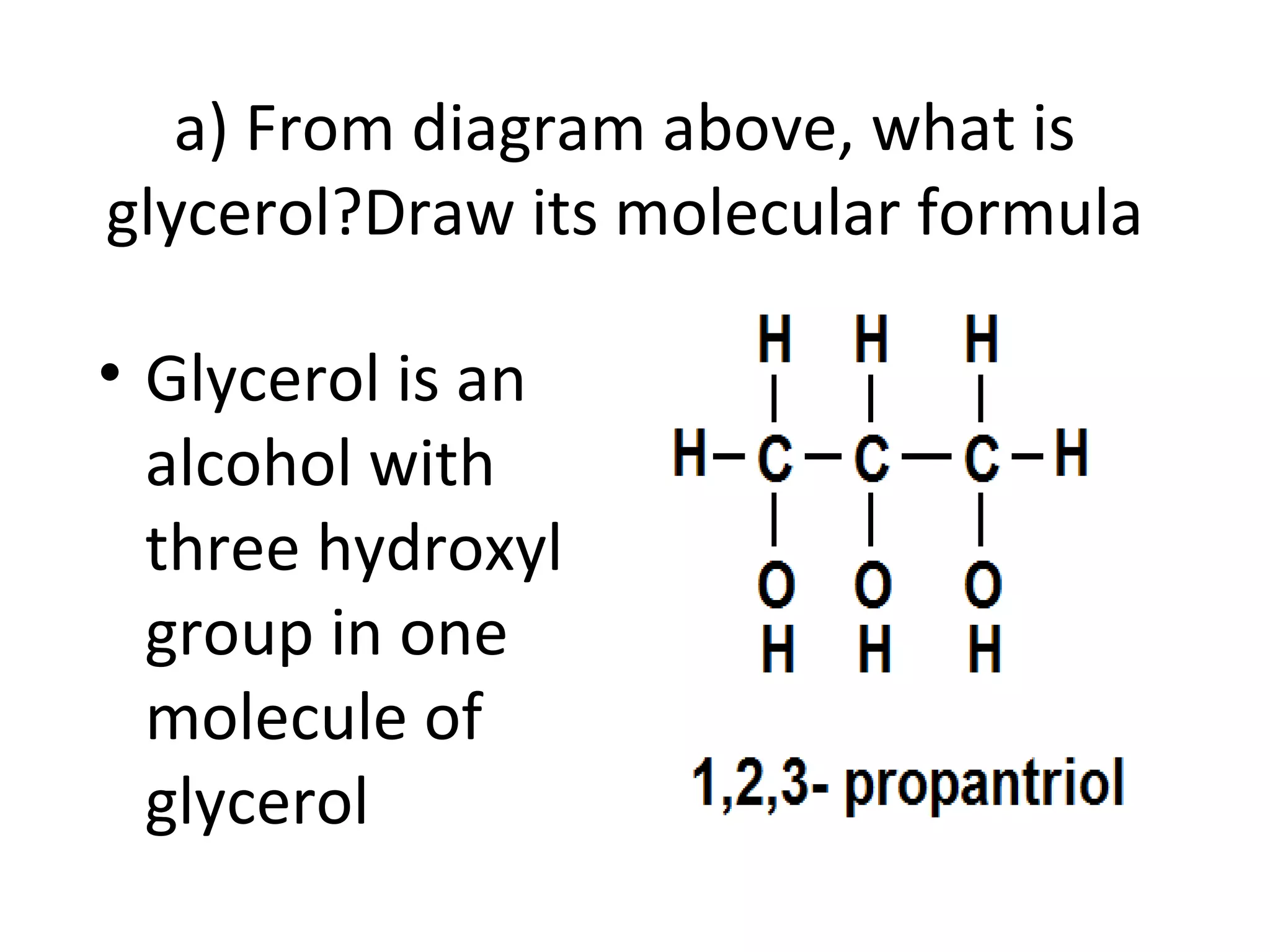
a) From diagram above, what is
glycerol?Draw its molecular formula

• Glycerol is an
  alcohol with
  three hydroxyl
  group in one
  molecule of
  glycerol
b) From diagram above, what is the
difference between a fat molecule and a
fatty acid molecule?

•A fat molecule is formed when long-
chained carboxylic acid reacts with
alcohol with three OH-groups (glycerol)
•A fatty acid molecule is carboxylic acid
molecule that has a long chain carbon
atom ( about 10- 20 atoms)
c) Hexanoic acid and pentanol react
together to form a product. Name the
product formed and state its
homologous series

 Name of product: pentyl hexanoate

 Homologous series : ester
•Can hexanoic acid and pentanol react
together to form Fat or Oil? Explain your
answer
   No, because hexanoic acid is a
   short chain carboxylic acid with
   carbon atoms only 6 atoms and
   pentanol is not a glycerol
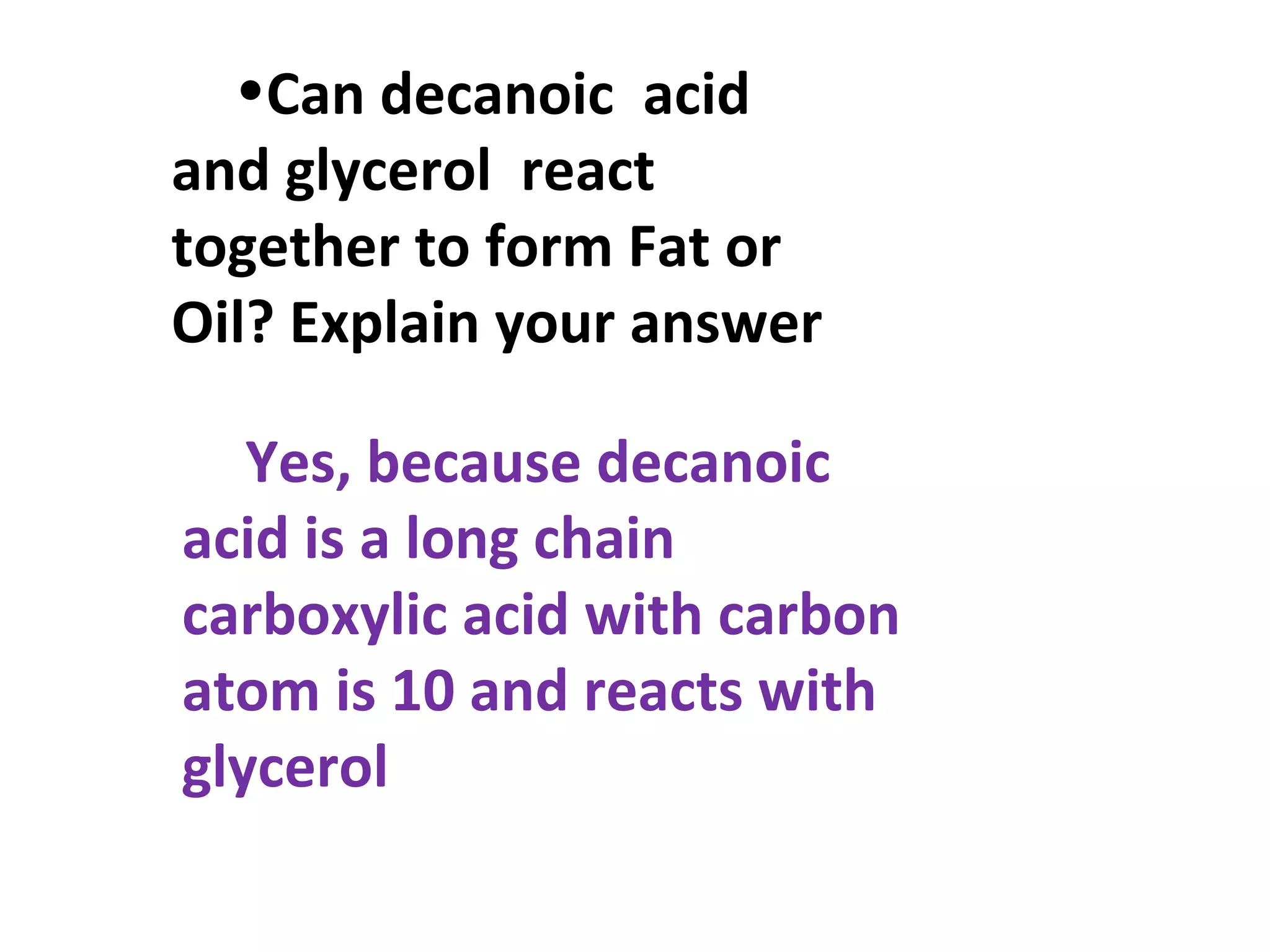
•Can decanoic acid
and glycerol react
together to form Fat or
Oil? Explain your answer

   Yes, because decanoic
acid is a long chain
carboxylic acid with carbon
atom is 10 and reacts with
glycerol
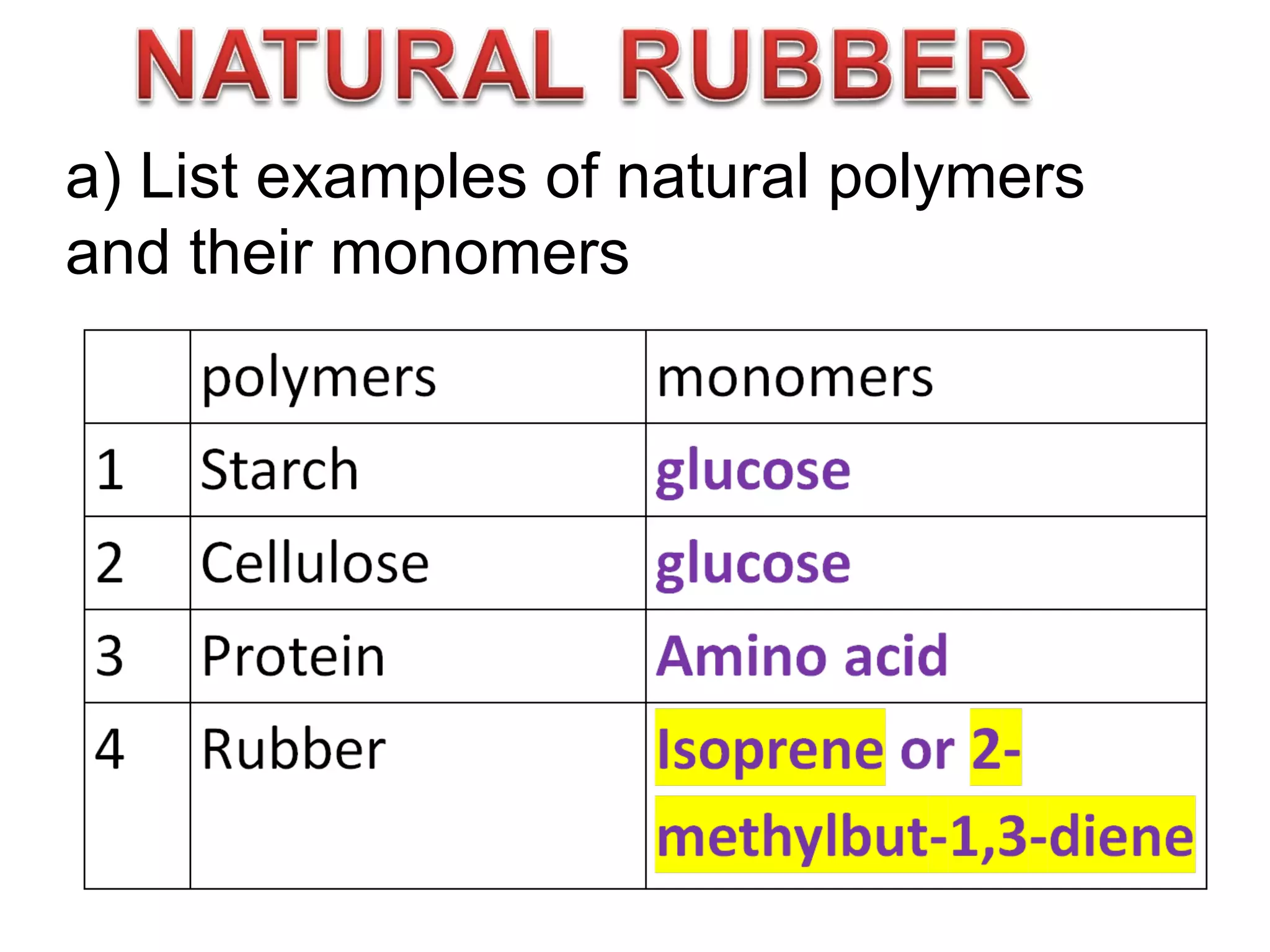
a) List examples of natural polymers
and their monomers
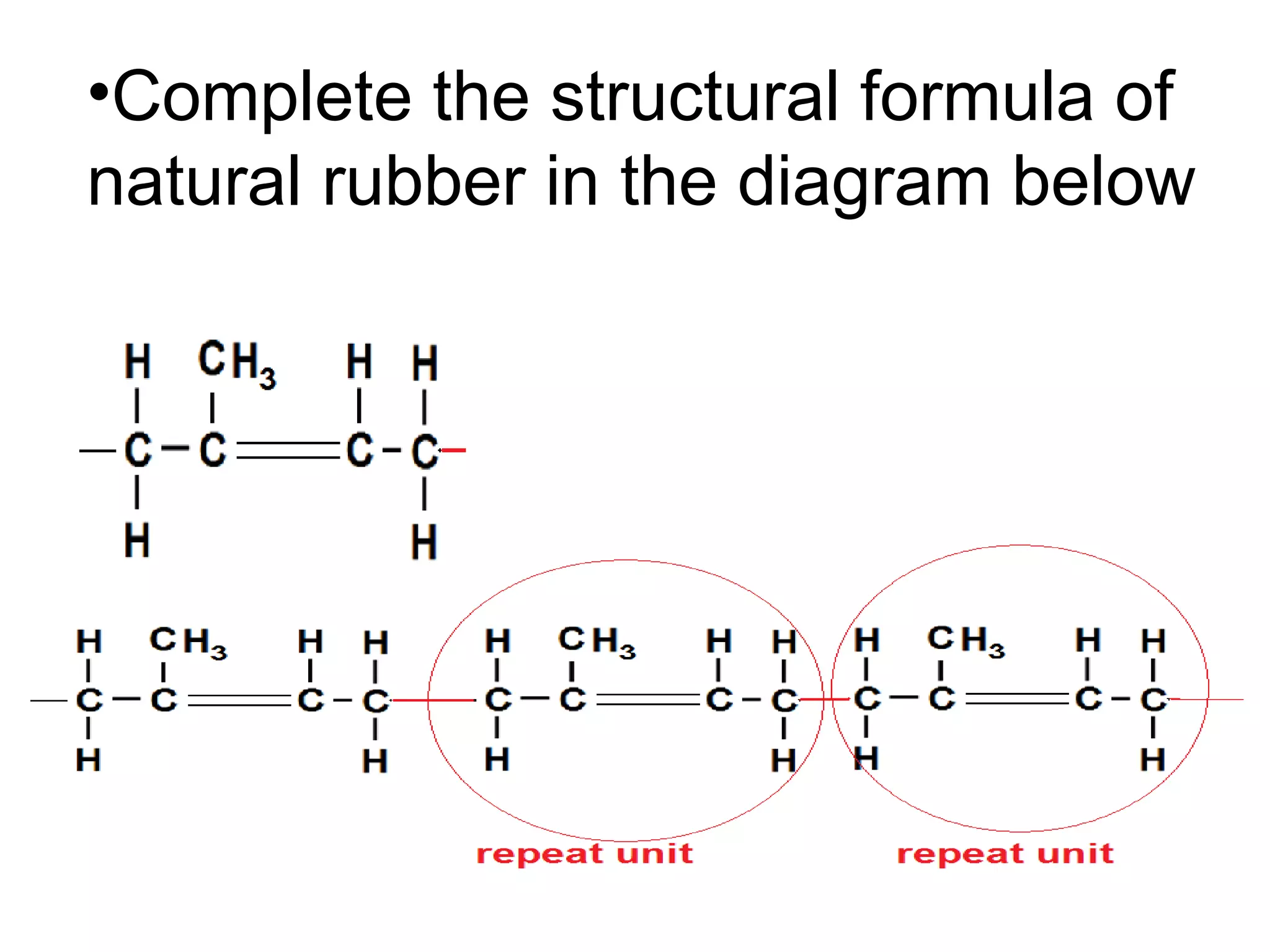
•Complete the structural formula of
natural rubber in the diagram below
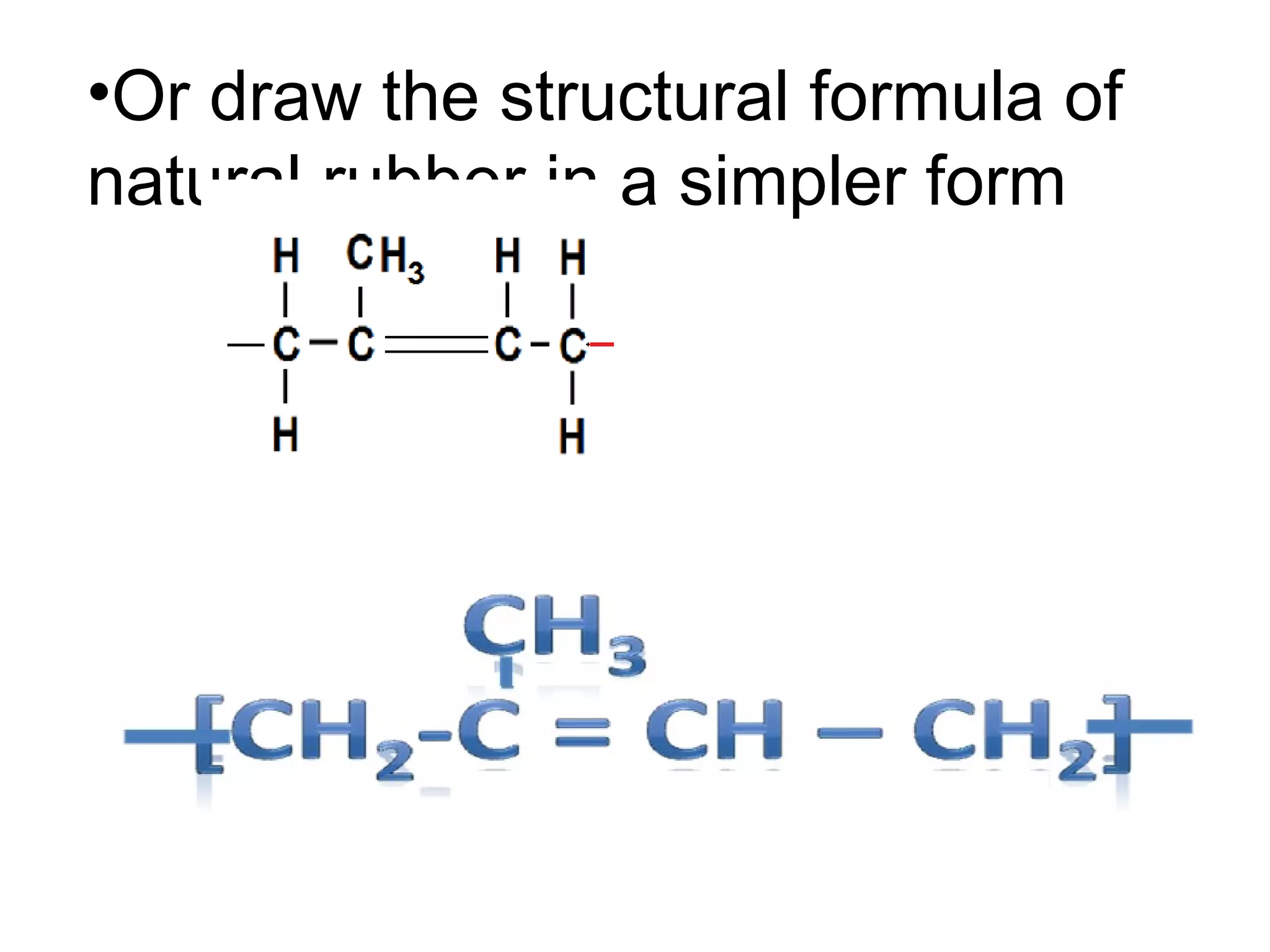
•Or draw the structural formula of
natural rubber in a simpler form
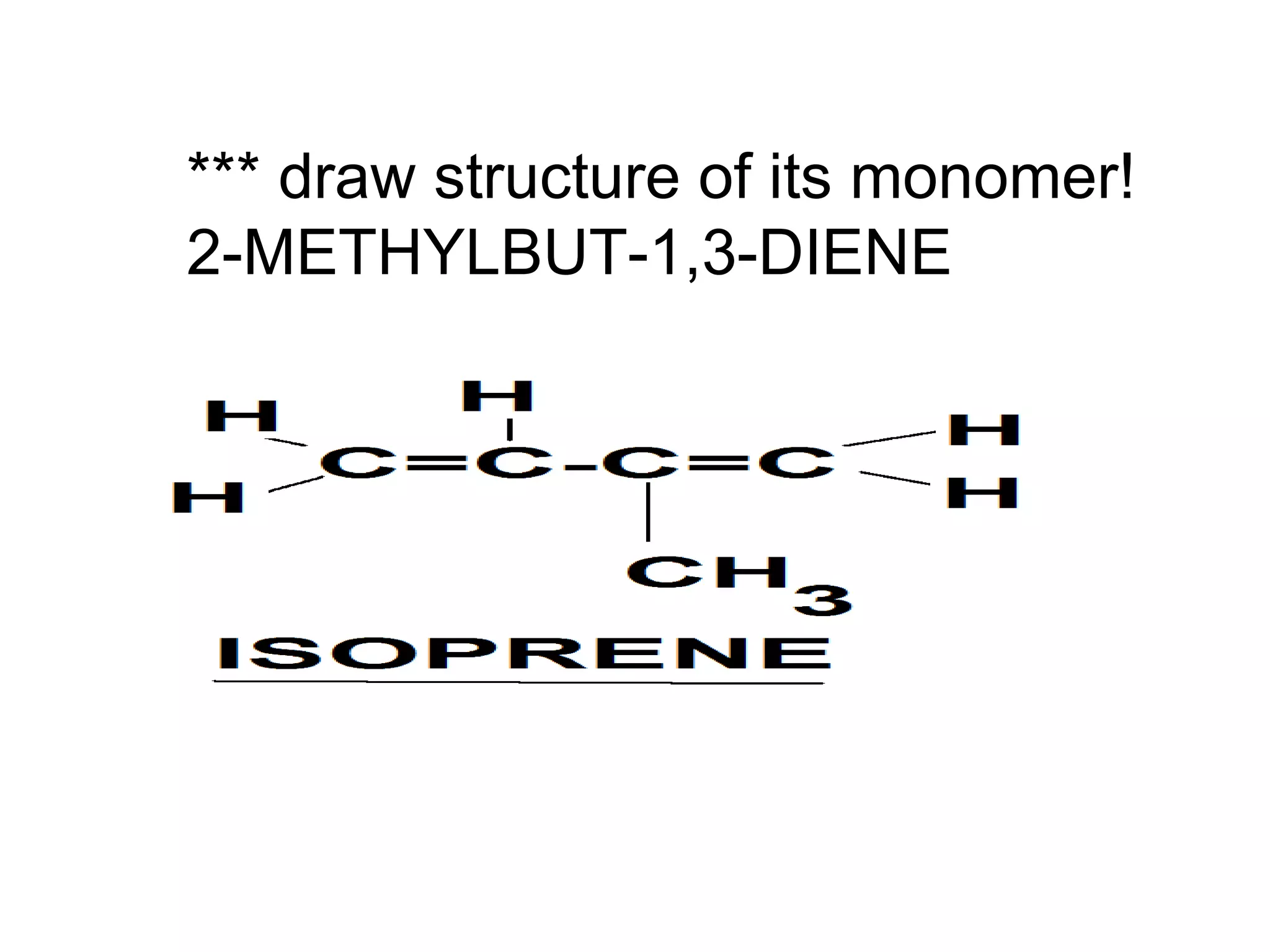
*** draw structure of its monomer!
2-METHYLBUT-1,3-DIENE
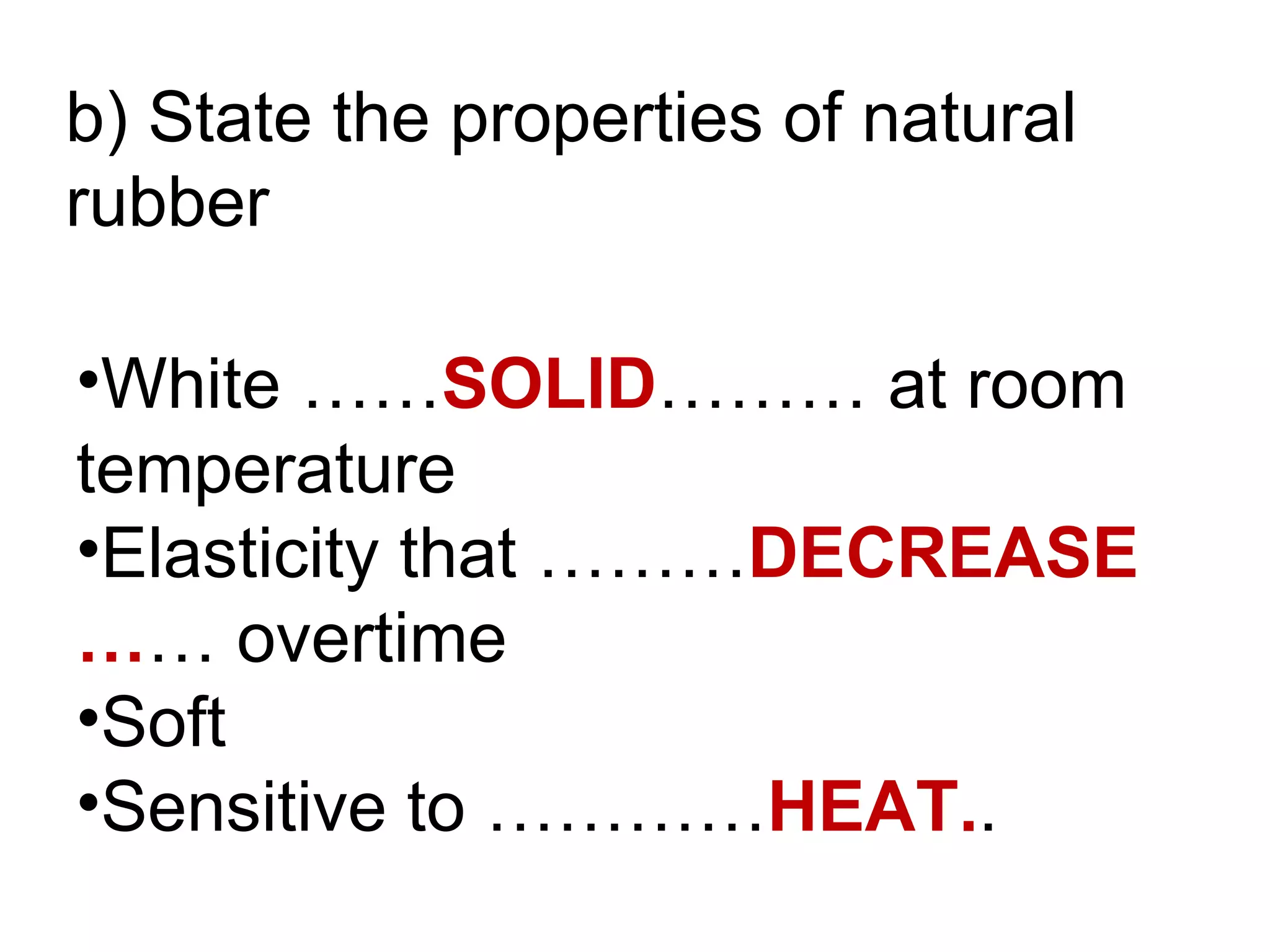
b) State the properties of natural
rubber

•White ……SOLID……… at room
temperature
•Elasticity that ………DECREASE
…… overtime
•Soft
•Sensitive to …………HEAT..
•State 3 uses of natural rubber

•In the making of tyres, footwear,
rubber threads, rubber foam,
conveyor belts and bitumen roads
•Buildings built on rubber blocks or
rubber bearings to help absorb
vibration
•Making of gloves, tubes and hoses
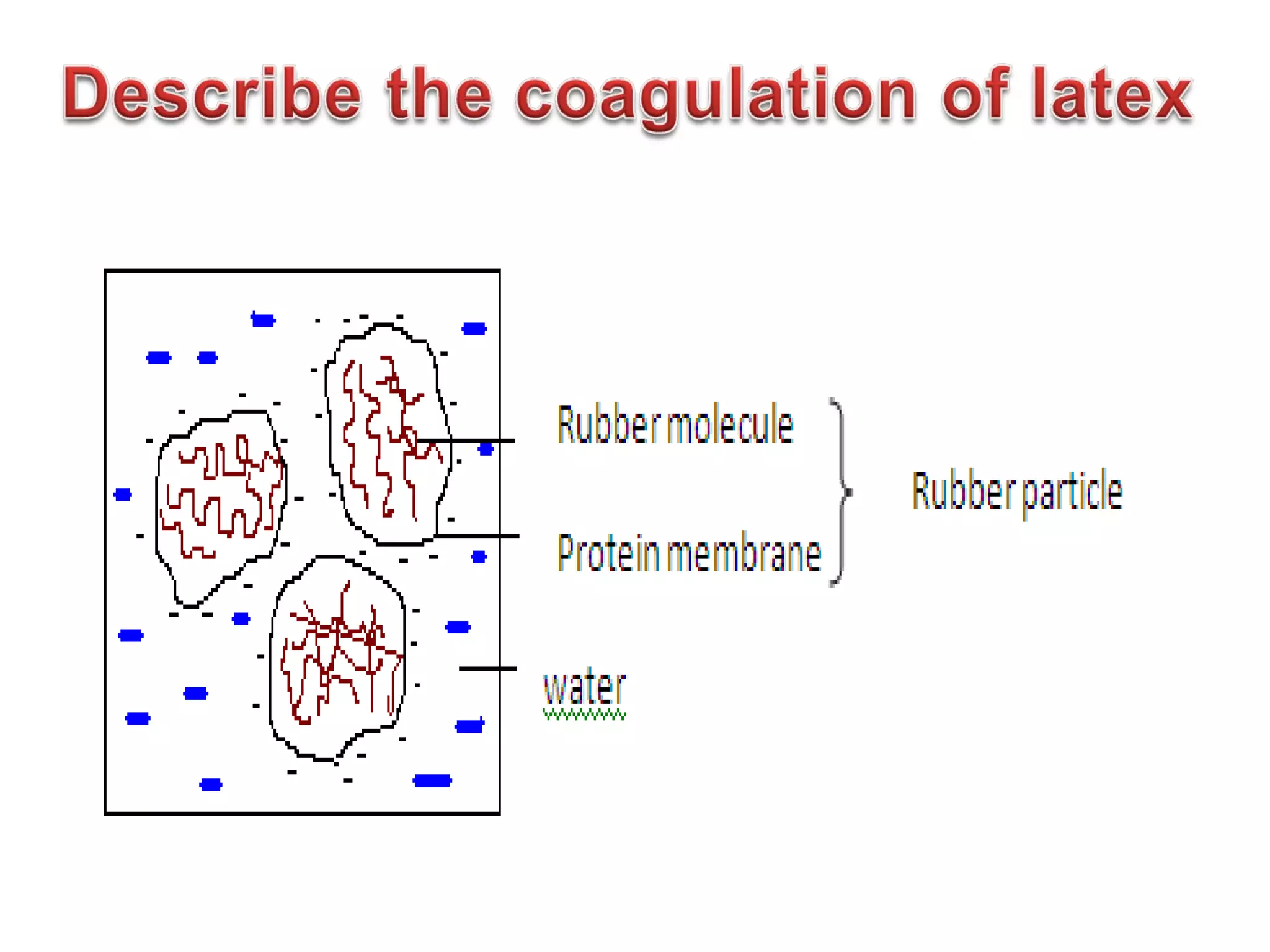
•Latex is a …………COLLOID…………
•It consists of ……RUBBER PARTICLES
particles dispersed in ……WATER…
•Each rubber particle is made-up many long-
chain ………RUBBER………..molecules
enclosed by a ………PROTEIN..-like membrane
which is ……NEGATIVELY-charged
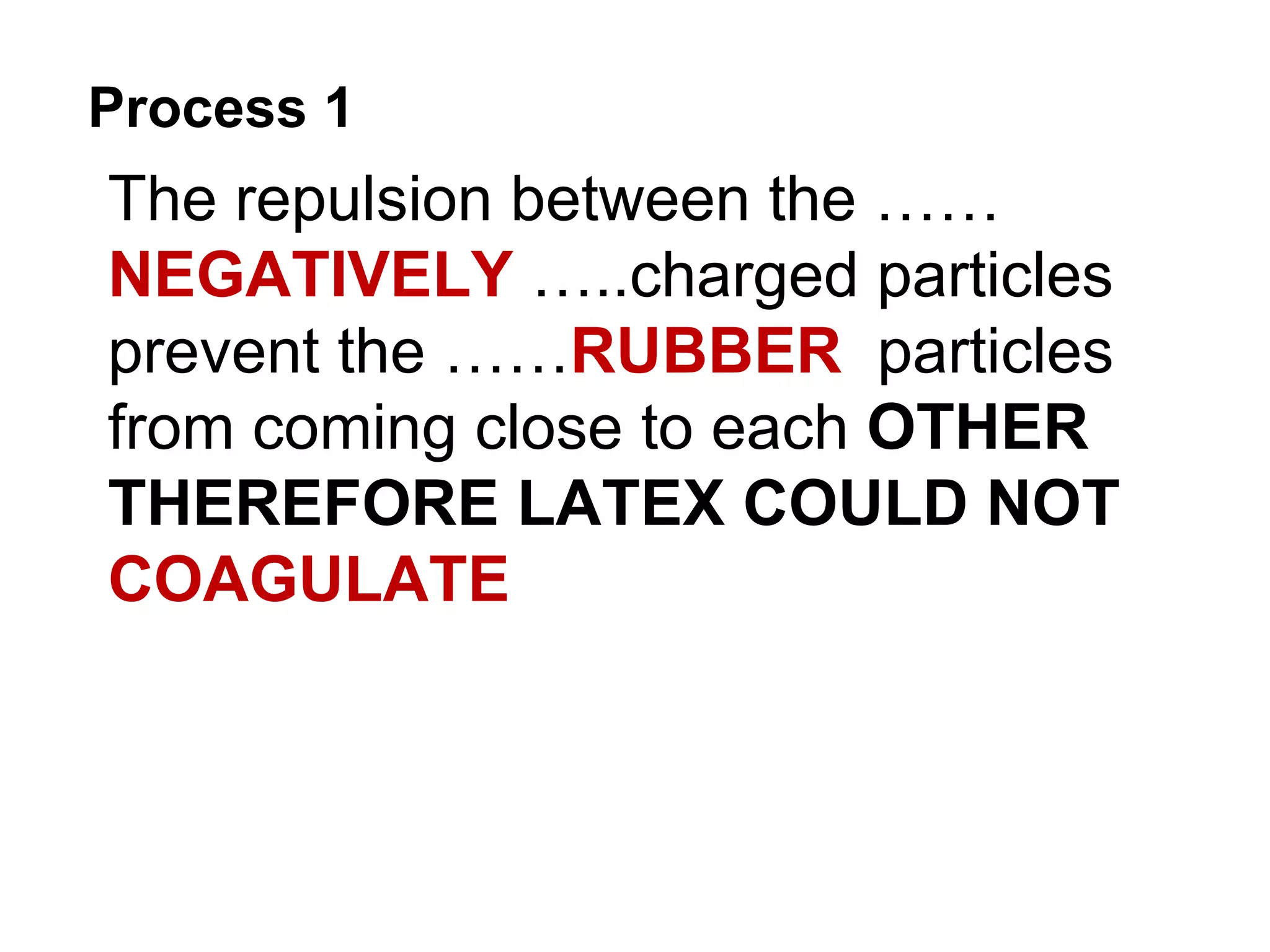
Process 1
The repulsion between the ……
NEGATIVELY …..charged particles
prevent the ……RUBBER particles
from coming close to each OTHER
THEREFORE LATEX COULD NOT
COAGULATE
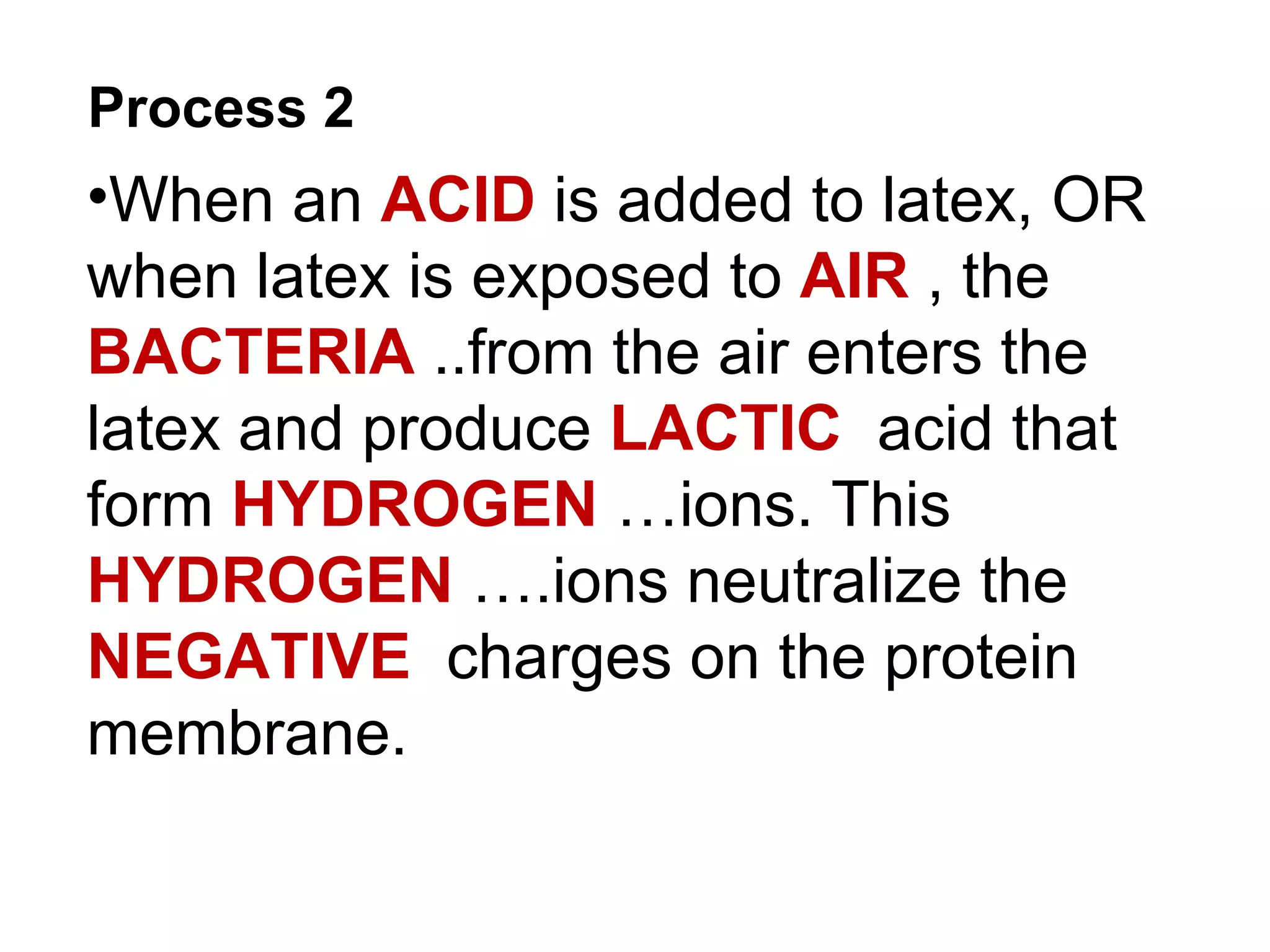
Process 2
•When an ACID is added to latex, OR
when latex is exposed to AIR , the
BACTERIA ..from the air enters the
latex and produce LACTIC acid that
form HYDROGEN …ions. This
HYDROGEN ….ions neutralize the
NEGATIVE charges on the protein
membrane.
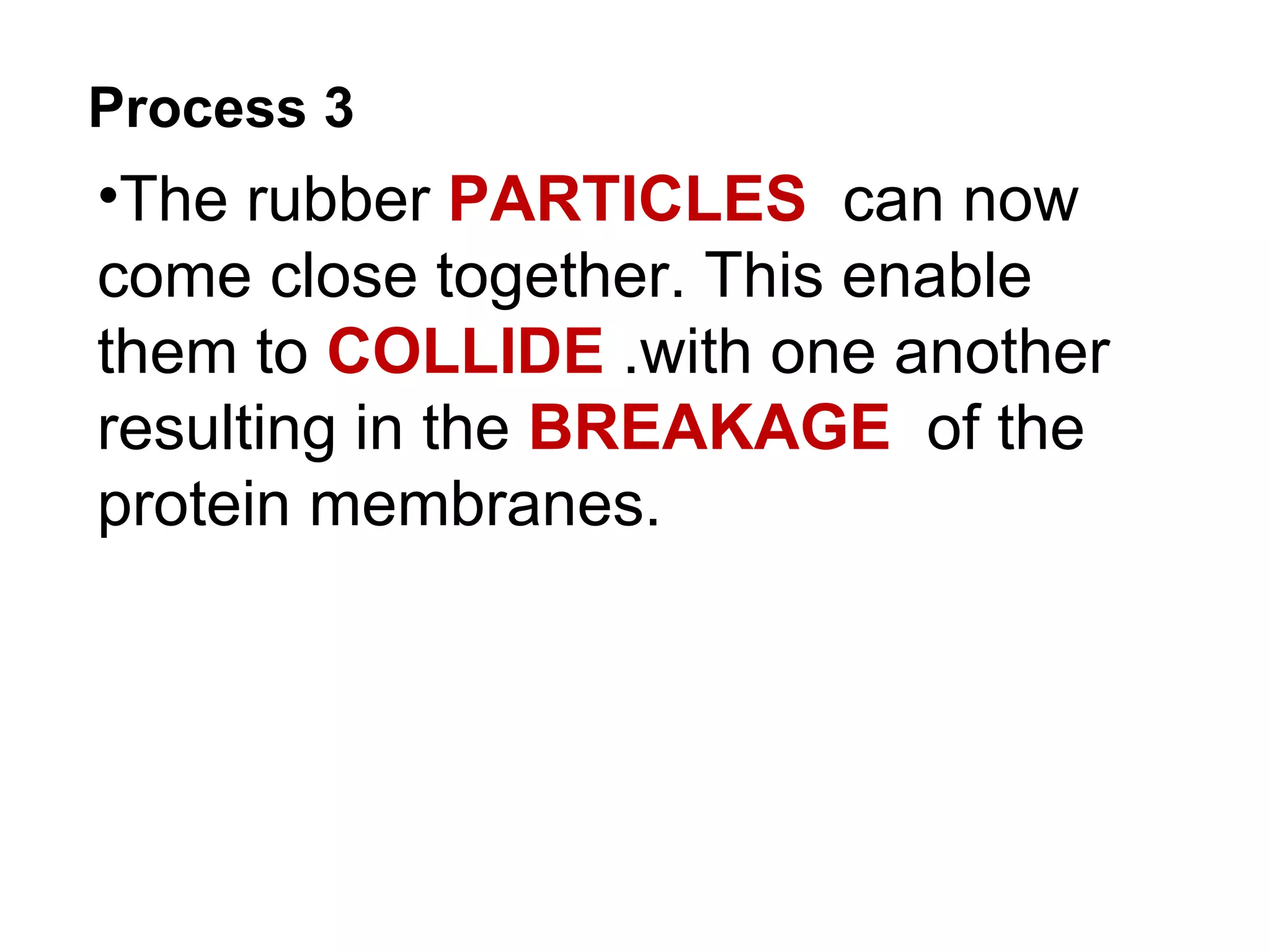
Process 3
•The rubber PARTICLES can now
come close together. This enable
them to COLLIDE .with one another
resulting in the BREAKAGE of the
protein membranes.
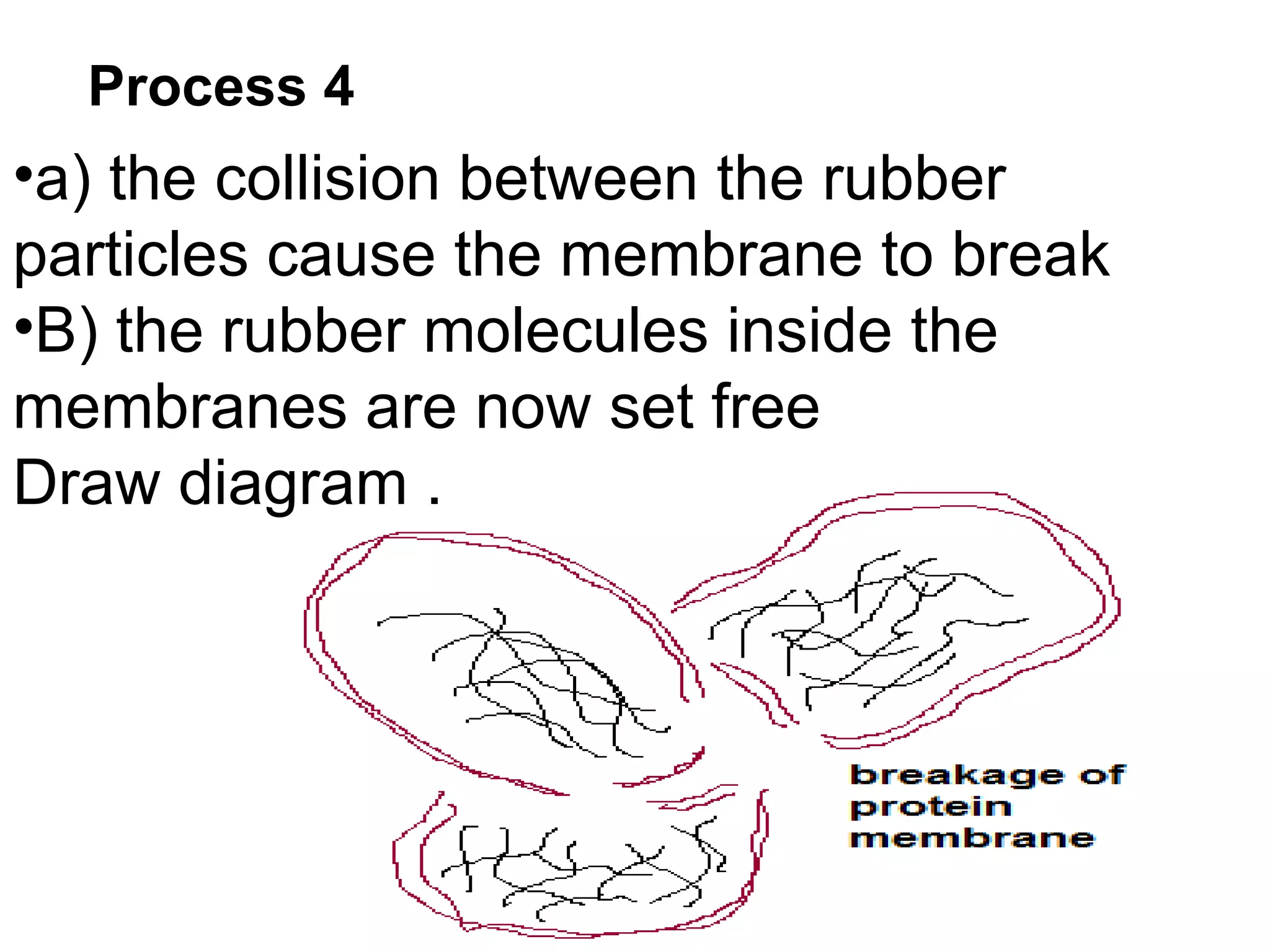
Process 4
•a) the collision between the rubber
particles cause the membrane to break
•B) the rubber molecules inside the
membranes are now set free
Draw diagram .
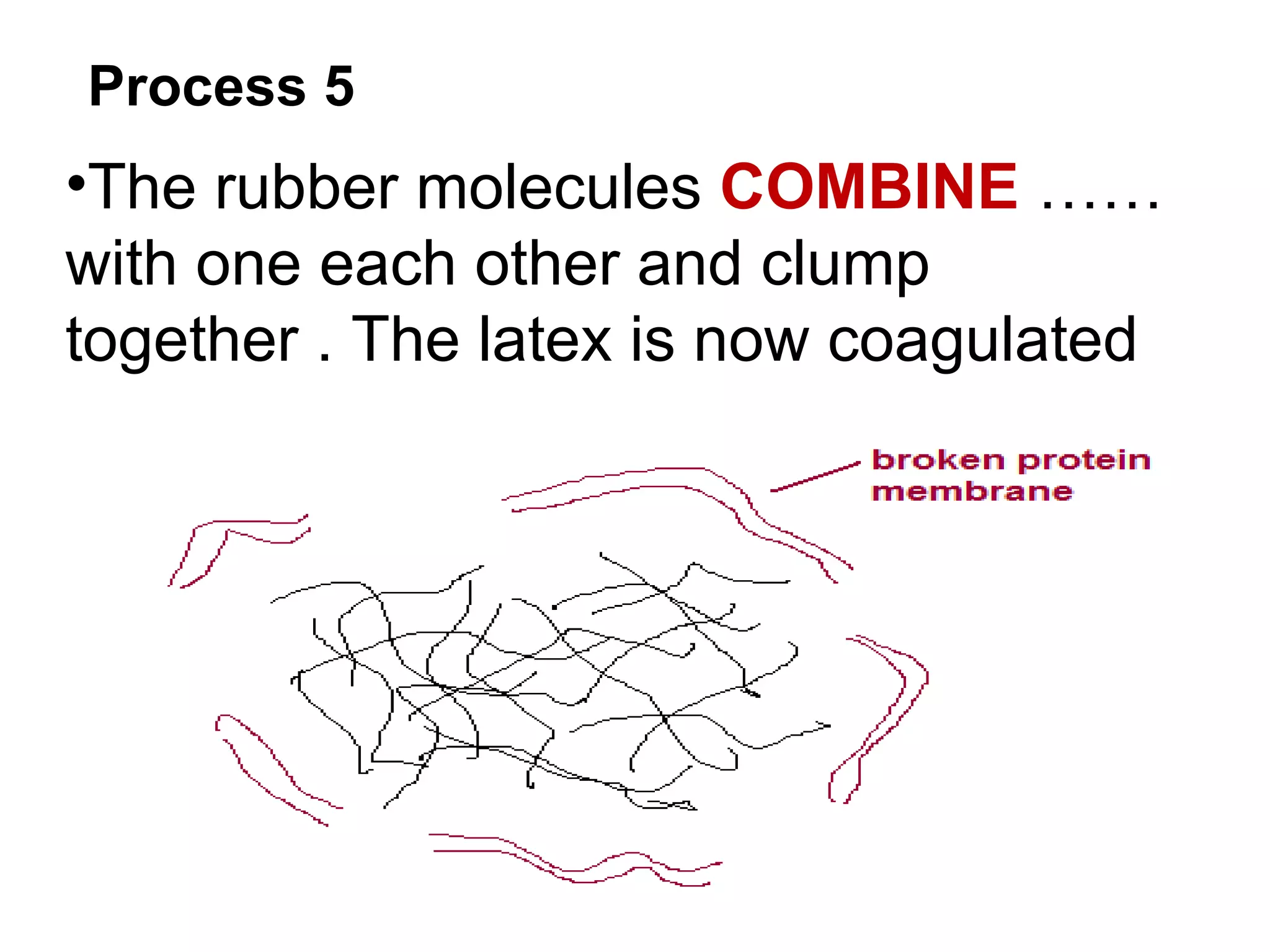
Process 5
•The rubber molecules COMBINE ……
with one each other and clump
together . The latex is now coagulated
iv) Describe how to prevent the
coagulation of latex
By adding AMMONIA ….solution, that
contains …HYDROXIDE ……….ions
which …NEUTRALIZE ………. the acid
produced by the bacteria . Therefore
rubber particles remain …
NEGATIVELY…… charged and the
coagulation is PREVENTED
VULCANISED RUBBER
a) What is meant by vulcanization
of rubber?
     ADDITION OF SULPHUR TO
RUBBER AT 140 OC AND HIGH
PRESSURE IN THE PRESENCE
OF ZINC OXIDE AS THE
CATALYST
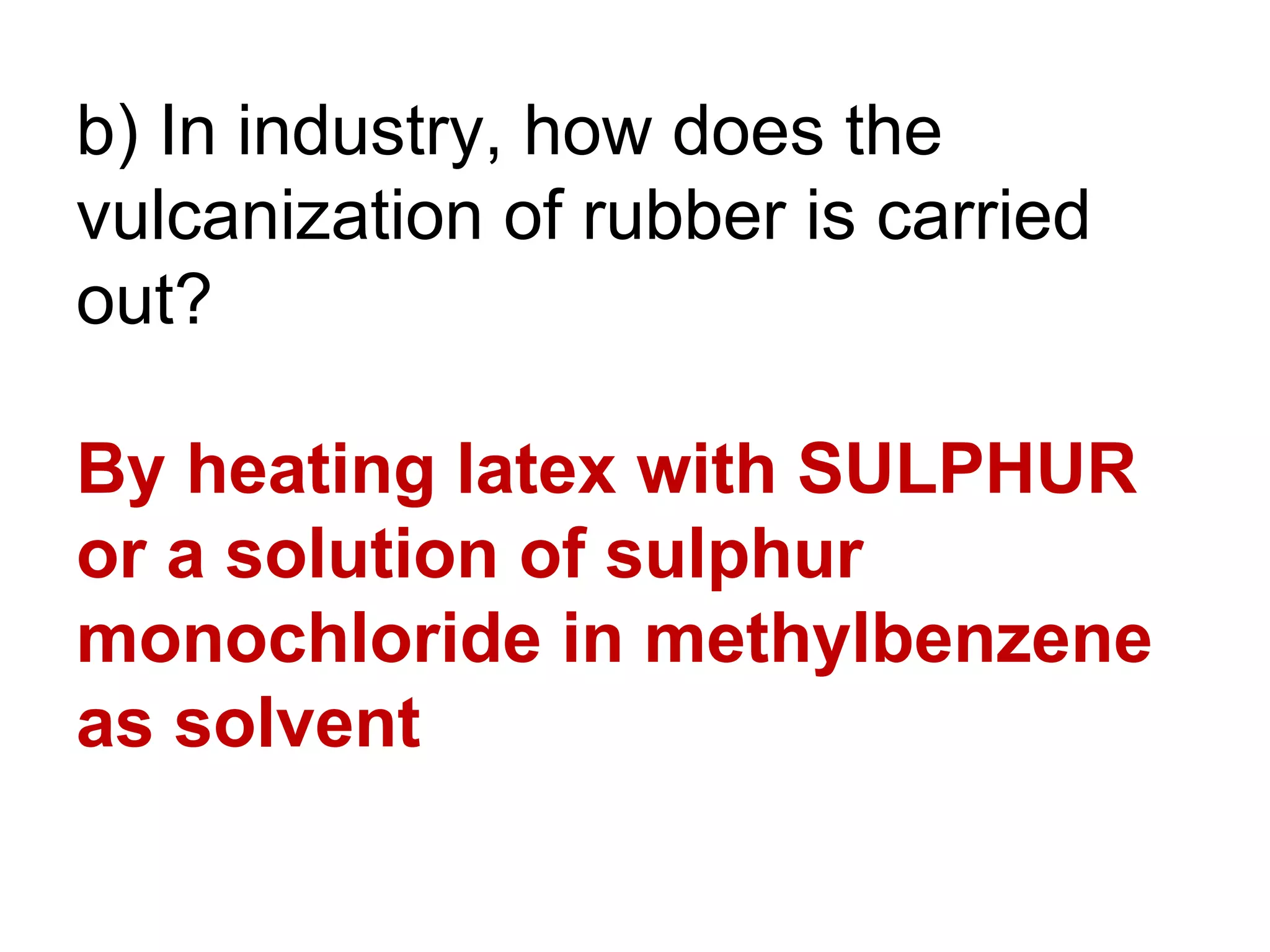
b) In industry, how does the
vulcanization of rubber is carried
out?

By heating latex with SULPHUR
or a solution of sulphur
monochloride in methylbenzene
as solvent
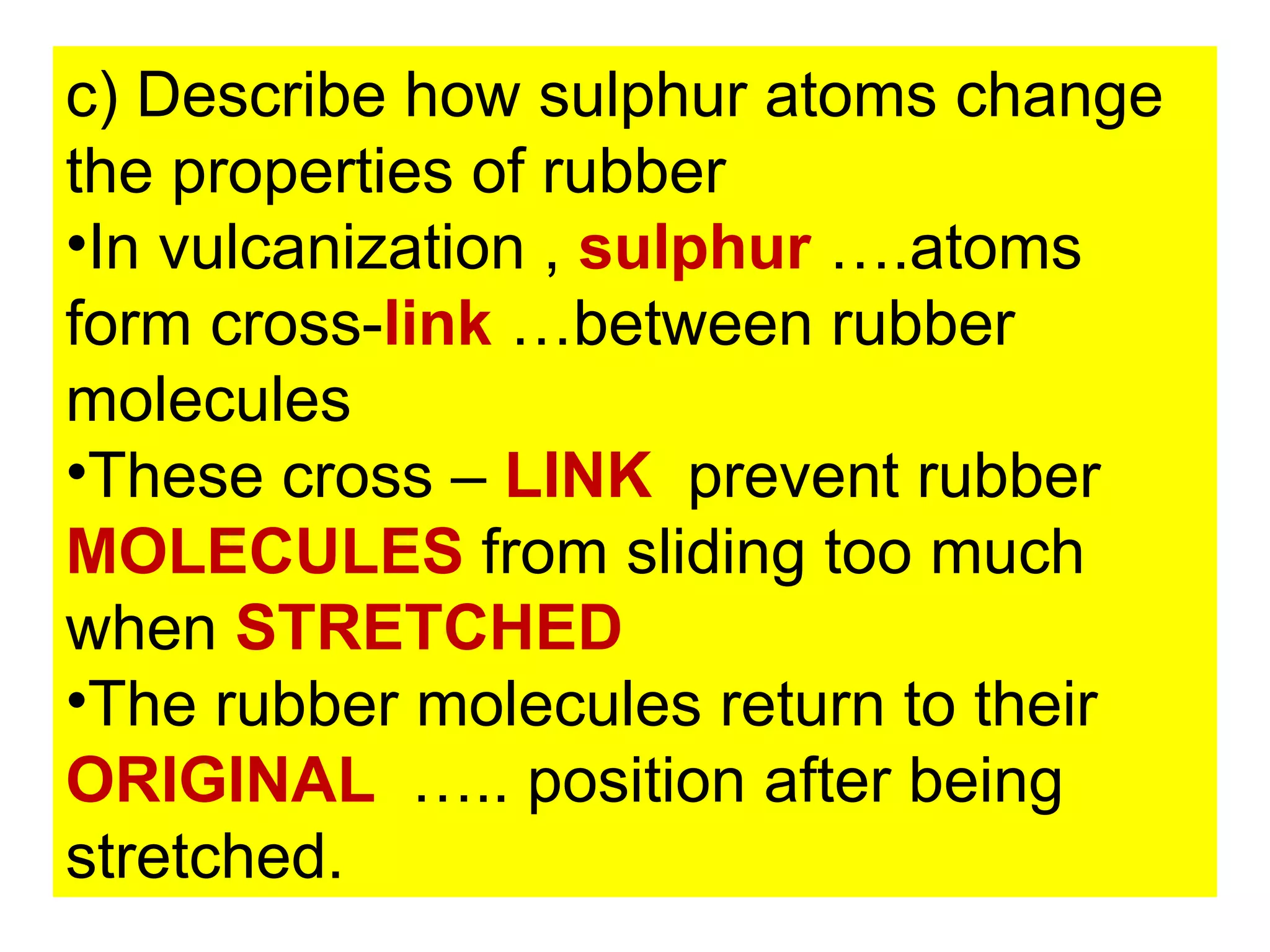
c) Describe how sulphur atoms change
the properties of rubber
•In vulcanization , sulphur ….atoms
form cross-link …between rubber
molecules
•These cross – LINK prevent rubber
MOLECULES from sliding too much
when STRETCHED
•The rubber molecules return to their
ORIGINAL ….. position after being
stretched.
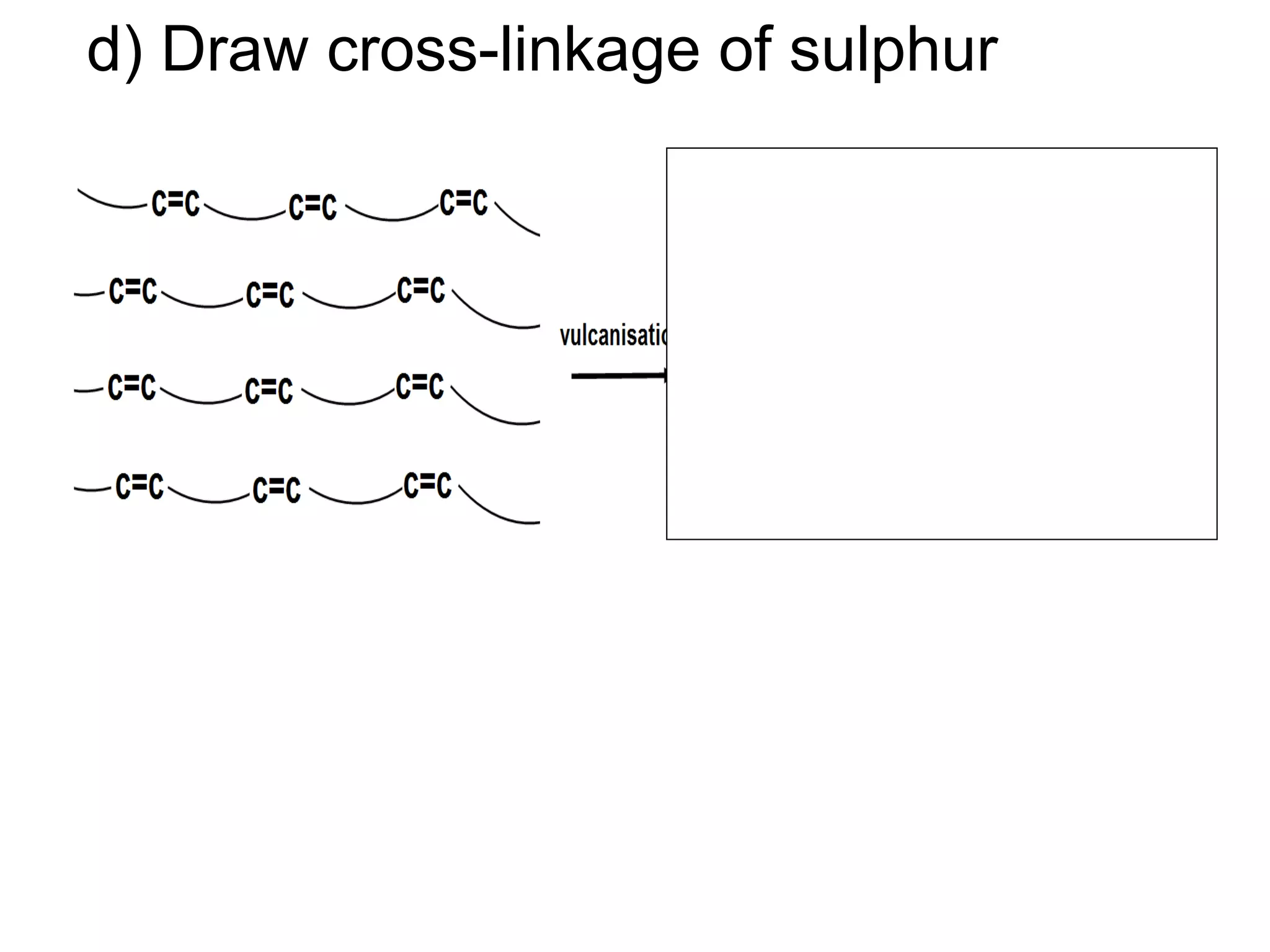
d) Draw cross-linkage of sulphur
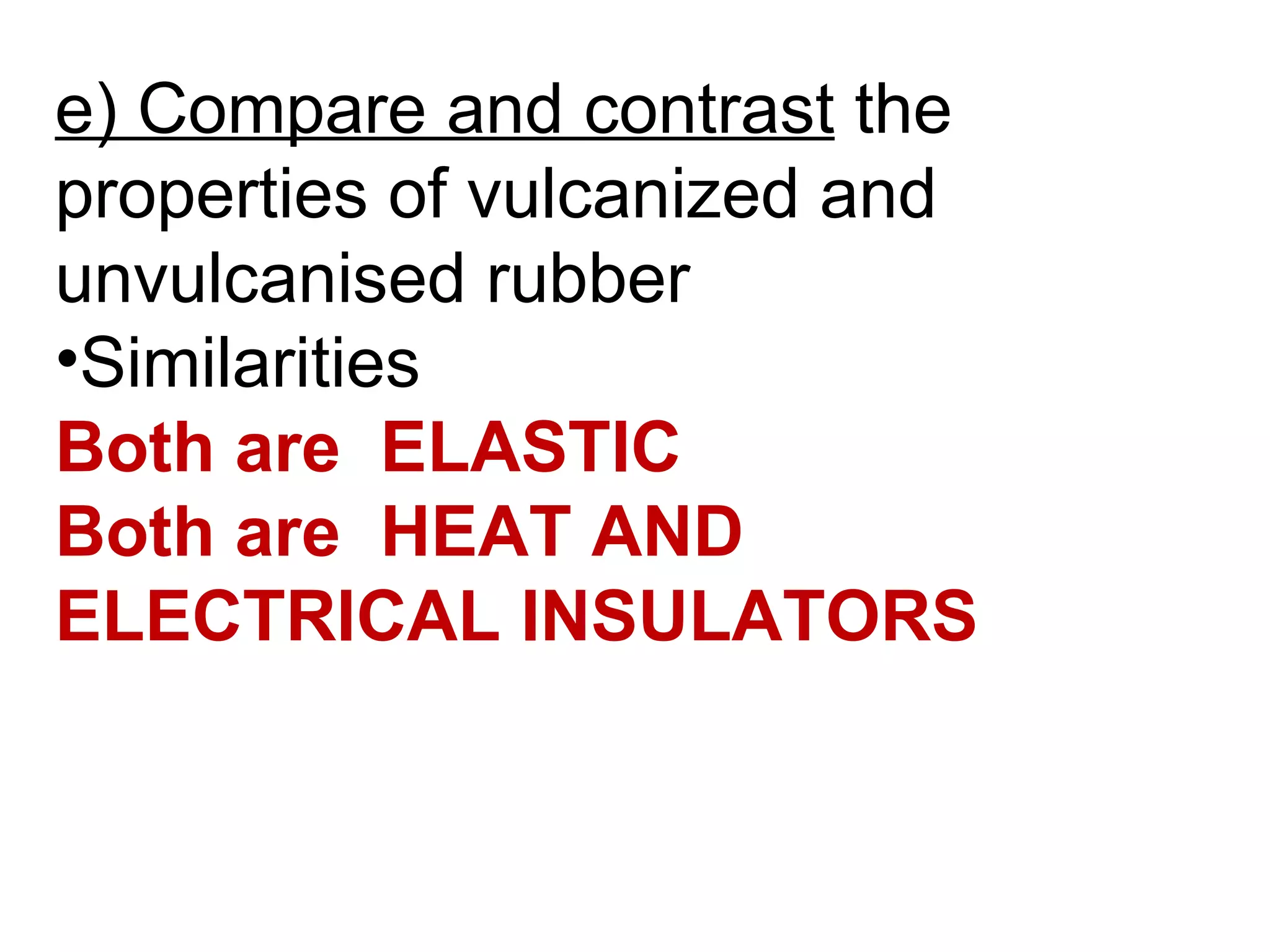
e) Compare and contrast the
properties of vulcanized and
unvulcanised rubber
•Similarities
Both are ELASTIC
Both are HEAT AND
ELECTRICAL INSULATORS
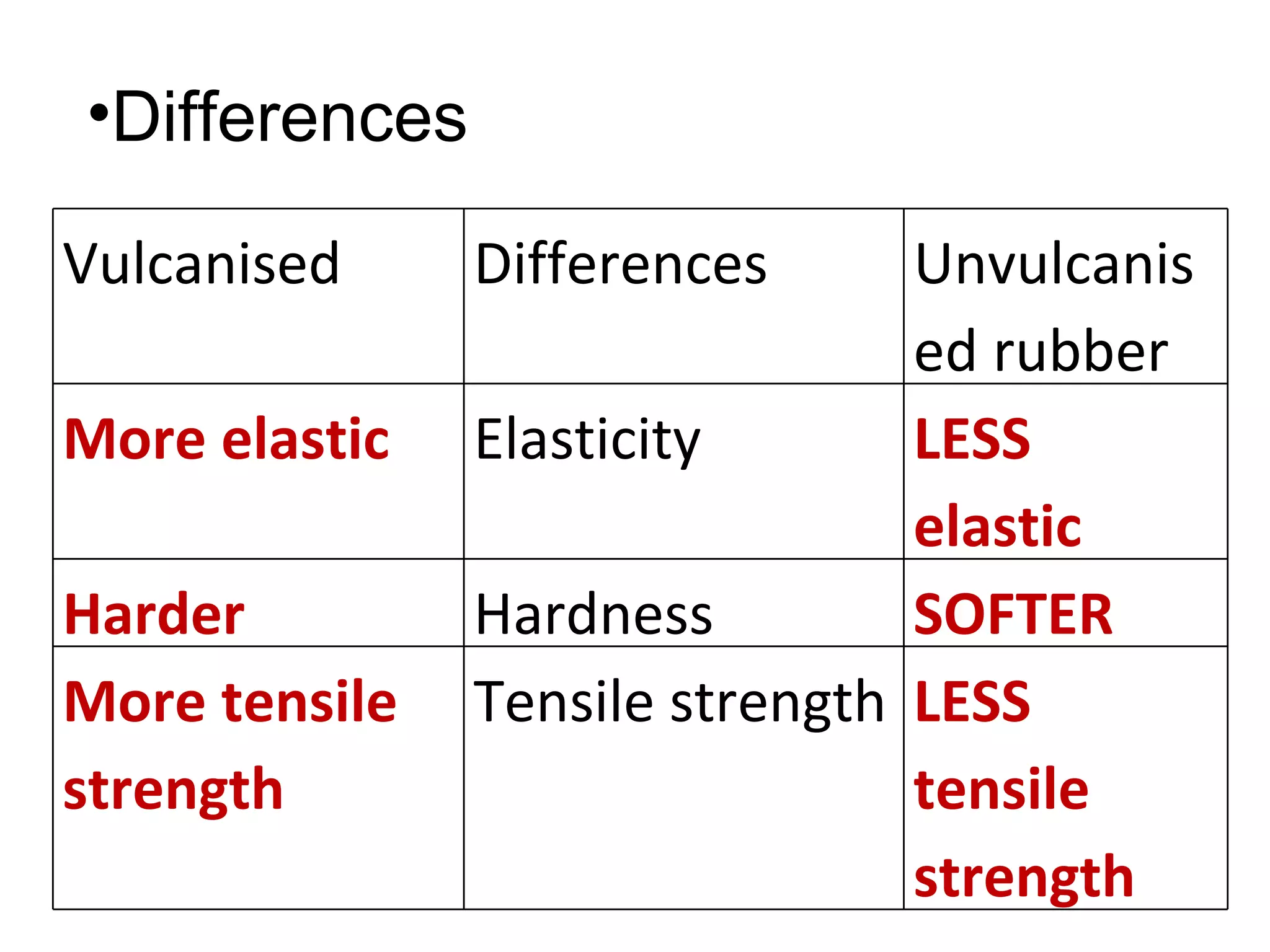
•Differences

Vulcanised     Differences      Unvulcanis
                                ed rubber
More elastic   Elasticity       LESS
                                elastic
Harder         Hardness         SOFTER
More tensile   Tensile strength LESS
strength                        tensile
                                strength
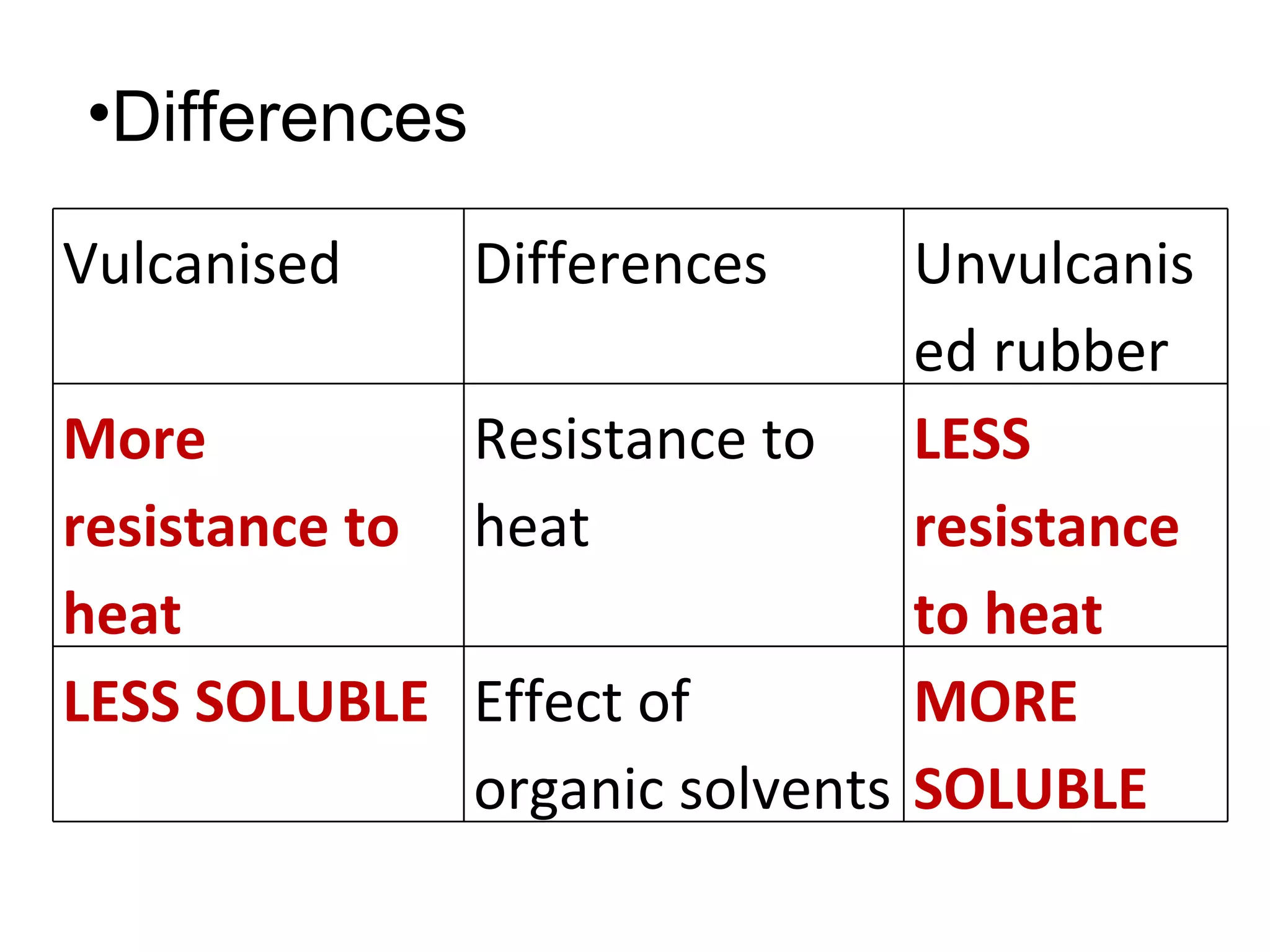
•Differences

Vulcanised     Differences     Unvulcanis
                               ed rubber
More          Resistance to    LESS
resistance to heat             resistance
heat                           to heat
LESS SOLUBLE Effect of         MORE
              organic solvents SOLUBLE
f) State one advantage of natural
rubber over synthetic rubber

Only natural rubber can take the
tremendous STRESS, STRENGH
AND HEAT ………produced
during landing and taking off of an
aero plane

fats and natural rubber module 3 carbon compounds with answers

  • 2.
    Saturated fat Fat molecule that has no carbon –carbon double bonds Unsaturated fat Fat molecule that has at least ONE carbon –carbon double bonds
  • 3.
    Oil Liquid at room temperature and found in plants Fat Solid at room temperature and found in animals
  • 4.
    Glycerol An alcohol that has 3 hydroxyl group in 1 molecule Fatty Carboxylic acid that has a acids long chain carbon, about 10 to 20 carbon atoms and has only one carboxyl group
  • 5.
    Examples Coconut oil, corn oil of oils Examples of fats Meat, butter, cheese
  • 6.
    Examples of saturated Meat, butter, cheese fats Examples of unsaturated Soybeans, peanuts, sunflower fats seeds, maize
  • 7.
    cholesterol White, fatty substance that make blood vessels become hard and narrow Hydrogenation Addition of hydrogens to the double bonds between 2 carbon atoms
  • 8.
    a) State 2similarities between fats and oils? •Both are esters •Both occur naturally in living tissues of organisms
  • 9.
    b) Fill inthe table below to list differences between oils and fats Oils Fats a)sources Plants and Animals animals • Physical liquid solid state a)Melting Lower than Higher point 20 oC than 20 o C
  • 10.
    c) Fill inthe table below to list differences between saturated and unsaturated fats Unsaturated Saturated fats fats ( C=C) (C-C) a)Proportion of More More saturated molecules unsaturated molecules than between molecules than unsaturated saturated and saturated molecules unsaturated molecules fats
  • 11.
    c) Fill inthe table below to list differences •between saturated and unsaturated fats Unsaturated Saturated fats fats ( C=C) (C-C b) Physical Mostly Mostly solids state at liquids room temp
  • 12.
    c) Fill inthe table below to list differences •between saturated and unsaturated fats Unsaturated Saturated fats fats ( C=C) (C-C) c) Melting Lower Higher melting point melting point point
  • 13.
    c) Fill inthe table below to list differences •between saturated and unsaturated fats Unsaturated Saturated fats ( C=C) fats d) sources Plants and (C-C) Animals vegetables
  • 14.
    d) Why dounsaturated fats turn bad or spoil easily? They contain carbon-carbon double bond that can easily reacts in the air.
  • 15.
    e) Explain howunsaturated fats can be changed to saturated fats? •Through catalytic hydrogenation Where carbon-carbon double bond absorbs one mole hydrogen •The process is carried out by bubbling hydrogen gas through hot liquid oil in the presence of fine particles of nickel catalyst at temp of 200 o C and pressure 4 atm
  • 16.
    Answer the followingquestions •FATS Oils and fats are esters Carboxylic + Alcohol  Fats or + water acids oil Glycerol or 1,2,3- Fatty acid propanetriol Has a very long chain carbon, (about 10-20 atoms) Examples, palmitic acids, stearic acids, linoleic acids
  • 17.
    a) From diagramabove, what is glycerol?Draw its molecular formula • Glycerol is an alcohol with three hydroxyl group in one molecule of glycerol
  • 18.
    b) From diagramabove, what is the difference between a fat molecule and a fatty acid molecule? •A fat molecule is formed when long- chained carboxylic acid reacts with alcohol with three OH-groups (glycerol) •A fatty acid molecule is carboxylic acid molecule that has a long chain carbon atom ( about 10- 20 atoms)
  • 19.
    c) Hexanoic acidand pentanol react together to form a product. Name the product formed and state its homologous series Name of product: pentyl hexanoate Homologous series : ester
  • 20.
    •Can hexanoic acidand pentanol react together to form Fat or Oil? Explain your answer No, because hexanoic acid is a short chain carboxylic acid with carbon atoms only 6 atoms and pentanol is not a glycerol
  • 21.
    •Can decanoic acid andglycerol react together to form Fat or Oil? Explain your answer Yes, because decanoic acid is a long chain carboxylic acid with carbon atom is 10 and reacts with glycerol
  • 22.
    a) List examplesof natural polymers and their monomers
  • 23.
    •Complete the structuralformula of natural rubber in the diagram below
  • 24.
    •Or draw thestructural formula of natural rubber in a simpler form
  • 25.
    *** draw structureof its monomer! 2-METHYLBUT-1,3-DIENE
  • 26.
    b) State theproperties of natural rubber •White ……SOLID……… at room temperature •Elasticity that ………DECREASE …… overtime •Soft •Sensitive to …………HEAT..
  • 27.
    •State 3 usesof natural rubber •In the making of tyres, footwear, rubber threads, rubber foam, conveyor belts and bitumen roads •Buildings built on rubber blocks or rubber bearings to help absorb vibration •Making of gloves, tubes and hoses
  • 28.
    •Latex is a…………COLLOID………… •It consists of ……RUBBER PARTICLES particles dispersed in ……WATER… •Each rubber particle is made-up many long- chain ………RUBBER………..molecules enclosed by a ………PROTEIN..-like membrane which is ……NEGATIVELY-charged
  • 30.
    Process 1 The repulsionbetween the …… NEGATIVELY …..charged particles prevent the ……RUBBER particles from coming close to each OTHER THEREFORE LATEX COULD NOT COAGULATE
  • 31.
    Process 2 •When anACID is added to latex, OR when latex is exposed to AIR , the BACTERIA ..from the air enters the latex and produce LACTIC acid that form HYDROGEN …ions. This HYDROGEN ….ions neutralize the NEGATIVE charges on the protein membrane.
  • 32.
    Process 3 •The rubberPARTICLES can now come close together. This enable them to COLLIDE .with one another resulting in the BREAKAGE of the protein membranes.
  • 33.
    Process 4 •a) thecollision between the rubber particles cause the membrane to break •B) the rubber molecules inside the membranes are now set free Draw diagram .
  • 34.
    Process 5 •The rubbermolecules COMBINE …… with one each other and clump together . The latex is now coagulated
  • 35.
    iv) Describe howto prevent the coagulation of latex By adding AMMONIA ….solution, that contains …HYDROXIDE ……….ions which …NEUTRALIZE ………. the acid produced by the bacteria . Therefore rubber particles remain … NEGATIVELY…… charged and the coagulation is PREVENTED
  • 36.
    VULCANISED RUBBER a) Whatis meant by vulcanization of rubber? ADDITION OF SULPHUR TO RUBBER AT 140 OC AND HIGH PRESSURE IN THE PRESENCE OF ZINC OXIDE AS THE CATALYST
  • 37.
    b) In industry,how does the vulcanization of rubber is carried out? By heating latex with SULPHUR or a solution of sulphur monochloride in methylbenzene as solvent
  • 38.
    c) Describe howsulphur atoms change the properties of rubber •In vulcanization , sulphur ….atoms form cross-link …between rubber molecules •These cross – LINK prevent rubber MOLECULES from sliding too much when STRETCHED •The rubber molecules return to their ORIGINAL ….. position after being stretched.
  • 39.
  • 40.
    e) Compare andcontrast the properties of vulcanized and unvulcanised rubber •Similarities Both are ELASTIC Both are HEAT AND ELECTRICAL INSULATORS
  • 41.
    •Differences Vulcanised Differences Unvulcanis ed rubber More elastic Elasticity LESS elastic Harder Hardness SOFTER More tensile Tensile strength LESS strength tensile strength
  • 42.
    •Differences Vulcanised Differences Unvulcanis ed rubber More Resistance to LESS resistance to heat resistance heat to heat LESS SOLUBLE Effect of MORE organic solvents SOLUBLE
  • 43.
    f) State oneadvantage of natural rubber over synthetic rubber Only natural rubber can take the tremendous STRESS, STRENGH AND HEAT ………produced during landing and taking off of an aero plane