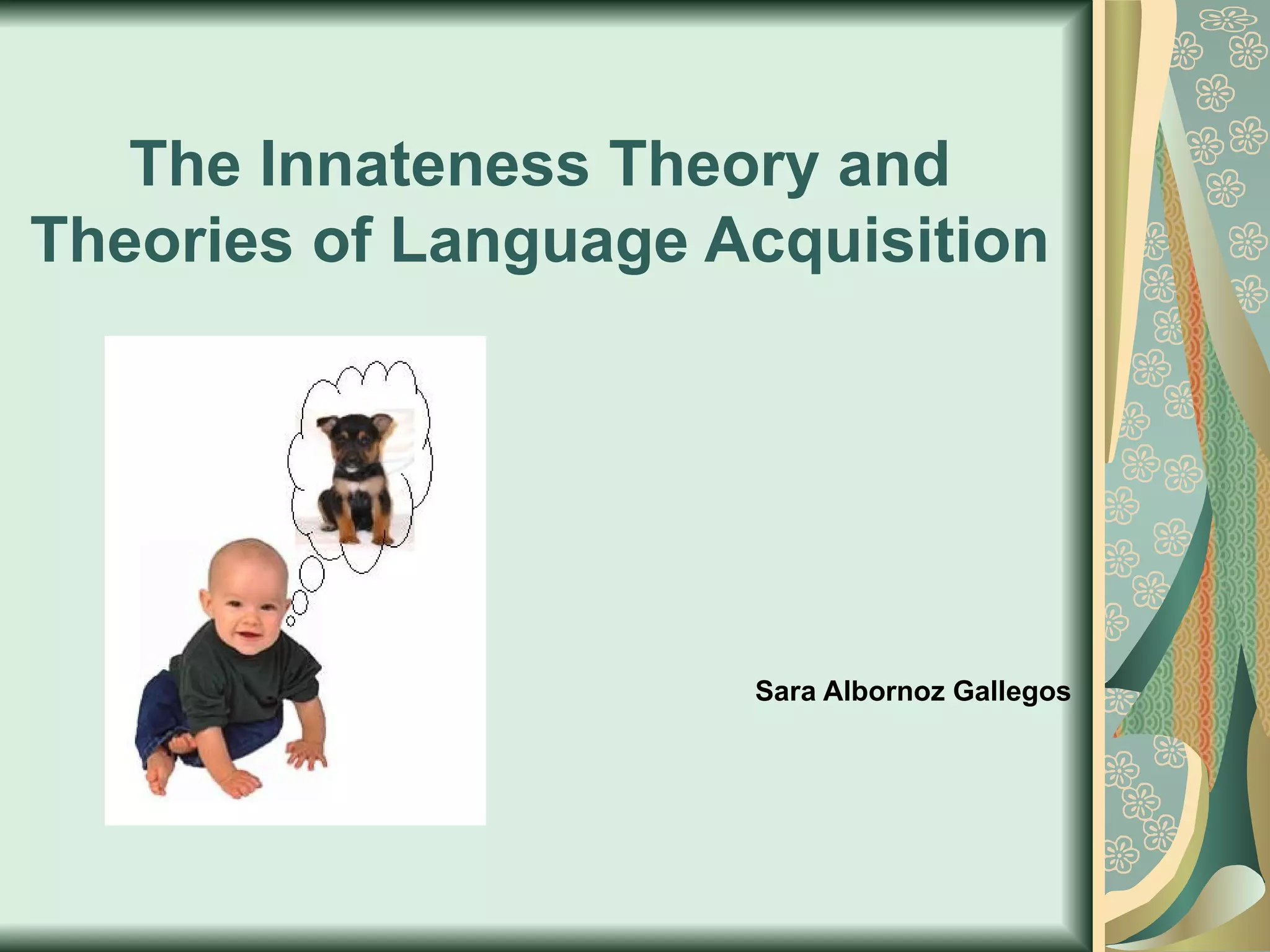
The Innateness Theory and Theories of Language Acquisition Sara Albornoz Gallegos
The Innateness Theory The active Construction of a Grammar Theory “ Language ability is innate in humans” Eric Lenneberg (by studying animal behavior)
The Innateness Theory The behavior emerges before it is necessary Its appearance is not the result of a conscious decision It emergence is not triggered by external events Direct teaching and intensive practice have  relatively little effect Regular sequence of “milestones” as the behavior develops, usually correlated with age and other aspects Critical period for the acquisition of the behavior
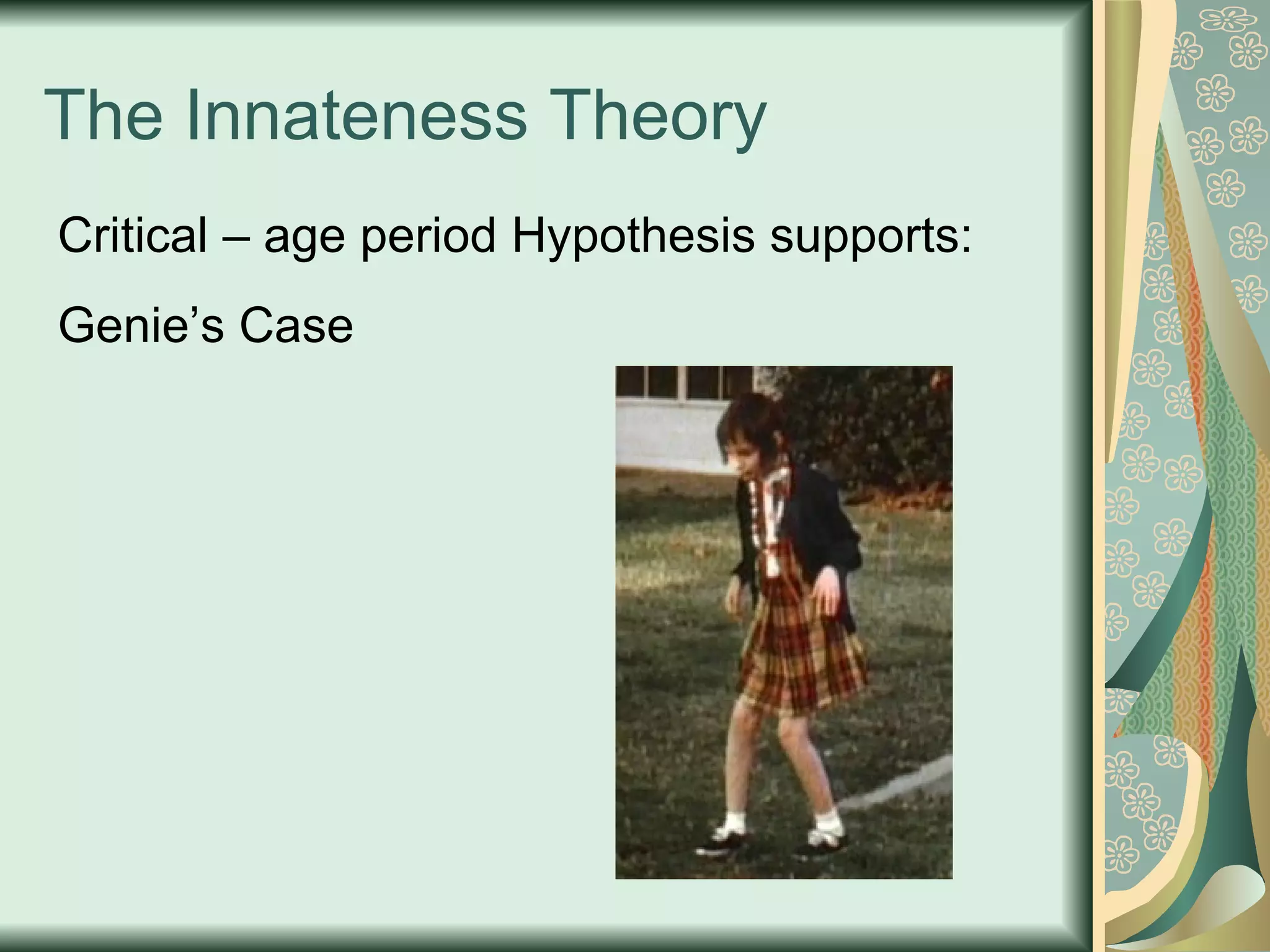
The Innateness Theory Critical – age period Hypothesis supports: Genie’s Case
Theories of Language Acquisition The Imitation Theory The Reinforcement Theory The Active Construction of a Grammar Theory
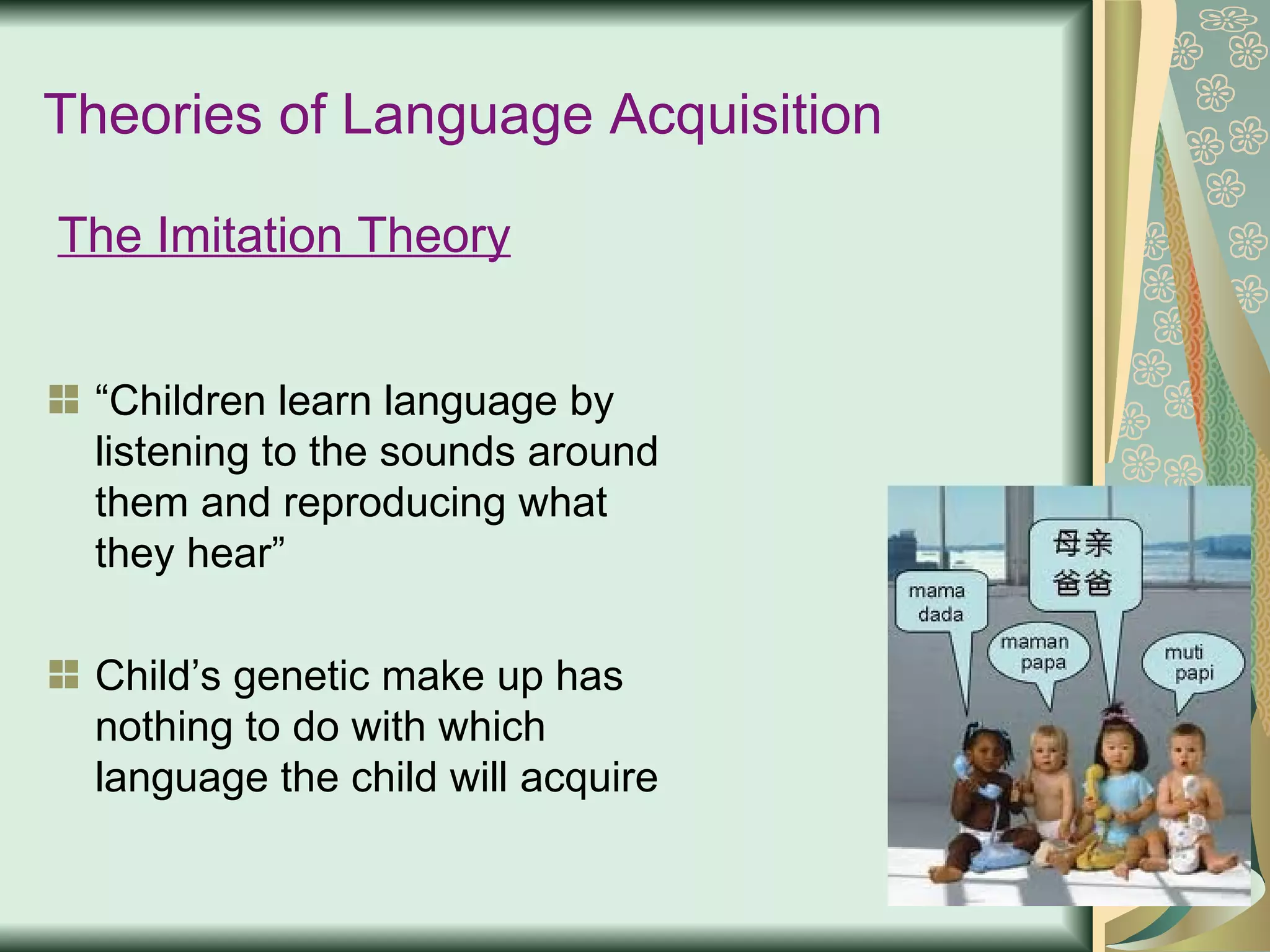
Theories of Language Acquisition “ Children learn language by listening to the sounds around them and reproducing what they hear” Child’s genetic make up has nothing to do with which language the child will acquire The Imitation Theory
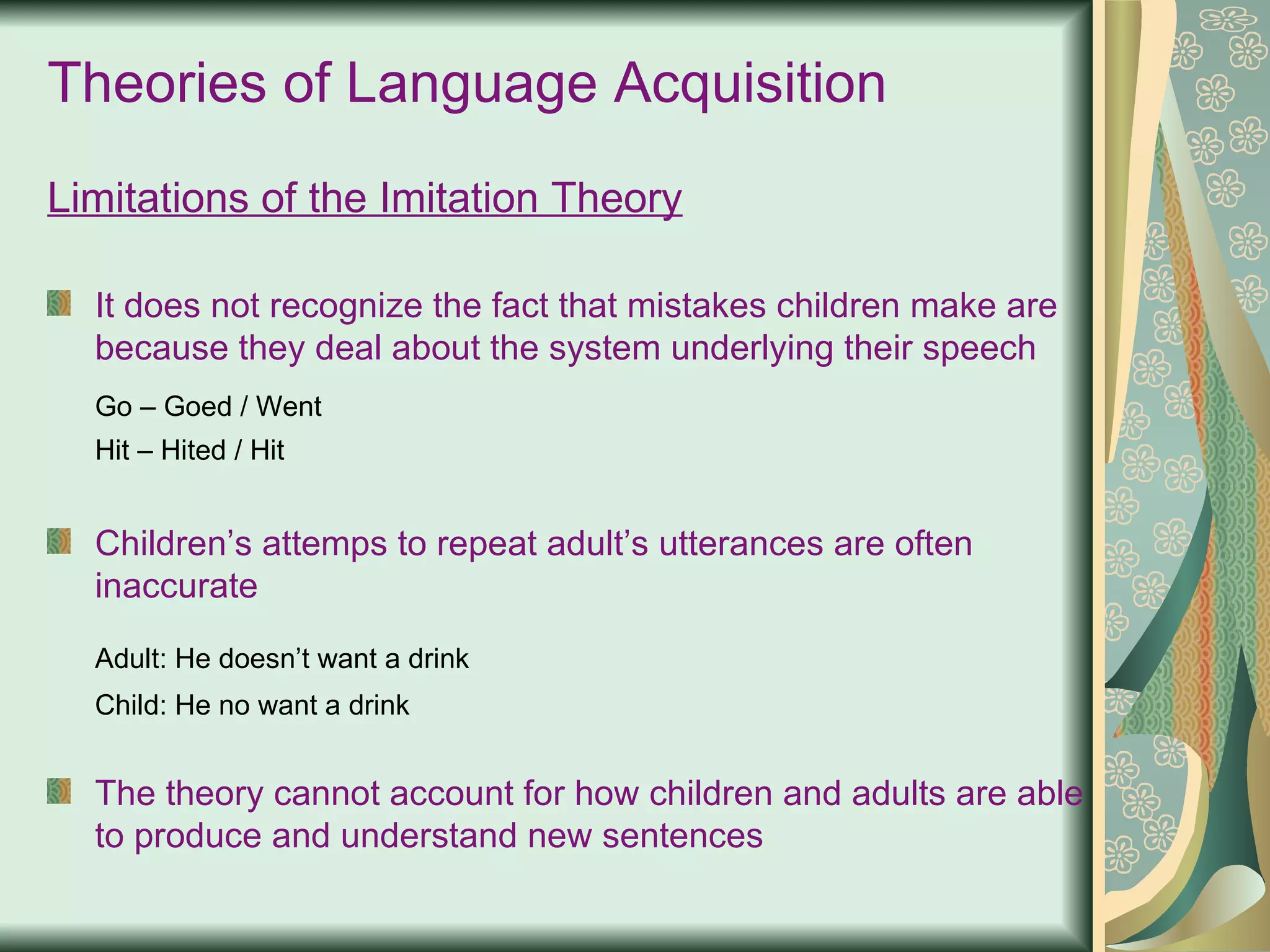
Theories of Language Acquisition Limitations of the Imitation Theory   It does not recognize the fact that mistakes children make are because they deal about the system underlying their speech Go – Goed / Went Hit – Hited / Hit Children’s attemps to repeat adult’s utterances are often inaccurate Adult: He doesn’t want a drink Child: He no want a drink The theory cannot account for how children and adults are able to produce and understand new sentences
Theories of Language Acquisition The Reinforcement Theory Children learn to speak because they are praised or reinforced when they use the right forms and are corrected when they use wrong forms Limitations of the Reinforcement Theory Corrections generally have more to do with the accuracy or truth of a statement and not its grammatical form
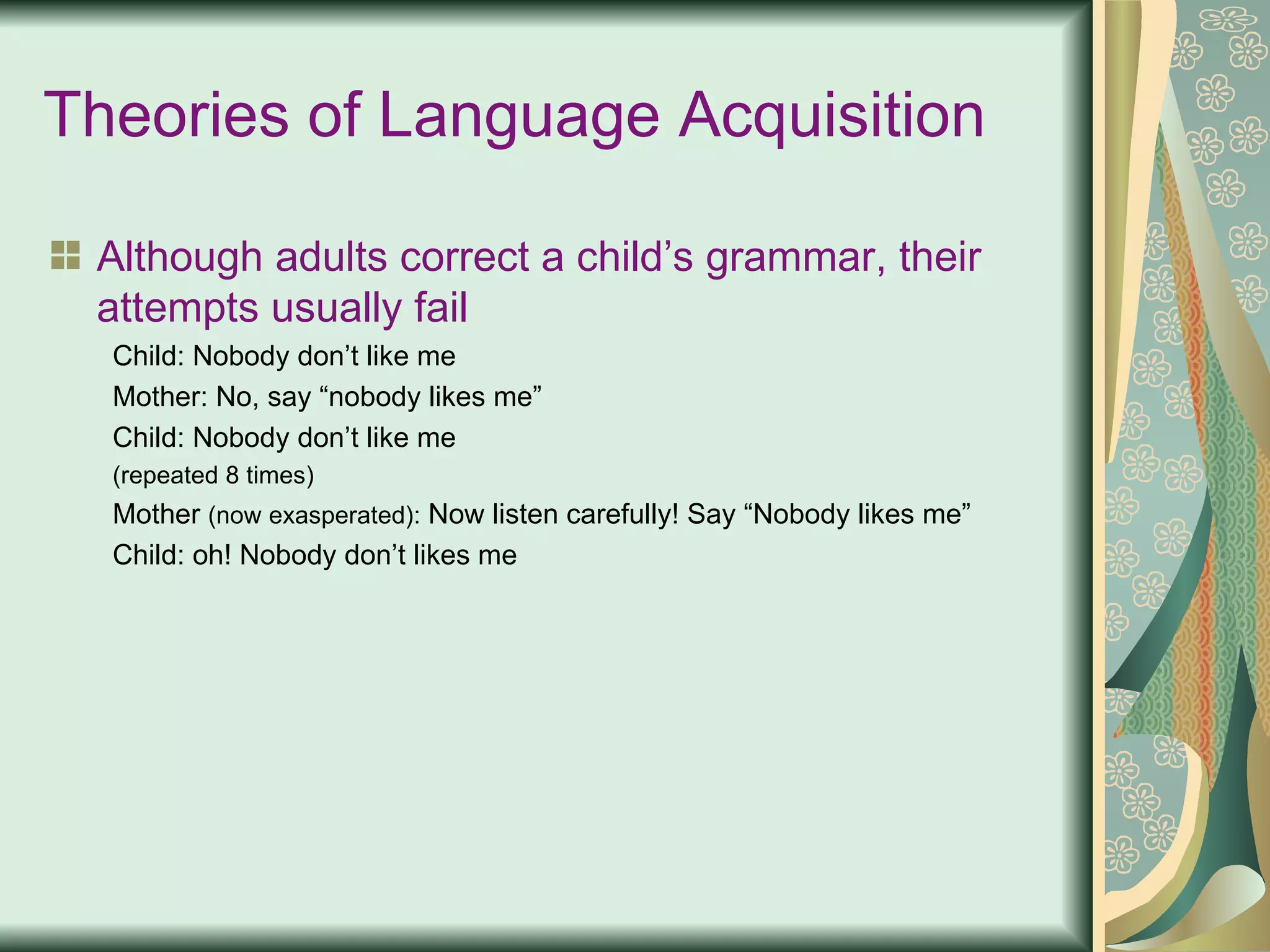
Theories of Language Acquisition Although adults correct a child’s grammar, their attempts usually fail Child: Nobody don’t like me Mother: No, say “nobody likes me” Child: Nobody don’t like me (repeated 8 times) Mother  (now exasperated):  Now listen carefully! Say “Nobody likes me” Child: oh! Nobody don’t likes me
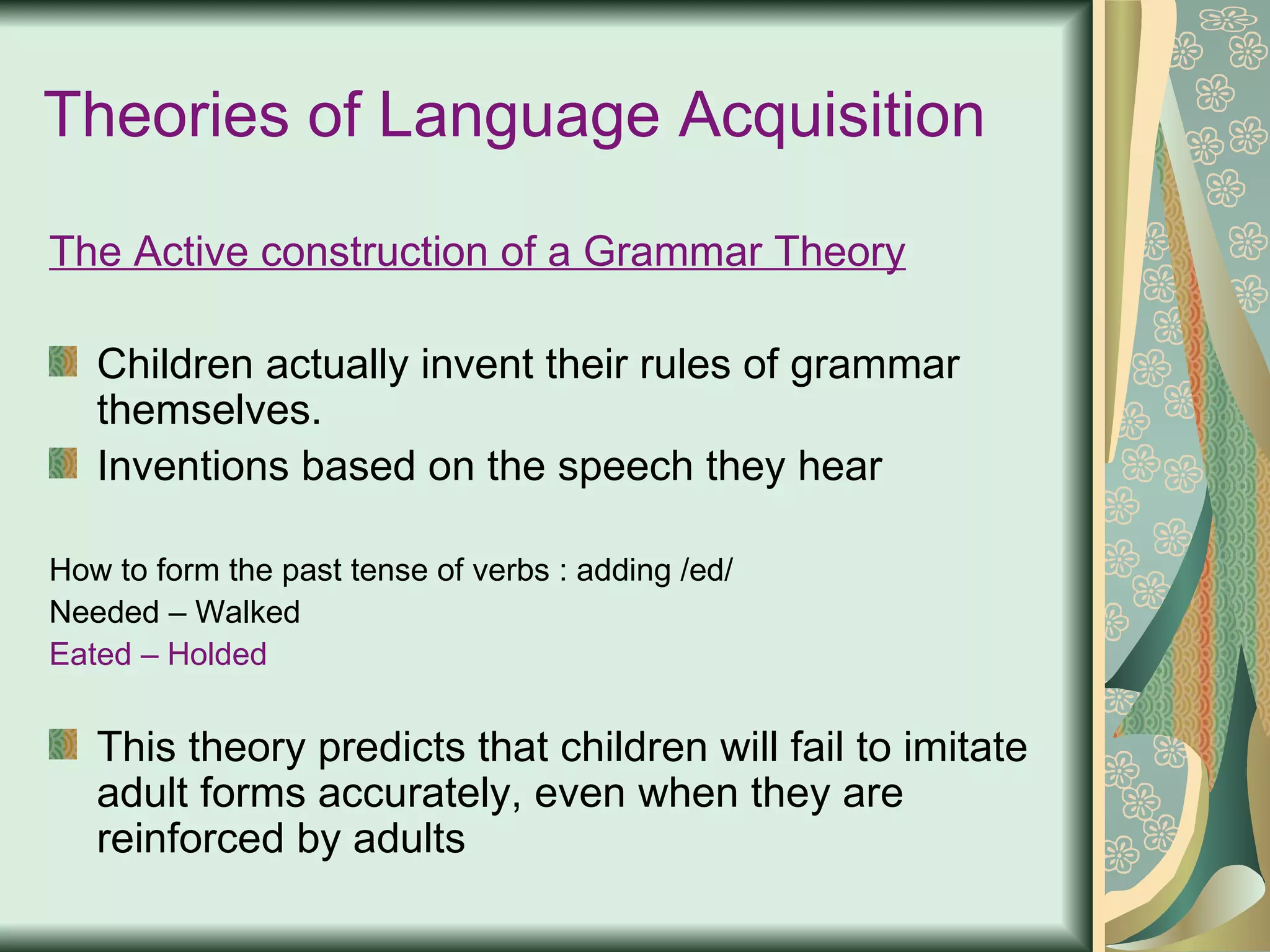
Theories of Language Acquisition The Active construction of a Grammar Theory Children actually invent their rules of grammar themselves. Inventions based on the speech they hear   How to form the past tense of verbs : adding /ed/ Needed – Walked Eated – Holded  This theory predicts that children will fail to imitate adult forms accurately, even when they are reinforced by adults

The innateness theory and theories of language acquisition

  • 1.
    The Innateness Theoryand Theories of Language Acquisition Sara Albornoz Gallegos
  • 2.
    The Innateness TheoryThe active Construction of a Grammar Theory “ Language ability is innate in humans” Eric Lenneberg (by studying animal behavior)
  • 3.
    The Innateness TheoryThe behavior emerges before it is necessary Its appearance is not the result of a conscious decision It emergence is not triggered by external events Direct teaching and intensive practice have relatively little effect Regular sequence of “milestones” as the behavior develops, usually correlated with age and other aspects Critical period for the acquisition of the behavior
  • 4.
    The Innateness TheoryCritical – age period Hypothesis supports: Genie’s Case
  • 5.
    Theories of LanguageAcquisition The Imitation Theory The Reinforcement Theory The Active Construction of a Grammar Theory
  • 6.
    Theories of LanguageAcquisition “ Children learn language by listening to the sounds around them and reproducing what they hear” Child’s genetic make up has nothing to do with which language the child will acquire The Imitation Theory
  • 7.
    Theories of LanguageAcquisition Limitations of the Imitation Theory It does not recognize the fact that mistakes children make are because they deal about the system underlying their speech Go – Goed / Went Hit – Hited / Hit Children’s attemps to repeat adult’s utterances are often inaccurate Adult: He doesn’t want a drink Child: He no want a drink The theory cannot account for how children and adults are able to produce and understand new sentences
  • 8.
    Theories of LanguageAcquisition The Reinforcement Theory Children learn to speak because they are praised or reinforced when they use the right forms and are corrected when they use wrong forms Limitations of the Reinforcement Theory Corrections generally have more to do with the accuracy or truth of a statement and not its grammatical form
  • 9.
    Theories of LanguageAcquisition Although adults correct a child’s grammar, their attempts usually fail Child: Nobody don’t like me Mother: No, say “nobody likes me” Child: Nobody don’t like me (repeated 8 times) Mother (now exasperated): Now listen carefully! Say “Nobody likes me” Child: oh! Nobody don’t likes me
  • 10.
    Theories of LanguageAcquisition The Active construction of a Grammar Theory Children actually invent their rules of grammar themselves. Inventions based on the speech they hear How to form the past tense of verbs : adding /ed/ Needed – Walked Eated – Holded This theory predicts that children will fail to imitate adult forms accurately, even when they are reinforced by adults