Structural geology
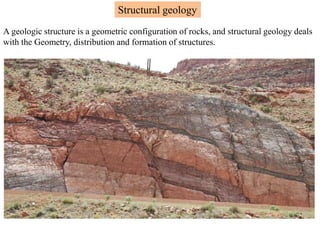
A geologic structure is a geometric configuration of rocks, and structural geology deals
with the Geometry, distribution and formation of structures.
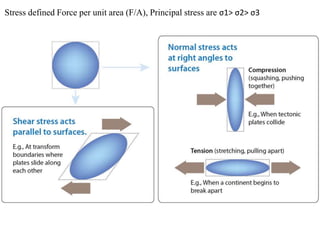
Stress defined Force per unit area (F/A), Principal stress are σ1> σ2> σ3
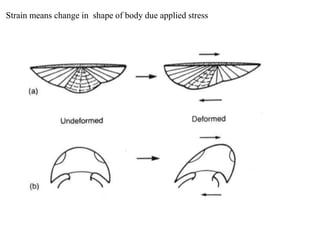
Strain means change in shape of body due applied stress
When a rock is subjected to increasing stress it passes through 3 successive stages of
deformation.
Elastic Deformation -- wherein the strain is reversible.
Ductile Deformation -- wherein the strain is irreversible.
Fracture - irreversible strain wherein the material breaks.
We can divide materials into two classes that depend on their relative behavior under
stress.
Brittle materials have a small or large region of elastic behavior but only a small region
of ductile behavior before they fracture
Ductile materials have a small region of elastic behavior and a large region of ductile
behavior before they fracture
How a material behaves will depend on several factors. Among them are
Temperature - At high temperature molecules and their bonds can stretch and move,
thus materials will behave in more ductile manner. At low Temperature, materials are
brittle.
Confining Pressure - At high confining pressure materials are less likely to fracture
because the pressure of the surroundings tends to hinder the formation of fractures. At
low confining stress, material will be brittle and tend to fracture sooner.
Strain rate -- At high strain rates material tends to fracture. At low strain rates more time
is available for individual atoms to move and therefore ductile behavior is favored.
Composition -- Some minerals, like quartz, olivine, and feldspars are very brittle.
Others, like clay minerals, micas, and calcite are more ductile This is due to the
chemical bond types that hold them together. Thus, the mineralogical composition of
the rock will be a factor in determining the deformational behavior of the rock. Another
aspect is presence or absence of water. Water appears to weaken the chemical bonds
and forms films around mineral grains along which slippage can take place. Thus wet
rock tends to behave in ductile manner, while dry rocks tend to behave in brittle manner
Brittle-Ductile Properties of the Lithosphere
We all know that rocks near the surface of the Earth behave in a brittle manner. Crustal
rocks are composed of minerals like quartz and feldspar which have high strength,
particularly at low pressure and temperature. As we go deeper in the Earth the strength
of these rocks initially increases.
At a depth of about 10-15 km we
reach a point called the brittle-
ductile transition zone. Below this
point rock strength decreases
because fractures become closed and
the temperature is higher, making
the rocks behave in a ductile manner
Evidence of Past Deformation
Evidence of deformation that has occurred in the past is very evident in crustal rocks.
For example, sedimentary strata and lava flows generally follow the law of original
horizontality. Thus, when we see such strata inclined instead of horizontal, evidence of
an episode of deformation.
Strike and dip of bed
Strike and dip refer to the orientation or attitude of a geologic feature.
The strike line of a bed, fault, or other planar feature, is a line representing the
intersection of that feature with a horizontal plane.
The dip gives the steepest angle of descent of a tilted bed or feature relative to a
horizontal plane, and is given by the number (0°-90°) as well as a letter (N,S,E,W) with
rough direction in which the bed is dipping downwards.
Apparent dip is the name of any dip measured in a vertical plane that is not
perpendicular to the strike line
Strike and dip are determined in the field with a compass and clinometer or a
combination of the two, such as a Brunton compass.
Foliation and Lineation
Deformation
Brittle deformation
Fractures and Joints
Faults
Ductile deformation
Folds
Fractures and Joints
Fractures are planar or gently curved surfaces of failure produced by brittle failure of
rocks. Where the rock masses on either side of a fracture have moved apart slightly, the
fracture is called an Extension fractures. If the two rock masses have slid past each
other, the fractures are shear fracture.
In the case of natural fractures, in the field, extension fractures are commonly called
Joints.
Shear fractures are known as Faults when the rocks on one side have been shifted
significantly along the fracture surface. In this section we examine joints; later sections
deal with faults.
Extension fractures, are fractures that show extension perpendicular to the walls.
displacement is parallel to the minimum principal stress. Joints have no detectable
displacement.
Shear Fracture is a fracture along which the relative movement parallel to the
fracture. The term shear fracture is used for fracture with small displacements.
Fractures and displacement are oblique to the maximum principal stress (maximum
compression
Joints may occur in sets of parallel, regularly spaced fractures, and several sets may occur
in the same rocks
Pressure release joints
Many joints form due to release of stored pressure. The weight of great thickness
overlying strata causes deeply buried and compressed. However overlying rock has been
Eroded, this load pressure is reduced.
Cooling Joints
Another common cause of joint formation is the contraction that takes in a cooling
igneous body Tabular igneous bodies like dykes and sills frequently exhibit polygonal
columnar jointing perpendicular To the cooling surfaces.
Faults
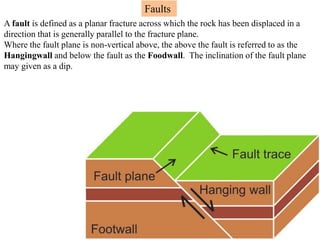
A fault is defined as a planar fracture across which the rock has been displaced in a
direction that is generally parallel to the fracture plane.
Where the fault plane is non-vertical above, the above the fault is referred to as the
Hangingwall and below the fault as the Foodwall. The inclination of the fault plane
may given as a dip.
Types of Faults
Non vertical fault separate the hanging wall from the underlying food wall. Where the
hanging wall Lowered or downthrown relative to the food wall the fault is Normal
fault. The opposite case, where the hanging wall is upthrown relative relative to the
food wall is a reverse fault. If the movement is lateral, in a horizontal plane, then the
Fault is strike slip fault.
Classification
fault
based
on
the
dip
of
fault
plane
Fold
Folds are form when planar structures transform into curved structures during ductile
deformation
In general folds are made up of a hinge that connects tow usually differently orientated
limbs. The maximum curvature of a folded layer is located in the centre of the hinge
zone and is called the hinge point. Hinge points are connected in three dimensions by a
hinge line. Hinge line Commonly found to be curved, some times straight that is called
fold axis. Fold with straight hinge lines are called cylindrical fold. Axial plane is
connection of hinge lines of tow or more folded surfaces.
Plunge is the vertical angle between the horizontal plane and the axis or line of
maximum elongation of a feature. Plunge is measured along the axis of a fold
Classification of fold based on four main features:
 Direction of closing
 Attitude of axial surface
 Size of inter limb angle
 Shape of profile
Closing and facing direction
Folds that close upwards, that is where limbs dip away from the hinge, the termed
Antiforms, and those that close downwards, where limbs dip towards the hinge
are termed Synfroms. Fold close side ways are termed neutral folds.
Fold with older rocks in the core called Anticline. Fold with younger rocks in the
core called Syncline.
Chevron fold: Sharp angular hinges
• Unconformities are a gap in
the geologic record. They
occur when there is erosion or
a hiatus in deposition between
rock beds
– So, the underlying bed
could be 180 million years
old, while the overlying
bed could be 30 million
years old – a gap of 150
million years!
– All other rock sequences
are assumed to be
conformable (continuous)
– There are a few types,
including angular
unconformities (like the
example from Original
Horizontality).
Unconformity
Unconformity
• This is an outcrop in
Colorado, with red sandstone
lying over white limestone.
• What is the relative order of
events here?
– 1. Layer A deposited
– 2. Layer A eroded,
creating the unconformity
– 3. Layer B deposited
Disconformity: exists where the layers above and below an erosional boundary have the
same orientation
Nonconformity: develops where sediments are deposited on top of an eroded surface of
igneous or metamorphic rocks
Paraconformity: strata on either side of the unconformity are parallel, there is little
apparent erosion
Angular unconformity: strata is deposited on tilted and eroded layers

CV268 Structural geology.pptx

  • 1.
    Structural geology A geologicstructure is a geometric configuration of rocks, and structural geology deals with the Geometry, distribution and formation of structures.
  • 4.
    Stress defined Forceper unit area (F/A), Principal stress are σ1> σ2> σ3
  • 5.
    Strain means changein shape of body due applied stress
  • 6.
    When a rockis subjected to increasing stress it passes through 3 successive stages of deformation. Elastic Deformation -- wherein the strain is reversible. Ductile Deformation -- wherein the strain is irreversible. Fracture - irreversible strain wherein the material breaks.
  • 8.
    We can dividematerials into two classes that depend on their relative behavior under stress. Brittle materials have a small or large region of elastic behavior but only a small region of ductile behavior before they fracture Ductile materials have a small region of elastic behavior and a large region of ductile behavior before they fracture
  • 9.
    How a materialbehaves will depend on several factors. Among them are Temperature - At high temperature molecules and their bonds can stretch and move, thus materials will behave in more ductile manner. At low Temperature, materials are brittle. Confining Pressure - At high confining pressure materials are less likely to fracture because the pressure of the surroundings tends to hinder the formation of fractures. At low confining stress, material will be brittle and tend to fracture sooner. Strain rate -- At high strain rates material tends to fracture. At low strain rates more time is available for individual atoms to move and therefore ductile behavior is favored. Composition -- Some minerals, like quartz, olivine, and feldspars are very brittle. Others, like clay minerals, micas, and calcite are more ductile This is due to the chemical bond types that hold them together. Thus, the mineralogical composition of the rock will be a factor in determining the deformational behavior of the rock. Another aspect is presence or absence of water. Water appears to weaken the chemical bonds and forms films around mineral grains along which slippage can take place. Thus wet rock tends to behave in ductile manner, while dry rocks tend to behave in brittle manner
  • 10.
    Brittle-Ductile Properties ofthe Lithosphere We all know that rocks near the surface of the Earth behave in a brittle manner. Crustal rocks are composed of minerals like quartz and feldspar which have high strength, particularly at low pressure and temperature. As we go deeper in the Earth the strength of these rocks initially increases. At a depth of about 10-15 km we reach a point called the brittle- ductile transition zone. Below this point rock strength decreases because fractures become closed and the temperature is higher, making the rocks behave in a ductile manner
  • 12.
    Evidence of PastDeformation Evidence of deformation that has occurred in the past is very evident in crustal rocks. For example, sedimentary strata and lava flows generally follow the law of original horizontality. Thus, when we see such strata inclined instead of horizontal, evidence of an episode of deformation.
  • 13.
  • 14.
    Strike and diprefer to the orientation or attitude of a geologic feature. The strike line of a bed, fault, or other planar feature, is a line representing the intersection of that feature with a horizontal plane. The dip gives the steepest angle of descent of a tilted bed or feature relative to a horizontal plane, and is given by the number (0°-90°) as well as a letter (N,S,E,W) with rough direction in which the bed is dipping downwards. Apparent dip is the name of any dip measured in a vertical plane that is not perpendicular to the strike line
  • 16.
    Strike and dipare determined in the field with a compass and clinometer or a combination of the two, such as a Brunton compass.
  • 17.
  • 20.
    Deformation Brittle deformation Fractures andJoints Faults Ductile deformation Folds
  • 21.
    Fractures and Joints Fracturesare planar or gently curved surfaces of failure produced by brittle failure of rocks. Where the rock masses on either side of a fracture have moved apart slightly, the fracture is called an Extension fractures. If the two rock masses have slid past each other, the fractures are shear fracture. In the case of natural fractures, in the field, extension fractures are commonly called Joints. Shear fractures are known as Faults when the rocks on one side have been shifted significantly along the fracture surface. In this section we examine joints; later sections deal with faults.
  • 23.
    Extension fractures, arefractures that show extension perpendicular to the walls. displacement is parallel to the minimum principal stress. Joints have no detectable displacement. Shear Fracture is a fracture along which the relative movement parallel to the fracture. The term shear fracture is used for fracture with small displacements. Fractures and displacement are oblique to the maximum principal stress (maximum compression
  • 25.
    Joints may occurin sets of parallel, regularly spaced fractures, and several sets may occur in the same rocks Pressure release joints Many joints form due to release of stored pressure. The weight of great thickness overlying strata causes deeply buried and compressed. However overlying rock has been Eroded, this load pressure is reduced.
  • 26.
    Cooling Joints Another commoncause of joint formation is the contraction that takes in a cooling igneous body Tabular igneous bodies like dykes and sills frequently exhibit polygonal columnar jointing perpendicular To the cooling surfaces.
  • 27.
    Faults A fault isdefined as a planar fracture across which the rock has been displaced in a direction that is generally parallel to the fracture plane. Where the fault plane is non-vertical above, the above the fault is referred to as the Hangingwall and below the fault as the Foodwall. The inclination of the fault plane may given as a dip.
  • 28.
    Types of Faults Nonvertical fault separate the hanging wall from the underlying food wall. Where the hanging wall Lowered or downthrown relative to the food wall the fault is Normal fault. The opposite case, where the hanging wall is upthrown relative relative to the food wall is a reverse fault. If the movement is lateral, in a horizontal plane, then the Fault is strike slip fault.
  • 31.
  • 34.
    Fold Folds are formwhen planar structures transform into curved structures during ductile deformation In general folds are made up of a hinge that connects tow usually differently orientated limbs. The maximum curvature of a folded layer is located in the centre of the hinge zone and is called the hinge point. Hinge points are connected in three dimensions by a hinge line. Hinge line Commonly found to be curved, some times straight that is called fold axis. Fold with straight hinge lines are called cylindrical fold. Axial plane is connection of hinge lines of tow or more folded surfaces.
  • 35.
    Plunge is thevertical angle between the horizontal plane and the axis or line of maximum elongation of a feature. Plunge is measured along the axis of a fold
  • 36.
    Classification of foldbased on four main features:  Direction of closing  Attitude of axial surface  Size of inter limb angle  Shape of profile
  • 37.
    Closing and facingdirection Folds that close upwards, that is where limbs dip away from the hinge, the termed Antiforms, and those that close downwards, where limbs dip towards the hinge are termed Synfroms. Fold close side ways are termed neutral folds. Fold with older rocks in the core called Anticline. Fold with younger rocks in the core called Syncline.
  • 40.
    Chevron fold: Sharpangular hinges
  • 42.
    • Unconformities area gap in the geologic record. They occur when there is erosion or a hiatus in deposition between rock beds – So, the underlying bed could be 180 million years old, while the overlying bed could be 30 million years old – a gap of 150 million years! – All other rock sequences are assumed to be conformable (continuous) – There are a few types, including angular unconformities (like the example from Original Horizontality). Unconformity
  • 43.
    Unconformity • This isan outcrop in Colorado, with red sandstone lying over white limestone. • What is the relative order of events here? – 1. Layer A deposited – 2. Layer A eroded, creating the unconformity – 3. Layer B deposited
  • 46.
    Disconformity: exists wherethe layers above and below an erosional boundary have the same orientation Nonconformity: develops where sediments are deposited on top of an eroded surface of igneous or metamorphic rocks Paraconformity: strata on either side of the unconformity are parallel, there is little apparent erosion Angular unconformity: strata is deposited on tilted and eroded layers