Structural Geology
Dr. K. Pavan Kumar
Associate Professor
Department of Civil Engineering
Vasavi College of Engineering
Learning Objectives
Elastic and plastic deformation of rocks under stress and strain
Principle type of folds and their characteristic features
Different types of faults and the clues for their identification
Genesis and parameters of joints in various types of rocks
Problems from rock structures in engineering constructions
Mechanism of Deformation of Rocks
 A rock body is deformed when it is subjected to external forces
 The factors responsible for deformation of rocks include:
- Pressure
- Temperature
- Rock composition
- Presence or absence of fluids
- Type of stress and its rate of application
 The most important factors among the above listed factors are:
- Type of stress
- Rate of stress
- Temperature
Effect of Stress and Strain – Brittle and Ductile Rock
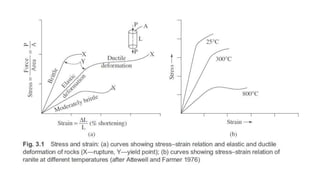
Stress is the force applied on the surface of the body and strain is the
resultant effect that causes a change in the shape, size or volume of that
body
Strain is the measure of material deformation
A change in the volume of a body is called dilation, whereas an alteration of
shape is called distortion
Stresses are classified into three types: compressive, shear, tensile
Compressive stress – compresses the body of rock, thereby reducing its volume
Shear stress – It tends to break apart (shear) one part of rock from the other
Tensile stress – tends to develop cracks in the body of the rock samples
Brittle – If a material deforms under stress by development of fractures
Ductile – Material deforms without breaking and cracking except when it deforms too much
and too quickly
Elastic And Plastic Deformation
 A rock subjected to stress gets deformed, but on removal of the stress it may
regain its original shape/form partially or fully. This property of a rock is
known as its elasticity
 If a rock cannot restore to its original shape even after the removal of stress,
the state of deformation of the rock is known as plastic deformation
 The deformation of a rock depends upon its physical property and the stress
difference under specific pressure-temperature conditions
 Cataclasis is the deformation of rocks by the mechanical processes of
shearing and granulation
 Cataclasis can be regarded as a ductile mechanism although it takes place
within the elastic-frictional regime of deformation
Some Basic Terms In Structural Geology
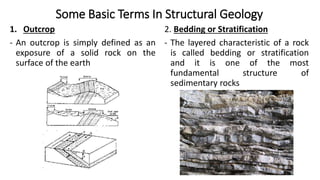
1. Outcrop
- An outcrop is simply defined as an
exposure of a solid rock on the
surface of the earth
2. Bedding or Stratification
- The layered characteristic of a rock
is called bedding or stratification
and it is one of the most
fundamental structure of
sedimentary rocks
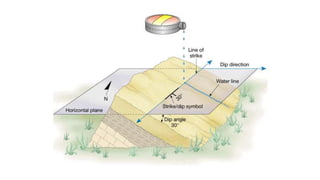
3. Dip and Strike
 The dip and strike are the two basic quantities used to express the altitude of
any rock body
 Dip is defined as the maximum angle of inclination of a layer of a rock with
the horizontal
 It is expressed in terms of degree of inclination and direction of inclination
 The amount of dip is the angle of inclination which a bedding plane makes
with a horizontal plane and it may vary from zero degrees to ninety degrees
 The angle of dip is determined using an instrument called clinometer
 Strike is a geographic direction given by the line of intersection of a horizontal
plane with a bedding plane
 It can be measured with a compass in the field
Apparent and True Dip
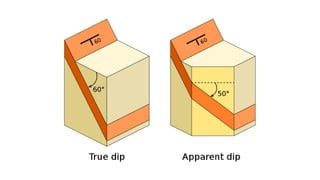
When the dip of a layer is measured in a direction that is essentially at right
angles to the strike of that particular layer, then it is called true dip
When the dip of a layer is measured in any other direction which is not at
right angle to its strike direction, then it is called apparent dip
True dip (β) and apparent dip (α) are related to each other as follows:
tan 𝛼 = tan 𝛽 cos 𝛾
𝛾 – angle between the strike of the layer and the direction in which apparent
dip is measured
Types of dip
- Primary dip – Angle of dip is between 5 to 10 degrees
- Secondary dip - Angle of dip varies from 10 to 90 degrees
- Local and regional dip – Do not show any appreciable variation, laterally or
vertically
4. Outcrop Dimensions
The width and breadth of the outcrop of a particular bed is given by the
distance between the top and bottom edges of the bed as measured on the
surface of the ground in a direction perpendicular to the strike of that
particular bed
The thickness of a particular layer or bed is the perpendicular distance
between the top and bottom surface of the same layer as seen in a vertical
section at right angles to the strike of the layer
The depth to a particular layer or bed at any place from the surface is given
by the perpendicular distance between the ground surface and the top
surface of that particular layer.
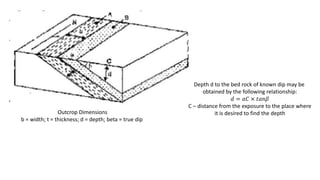
Outcrop Dimensions
b = width; t = thickness; d = depth; beta = true dip
Depth d to the bed rock of known dip may be
obtained by the following relationship:
𝑑 = 𝑎𝐶 × 𝑡𝑎𝑛𝛽
C – distance from the exposure to the place where
it is desired to find the depth
FOLDS AND THE CAUSES OF THEIR
FORMATION
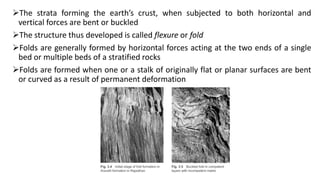
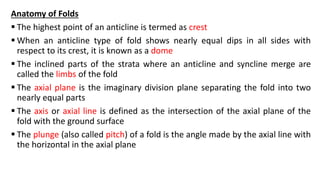
The strata forming the earth’s crust, when subjected to both horizontal and
vertical forces are bent or buckled
The structure thus developed is called flexure or fold
Folds are generally formed by horizontal forces acting at the two ends of a single
bed or multiple beds of a stratified rocks
Folds are formed when one or a stalk of originally flat or planar surfaces are bent
or curved as a result of permanent deformation
Anatomy of Folds
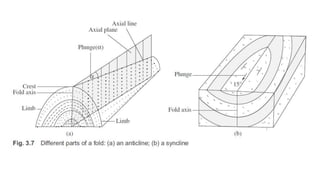
 The highest point of an anticline is termed as crest
 When an anticline type of fold shows nearly equal dips in all sides with
respect to its crest, it is known as a dome
 The inclined parts of the strata where an anticline and syncline merge are
called the limbs of the fold
 The axial plane is the imaginary division plane separating the fold into two
nearly equal parts
 The axis or axial line is defined as the intersection of the axial plane of the
fold with the ground surface
 The plunge (also called pitch) of a fold is the angle made by the axial line with
the horizontal in the axial plane
Anticline and Syncline
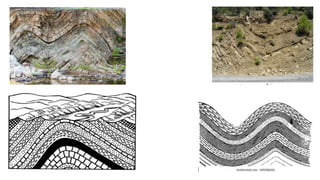
An anticline is the upward convex flexure of a bed, whereas a syncline is the
downward convex flexure
In an anticline younger beds will be in the convex side and older beds in the core
In a syncline younger beds will be in the concave side and older beds in the core
Due to tension at the top of an anticline joints or cracks are developed, which are
termed as tension joints
Similarly, the bottom part of a syncline is also likely to develop fractures due to
tensional force
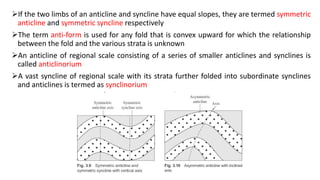
If the two limbs of an anticline and syncline have equal slopes, they are termed symmetric
anticline and symmetric syncline respectively
The term anti-form is used for any fold that is convex upward for which the relationship
between the fold and the various strata is unknown
An anticline of regional scale consisting of a series of smaller anticlines and synclines is
called anticlinorium
A vast syncline of regional scale with its strata further folded into subordinate synclines
and anticlines is termed as synclinorium

Structural Geology.pptx

  • 1.
    Structural Geology Dr. K.Pavan Kumar Associate Professor Department of Civil Engineering Vasavi College of Engineering
  • 2.
    Learning Objectives Elastic andplastic deformation of rocks under stress and strain Principle type of folds and their characteristic features Different types of faults and the clues for their identification Genesis and parameters of joints in various types of rocks Problems from rock structures in engineering constructions
  • 3.
    Mechanism of Deformationof Rocks  A rock body is deformed when it is subjected to external forces  The factors responsible for deformation of rocks include: - Pressure - Temperature - Rock composition - Presence or absence of fluids - Type of stress and its rate of application  The most important factors among the above listed factors are: - Type of stress - Rate of stress - Temperature
  • 4.
    Effect of Stressand Strain – Brittle and Ductile Rock Stress is the force applied on the surface of the body and strain is the resultant effect that causes a change in the shape, size or volume of that body Strain is the measure of material deformation A change in the volume of a body is called dilation, whereas an alteration of shape is called distortion Stresses are classified into three types: compressive, shear, tensile Compressive stress – compresses the body of rock, thereby reducing its volume Shear stress – It tends to break apart (shear) one part of rock from the other Tensile stress – tends to develop cracks in the body of the rock samples Brittle – If a material deforms under stress by development of fractures Ductile – Material deforms without breaking and cracking except when it deforms too much and too quickly
  • 6.
    Elastic And PlasticDeformation  A rock subjected to stress gets deformed, but on removal of the stress it may regain its original shape/form partially or fully. This property of a rock is known as its elasticity  If a rock cannot restore to its original shape even after the removal of stress, the state of deformation of the rock is known as plastic deformation  The deformation of a rock depends upon its physical property and the stress difference under specific pressure-temperature conditions  Cataclasis is the deformation of rocks by the mechanical processes of shearing and granulation  Cataclasis can be regarded as a ductile mechanism although it takes place within the elastic-frictional regime of deformation
  • 7.
    Some Basic TermsIn Structural Geology 1. Outcrop - An outcrop is simply defined as an exposure of a solid rock on the surface of the earth 2. Bedding or Stratification - The layered characteristic of a rock is called bedding or stratification and it is one of the most fundamental structure of sedimentary rocks
  • 8.
    3. Dip andStrike  The dip and strike are the two basic quantities used to express the altitude of any rock body  Dip is defined as the maximum angle of inclination of a layer of a rock with the horizontal  It is expressed in terms of degree of inclination and direction of inclination  The amount of dip is the angle of inclination which a bedding plane makes with a horizontal plane and it may vary from zero degrees to ninety degrees  The angle of dip is determined using an instrument called clinometer  Strike is a geographic direction given by the line of intersection of a horizontal plane with a bedding plane  It can be measured with a compass in the field
  • 10.
    Apparent and TrueDip When the dip of a layer is measured in a direction that is essentially at right angles to the strike of that particular layer, then it is called true dip When the dip of a layer is measured in any other direction which is not at right angle to its strike direction, then it is called apparent dip True dip (β) and apparent dip (α) are related to each other as follows: tan 𝛼 = tan 𝛽 cos 𝛾 𝛾 – angle between the strike of the layer and the direction in which apparent dip is measured Types of dip - Primary dip – Angle of dip is between 5 to 10 degrees - Secondary dip - Angle of dip varies from 10 to 90 degrees - Local and regional dip – Do not show any appreciable variation, laterally or vertically
  • 12.
    4. Outcrop Dimensions Thewidth and breadth of the outcrop of a particular bed is given by the distance between the top and bottom edges of the bed as measured on the surface of the ground in a direction perpendicular to the strike of that particular bed The thickness of a particular layer or bed is the perpendicular distance between the top and bottom surface of the same layer as seen in a vertical section at right angles to the strike of the layer The depth to a particular layer or bed at any place from the surface is given by the perpendicular distance between the ground surface and the top surface of that particular layer.
  • 13.
    Outcrop Dimensions b =width; t = thickness; d = depth; beta = true dip Depth d to the bed rock of known dip may be obtained by the following relationship: 𝑑 = 𝑎𝐶 × 𝑡𝑎𝑛𝛽 C – distance from the exposure to the place where it is desired to find the depth
  • 14.
    FOLDS AND THECAUSES OF THEIR FORMATION
  • 15.
    The strata formingthe earth’s crust, when subjected to both horizontal and vertical forces are bent or buckled The structure thus developed is called flexure or fold Folds are generally formed by horizontal forces acting at the two ends of a single bed or multiple beds of a stratified rocks Folds are formed when one or a stalk of originally flat or planar surfaces are bent or curved as a result of permanent deformation
  • 16.
    Anatomy of Folds The highest point of an anticline is termed as crest  When an anticline type of fold shows nearly equal dips in all sides with respect to its crest, it is known as a dome  The inclined parts of the strata where an anticline and syncline merge are called the limbs of the fold  The axial plane is the imaginary division plane separating the fold into two nearly equal parts  The axis or axial line is defined as the intersection of the axial plane of the fold with the ground surface  The plunge (also called pitch) of a fold is the angle made by the axial line with the horizontal in the axial plane
  • 18.
    Anticline and Syncline Ananticline is the upward convex flexure of a bed, whereas a syncline is the downward convex flexure In an anticline younger beds will be in the convex side and older beds in the core In a syncline younger beds will be in the concave side and older beds in the core Due to tension at the top of an anticline joints or cracks are developed, which are termed as tension joints Similarly, the bottom part of a syncline is also likely to develop fractures due to tensional force
  • 20.
    If the twolimbs of an anticline and syncline have equal slopes, they are termed symmetric anticline and symmetric syncline respectively The term anti-form is used for any fold that is convex upward for which the relationship between the fold and the various strata is unknown An anticline of regional scale consisting of a series of smaller anticlines and synclines is called anticlinorium A vast syncline of regional scale with its strata further folded into subordinate synclines and anticlines is termed as synclinorium