Amit K. Mishra
Assistant Professor
Department of Geology
Banasthali University
• As the concept of sea floor spreading gained
acceptance in the late 60's, the consequences for
geology gradually began to dawn.
• One of the first to recognise how plate tectonics
could be applied to the geological record was J.
Tuzo Wilson.
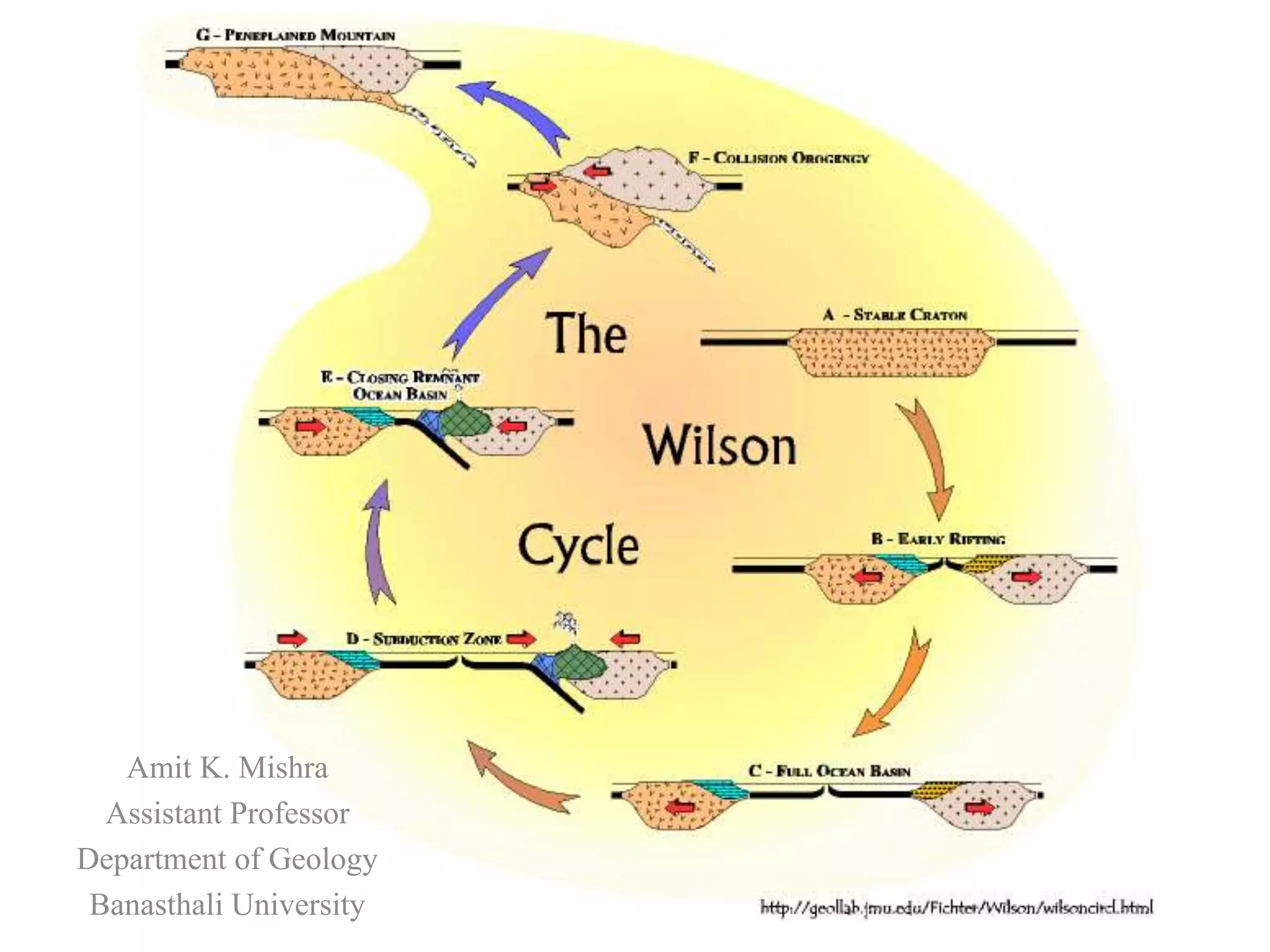
• If continents rift apart to form ocean basins, other
oceans must close.
• This may be repeated throughout Earth history.
Example: the IAPETUS ocean between England &
Scotland in the Lower Palaeozoic, closed in the
Caledonian; later opening of the Atlantic, almost in
the same place. The cycle is known as the Wilson
Cycle:
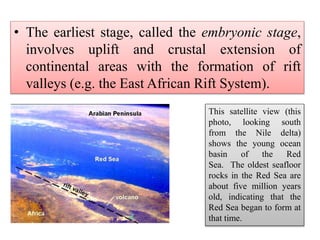
• The earliest stage, called the embryonic stage,
involves uplift and crustal extension of
continental areas with the formation of rift
valleys (e.g. the East African Rift System).
This satellite view (this
photo, looking south
from the Nile delta)
shows the young ocean
basin of the Red
Sea. The oldest seafloor
rocks in the Red Sea are
about five million years
old, indicating that the
Red Sea began to form at
that time.
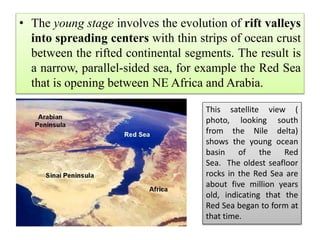
• The young stage involves the evolution of rift valleys
into spreading centers with thin strips of ocean crust
between the rifted continental segments. The result is
a narrow, parallel-sided sea, for example the Red Sea
that is opening between NE Africa and Arabia.
This satellite view (
photo, looking south
from the Nile delta)
shows the young ocean
basin of the Red
Sea. The oldest seafloor
rocks in the Red Sea are
about five million years
old, indicating that the
Red Sea began to form at
that time.
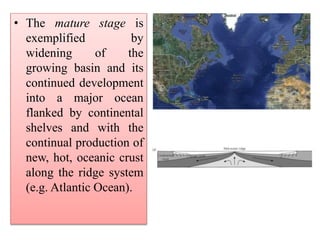
• The mature stage is
exemplified by
widening of the
growing basin and its
continued development
into a major ocean
flanked by continental
shelves and with the
continual production of
new, hot, oceanic crust
along the ridge system
(e.g. Atlantic Ocean).
• Eventually, this expanding
system becomes unstable and,
away from the ridge, the oldest
oceanic lithosphere sinks back
into the asthenosphere, forming
an oceanic trench subduction
system with a Wadati-Benioff
zone marking the descending
plate and associated island arcs,
such as the situation in the
western Pacific Ocean, or
Andean-type volcanism. The
onset of subduction at the
ocean boundary marks the
subduction stage of the cycle
(e.g. the Pacific Ocean).
• Once subduction outpaces
the formation of new crust at
the constructive boundary,
the ocean begins to contract.
Island arc complexes,
complete with their
inventory of sedimentary and
volcanic rocks, collide and
create young mountain
ranges around the periphery
of the contracting ocean.
These features mark
the terminal stage of the
cycle (e.g. the
Mediterranean).
• The end stage occurs once
all the oceanic crust
between the continental
masses has subducted, and
the continents converge
along a collision zone
characterised by an active
fold mountain belt, such as
the Himalayas. Finally the
plate boundary becomes
inactive, but the site of the
join, or suture, between the
two continental masses is a
zone of weakness in the
lithosphere that has the
potential to become the site
of a new rift and so the
cycle continues.

Wilson cycle

  • 1.
    Amit K. Mishra AssistantProfessor Department of Geology Banasthali University
  • 2.
    • As theconcept of sea floor spreading gained acceptance in the late 60's, the consequences for geology gradually began to dawn. • One of the first to recognise how plate tectonics could be applied to the geological record was J. Tuzo Wilson. • If continents rift apart to form ocean basins, other oceans must close. • This may be repeated throughout Earth history. Example: the IAPETUS ocean between England & Scotland in the Lower Palaeozoic, closed in the Caledonian; later opening of the Atlantic, almost in the same place. The cycle is known as the Wilson Cycle:
  • 6.
    • The earlieststage, called the embryonic stage, involves uplift and crustal extension of continental areas with the formation of rift valleys (e.g. the East African Rift System). This satellite view (this photo, looking south from the Nile delta) shows the young ocean basin of the Red Sea. The oldest seafloor rocks in the Red Sea are about five million years old, indicating that the Red Sea began to form at that time.
  • 7.
    • The youngstage involves the evolution of rift valleys into spreading centers with thin strips of ocean crust between the rifted continental segments. The result is a narrow, parallel-sided sea, for example the Red Sea that is opening between NE Africa and Arabia. This satellite view ( photo, looking south from the Nile delta) shows the young ocean basin of the Red Sea. The oldest seafloor rocks in the Red Sea are about five million years old, indicating that the Red Sea began to form at that time.
  • 8.
    • The maturestage is exemplified by widening of the growing basin and its continued development into a major ocean flanked by continental shelves and with the continual production of new, hot, oceanic crust along the ridge system (e.g. Atlantic Ocean).
  • 9.
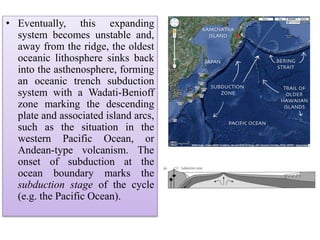
    • Eventually, thisexpanding system becomes unstable and, away from the ridge, the oldest oceanic lithosphere sinks back into the asthenosphere, forming an oceanic trench subduction system with a Wadati-Benioff zone marking the descending plate and associated island arcs, such as the situation in the western Pacific Ocean, or Andean-type volcanism. The onset of subduction at the ocean boundary marks the subduction stage of the cycle (e.g. the Pacific Ocean).
  • 10.
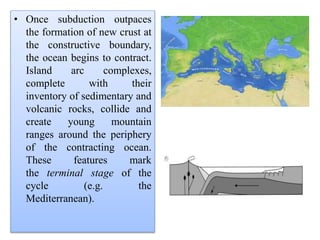
    • Once subductionoutpaces the formation of new crust at the constructive boundary, the ocean begins to contract. Island arc complexes, complete with their inventory of sedimentary and volcanic rocks, collide and create young mountain ranges around the periphery of the contracting ocean. These features mark the terminal stage of the cycle (e.g. the Mediterranean).
  • 11.
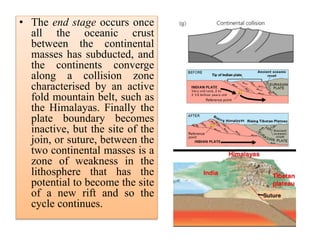
    • The endstage occurs once all the oceanic crust between the continental masses has subducted, and the continents converge along a collision zone characterised by an active fold mountain belt, such as the Himalayas. Finally the plate boundary becomes inactive, but the site of the join, or suture, between the two continental masses is a zone of weakness in the lithosphere that has the potential to become the site of a new rift and so the cycle continues.