Linear Equations
Terms Involving Equations 
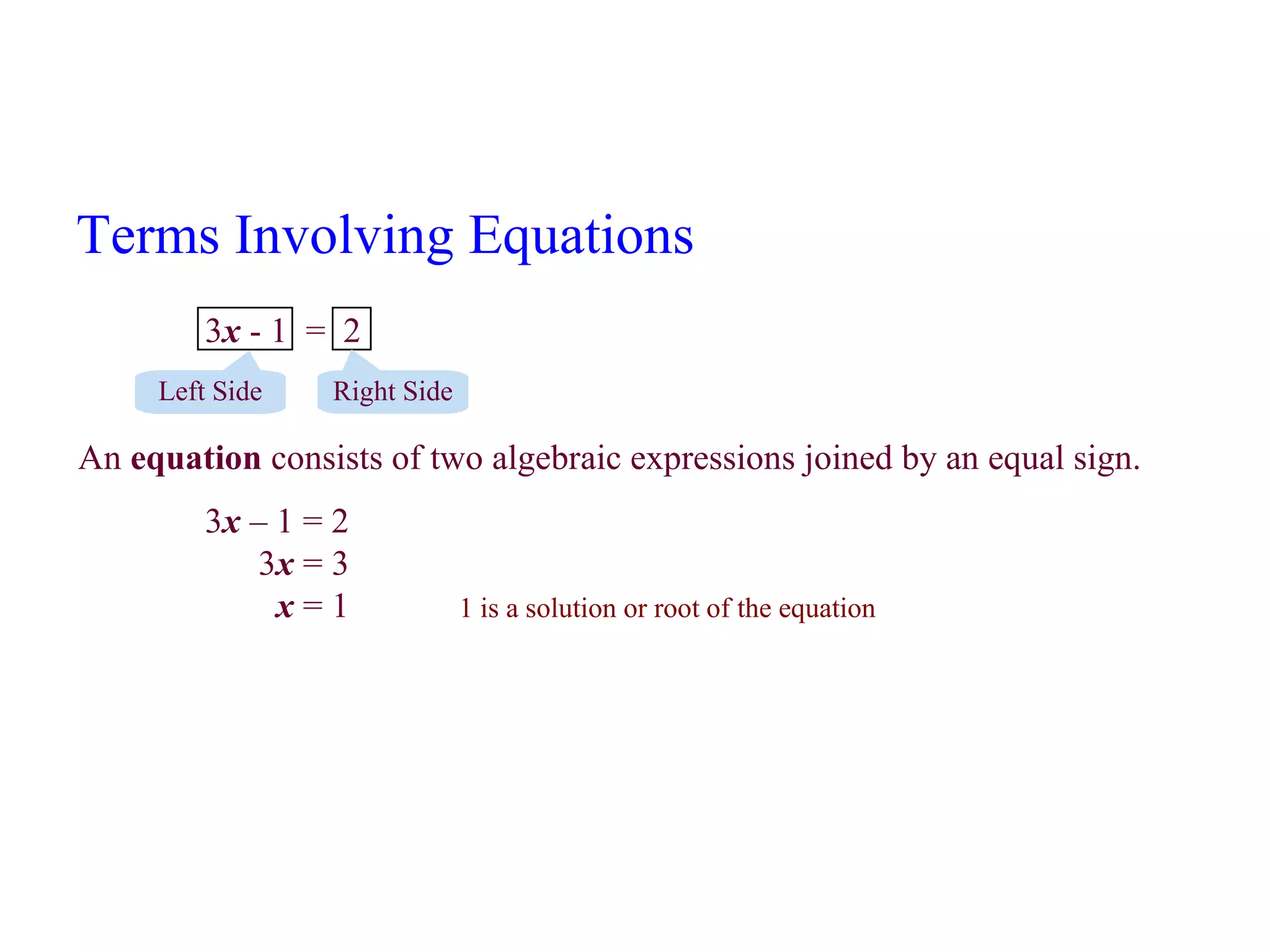
3x - 1 = 2 
Left Side Right Side 
An equation consists of two algebraic expressions joined by an equal sign. 
3x – 1 = 2 
3x = 3 
x = 1 1 is a solution or root of the equation
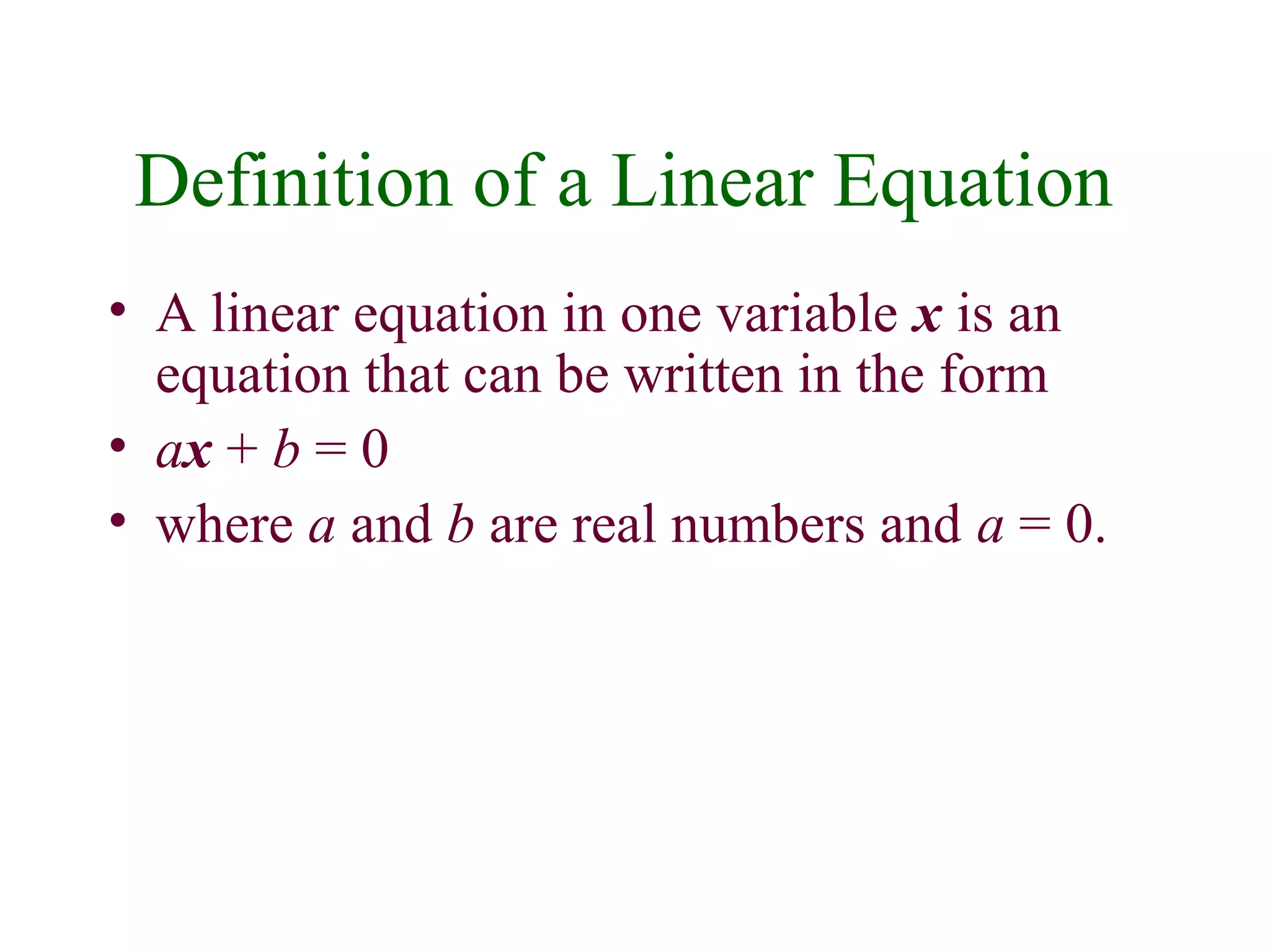
Definition of a Linear Equation 
• A linear equation in one variable x is an 
equation that can be written in the form 
• ax + b = 0 
• where a and b are real numbers and a = 0.
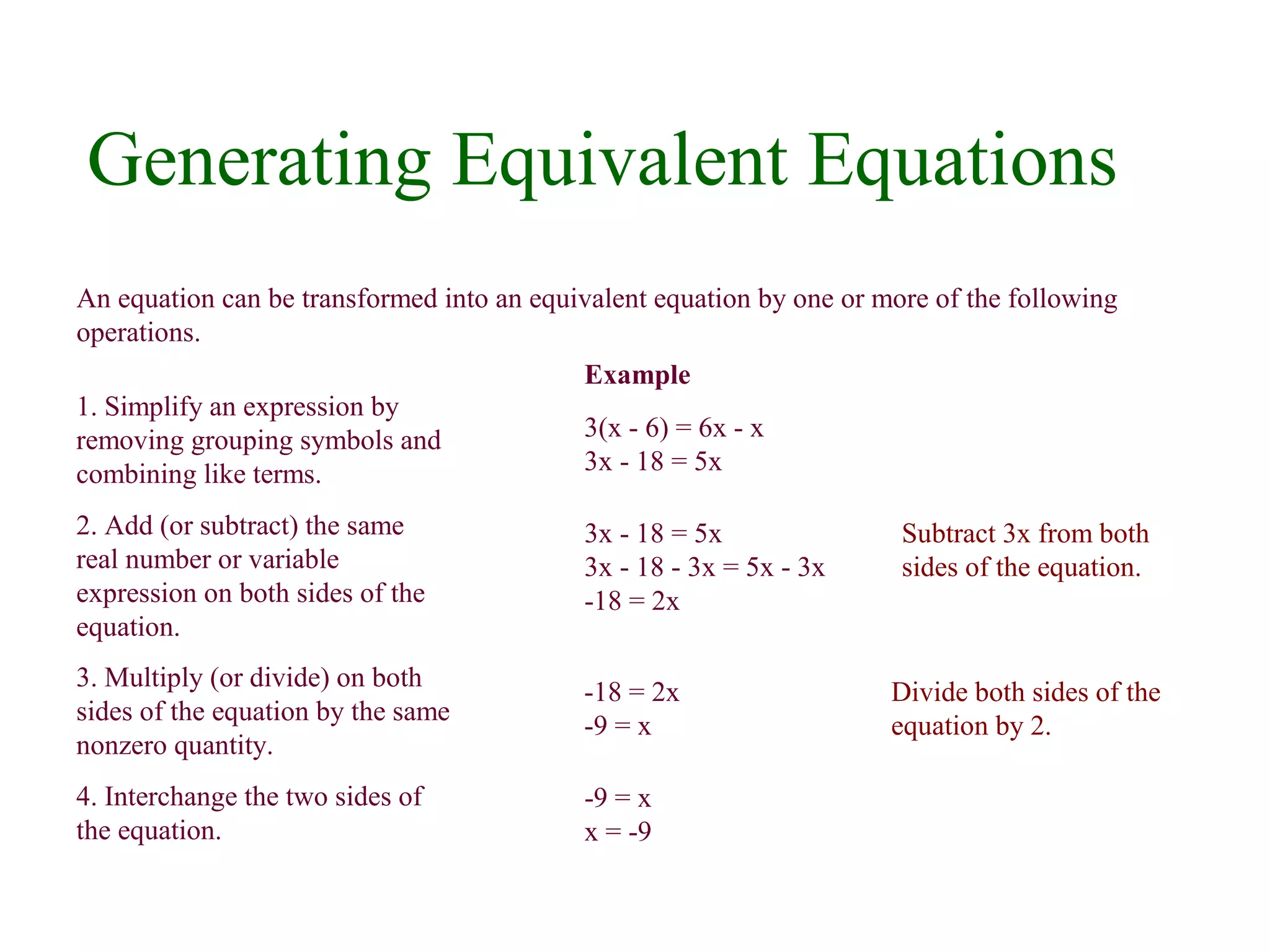
Generating Equivalent Equations 
An equation can be transformed into an equivalent equation by one or more of the following 
operations. 
Example 
1. Simplify an expression by 
removing grouping symbols and 
combining like terms. 
3(x - 6) = 6x - x 
3x - 18 = 5x 
-18 = 2x 
-9 = x 
Divide both sides of the 
equation by 2. 
3. Multiply (or divide) on both 
sides of the equation by the same 
nonzero quantity. 
Subtract 3x from both 
sides of the equation. 
3x - 18 = 5x 
3x - 18 - 3x = 5x - 3x 
-18 = 2x 
2. Add (or subtract) the same 
real number or variable 
expression on both sides of the 
equation. 
-9 = x 
x = -9 
4. Interchange the two sides of 
the equation.
Solving a Linear Equation 
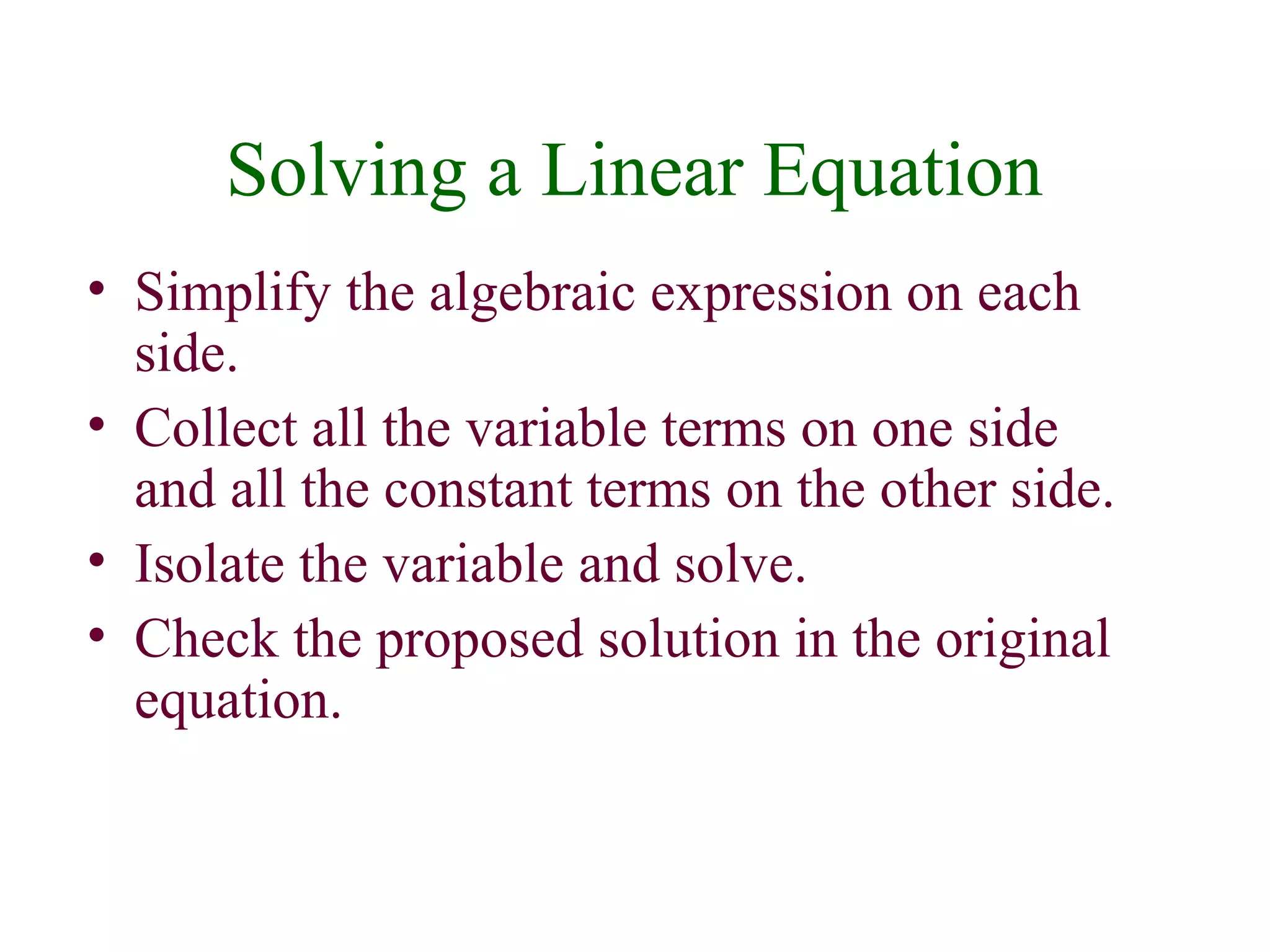
• Simplify the algebraic expression on each 
side. 
• Collect all the variable terms on one side 
and all the constant terms on the other side. 
• Isolate the variable and solve. 
• Check the proposed solution in the original 
equation.
Text Example 
Solve the equation: 2(x - 3) - 17 = 13 - 3(x + 2). 
Solution 
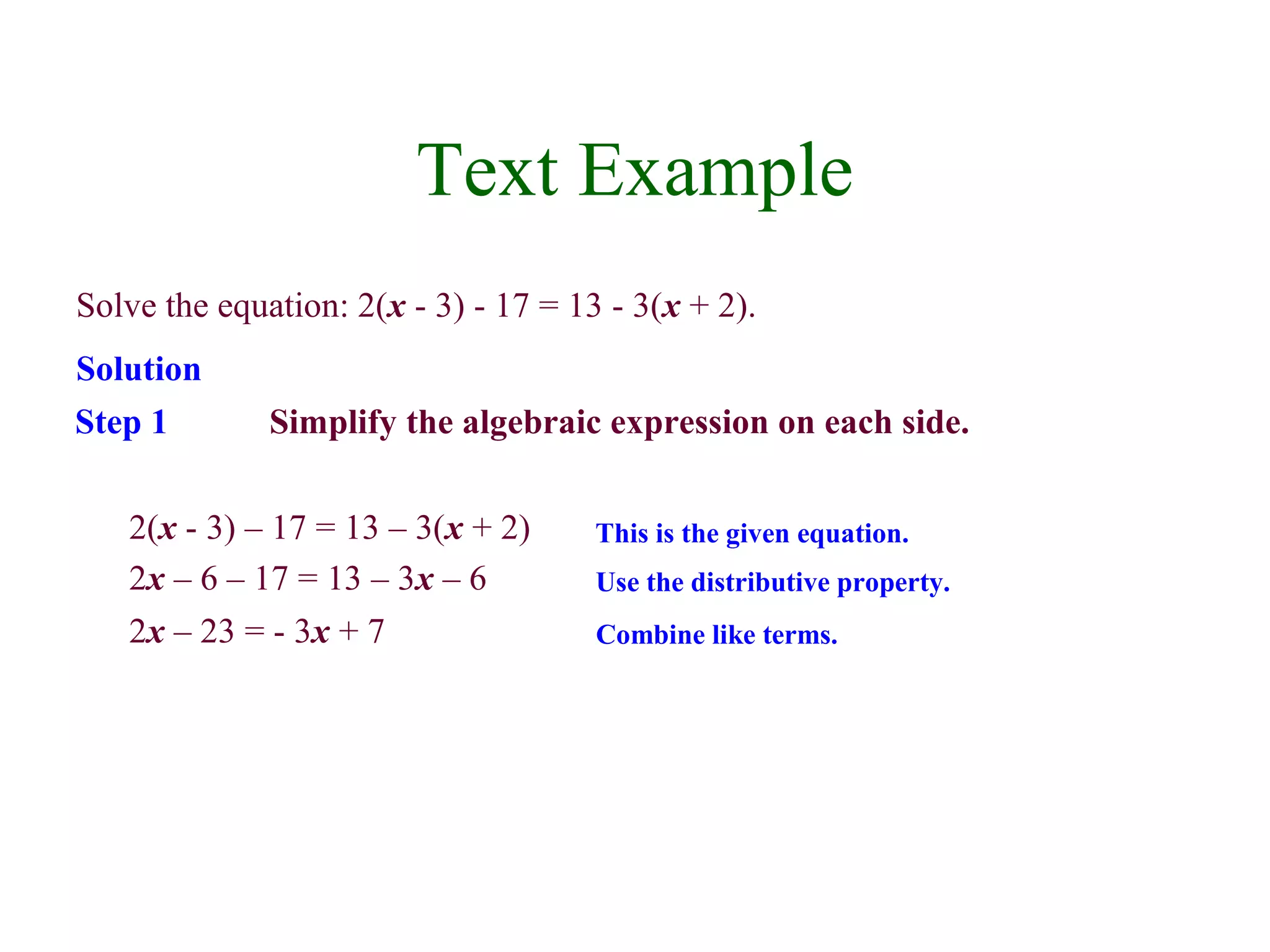
Step 1 Simplify the algebraic expression on each side. 
2(x - 3) – 17 = 13 – 3(x + 2) This is the given equation. 
2x – 6 – 17 = 13 – 3x – 6 Use the distributive property. 
2x – 23 = - 3x + 7 Combine like terms.
Text Example 
Solve the equation: 2(x - 3) - 17 = 13 - 3(x + 2). 
Solution 
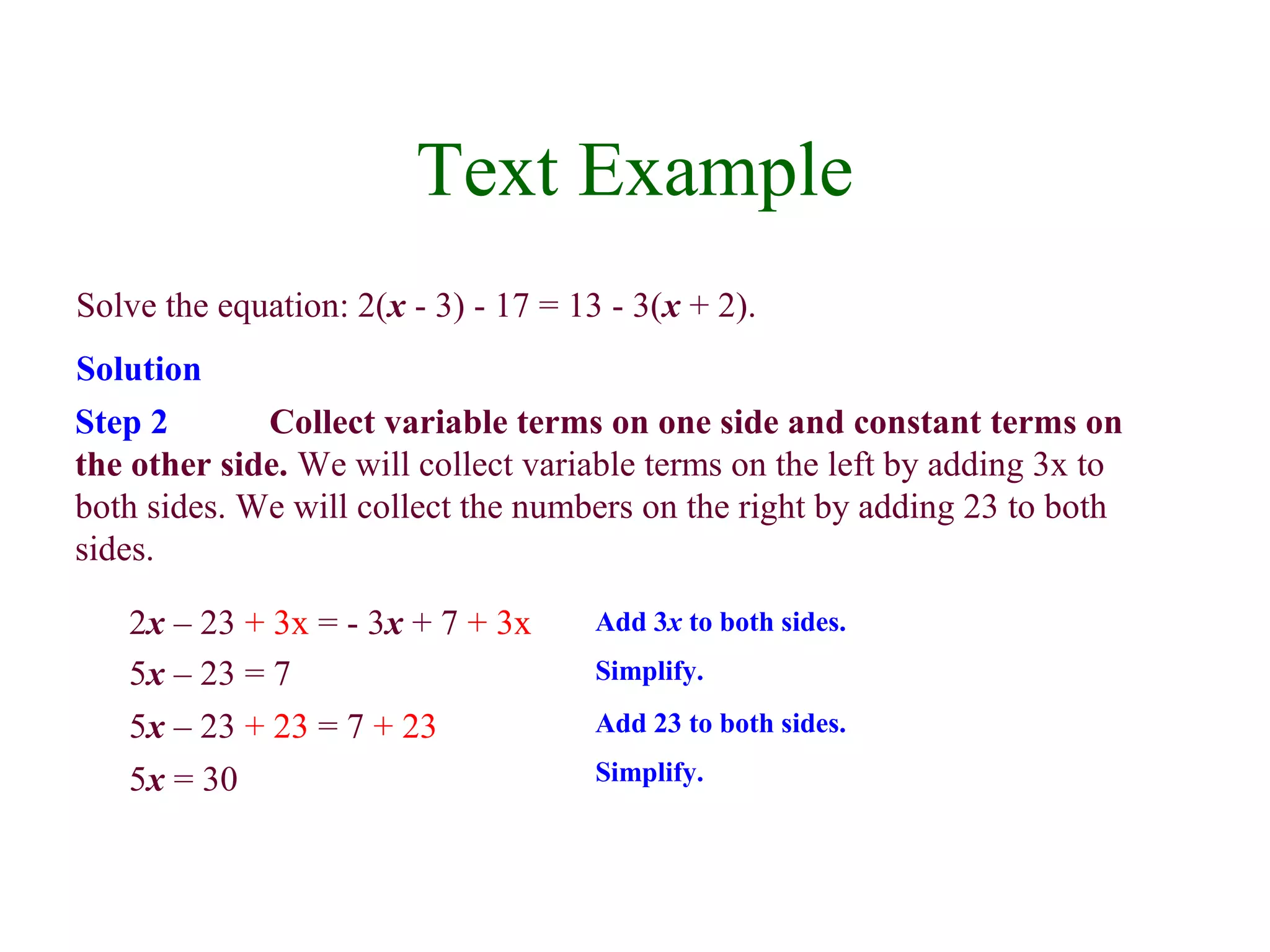
Step 2 Collect variable terms on one side and constant terms on 
the other side. We will collect variable terms on the left by adding 3x to 
both sides. We will collect the numbers on the right by adding 23 to both 
sides. 
2x – 23 + 3x = - 3x + 7 + 3x Add 3x to both sides. 
5x – 23 = 7 Simplify. 
5x – 23 + 23 = 7 + 23 Add 23 to both sides. 
5x = 30 Simplify.
Text Example 
Solve the equation: 2(x - 3) - 17 = 13 - 3(x + 2). 
Solution 
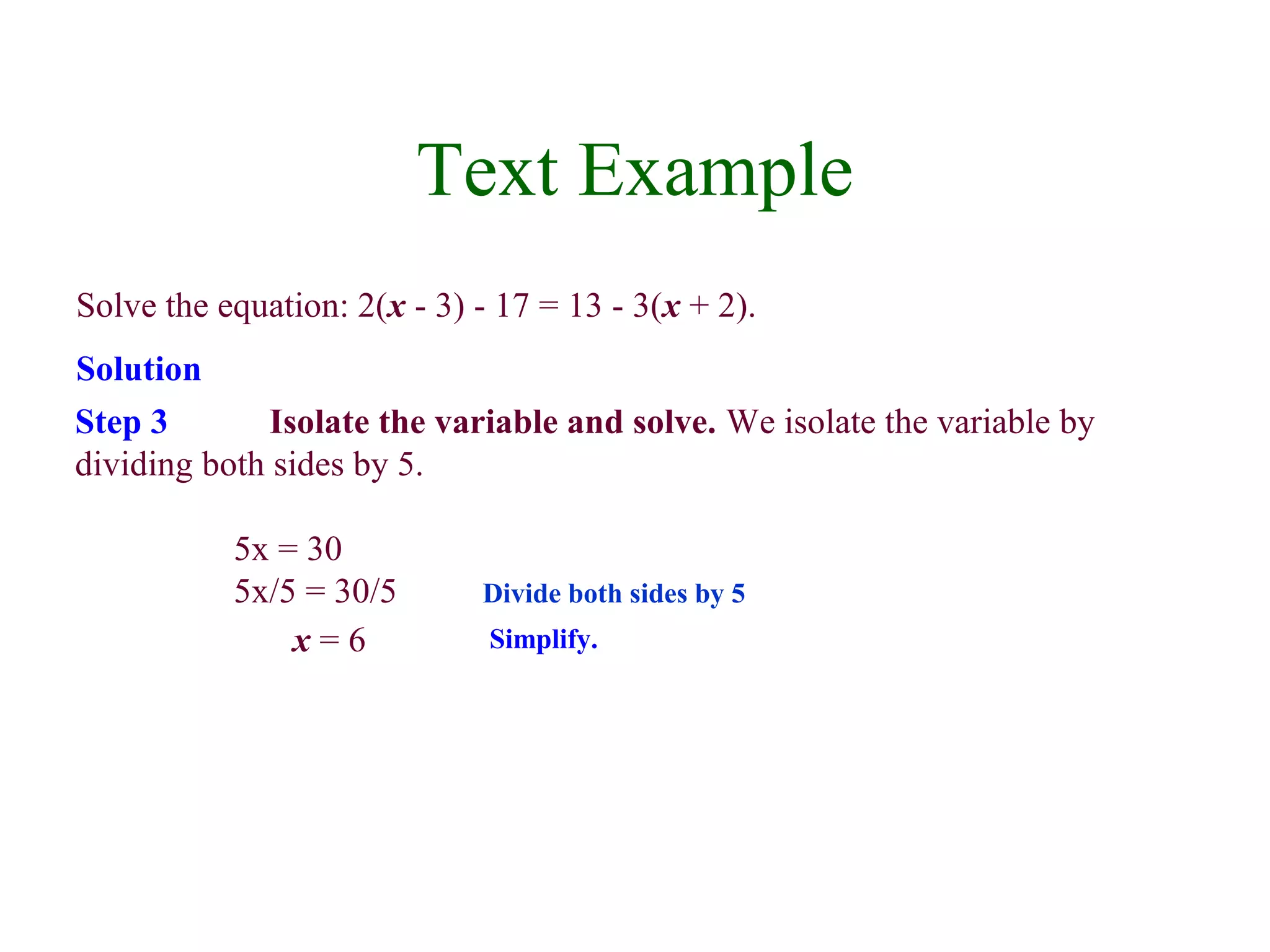
Step 3 Isolate the variable and solve. We isolate the variable by 
dividing both sides by 5. 
5x = 30 
5x/5 = 30/5 Divide both sides by 5 
x = 6 Simplify.
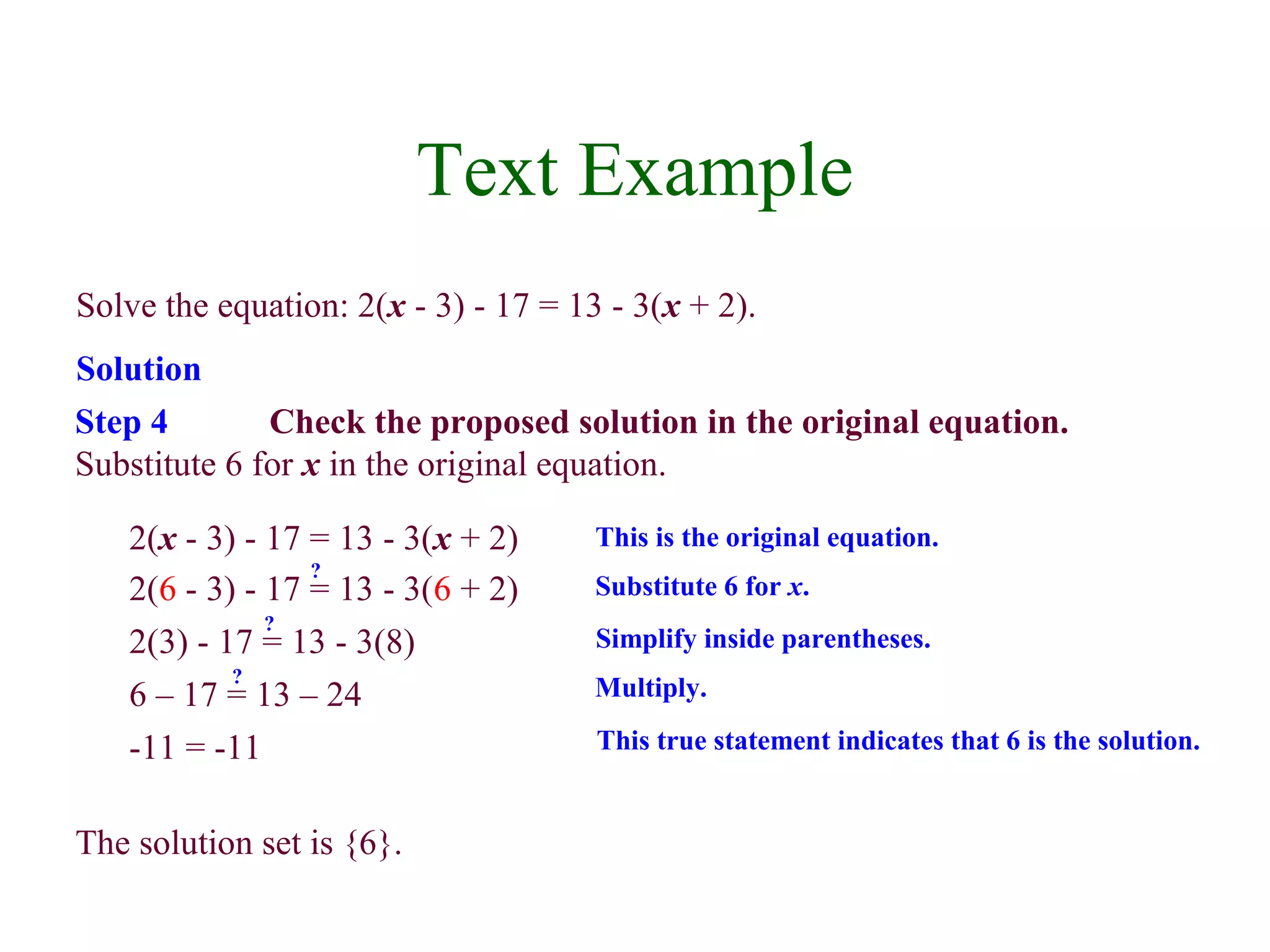
Solve the equation: 2(x - 3) - 17 = 13 - 3(x + 2). 
Solution 
Step 4 Check the proposed solution in the original equation. 
Substitute 6 for x in the original equation. 
2(x - 3) - 17 = 13 - 3(x + 2) This is the original equation. 
2(6 - 3) - 17 = 13 - 3(6 + 2) Substitute 6 for x. ? 
2(3) - 17 = 13 - 3(8) Simplify inside parentheses. ? 
6 – 17 =? 13 – 24 Multiply. 
-11 = -11 This true statement indicates that 6 is the solution. 
The solution set is {6}. 
Text Example
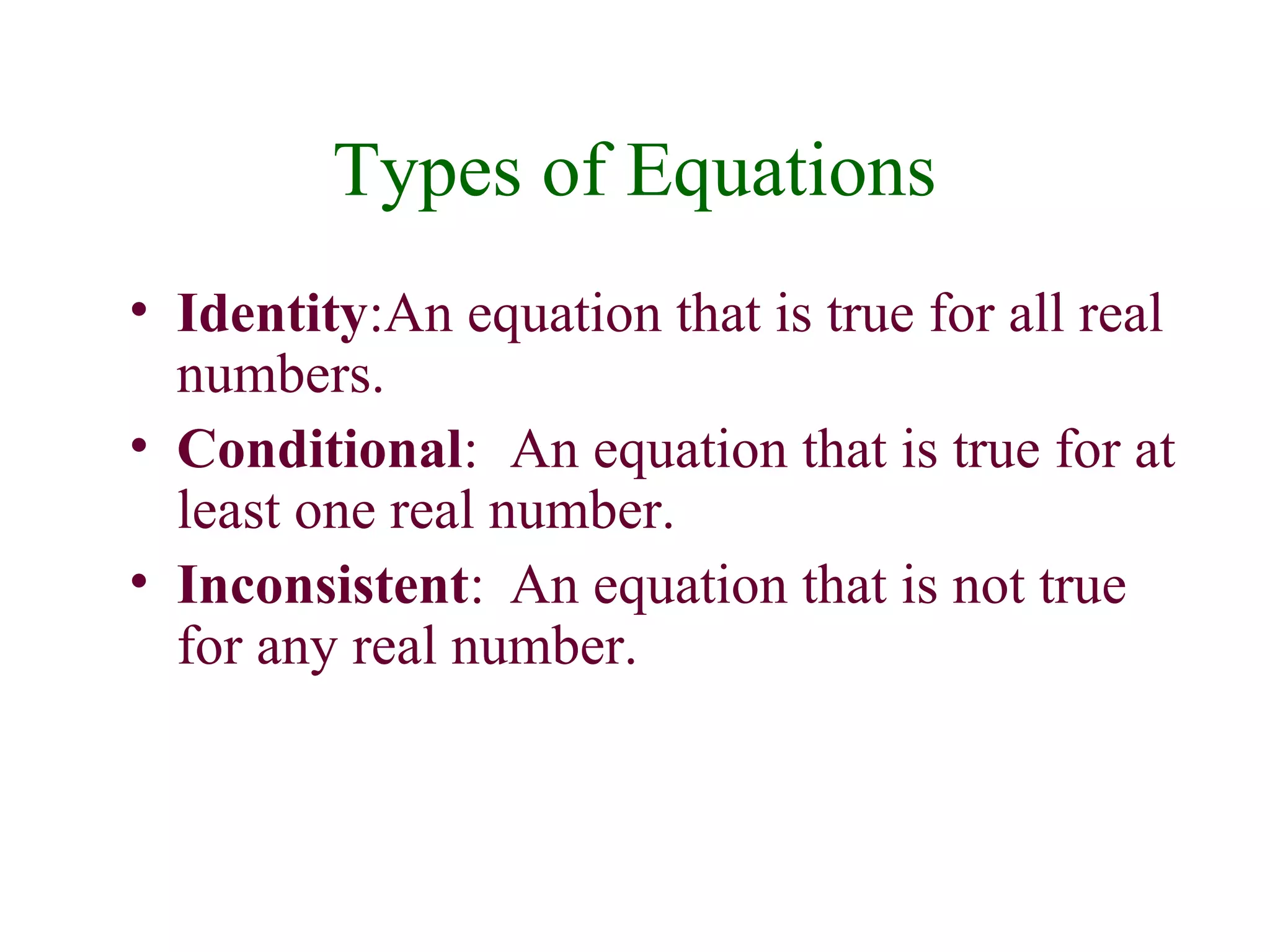
Types of Equations 
• Identity:An equation that is true for all real 
numbers. 
• Conditional: An equation that is true for at 
least one real number. 
• Inconsistent: An equation that is not true 
for any real number.
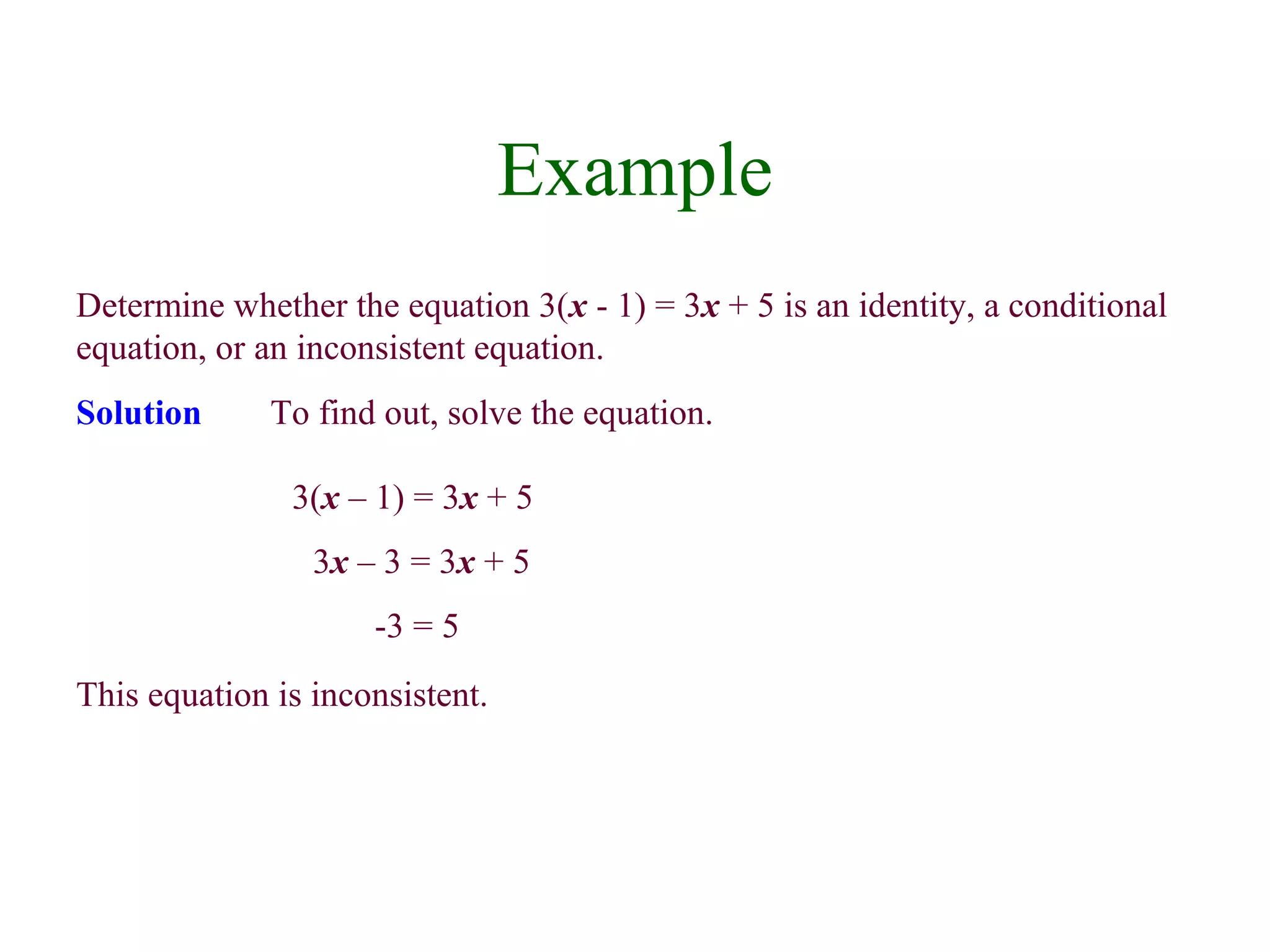
Determine whether the equation 3(x - 1) = 3x + 5 is an identity, a conditional 
equation, or an inconsistent equation. 
Solution To find out, solve the equation. 
3(x – 1) = 3x + 5 
3x – 3 = 3x + 5 
-3 = 5 
This equation is inconsistent. 
Example
Linear Equations

Linear equations

  • 1.
  • 2.
    Terms Involving Equations 3x - 1 = 2 Left Side Right Side An equation consists of two algebraic expressions joined by an equal sign. 3x – 1 = 2 3x = 3 x = 1 1 is a solution or root of the equation
  • 3.
    Definition of aLinear Equation • A linear equation in one variable x is an equation that can be written in the form • ax + b = 0 • where a and b are real numbers and a = 0.
  • 4.
    Generating Equivalent Equations An equation can be transformed into an equivalent equation by one or more of the following operations. Example 1. Simplify an expression by removing grouping symbols and combining like terms. 3(x - 6) = 6x - x 3x - 18 = 5x -18 = 2x -9 = x Divide both sides of the equation by 2. 3. Multiply (or divide) on both sides of the equation by the same nonzero quantity. Subtract 3x from both sides of the equation. 3x - 18 = 5x 3x - 18 - 3x = 5x - 3x -18 = 2x 2. Add (or subtract) the same real number or variable expression on both sides of the equation. -9 = x x = -9 4. Interchange the two sides of the equation.
  • 5.
    Solving a LinearEquation • Simplify the algebraic expression on each side. • Collect all the variable terms on one side and all the constant terms on the other side. • Isolate the variable and solve. • Check the proposed solution in the original equation.
  • 6.
    Text Example Solvethe equation: 2(x - 3) - 17 = 13 - 3(x + 2). Solution Step 1 Simplify the algebraic expression on each side. 2(x - 3) – 17 = 13 – 3(x + 2) This is the given equation. 2x – 6 – 17 = 13 – 3x – 6 Use the distributive property. 2x – 23 = - 3x + 7 Combine like terms.
  • 7.
    Text Example Solvethe equation: 2(x - 3) - 17 = 13 - 3(x + 2). Solution Step 2 Collect variable terms on one side and constant terms on the other side. We will collect variable terms on the left by adding 3x to both sides. We will collect the numbers on the right by adding 23 to both sides. 2x – 23 + 3x = - 3x + 7 + 3x Add 3x to both sides. 5x – 23 = 7 Simplify. 5x – 23 + 23 = 7 + 23 Add 23 to both sides. 5x = 30 Simplify.
  • 8.
    Text Example Solvethe equation: 2(x - 3) - 17 = 13 - 3(x + 2). Solution Step 3 Isolate the variable and solve. We isolate the variable by dividing both sides by 5. 5x = 30 5x/5 = 30/5 Divide both sides by 5 x = 6 Simplify.
  • 9.
    Solve the equation:2(x - 3) - 17 = 13 - 3(x + 2). Solution Step 4 Check the proposed solution in the original equation. Substitute 6 for x in the original equation. 2(x - 3) - 17 = 13 - 3(x + 2) This is the original equation. 2(6 - 3) - 17 = 13 - 3(6 + 2) Substitute 6 for x. ? 2(3) - 17 = 13 - 3(8) Simplify inside parentheses. ? 6 – 17 =? 13 – 24 Multiply. -11 = -11 This true statement indicates that 6 is the solution. The solution set is {6}. Text Example
  • 10.
    Types of Equations • Identity:An equation that is true for all real numbers. • Conditional: An equation that is true for at least one real number. • Inconsistent: An equation that is not true for any real number.
  • 11.
    Determine whether theequation 3(x - 1) = 3x + 5 is an identity, a conditional equation, or an inconsistent equation. Solution To find out, solve the equation. 3(x – 1) = 3x + 5 3x – 3 = 3x + 5 -3 = 5 This equation is inconsistent. Example
  • 12.