Line Following Robot
By Elijah Barner, Timothy Moore, Bryan Quiroz
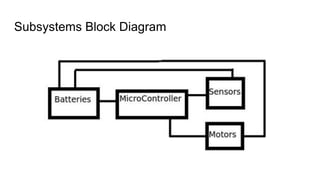
Subsystems Block Diagram
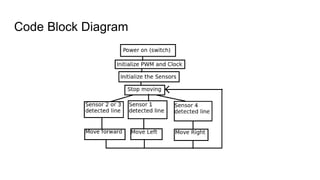
Code Block Diagram
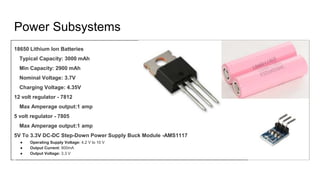
Power Subsystems
18650 Lithium Ion Batteries
Typical Capacity: 3000 mAh
Min Capacity: 2900 mAh
Nominal Voltage: 3.7V
Charging Voltage: 4.35V
12 volt regulator - 7812
Max Amperage output:1 amp
5 volt regulator - 7805
Max Amperage output:1 amp
5V To 3.3V DC-DC Step-Down Power Supply Buck Module -AMS1117
● Operating Supply Voltage: 4.2 V to 10 V
● Output Current: 800mA
● Output Voltage: 3.3 V
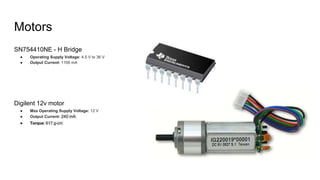
Motors
SN754410NE - H Bridge
● Operating Supply Voltage: 4.5 V to 36 V
● Output Current: 1100 mA
Digilent 12v motor
● Max Operating Supply Voltage: 12 V
● Output Current: 240 mA
● Torque: 617 g-cm
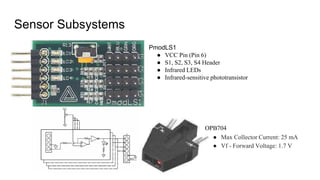
Sensor Subsystems
PmodLS1
● VCC Pin (Pin 6)
● S1, S2, S3, S4 Header
● Infrared LEDs
● Infrared-sensitive phototransistor
OPB704
● Max Collector Current: 25 mA
● Vf - Forward Voltage: 1.7 V
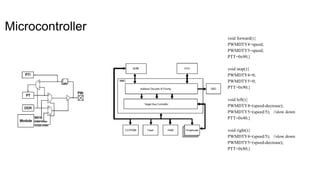
Microcontroller
void forward(){
PWMDTY4=speed;
PWMDTY5=speed;
PTT=0x90;}
void stop(){
PWMDTY4=0;
PWMDTY5=0;
PTT=0x90;}
void left(){
PWMDTY4=(speed-decrease);
PWMDTY5=(speed/5); //slow down
PTT=0x40;}
void right(){
PWMDTY4=(speed/5); //slow down
PWMDTY5=(speed-decrease);
PTT=0x80;}
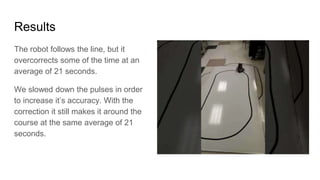
Results
The robot follows the line, but it
overcorrects some of the time at an
average of 21 seconds.
We slowed down the pulses in order
to increase it’s accuracy. With the
correction it still makes it around the
course at the same average of 21
seconds.
Summary/Conclusion
This was a very hard project but it was a sum of all that we learned so far.
Programming a microcontroller
Building a Power supply
Wiring and creating a circuit
The Axiom TWR-S12G128 kit was one of the worst ones to use. I think that there could have been something more
affordable in the market where it would have been easier to learn how to code.

Line Following Robot

  • 1.
    Line Following Robot ByElijah Barner, Timothy Moore, Bryan Quiroz
  • 2.
  • 3.
  • 4.
    Power Subsystems 18650 LithiumIon Batteries Typical Capacity: 3000 mAh Min Capacity: 2900 mAh Nominal Voltage: 3.7V Charging Voltage: 4.35V 12 volt regulator - 7812 Max Amperage output:1 amp 5 volt regulator - 7805 Max Amperage output:1 amp 5V To 3.3V DC-DC Step-Down Power Supply Buck Module -AMS1117 ● Operating Supply Voltage: 4.2 V to 10 V ● Output Current: 800mA ● Output Voltage: 3.3 V
  • 5.
    Motors SN754410NE - HBridge ● Operating Supply Voltage: 4.5 V to 36 V ● Output Current: 1100 mA Digilent 12v motor ● Max Operating Supply Voltage: 12 V ● Output Current: 240 mA ● Torque: 617 g-cm
  • 6.
    Sensor Subsystems PmodLS1 ● VCCPin (Pin 6) ● S1, S2, S3, S4 Header ● Infrared LEDs ● Infrared-sensitive phototransistor OPB704 ● Max Collector Current: 25 mA ● Vf - Forward Voltage: 1.7 V
  • 7.
    Microcontroller void forward(){ PWMDTY4=speed; PWMDTY5=speed; PTT=0x90;} void stop(){ PWMDTY4=0; PWMDTY5=0; PTT=0x90;} voidleft(){ PWMDTY4=(speed-decrease); PWMDTY5=(speed/5); //slow down PTT=0x40;} void right(){ PWMDTY4=(speed/5); //slow down PWMDTY5=(speed-decrease); PTT=0x80;}
  • 8.
    Results The robot followsthe line, but it overcorrects some of the time at an average of 21 seconds. We slowed down the pulses in order to increase it’s accuracy. With the correction it still makes it around the course at the same average of 21 seconds.
  • 9.
    Summary/Conclusion This was avery hard project but it was a sum of all that we learned so far. Programming a microcontroller Building a Power supply Wiring and creating a circuit The Axiom TWR-S12G128 kit was one of the worst ones to use. I think that there could have been something more affordable in the market where it would have been easier to learn how to code.