CTEV
By Dr Praveen
Lisie hospital,kochi
INTRODUCTION
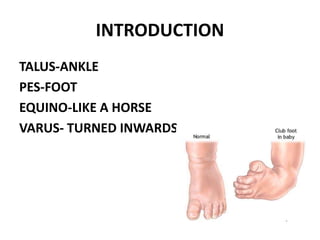
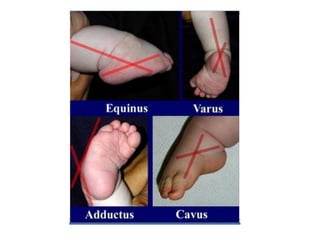
TALUS-ANKLE
PES-FOOT
EQUINO-LIKE A HORSE
VARUS- TURNED INWARDS
HISTORICAL ASPECTS
- EARLIEST EVIDENCE IN EGYPTIAN PERIOD.
- YAJURVEDA ADVISED TO MASSAGE TO
CORRECT DEFORMITY.
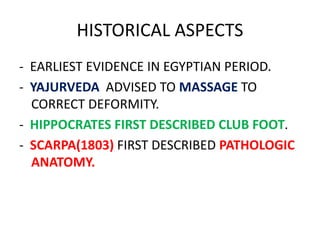
- HIPPOCRATES FIRST DESCRIBED CLUB FOOT.
- SCARPA(1803) FIRST DESCRIBED PATHOLOGIC
ANATOMY.
- KITE (1930) DESCRIBED NON OPERATIVE
TREATMENT WITH SEVERAL MANIPULATION
AND PLASTER CAST APPLICATION.
- DENNIS BROWN (1934) DEVISED SPLINT FOR
MAINTENANCE OF CLUBFOOT CORRECTION.
- IGNACIO PONSETI (1950) DEVELOPED
METHOD CORRECTION.
DEFINITION
CONGENITAL DYSPLASIA OF MUSCULOSKELETAL
TISSUES DISTAL TO KNEE JOINT IN THE FORM OF
DEFORMITY OF FOOT AND ANKLE.
Biology
• Clubfoot is not an embryonic malformation.
• Developmental deformation
• Rarely detected with USG before the 16th
week of gestation
• Excessive pull of the tibialis posterior abetted
by the gastrosoleus and the long toe flexors
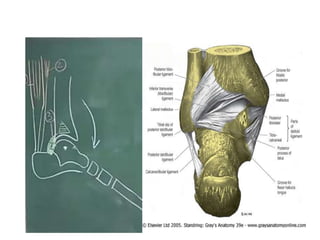
• The ligaments of the posterior and medial
aspect of the ankle and tarsal joints are very
thick and taut
• Excessive collagen synthesis in the ligaments,
tendons, and muscles may persist until the
child is 3 or 4 years of age and might be a
cause of relapses.
• The bundles of collagen fibers display a wavy
appearance known as crimp.
Kinematics
• Talus: most deformed and least displaced.
Head & neck deviated medially & plantarward
Body rotated externally in the ankle mortise,
superior articular surface escapes from mortice.
Talar neck is short and medially deviated.
Smaller than normal, disturbance of vascular
supply, ossification centre eccentrically placed.
• Navicular:
Medially displaced
Close to medial malleolus
Articulates with medial surface of head of talus
• calcaneus is
– adducted and
– inverted under the talus
• Cuboid
Displaced medially on the dysmorphic distal end
of the calcaneus
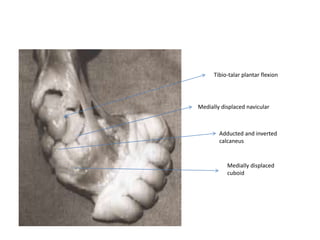
Tibio-talar plantar flexion
Medially displaced navicular
Adducted and inverted
calcaneus
Medially displaced
cuboid
• Correction of the extreme medial
displacement and inversion of the tarsal
bones in the clubfoot necessitates a
simultaneous gradual lateral shift of the
navicular, cuboid, and calcaneus before they
can be everted into a neutral position
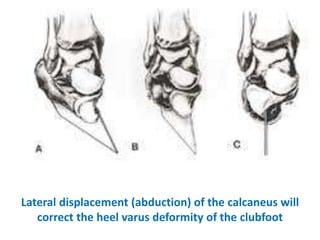
Lateral displacement (abduction) of the calcaneus will
correct the heel varus deformity of the clubfoot
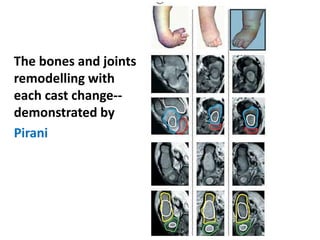
The bones and joints
remodelling with
each cast change--
demonstrated by
Pirani
• The tendo Achillis, unlike the tarsal ligaments
that are stretchable, is made of
non-stretchable, thick, tight collagen bundles
with few cells.
• Most cases of clubfoot are corrected after five
to six cast changes and, in many cases, a
tendo Achillis tenotomy needed.
1.MECHANICAL FACTORS- HIPPOCRATES
Oligohydramnios
Abnormal fetal positioning
Unstretched uterus
Placental insufficiency
Constriction bands
2.PRIMARY GERM PLASM DEFECT
3.ARRESTED FOETAL DEVELOPMENT
4.HEREDITARY- AD
5.MUSCULOLIGAMENTOUS FIBROSIS
6. VASCULAR HYPOTHESIS- 90% of CTEV limbs
showed hypoplasia / absence of anterior
tibial artery.
SECONDARY CLUBFOOT
1.PARALYTIC DISORDERS - evertors and dorsiflexors
are weak.
Ex- Polio , Spina Bifida, Myelodysplasia,
Friedreich Ataxia.
2.SYNDROMES -Arthogryposis Multiplex Congenita
Downs Syndrome, Larsen Syndrome.
• IN UPPER MOTOR NEURON
– Cerebral palsy
– Friedreich ataxia
– Syringomyelia
• In nerve root
– Spina bifida
– Spinal dysraphism
• In the nerve-neuropathy(leprosy)
• In myoneural junction-myasthenia gravis
• In foot muscles
– Muscular dystrophy
– Arthrogryposis Multiplex Congenita
INCIDENCE- 1 to 2 in 1000 livebirths.
SEX – MALE >FEMALE
BILATERAL IN MORE THAN 50 % .
FAMILY HISTORY- 5-50% POSITIVE.
Classifying the clubfoot
• The classification of a clubfoot may change
with time depending on management
Typical clubfoot
• Classic clubfoot and is found in otherwise
normal infants
• It generally corrects in five casts, and with
Ponseti management the long-term oucome is
usually good or excellent.
• Positional clubfoot
– deformity is very flexible
– due to intrauterine crowding
– Correction is often achieved with one or two
castings.
• Delayed treated clubfoot-beyond 6 months of
age.
• Alternatively treated typical clubfoot
– treated by surgery or non-Ponseti casting.
• Recurrent typical clubfoot
– may occur whether the original treatment was by
Ponseti management or other methods.
– Relapse is much less frequent after Ponseti
management and is usually due to a premature
discontinuation of bracing.
– The recurrence is most often supination and
equinus that is first dynamic but may become
fixed with time.
Atypical clubfoot
usually associated with other problems
Start with Ponseti management
Correction usually is more difficult
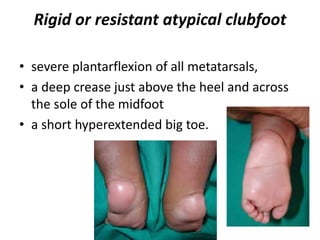
Rigid or resistant atypical clubfoot
• severe plantarflexion of all metatarsals,
• a deep crease just above the heel and across
the sole of the midfoot
• a short hyperextended big toe.
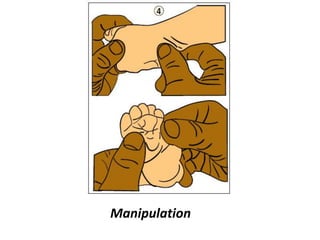
Manipulation
• Do not abduct more than 30 degrees. After 30
degrees abduction is achieved, change
emphasis to correction of the cavus and
equinus.
• Casting Always apply casts with the above-
knee portion in 110 degrees flexion to
prevent slippage. Up to 6–8 casts can be
needed to correct deformity
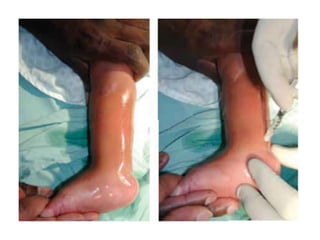
• Tenotomy
– A tenotomy is necessary in most cases.
– At least 10 degrees dorsiflexion is necessary
– change casts at weekly intervals after the
tenotomy if sufficient dorsiflexion is not achieved
immediately after the tenotomy.
• Bracing Reduce abduction on the affected
side to 30 degrees in the foot abduction
brace. The follow-up management remains
the same.
• Teratologic clubfoot such as congenital tarsal
synchondrosis
• Neurogenic clubfoot associated with a
neurological disorder such as
meningomyelocele.
• Acquired clubfoot such as Streeter dysplasia.
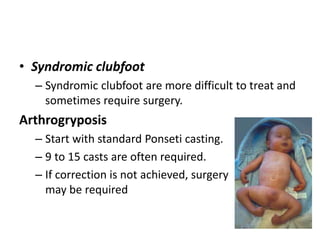
• Syndromic clubfoot
– Syndromic clubfoot are more difficult to treat and
sometimes require surgery.
Arthrogryposis
– Start with standard Ponseti casting.
– 9 to 15 casts are often required.
– If correction is not achieved, surgery
may be required
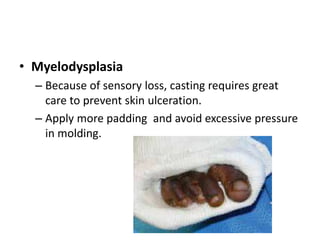
• Myelodysplasia
– Because of sensory loss, casting requires great
care to prevent skin ulceration.
– Apply more padding and avoid excessive pressure
in molding.
Radiology
• Plain radiograph: Can be assessed prior to
treatment with A-P & Lateral of foot
• Foot held in position of best correction, with weight-
bearing, or simulated weight-bearing
Anteroposterior view
• Talocalcaneal angle
• Calcaneal-second metatarsal angle
• Talus –first metatarsal angle
• Intermetatarsal angle
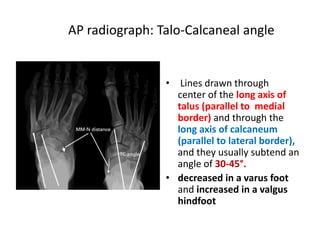
AP radiograph: Talo-Calcaneal angle
• Lines drawn through
center of the long axis of
talus (parallel to medial
border) and through the
long axis of calcaneum
(parallel to lateral border),
and they usually subtend an
angle of 30-45°.
• decreased in a varus foot
and increased in a valgus
hindfoot
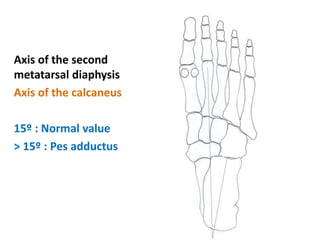
Axis of the second
metatarsal diaphysis
Axis of the calcaneus
15º : Normal value
> 15º : Pes adductus
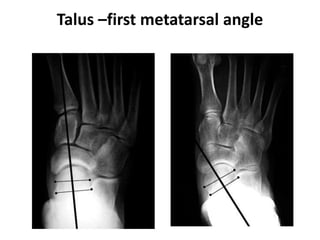
Talus –first metatarsal angle
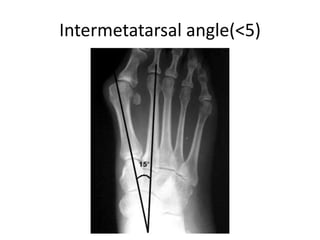
Intermetatarsal angle(<5)
Lateral view
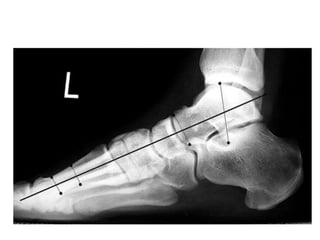
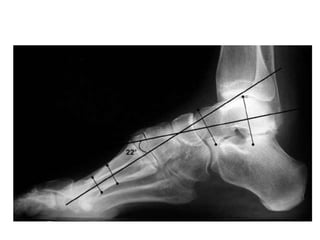
• The lateral talocalcaneal angle
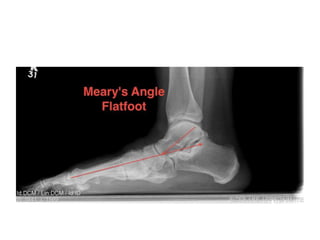
• Meary angle
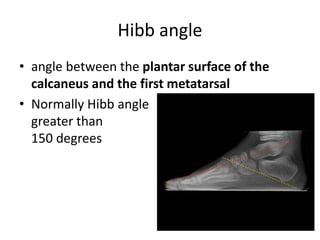
• Hibb angle
• Calcaneal pitch
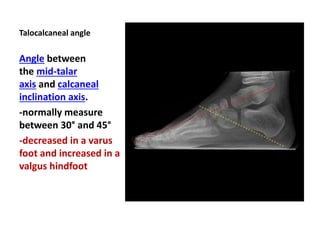
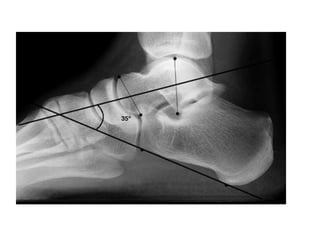
Talocalcaneal angle
Angle between
the mid-talar
axis and calcaneal
inclination axis.
-normally measure
between 30° and 45°
-decreased in a varus
foot and increased in a
valgus hindfoot
Meary angle
• B/n long axis of the talus and the long axis of
the 1st MT
• Normally, these lines are colinear
• apex directed dorsally-cavus foot
• apex angled plantarward- valgus or flatfeet
Hibb angle
• angle between the plantar surface of the
calcaneus and the first metatarsal
• Normally Hibb angle is
greater than
150 degrees
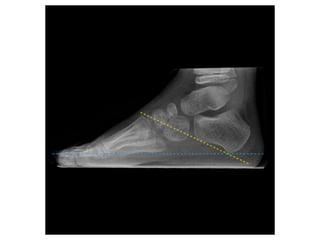
Calcaneal pitch
• Angle between the horizontal and the plantar
surface of the calcaneus
• Important in evaluating a cavus foot or
clubfoot
• low: 10-20° - indicative of pes planus
• medium: 20-30°
• high: ≥30° - indicative of pes cavus
SCORING SYSTEMS
• Serial scoring useful in
– classifying the clubfoot,
– assessing progress,
– showing signs of recurrence, and
– establishing the prognosis.
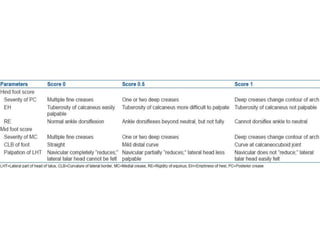
Pirani Score
• Documents the severity of the Deformity
• Sequential scores are an excellent way to
monitor progress.
• Six parameters : 3 of midfoot and 3 of hindfoot
• Each parameter is given a value as follows:
0: normal
0.5: Mildly abnormal
1: severely abnormal
Mid foot score
• Curved lateral border
[A]
• Medial crease [B]
• Talar head coverage [C]
Hind foot score
• Posterior crease [D]
• Rigid equinus [E]
• Empty heel [F]
Uses of Pirani’s score
• Predicting need for tenotomy
• Estimation of probable no. of casts required*
• Very good interobserver reliability and reproducibility**
• Scoring of 4 or more is likely to require at least
four casts.
• Scoring less than 4 will require three or fewer
• A foot with a hindfoot score of 2.5 or 3 has a
72% chance of requiring a Tenotomy.
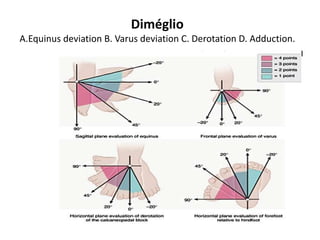
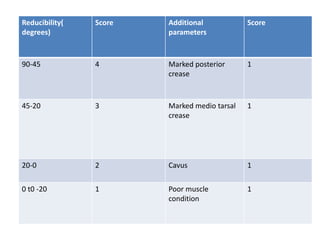
Diméglio
A.Equinus deviation B. Varus deviation C. Derotation D. Adduction.
Reducibility(
degrees)
Score Additional
parameters
Score
90-45 4 Marked posterior
crease
1
45-20 3 Marked medio tarsal
crease
1
20-0 2 Cavus 1
0 t0 -20 1 Poor muscle
condition
1
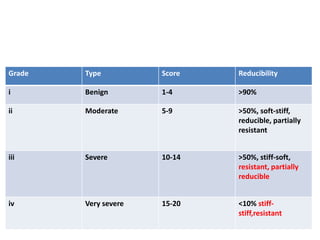
Grade Type Score Reducibility
i Benign 1-4 >90%
ii Moderate 5-9 >50%, soft-stiff,
reducible, partially
resistant
iii Severe 10-14 >50%, stiff-soft,
resistant, partially
reducible
iv Very severe 15-20 <10% stiff-
stiff,resistant
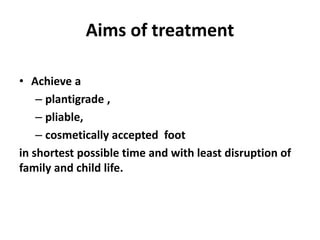
Aims of treatment
• Achieve a
– plantigrade ,
– pliable,
– cosmetically accepted foot
in shortest possible time and with least disruption of
family and child life.
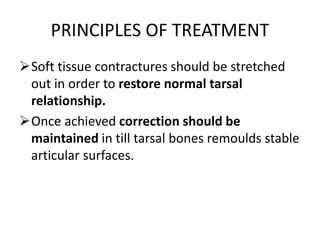
PRINCIPLES OF TREATMENT
Soft tissue contractures should be stretched
out in order to restore normal tarsal
relationship.
Once achieved correction should be
maintained in till tarsal bones remoulds stable
articular surfaces.
TWO OPTIONS –
1. NON OPERATIVE- immediately after birth
2. OPERATIVE
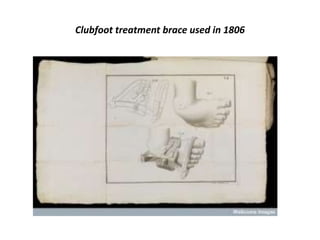
Clubfoot treatment brace used in 1806
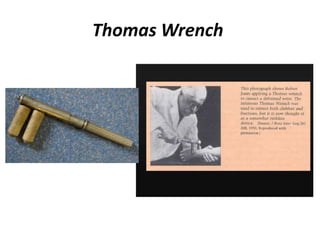
Thomas Wrench
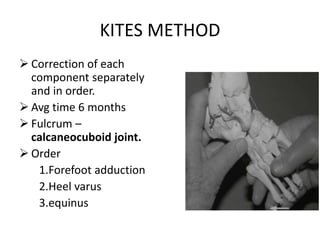
KITES METHOD
 Correction of each
component separately
and in order.
 Avg time 6 months
 Fulcrum –
calcaneocuboid joint.
 Order
1.Forefoot adduction
2.Heel varus
3.equinus
Kite method
• Believed heel varus would correct simply by everting
calcaneus
• Did not realize calcaneus can evert only when it is
abducted (i.e., laterally rotated) under the talus
• Forefoot overcorrected into mild flatfoot
• Calcaneus is rolled out of inversion by placing plantar
surface of a slipper cast on glass plate to flatten the
sole
• Dorsiflexion of foot with wedging casts
Reasons for poor results in kites method
1. FULCRUM- prevents abduction of calcaneum
and thereby eversion of calcaneum.
2. Pronation of forefoot worsens cavus.
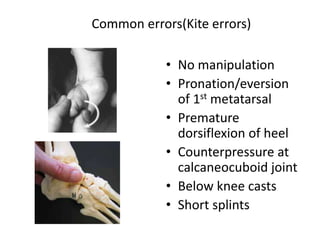
Common errors(Kite errors)
• No manipulation
• Pronation/eversion
of 1st metatarsal
• Premature
dorsiflexion of heel
• Counterpressure at
calcaneocuboid joint
• Below knee casts
• Short splints
Ponseti Cast Correction
• weekly manipulation and cast application to hold
correction
• Percutaneous tenotomy of tendo achilles for “hind
foot stall”
• Once foot corrected, an abduction foot orthosis
worn full time for 12 weeks, and then at nights and
naps, up to age of four.
• Order- cavus
adduction
varus
equinus
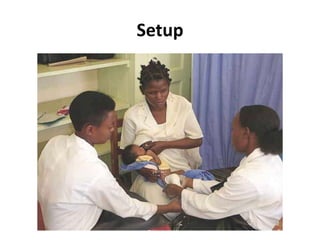
Setup
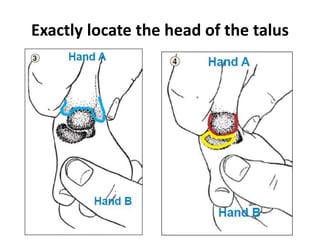
Exactly locate the head of the talus
Manipulation
• Start as soon after birth as possible
• Abduction of the foot beneath the stabilized
talar head.
• All components of clubfoot deformity, except
for the ankle equinus, are corrected
simultaneously
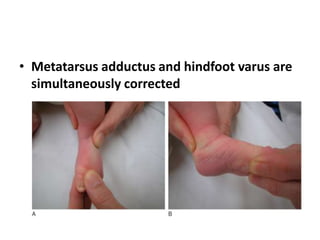
• Metatarsus adductus and hindfoot varus are
simultaneously corrected
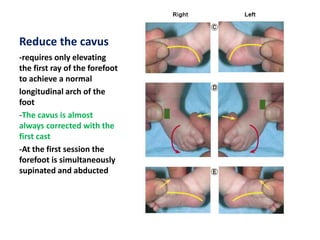
Reduce the cavus
-requires only elevating
the first ray of the forefoot
to achieve a normal
longitudinal arch of the
foot
-The cavus is almost
always corrected with the
first cast
-At the first session the
forefoot is simultaneously
supinated and abducted
• First, forefoot abduction should be
performed with the foot in slight supination
• Second, the heel should not be constrained
by premature dorsiflexion
• Third, care is taken to locate the fulcrum for
counterpressure on the lateral head of the
talus
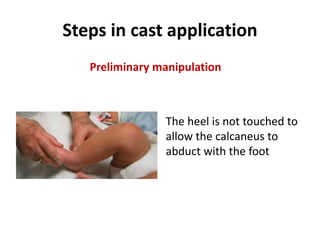
Steps in cast application
Preliminary manipulation
The heel is not touched to
allow the calcaneus to
abduct with the foot
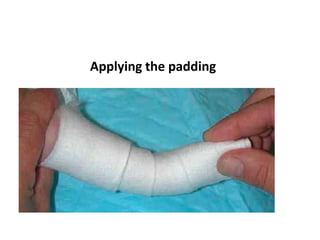
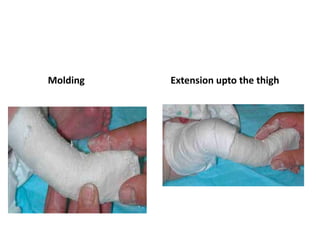
Applying the padding
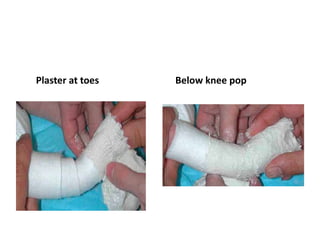
Plaster at toes Below knee pop
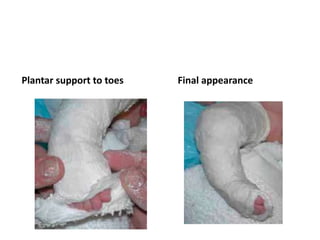
• press and release talar head repetitively to
avoid pressure sores of the skin.
• Mold the plaster over the head of the talus
while holding the foot in the corrected
position
• The calcaneus is never touched during the
manipulation or casting.
Molding Extension upto the thigh
Plantar support to toes Final appearance
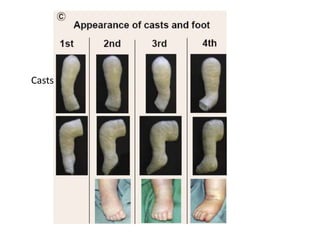
Casts and foot
Characteristics of adequate abduction
• Confirm that the foot is sufficiently abducted
to safely bring the foot into 0 to 5 degrees of
dorsiflexion before performing tenotomy.
• The best sign-ability to palpate the anterior
process of the calcaneus as it abducts out
from beneath the talus
• Abduction of approximately 60 degrees in
relationship to the frontal plane of the tibia is
possible.
• Neutral or slight valgus of os calcis is present.
This is determined by palpating the posterior
os calcis.
• The correction is accomplished by abducting
the foot under the head of the talus. The foot
is never pronated.
The final outcome
• At the completion of casting, the foot appears
to be over-corrected into abduction with
respect to normal foot appearance during
walking.
Complications of casting
• Tight cast
• Rocker bottom deformity
• Crowded toes
• Flat heel pad
• Superficial sores
• Deep sores
• Pressure sores
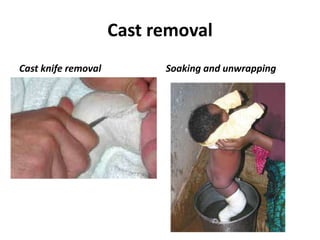
Cast removal
Cast knife removal Soaking and unwrapping
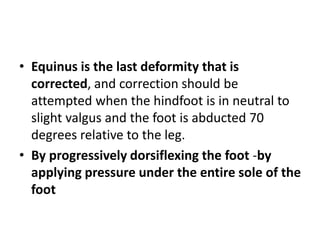
• Equinus is the last deformity that is
corrected, and correction should be
attempted when the hindfoot is in neutral to
slight valgus and the foot is abducted 70
degrees relative to the leg.
• By progressively dorsiflexing the foot -by
applying pressure under the entire sole of the
foot
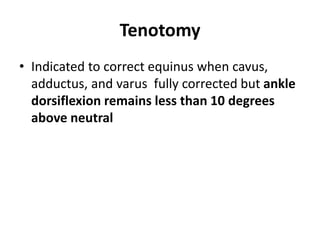
Tenotomy
• Indicated to correct equinus when cavus,
adductus, and varus fully corrected but ankle
dorsiflexion remains less than 10 degrees
above neutral
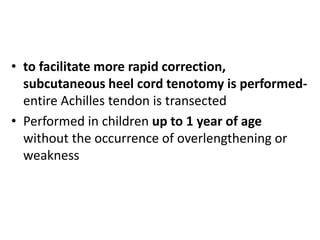
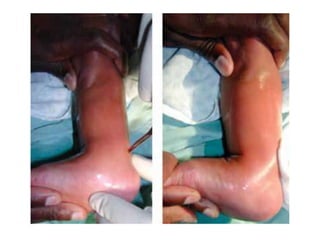
• to facilitate more rapid correction,
subcutaneous heel cord tenotomy is performed-
entire Achilles tendon is transected
• Performed in children up to 1 year of age
without the occurrence of overlengthening or
weakness
• Foot is held by an assistant in maximum
dorsiflexion
• select a site about 1.5 cm above the
calcaneus for the tenotomy
• The blade enters the skin along the medial
border of the Achilles tendon.
• Successful tenotomy -palpable pop and
ability for further dorsiflexion of about 15 to
20 degrees
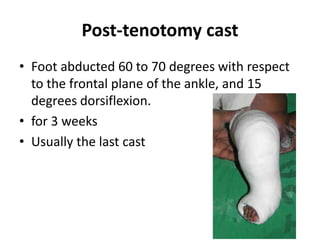
Post-tenotomy cast
• Foot abducted 60 to 70 degrees with respect
to the frontal plane of the ankle, and 15
degrees dorsiflexion.
• for 3 weeks
• Usually the last cast
• An alternative to percutaneous heel cord
tenotomy -suggested by Alvarez and
colleagues
• Botulinum A toxin is injected into the triceps
surae muscle .
• Very short-term success with this approach
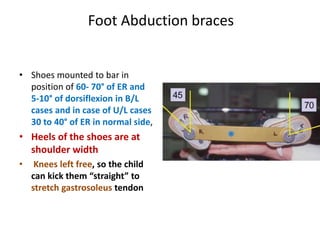
Foot Abduction braces
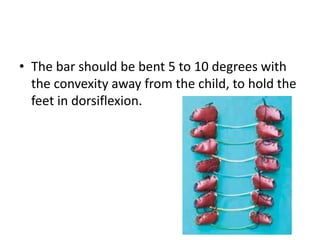
• Shoes mounted to bar in
position of 60- 70° of ER and
5-10° of dorsiflexion in B/L
cases and in case of U/L cases
30 to 40° of ER in normal side,
• Heels of the shoes are at
shoulder width
• Knees left free, so the child
can kick them “straight” to
stretch gastrosoleus tendon
• The bar should be bent 5 to 10 degrees with
the convexity away from the child, to hold the
feet in dorsiflexion.
Bracing protocol
• Worn 24 hours each day for first 3-4 months.
• Afterward it is worn at nap and nighttime for 2 to 4
years.
• Noncompliance with bracing protocol – the most
common cause of recurrence in children on Ponseti
regimen
.
• Occasionally, a child will develop excessive
heel valgus and external tibial torsion while
using the brace. In such instances, the
physician should reduce the external rotation
of the shoes on the bar from approximately
70 degrees to 40 degrees.
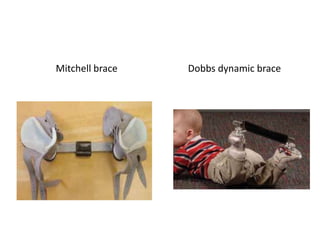
Mitchell brace Dobbs dynamic brace
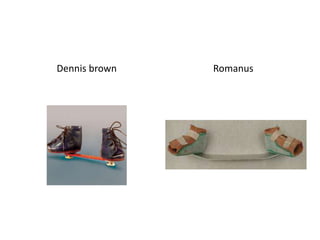
Dennis brown Romanus
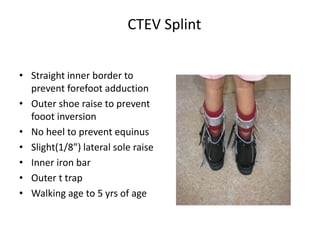
CTEV Splint
• Straight inner border to
prevent forefoot adduction
• Outer shoe raise to prevent
fooot inversion
• No heel to prevent equinus
• Slight(1/8”) lateral sole raise
• Inner iron bar
• Outer t trap
• Walking age to 5 yrs of age
Results of Ponseti method
• Cooper and Dietz published long-term results
from Iowa in 1995.
• In this retrospective review, 45 patients with 71
clubfeet were evaluated an average of 34 years
later.
• Results compared with NORMAL CONTROLS
– Thirty of the 71 feet required tibialis anterior
transfer.
– 62% of clubfeet were normal,
– 16% were good, and
– 15% were poor.
• Physical examination documented very good
strength and decreased foot motion in
comparison to those whose contralateral foot
was normal.
• Radiographs showed :feet not completely
corrected, but functioned well despite this
The French method
Bensahel/Dimeglio regime
 Daily manipulations by a skilled physiotherapist and
temporary immobilisation with elastic and non-
elastic adhesive taping .
 GOAL- reduce talonavicular joint, stretch out medial
tissues, correct deformities squentially.
• Mobilization during the hours of sleep with
CPM machine.
• Successful in 51% of cases ( of which 9% req
TA tenotomy) ;
• 49% Required extensive soft tissue release
– 29% post release and
– 20% comprehensive posteromedial release**.
Follow up protocol
• 2 weeks: to check for compliance of full-time bracing.
• 3 months: to graduate to the nights and naps protocol
• Every 4 months: until age 3 years to monitor compliance
and check for relapses
• Every 6 months: until age 4 years.
• Every 1 to 2 years: until skeletal maturity
RESULTS OF NON OPERATIVE
TREATMENT
OVERALL – 19% TO 95%.
KITES METHD- 80%.
PONSETI – 95%
Surgery in clubfoot
INDICATIONS
• Resistant clubfoot
• Persistently deformed clubfoot
• Relapsed clubfoot
• Neglected clubfoot
( no treatment given till age of 2 yrs)
one of the more complicated procedures
performed in all of orthopaedics
General Principles
• Goal: address all pathoantomic structures.
• Type of surgery depend on age and deformity.
• Soft tissue release for upto 2 years
• 2-4 years-Dwyer calcaneal osteotomy
• 8-10 years-calcaneocuboid fusion
• After that-triple arthrodesis
Timing of the Procedure
• before the age of 12 months
• There is therefore little advantage to
performing the surgery before 9 to 10 months
• Ensure that the child will be weight bearing
when the postoperative cast immobilization is
completed
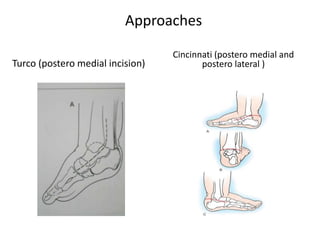
Approaches
Turco (postero medial incision)
Cincinnati (postero medial and
postero lateral )
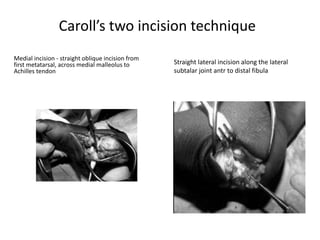
Caroll’s two incision technique
Medial incision - straight oblique incision from
first metatarsal, across medial malleolus to
Achilles tendon
Straight lateral incision along the lateral
subtalar joint antr to distal fibula
TURCOS ONE STAGE RELEASE
• First complete one-stage posteromedial release
• curved posteromedial incision
• complete subtalar release
• release of the calcaneofibular ligaments
• posterior tibialis tendon being lengthened or
released
• The Achilles tendon and long toe flexors are
lengthened and repaired
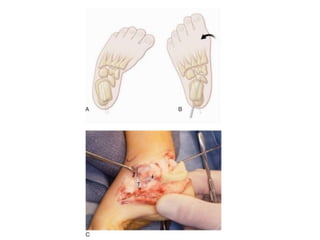
• talonavicular joint opened dorsally, medially,
and inferiorly, and the calcaneonavicular
spring ligament released
• The talonavicular joint is reduced and pinned
• Turco immobilized his patients for a total of 4
months and removed the K-wires at 6 weeks
• Night splints were used for an additional year
after the end of cast immobilization
• emphasized plantar fascial release and
capsulotomy of the calcaneocuboid joint
because forefoot adduction and supination
(actual cavus) were not addressed by Turco's
procedure
McKay and Simons
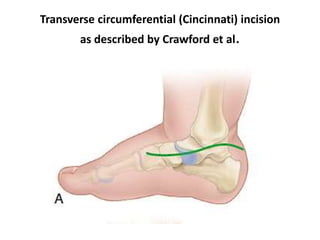
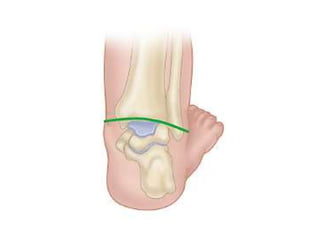
• Cincinnati incision
• A medial and lateral circumferential
talocalcaneal release is performed
• Complete release of the talonavicular and
calcaneocuboid is included, and both these
structures are pinned
Suggested Operative Technique
• Prone/supine position
• Cincinnati incision
• exposure is key
• posterolateral corner of the ankle
• precise and complete release of the
calcaneofibular and lateral subtalar ligaments
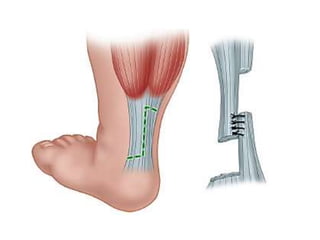
• Achilles tendon Z-lengthening
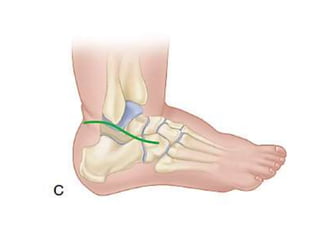
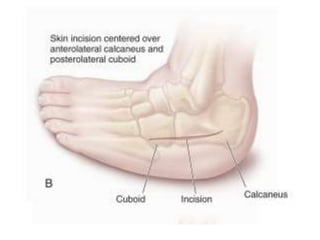
Transverse circumferential (Cincinnati) incision
as described by Crawford et al.
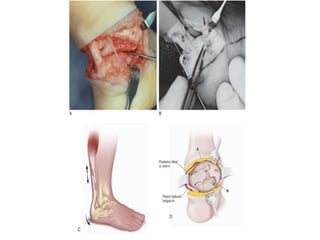
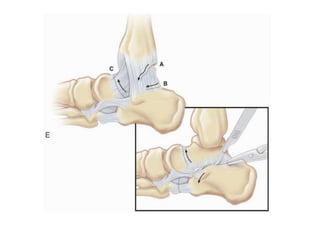
• Posterior and medial release of the subtalar
and tibiotalar joints
• The neurovascular bundle is mobilized and
protected with a Penrose drain
• Posterior tibialis ,flexor digitorum longus,
flexor hallucis longus sheaths are also incised
for retraction or lengthening, or both
• Talonavicular release -talonavicular
capsulotomy is performed medially, dorsally,
and plantarward
• calcaneocuboid joint, which is incised and
mobilized
• If cavus is a significant component -plantar
fascia should be divided transversely
• The talonavicular joint is now reduced and
pinned
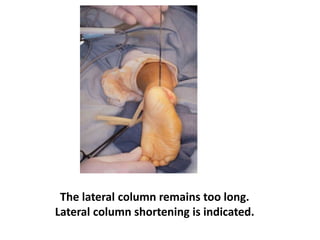
The lateral column remains too long.
Lateral column shortening is indicated.
• Skin closure
• above-knee cast
• Immobilization
Residual deformities
• Residual hindfoot equinus : Achilles tendon
lengthening and posterior capsulotomy of
ankle and subtalar joints
• Dynamic metatarsus adductus : Transfer of
anterior tibial tendon, either as split transfer
or entire tendon
Resistant clubfoot
• Metatarsus adductus : >5 yrs metatarsal osteototomy
• Hindfoor varus : <2-3 yrs modified Mckay procedure
3- 10 yrs
Dwyer osteotomy ( isolated heel varus)
Dilwyn Evans procedure (short medial column)
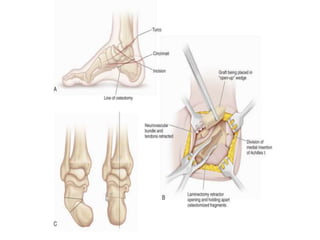
Lichtblau procedure( long lateral column)
10-12 yrs triple arthrodesis
• Equinus : Achilles tendon lengthening and posterior
capsulotomy of subtalar joint, ankle joint / Lambrinudi procedure
• All three deformities >10 yrs triple arthrodesis
TENDON TRANSFERS
• INDICATION –PASSIVELY CORRECTABLE FOOT
RESULTING FROM MUSCLE IMBALANCE.
• NEVER A PRIMARY PROCEDURE
• THREE TYPES-
• 1.TIBIALIS ANTERIOR
• 2.TIBIALIS POSTERIOR
• 3.SPLIT ANTERIOR TIBIALIS TENDON
TRANSFER
TIBIALIS ANTERIOR TRANSFER
• Indicated when there is dynamic inversion or
supination of the midfoot, especially in swing
phase.
• The goal is to eliminate the supinated
position for the initiation of stance.
• Split transfer-lateral arm reinserted in the
cuboid or lateral cuneiform.
• Entire tendon transfer-the insertion should
be moved to the midline or just slightly
lateral to midline.
• Anterior tibialis transfer with lengthening-as
part of revision for a postoperative dorsal
bunion when the first ray is excessively
dorsiflexed
Transfer for Insufficient Triceps Surae
(Calcaneus Gait)
• Plantar flexion weakness is universal
following tendoachillies lengthening.
• Diagnose plantar flexion weakness as early as
possible.
• Muscles available-peroneus ,tibialis posterior
and long toe flexors
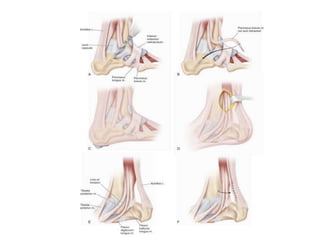
• Foot is passively held in equinus and
immobilized for 6 to 8 weeks
• Thereafter, a solid ankle-foot orthosis with
dorsiflexion stopped at neutral should be
continued for an additional 4 months in an
attempt to prevent the transfers from
stretching out, and active plantar flexion
exercises should be performed non–weight
bearing with the brace off.
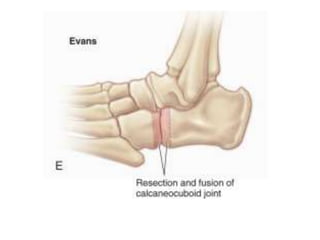
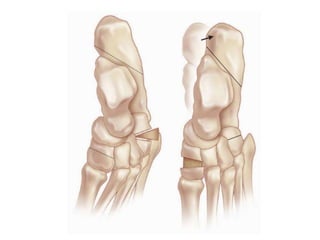
Dilwyn Evans Osteotomy
• Posteromedial release
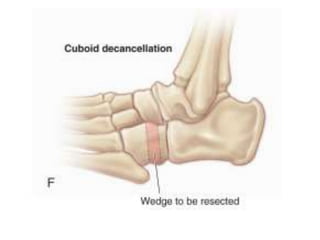
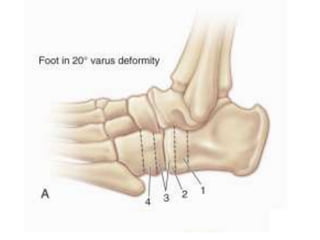
• Calcaneocuboid wedge resection and arthrodesis
• Shortens lateral column
• Stiffness at subtalar and midfoot joints
• Preferred in older children (4-8 yrs)
• standard technique for recurrent clubfoot deformity
in which the midfoot is clearly in varus
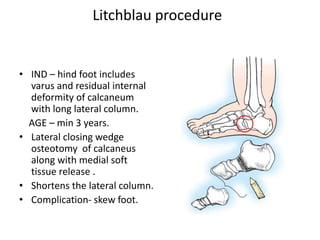
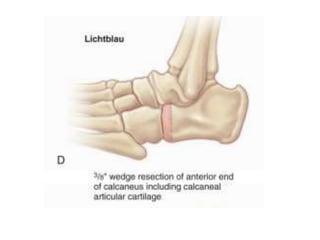
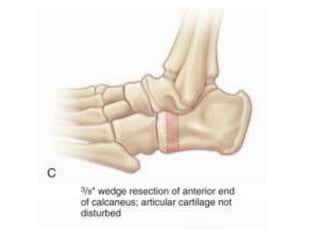
Litchblau procedure
• IND – hind foot includes
varus and residual internal
deformity of calcaneum
with long lateral column.
AGE – min 3 years.
• Lateral closing wedge
osteotomy of calcaneus
along with medial soft
tissue release .
• Shortens the lateral column.
• Complication- skew foot.
• calcaneocuboid arthroplasty
• can be used whenever the lateral column is
too long
Fowler's procedure
• Older than 6 years with a varus forefoot
position
• lateral column shortening has been combined
with medial column lengthening
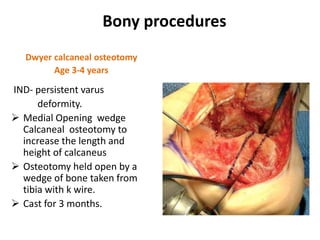
Bony procedures
Dwyer calcaneal osteotomy
Age 3-4 years
IND- persistent varus
deformity.
 Medial Opening wedge
Calcaneal osteotomy to
increase the length and
height of calcaneus
 Osteotomy held open by a
wedge of bone taken from
tibia with k wire.
 Cast for 3 months.
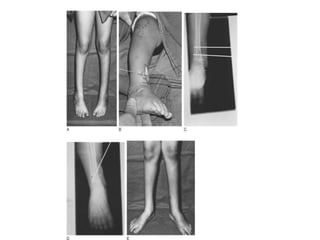
Supramalleolar Osteotomy
• If the toe-in gait persists for 2 years after
clubfoot surgery.
• Reserved only for rotational correction.
Salvage procedures
Triple arthrodesis
• Salvage procedure for painful stiff foot.
• Correction of large degrees of deformity in
neglected clubfeet.
• After the age of 10 years
• Not performed before advanced skeletal maturity
• 3 Joints fused
– 1.Subtalar joint.
– 2.Talonavicular joint.
– 3.Calcaneo cuboid joint.
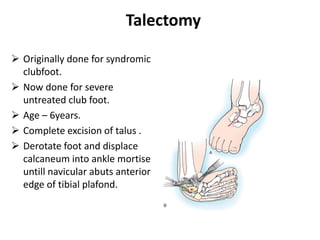
Talectomy
 Originally done for syndromic
clubfoot.
 Now done for severe
untreated club foot.
 Age – 6years.
 Complete excision of talus .
 Derotate foot and displace
calcaneum into ankle mortise
untill navicular abuts anterior
edge of tibial plafond.
Complications- limb length discrepancy.
limitation of ankle
movements.
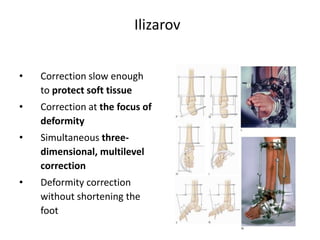
Ilizarov
• Correction slow enough
to protect soft tissue
• Correction at the focus of
deformity
• Simultaneous three-
dimensional, multilevel
correction
• Deformity correction
without shortening the
foot
JOSHI EXTERNAL STABILISATION SYSTEM
• DR.B.B. JOSHI, MUMBAI.
• Principle –tension stress applied in physiological
doses by mechanical device have shown to stimulate
histiogenesis.
JOSHI EXTERNAL STABILISATION SYSTEM
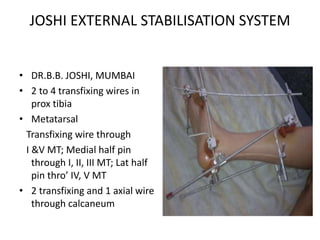
• DR.B.B. JOSHI, MUMBAI
• 2 to 4 transfixing wires in
prox tibia
• Metatarsal
Transfixing wire through
I &V MT; Medial half pin
through I, II, III MT; Lat half
pin thro’ IV, V MT
• 2 transfixing and 1 axial wire
through calcaneum
JESS
• Distraction used to Sequentially correct deformities
(Medial- 0.25 mm every 6 hours ,
Lateral- 0.25 mm every 12 hours).
• Distraction continued until approximately 20 degrees of
dorsiflexion and overcorrection of the forefoot deformities
was achieved .
• Maintained in this overcorrected position for twice as long as
the distraction phase by casts/braces.
ADVANTAGES OF JESS
1. Causes lengthening of all contracted tissues
and prevent further scarring by surgery.
2. Magnitude of correction can be controlled by
distraction.
3. Resultant foot are supple in contrast to foot
in surgery.
Results with JESS
• Good or excellent results reported by Joshi in
84% of his patients
• Recommended in all who have not responded
to serial plaster casting methods.
Complications of surgery
• Neurovascular injury
• Loss of foot (10% have atrophic dorsalis pedis artery
bundle)
• Skin dehiscence
• Wound infection
• AVN talus
• Dislocation of the navicular
• Flattening and breaking of the talar head
• Undercorrection/ Overcorrection.
• Forefoot adductus
• Hindfoot varus
• Severe scarring
• Stiff joints
• Weakness of the plantar flexors of the ankle
Conclusion
• Proper understanding of the patho-anatomy a
must
• Ponseti method is now the standard
treatment method
• Indications of surgery limited but well defined
• Turco’s posteromedial soft tissue release
remains the treatment of choice in most cases
amenable to surgical treatment
Thank you

Ctev

  • 1.
  • 2.
  • 4.
    HISTORICAL ASPECTS - EARLIESTEVIDENCE IN EGYPTIAN PERIOD. - YAJURVEDA ADVISED TO MASSAGE TO CORRECT DEFORMITY. - HIPPOCRATES FIRST DESCRIBED CLUB FOOT. - SCARPA(1803) FIRST DESCRIBED PATHOLOGIC ANATOMY.
  • 5.
    - KITE (1930)DESCRIBED NON OPERATIVE TREATMENT WITH SEVERAL MANIPULATION AND PLASTER CAST APPLICATION. - DENNIS BROWN (1934) DEVISED SPLINT FOR MAINTENANCE OF CLUBFOOT CORRECTION. - IGNACIO PONSETI (1950) DEVELOPED METHOD CORRECTION.
  • 6.
    DEFINITION CONGENITAL DYSPLASIA OFMUSCULOSKELETAL TISSUES DISTAL TO KNEE JOINT IN THE FORM OF DEFORMITY OF FOOT AND ANKLE.
  • 7.
    Biology • Clubfoot isnot an embryonic malformation. • Developmental deformation • Rarely detected with USG before the 16th week of gestation
  • 9.
    • Excessive pullof the tibialis posterior abetted by the gastrosoleus and the long toe flexors • The ligaments of the posterior and medial aspect of the ankle and tarsal joints are very thick and taut
  • 10.
    • Excessive collagensynthesis in the ligaments, tendons, and muscles may persist until the child is 3 or 4 years of age and might be a cause of relapses. • The bundles of collagen fibers display a wavy appearance known as crimp.
  • 11.
    Kinematics • Talus: mostdeformed and least displaced. Head & neck deviated medially & plantarward Body rotated externally in the ankle mortise, superior articular surface escapes from mortice. Talar neck is short and medially deviated. Smaller than normal, disturbance of vascular supply, ossification centre eccentrically placed.
  • 12.
    • Navicular: Medially displaced Closeto medial malleolus Articulates with medial surface of head of talus • calcaneus is – adducted and – inverted under the talus
  • 13.
    • Cuboid Displaced mediallyon the dysmorphic distal end of the calcaneus
  • 14.
    Tibio-talar plantar flexion Mediallydisplaced navicular Adducted and inverted calcaneus Medially displaced cuboid
  • 15.
    • Correction ofthe extreme medial displacement and inversion of the tarsal bones in the clubfoot necessitates a simultaneous gradual lateral shift of the navicular, cuboid, and calcaneus before they can be everted into a neutral position
  • 16.
    Lateral displacement (abduction)of the calcaneus will correct the heel varus deformity of the clubfoot
  • 17.
    The bones andjoints remodelling with each cast change-- demonstrated by Pirani
  • 18.
    • The tendoAchillis, unlike the tarsal ligaments that are stretchable, is made of non-stretchable, thick, tight collagen bundles with few cells.
  • 19.
    • Most casesof clubfoot are corrected after five to six cast changes and, in many cases, a tendo Achillis tenotomy needed.
  • 20.
    1.MECHANICAL FACTORS- HIPPOCRATES Oligohydramnios Abnormalfetal positioning Unstretched uterus Placental insufficiency Constriction bands 2.PRIMARY GERM PLASM DEFECT 3.ARRESTED FOETAL DEVELOPMENT
  • 21.
    4.HEREDITARY- AD 5.MUSCULOLIGAMENTOUS FIBROSIS 6.VASCULAR HYPOTHESIS- 90% of CTEV limbs showed hypoplasia / absence of anterior tibial artery.
  • 22.
    SECONDARY CLUBFOOT 1.PARALYTIC DISORDERS- evertors and dorsiflexors are weak. Ex- Polio , Spina Bifida, Myelodysplasia, Friedreich Ataxia. 2.SYNDROMES -Arthogryposis Multiplex Congenita Downs Syndrome, Larsen Syndrome.
  • 23.
    • IN UPPERMOTOR NEURON – Cerebral palsy – Friedreich ataxia – Syringomyelia
  • 24.
    • In nerveroot – Spina bifida – Spinal dysraphism • In the nerve-neuropathy(leprosy) • In myoneural junction-myasthenia gravis • In foot muscles – Muscular dystrophy – Arthrogryposis Multiplex Congenita
  • 25.
    INCIDENCE- 1 to2 in 1000 livebirths. SEX – MALE >FEMALE BILATERAL IN MORE THAN 50 % . FAMILY HISTORY- 5-50% POSITIVE.
  • 30.
    Classifying the clubfoot •The classification of a clubfoot may change with time depending on management Typical clubfoot • Classic clubfoot and is found in otherwise normal infants • It generally corrects in five casts, and with Ponseti management the long-term oucome is usually good or excellent.
  • 31.
    • Positional clubfoot –deformity is very flexible – due to intrauterine crowding – Correction is often achieved with one or two castings. • Delayed treated clubfoot-beyond 6 months of age. • Alternatively treated typical clubfoot – treated by surgery or non-Ponseti casting.
  • 32.
    • Recurrent typicalclubfoot – may occur whether the original treatment was by Ponseti management or other methods. – Relapse is much less frequent after Ponseti management and is usually due to a premature discontinuation of bracing. – The recurrence is most often supination and equinus that is first dynamic but may become fixed with time.
  • 33.
    Atypical clubfoot usually associatedwith other problems Start with Ponseti management Correction usually is more difficult
  • 34.
    Rigid or resistantatypical clubfoot • severe plantarflexion of all metatarsals, • a deep crease just above the heel and across the sole of the midfoot • a short hyperextended big toe.
  • 35.
  • 36.
    • Do notabduct more than 30 degrees. After 30 degrees abduction is achieved, change emphasis to correction of the cavus and equinus. • Casting Always apply casts with the above- knee portion in 110 degrees flexion to prevent slippage. Up to 6–8 casts can be needed to correct deformity
  • 37.
    • Tenotomy – Atenotomy is necessary in most cases. – At least 10 degrees dorsiflexion is necessary – change casts at weekly intervals after the tenotomy if sufficient dorsiflexion is not achieved immediately after the tenotomy.
  • 38.
    • Bracing Reduceabduction on the affected side to 30 degrees in the foot abduction brace. The follow-up management remains the same.
  • 39.
    • Teratologic clubfootsuch as congenital tarsal synchondrosis • Neurogenic clubfoot associated with a neurological disorder such as meningomyelocele. • Acquired clubfoot such as Streeter dysplasia.
  • 40.
    • Syndromic clubfoot –Syndromic clubfoot are more difficult to treat and sometimes require surgery. Arthrogryposis – Start with standard Ponseti casting. – 9 to 15 casts are often required. – If correction is not achieved, surgery may be required
  • 41.
    • Myelodysplasia – Becauseof sensory loss, casting requires great care to prevent skin ulceration. – Apply more padding and avoid excessive pressure in molding.
  • 42.
    Radiology • Plain radiograph:Can be assessed prior to treatment with A-P & Lateral of foot • Foot held in position of best correction, with weight- bearing, or simulated weight-bearing
  • 43.
    Anteroposterior view • Talocalcanealangle • Calcaneal-second metatarsal angle • Talus –first metatarsal angle • Intermetatarsal angle
  • 44.
    AP radiograph: Talo-Calcanealangle • Lines drawn through center of the long axis of talus (parallel to medial border) and through the long axis of calcaneum (parallel to lateral border), and they usually subtend an angle of 30-45°. • decreased in a varus foot and increased in a valgus hindfoot
  • 45.
    Axis of thesecond metatarsal diaphysis Axis of the calcaneus 15º : Normal value > 15º : Pes adductus
  • 46.
  • 47.
  • 48.
    Lateral view • Thelateral talocalcaneal angle • Meary angle • Hibb angle • Calcaneal pitch
  • 49.
    Talocalcaneal angle Angle between themid-talar axis and calcaneal inclination axis. -normally measure between 30° and 45° -decreased in a varus foot and increased in a valgus hindfoot
  • 51.
    Meary angle • B/nlong axis of the talus and the long axis of the 1st MT • Normally, these lines are colinear • apex directed dorsally-cavus foot • apex angled plantarward- valgus or flatfeet
  • 55.
    Hibb angle • anglebetween the plantar surface of the calcaneus and the first metatarsal • Normally Hibb angle is greater than 150 degrees
  • 56.
    Calcaneal pitch • Anglebetween the horizontal and the plantar surface of the calcaneus • Important in evaluating a cavus foot or clubfoot • low: 10-20° - indicative of pes planus • medium: 20-30° • high: ≥30° - indicative of pes cavus
  • 58.
  • 59.
    • Serial scoringuseful in – classifying the clubfoot, – assessing progress, – showing signs of recurrence, and – establishing the prognosis.
  • 61.
    Pirani Score • Documentsthe severity of the Deformity • Sequential scores are an excellent way to monitor progress. • Six parameters : 3 of midfoot and 3 of hindfoot • Each parameter is given a value as follows: 0: normal 0.5: Mildly abnormal 1: severely abnormal
  • 63.
    Mid foot score •Curved lateral border [A] • Medial crease [B] • Talar head coverage [C]
  • 64.
    Hind foot score •Posterior crease [D] • Rigid equinus [E] • Empty heel [F]
  • 65.
    Uses of Pirani’sscore • Predicting need for tenotomy • Estimation of probable no. of casts required* • Very good interobserver reliability and reproducibility**
  • 66.
    • Scoring of4 or more is likely to require at least four casts. • Scoring less than 4 will require three or fewer • A foot with a hindfoot score of 2.5 or 3 has a 72% chance of requiring a Tenotomy.
  • 67.
    Diméglio A.Equinus deviation B.Varus deviation C. Derotation D. Adduction.
  • 68.
    Reducibility( degrees) Score Additional parameters Score 90-45 4Marked posterior crease 1 45-20 3 Marked medio tarsal crease 1 20-0 2 Cavus 1 0 t0 -20 1 Poor muscle condition 1
  • 69.
    Grade Type ScoreReducibility i Benign 1-4 >90% ii Moderate 5-9 >50%, soft-stiff, reducible, partially resistant iii Severe 10-14 >50%, stiff-soft, resistant, partially reducible iv Very severe 15-20 <10% stiff- stiff,resistant
  • 70.
    Aims of treatment •Achieve a – plantigrade , – pliable, – cosmetically accepted foot in shortest possible time and with least disruption of family and child life.
  • 71.
    PRINCIPLES OF TREATMENT Softtissue contractures should be stretched out in order to restore normal tarsal relationship. Once achieved correction should be maintained in till tarsal bones remoulds stable articular surfaces.
  • 72.
    TWO OPTIONS – 1.NON OPERATIVE- immediately after birth 2. OPERATIVE
  • 73.
  • 74.
  • 75.
    KITES METHOD  Correctionof each component separately and in order.  Avg time 6 months  Fulcrum – calcaneocuboid joint.  Order 1.Forefoot adduction 2.Heel varus 3.equinus
  • 76.
    Kite method • Believedheel varus would correct simply by everting calcaneus • Did not realize calcaneus can evert only when it is abducted (i.e., laterally rotated) under the talus • Forefoot overcorrected into mild flatfoot • Calcaneus is rolled out of inversion by placing plantar surface of a slipper cast on glass plate to flatten the sole • Dorsiflexion of foot with wedging casts
  • 77.
    Reasons for poorresults in kites method 1. FULCRUM- prevents abduction of calcaneum and thereby eversion of calcaneum. 2. Pronation of forefoot worsens cavus.
  • 78.
    Common errors(Kite errors) •No manipulation • Pronation/eversion of 1st metatarsal • Premature dorsiflexion of heel • Counterpressure at calcaneocuboid joint • Below knee casts • Short splints
  • 79.
  • 80.
    • weekly manipulationand cast application to hold correction • Percutaneous tenotomy of tendo achilles for “hind foot stall” • Once foot corrected, an abduction foot orthosis worn full time for 12 weeks, and then at nights and naps, up to age of four.
  • 81.
  • 82.
  • 83.
    Exactly locate thehead of the talus
  • 84.
    Manipulation • Start assoon after birth as possible • Abduction of the foot beneath the stabilized talar head. • All components of clubfoot deformity, except for the ankle equinus, are corrected simultaneously
  • 85.
    • Metatarsus adductusand hindfoot varus are simultaneously corrected
  • 86.
    Reduce the cavus -requiresonly elevating the first ray of the forefoot to achieve a normal longitudinal arch of the foot -The cavus is almost always corrected with the first cast -At the first session the forefoot is simultaneously supinated and abducted
  • 87.
    • First, forefootabduction should be performed with the foot in slight supination • Second, the heel should not be constrained by premature dorsiflexion • Third, care is taken to locate the fulcrum for counterpressure on the lateral head of the talus
  • 88.
    Steps in castapplication Preliminary manipulation The heel is not touched to allow the calcaneus to abduct with the foot
  • 89.
  • 90.
    Plaster at toesBelow knee pop
  • 91.
    • press andrelease talar head repetitively to avoid pressure sores of the skin. • Mold the plaster over the head of the talus while holding the foot in the corrected position • The calcaneus is never touched during the manipulation or casting.
  • 92.
  • 93.
    Plantar support totoes Final appearance
  • 94.
  • 95.
    Characteristics of adequateabduction • Confirm that the foot is sufficiently abducted to safely bring the foot into 0 to 5 degrees of dorsiflexion before performing tenotomy. • The best sign-ability to palpate the anterior process of the calcaneus as it abducts out from beneath the talus
  • 96.
    • Abduction ofapproximately 60 degrees in relationship to the frontal plane of the tibia is possible. • Neutral or slight valgus of os calcis is present. This is determined by palpating the posterior os calcis. • The correction is accomplished by abducting the foot under the head of the talus. The foot is never pronated.
  • 97.
    The final outcome •At the completion of casting, the foot appears to be over-corrected into abduction with respect to normal foot appearance during walking.
  • 98.
    Complications of casting •Tight cast • Rocker bottom deformity • Crowded toes • Flat heel pad • Superficial sores • Deep sores • Pressure sores
  • 99.
    Cast removal Cast kniferemoval Soaking and unwrapping
  • 100.
    • Equinus isthe last deformity that is corrected, and correction should be attempted when the hindfoot is in neutral to slight valgus and the foot is abducted 70 degrees relative to the leg. • By progressively dorsiflexing the foot -by applying pressure under the entire sole of the foot
  • 101.
    Tenotomy • Indicated tocorrect equinus when cavus, adductus, and varus fully corrected but ankle dorsiflexion remains less than 10 degrees above neutral
  • 102.
    • to facilitatemore rapid correction, subcutaneous heel cord tenotomy is performed- entire Achilles tendon is transected • Performed in children up to 1 year of age without the occurrence of overlengthening or weakness
  • 105.
    • Foot isheld by an assistant in maximum dorsiflexion • select a site about 1.5 cm above the calcaneus for the tenotomy • The blade enters the skin along the medial border of the Achilles tendon. • Successful tenotomy -palpable pop and ability for further dorsiflexion of about 15 to 20 degrees
  • 106.
    Post-tenotomy cast • Footabducted 60 to 70 degrees with respect to the frontal plane of the ankle, and 15 degrees dorsiflexion. • for 3 weeks • Usually the last cast
  • 107.
    • An alternativeto percutaneous heel cord tenotomy -suggested by Alvarez and colleagues • Botulinum A toxin is injected into the triceps surae muscle . • Very short-term success with this approach
  • 108.
    Foot Abduction braces •Shoes mounted to bar in position of 60- 70° of ER and 5-10° of dorsiflexion in B/L cases and in case of U/L cases 30 to 40° of ER in normal side, • Heels of the shoes are at shoulder width • Knees left free, so the child can kick them “straight” to stretch gastrosoleus tendon
  • 109.
    • The barshould be bent 5 to 10 degrees with the convexity away from the child, to hold the feet in dorsiflexion.
  • 110.
    Bracing protocol • Worn24 hours each day for first 3-4 months. • Afterward it is worn at nap and nighttime for 2 to 4 years. • Noncompliance with bracing protocol – the most common cause of recurrence in children on Ponseti regimen .
  • 111.
    • Occasionally, achild will develop excessive heel valgus and external tibial torsion while using the brace. In such instances, the physician should reduce the external rotation of the shoes on the bar from approximately 70 degrees to 40 degrees.
  • 112.
    Mitchell brace Dobbsdynamic brace
  • 113.
  • 114.
    CTEV Splint • Straightinner border to prevent forefoot adduction • Outer shoe raise to prevent fooot inversion • No heel to prevent equinus • Slight(1/8”) lateral sole raise • Inner iron bar • Outer t trap • Walking age to 5 yrs of age
  • 115.
    Results of Ponsetimethod • Cooper and Dietz published long-term results from Iowa in 1995. • In this retrospective review, 45 patients with 71 clubfeet were evaluated an average of 34 years later. • Results compared with NORMAL CONTROLS – Thirty of the 71 feet required tibialis anterior transfer. – 62% of clubfeet were normal, – 16% were good, and – 15% were poor.
  • 116.
    • Physical examinationdocumented very good strength and decreased foot motion in comparison to those whose contralateral foot was normal. • Radiographs showed :feet not completely corrected, but functioned well despite this
  • 117.
    The French method Bensahel/Dimeglioregime  Daily manipulations by a skilled physiotherapist and temporary immobilisation with elastic and non- elastic adhesive taping .  GOAL- reduce talonavicular joint, stretch out medial tissues, correct deformities squentially.
  • 118.
    • Mobilization duringthe hours of sleep with CPM machine. • Successful in 51% of cases ( of which 9% req TA tenotomy) ; • 49% Required extensive soft tissue release – 29% post release and – 20% comprehensive posteromedial release**.
  • 119.
    Follow up protocol •2 weeks: to check for compliance of full-time bracing. • 3 months: to graduate to the nights and naps protocol • Every 4 months: until age 3 years to monitor compliance and check for relapses • Every 6 months: until age 4 years. • Every 1 to 2 years: until skeletal maturity
  • 120.
    RESULTS OF NONOPERATIVE TREATMENT OVERALL – 19% TO 95%. KITES METHD- 80%. PONSETI – 95%
  • 121.
    Surgery in clubfoot INDICATIONS •Resistant clubfoot • Persistently deformed clubfoot • Relapsed clubfoot • Neglected clubfoot ( no treatment given till age of 2 yrs) one of the more complicated procedures performed in all of orthopaedics
  • 122.
    General Principles • Goal:address all pathoantomic structures. • Type of surgery depend on age and deformity. • Soft tissue release for upto 2 years • 2-4 years-Dwyer calcaneal osteotomy • 8-10 years-calcaneocuboid fusion • After that-triple arthrodesis
  • 123.
    Timing of theProcedure • before the age of 12 months • There is therefore little advantage to performing the surgery before 9 to 10 months • Ensure that the child will be weight bearing when the postoperative cast immobilization is completed
  • 124.
    Approaches Turco (postero medialincision) Cincinnati (postero medial and postero lateral )
  • 125.
    Caroll’s two incisiontechnique Medial incision - straight oblique incision from first metatarsal, across medial malleolus to Achilles tendon Straight lateral incision along the lateral subtalar joint antr to distal fibula
  • 126.
    TURCOS ONE STAGERELEASE • First complete one-stage posteromedial release • curved posteromedial incision • complete subtalar release • release of the calcaneofibular ligaments • posterior tibialis tendon being lengthened or released • The Achilles tendon and long toe flexors are lengthened and repaired
  • 127.
    • talonavicular jointopened dorsally, medially, and inferiorly, and the calcaneonavicular spring ligament released • The talonavicular joint is reduced and pinned • Turco immobilized his patients for a total of 4 months and removed the K-wires at 6 weeks • Night splints were used for an additional year after the end of cast immobilization
  • 129.
    • emphasized plantarfascial release and capsulotomy of the calcaneocuboid joint because forefoot adduction and supination (actual cavus) were not addressed by Turco's procedure
  • 131.
    McKay and Simons •Cincinnati incision • A medial and lateral circumferential talocalcaneal release is performed • Complete release of the talonavicular and calcaneocuboid is included, and both these structures are pinned
  • 132.
    Suggested Operative Technique •Prone/supine position • Cincinnati incision • exposure is key • posterolateral corner of the ankle • precise and complete release of the calcaneofibular and lateral subtalar ligaments • Achilles tendon Z-lengthening
  • 133.
    Transverse circumferential (Cincinnati)incision as described by Crawford et al.
  • 139.
    • Posterior andmedial release of the subtalar and tibiotalar joints • The neurovascular bundle is mobilized and protected with a Penrose drain • Posterior tibialis ,flexor digitorum longus, flexor hallucis longus sheaths are also incised for retraction or lengthening, or both
  • 140.
    • Talonavicular release-talonavicular capsulotomy is performed medially, dorsally, and plantarward • calcaneocuboid joint, which is incised and mobilized • If cavus is a significant component -plantar fascia should be divided transversely • The talonavicular joint is now reduced and pinned
  • 141.
    The lateral columnremains too long. Lateral column shortening is indicated.
  • 142.
    • Skin closure •above-knee cast • Immobilization
  • 143.
    Residual deformities • Residualhindfoot equinus : Achilles tendon lengthening and posterior capsulotomy of ankle and subtalar joints • Dynamic metatarsus adductus : Transfer of anterior tibial tendon, either as split transfer or entire tendon
  • 144.
    Resistant clubfoot • Metatarsusadductus : >5 yrs metatarsal osteototomy • Hindfoor varus : <2-3 yrs modified Mckay procedure 3- 10 yrs Dwyer osteotomy ( isolated heel varus) Dilwyn Evans procedure (short medial column) Lichtblau procedure( long lateral column) 10-12 yrs triple arthrodesis • Equinus : Achilles tendon lengthening and posterior capsulotomy of subtalar joint, ankle joint / Lambrinudi procedure • All three deformities >10 yrs triple arthrodesis
  • 145.
    TENDON TRANSFERS • INDICATION–PASSIVELY CORRECTABLE FOOT RESULTING FROM MUSCLE IMBALANCE. • NEVER A PRIMARY PROCEDURE • THREE TYPES- • 1.TIBIALIS ANTERIOR • 2.TIBIALIS POSTERIOR • 3.SPLIT ANTERIOR TIBIALIS TENDON TRANSFER
  • 146.
    TIBIALIS ANTERIOR TRANSFER •Indicated when there is dynamic inversion or supination of the midfoot, especially in swing phase. • The goal is to eliminate the supinated position for the initiation of stance.
  • 147.
    • Split transfer-lateralarm reinserted in the cuboid or lateral cuneiform. • Entire tendon transfer-the insertion should be moved to the midline or just slightly lateral to midline. • Anterior tibialis transfer with lengthening-as part of revision for a postoperative dorsal bunion when the first ray is excessively dorsiflexed
  • 148.
    Transfer for InsufficientTriceps Surae (Calcaneus Gait) • Plantar flexion weakness is universal following tendoachillies lengthening. • Diagnose plantar flexion weakness as early as possible. • Muscles available-peroneus ,tibialis posterior and long toe flexors
  • 150.
    • Foot ispassively held in equinus and immobilized for 6 to 8 weeks • Thereafter, a solid ankle-foot orthosis with dorsiflexion stopped at neutral should be continued for an additional 4 months in an attempt to prevent the transfers from stretching out, and active plantar flexion exercises should be performed non–weight bearing with the brace off.
  • 151.
    Dilwyn Evans Osteotomy •Posteromedial release • Calcaneocuboid wedge resection and arthrodesis • Shortens lateral column • Stiffness at subtalar and midfoot joints • Preferred in older children (4-8 yrs) • standard technique for recurrent clubfoot deformity in which the midfoot is clearly in varus
  • 153.
    Litchblau procedure • IND– hind foot includes varus and residual internal deformity of calcaneum with long lateral column. AGE – min 3 years. • Lateral closing wedge osteotomy of calcaneus along with medial soft tissue release . • Shortens the lateral column. • Complication- skew foot.
  • 154.
    • calcaneocuboid arthroplasty •can be used whenever the lateral column is too long
  • 160.
    Fowler's procedure • Olderthan 6 years with a varus forefoot position • lateral column shortening has been combined with medial column lengthening
  • 162.
    Bony procedures Dwyer calcanealosteotomy Age 3-4 years IND- persistent varus deformity.  Medial Opening wedge Calcaneal osteotomy to increase the length and height of calcaneus  Osteotomy held open by a wedge of bone taken from tibia with k wire.  Cast for 3 months.
  • 164.
    Supramalleolar Osteotomy • Ifthe toe-in gait persists for 2 years after clubfoot surgery. • Reserved only for rotational correction.
  • 166.
    Salvage procedures Triple arthrodesis •Salvage procedure for painful stiff foot. • Correction of large degrees of deformity in neglected clubfeet. • After the age of 10 years • Not performed before advanced skeletal maturity • 3 Joints fused – 1.Subtalar joint. – 2.Talonavicular joint. – 3.Calcaneo cuboid joint.
  • 167.
    Talectomy  Originally donefor syndromic clubfoot.  Now done for severe untreated club foot.  Age – 6years.  Complete excision of talus .  Derotate foot and displace calcaneum into ankle mortise untill navicular abuts anterior edge of tibial plafond.
  • 168.
    Complications- limb lengthdiscrepancy. limitation of ankle movements.
  • 169.
    Ilizarov • Correction slowenough to protect soft tissue • Correction at the focus of deformity • Simultaneous three- dimensional, multilevel correction • Deformity correction without shortening the foot
  • 170.
    JOSHI EXTERNAL STABILISATIONSYSTEM • DR.B.B. JOSHI, MUMBAI. • Principle –tension stress applied in physiological doses by mechanical device have shown to stimulate histiogenesis.
  • 171.
    JOSHI EXTERNAL STABILISATIONSYSTEM • DR.B.B. JOSHI, MUMBAI • 2 to 4 transfixing wires in prox tibia • Metatarsal Transfixing wire through I &V MT; Medial half pin through I, II, III MT; Lat half pin thro’ IV, V MT • 2 transfixing and 1 axial wire through calcaneum
  • 172.
    JESS • Distraction usedto Sequentially correct deformities (Medial- 0.25 mm every 6 hours , Lateral- 0.25 mm every 12 hours). • Distraction continued until approximately 20 degrees of dorsiflexion and overcorrection of the forefoot deformities was achieved . • Maintained in this overcorrected position for twice as long as the distraction phase by casts/braces.
  • 173.
    ADVANTAGES OF JESS 1.Causes lengthening of all contracted tissues and prevent further scarring by surgery. 2. Magnitude of correction can be controlled by distraction. 3. Resultant foot are supple in contrast to foot in surgery.
  • 174.
    Results with JESS •Good or excellent results reported by Joshi in 84% of his patients • Recommended in all who have not responded to serial plaster casting methods.
  • 175.
    Complications of surgery •Neurovascular injury • Loss of foot (10% have atrophic dorsalis pedis artery bundle) • Skin dehiscence • Wound infection • AVN talus • Dislocation of the navicular
  • 176.
    • Flattening andbreaking of the talar head • Undercorrection/ Overcorrection. • Forefoot adductus • Hindfoot varus • Severe scarring • Stiff joints • Weakness of the plantar flexors of the ankle
  • 177.
    Conclusion • Proper understandingof the patho-anatomy a must • Ponseti method is now the standard treatment method • Indications of surgery limited but well defined • Turco’s posteromedial soft tissue release remains the treatment of choice in most cases amenable to surgical treatment
  • 178.