INTRODUCTION
• Photometry is the study and measurement of light in terms of the
visual response it produces.
• The study of radiant energy, including visible light, without regard to
its visual response is known as radiometry.
• For the average light adapted eye at moderate intensities (photopic
vision) the maximum visual effect is obtained with light of
wavelength 555nm (yellow-green).
• This maximum shifts to 500nm in scotopic vision (for the average
dark adapted eye). This is known as the Purkinje shift.
• Occupational Safety legislation puts a duty on employers to
provide sufficient lighting of suitable standard for specific
purposes.
• By ensuring that photometric quantities conform to standards,
mankind benefits in terms of:
• reduction of eyestrain
• fewer accidents
• better working conditions
• greater productivity
• improved leisure facilities etc.
SOLID ANGLES
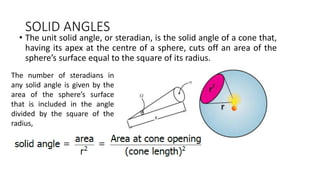
• The unit solid angle, or steradian, is the solid angle of a cone that,
having its apex at the centre of a sphere, cuts off an area of the
sphere’s surface equal to the square of its radius.
The number of steradians in
any solid angle is given by the
area of the sphere’s surface
that is included in the angle
divided by the square of the
radius,
LUMINOUS POWER / flux AND LUMINOUS
INTENSITY
• The rate at which light energy flows is called the luminous power
(flux).
• Visual sensation produced depends on the rate at which light energy
reaches the retina and not on the total energy. Hence, a dimly lit
object will not continue to grow brighter and brighter as it is
observed.
• The luminous power is therefore the luminous energy flowing per
second and this could be expressed in joules per second (watts).
However, in photometry, we use the unit called the lumen.
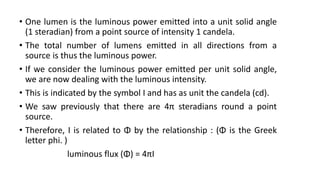
• One lumen is the luminous power emitted into a unit solid angle
(1 steradian) from a point source of intensity 1 candela.
• The total number of lumens emitted in all directions from a
source is thus the luminous power.
• If we consider the luminous power emitted per unit solid angle,
we are now dealing with the luminous intensity.
• This is indicated by the symbol I and has as unit the candela (cd).
• We saw previously that there are 4π steradians round a point
source.
• Therefore, I is related to Φ by the relationship : (Φ is the Greek
letter phi. )
luminous flux (Φ) = 4πI
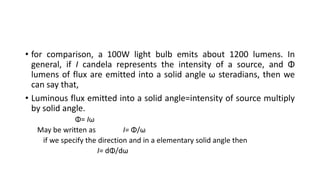
• for comparison, a 100W light bulb emits about 1200 lumens. In
general, if I candela represents the intensity of a source, and Φ
lumens of flux are emitted into a solid angle ω steradians, then we
can say that,
• Luminous flux emitted into a solid angle=intensity of source multiply
by solid angle.
Φ= Iω
May be written as I= Φ/ω
if we specify the direction and in a elementary solid angle then
I= dΦ/dω
LUMINOUS EFFICIENCY AND LUMINOUS EFFICACY
• To be useful for lighting purposes, we need most of the output to be
in the visible region.
• Two concepts are used to indicate the effectiveness of a source.
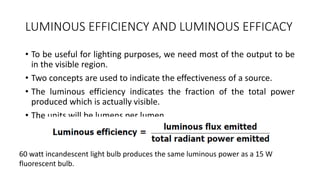
• The luminous efficiency indicates the fraction of the total power
produced which is actually visible.
• The units will be lumens per lumen.
60 watt incandescent light bulb produces the same luminous power as a 15 W
fluorescent bulb.
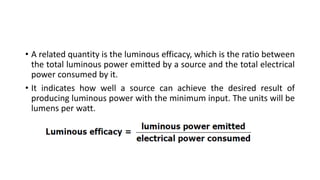
• A related quantity is the luminous efficacy, which is the ratio between
the total luminous power emitted by a source and the total electrical
power consumed by it.
• It indicates how well a source can achieve the desired result of
producing luminous power with the minimum input. The units will be
lumens per watt.
RADIOMETRIC AND PHOTOMETRIC UNITS
• This is the radiometric system most people are familiar with, e.g. the
energy emitted by a lamp by unit of time is measured in Watt.
• In some circumstances, such a measurement in Watt may not be
useful. For instance a lamp emitting 10W in the IR would actually
appear turned off to us. So an alternative system exists, the
photometric system.
• In this system wavelengths are weighted according to how sensitive
the eye is to them. The energy emitted by a lamp by unit of time is
then measured in Candela.
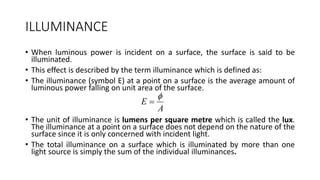
ILLUMINANCE
• When luminous power is incident on a surface, the surface is said to be
illuminated.
• This effect is described by the term illuminance which is defined as:
• The illuminance (symbol E) at a point on a surface is the average amount of
luminous power falling on unit area of the surface.
• The unit of illuminance is lumens per square metre which is called the lux.
The illuminance at a point on a surface does not depend on the nature of the
surface since it is only concerned with incident light.
• The total illuminance on a surface which is illuminated by more than one
light source is simply the sum of the individual illuminances.
A
E


• The perceived brightness of an extended source or extended surface
area is known as its luminance.
• It quantifies light given off by (reflected from) an extended area. The
basic SI unit is the nit :
1 nit = 1 candela/m2
• The footlambert is another common unit.
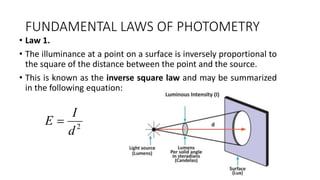
FUNDAMENTAL LAWS OF PHOTOMETRY
• Law 1.
• The illuminance at a point on a surface is inversely proportional to
the square of the distance between the point and the source.
• This is known as the inverse square law and may be summarized
in the following equation:
2
d
I
E 
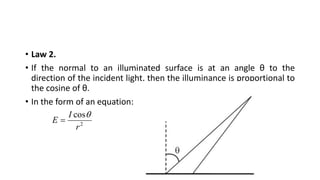
• Law 2.
• If the normal to an illuminated surface is at an angle θ to the
direction of the incident light, then the illuminance is proportional to
the cosine of θ.
• In the form of an equation:
2
cos
r
I
E


troland
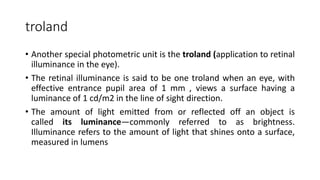
• Another special photometric unit is the troland (application to retinal
illuminance in the eye).
• The retinal illuminance is said to be one troland when an eye, with
effective entrance pupil area of 1 mm , views a surface having a
luminance of 1 cd/m2 in the line of sight direction.
• The amount of light emitted from or reflected off an object is
called its luminance—commonly referred to as brightness.
Illuminance refers to the amount of light that shines onto a surface,
measured in lumens
• In connection with brightness, we should also mention the term
contrast(C). This is used both subjectively and objectively.
• In the former case, contrast describes the difference in the
appearance of two areas of a visual-field seen successively or
together.
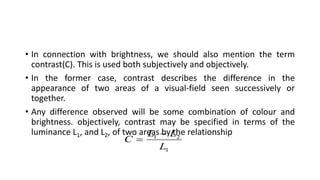
• Any difference observed will be some combination of colour and
brightness. objectively, contrast may be specified in terms of the
luminance L1, and L2, of two areas by the relationship
1
2
1
L
L
L
C


photometers
The Weber-Fechner Law
• The user of a visual photometer is required to assess the equality of
brightness of two adjacent illuminated surfaces. It is therefore of
value to consider the accuracy with which this can be done.
• The eye cannot give any quantitative comparison between different
luminances: that is, it is not capable of determining, say, that one
surface is twice as bright as another.
• However, the eye can judge with a fair degree of accuracy when two
adjacent surfaces appear to be equally bright, provided they appear
the same or nearly the same colour.
• When applied specifically to luminance the effect is referred to as
Fechner's Law.
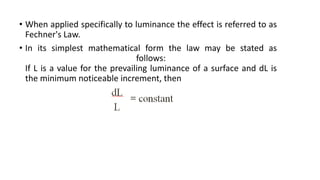
• In its simplest mathematical form the law may be stated as
follows:
If L is a value for the prevailing luminance of a surface and dL is
the minimum noticeable increment, then
Visual photometers
• The grease-spot photometer
• The wax block photometer
• The shadow photometer
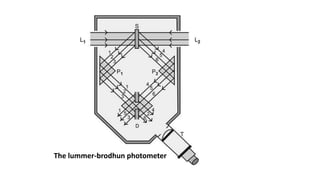
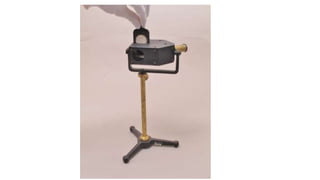
• The lummer-brodhun photometer
• The flicker photometer
• The integrating photometer
The lummer-brodhun photometer
Non-visual photometer
• Non-visual photometer measures directly the illuminance falling in
them.
• The photovoltaic cell

Photometry and Radiometry in optics and optometry

  • 1.
    INTRODUCTION • Photometry isthe study and measurement of light in terms of the visual response it produces. • The study of radiant energy, including visible light, without regard to its visual response is known as radiometry. • For the average light adapted eye at moderate intensities (photopic vision) the maximum visual effect is obtained with light of wavelength 555nm (yellow-green). • This maximum shifts to 500nm in scotopic vision (for the average dark adapted eye). This is known as the Purkinje shift.
  • 2.
    • Occupational Safetylegislation puts a duty on employers to provide sufficient lighting of suitable standard for specific purposes. • By ensuring that photometric quantities conform to standards, mankind benefits in terms of: • reduction of eyestrain • fewer accidents • better working conditions • greater productivity • improved leisure facilities etc.
  • 3.
    SOLID ANGLES • Theunit solid angle, or steradian, is the solid angle of a cone that, having its apex at the centre of a sphere, cuts off an area of the sphere’s surface equal to the square of its radius. The number of steradians in any solid angle is given by the area of the sphere’s surface that is included in the angle divided by the square of the radius,
  • 4.
    LUMINOUS POWER /flux AND LUMINOUS INTENSITY • The rate at which light energy flows is called the luminous power (flux). • Visual sensation produced depends on the rate at which light energy reaches the retina and not on the total energy. Hence, a dimly lit object will not continue to grow brighter and brighter as it is observed. • The luminous power is therefore the luminous energy flowing per second and this could be expressed in joules per second (watts). However, in photometry, we use the unit called the lumen.
  • 5.
    • One lumenis the luminous power emitted into a unit solid angle (1 steradian) from a point source of intensity 1 candela. • The total number of lumens emitted in all directions from a source is thus the luminous power. • If we consider the luminous power emitted per unit solid angle, we are now dealing with the luminous intensity. • This is indicated by the symbol I and has as unit the candela (cd). • We saw previously that there are 4π steradians round a point source. • Therefore, I is related to Φ by the relationship : (Φ is the Greek letter phi. ) luminous flux (Φ) = 4πI
  • 6.
    • for comparison,a 100W light bulb emits about 1200 lumens. In general, if I candela represents the intensity of a source, and Φ lumens of flux are emitted into a solid angle ω steradians, then we can say that, • Luminous flux emitted into a solid angle=intensity of source multiply by solid angle. Φ= Iω May be written as I= Φ/ω if we specify the direction and in a elementary solid angle then I= dΦ/dω
  • 7.
    LUMINOUS EFFICIENCY ANDLUMINOUS EFFICACY • To be useful for lighting purposes, we need most of the output to be in the visible region. • Two concepts are used to indicate the effectiveness of a source. • The luminous efficiency indicates the fraction of the total power produced which is actually visible. • The units will be lumens per lumen. 60 watt incandescent light bulb produces the same luminous power as a 15 W fluorescent bulb.
  • 8.
    • A relatedquantity is the luminous efficacy, which is the ratio between the total luminous power emitted by a source and the total electrical power consumed by it. • It indicates how well a source can achieve the desired result of producing luminous power with the minimum input. The units will be lumens per watt.
  • 9.
    RADIOMETRIC AND PHOTOMETRICUNITS • This is the radiometric system most people are familiar with, e.g. the energy emitted by a lamp by unit of time is measured in Watt. • In some circumstances, such a measurement in Watt may not be useful. For instance a lamp emitting 10W in the IR would actually appear turned off to us. So an alternative system exists, the photometric system. • In this system wavelengths are weighted according to how sensitive the eye is to them. The energy emitted by a lamp by unit of time is then measured in Candela.
  • 10.
    ILLUMINANCE • When luminouspower is incident on a surface, the surface is said to be illuminated. • This effect is described by the term illuminance which is defined as: • The illuminance (symbol E) at a point on a surface is the average amount of luminous power falling on unit area of the surface. • The unit of illuminance is lumens per square metre which is called the lux. The illuminance at a point on a surface does not depend on the nature of the surface since it is only concerned with incident light. • The total illuminance on a surface which is illuminated by more than one light source is simply the sum of the individual illuminances. A E  
  • 11.
    • The perceivedbrightness of an extended source or extended surface area is known as its luminance. • It quantifies light given off by (reflected from) an extended area. The basic SI unit is the nit : 1 nit = 1 candela/m2 • The footlambert is another common unit.
  • 12.
    FUNDAMENTAL LAWS OFPHOTOMETRY • Law 1. • The illuminance at a point on a surface is inversely proportional to the square of the distance between the point and the source. • This is known as the inverse square law and may be summarized in the following equation: 2 d I E 
  • 13.
    • Law 2. •If the normal to an illuminated surface is at an angle θ to the direction of the incident light, then the illuminance is proportional to the cosine of θ. • In the form of an equation: 2 cos r I E  
  • 14.
    troland • Another specialphotometric unit is the troland (application to retinal illuminance in the eye). • The retinal illuminance is said to be one troland when an eye, with effective entrance pupil area of 1 mm , views a surface having a luminance of 1 cd/m2 in the line of sight direction. • The amount of light emitted from or reflected off an object is called its luminance—commonly referred to as brightness. Illuminance refers to the amount of light that shines onto a surface, measured in lumens
  • 15.
    • In connectionwith brightness, we should also mention the term contrast(C). This is used both subjectively and objectively. • In the former case, contrast describes the difference in the appearance of two areas of a visual-field seen successively or together. • Any difference observed will be some combination of colour and brightness. objectively, contrast may be specified in terms of the luminance L1, and L2, of two areas by the relationship 1 2 1 L L L C  
  • 16.
    photometers The Weber-Fechner Law •The user of a visual photometer is required to assess the equality of brightness of two adjacent illuminated surfaces. It is therefore of value to consider the accuracy with which this can be done. • The eye cannot give any quantitative comparison between different luminances: that is, it is not capable of determining, say, that one surface is twice as bright as another. • However, the eye can judge with a fair degree of accuracy when two adjacent surfaces appear to be equally bright, provided they appear the same or nearly the same colour.
  • 17.
    • When appliedspecifically to luminance the effect is referred to as Fechner's Law. • In its simplest mathematical form the law may be stated as follows: If L is a value for the prevailing luminance of a surface and dL is the minimum noticeable increment, then
  • 18.
    Visual photometers • Thegrease-spot photometer • The wax block photometer • The shadow photometer • The lummer-brodhun photometer • The flicker photometer • The integrating photometer
  • 19.
  • 21.
    Non-visual photometer • Non-visualphotometer measures directly the illuminance falling in them. • The photovoltaic cell

Editor's Notes

  • #2 IR and UV light do not produce that much of a visual response compared to some visible light
  • #3 This is done because the aim of photometry is to measure light in such a way that the results correlate with human vision.
  • #6 One candela is equals to one sixtieth (1/60) of the luminous intensity per square centimeter of a black body at the temperature of solidification of platinum. The luminous intensity of a light souce refered to the strength of the source in a given direction.
  • #8 radiant energy, (energy in the form of electromagnetic radiation). For example, a 60 watt incandescent light bulb produces the same luminous power as a 15 W fluorescent bulb. This is because much of the incandescent light bulb output is invisible infrared. Its luminous efficiency is much less since it is converting a large portion of the power input into wasted heat.
  • #9 It should be noted that the power output at each wavelength is multiplied by a factor determined by the visual response of the eye to light of that wavelength. The human eye is most sensitive to green light with a wavelength of 555 nm. One watt of such light is “worth” 683 lumens. In contrast, infrared and ultraviolet radiation are invisible and therefore count zero lumens. Using the same principle, we find that one watt of 700 nm red light is “worth” only 27 lumens.
  • #10 Because light is usually made of many different wavelengths, there is not simple rule to convert radiometric units into photometric units.
  • #13 This will apply when the surface is not at an angle to the direction of the incident light (directly below or in front of the source). If the surface is at an angle to the incident light, the illuminance is reduced. This situation is catered for by the second law.
  • #19 grease-spot photometer:-a photometer in which a grease spot on a piece of paper becomes invisible when a light on each side of the paper illuminates the spot equally.
  • #22 Used in the solar cell to produce electricity from the sunlight.