Kapil Gautam
Optometrist, IOM, MMC
 Study of measurement of light in terms of
visual response it produces
 Study concerned with the ways of measuring
intensity of light
 Branch of radiometry
 Sensitivity of an individual to a particular
wavelength at a given viewing condition
 Different for different individuals
 Variation can be achieved from the
sensitivity/ luminosity curve
 Photopic vision
 Maximum visual effect at 555 nm(yellow- green)
 At 510nm and 610 nm the sensitivity reduces to
half
 Scotopic vision
 Maximum effect at 507 nm(blue-green)
 Lower intensities are needed
 The shift of maximum visual sensitivity in
photopic to scotopic vision from 555nm to
507 nm
 Red end of the spectrum is relatively dull in
scotopic condition due to Purkinje shift and
shortened range of sensitivity
 Angle subtended by a part of sphere at its
center.
 Measured in Steradian( Sr).
Total Solid angle around a Point(ω)= Area
Radius2
= 4πr2 / r2
= 4π Sr
 Standard Source
 Black body radiator
 Sub-standard Source
 Incandescent light sources
 Luminescent light sources
 Wein’s displacement law
Peak wavelength α 1/Temperature
λ α 1/T
 Stefan- Boltzman law
Total Power αTemperature4
E αT4
Photometric Quantities
 Total light power produced or transferred by
a source
 The rate of flow of light energy
 Unit: Lumen
 Depends upon luminous efficiency of the
light
 Shows spectral power distribution
 1 lumen is the luminous flux emitted into a
unit solid angle from an point source of 1
candela intensity
Luminous flux at a solid angle= Intensity of source X Solid angle
φ = I ω
 Unit of scotopic photometric power.
 680 scotopic lumens per watt at 555nm
 Necessary to evaluate the total luminous flux
by a light source of a specific wavelength
Luminous efficiency at 555nm =Luminous efficiency atY nm
680 scotopic lumens/W X scotopic lumens/W
 Most objects emit mixture of many different
wavelengths.
 The total number of lumens produced by this
stimulus is given by calculating the no. of
lumens produced by each wavelength in the
mixture and then adding these values
together
 5W of 475 nm: (0.1) ( 680 lumens/W) (5W) = 340 lumens
 2.5W of 555 nm: (1.0) ( 680 lumens/W) (2.5W) = 1700 lumens
 2.5W of 600 nm:(0.62) ( 680 lumens/W) (2.5 W)=1054 lumens
 Total = 3094 lumens
 Refers to the strength of the source in a given
direction.
 Luminous flux emitted per unit solid angle in
a specified direction
 Unit: Candela or Lumen/ Steradian
 1 candela is the luminous intensity of a source
that emits 1 lumen of flux into 1 steradian of
space
Luminous Intensity= Flux emitted by source into 1 steradian of space
Flux emitted by 1 candela into 1 steradian of space
 Gives idea of source directionality.
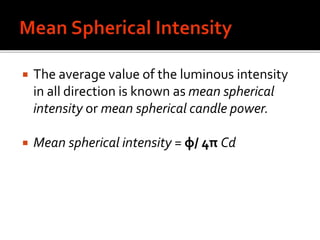
 The average value of the luminous intensity
in all direction is known as mean spherical
intensity or mean spherical candle power.
 Mean spherical intensity = φ/ 4π Cd
 Luminous power that falls on a surface
 Flux per unit area or flux density
 Illuminance (E) at a point on a surface is the
amount of luminous flux falling on unit area
of the surface.
 Illuminance = amount of incident luminous flux(lumen)
area of surface(m2)
E = φ/ A
 Unit: Lux
 1 lux is the amount of illuminance when 1 lm
of light is incident on an area of 1 m2
SOURCES ILLUMINANCE(LUX)
Bright Sunlight
105
VisionChart
500
Interior Light
100
Full Moonlight
0.2
APPLICATION ILLUMINANCE(LUX)
OperatingTheatres Up to 50000
Carpet Manufacture 1000
Drawing Office 750
Supermarket 500
Library Reading Area 350
Living Room, General Room 50
Classroom 500 - 1000
Eye Surgery 1000- 2000
 1st law ( Inverse Square Law):
 The illuminance at a point on a surface is inversely
proportional to the square of the distance between
the point and the source.
Illuminance (E) = φ/A = 4πI / 4πr2
E = I/ r2
 So E α 1/ r2
 2nd law ( Cosine Law):
 If the normal to an illuminated surface is at an
angel θ to the direction of the incident light , the
illuminance is proportional to the cosine of θ.
 Since E = φ / A
E = φ / (A / Cos θ)
E = I Cos θ / r2
E α Cos θ
 The luminous density of the surface, which is
reflecting light , per unit projected area in a
given direction
 Similar to brightness
 Doesn’t depend on the distance
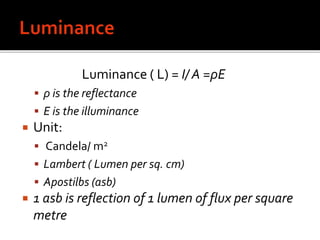
Luminance ( L) = I/ A =ρE
 ρ is the reflectance
 E is the illuminance
 Unit:
 Candela/ m2
 Lambert ( Lumen per sq. cm)
 Apostilbs (asb)
 1 asb is reflection of 1 lumen of flux per square
metre
L= I/A cosѲ
L= luminance
I= luminous intensity
Ѳ= angle subtended by the area
SOURCE LUMINANCE ( cd/ m2)
Surface of sun 2 x 1o9
White paper in sunlight 2.5 x 10⁴
Fluorescent lamp 6 x 10³
Moon surface 2.9 x 10³
TV screen – white 100
White writing paper in classroom 70
White paper in moonlight 3 x 10⁻²
 These are the surfaces which shows same
luminance regardless of the angle at which it
is measured.
 Also known as Lambert/ Perfectly diffusing/
Matte surfaces.
 E.g. Paper, cloth,etc.
 Weber Fechner Law:
 2 bodies with same luminance are called to have
same brightness but when one of them has
double luminance, brightness is not said to be
doubled
 Weber Fechner Law:
 If L is a value for the prevailing luminance of a
surface and dL is the minimum noticeable
increment
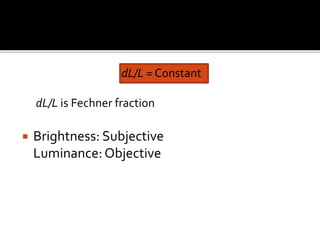
dL/L = Constant
dL/L is Fechner fraction
 Brightness: Subjective
Luminance:Objective
 Denoted by ρ
 ρ= Luminous flux per unit area reflected by the surface
Luminous flux per unit area incident on the surface
 Depends upon the nature of surface and
angle of incidence
 Denoted by г
 Г = Luminous flux per unit area transmitted by the body
Luminous flux per unit area incident on the surface
 Neutral substances: Optical materials that
produce no significant change in the
appreciation of color and display almost
constant transmittance across a spectrum
 Substances which allow light to pass through
by refining them
 Types:
 Colored Filters:
▪ Narrow –band filters
▪ Interference filters
▪ Broad –band filters
▪ Long Pass Filters
 Neutral Density Filters
 Colored Filters : Absorb some wavelengths
and transmit others
 Narrow –band Filters:Allows only a narrow
spectral band of light.
 Depends on half height bandwidth.
 Interference filters: Have narrow
transmission.Thought to be transmitting
only a single wavelength
 Broad –band filters:Transmits a broad range
of wavelengths
 Long-pass filters:Transmits only long
wavelengths
 Neutral density filter:
 Has a flat transmission curve.
 They are neutral to every wavelength.
 Used to minimize color distortion.
 Optical Density (OD):
 Density of a neutral density filter
 Expressed as OD = log (1/T)
 Help in comparing the intensities of two
surfaces
 Two types:
 Visual photometers
 Non visual photometers
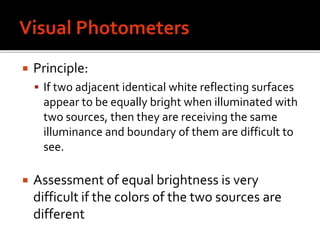
 Principle:
 If two adjacent identical white reflecting surfaces
appear to be equally bright when illuminated with
two sources, then they are receiving the same
illuminance and boundary of them are difficult to
see.
 Assessment of equal brightness is very
difficult if the colors of the two sources are
different
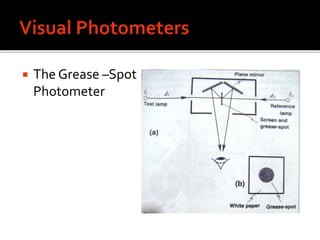
 The Grease –Spot
Photometer
 TheWax Block
Photometer
 The Shadow
Photometer
 Measure directly the illuminance falling on
them.
 Constitutes an electric current (mA)
 Is an example of Photoelectric effect
 Luminous efficacy = luminous flux emitted
power consumed
 Is different from luminous efficiency.
 Reduction of eyestrain
 Fewer accidents
 Better working conditions
 Greater production of manufactured goods
like textiles, dyes, paints, etc.
 Improved leisure facilities
 To prevent Cataract
 Proper illumination for surgery
 Contrast sensitivity
 Useful in glasses and contact lens practice

Photometry

  • 1.
  • 2.
     Study ofmeasurement of light in terms of visual response it produces  Study concerned with the ways of measuring intensity of light  Branch of radiometry
  • 3.
     Sensitivity ofan individual to a particular wavelength at a given viewing condition  Different for different individuals  Variation can be achieved from the sensitivity/ luminosity curve
  • 5.
     Photopic vision Maximum visual effect at 555 nm(yellow- green)  At 510nm and 610 nm the sensitivity reduces to half  Scotopic vision  Maximum effect at 507 nm(blue-green)  Lower intensities are needed
  • 6.
     The shiftof maximum visual sensitivity in photopic to scotopic vision from 555nm to 507 nm  Red end of the spectrum is relatively dull in scotopic condition due to Purkinje shift and shortened range of sensitivity
  • 7.
     Angle subtendedby a part of sphere at its center.  Measured in Steradian( Sr). Total Solid angle around a Point(ω)= Area Radius2 = 4πr2 / r2 = 4π Sr
  • 8.
     Standard Source Black body radiator  Sub-standard Source  Incandescent light sources  Luminescent light sources
  • 9.
     Wein’s displacementlaw Peak wavelength α 1/Temperature λ α 1/T  Stefan- Boltzman law Total Power αTemperature4 E αT4
  • 11.
  • 12.
     Total lightpower produced or transferred by a source  The rate of flow of light energy  Unit: Lumen  Depends upon luminous efficiency of the light
  • 13.
     Shows spectralpower distribution  1 lumen is the luminous flux emitted into a unit solid angle from an point source of 1 candela intensity Luminous flux at a solid angle= Intensity of source X Solid angle φ = I ω
  • 15.
     Unit ofscotopic photometric power.  680 scotopic lumens per watt at 555nm  Necessary to evaluate the total luminous flux by a light source of a specific wavelength
  • 16.
    Luminous efficiency at555nm =Luminous efficiency atY nm 680 scotopic lumens/W X scotopic lumens/W
  • 18.
     Most objectsemit mixture of many different wavelengths.  The total number of lumens produced by this stimulus is given by calculating the no. of lumens produced by each wavelength in the mixture and then adding these values together
  • 20.
     5W of475 nm: (0.1) ( 680 lumens/W) (5W) = 340 lumens  2.5W of 555 nm: (1.0) ( 680 lumens/W) (2.5W) = 1700 lumens  2.5W of 600 nm:(0.62) ( 680 lumens/W) (2.5 W)=1054 lumens  Total = 3094 lumens
  • 21.
     Refers tothe strength of the source in a given direction.  Luminous flux emitted per unit solid angle in a specified direction  Unit: Candela or Lumen/ Steradian
  • 22.
     1 candelais the luminous intensity of a source that emits 1 lumen of flux into 1 steradian of space Luminous Intensity= Flux emitted by source into 1 steradian of space Flux emitted by 1 candela into 1 steradian of space  Gives idea of source directionality.
  • 25.
     The averagevalue of the luminous intensity in all direction is known as mean spherical intensity or mean spherical candle power.  Mean spherical intensity = φ/ 4π Cd
  • 26.
     Luminous powerthat falls on a surface  Flux per unit area or flux density  Illuminance (E) at a point on a surface is the amount of luminous flux falling on unit area of the surface.  Illuminance = amount of incident luminous flux(lumen) area of surface(m2)
  • 27.
    E = φ/A  Unit: Lux  1 lux is the amount of illuminance when 1 lm of light is incident on an area of 1 m2
  • 28.
  • 29.
    APPLICATION ILLUMINANCE(LUX) OperatingTheatres Upto 50000 Carpet Manufacture 1000 Drawing Office 750 Supermarket 500 Library Reading Area 350 Living Room, General Room 50 Classroom 500 - 1000 Eye Surgery 1000- 2000
  • 30.
     1st law( Inverse Square Law):  The illuminance at a point on a surface is inversely proportional to the square of the distance between the point and the source. Illuminance (E) = φ/A = 4πI / 4πr2 E = I/ r2  So E α 1/ r2
  • 32.
     2nd law( Cosine Law):  If the normal to an illuminated surface is at an angel θ to the direction of the incident light , the illuminance is proportional to the cosine of θ.  Since E = φ / A E = φ / (A / Cos θ) E = I Cos θ / r2 E α Cos θ
  • 33.
     The luminousdensity of the surface, which is reflecting light , per unit projected area in a given direction  Similar to brightness  Doesn’t depend on the distance
  • 34.
    Luminance ( L)= I/ A =ρE  ρ is the reflectance  E is the illuminance  Unit:  Candela/ m2  Lambert ( Lumen per sq. cm)  Apostilbs (asb)  1 asb is reflection of 1 lumen of flux per square metre
  • 36.
    L= I/A cosѲ L=luminance I= luminous intensity Ѳ= angle subtended by the area
  • 37.
    SOURCE LUMINANCE (cd/ m2) Surface of sun 2 x 1o9 White paper in sunlight 2.5 x 10⁴ Fluorescent lamp 6 x 10³ Moon surface 2.9 x 10³ TV screen – white 100 White writing paper in classroom 70 White paper in moonlight 3 x 10⁻²
  • 39.
     These arethe surfaces which shows same luminance regardless of the angle at which it is measured.  Also known as Lambert/ Perfectly diffusing/ Matte surfaces.  E.g. Paper, cloth,etc.
  • 40.
     Weber FechnerLaw:  2 bodies with same luminance are called to have same brightness but when one of them has double luminance, brightness is not said to be doubled  Weber Fechner Law:  If L is a value for the prevailing luminance of a surface and dL is the minimum noticeable increment
  • 41.
    dL/L = Constant dL/Lis Fechner fraction  Brightness: Subjective Luminance:Objective
  • 42.
     Denoted byρ  ρ= Luminous flux per unit area reflected by the surface Luminous flux per unit area incident on the surface  Depends upon the nature of surface and angle of incidence
  • 44.
     Denoted byг  Г = Luminous flux per unit area transmitted by the body Luminous flux per unit area incident on the surface  Neutral substances: Optical materials that produce no significant change in the appreciation of color and display almost constant transmittance across a spectrum
  • 45.
     Substances whichallow light to pass through by refining them  Types:  Colored Filters: ▪ Narrow –band filters ▪ Interference filters ▪ Broad –band filters ▪ Long Pass Filters  Neutral Density Filters
  • 46.
     Colored Filters: Absorb some wavelengths and transmit others  Narrow –band Filters:Allows only a narrow spectral band of light.  Depends on half height bandwidth.
  • 49.
     Interference filters:Have narrow transmission.Thought to be transmitting only a single wavelength  Broad –band filters:Transmits a broad range of wavelengths  Long-pass filters:Transmits only long wavelengths
  • 50.
     Neutral densityfilter:  Has a flat transmission curve.  They are neutral to every wavelength.  Used to minimize color distortion.  Optical Density (OD):  Density of a neutral density filter  Expressed as OD = log (1/T)
  • 51.
     Help incomparing the intensities of two surfaces  Two types:  Visual photometers  Non visual photometers
  • 52.
     Principle:  Iftwo adjacent identical white reflecting surfaces appear to be equally bright when illuminated with two sources, then they are receiving the same illuminance and boundary of them are difficult to see.  Assessment of equal brightness is very difficult if the colors of the two sources are different
  • 54.
     The Grease–Spot Photometer
  • 55.
     TheWax Block Photometer The Shadow Photometer
  • 59.
     Measure directlythe illuminance falling on them.  Constitutes an electric current (mA)  Is an example of Photoelectric effect
  • 60.
     Luminous efficacy= luminous flux emitted power consumed  Is different from luminous efficiency.
  • 61.
     Reduction ofeyestrain  Fewer accidents  Better working conditions  Greater production of manufactured goods like textiles, dyes, paints, etc.  Improved leisure facilities
  • 62.
     To preventCataract  Proper illumination for surgery  Contrast sensitivity  Useful in glasses and contact lens practice