









And the Aging Eye
Copyright Materials
This presentation is protected by US and International Copyright laws. Reproduction, distribution, display and
use of the presentation without written permission of the speaker is prohibited.
© Visa Lighting 2015
Credit(s) earned on completion of this course will be
reported to AIA CES for AIA members. Certificates of
Completion for both AIA members and non-AIA
members are available upon request.
This course is registered with AIA CES for
continuing professional education. As such, it does
not include content that may be deemed or
construed to be an approval or endorsement by the
AIA of any material of construction or any method or
manner of
handling, using, distributing, or dealing in any
material or product.
___________________________________________
Questions related to specific materials, methods, and services will
be addressed at the conclusion of this presentation.
Credit(s) earned on completion of this course will be reported to AIA CES
for AIA members. Certificates of Completion for both AIA members and
non-AIA members are available upon request.
This course is registered with AIA CES for continuing professional
education. As such, it does not include content that may be deemed or
construed to be an approval or endorsement by the AIA of any material of
construction or any method or manner of
handling, using, distributing, or dealing in any material or product.
___________________________________________________
Questions related to specific materials, methods, and services will be addressed at the
conclusion of this presentation.
As our population continues to age so do our eyes. The visual requirements of older persons
are much different than the younger population. Increased light levels, attention to contrast,
detail and the healing attributes of lighting are all important factors in designing lighting for the
elderly. This presentation will identify ways in which the eye ages, common diseases and what
we can do with lighting as a tool in designing for the aging eye.
At the end of the this course, participants will be able to:
1. Understand the terminology and physical factors of the eye.
2. Describe the phases of the aging eye and common diseases.
3. Look at lighting solutions where lighting can be used as a tool when
designing for the elderly.
4. Describe evidence based research on ighting that can improve human
health.
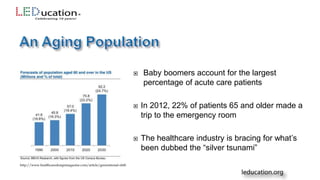
 Baby boomers account for the largest
percentage of acute care patients
 In 2012, 22% of patients 65 and older made a
trip to the emergency room
 The healthcare industry is bracing for what’s
been dubbed the “silver tsunami”
http://www.healthcaredesignmagazine.com/article/generational-shift
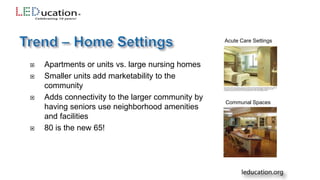
 Apartments or units vs. large nursing homes
 Smaller units add marketability to the
community
 Adds connectivity to the larger community by
having seniors use neighborhood amenities
and facilities
 80 is the new 65!
Communal Spaces
Acute Care Settings
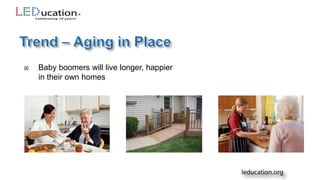
 Baby boomers will live longer, happier
in their own homes
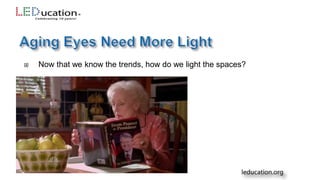
 Now that we know the trends, how do we light the spaces?
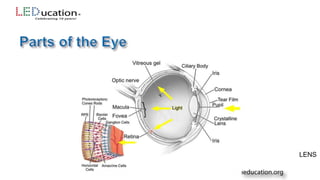
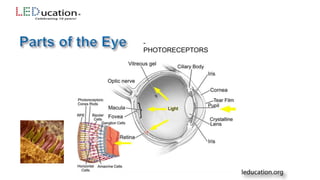
LENS
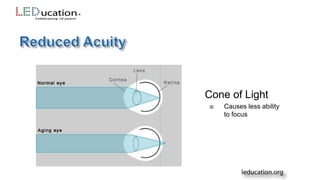
Cone of Light
 Causes less ability
to focus
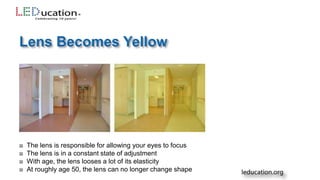
 The lens is responsible for allowing your eyes to focus
 The lens is in a constant state of adjustment
 With age, the lens looses a lot of its elasticity
 At roughly age 50, the lens can no longer change shape
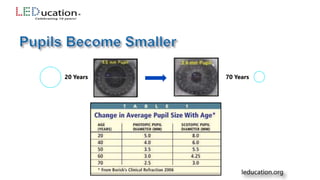
70 Years20 Years
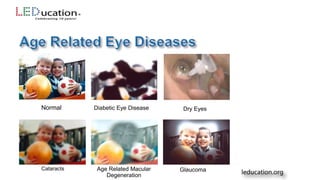
Normal Diabetic Eye Disease Dry Eyes
Cataracts Age Related Macular
Degeneration
Glaucoma
-
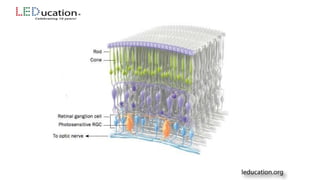
PHOTORECEPTORS
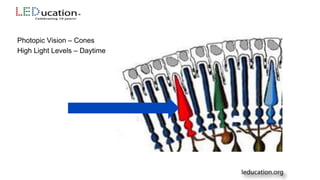
Photopic Vision – Cones
High Light Levels – Daytime
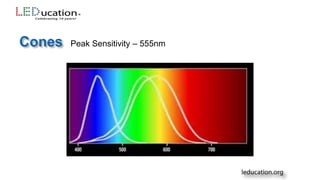
Peak Sensitivity – 555nm
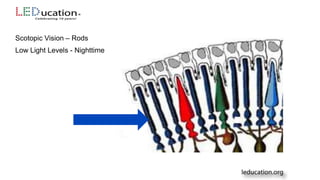
Scotopic Vision – Rods
Low Light Levels - Nighttime
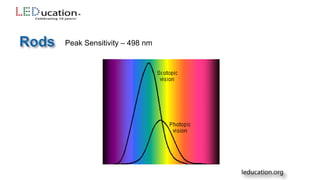
Peak Sensitivity – 498 nm
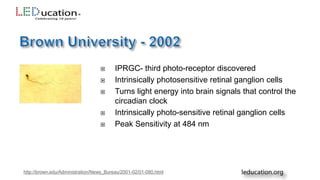
 IPRGC- third photo-receptor discovered
 Intrinsically photosensitive retinal ganglion cells
 Turns light energy into brain signals that control the
circadian clock
 Intrinsically photo-sensitive retinal ganglion cells
 Peak Sensitivity at 484 nm
http://brown.edu/Administration/News_Bureau/2001-02/01-080.html
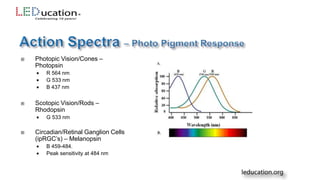
 Photopic Vision/Cones –
Photopsin
 R 564 nm
 G 533 nm
 B 437 nm
 Scotopic Vision/Rods –
Rhodopsin
 G 533 nm
 Circadian/Retinal Ganglion Cells
(ipRGC’s) – Melanopsin
 B 459-484.
 Peak sensitivity at 484 nm
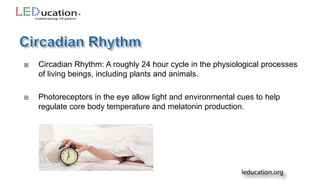
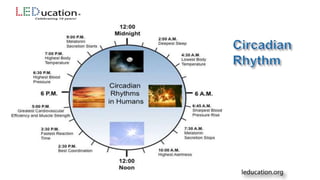
 Circadian Rhythm: A roughly 24 hour cycle in the physiological processes
of living beings, including plants and animals.
 Photoreceptors in the eye allow light and environmental cues to help
regulate core body temperature and melatonin production.
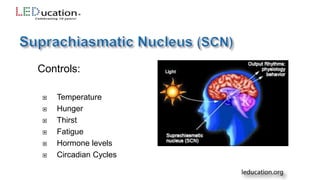
Controls:
 Temperature
 Hunger
 Thirst
 Fatigue
 Hormone levels
 Circadian Cycles
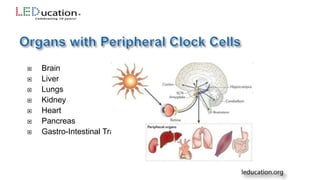
 Brain
 Liver
 Lungs
 Kidney
 Heart
 Pancreas
 Gastro-Intestinal Tract
Light that mimics nature can improve:
 Circadian system functions
 Sleep
 Mood
 Performance
 Health
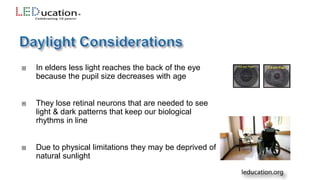
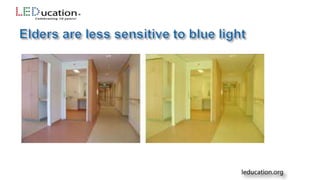
 In elders less light reaches the back of the eye
because the pupil size decreases with age
 They lose retinal neurons that are needed to see
light & dark patterns that keep our biological
rhythms in line
 Due to physical limitations they may be deprived of
natural sunlight
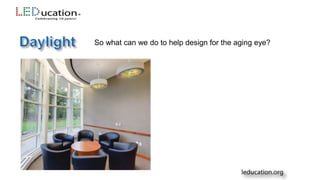
So what can we do to help design for the aging eye?
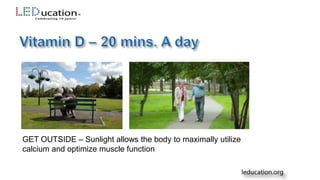
GET OUTSIDE – Sunlight allows the body to maximally utilize
calcium and optimize muscle function
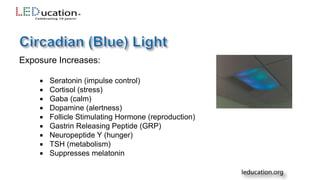
Exposure Increases:
 Seratonin (impulse control)
 Cortisol (stress)
 Gaba (calm)
 Dopamine (alertness)
 Follicle Stimulating Hormone (reproduction)
 Gastrin Releasing Peptide (GRP)
 Neuropeptide Y (hunger)
 TSH (metabolism)
 Suppresses melatonin
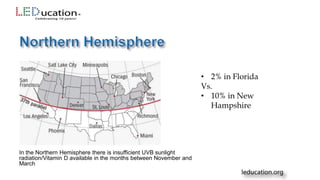
In the Northern Hemisphere there is insufficient UVB sunlight
radiation/Vitamin D available in the months between November and
March
• 2% in Florida
Vs.
• 10% in New
Hampshire
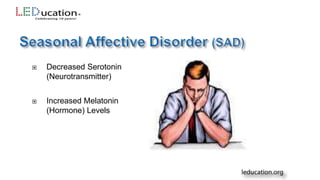
 Decreased Serotonin
(Neurotransmitter)
 Increased Melatonin
(Hormone) Levels
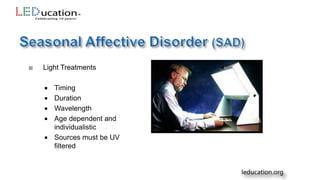
 Light Treatments
 Timing
 Duration
 Wavelength
 Age dependent and
individualistic
 Sources must be UV
filtered
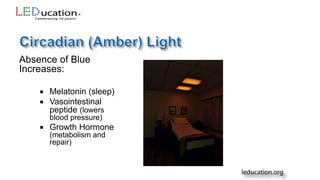
Absence of Blue
Increases:
 Melatonin (sleep)
 Vasointestinal
peptide (lowers
blood pressure)
 Growth Hormone
(metabolism and
repair)
 Keep sleep disturbances to a minimum
 Maintain sleep schedule, decrease naps as needed
 Exposure to bright white light in the morning
(2 hours when possible)
 Amber/Red light at night only (650nm)
 Blue light exposure in early evening (470nm)
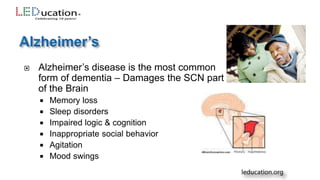
 Alzheimer’s disease is the most common
form of dementia – Damages the SCN part
of the Brain
 Memory loss
 Sleep disorders
 Impaired logic & cognition
 Inappropriate social behavior
 Agitation
 Mood swings
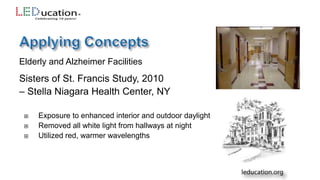
Elderly and Alzheimer Facilities
Sisters of St. Francis Study, 2010
– Stella Niagara Health Center, NY
 Exposure to enhanced interior and outdoor daylight
 Removed all white light from hallways at night
 Utilized red, warmer wavelengths
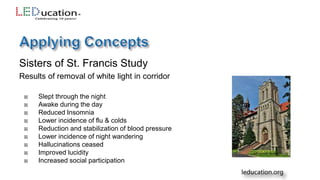
Sisters of St. Francis Study
Results of removal of white light in corridor
 Slept through the night
 Awake during the day
 Reduced Insomnia
 Lower incidence of flu & colds
 Reduction and stabilization of blood pressure
 Lower incidence of night wandering
 Hallucinations ceased
 Improved lucidity
 Increased social participation
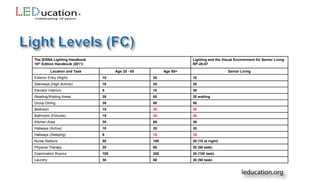
The IESNA Lighting Handbook
10th Edition Handbook (2011)
Lighting and the Visual Environment for Senior Living
RP-28-07
Location and Task Age 25 - 65 Age 65+ Senior Living
Exterior Entry (Night) 10 20 10
Stairways (High Activity) 10 20 30
Elevator Interiors 5 10 30
Reading/Waiting Areas 30 60 30 waiting
Group Dining 30 60 50
Bedroom 15 30 30
Bathroom (Fixtures) 15 30 30
Kitchen Area 30 60 30
Hallways (Active) 10 20 30
Hallways (Sleeping) 5 10 10
Nurse Stations 50 100 30 (10 at night)
Physical Therapy 30 60 30 (50 task)
Examination Rooms 100 200 30 (100 task)
Laundry 30 60 30 (50 task)
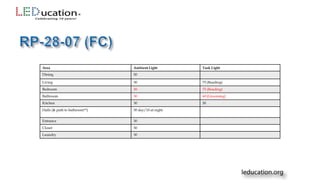
Area Ambient Light Task Light
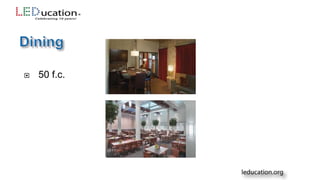
Dining 50
Living 30 75 (Reading)
Bedroom 30 75 (Reading)
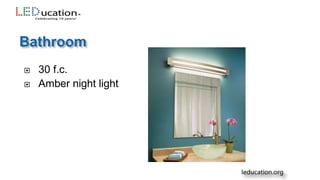
Bathroom 30 60 (Grooming)
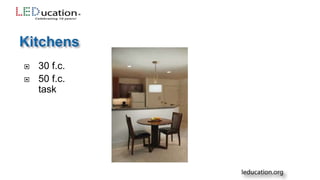
Kitchen 30 50
Halls (& path to bathroom**) 30 day/10 at night
Entrance 30
Closet 30
Laundry 30
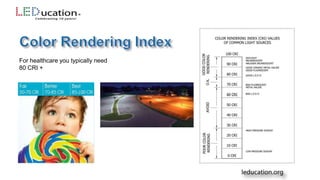
For healthcare you typically need
80 CRI +
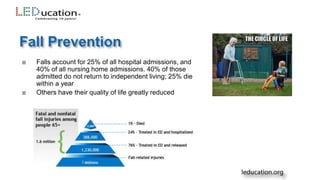
 Falls account for 25% of all hospital admissions, and
40% of all nursing home admissions. 40% of those
admitted do not return to independent living; 25% die
within a year
 Others have their quality of life greatly reduced
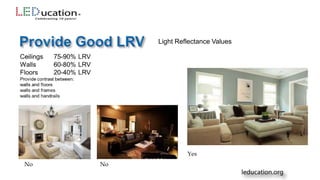
Light Reflectance Values
Yes
NoNo
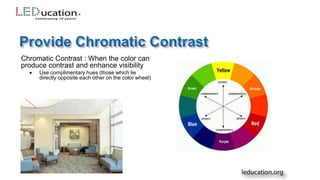
Chromatic Contrast : When the color can
produce contrast and enhance visibility
 Use complimentary hues (those which lie
directly opposite each other on the color wheel)
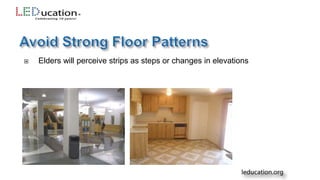
 Elders will perceive strips as steps or changes in elevations
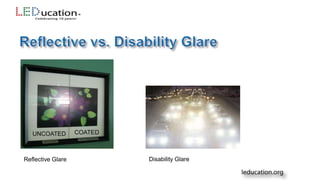
Disability GlareReflective Glare
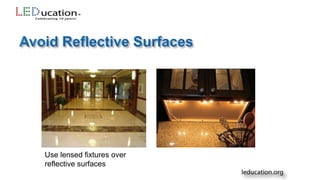
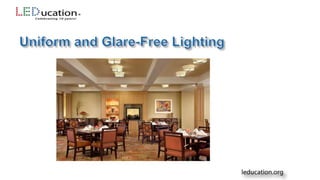
Use lensed fixtures over
reflective surfaces
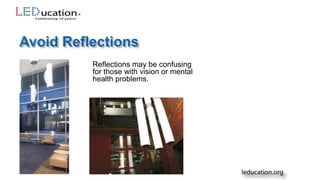
Reflections may be confusing
for those with vision or mental
health problems.
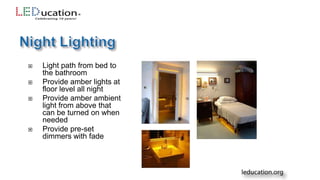
 Light path from bed to
the bathroom
 Provide amber lights at
floor level all night
 Provide amber ambient
light from above that
can be turned on when
needed
 Provide pre-set
dimmers with fade
Adaptation: The ability of the eye to adjust to various light levels
 As the eye ages there is a delay in this adjustment
(30 min.) - Full light to dark adaptation in a 20 yr old
(45 min.) - Full light to dark adaptation in a 50 +
 Important at points of Egress to the outdoors
 Lobbies and corridors should be dimmed according to time of
day to allow for adaptation
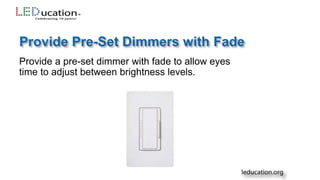
Provide a pre-set dimmer with fade to allow eyes
time to adjust between brightness levels.
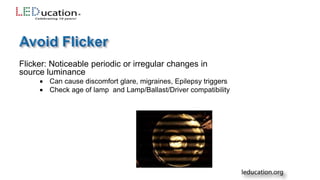
Flicker: Noticeable periodic or irregular changes in
source luminance
 Can cause discomfort glare, migraines, Epilepsy triggers
 Check age of lamp and Lamp/Ballast/Driver compatibility
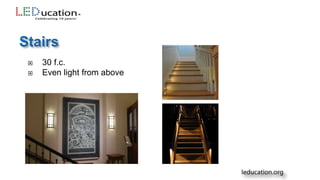
 30 f.c.
 Even light from above
 75 f.c.
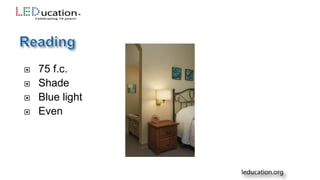
 Shade
 Blue light
 Even
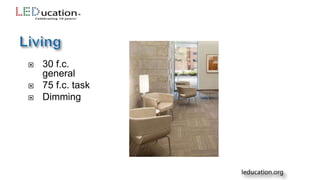
 30 f.c.
general
 75 f.c. task
 Dimming
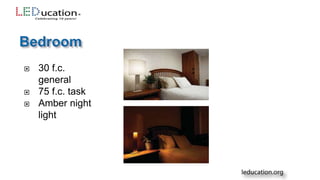
 30 f.c.
general
 75 f.c. task
 Amber night
light
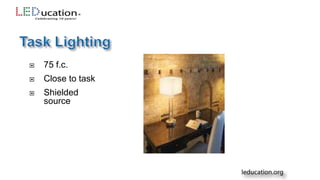
 75 f.c.
 Close to task
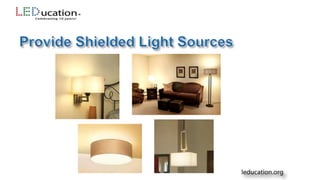
 Shielded
source
 30 f.c.
 Amber night light
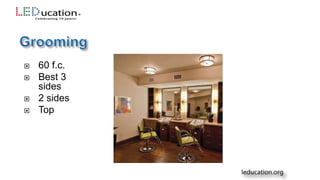
 60 f.c.
 Best 3
sides
 2 sides
 Top
 50 f.c.
 30 f.c.
 50 f.c.
task
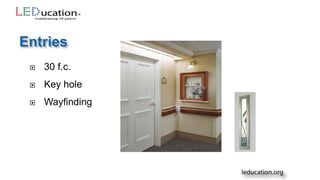
 30 f.c.
 Key hole
 Wayfinding
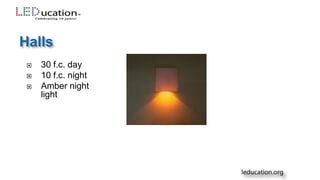
 30 f.c. day
 10 f.c. night
 Amber night
light
The Lighting Handbook – IES 10th Edition
 Has recommended lighting levels by age
ANSI/IESNA RP 28-07
 Lighting and the Visual Environment for Senior Living
ASHRAE
 Energy and lighting power density code requirements
 Check local code
 Increase light levels when designing for the elderly
 Pay attention to source and color
 Decrease white light and bright light sources at night
 Maintain regular sleep patterns
 Increase exposure to daylight
 Center of Design for an Aging Society
 Institute for Patient Centered Design
 The Center for Health Design
 Research Department American Health
Care Association
 Lighting Research Center
 Center for Human Centric Lighting
This concludes The American Institute of Architects
Continuing Education Systems Course
Lauren Roberts, LC, EDAC, IES
Healthcare Market Development Manager
lroberts@visalighting.com

Lighting for Elders and the Aging Eye

  • 2.
  • 3.
    Copyright Materials This presentationis protected by US and International Copyright laws. Reproduction, distribution, display and use of the presentation without written permission of the speaker is prohibited. © Visa Lighting 2015
  • 4.
    Credit(s) earned oncompletion of this course will be reported to AIA CES for AIA members. Certificates of Completion for both AIA members and non-AIA members are available upon request. This course is registered with AIA CES for continuing professional education. As such, it does not include content that may be deemed or construed to be an approval or endorsement by the AIA of any material of construction or any method or manner of handling, using, distributing, or dealing in any material or product. ___________________________________________ Questions related to specific materials, methods, and services will be addressed at the conclusion of this presentation.
  • 5.
    Credit(s) earned oncompletion of this course will be reported to AIA CES for AIA members. Certificates of Completion for both AIA members and non-AIA members are available upon request. This course is registered with AIA CES for continuing professional education. As such, it does not include content that may be deemed or construed to be an approval or endorsement by the AIA of any material of construction or any method or manner of handling, using, distributing, or dealing in any material or product. ___________________________________________________ Questions related to specific materials, methods, and services will be addressed at the conclusion of this presentation.
  • 6.
    As our populationcontinues to age so do our eyes. The visual requirements of older persons are much different than the younger population. Increased light levels, attention to contrast, detail and the healing attributes of lighting are all important factors in designing lighting for the elderly. This presentation will identify ways in which the eye ages, common diseases and what we can do with lighting as a tool in designing for the aging eye.
  • 7.
    At the endof the this course, participants will be able to: 1. Understand the terminology and physical factors of the eye. 2. Describe the phases of the aging eye and common diseases. 3. Look at lighting solutions where lighting can be used as a tool when designing for the elderly. 4. Describe evidence based research on ighting that can improve human health.
  • 9.
     Baby boomersaccount for the largest percentage of acute care patients  In 2012, 22% of patients 65 and older made a trip to the emergency room  The healthcare industry is bracing for what’s been dubbed the “silver tsunami” http://www.healthcaredesignmagazine.com/article/generational-shift
  • 11.
     Apartments orunits vs. large nursing homes  Smaller units add marketability to the community  Adds connectivity to the larger community by having seniors use neighborhood amenities and facilities  80 is the new 65! Communal Spaces Acute Care Settings
  • 12.
     Baby boomerswill live longer, happier in their own homes
  • 13.
     Now thatwe know the trends, how do we light the spaces?
  • 15.
  • 16.
    Cone of Light Causes less ability to focus
  • 17.
     The lensis responsible for allowing your eyes to focus  The lens is in a constant state of adjustment  With age, the lens looses a lot of its elasticity  At roughly age 50, the lens can no longer change shape
  • 18.
  • 19.
    Normal Diabetic EyeDisease Dry Eyes Cataracts Age Related Macular Degeneration Glaucoma
  • 21.
  • 23.
    Photopic Vision –Cones High Light Levels – Daytime
  • 24.
  • 25.
    Scotopic Vision –Rods Low Light Levels - Nighttime
  • 26.
  • 27.
     IPRGC- thirdphoto-receptor discovered  Intrinsically photosensitive retinal ganglion cells  Turns light energy into brain signals that control the circadian clock  Intrinsically photo-sensitive retinal ganglion cells  Peak Sensitivity at 484 nm http://brown.edu/Administration/News_Bureau/2001-02/01-080.html
  • 29.
     Photopic Vision/Cones– Photopsin  R 564 nm  G 533 nm  B 437 nm  Scotopic Vision/Rods – Rhodopsin  G 533 nm  Circadian/Retinal Ganglion Cells (ipRGC’s) – Melanopsin  B 459-484.  Peak sensitivity at 484 nm
  • 36.
     Circadian Rhythm:A roughly 24 hour cycle in the physiological processes of living beings, including plants and animals.  Photoreceptors in the eye allow light and environmental cues to help regulate core body temperature and melatonin production.
  • 37.
    Controls:  Temperature  Hunger Thirst  Fatigue  Hormone levels  Circadian Cycles
  • 39.
     Brain  Liver Lungs  Kidney  Heart  Pancreas  Gastro-Intestinal Tract
  • 40.
    Light that mimicsnature can improve:  Circadian system functions  Sleep  Mood  Performance  Health
  • 42.
     In eldersless light reaches the back of the eye because the pupil size decreases with age  They lose retinal neurons that are needed to see light & dark patterns that keep our biological rhythms in line  Due to physical limitations they may be deprived of natural sunlight
  • 44.
    So what canwe do to help design for the aging eye?
  • 45.
    GET OUTSIDE –Sunlight allows the body to maximally utilize calcium and optimize muscle function
  • 48.
    Exposure Increases:  Seratonin(impulse control)  Cortisol (stress)  Gaba (calm)  Dopamine (alertness)  Follicle Stimulating Hormone (reproduction)  Gastrin Releasing Peptide (GRP)  Neuropeptide Y (hunger)  TSH (metabolism)  Suppresses melatonin
  • 49.
    In the NorthernHemisphere there is insufficient UVB sunlight radiation/Vitamin D available in the months between November and March • 2% in Florida Vs. • 10% in New Hampshire
  • 50.
     Decreased Serotonin (Neurotransmitter) Increased Melatonin (Hormone) Levels
  • 51.
     Light Treatments Timing  Duration  Wavelength  Age dependent and individualistic  Sources must be UV filtered
  • 52.
    Absence of Blue Increases: Melatonin (sleep)  Vasointestinal peptide (lowers blood pressure)  Growth Hormone (metabolism and repair)
  • 53.
     Keep sleepdisturbances to a minimum  Maintain sleep schedule, decrease naps as needed  Exposure to bright white light in the morning (2 hours when possible)  Amber/Red light at night only (650nm)  Blue light exposure in early evening (470nm)
  • 54.
     Alzheimer’s diseaseis the most common form of dementia – Damages the SCN part of the Brain  Memory loss  Sleep disorders  Impaired logic & cognition  Inappropriate social behavior  Agitation  Mood swings
  • 55.
    Elderly and AlzheimerFacilities Sisters of St. Francis Study, 2010 – Stella Niagara Health Center, NY  Exposure to enhanced interior and outdoor daylight  Removed all white light from hallways at night  Utilized red, warmer wavelengths
  • 56.
    Sisters of St.Francis Study Results of removal of white light in corridor  Slept through the night  Awake during the day  Reduced Insomnia  Lower incidence of flu & colds  Reduction and stabilization of blood pressure  Lower incidence of night wandering  Hallucinations ceased  Improved lucidity  Increased social participation
  • 58.
    The IESNA LightingHandbook 10th Edition Handbook (2011) Lighting and the Visual Environment for Senior Living RP-28-07 Location and Task Age 25 - 65 Age 65+ Senior Living Exterior Entry (Night) 10 20 10 Stairways (High Activity) 10 20 30 Elevator Interiors 5 10 30 Reading/Waiting Areas 30 60 30 waiting Group Dining 30 60 50 Bedroom 15 30 30 Bathroom (Fixtures) 15 30 30 Kitchen Area 30 60 30 Hallways (Active) 10 20 30 Hallways (Sleeping) 5 10 10 Nurse Stations 50 100 30 (10 at night) Physical Therapy 30 60 30 (50 task) Examination Rooms 100 200 30 (100 task) Laundry 30 60 30 (50 task)
  • 59.
    Area Ambient LightTask Light Dining 50 Living 30 75 (Reading) Bedroom 30 75 (Reading) Bathroom 30 60 (Grooming) Kitchen 30 50 Halls (& path to bathroom**) 30 day/10 at night Entrance 30 Closet 30 Laundry 30
  • 60.
    For healthcare youtypically need 80 CRI +
  • 61.
     Falls accountfor 25% of all hospital admissions, and 40% of all nursing home admissions. 40% of those admitted do not return to independent living; 25% die within a year  Others have their quality of life greatly reduced
  • 62.
  • 63.
    Chromatic Contrast :When the color can produce contrast and enhance visibility  Use complimentary hues (those which lie directly opposite each other on the color wheel)
  • 64.
     Elders willperceive strips as steps or changes in elevations
  • 66.
  • 67.
    Use lensed fixturesover reflective surfaces
  • 68.
    Reflections may beconfusing for those with vision or mental health problems.
  • 72.
     Light pathfrom bed to the bathroom  Provide amber lights at floor level all night  Provide amber ambient light from above that can be turned on when needed  Provide pre-set dimmers with fade
  • 73.
    Adaptation: The abilityof the eye to adjust to various light levels  As the eye ages there is a delay in this adjustment (30 min.) - Full light to dark adaptation in a 20 yr old (45 min.) - Full light to dark adaptation in a 50 +  Important at points of Egress to the outdoors  Lobbies and corridors should be dimmed according to time of day to allow for adaptation
  • 74.
    Provide a pre-setdimmer with fade to allow eyes time to adjust between brightness levels.
  • 75.
    Flicker: Noticeable periodicor irregular changes in source luminance  Can cause discomfort glare, migraines, Epilepsy triggers  Check age of lamp and Lamp/Ballast/Driver compatibility
  • 77.
     30 f.c. Even light from above
  • 78.
     75 f.c. Shade  Blue light  Even
  • 79.
     30 f.c. general 75 f.c. task  Dimming
  • 80.
     30 f.c. general 75 f.c. task  Amber night light
  • 81.
     75 f.c. Close to task  Shielded source
  • 82.
     30 f.c. Amber night light
  • 83.
     60 f.c. Best 3 sides  2 sides  Top
  • 84.
  • 85.
     30 f.c. 50 f.c. task
  • 86.
     30 f.c. Key hole  Wayfinding
  • 87.
     30 f.c.day  10 f.c. night  Amber night light
  • 88.
    The Lighting Handbook– IES 10th Edition  Has recommended lighting levels by age ANSI/IESNA RP 28-07  Lighting and the Visual Environment for Senior Living ASHRAE  Energy and lighting power density code requirements  Check local code
  • 89.
     Increase lightlevels when designing for the elderly  Pay attention to source and color  Decrease white light and bright light sources at night  Maintain regular sleep patterns  Increase exposure to daylight
  • 90.
     Center ofDesign for an Aging Society  Institute for Patient Centered Design  The Center for Health Design  Research Department American Health Care Association  Lighting Research Center  Center for Human Centric Lighting
  • 91.
    This concludes TheAmerican Institute of Architects Continuing Education Systems Course
  • 92.
    Lauren Roberts, LC,EDAC, IES Healthcare Market Development Manager lroberts@visalighting.com

Editor's Notes

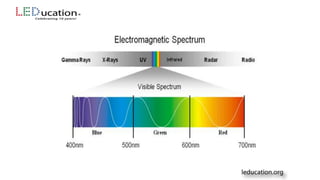
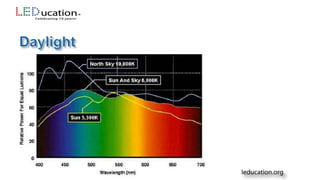
  • #23 When sunlight shines through a prism, you can see all the colors of the rainbow (or visible spectrum). Daylight is a mix of all colors and all the colors of nature come from light.
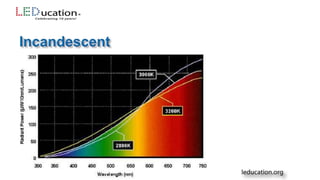
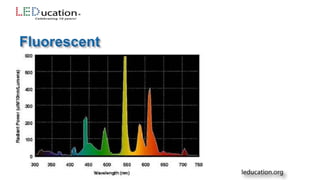
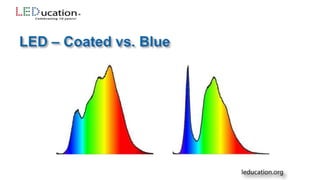
  • #34 For electric lighting, we don't need all the colors to make white. We only need the primary colors of light - red, green, and blue - and the amazing human visual system sort of "fills in," and our perception  takes care of the rest.  This method of just using particular portions of the spectrum is employed in fluorescent, high intensity discharge and LED lighting to produce "white" light.