ENVIRONMENT & BEHAVIOUR
VISUAL SENSE IN INDOOR ENVIRONMENT
AKSHAY SHAJY
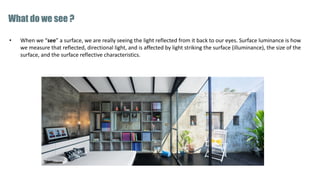
• When we “see” a surface, we are really seeing the light reflected from it back to our eyes. Surface luminance is how
we measure that reflected, directional light, and is affected by light striking the surface (illuminance), the size of the
surface, and the surface reflective characteristics.
What do we see ?
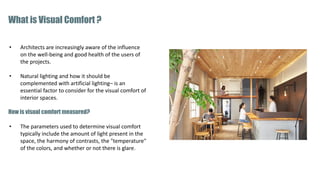
• Architects are increasingly aware of the influence
on the well-being and good health of the users of
the projects.
• Natural lighting and how it should be
complemented with artificial lighting– is an
essential factor to consider for the visual comfort of
interior spaces.
How is visual comfort measured?
• The parameters used to determine visual comfort
typically include the amount of light present in the
space, the harmony of contrasts, the "temperature"
of the colors, and whether or not there is glare.
What is Visual Comfort ?
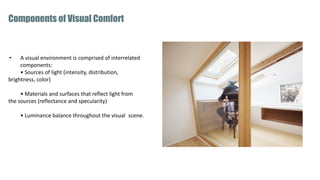
• A visual environment is comprised of interrelated
components:
• Sources of light (intensity, distribution,
brightness, color)
• Materials and surfaces that reflect light from
the sources (reflectance and specularity)
• Luminance balance throughout the visual scene.
Components of Visual Comfort
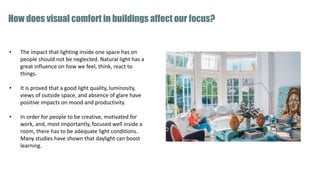
• The impact that lighting inside one space has on
people should not be neglected. Natural light has a
great influence on how we feel, think, react to
things.
• It is proved that a good light quality, luminosity,
views of outside space, and absence of glare have
positive impacts on mood and productivity.
• In order for people to be creative, motivated for
work, and, most importantly, focused well inside a
room, there has to be adequate light conditions.
Many studies have shown that daylight can boost
learning.
How does visual comfort in buildings affect our focus?
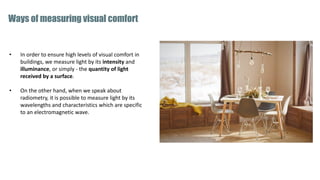
• In order to ensure high levels of visual comfort in
buildings, we measure light by its intensity and
illuminance, or simply - the quantity of light
received by a surface.
• On the other hand, when we speak about
radiometry, it is possible to measure light by its
wavelengths and characteristics which are specific
to an electromagnetic wave.
Ways of measuring visual comfort
Impact of Colour
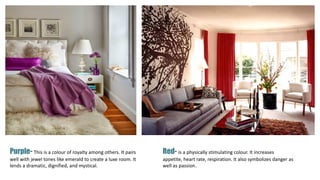
Purple- This is a colour of royalty among others. It pairs
well with jewel tones like emerald to create a luxe room. It
lends a dramatic, dignified, and mystical.
Red- is a physically stimulating colour. It increases
appetite, heart rate, respiration. It also symbolizes danger as
well as passion.
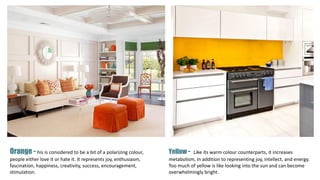
Orange - his is considered to be a bit of a polarizing colour,
people either love it or hate it. It represents joy, enthusiasm,
fascination, happiness, creativity, success, encouragement,
stimulation.
Yellow - Like its warm colour counterparts, it increases
metabolism, in addition to representing joy, intellect, and energy.
Too much of yellow is like looking into the sun and can become
overwhelmingly bright.
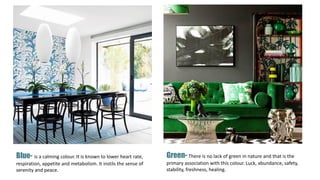
Blue- is a calming colour. It is known to lower heart rate,
respiration, appetite and metabolism. It instils the sense of
serenity and peace.
Green- There is no lack of green in nature and that is the
primary association with this colour. Luck, abundance, safety,
stability, freshness, healing.
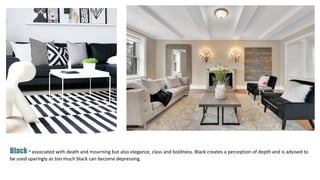
Black -associated with death and mourning but also elegance, class and boldness. Black creates a perception of depth and is advised to
be used sparingly as too much black can become depressing.
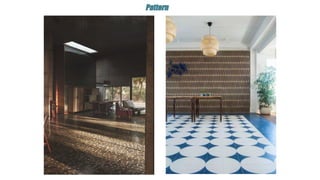
Pattern
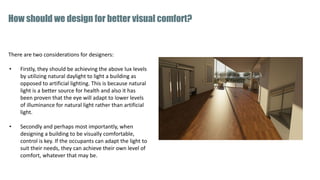
There are two considerations for designers:
• Firstly, they should be achieving the above lux levels
by utilizing natural daylight to light a building as
opposed to artificial lighting. This is because natural
light is a better source for health and also it has
been proven that the eye will adapt to lower levels
of illuminance for natural light rather than artificial
light.
• Secondly and perhaps most importantly, when
designing a building to be visually comfortable,
control is key. If the occupants can adapt the light to
suit their needs, they can achieve their own level of
comfort, whatever that may be.
How should we design for better visual comfort?
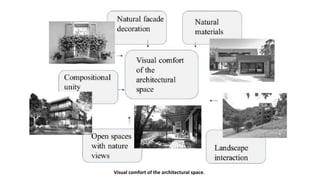
Visual comfort of the architectural space.
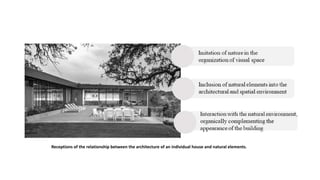
Receptions of the relationship between the architecture of an individual house and natural elements.
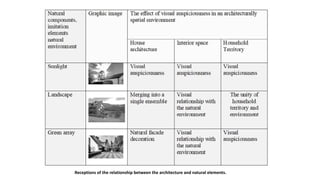
Receptions of the relationship between the architecture and natural elements.
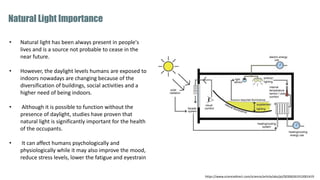
• Natural light has been always present in people's
lives and is a source not probable to cease in the
near future.
• However, the daylight levels humans are exposed to
indoors nowadays are changing because of the
diversification of buildings, social activities and a
higher need of being indoors.
• Although it is possible to function without the
presence of daylight, studies have proven that
natural light is significantly important for the health
of the occupants.
• It can affect humans psychologically and
physiologically while it may also improve the mood,
reduce stress levels, lower the fatigue and eyestrain
Natural Light Importance
https://www.sciencedirect.com/science/article/abs/pii/S0306261912001419
References
• https://www.archdaily.com/935258/biophilia-bringing-nature-into-interior-design.
• https://www.researchgate.net/figure/Visual-comfort-of-the-architectural-space_fig2_347024416
• https://multicomfort.saint-gobain.co.uk/recommended-level-of-light-into-a-building/#:~:text=Visual%20comfort%20is
%20usually%20defined,measure%20as%20part%20of%20it.
• archdaily.com/911210/let-there-be-light-key-indicators-to-describe-and-design-visual-comfort
THANK YOU

visual.pptx (1).pdf

  • 1.
    ENVIRONMENT & BEHAVIOUR VISUALSENSE IN INDOOR ENVIRONMENT AKSHAY SHAJY
  • 9.
    • When we“see” a surface, we are really seeing the light reflected from it back to our eyes. Surface luminance is how we measure that reflected, directional light, and is affected by light striking the surface (illuminance), the size of the surface, and the surface reflective characteristics. What do we see ?
  • 10.
    • Architects areincreasingly aware of the influence on the well-being and good health of the users of the projects. • Natural lighting and how it should be complemented with artificial lighting– is an essential factor to consider for the visual comfort of interior spaces. How is visual comfort measured? • The parameters used to determine visual comfort typically include the amount of light present in the space, the harmony of contrasts, the "temperature" of the colors, and whether or not there is glare. What is Visual Comfort ?
  • 11.
    • A visualenvironment is comprised of interrelated components: • Sources of light (intensity, distribution, brightness, color) • Materials and surfaces that reflect light from the sources (reflectance and specularity) • Luminance balance throughout the visual scene. Components of Visual Comfort
  • 12.
    • The impactthat lighting inside one space has on people should not be neglected. Natural light has a great influence on how we feel, think, react to things. • It is proved that a good light quality, luminosity, views of outside space, and absence of glare have positive impacts on mood and productivity. • In order for people to be creative, motivated for work, and, most importantly, focused well inside a room, there has to be adequate light conditions. Many studies have shown that daylight can boost learning. How does visual comfort in buildings affect our focus?
  • 13.
    • In orderto ensure high levels of visual comfort in buildings, we measure light by its intensity and illuminance, or simply - the quantity of light received by a surface. • On the other hand, when we speak about radiometry, it is possible to measure light by its wavelengths and characteristics which are specific to an electromagnetic wave. Ways of measuring visual comfort
  • 14.
  • 15.
    Purple- This isa colour of royalty among others. It pairs well with jewel tones like emerald to create a luxe room. It lends a dramatic, dignified, and mystical. Red- is a physically stimulating colour. It increases appetite, heart rate, respiration. It also symbolizes danger as well as passion.
  • 16.
    Orange - hisis considered to be a bit of a polarizing colour, people either love it or hate it. It represents joy, enthusiasm, fascination, happiness, creativity, success, encouragement, stimulation. Yellow - Like its warm colour counterparts, it increases metabolism, in addition to representing joy, intellect, and energy. Too much of yellow is like looking into the sun and can become overwhelmingly bright.
  • 17.
    Blue- is acalming colour. It is known to lower heart rate, respiration, appetite and metabolism. It instils the sense of serenity and peace. Green- There is no lack of green in nature and that is the primary association with this colour. Luck, abundance, safety, stability, freshness, healing.
  • 18.
    Black -associated withdeath and mourning but also elegance, class and boldness. Black creates a perception of depth and is advised to be used sparingly as too much black can become depressing.
  • 19.
  • 20.
    There are twoconsiderations for designers: • Firstly, they should be achieving the above lux levels by utilizing natural daylight to light a building as opposed to artificial lighting. This is because natural light is a better source for health and also it has been proven that the eye will adapt to lower levels of illuminance for natural light rather than artificial light. • Secondly and perhaps most importantly, when designing a building to be visually comfortable, control is key. If the occupants can adapt the light to suit their needs, they can achieve their own level of comfort, whatever that may be. How should we design for better visual comfort?
  • 21.
    Visual comfort ofthe architectural space.
  • 22.
    Receptions of therelationship between the architecture of an individual house and natural elements.
  • 23.
    Receptions of therelationship between the architecture and natural elements.
  • 24.
    • Natural lighthas been always present in people's lives and is a source not probable to cease in the near future. • However, the daylight levels humans are exposed to indoors nowadays are changing because of the diversification of buildings, social activities and a higher need of being indoors. • Although it is possible to function without the presence of daylight, studies have proven that natural light is significantly important for the health of the occupants. • It can affect humans psychologically and physiologically while it may also improve the mood, reduce stress levels, lower the fatigue and eyestrain Natural Light Importance https://www.sciencedirect.com/science/article/abs/pii/S0306261912001419
  • 25.
    References • https://www.archdaily.com/935258/biophilia-bringing-nature-into-interior-design. • https://www.researchgate.net/figure/Visual-comfort-of-the-architectural-space_fig2_347024416 •https://multicomfort.saint-gobain.co.uk/recommended-level-of-light-into-a-building/#:~:text=Visual%20comfort%20is %20usually%20defined,measure%20as%20part%20of%20it. • archdaily.com/911210/let-there-be-light-key-indicators-to-describe-and-design-visual-comfort
  • 26.