






















March 5 & 6, 2015
New strategies for applying light:
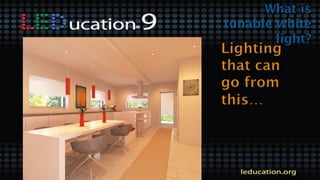
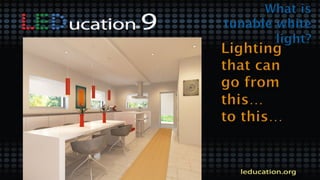
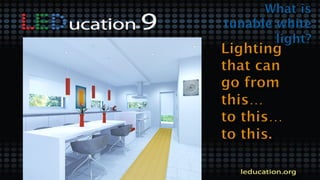
integrating variable white lighting products
Ann Schiffers – USAI Lighting
Senior VP of Specification Sales (MFA, BS, IES)
March 5 & 6, 2015
 Brief review of light and color
 Definition of tunable white light
 Review of how light interacts with the circadian system
 How new information will change the way you design
 Applications for tunable white light in architectural lighting
practice
 Example project from special guest
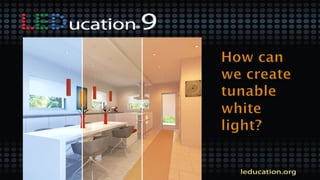
1. What is tunable white light and how is it tuned?
2. Different technologies used to achieve and create
tunable white light
3. Importance behind coordinating dimming, building
control systems, and tunable white light fixtures
4. Applications in which tunable white light has been used
5. New opportunities for using tunable light that may help
you
What do these places have in common?
 Catering to needs of
patients and staff alike
 Assist and promote
comfort and recovery
 Enhance visual acuity for
medical professionals
 Welcome visitors
 Designed to promote
appreciation of fine art
 Visual presentation must be
of the highest caliber
 Colors rendered accurately
 Light levels high enough for
viewing, but below
materials’ damage
threshold
 Have no UV or IR
March 5 & 6, 2015
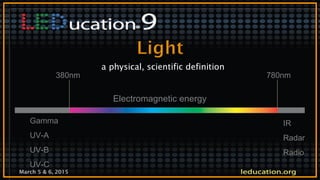
380nm 780nm
IR
Radar
Radio
Gamma
UV-A
UV-B
UV-C
Electromagnetic energy
a physical, scientific definition
March 5 & 6, 2015
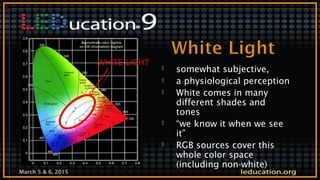
 somewhat subjective,
 a physiological perception
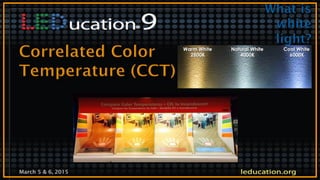
 White comes in many
different shades and
tones
 “we know it when we see
it”
 RGB sources cover this
whole color space
(including non-white)
WHITE LIGHT
March 5 & 6, 2015
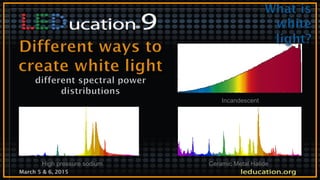
Ceramic Metal HalideHigh pressure sodium
Incandescent
March 5 & 6, 2015
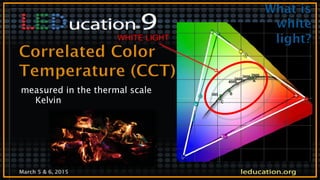
measured in the thermal scale
Kelvin
WHITE LIGHT
March 5 & 6, 2015
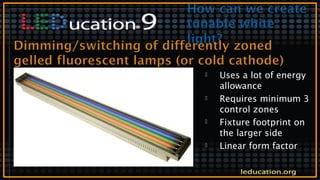
 Uses a lot of energy
allowance
 Requires minimum 3
control zones
 Fixture footprint on
the larger side
 Linear form factor
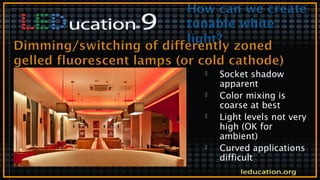
 Socket shadow
apparent
 Color mixing is
coarse at best
 Light levels not very
high (OK for
ambient)
 Curved applications
difficult
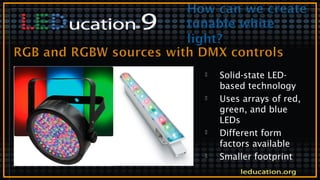
 Solid-state LED-
based technology
 Uses arrays of red,
green, and blue
LEDs
 Different form
factors available
 Smaller footprint
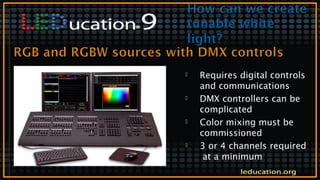
 Requires digital controls
and communications
 DMX controllers can be
complicated
 Color mixing must be
commissioned
 3 or 4 channels required
at a minimum
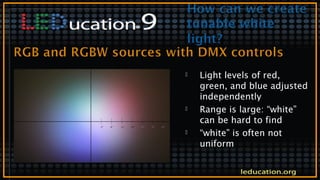
 Light levels of red,
green, and blue adjusted
independently
 Range is large: “white”
can be hard to find
 “white” is often not
uniform
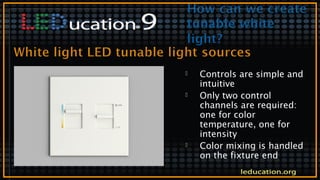
 Controls are simple and
intuitive
 Only two control
channels are required:
one for color
temperature, one for
intensity
 Color mixing is handled
on the fixture end
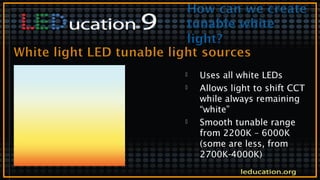
 Uses all white LEDs
 Allows light to shift CCT
while always remaining
“white”
 Smooth tunable range
from 2200K – 6000K
(some are less, from
2700K-4000K)
March 5 & 6, 2015
It’s good for us
March 5 & 6, 2015
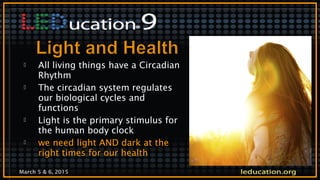
 All living things have a Circadian
Rhythm
 The circadian system regulates
our biological cycles and
functions
 Light is the primary stimulus for
the human body clock
 we need light AND dark at the
right times for our health
March 5 & 6, 2015
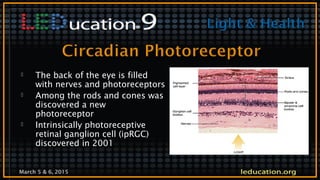
 The back of the eye is filled
with nerves and photoreceptors
 Among the rods and cones was
discovered a new
photoreceptor
 Intrinsically photoreceptive
retinal ganglion cell (ipRGC)
discovered in 2001
March 5 & 6, 2015
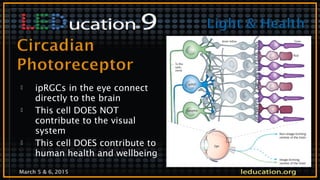
 ipRGCs in the eye connect
directly to the brain
 This cell DOES NOT
contribute to the visual
system
 This cell DOES contribute to
human health and wellbeing
March 5 & 6, 2015
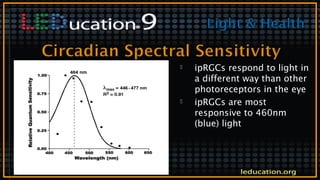
 ipRGCs respond to light in
a different way than other
photoreceptors in the eye
 ipRGCs are most
responsive to 460nm
(blue) light
March 5 & 6, 2015
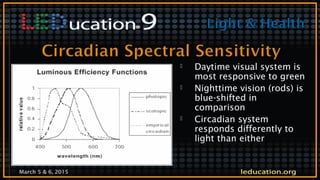
 Daytime visual system is
most responsive to green
 Nighttime vision (rods) is
blue-shifted in
comparison
 Circadian system
responds differently to
light than either
March 5 & 6, 2015
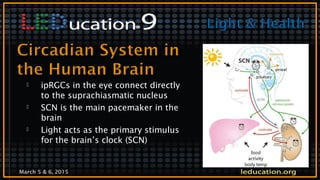
 ipRGCs in the eye connect directly
to the suprachiasmatic nucleus
 SCN is the main pacemaker in the
brain
 Light acts as the primary stimulus
for the brain’s clock (SCN)
March 5 & 6, 2015
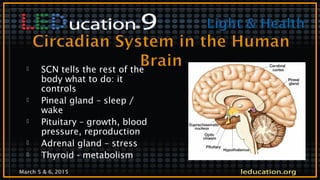
 SCN tells the rest of the
body what to do: it
controls
 Pineal gland – sleep /
wake
 Pituitary – growth, blood
pressure, reproduction
 Adrenal gland – stress
 Thyroid - metabolism
March 5 & 6, 2015
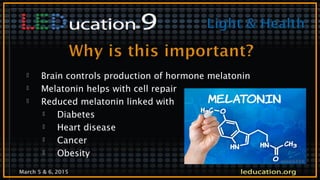
 Brain controls production of hormone melatonin
 Melatonin helps with cell repair
 Reduced melatonin linked with
 Diabetes
 Heart disease
 Cancer
 Obesity
March 5 & 6, 2015
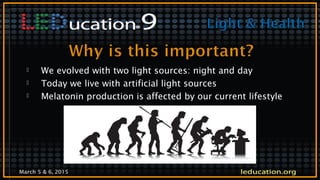
 We evolved with two light sources: night and day
 Today we live with artificial light sources
 Melatonin production is affected by our current lifestyle
March 5 & 6, 2015
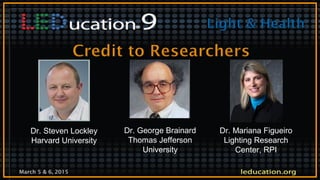
Dr. George Brainard
Thomas Jefferson
University
Dr. Mariana Figueiro
Lighting Research
Center, RPI
Dr. Steven Lockley
Harvard University
March 5 & 6, 2015
some applications where it has
been used effectively
March 5 & 6, 2015
 Where couldn’t we use it?
March 5 & 6, 2015
 Seattle Mariners clubhouse lighting project
 Airbus Industries Mockup
 Benefits for students and office workers
 Lighting and Alzheimer's
 School for the Visually Impaired
 Auction House Optimization
 A morbid tale
March 5 & 6, 2015
 Home team locker room
 Mariners wanted 5000 Kelvin before the baseball game, and
wanted 2700 Kelvin after the game.
 Used new tunable white technology –
2x2s.
March 5 & 6, 2015
 “Whether due to jet lag or some other aetiology, our finds are of
practical importance for the west coast teams, because they
face the double handicap of playing away games after eastward
trips. The result is that these teams are giving up more than one
additional run in every game played after such travel.”
March 5 & 6, 2015
 Airbus completed a mock
up last year that was similar
to a flight simulator. It was
complete with seating,
noise, vibration, etc. They
installed tunable white LED
to test the reduction effect
on jet lag in intercontinental
travel.
March 5 & 6, 2015
 High CCT in morning (help wake
up)
 3500 to 5000K during normal
work
 Increased light levels for tests
 Low CCT and light level after
recess
 Studies conducted with
fluorescent, but will be much
better with LED
March 5 & 6, 2015
 Daylight is the ultimate
tunable white light source
 Daylight = better entrainment
 Studies show a correlation
between daylight and
workplace satisfaction
 Researchers and designers
recreate daylight with tunable
white light sources
March 5 & 6, 2015
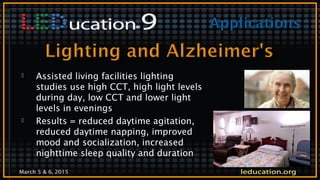
 Assisted living facilities lighting
studies use high CCT, high light levels
during day, low CCT and lower light
levels in evenings
 Results = reduced daytime agitation,
reduced daytime napping, improved
mood and socialization, increased
nighttime sleep quality and duration
March 5 & 6, 2015
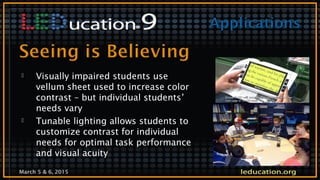
 Visually impaired students use
vellum sheet used to increase color
contrast – but individual students’
needs vary
 Tunable lighting allows students to
customize contrast for individual
needs for optimal task performance
and visual acuity
March 5 & 6, 2015
 Everything must be right for a
multi-billion dollar art sale
 High profile auction houses
customize tunable sources to
recreate the ideal light in which to
view artwork – recreating the light
that was used at time of work’s
creation
March 5 & 6, 2015
 Funeral homes ask for tunable white technology to provide
the best possible viewing conditions for open-casket
funerals
 Able to customize the tunable light source for different skin
tones
March 5 & 6, 2015
Jeanmarie Zimmerman
AIA, ACHA, CCIDC, EDAC
Puchlick Design Associates
Associate / Design Director
 Providence Holy Cross Palliative Care
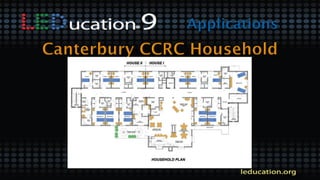
 Canterbury Continued Care Retirement Community (CCRC)
Household
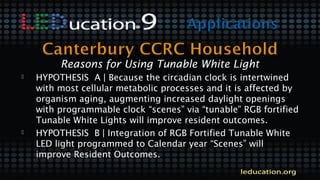
 HYPOTHESIS A | Because the circadian clock is intertwined
with most cellular metabolic processes and it is affected by
organism aging, augmenting increased daylight openings
with programmable clock “scenes” via “tunable” RGB fortified
Tunable White Lights will improve resident outcomes.
 HYPOTHESIS B | Integration of RGB Fortified Tunable White
LED light programmed to Calendar year “Scenes” will
improve Resident Outcomes.
Reasons for Using Tunable White Light
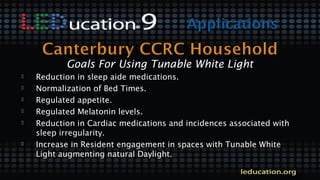
 Reduction in sleep aide medications.
 Normalization of Bed Times.
 Regulated appetite.
 Regulated Melatonin levels.
 Reduction in Cardiac medications and incidences associated with
sleep irregularity.
 Increase in Resident engagement in spaces with Tunable White
Light augmenting natural Daylight.
Goals For Using Tunable White Light
 Clinical Outcome Analytics
 Sleep Medications Data
 Resident Meal Data
 Patient Vitals Data
Metrics for Measuring Design Effectiveness
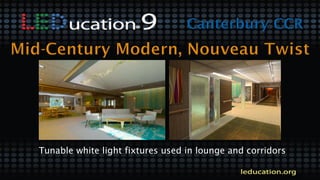
Tunable white light fixtures used in lounge and corridors
Tunable white light fixtures used in resident rooms and kitchens
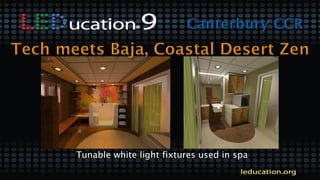
Tunable white light fixtures used in spa
Healthcare to Art Museums: New Strategies for applying light: integrating variable light lighting - Presented by: Ann Schiffers, USA Illuminations

Healthcare to Art Museums: New Strategies for applying light: integrating variable light lighting - Presented by: Ann Schiffers, USA Illuminations

  • 1.
    March 5 &6, 2015 New strategies for applying light: integrating variable white lighting products Ann Schiffers – USAI Lighting Senior VP of Specification Sales (MFA, BS, IES)
  • 2.
    March 5 &6, 2015  Brief review of light and color  Definition of tunable white light  Review of how light interacts with the circadian system  How new information will change the way you design  Applications for tunable white light in architectural lighting practice  Example project from special guest
  • 3.
    1. What istunable white light and how is it tuned? 2. Different technologies used to achieve and create tunable white light 3. Importance behind coordinating dimming, building control systems, and tunable white light fixtures 4. Applications in which tunable white light has been used 5. New opportunities for using tunable light that may help you
  • 4.
    What do theseplaces have in common?
  • 5.
     Catering toneeds of patients and staff alike  Assist and promote comfort and recovery  Enhance visual acuity for medical professionals  Welcome visitors
  • 6.
     Designed topromote appreciation of fine art  Visual presentation must be of the highest caliber  Colors rendered accurately  Light levels high enough for viewing, but below materials’ damage threshold  Have no UV or IR
  • 7.
    March 5 &6, 2015 380nm 780nm IR Radar Radio Gamma UV-A UV-B UV-C Electromagnetic energy a physical, scientific definition
  • 8.
    March 5 &6, 2015  somewhat subjective,  a physiological perception  White comes in many different shades and tones  “we know it when we see it”  RGB sources cover this whole color space (including non-white) WHITE LIGHT
  • 9.
    March 5 &6, 2015 Ceramic Metal HalideHigh pressure sodium Incandescent
  • 10.
    March 5 &6, 2015 measured in the thermal scale Kelvin WHITE LIGHT
  • 11.
    March 5 &6, 2015
  • 17.
     Uses alot of energy allowance  Requires minimum 3 control zones  Fixture footprint on the larger side  Linear form factor
  • 18.
     Socket shadow apparent Color mixing is coarse at best  Light levels not very high (OK for ambient)  Curved applications difficult
  • 19.
     Solid-state LED- basedtechnology  Uses arrays of red, green, and blue LEDs  Different form factors available  Smaller footprint
  • 20.
     Requires digitalcontrols and communications  DMX controllers can be complicated  Color mixing must be commissioned  3 or 4 channels required at a minimum
  • 21.
     Light levelsof red, green, and blue adjusted independently  Range is large: “white” can be hard to find  “white” is often not uniform
  • 22.
     Controls aresimple and intuitive  Only two control channels are required: one for color temperature, one for intensity  Color mixing is handled on the fixture end
  • 23.
     Uses allwhite LEDs  Allows light to shift CCT while always remaining “white”  Smooth tunable range from 2200K – 6000K (some are less, from 2700K-4000K)
  • 24.
    March 5 &6, 2015 It’s good for us
  • 25.
    March 5 &6, 2015  All living things have a Circadian Rhythm  The circadian system regulates our biological cycles and functions  Light is the primary stimulus for the human body clock  we need light AND dark at the right times for our health
  • 26.
    March 5 &6, 2015  The back of the eye is filled with nerves and photoreceptors  Among the rods and cones was discovered a new photoreceptor  Intrinsically photoreceptive retinal ganglion cell (ipRGC) discovered in 2001
  • 27.
    March 5 &6, 2015  ipRGCs in the eye connect directly to the brain  This cell DOES NOT contribute to the visual system  This cell DOES contribute to human health and wellbeing
  • 28.
    March 5 &6, 2015  ipRGCs respond to light in a different way than other photoreceptors in the eye  ipRGCs are most responsive to 460nm (blue) light
  • 29.
    March 5 &6, 2015  Daytime visual system is most responsive to green  Nighttime vision (rods) is blue-shifted in comparison  Circadian system responds differently to light than either
  • 30.
    March 5 &6, 2015  ipRGCs in the eye connect directly to the suprachiasmatic nucleus  SCN is the main pacemaker in the brain  Light acts as the primary stimulus for the brain’s clock (SCN)
  • 31.
    March 5 &6, 2015  SCN tells the rest of the body what to do: it controls  Pineal gland – sleep / wake  Pituitary – growth, blood pressure, reproduction  Adrenal gland – stress  Thyroid - metabolism
  • 32.
    March 5 &6, 2015  Brain controls production of hormone melatonin  Melatonin helps with cell repair  Reduced melatonin linked with  Diabetes  Heart disease  Cancer  Obesity
  • 33.
    March 5 &6, 2015  We evolved with two light sources: night and day  Today we live with artificial light sources  Melatonin production is affected by our current lifestyle
  • 34.
    March 5 &6, 2015 Dr. George Brainard Thomas Jefferson University Dr. Mariana Figueiro Lighting Research Center, RPI Dr. Steven Lockley Harvard University
  • 35.
    March 5 &6, 2015 some applications where it has been used effectively
  • 36.
    March 5 &6, 2015  Where couldn’t we use it?
  • 37.
    March 5 &6, 2015  Seattle Mariners clubhouse lighting project  Airbus Industries Mockup  Benefits for students and office workers  Lighting and Alzheimer's  School for the Visually Impaired  Auction House Optimization  A morbid tale
  • 38.
    March 5 &6, 2015  Home team locker room  Mariners wanted 5000 Kelvin before the baseball game, and wanted 2700 Kelvin after the game.  Used new tunable white technology – 2x2s.
  • 39.
    March 5 &6, 2015  “Whether due to jet lag or some other aetiology, our finds are of practical importance for the west coast teams, because they face the double handicap of playing away games after eastward trips. The result is that these teams are giving up more than one additional run in every game played after such travel.”
  • 40.
    March 5 &6, 2015  Airbus completed a mock up last year that was similar to a flight simulator. It was complete with seating, noise, vibration, etc. They installed tunable white LED to test the reduction effect on jet lag in intercontinental travel.
  • 41.
    March 5 &6, 2015  High CCT in morning (help wake up)  3500 to 5000K during normal work  Increased light levels for tests  Low CCT and light level after recess  Studies conducted with fluorescent, but will be much better with LED
  • 42.
    March 5 &6, 2015  Daylight is the ultimate tunable white light source  Daylight = better entrainment  Studies show a correlation between daylight and workplace satisfaction  Researchers and designers recreate daylight with tunable white light sources
  • 43.
    March 5 &6, 2015  Assisted living facilities lighting studies use high CCT, high light levels during day, low CCT and lower light levels in evenings  Results = reduced daytime agitation, reduced daytime napping, improved mood and socialization, increased nighttime sleep quality and duration
  • 44.
    March 5 &6, 2015  Visually impaired students use vellum sheet used to increase color contrast – but individual students’ needs vary  Tunable lighting allows students to customize contrast for individual needs for optimal task performance and visual acuity
  • 45.
    March 5 &6, 2015  Everything must be right for a multi-billion dollar art sale  High profile auction houses customize tunable sources to recreate the ideal light in which to view artwork – recreating the light that was used at time of work’s creation
  • 46.
    March 5 &6, 2015  Funeral homes ask for tunable white technology to provide the best possible viewing conditions for open-casket funerals  Able to customize the tunable light source for different skin tones
  • 47.
    March 5 &6, 2015 Jeanmarie Zimmerman AIA, ACHA, CCIDC, EDAC Puchlick Design Associates Associate / Design Director
  • 48.
     Providence HolyCross Palliative Care  Canterbury Continued Care Retirement Community (CCRC) Household
  • 51.
     HYPOTHESIS A| Because the circadian clock is intertwined with most cellular metabolic processes and it is affected by organism aging, augmenting increased daylight openings with programmable clock “scenes” via “tunable” RGB fortified Tunable White Lights will improve resident outcomes.  HYPOTHESIS B | Integration of RGB Fortified Tunable White LED light programmed to Calendar year “Scenes” will improve Resident Outcomes. Reasons for Using Tunable White Light
  • 52.
     Reduction insleep aide medications.  Normalization of Bed Times.  Regulated appetite.  Regulated Melatonin levels.  Reduction in Cardiac medications and incidences associated with sleep irregularity.  Increase in Resident engagement in spaces with Tunable White Light augmenting natural Daylight. Goals For Using Tunable White Light
  • 53.
     Clinical OutcomeAnalytics  Sleep Medications Data  Resident Meal Data  Patient Vitals Data Metrics for Measuring Design Effectiveness
  • 54.
    Tunable white lightfixtures used in lounge and corridors
  • 55.
    Tunable white lightfixtures used in resident rooms and kitchens
  • 56.
    Tunable white lightfixtures used in spa