









Angela Matchica PE, LC, LEED AP
Credit(s) earned on completion of this course will be
reported to AIA CES for AIA members. Certificates of
Completion for both AIA members and non-AIA
members are available upon request.
This course is registered with AIA CES for
continuing professional education. As such, it does
not include content that may be deemed or
construed to be an approval or endorsement by the
AIA of any material of construction or any method or
manner of
handling, using, distributing, or dealing in any
material or product.
___________________________________________
Questions related to specific materials, methods, and services will
be addressed at the conclusion of this presentation.
Recent advancements in LED lighting have made the source an
applicable solution in all building types… but the question
remains, how do we incorporate it successfully into our
designs?
A selection of case studies will be used to review lessons
learned in designing with LED lighting- from light
characteristics, managing product quality, controls, and design
parameters for multiple building types
 Review important characteristics to consider when selecting LED
Luminaires
 Review design parameters for using LEDs for general/ambient
lighting
 Review design parameters for using LEDs as a directional lighting
source (i.e. for spot lighting/museum applications)
 Understanding LED and lighting control compatibility
 Discuss methods to manage the submittal and construction
process when designing with LED luminaires
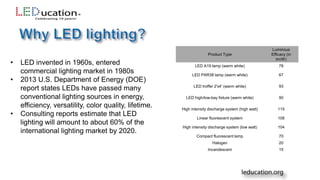
• LED invented in 1960s, entered
commercial lighting market in 1980s
• 2013 U.S. Department of Energy (DOE)
report states LEDs have passed many
conventional lighting sources in energy,
efficiency, versatility, color quality, lifetime.
• Consulting reports estimate that LED
lighting will amount to about 60% of the
international lighting market by 2020.
Product Type
Luminous
Efficacy (in
lm/W)
LED A19 lamp (warm white) 78
LED PAR38 lamp (warm white) 67
LED troffer 2'x4' (warm white) 93
LED high/low-bay fixture (warm white) 90
High intensity discharge system (high watt) 115
Linear fluorescent system 108
High intensity discharge system (low watt) 104
Compact fluorescent lamp 70
Halogen 20
Incandescent 15
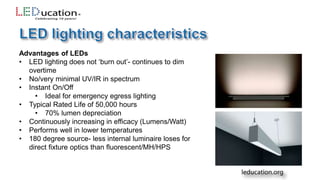
Advantages of LEDs
• LED lighting does not ‘burn out’- continues to dim
overtime
• No/very minimal UV/IR in spectrum
• Instant On/Off
• Ideal for emergency egress lighting
• Typical Rated Life of 50,000 hours
• 70% lumen depreciation
• Continuously increasing in efficacy (Lumens/Watt)
• Performs well in lower temperatures
• 180 degree source- less internal luminaire loses for
direct fixture optics than fluorescent/MH/HPS
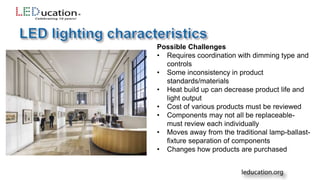
Possible Challenges
• Requires coordination with dimming type and
controls
• Some inconsistency in product
standards/materials
• Heat build up can decrease product life and
light output
• Cost of various products must be reviewed
• Components may not all be replaceable-
must review each individually
• Moves away from the traditional lamp-ballast-
fixture separation of components
• Changes how products are purchased
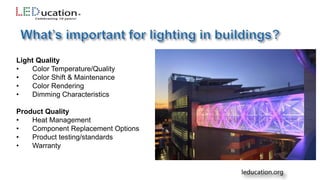
Light Quality
• Color Temperature/Quality
• Color Shift & Maintenance
• Color Rendering
• Dimming Characteristics
Product Quality
• Heat Management
• Component Replacement Options
• Product testing/standards
• Warranty
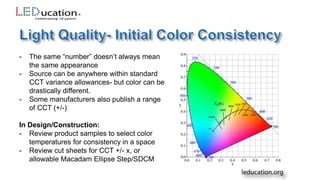
- The same “number” doesn’t always mean
the same appearance
- Source can be anywhere within standard
CCT variance allowances- but color can be
drastically different.
- Some manufacturers also publish a range
of CCT (+/-)
In Design/Construction:
- Review product samples to select color
temperatures for consistency in a space
- Review cut sheets for CCT +/- x, or
allowable Macadam Ellipse Step/SDCM
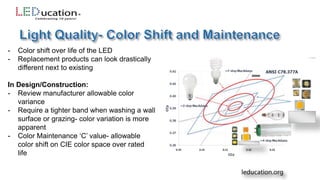
- Color shift over life of the LED
- Replacement products can look drastically
different next to existing
In Design/Construction:
- Review manufacturer allowable color
variance
- Require a tighter band when washing a wall
surface or grazing- color variation is more
apparent
- Color Maintenance ‘C’ value- allowable
color shift on CIE color space over rated
life
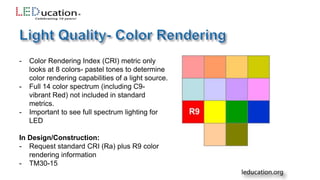
- Color Rendering Index (CRI) metric only
looks at 8 colors- pastel tones to determine
color rendering capabilities of a light source.
- Full 14 color spectrum (including C9-
vibrant Red) not included in standard
metrics.
- Important to see full spectrum lighting for
LED
In Design/Construction:
- Request standard CRI (Ra) plus R9 color
rendering information
- TM30-15
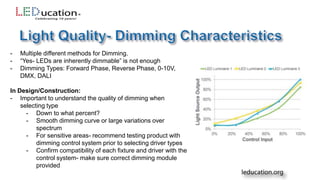
- Multiple different methods for Dimming.
- “Yes- LEDs are inherently dimmable” is not enough
- Dimming Types: Forward Phase, Reverse Phase, 0-10V,
DMX, DALI
In Design/Construction:
- Important to understand the quality of dimming when
selecting type
- Down to what percent?
- Smooth dimming curve or large variations over
spectrum
- For sensitive areas- recommend testing product with
dimming control system prior to selecting driver types
- Confirm compatibility of each fixture and driver with the
control system- make sure correct dimming module
provided
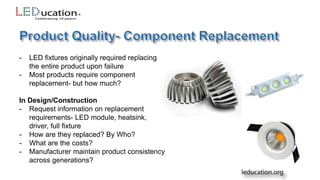
- LED fixtures originally required replacing
the entire product upon failure
- Most products require component
replacement- but how much?
In Design/Construction
- Request information on replacement
requirements- LED module, heatsink,
driver, full fixture
- How are they replaced? By Who?
- What are the costs?
- Manufacturer maintain product consistency
across generations?
- LEDs are heat sensitive
- Excessive heat affects light output and lifespan of LED
- Important to manage junction temperature of LEDs
In Design/Construction:
- Review manufacturer information for ambient temperature
requirements for quoted LED life
- Review manufacturer information for LED lumen depreciation
curve over rated life
- Rated life for LED- time for light to depreciate to 70%
output.
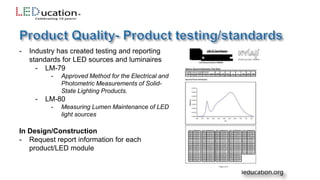
- Industry has created testing and reporting
standards for LED sources and luminaires
- LM-79
- Approved Method for the Electrical and
Photometric Measurements of Solid-
State Lighting Products.
- LM-80
- Measuring Lumen Maintenance of LED
light sources
In Design/Construction
- Request report information for each
product/LED module
• 3-5 year typical for general warranty
• Review if lighting quality warranty is available
• Update project specifications to include specific requirements about
replacement and labor costs
Case Study: National Museum of American
History- Public Space Renewal Phase 3
• Opened in 1964 as the National Museum
of History and Technology
• Mission: ‘Collection, care and study of
objects that reflect the experience of the
American people.’
• 3 Million Artifacts
• Star-Spangled Banner
• Jefferson’s Desk
• Lincoln’s Top hat
• Dorothy’s Ruby Slippers
• Illuminate the very light sensitive to the
light indestructible.
• Light level Range
• 1 – 25 footcandles range
throughout the museum
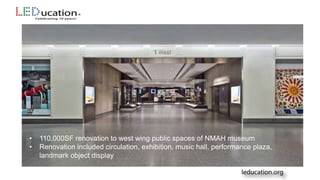
• 110,000SF renovation to west wing public spaces of NMAH museum
• Renovation included circulation, exhibition, music hall, performance plaza,
landmark object display
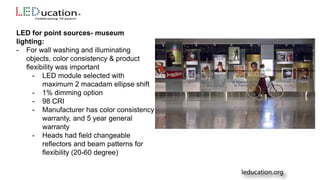
LED for point sources- museum
lighting:
- For wall washing and illuminating
objects, color consistency & product
flexibility was important
- LED module selected with
maximum 2 macadam ellipse shift
- 1% dimming option
- 98 CRI
- Manufacturer has color consistency
warranty, and 5 year general
warranty
- Heads had field changeable
reflectors and beam patterns for
flexibility (20-60 degree)
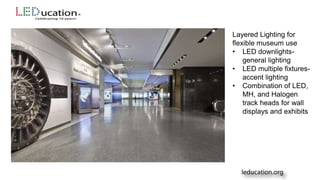
Layered Lighting for
flexible museum use
• LED downlights-
general lighting
• LED multiple fixtures-
accent lighting
• Combination of LED,
MH, and Halogen
track heads for wall
displays and exhibits
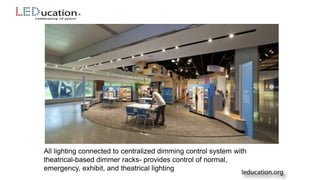
All lighting connected to centralized dimming control system with
theatrical-based dimmer racks- provides control of normal,
emergency, exhibit, and theatrical lighting
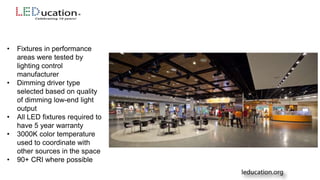
• Fixtures in performance
areas were tested by
lighting control
manufacturer
• Dimming driver type
selected based on quality
of dimming low-end light
output
• All LED fixtures required to
have 5 year warranty
• 3000K color temperature
used to coordinate with
other sources in the space
• 90+ CRI where possible
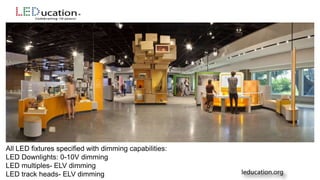
All LED fixtures specified with dimming capabilities:
LED Downlights: 0-10V dimming
LED multiples- ELV dimming
LED track heads- ELV dimming
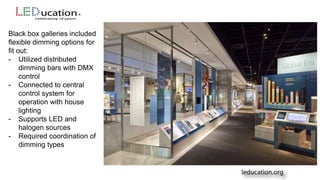
Black box galleries included
flexible dimming options for
fit out:
- Utilized distributed
dimming bars with DMX
control
- Connected to central
control system for
operation with house
lighting
- Supports LED and
halogen sources
- Required coordination of
dimming types
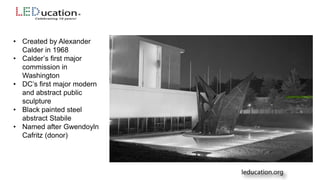
Case Study: Alexander Calder- Gwenfritz
Sculpture Renewal
• Created by Alexander
Calder in 1968
• Calder’s first major
commission in
Washington
• DC’s first major modern
and abstract public
sculpture
• Black painted steel
abstract Stabile
• Named after Gwendoyln
Cafritz (donor)
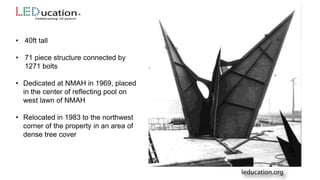
• 40ft tall
• 71 piece structure connected by
1271 bolts
• Dedicated at NMAH in 1969, placed
in the center of reflecting pool on
west lawn of NMAH
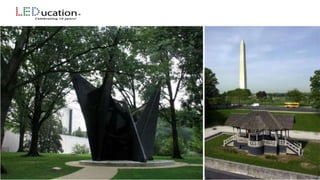
• Relocated in 1983 to the northwest
corner of the property in an area of
dense tree cover
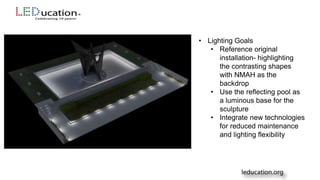
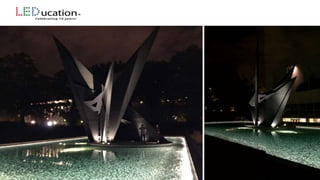
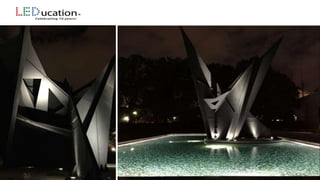
• Lighting Goals
• Reference original
installation- highlighting
the contrasting shapes
with NMAH as the
backdrop
• Use the reflecting pool as
a luminous base for the
sculpture
• Integrate new technologies
for reduced maintenance
and lighting flexibility
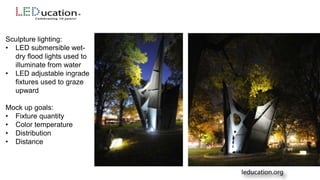
Sculpture lighting:
• LED submersible wet-
dry flood lights used to
illuminate from water
• LED adjustable ingrade
fixtures used to graze
upward
Mock up goals:
• Fixture quantity
• Color temperature
• Distribution
• Distance
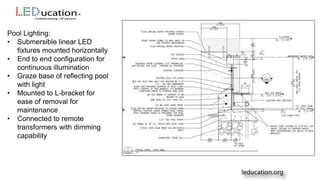
Pool Lighting:
• Submersible linear LED
fixtures mounted horizontally
• End to end configuration for
continuous illumination
• Graze base of reflecting pool
with light
• Mounted to L-bracket for
ease of removal for
maintenance
• Connected to remote
transformers with dimming
capability
Case Study: Net Zero Corporate Headquarters
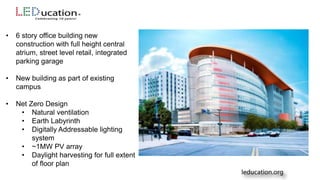
• 6 story office building new
construction with full height central
atrium, street level retail, integrated
parking garage
• New building as part of existing
campus
• Net Zero Design
• Natural ventilation
• Earth Labyrinth
• Digitally Addressable lighting
system
• ~1MW PV array
• Daylight harvesting for full extent
of floor plan
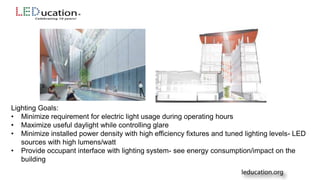
Lighting Goals:
• Minimize requirement for electric light usage during operating hours
• Maximize useful daylight while controlling glare
• Minimize installed power density with high efficiency fixtures and tuned lighting levels- LED
sources with high lumens/watt
• Provide occupant interface with lighting system- see energy consumption/impact on the
building
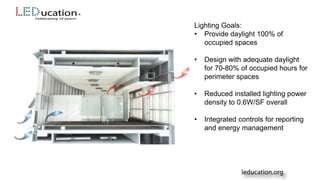
Lighting Goals:
• Provide daylight 100% of
occupied spaces
• Design with adequate daylight
for 70-80% of occupied hours for
perimeter spaces
• Reduced installed lighting power
density to 0.6W/SF overall
• Integrated controls for reporting
and energy management
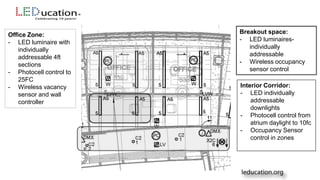
Office Zone:
- LED luminaire with
individually
addressable 4ft
sections
- Photocell control to
25FC
- Wireless vacancy
sensor and wall
controller
Breakout space:
- LED luminaires-
individually
addressable
- Wireless occupancy
sensor control
Interior Corridor:
- LED individually
addressable
downlights
- Photocell control from
atrium daylight to 10fc
- Occupancy Sensor
control in zones
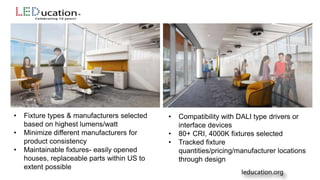
• Fixture types & manufacturers selected
based on highest lumens/watt
• Minimize different manufacturers for
product consistency
• Maintainable fixtures- easily opened
houses, replaceable parts within US to
extent possible
• Compatibility with DALI type drivers or
interface devices
• 80+ CRI, 4000K fixtures selected
• Tracked fixture
quantities/pricing/manufacturer locations
through design
• It’s important to include both product quality and light quality characteristics in
specifications and luminaire schedules for LED fixtures
• Not a one size fits all light source type
• Determine appropriate areas on a project by project basis for LED- depends
on budget, control requirements, building type needs.
• Hold specification requirements to get LED product information for review
before final approval of products.
This concludes The American Institute of Architects
Continuing Education Systems Course
 EwingCole www.ewingcole.com
 US Office of Energy Efficiency and Renewable Energy
 US Department of Energy
 NVLAP
 Smithsonian Institution Archives
 “LED Luminaire Life Time: Recommendations for Testing and Reporting”- next generation lighting industry alliance- LED systems
reliability consortium

Museums to Net Zero Buildings - Lessons Learned with LED Lighting

  • 2.
  • 3.
    Credit(s) earned oncompletion of this course will be reported to AIA CES for AIA members. Certificates of Completion for both AIA members and non-AIA members are available upon request. This course is registered with AIA CES for continuing professional education. As such, it does not include content that may be deemed or construed to be an approval or endorsement by the AIA of any material of construction or any method or manner of handling, using, distributing, or dealing in any material or product. ___________________________________________ Questions related to specific materials, methods, and services will be addressed at the conclusion of this presentation.
  • 4.
    Recent advancements inLED lighting have made the source an applicable solution in all building types… but the question remains, how do we incorporate it successfully into our designs? A selection of case studies will be used to review lessons learned in designing with LED lighting- from light characteristics, managing product quality, controls, and design parameters for multiple building types
  • 5.
     Review importantcharacteristics to consider when selecting LED Luminaires  Review design parameters for using LEDs for general/ambient lighting  Review design parameters for using LEDs as a directional lighting source (i.e. for spot lighting/museum applications)  Understanding LED and lighting control compatibility  Discuss methods to manage the submittal and construction process when designing with LED luminaires
  • 6.
    • LED inventedin 1960s, entered commercial lighting market in 1980s • 2013 U.S. Department of Energy (DOE) report states LEDs have passed many conventional lighting sources in energy, efficiency, versatility, color quality, lifetime. • Consulting reports estimate that LED lighting will amount to about 60% of the international lighting market by 2020. Product Type Luminous Efficacy (in lm/W) LED A19 lamp (warm white) 78 LED PAR38 lamp (warm white) 67 LED troffer 2'x4' (warm white) 93 LED high/low-bay fixture (warm white) 90 High intensity discharge system (high watt) 115 Linear fluorescent system 108 High intensity discharge system (low watt) 104 Compact fluorescent lamp 70 Halogen 20 Incandescent 15
  • 7.
    Advantages of LEDs •LED lighting does not ‘burn out’- continues to dim overtime • No/very minimal UV/IR in spectrum • Instant On/Off • Ideal for emergency egress lighting • Typical Rated Life of 50,000 hours • 70% lumen depreciation • Continuously increasing in efficacy (Lumens/Watt) • Performs well in lower temperatures • 180 degree source- less internal luminaire loses for direct fixture optics than fluorescent/MH/HPS
  • 8.
    Possible Challenges • Requirescoordination with dimming type and controls • Some inconsistency in product standards/materials • Heat build up can decrease product life and light output • Cost of various products must be reviewed • Components may not all be replaceable- must review each individually • Moves away from the traditional lamp-ballast- fixture separation of components • Changes how products are purchased
  • 9.
    Light Quality • ColorTemperature/Quality • Color Shift & Maintenance • Color Rendering • Dimming Characteristics Product Quality • Heat Management • Component Replacement Options • Product testing/standards • Warranty
  • 10.
    - The same“number” doesn’t always mean the same appearance - Source can be anywhere within standard CCT variance allowances- but color can be drastically different. - Some manufacturers also publish a range of CCT (+/-) In Design/Construction: - Review product samples to select color temperatures for consistency in a space - Review cut sheets for CCT +/- x, or allowable Macadam Ellipse Step/SDCM
  • 11.
    - Color shiftover life of the LED - Replacement products can look drastically different next to existing In Design/Construction: - Review manufacturer allowable color variance - Require a tighter band when washing a wall surface or grazing- color variation is more apparent - Color Maintenance ‘C’ value- allowable color shift on CIE color space over rated life
  • 12.
    - Color RenderingIndex (CRI) metric only looks at 8 colors- pastel tones to determine color rendering capabilities of a light source. - Full 14 color spectrum (including C9- vibrant Red) not included in standard metrics. - Important to see full spectrum lighting for LED In Design/Construction: - Request standard CRI (Ra) plus R9 color rendering information - TM30-15
  • 13.
    - Multiple differentmethods for Dimming. - “Yes- LEDs are inherently dimmable” is not enough - Dimming Types: Forward Phase, Reverse Phase, 0-10V, DMX, DALI In Design/Construction: - Important to understand the quality of dimming when selecting type - Down to what percent? - Smooth dimming curve or large variations over spectrum - For sensitive areas- recommend testing product with dimming control system prior to selecting driver types - Confirm compatibility of each fixture and driver with the control system- make sure correct dimming module provided
  • 14.
    - LED fixturesoriginally required replacing the entire product upon failure - Most products require component replacement- but how much? In Design/Construction - Request information on replacement requirements- LED module, heatsink, driver, full fixture - How are they replaced? By Who? - What are the costs? - Manufacturer maintain product consistency across generations?
  • 15.
    - LEDs areheat sensitive - Excessive heat affects light output and lifespan of LED - Important to manage junction temperature of LEDs In Design/Construction: - Review manufacturer information for ambient temperature requirements for quoted LED life - Review manufacturer information for LED lumen depreciation curve over rated life - Rated life for LED- time for light to depreciate to 70% output.
  • 16.
    - Industry hascreated testing and reporting standards for LED sources and luminaires - LM-79 - Approved Method for the Electrical and Photometric Measurements of Solid- State Lighting Products. - LM-80 - Measuring Lumen Maintenance of LED light sources In Design/Construction - Request report information for each product/LED module
  • 17.
    • 3-5 yeartypical for general warranty • Review if lighting quality warranty is available • Update project specifications to include specific requirements about replacement and labor costs
  • 18.
    Case Study: NationalMuseum of American History- Public Space Renewal Phase 3
  • 19.
    • Opened in1964 as the National Museum of History and Technology • Mission: ‘Collection, care and study of objects that reflect the experience of the American people.’ • 3 Million Artifacts • Star-Spangled Banner • Jefferson’s Desk • Lincoln’s Top hat • Dorothy’s Ruby Slippers • Illuminate the very light sensitive to the light indestructible. • Light level Range • 1 – 25 footcandles range throughout the museum
  • 20.
    • 110,000SF renovationto west wing public spaces of NMAH museum • Renovation included circulation, exhibition, music hall, performance plaza, landmark object display
  • 21.
    LED for pointsources- museum lighting: - For wall washing and illuminating objects, color consistency & product flexibility was important - LED module selected with maximum 2 macadam ellipse shift - 1% dimming option - 98 CRI - Manufacturer has color consistency warranty, and 5 year general warranty - Heads had field changeable reflectors and beam patterns for flexibility (20-60 degree)
  • 22.
    Layered Lighting for flexiblemuseum use • LED downlights- general lighting • LED multiple fixtures- accent lighting • Combination of LED, MH, and Halogen track heads for wall displays and exhibits
  • 23.
    All lighting connectedto centralized dimming control system with theatrical-based dimmer racks- provides control of normal, emergency, exhibit, and theatrical lighting
  • 24.
    • Fixtures inperformance areas were tested by lighting control manufacturer • Dimming driver type selected based on quality of dimming low-end light output • All LED fixtures required to have 5 year warranty • 3000K color temperature used to coordinate with other sources in the space • 90+ CRI where possible
  • 25.
    All LED fixturesspecified with dimming capabilities: LED Downlights: 0-10V dimming LED multiples- ELV dimming LED track heads- ELV dimming
  • 26.
    Black box galleriesincluded flexible dimming options for fit out: - Utilized distributed dimming bars with DMX control - Connected to central control system for operation with house lighting - Supports LED and halogen sources - Required coordination of dimming types
  • 27.
    Case Study: AlexanderCalder- Gwenfritz Sculpture Renewal
  • 28.
    • Created byAlexander Calder in 1968 • Calder’s first major commission in Washington • DC’s first major modern and abstract public sculpture • Black painted steel abstract Stabile • Named after Gwendoyln Cafritz (donor)
  • 29.
    • 40ft tall •71 piece structure connected by 1271 bolts • Dedicated at NMAH in 1969, placed in the center of reflecting pool on west lawn of NMAH • Relocated in 1983 to the northwest corner of the property in an area of dense tree cover
  • 31.
    • Lighting Goals •Reference original installation- highlighting the contrasting shapes with NMAH as the backdrop • Use the reflecting pool as a luminous base for the sculpture • Integrate new technologies for reduced maintenance and lighting flexibility
  • 32.
    Sculpture lighting: • LEDsubmersible wet- dry flood lights used to illuminate from water • LED adjustable ingrade fixtures used to graze upward Mock up goals: • Fixture quantity • Color temperature • Distribution • Distance
  • 33.
    Pool Lighting: • Submersiblelinear LED fixtures mounted horizontally • End to end configuration for continuous illumination • Graze base of reflecting pool with light • Mounted to L-bracket for ease of removal for maintenance • Connected to remote transformers with dimming capability
  • 36.
    Case Study: NetZero Corporate Headquarters
  • 37.
    • 6 storyoffice building new construction with full height central atrium, street level retail, integrated parking garage • New building as part of existing campus • Net Zero Design • Natural ventilation • Earth Labyrinth • Digitally Addressable lighting system • ~1MW PV array • Daylight harvesting for full extent of floor plan
  • 38.
    Lighting Goals: • Minimizerequirement for electric light usage during operating hours • Maximize useful daylight while controlling glare • Minimize installed power density with high efficiency fixtures and tuned lighting levels- LED sources with high lumens/watt • Provide occupant interface with lighting system- see energy consumption/impact on the building
  • 39.
    Lighting Goals: • Providedaylight 100% of occupied spaces • Design with adequate daylight for 70-80% of occupied hours for perimeter spaces • Reduced installed lighting power density to 0.6W/SF overall • Integrated controls for reporting and energy management
  • 40.
    Office Zone: - LEDluminaire with individually addressable 4ft sections - Photocell control to 25FC - Wireless vacancy sensor and wall controller Breakout space: - LED luminaires- individually addressable - Wireless occupancy sensor control Interior Corridor: - LED individually addressable downlights - Photocell control from atrium daylight to 10fc - Occupancy Sensor control in zones
  • 41.
    • Fixture types& manufacturers selected based on highest lumens/watt • Minimize different manufacturers for product consistency • Maintainable fixtures- easily opened houses, replaceable parts within US to extent possible • Compatibility with DALI type drivers or interface devices • 80+ CRI, 4000K fixtures selected • Tracked fixture quantities/pricing/manufacturer locations through design
  • 42.
    • It’s importantto include both product quality and light quality characteristics in specifications and luminaire schedules for LED fixtures • Not a one size fits all light source type • Determine appropriate areas on a project by project basis for LED- depends on budget, control requirements, building type needs. • Hold specification requirements to get LED product information for review before final approval of products.
  • 43.
    This concludes TheAmerican Institute of Architects Continuing Education Systems Course
  • 44.
     EwingCole www.ewingcole.com US Office of Energy Efficiency and Renewable Energy  US Department of Energy  NVLAP  Smithsonian Institution Archives  “LED Luminaire Life Time: Recommendations for Testing and Reporting”- next generation lighting industry alliance- LED systems reliability consortium